
Head Injury Severity Dr Derick T Wade Professor
- Slides: 40
Head Injury Severity Dr Derick T Wade, Professor in Neurological Rehabilitation, Oxford Centre for Enablement, Windmill Road, OXFORD OX 3 7 HE, UK email: derick. wade@ntlworld. com
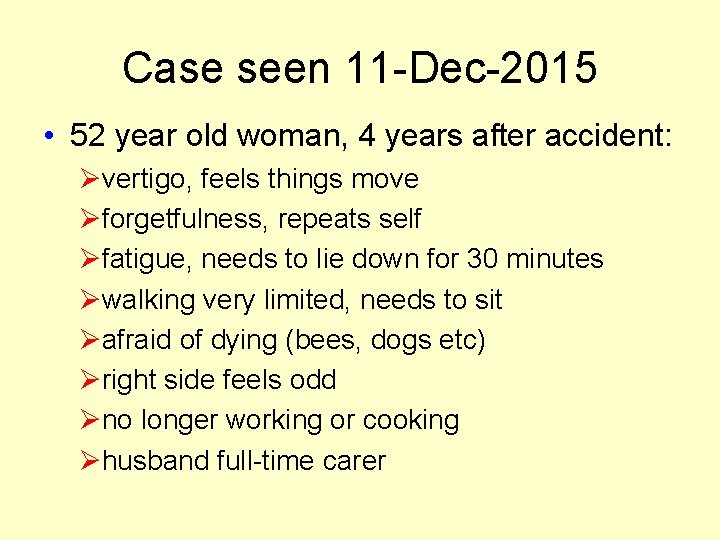
Case seen 11 -Dec-2015 • 52 year old woman, 4 years after accident: Øvertigo, feels things move Øforgetfulness, repeats self Øfatigue, needs to lie down for 30 minutes Øwalking very limited, needs to sit Øafraid of dying (bees, dogs etc) Øright side feels odd Øno longer working or cooking Øhusband full-time carer
Messages • “How severe? ” cannot be answered • Biopsychosocial model/framework helps Øanalyse the question (how severe) Øgive a logical answer Øplan future management
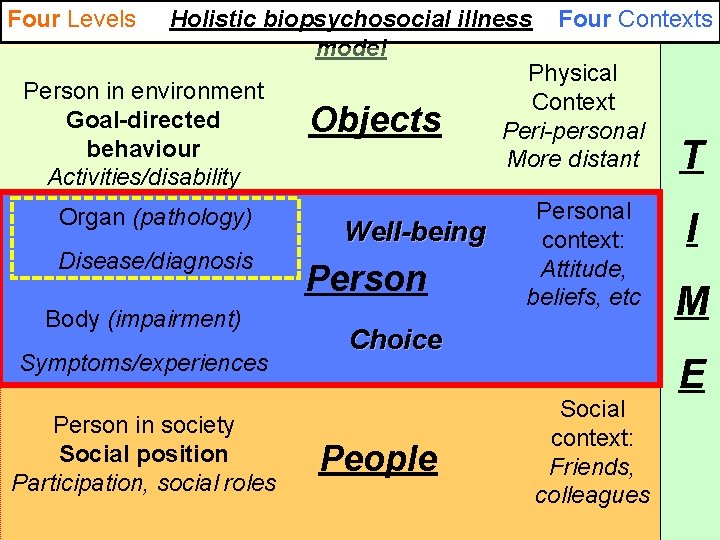
Four Levels Holistic biopsychosocial illness Four Contexts model Physical Person in environment Context Goal-directed Objects Peri-personal behaviour More distant Activities/disability Personal Organ (pathology) Well-being context: Disease/diagnosis Attitude, Person beliefs, etc Body (impairment) T I M Symptoms/experiences Person in society Social position Participation, social roles Choice People Social context: Friends, colleagues E
Background • From Lithuania 2002 Ømarried, two sons; mother; 3 brothers Øworked full-time (good record) Øtraveled in UK & home, cooked, family++ Øsplenectomy (cow aged 7); nil else Øground floor flat
History • Injury & rehabilitation Ø 9 th Sep 2011, hit by lorry at 20 mph Øconfused; Glasgow Coma Scale 9/15 Øright extradural and Lt contusion; craniotomy ØPTA about two weeks ØNeuro-rehabilitation 5 th Oct, home 10 th Nov Ørecovery over first 18 months to moderate Øworse last two years
What is a head injury? • Scalp and facial injuries Ødisfiguring, remind, localise pain • Boney injuries without injury to content Øfear, labyrinthine damage, anosmia • Brain injury • Injury to psyche • (Also associated other injuries)
Consequently • When seeing a case need to establish Øpresence and nature of brain damage Øpresence and nature of other damage Øsecondary mechanisms • direct (e. g. hypoxaemia, hydrocephalus) • indirect – biological (e. g. muscle wasting, critical illness neuropathy) – psychological
Is there traumatic brain injury? • History and contemporaneous notes ØMechanism ØCerebral imaging • Contusions, haemorrhage etc ØDocumented neurological features • Levels of consciousness, post-traumatic amnesia ØChange over time • improvement
Mechanism • Direct, immediate trauma ØDeceleration ØBlunt injury • Indirect, secondary and later ØHaemorrhage, compression ØHypoxia etc
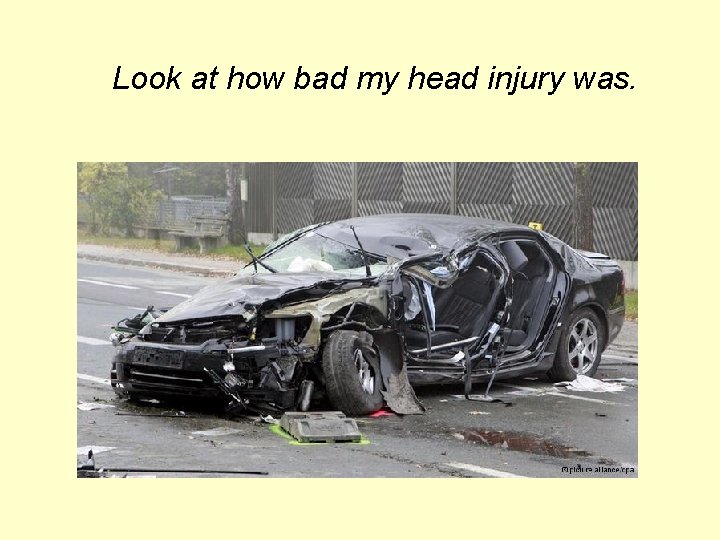
Imaging • Acute phase CT-scans ØNature, extent & location of changes • Photographs of ØHead ØAccident • But outcome is not determined by: ØChanges see on brain imaging ØSeverity of damage to car, head etc
Look at how bad my head injury was.
Time • Course of recovery ØLandmarks • End of coma, end of PTA • First walk, leave hospital etc ØComplications • Hydrocephalus, seizures etc
Diagnosing trauma to brain • Loss of consciousness – over one minute? ØPitfalls –amnesia often referred to as coma • Period of amnesia – any (over 2 minutes? ) ØPitfalls – sedation, analgesia etc • Other definite new neurological signs • Imaging in acute phase ØCT, MRI • (NB note importance of contusions; DVLA)
How severe was brain damage? • Existing classifications • Different meanings • Different levels
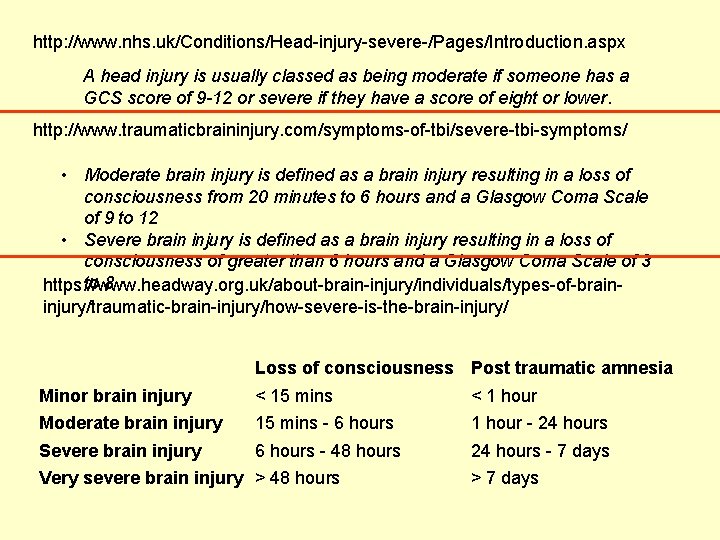
http: //www. nhs. uk/Conditions/Head-injury-severe-/Pages/Introduction. aspx A head injury is usually classed as being moderate if someone has a GCS score of 9 -12 or severe if they have a score of eight or lower. http: //www. traumaticbraininjury. com/symptoms-of-tbi/severe-tbi-symptoms/ • Moderate brain injury is defined as a brain injury resulting in a loss of consciousness from 20 minutes to 6 hours and a Glasgow Coma Scale of 9 to 12 • Severe brain injury is defined as a brain injury resulting in a loss of consciousness of greater than 6 hours and a Glasgow Coma Scale of 3 to 8 https: //www. headway. org. uk/about-brain-injury/individuals/types-of-braininjury/traumatic-brain-injury/how-severe-is-the-brain-injury/ Loss of consciousness Post traumatic amnesia Minor brain injury < 15 mins < 1 hour Moderate brain injury 15 mins - 6 hours 1 hour - 24 hours Severe brain injury 6 hours - 48 hours 24 hours - 7 days Very severe brain injury > 48 hours > 7 days
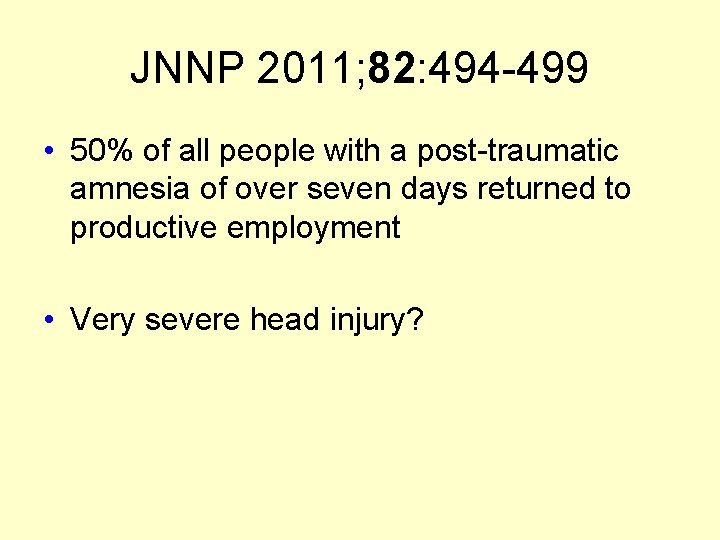
JNNP 2011; 82: 494 -499 • 50% of all people with a post-traumatic amnesia of over seven days returned to productive employment • Very severe head injury?
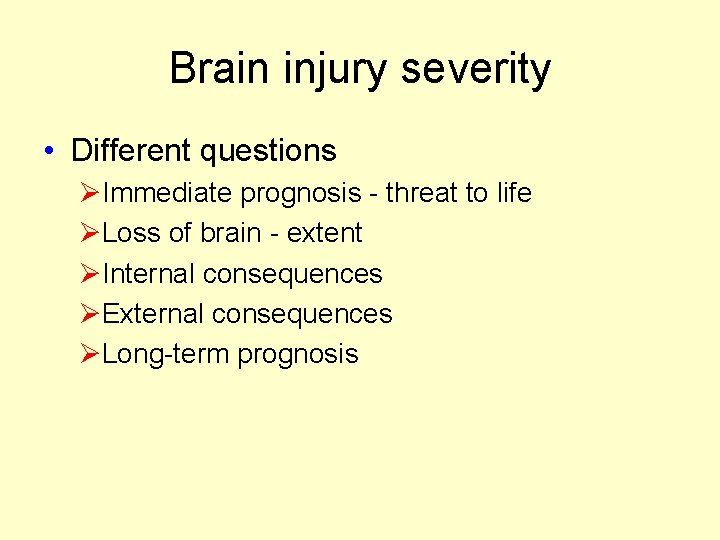
Brain injury severity • Different questions ØImmediate prognosis - threat to life ØLoss of brain - extent ØInternal consequences ØExternal consequences ØLong-term prognosis
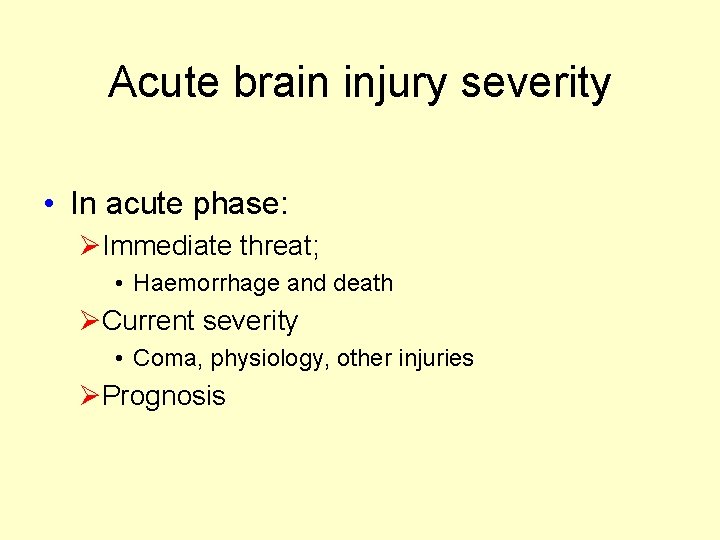
Acute brain injury severity • In acute phase: ØImmediate threat; • Haemorrhage and death ØCurrent severity • Coma, physiology, other injuries ØPrognosis
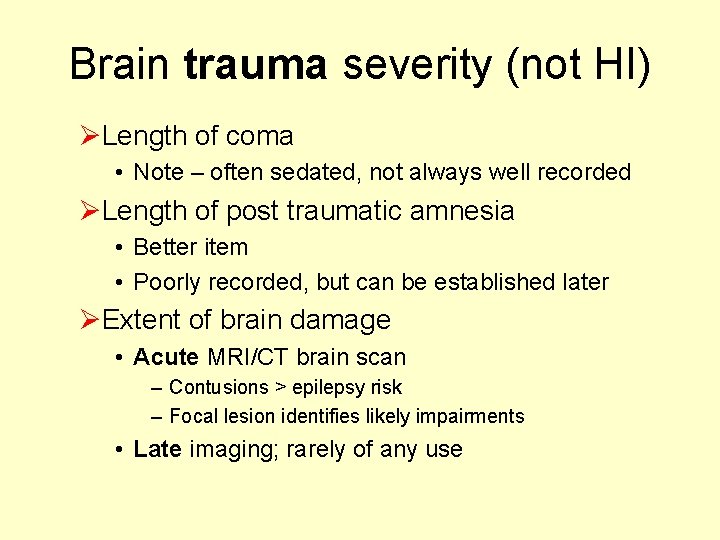
Brain trauma severity (not HI) ØLength of coma • Note – often sedated, not always well recorded ØLength of post traumatic amnesia • Better item • Poorly recorded, but can be established later ØExtent of brain damage • Acute MRI/CT brain scan – Contusions > epilepsy risk – Focal lesion identifies likely impairments • Late imaging; rarely of any use
Prognostic severity • Depth and duration of coma ØNot well studied ØNot well recorded after 1 -2 weeks • Duration of post-traumatic amnesia ØTraditional ØBut: • 20% of people with PTA over 10 weeks returned to work
Brain injury severity - comment • Need to distinguish ØCurrent severity from ØPrognostic ‘severity’ • Use known early prognostic indicators to ØValidate impairments/activity limitations ØRaise awareness of, screen for problems ØHelp in analysis and identifying other factors • Do not use prognostic classification to label current severity
Current severity (overall) • In various domains: ØExperiences/impairments • Pain, cognition, emotion etc ØActivities • Walking, domestic, vocational, leisure etc ØSocial • Work, other roles, ØQuality of life? • Re-normalises
Thus severity includes • Brain injury severity: ØInitial risk to life and of long-term problems ØLong-term limitation on social participation • Measured by ØAcute features, especially haemorrhage/coma ØBehavioural repertoire & social position • which are also influenced by non-brain injuries etc
Consequences of accident • Patient (others) will focus on ØDamage to brain/nervous system • This ØMay limit upper performance ØIs only one factor affecting activities • Doctor’s job is to analyse the others
Case illustrates ‘other factors’ • Overall severity also influenced by: Øother, associated injuries/illnesses • skull – e. g. anosmia, vertigo • bones, critical illness neuropathy Øconsequence of prolonged hospitalisation Øpsychological factors, which are secondary to: • loss of brain function • persistent symptoms, limitations on activity • facts of accident
Patients (& lawyers) • attribute all current problems to brain damage
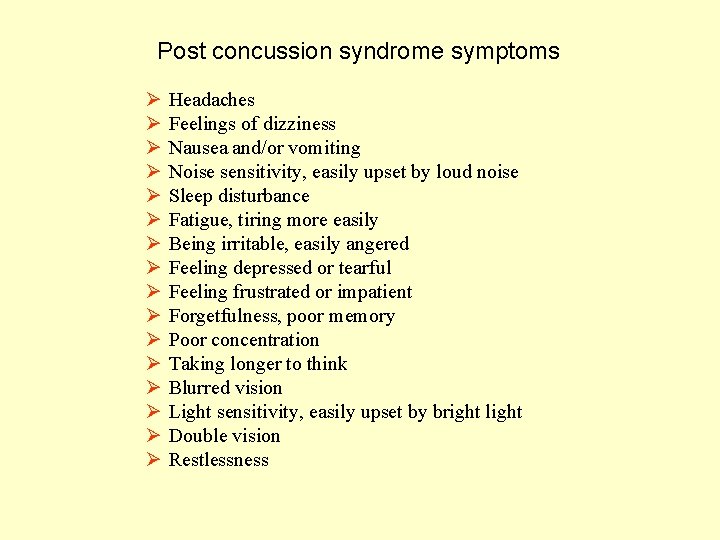
Post concussion syndrome symptoms Ø Ø Ø Ø Headaches Feelings of dizziness Nausea and/or vomiting Noise sensitivity, easily upset by loud noise Sleep disturbance Fatigue, tiring more easily Being irritable, easily angered Feeling depressed or tearful Feeling frustrated or impatient Forgetfulness, poor memory Poor concentration Taking longer to think Blurred vision Light sensitivity, easily upset by bright light Double vision Restlessness
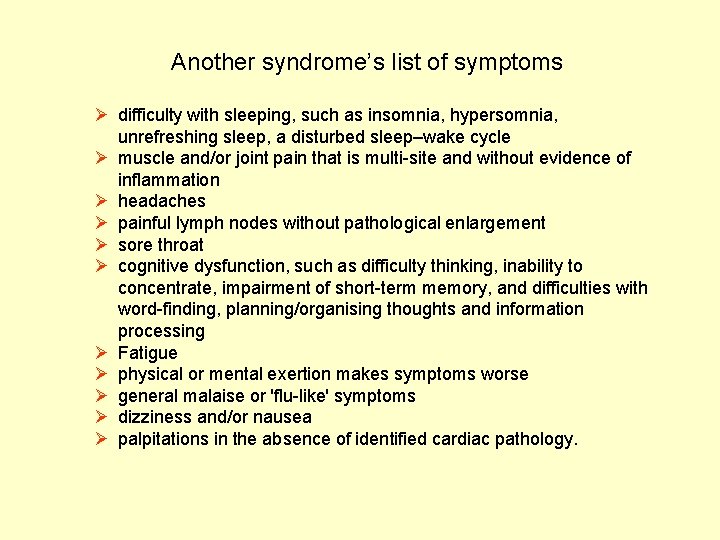
Another syndrome’s list of symptoms Ø difficulty with sleeping, such as insomnia, hypersomnia, unrefreshing sleep, a disturbed sleep–wake cycle Ø muscle and/or joint pain that is multi-site and without evidence of inflammation Ø headaches Ø painful lymph nodes without pathological enlargement Ø sore throat Ø cognitive dysfunction, such as difficulty thinking, inability to concentrate, impairment of short-term memory, and difficulties with word-finding, planning/organising thoughts and information processing Ø Fatigue Ø physical or mental exertion makes symptoms worse Ø general malaise or 'flu-like' symptoms Ø dizziness and/or nausea Ø palpitations in the absence of identified cardiac pathology.
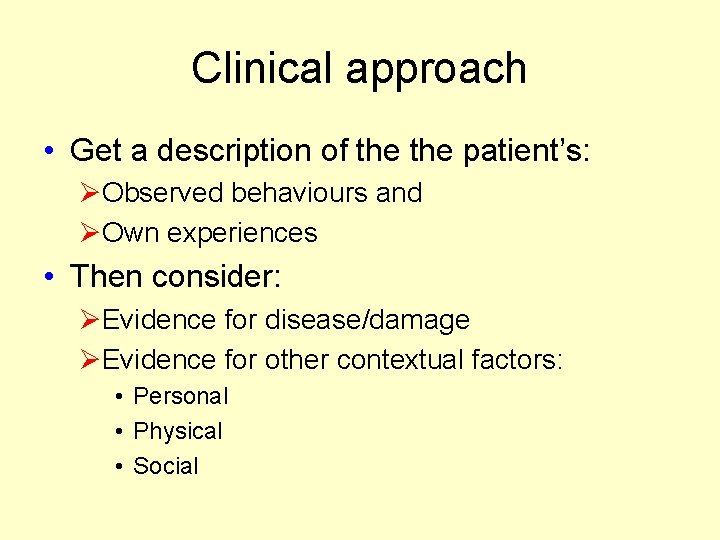
Clinical approach • Get a description of the patient’s: ØObserved behaviours and ØOwn experiences • Then consider: ØEvidence for disease/damage ØEvidence for other contextual factors: • Personal • Physical • Social
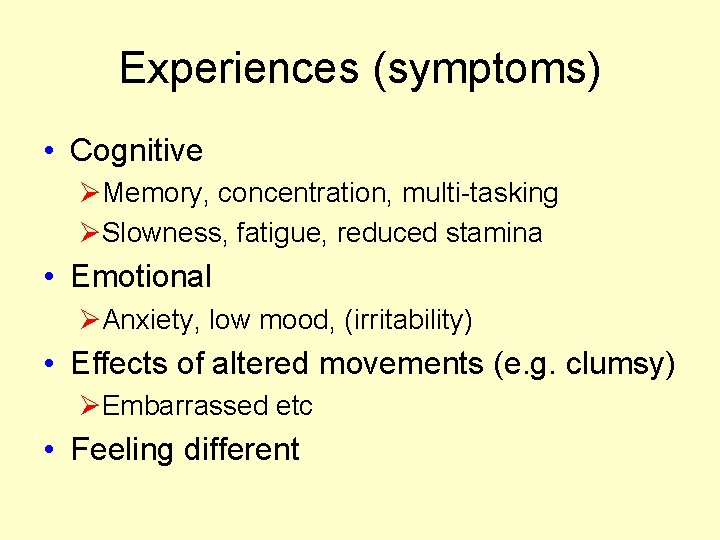
Experiences (symptoms) • Cognitive ØMemory, concentration, multi-tasking ØSlowness, fatigue, reduced stamina • Emotional ØAnxiety, low mood, (irritability) • Effects of altered movements (e. g. clumsy) ØEmbarrassed etc • Feeling different
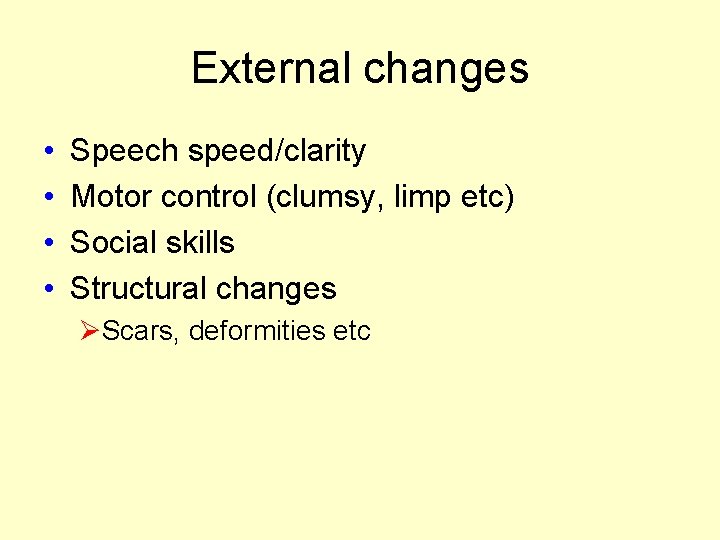
External changes • • Speech speed/clarity Motor control (clumsy, limp etc) Social skills Structural changes ØScars, deformities etc
Activities limited • High demand activities ØConversations, complex social events ØSkilled work: cognitive, or motor • Endurance
Social consequences • Roles ØEffect of loss of roles • Secondary effects of loss of activities (e. g. not attend gym) ØLack of new roles • Take up being a patient • Social isolation ØLoss of friends
Personal contextual factors • Effects of the label ØExpectations clinically ØExpectations generally • Attitudes towards being disabled • Beliefs, interpretation ØRelevance of scans ØMeaning of experiences • Experience of recovery/rehabilitation
Approach to patient • Need to establish ØProven/likely neurological damage • Brain and elsewhere ØNature and extent of symptoms • All, not simply those attributed to head injury ØQuantity and quality of activities done • All, compared with beforehand ØChanges in social roles and participation
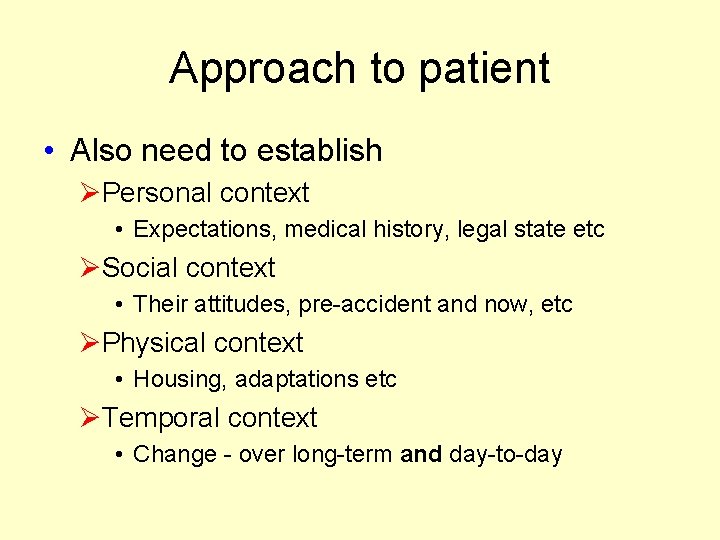
Approach to patient • Also need to establish ØPersonal context • Expectations, medical history, legal state etc ØSocial context • Their attitudes, pre-accident and now, etc ØPhysical context • Housing, adaptations etc ØTemporal context • Change - over long-term and day-to-day
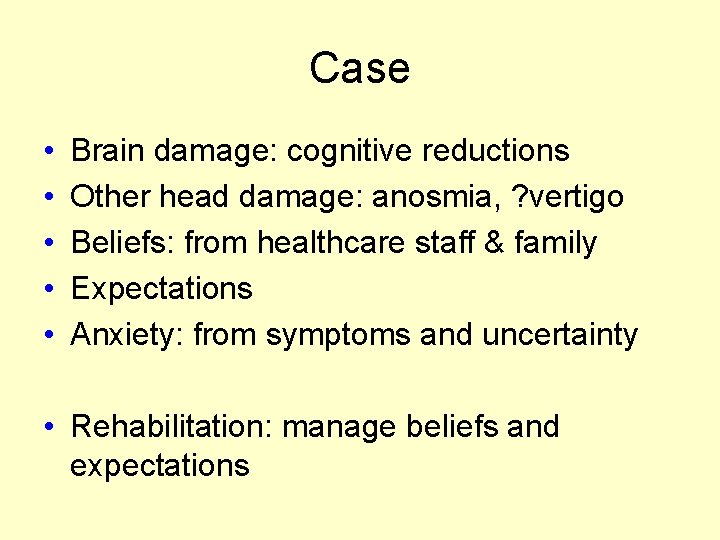
Case • • • Brain damage: cognitive reductions Other head damage: anosmia, ? vertigo Beliefs: from healthcare staff & family Expectations Anxiety: from symptoms and uncertainty • Rehabilitation: manage beliefs and expectations
Head Injury Dr Derick T Wade, Professor in Neurological Rehabilitation, Oxford Centre for Enablement, Windmill Road, OXFORD OX 3 7 HE, UK Tel: +44 -(0)1865 -737310 Fax: +44 -(0)1865 -737309 email: derick. wade@ntlworld. com
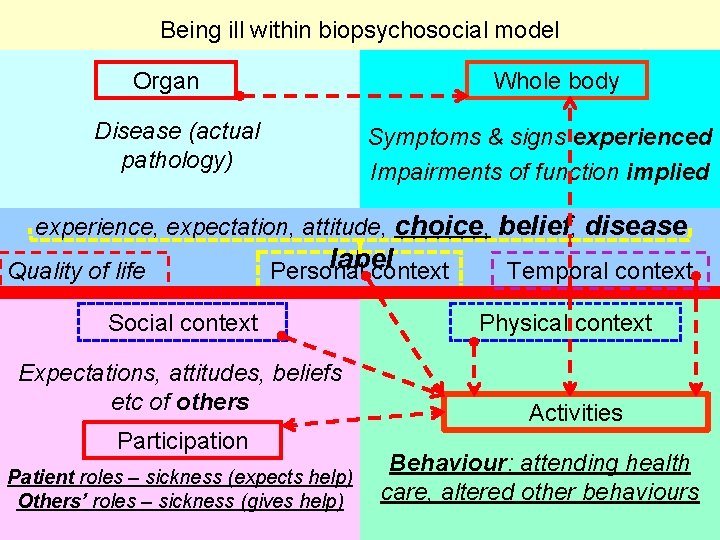
Being ill within biopsychosocial model Organ Whole body Disease (actual pathology) Symptoms & signs experienced Impairments of function implied experience, expectation, attitude, choice, belief, disease Quality of life label Personal context Social context Expectations, attitudes, beliefs etc of others Participation Patient roles – sickness (expects help) Others’ roles – sickness (gives help) Temporal context Physical context Activities Behaviour: attending health care, altered other behaviours