
Head injury Presented by Dr Waseem ahmad Dept
Head injury Presented by: Dr Waseem ahmad Dept. of Jarahat � AMU, Aligarh
Contents � Surgical anatomy of skull � Injury to scalp � Injury to skull � Injury to brain � Intracranial hemorrhage
Surgical anatomy The scalp contains 5 layers after its five letters � Skin � Connective tissue layer � Apo neurosis � Loose areolar tissue � Pericranium
Surgical anatomy Contd… Skin: � the skin is very dense and contains many sebaceous glands. Connective tissue layer: � The connective tissue layer which binds the skin to the galea aponeurotica is dense and contains many blood vessels and nerves. � The injury to this layer results in profuse bleeding and does not stop itself. This is because of the fact that the walls of the blood vessels which are firmly anchored to the fibrous septa traverse through this layer.
Surgical anatomy Contd… Galea aponeurotica: The galea aponeurotica is dense aponeurosis and is continuous anteriorly with the frontalis muscle and inserted into the base of the nose and eyebrows, posteriorly with occipitalis muscle and inserted in occipital bone. Laterally with the temporalis fascia and attached to the zygomatic arch. Loose areolar tissue: The loose areolar tissue is supposed to be very dangerous layer because the emissary veins which connect the dural sinus to the vein of the scalp traverse through this layer. Infection of this is most likely to reach the brain.
Surgical anatomy Contd… Pericranuim: Pericranium is like a periosteum. It is loosely attached to the skull except at the suture line where it is firmly attached. Collection of the fluid underneath the pericranium takes the shape of the bone concerned and is called cephal haematoma.
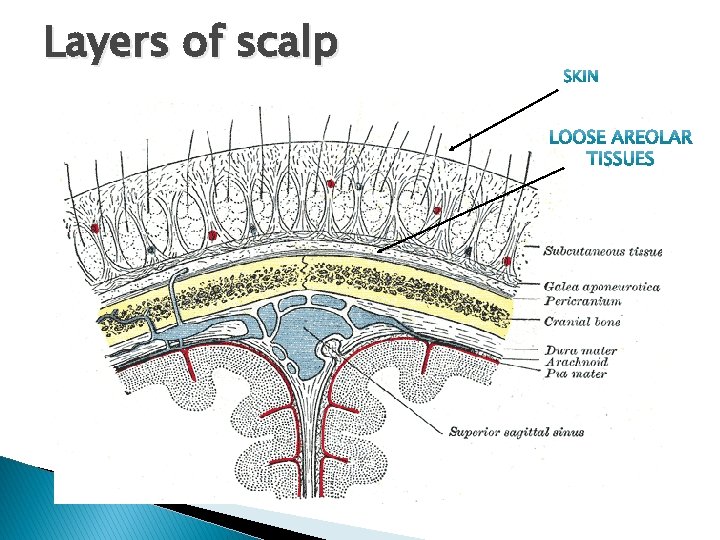
Layers of scalp

Galea aponeurotica
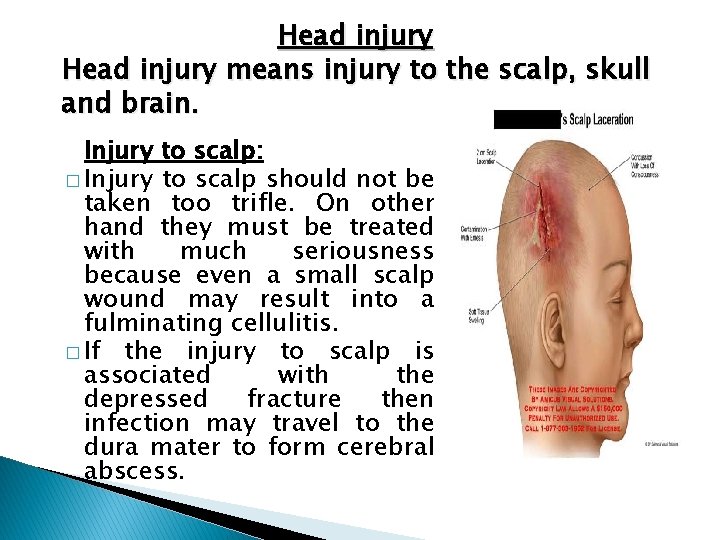
Head injury means injury to the scalp, skull and brain. Injury to scalp: � Injury to scalp should not be taken too trifle. On other hand they must be treated with much seriousness because even a small scalp wound may result into a fulminating cellulitis. � If the injury to scalp is associated with the depressed fracture then infection may travel to the dura mater to form cerebral abscess.
Treatment of the injury to scalp: Examination: � The first step is to know the extent and severity which can be done with utmost care and by wearing gloves. � x-ray is necessary to know whethere is depressed fracture or not. � Treatment of the depressed fracture: it will be explained in the facture of skull.
Treatment of the scalp injury when depressed fracture is not present Shaving: � Wash whole of the scalp with water and soap. � Use razor to remove hairs 5 to 7 cm around the wound. � After shaving the wound is again washed with soap and water. Debridement: In case of small injury, debridement of devitalized tissue can be done under local anaesthesia. 2 % lignocaine is injected in surrounding healthy tissue circumferentially around the wound.
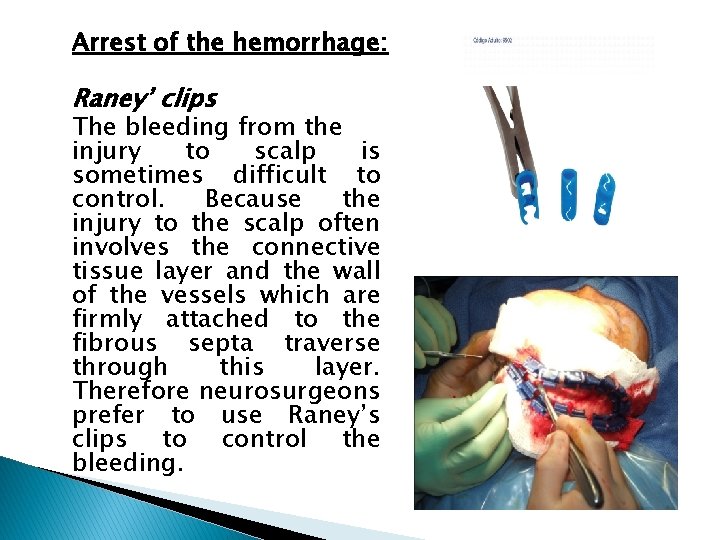
Arrest of the hemorrhage: Raney’ clips The bleeding from the injury to scalp is sometimes difficult to control. Because the injury to the scalp often involves the connective tissue layer and the wall of the vessels which are firmly attached to the fibrous septa traverse through this layer. Therefore neurosurgeons prefer to use Raney’s clips to control the bleeding.
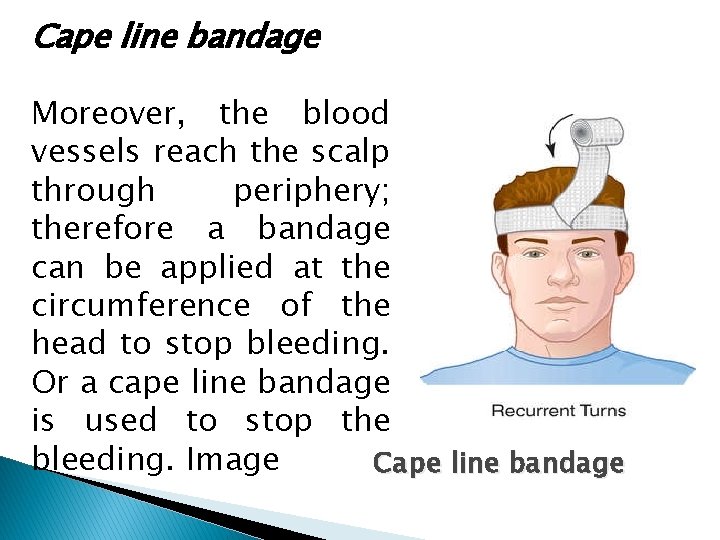
Cape line bandage Moreover, the blood vessels reach the scalp through periphery; therefore a bandage can be applied at the circumference of the head to stop bleeding. Or a cape line bandage is used to stop the bleeding. Image Cape line bandage
Suturing: In small injury: Interrupted and single layer suture are enough. This single layer suturing will be through skin, connective tissue and galea aponeurotica.
In large injury: After debridement the double layer suturing is preferred. In the first layer the galea aponeurotica is sutured with the chromic catgut and in second layer the skin and connective tissue layer is sutured with the non absorbable suture material.
Complication of the injury to scalp: � Infection � Cellulitis � Pus collection in loose areolar tissue. � Cerebral abscess � Tetanus, meningitis. � Gas gangrene.
Fracture of the skull: 1. Fracture of the vault of the skull 2. Fracture of the base of the skull 1. Fracture of the vault of the skull A. Closed fracture B. Open fracture A. Closed fracture: The fracture site is not exposed to the outside that means the scalp remains intact though it may be bruised or grazed. B. Open fracture: The fracture site is exposed to outside that means the scalp is lacerated. The danger of the open fracture is that it may provide an access to the infection to reach deep into the brain to cause meningitis and brain abscess.
Mechanism of fracture: Fracture of the skull may be caused by one of the following mechanism 1. Compression against the flat surface 2. Local indentation 3. Tangential injury
Compression of the sphere: When the skull is compressed against the hard flat surface, it renders the skull more ovoid and a linear fracture starts at the maximum point of convexity through the thin area of the bone. This fracture line may reach up to the base of the skull. image
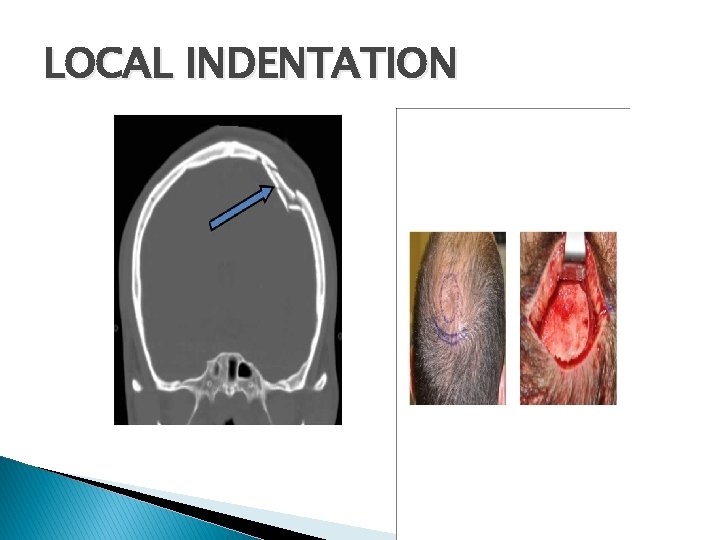
Local indentation: By large and round object: If the large and round object hits the sphere, it may cause closed round depressed fracture. In this fracture, the scalp may be bruised and fractured bone is indented but not indriven so that underlying dura is intact. By small and round object: If the small and round object hits the sphere, it may cause open depressed fracture. In this fracture, the skin is lacerated, the fractured bone is indented and indriven so that the underlying dura and subjacent brain tissues are also injured. In this fracture there is immediate risk of infection and later risk of epilepsy due to contraction of the injured tissues.
LOCAL INDENTATION
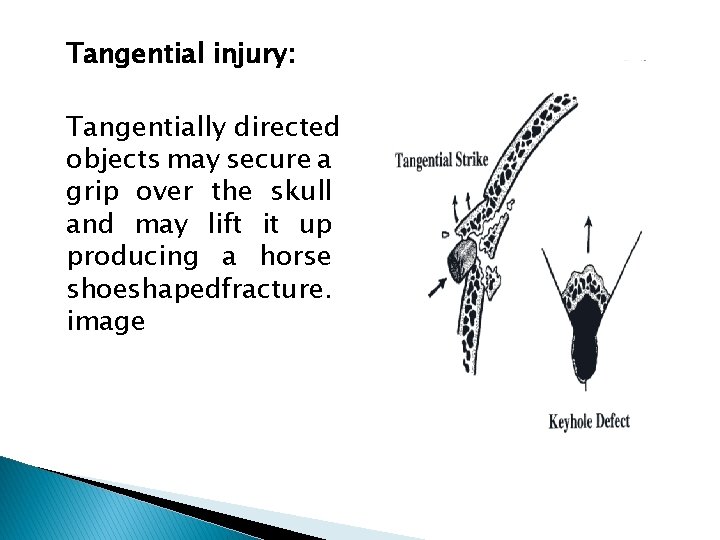
Tangential injury: Tangentially directed objects may secure a grip over the skull and may lift it up producing a horse shoeshapedfracture. image
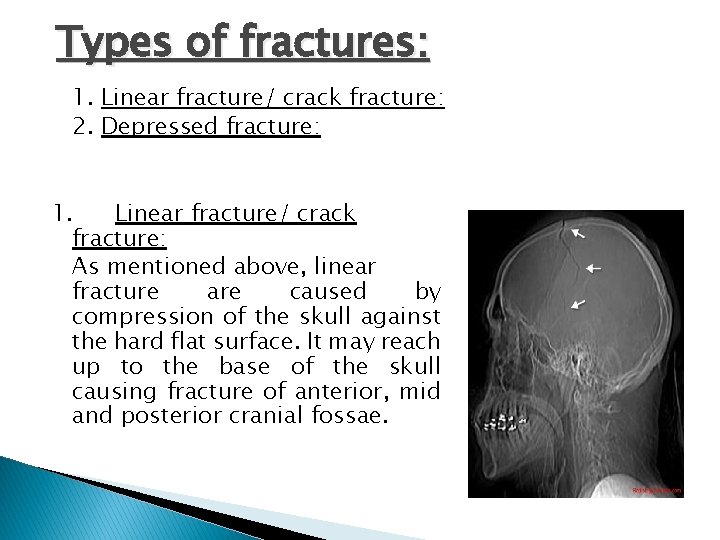
Types of fractures: 1. Linear fracture/ crack fracture: 2. Depressed fracture: 1. Linear fracture/ crack fracture: As mentioned above, linear fracture are caused by compression of the skull against the hard flat surface. It may reach up to the base of the skull causing fracture of anterior, mid and posterior cranial fossae.
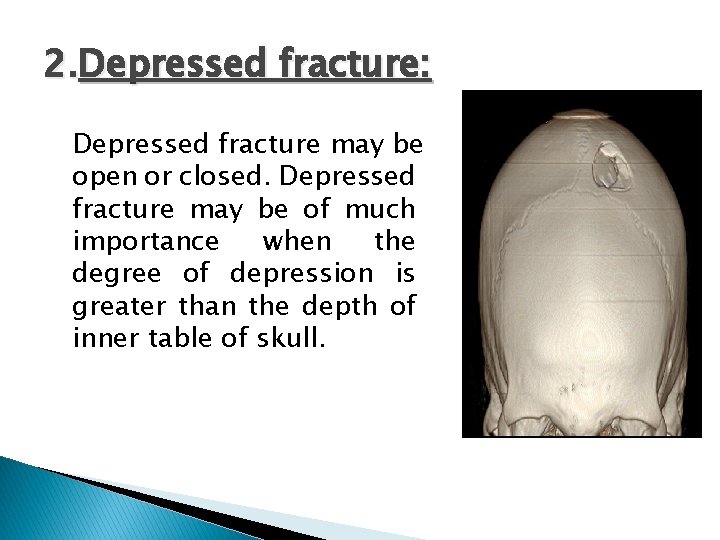
2. Depressed fracture: Depressed fracture may be open or closed. Depressed fracture may be of much importance when the degree of depression is greater than the depth of inner table of skull.
Complications of fractures of skull � Dural tear – indication for surgery � Pressure on the cerebral cortex � Underlying hemorrhage � Epilepsy � Pressure on the dural venous sinuses All the conditions lead to the cerebral compression and ultimately deterioration in the level of unconsciousness
Treatment of skull fractures � Shaving of the whole scalp is done � Identify whether it is open or closed fracture � An assessment is done to see whethere is neurological deficit or not(GCS)
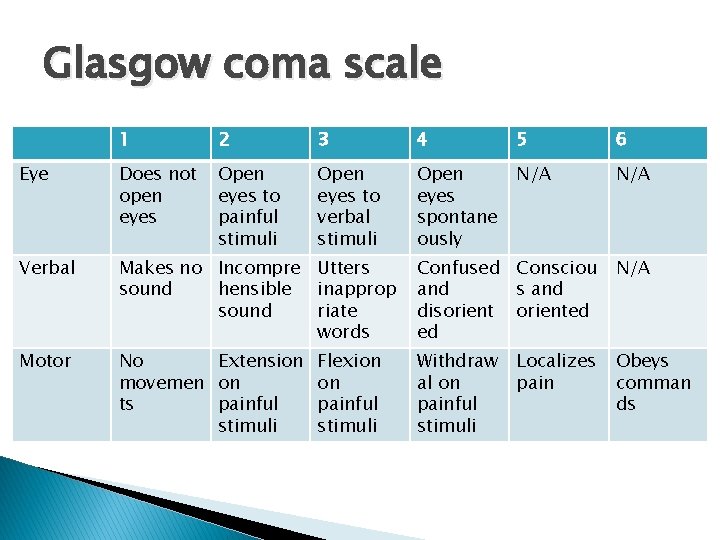
Glasgow coma scale 1 2 3 4 5 6 Eye Does not open eyes Open eyes to painful stimuli Open eyes to verbal stimuli Open eyes spontane ously N/A Verbal Makes no Incompre Utters sound hensible inapprop sound riate words Confused Consciou and s and disoriented ed N/A Motor No Extension Flexion movemen on on ts painful stimuli Withdraw al on painful stimuli Obeys comman ds Localizes pain
SIMPLE LINEAR FRACTURE: � � No special treatment is required. If skin is lacerated then cleaning and dressing is done. If skin is lacerated and contaminated the debridement is done followed by suturing. Antibiotics are given as prophylaxis
DEPRESSED FRACTURE: � � � If it is depressed fracture identify whether it is open or closed, the scalp is shaved properly. Assessment is done to exclude the neurological deficit (GCS). If the skin is lacerated and contaminated then it should be debrided keeping in mind that the skin will be used to cover the skull after treatment of depressed fracture. If the bony fragment is detached then it should be removed. If the depressed fracture is deep greater than the depth of the inner table of the skull then depressed bone is elevated. Elevation of depressed bone: make a burr hole through the normal skin by the side of the fractured skull. Adson’s elevator is introduced through this hole. Now lift the bone up and separate the dura mater from inner surface of the depressed skull The dura is inspected for any injury. If injury to dura is present then its treatment is performed.
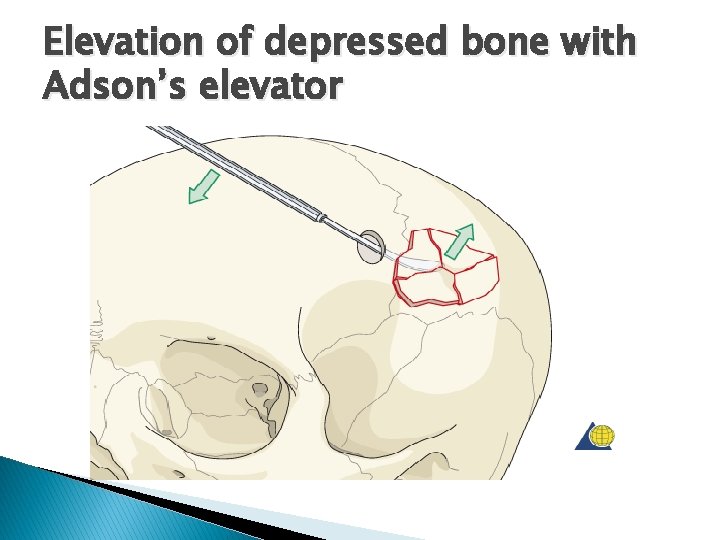
Elevation of depressed bone with Adson’s elevator
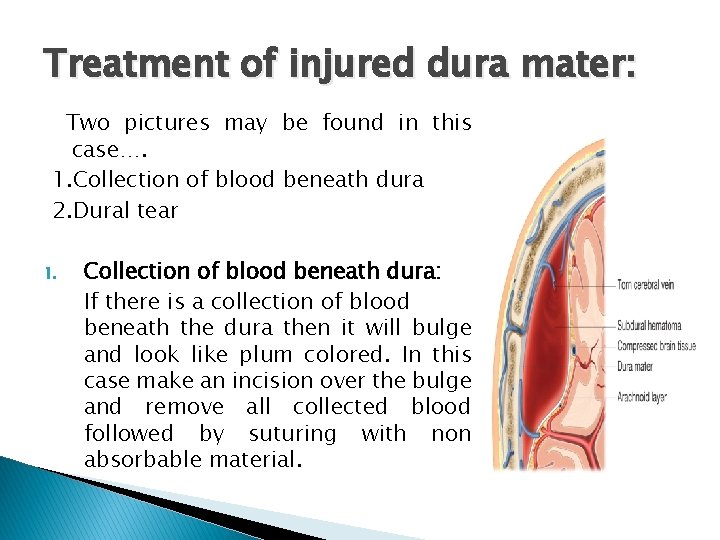
Treatment of injured dura mater: Two pictures may be found in this case…. 1. Collection of blood beneath dura 2. Dural tear 1. Collection of blood beneath dura: If there is a collection of blood beneath the dura then it will bulge and look like plum colored. In this case make an incision over the bulge and remove all collected blood followed by suturing with non absorbable material.
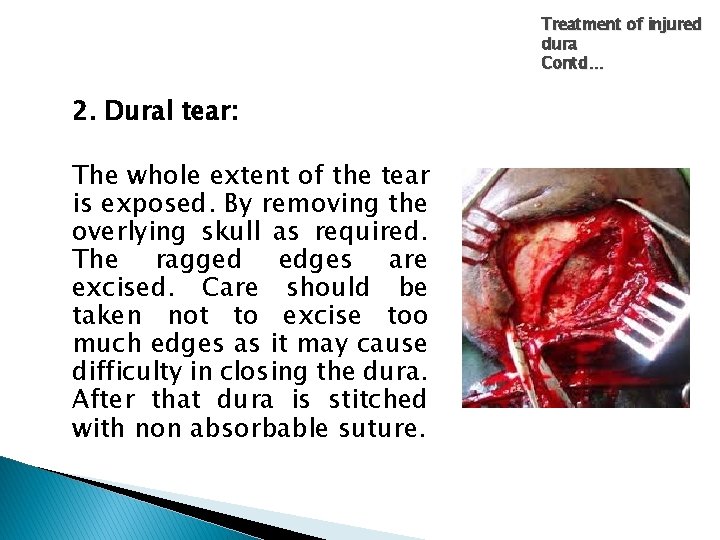
Treatment of injured dura Contd… 2. Dural tear: The whole extent of the tear is exposed. By removing the overlying skull as required. The ragged edges are excised. Care should be taken not to excise too much edges as it may cause difficulty in closing the dura. After that dura is stitched with non absorbable suture.
� � � If there is dural loss then transplantation of fascia lata is done over the dural loss. If there is hemorrhage from the blood vessels of the dura then electric diathermy is used to achieve hemostasis. If there is tearing to the dural sinus then it may be difficult to stop the bleeding. In case of small tear to dural sinus, the graft of the pericranium is stitched over the dural tear to stop bleeding. If the tear to dural sinus is large then a graft from temporalis muscle is stitched over the damaged dural sinus to stop the bleeding. If there is damage to the brain tissues then all the devitalized tissues are removed along with the removal of foreign body and detached bone fragments. Then damaged area should be cleared off with combination of suction and irrigation with the help of normal saline.
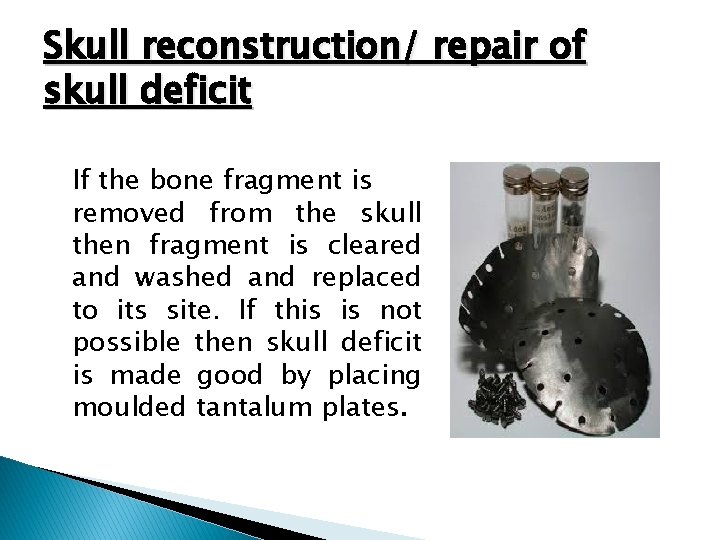
Skull reconstruction/ repair of skull deficit If the bone fragment is removed from the skull then fragment is cleared and washed and replaced to its site. If this is not possible then skull deficit is made good by placing moulded tantalum plates.
Fracture of the base of the skull: 1. Fracture of the anterior cranial fossa 2. Fracture of the middle cranial fossa 3. Fracture of the posterior cranial fossa
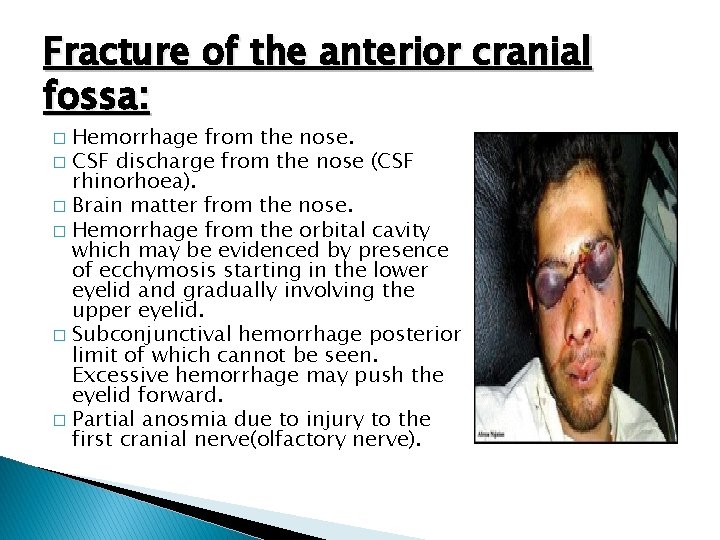
Fracture of the anterior cranial fossa: Hemorrhage from the nose. � CSF discharge from the nose (CSF rhinorhoea). � Brain matter from the nose. � Hemorrhage from the orbital cavity which may be evidenced by presence of ecchymosis starting in the lower eyelid and gradually involving the upper eyelid. � Subconjunctival hemorrhage posterior limit of which cannot be seen. Excessive hemorrhage may push the eyelid forward. � Partial anosmia due to injury to the first cranial nerve(olfactory nerve). �
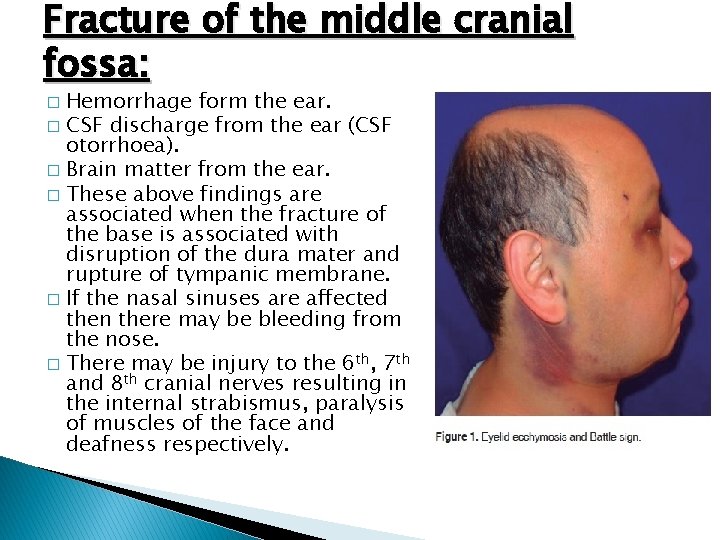
Fracture of the middle cranial fossa: Hemorrhage form the ear. � CSF discharge from the ear (CSF otorrhoea). � Brain matter from the ear. � These above findings are associated when the fracture of the base is associated with disruption of the dura mater and rupture of tympanic membrane. � If the nasal sinuses are affected then there may be bleeding from the nose. � There may be injury to the 6 th, 7 th and 8 th cranial nerves resulting in the internal strabismus, paralysis of muscles of the face and deafness respectively. �
Fracture of the posterior cranial fossa: � There may be the extravasations of the blood from the sub occipital region resulting in the swelling at upper part of the neck. � Ecchymosis at the tip of the mastoid process (Battle’s sign). � Here may be injury to the 9 yh, 10 th and 11 th cranial nerves.
Injury to the brain can be divided into two parts 1. Primary brain injury: The injury is inflicted on the brain at the time of impact of injury. 2. Secondary brain injury: the injury is not inflicted at the time of impact of trauma but few hours later. The injury to the brain results in swelling, edema and intracranial hemorrhage few hours after the injury which will result in loss of consciousness.
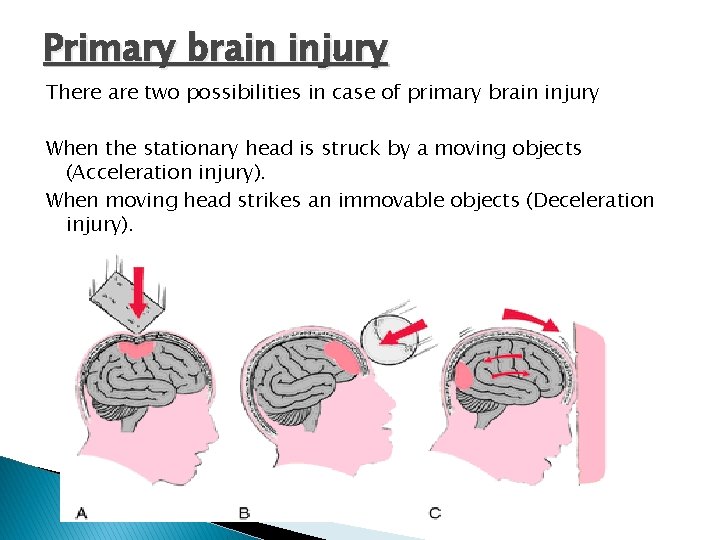
Primary brain injury There are two possibilities in case of primary brain injury When the stationary head is struck by a moving objects (Acceleration injury). When moving head strikes an immovable objects (Deceleration injury).
Primary brain injury contd… When the stationary head is struck by a moving objects (Acceleration injury). � When the head is struck from in front: Both the cerebral hemisphere are displaced poteriorly against the brain stem, mid brain and hypothalamus. � � When the head is struck from behind or in front at one side and opposite at other side: This will result in the displacement of the cerebral hemisphere against each other that will result into the damage of corpus callosum. In some cases the grey matter of the cortex moves over the white matter that will result into the tearing of the axons and nerve fibres of that region. When moving head strikes an immovable objects (Deceleration injury). As seen in road accidents when moving head strikes against the immovable objects like footpath and road.
To indicate the type of brain damage three terms are used 1. Cerebral concussion. 2. Cerebral contusion. 3. Cerebral laceration.
Cerebral concussion: Temporary physiological paralysis of the cerebral cortex without structural organic damage. There is transient loss of consciousness along with the dizziness and mild confusion which is followed by complete recovery. It may be short lasting few minutes to half an hour or long lasting few hours to few days. With the loss of consciousness the patient falls down and the skin becomes cold and covered with clammy sweat. The temperature drops below normal and pulse becomes imperceptible. The cause of the cerebral concussion is not clear but several theories are there. � It is due to cerebral anemia. � It is due to compression of the brain resulting into the emptying of vessels and ischemia. � It is due to the molecular disturbances of hypothalamus and brain stem. � It is due to abrupt stretching of delicate anterior and posterior perforating arteries.
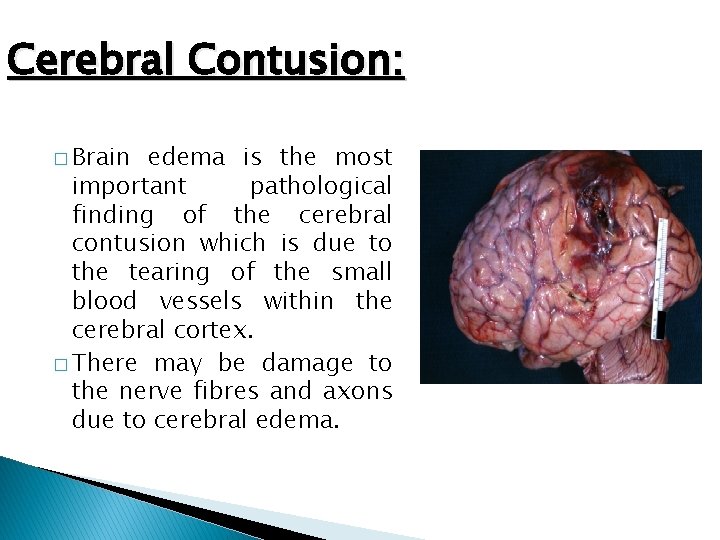
Cerebral Contusion: � Brain edema is the most important pathological finding of the cerebral contusion which is due to the tearing of the small blood vessels within the cerebral cortex. � There may be damage to the nerve fibres and axons due to cerebral edema.
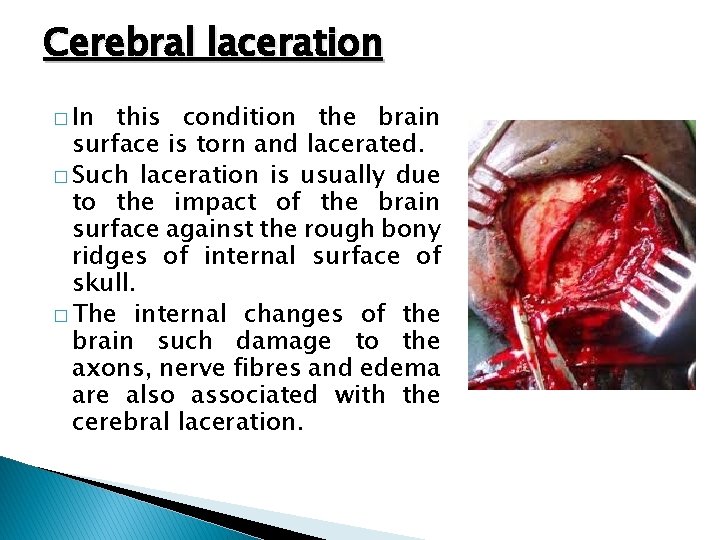
Cerebral laceration � In this condition the brain surface is torn and lacerated. � Such laceration is usually due to the impact of the brain surface against the rough bony ridges of internal surface of skull. � The internal changes of the brain such damage to the axons, nerve fibres and edema are also associated with the cerebral laceration.
Sequelae of contusion or laceration Most important is post traumatic amnesia (PTA): This is the time between the head injury and return to conscious memory. The duration of PTA is best guide to assess the severity of head injury. 1 hour : Mild head injury 1 to 24 hours : Moderate head injury 1 to 7 days : Severe head injury Cerebral irritation: In this condition the patient curls up on his side with legs drawn up and arms flexed (flexion attitude) and the patient avoid lights. There is headache, depression, lack of concentration and defective memory. It is followed by complete recovery. The cerebral irritation is due to local edema caused by cerebral contusion or laceration Post-contusional syndrome: Headache, nausea vomiting, photophobia, delirium and lack of concentration are the complaints of patients.
Sequelae of contusion or laceration contd… Traumatic epilepsy of Jacksonian type: Due to the contraction of the healed scar of the brain, there is a constant pull over the whole frame work of brain. This will results in epilepsy after few years of injury. It is called traumatic epilepsy of Jacksonian type. Focal neurological deficit: � Anosmia in case of injury to the inferior aspect of frontal lobe. � Hemianopia and blindness in case of injury to the occipital lobe. � Ataxia and nystagmus in case of injury to the cerebellum. If contusion or laceration give rise to hemorrhage and edema then features of cerebral compression may set in.
Secondary brain injury implies cerebral compression arising as a result of swelling/edema, intracranial hemorrhage and coning after some time due to head injury. Cerebral swelling: Brain often reacts to any insult be it traumatic or inflammatory in form of swelling. Initially the swelling is localized to the site of injury but in later stages it gradually extends throughout both the cerebral hemispheres. So there is considerable rise in intracranial pressure which may lead to cerebral compression. Intracranial hemorrhage: After injury there may be intra cerebral, subarachnoid, subdural and extra dural hemorrhage which may lead to cerebral compression. Coning: Coning is the herniation of the brain part through tentorial hiatus and foramen magnum.
CLINICAL FEATURES OF CEREBRAL COMPRESSION � The patient being conscious for a while passes into the profound unconsciousness. Progressive deterioration in the level of unconsciousness is the main feature. � The pulse becomes slow and bounding i. e. of high volume. � Respiration becomes slow, deep and stertorous. � Face becomes flushed. � Temperature becomes unequal being higher on paralyzed side. � Hemi paresis is seen on the opposite side of the head injury. � Hutchinson’s pupils.
INTRACRANIAL HEMORRHAGE � Hemorrhage from any of the intracranial vessel may occur from head injury. � This may occur either from supratentorial or infra tentorial compartment and become responsible for the cerebral compression. � The time taken to develop the cerebral compression from time of head injury is called lucid interval. � During this interval the patient remains conscious and oriented. The duration of the interval depends upon the type of blood vessel affected and calibre of the blood vessels.
Types of intracranial hemorrhage: 1. 2. 3. 4. Intracerebral hemorrhage Subarachnoid hemorrhage Subdural hemorrhage Extradural hemorrhage
Intracranial hemorrhage contd… Intracerebral hemorrhage: � Least common and least significant of all supratentorial hemorrhage. � It does not produce cerebral compression of much significant magnitude. � But if central artery is ruptured then it may rupture into the ventricle which may result into intra ventricular hemorrhage. S/S of which are hyperthermia and epileptic fits. Therefore arteriography is advisable if time permits to make a proper diagnosis. � Mostly the Intracerebral hemorrhage results in the formation of hematoma the S/S of which mimics the cerebral tumor. Therefore CT is necessary to make a proper diagnosis. � Treatment is surgical removal of such hematoma.
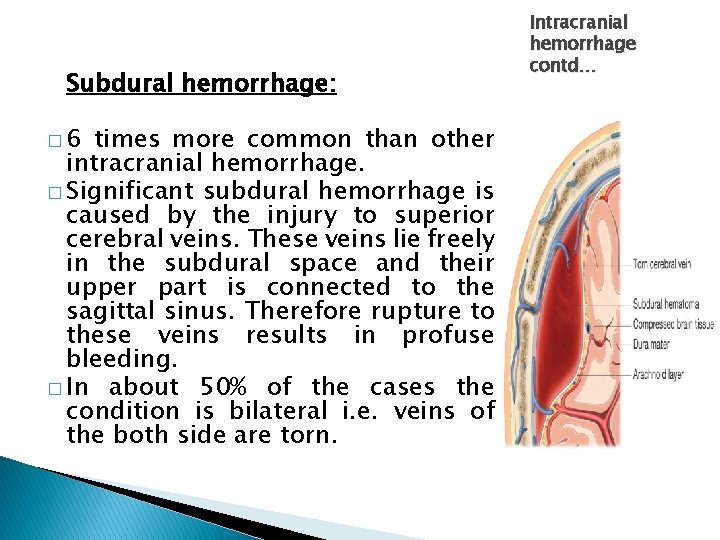
Subdural hemorrhage: � 6 times more common than other intracranial hemorrhage. � Significant subdural hemorrhage is caused by the injury to superior cerebral veins. These veins lie freely in the subdural space and their upper part is connected to the sagittal sinus. Therefore rupture to these veins results in profuse bleeding. � In about 50% of the cases the condition is bilateral i. e. veins of the both side are torn. Intracranial hemorrhage contd…
Clinical features of subdural hemorrhage: � As subdural hemorrhage is accompanied with the severe primary brain damage so there is no definite lucid interval. � Level of unconsciousness deteriorates very quickly. � S/S become more evident Ø Unconsciousness Ø Slow and bounding pulse Ø Slow and deep respiration Ø Cold and clammy skin Ø Skin becomes flushed and pale Ø Damage to memory
� When Clinical features of subdural hemorrhage Contd… subdural hemorrhage is less dramatic and is delayed by several days then it is called sub acute subdural hemorrhage. Severe and prolonged headache, mental apathy and slowness to respond to questions. Patient may go into coma. � When subdural hemorrhage is delayed by few days to months then it is called chronic subdural hemorrhage. In this case is difficult to remember the head injury as a cause of the abnormal behavior.
Treatment: � CT scan and arteriography are performed if time permits as to locate the site of hemorrhage and hemorrhagic vessels. � In case of acute subdural hemorrhage, immediate surgical intervention is the way to save the patient’s life. Extensive craniotomy is performed to visualize the hemorrhage and hemorrhagic vessels. The hemorrhagic vessels are carefully secured and ligated.
Extra dural hemorrhage It is the hemorrhage outside the duramater but inside the skull. The importance of the Extradural hemorrhage lies in the fact that it is amenable to surgery and if the patient is not diagnosed in right time then the patient may die. Vessels affected in extra dural hemorrhage: 1. Main trunk of middle meningeal artery or its branches anterior or posterior. 2. Middle meningeal vein. 3. Internal maxillary artery.
1. Main trunk of middle meningeal artery or its branches anterior or posterior. If the main trunk of the middle meningeal artery is injured then bleeding occurs in middle cranial fossa. The anterior and posterior branches are injured in the ratio of 5: 1. 2. Middle meningeal vein: The bleeding from middle meningeal vein occurs in middle cranial fossa. The bleeding from it is less forcible therefore it does not cause much danger to the patient. 3. Internal maxillary artery: The bleeding from internal maxillary artery occurs in anterior cranial fossa. Often the bleeding of internal maxillary artery is associated with anterior branch of middle meningeal artery. Bleeding may also occur from superior sagittal sinus or transverse sinus. If the superior sagittal sinus is injured then bleeding occurs in anterior and middle cranial fossa. If transverse sinus is injured then bleeding occurs in posterior crania fossa.
Mechanism of middle meningeal artery bleeding: Injury to the trunk of middle meningeal artery or one of its branches occurs from relatively trivial injury which comes from the lateral direction. A blow on the thin bone of the temporal plate will cause a fracture of squamous part of the bone which derives the dura inwards. The middle meningeal artery leaves the bony canal in pterion, crosses the Extradural space and gains attachment to the outer surface of the duramater. The part of middle meningeal artery which lie between the inner surface of skull and outer surface of dura mater is free and therefore becomes easily torn.
Clinical features Ø History of laterally directed blow of relatively trivial in nature. Ø There may or may not be a short period of cerebral concussion. If there is a period of concussion, the patient becomes unconscious immediately after the injury. After a short while the patient recovers completely and continues with what he was doing. Later on the patient complains of headache and drowsiness followed by unconsciousness which is caused by cerebral compression. This is called lucid interval.
In certain cases there may not be a period of lucid interval. There are two causes � When the primary head injury is so severe that the period of concussion is prolonged. By the end of concussion the cerebral compression sets in. � When primary head injury is so severe that it would cause profuse intracranial hemorrhage. By the end of concussion, sufficient amount of blood is accumulated to cause the cerebral compression.
Physical examination Site of injury: A hematoma at temporal region is suggestive of Extradural hemorrhage. Eyes: Hutchinson’s pupil Paralysis: when the blood is collected in the motor cortex from below upward, the opposite side of the body becomes paralyzed in descending order. Pulse: Cerebral concussion: Rapid and thready. Cerebral compression: slow and bounding. Blood pressure: Cerebral concussion: BP decreases Cerebral compression: BP rises Respiration: initially slow and deep. Later on Cheyne stoke’s respiration. Temperature: Victor Horsley’s sign.
Treatment � The main aim of the treatment is to detect and to evacuate the hematoma before it causes deterioration and secondary brain damage. � When the diagnosis is almost certain the patient is transferred to neurosurgical department and surgical intervention is done without special investigation. � In some cases CT scan is performed particularly in the patients of coma. � The next thing is to decide the side to be explored
� The side of temporal hematoma formation. � The side which shows fracture of skull on Xrays � The side from which calcified pineal gland has been shifted to other side � The side on which pupil first dilates
Preoperative preparation: Ø GA with endotracheal intubation and controlled ventilation are used. If these facilities are not available then procedure can be performed under LA with endotracheal intubation to prevent airway obstruction. Ø Sterile towel is placed in such a fashion that it will allow easy access to the side which is to be explored. Ø Blood must be drawn for grouping and at least a bottle of blood should be arranged at the time of operation. Operation 1. Burr-hole exploration 2. Craniotomy
Burr-hole exploration � It should be made at a region where middle meningeal artery divides into anterior and posterior branch after it has come out from bony canal of pterion. The surface marking of this point is 2 inches behind the external angular process and 2 inches above the zygomatic process. � A vertical incision 3 cm in length is made above the zygomatic arch midway between the external angular process and external auditory maetus. � The incision is made through the skin, connective tissue layer, aponeurosis, temporalis fascia and temporalis muscle. The temporalis fascia and muscle are retracted to explore the underlying temporal bone. A small burr hole is made at this region.
� If the burr hole has been made exactly just at the site of hemorrhage, the hematoma will be seen from the small burr hole as black currant jelly. � The burr hole is made enlarged with the help of bone nibbler (craniectomy). � Next step is to remove the clot. Very often, after removing the clot, the fresh blood will well up the wound and obscure the view. � To have a clear view a combination of irrigation and suction with the help of normal saline is started. � When the bleeding artery has been visualized, it should be coagulated with diathermy electrode. � When the middle meningeal artery has been torn at the bony canal of pterion, the canal should be plugged with bone-wax or match stick.
� If dural sinus is torn, a graft from the temporalis muscle should be stitched over the torn dural sinus. � Next step is to stitch the temporalis muscle, temporalis fascia, galea aponeurotica and skin in layers. � Finally the scalp is dressed with gauze and crepe bandages. � Note: If the temporal burr hole fails to locate the hemorrhage site, the parietal burr hole is made 4 cm above and behind the external auditory maetus. � In case of failure of parietal burr hole, frontal burr hole is made.
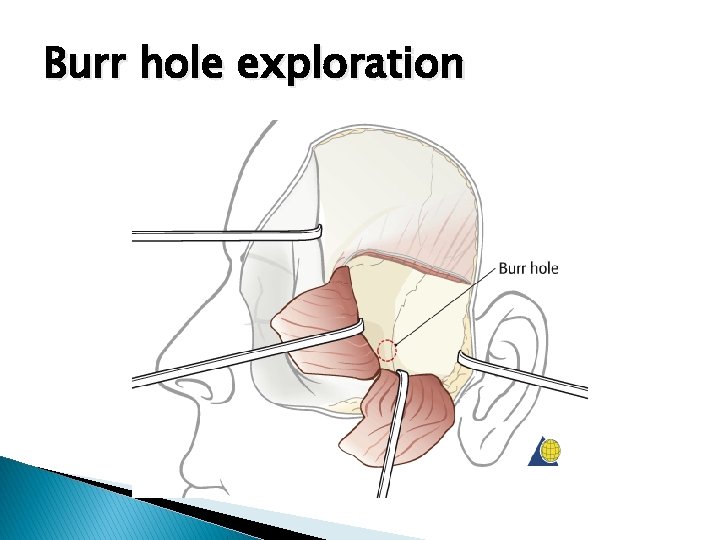
Burr hole exploration
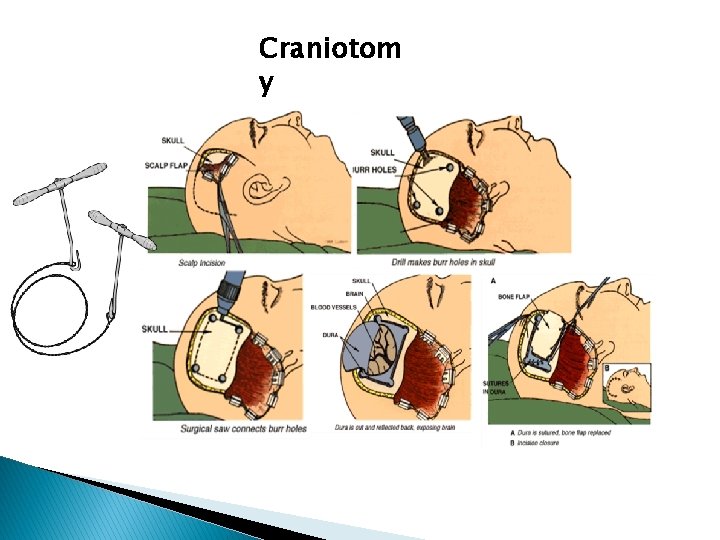
Craniotomy �A craniotomy is a surgical operation in which a bone flap is temporarily removed from the skull to access the brain. � A U shaped incision on the scalp, base of which is looking downward is made. � The flap is raised and 5 or more burr holes are made at the skull to lift the osteoplastic flap. � The dura mater is separated from the inner surface of the bony flap by a curved deceptor by insinuating it through the burr holes. � By means of special guide, a Gigli saw is passed between the adjacent holes and intervening part is divided in a manner that will make an outward bevel on the bony flap. This will prevent the sinking of bony flap after replacing it.
Craniotom y

Thank you
- Slides: 72