
HEA 104 Cell Structure and Function Home Economics




- Slides: 40
HEA 104: Cell Structure and Function Home Economics Department Eden Mohila College Dhaka Dated: 25/03/2020 1
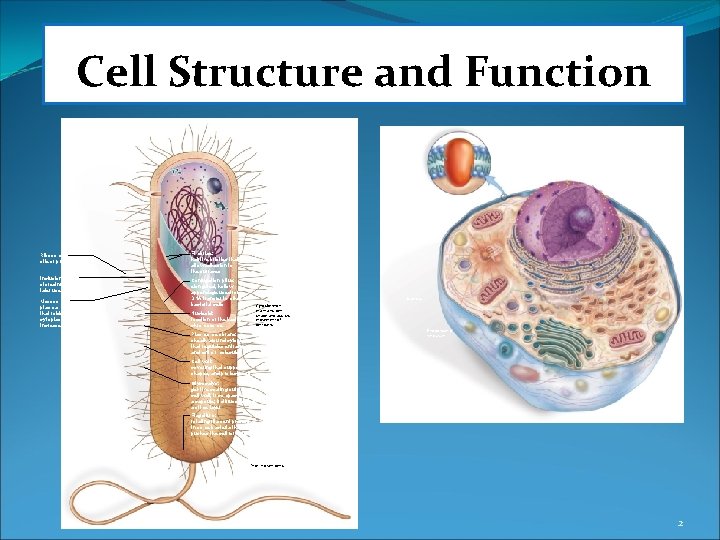
Cell Structure and Function Ribosome: site of protein synthesis Fimbriae: hairlike bristles that allow adhesion to the surfaces Inclusion body: stored nutrients for later use Conjugation pilus: elongated, hollow appendage used for DNA transfer to other bacterial cells Mesosome: plasma membrane that folds into the cytoplasm and increases surface area Plasma membrane: outer surface that regulates entrance and exit of molecules Nucleus: Cytoskeleton: maintains cell shape and assists movement of cell parts: Nucleoid: location of the bacterial chromosome Plasma membrane: sheath around cytoplasm that regulates entrance and exit of molecules Endoplasmic reticulum: Cell wall: covering that supports, shapes, and protects cell Glycocalyx: gel-like coating outside cell wall; if compact, called a capsule; if diffuse, called a slime layer Flagellum: rotating filament present in some bacteria that pushes the cell forward *not in plant cells 2
Outline Cellular Level of Organization Cell theory Cell size Prokaryotic Cells Eukaryotic Cells Organelles Nucleus and Ribosome Endomembrane System Other Vesicles and Vacuoles Energy related organelles Cytoskeleton Centrioles, Cilia, and Flagella 3
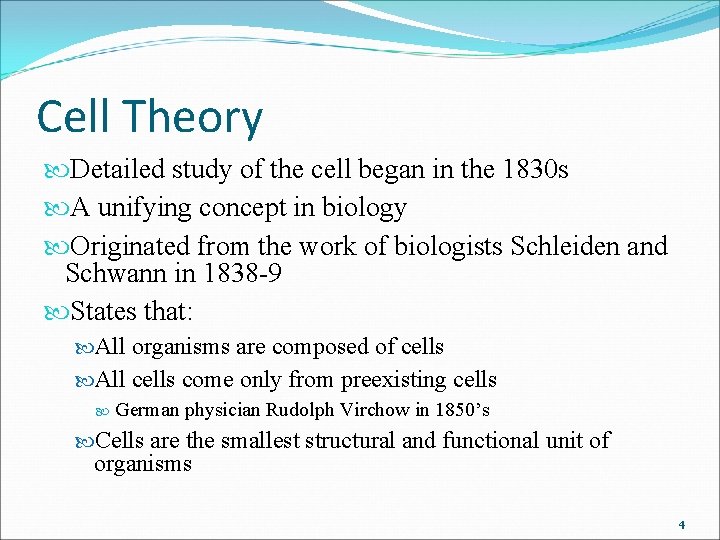
Cell Theory Detailed study of the cell began in the 1830 s A unifying concept in biology Originated from the work of biologists Schleiden and Schwann in 1838 -9 States that: All organisms are composed of cells All cells come only from preexisting cells German physician Rudolph Virchow in 1850’s Cells are the smallest structural and functional unit of organisms 4
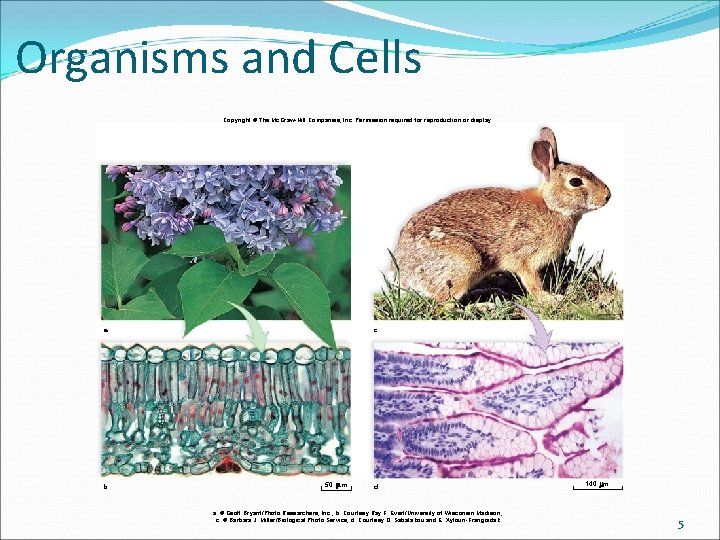
Organisms and Cells Copyright © The Mc. Graw-Hill Companies, Inc. Permission required for reproduction or display. a. b. c. 50 m d. a: © Geoff Bryant/Photo Researchers, Inc. ; b: Courtesy Ray F. Evert/University of Wisconsin Madison; c: © Barbara J. Miller/Biological Photo Service; d: Courtesy O. Sabatakou and E. Xylouri-Frangiadak 140 m 5
Sizes of Living Things Copyright © The Mc. Graw-Hill Companies, Inc. Permission required for reproduction or display. 0. 1 nm 100 nm protein amino acid 1 m chloroplast 10 m 100 plant and animal cells m 1 mm 1 cm human egg atom ant 1 m 100 m 1 km rose mouse frog egg virus most bacteria 0. 1 m ostrich egg blue whale human electron microscope light microscope human eye 6
Cell Size Cells range in size from one millimeter down to one micrometer Cells need a large surface area of plasma membrane to adequately exchange materials. 7
Prokaryotic Cells Lack a membrane-bound nucleus Structurally smaller and simpler than eukaryotic cells (which have a nucleus). Prokaryotic cells are placed in two taxonomic domains: Bacteria Archaea Live in extreme habitats Domains are structurally similar but biochemically different 8
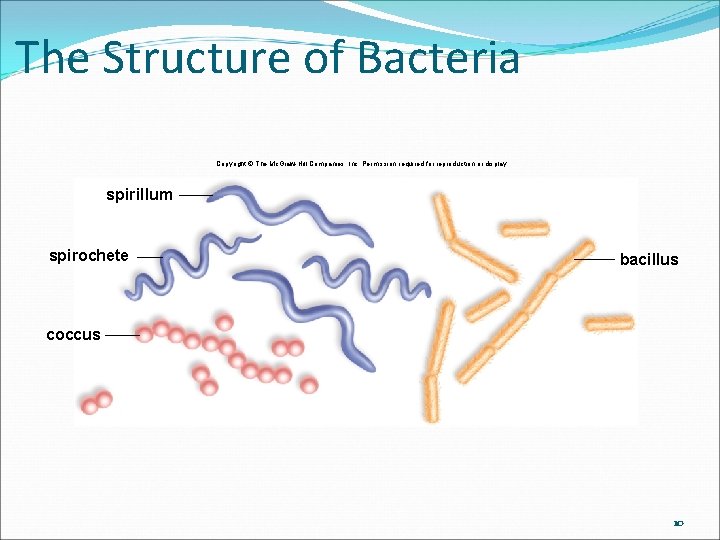
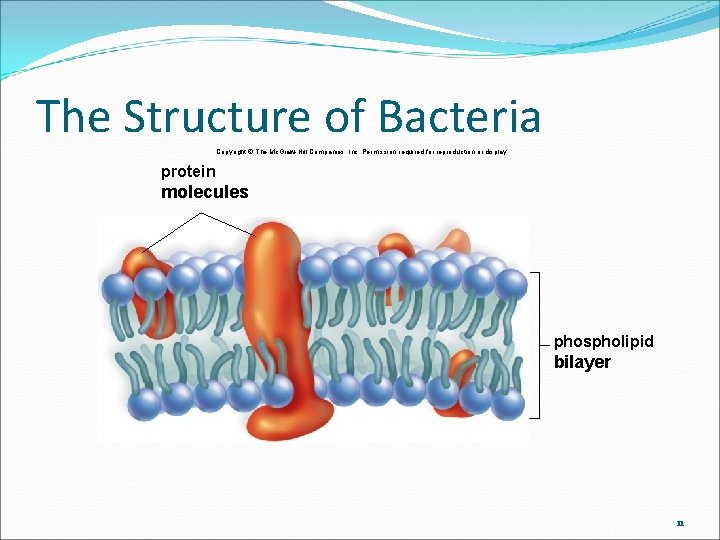
The Structure of Bacteria Extremely small - 1– 1. 5 μm wide and 2– 6 μm long Occur in three basic shapes: Spherical coccus, Rod-shaped bacillus, Spiral spirillum (if rigid) or spirochete (if flexible). Cell Envelope includes: Plasma membrane - lipid bilayer with imbedded and peripheral protein Form internal pouches (mesosomes) Cell wall - maintains the shape of the cell and is strengthened by peptidoglycan 9
The Structure of Bacteria Copyright © The Mc. Graw-Hill Companies, Inc. Permission required for reproduction or display. spirillum spirochete bacillus coccus 10
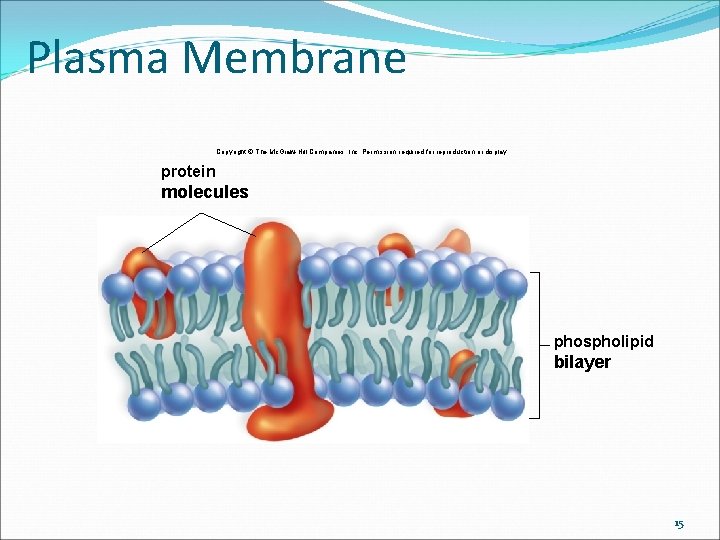
The Structure of Bacteria Copyright © The Mc. Graw-Hill Companies, Inc. Permission required for reproduction or display. protein molecules phospholipid bilayer 11
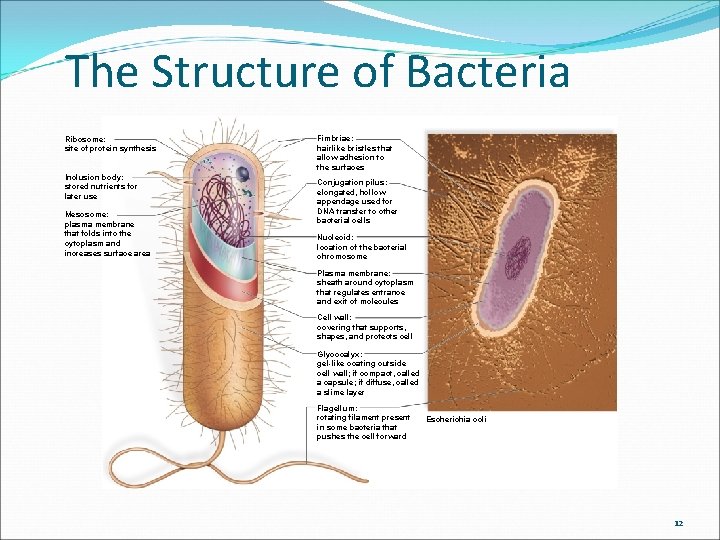
The Structure of Bacteria Ribosome: site of protein synthesis Inclusion body: stored nutrients for later use Mesosome: plasma membrane that folds into the cytoplasm and increases surface area Fimbriae: hairlike bristles that allow adhesion to the surfaces Conjugation pilus: elongated, hollow appendage used for DNA transfer to other bacterial cells Nucleoid: location of the bacterial chromosome Plasma membrane: sheath around cytoplasm that regulates entrance and exit of molecules Cell wall: covering that supports, shapes, and protects cell Glycocalyx: gel-like coating outside cell wall; if compact, called a capsule; if diffuse, called a slime layer Flagellum: rotating filament present in some bacteria that pushes the cell forward Escherichia coli 12
Eukaryotic Cells Domain Eukarya includes: Protists Fungi Plants Animals Cells contain: Membrane-bound nucleus that houses DNA Specialized organelles Plasma membrane Much larger than prokaryotic cells Some cells (e. g. , plant cells) have a cell wall 13
Eukaryotic Cells: Organelles Eukaryotic cells are compartmentalized They contain small structures called organelles Perform specific functions Isolates reactions from others Two classes of organelles: Endomembrane system: Organelles that communicate with one another Via membrane channels Via small vesicles Energy related organelles Mitochondria & chloroplasts Basically independent & self-sufficient 14
Plasma Membrane Copyright © The Mc. Graw-Hill Companies, Inc. Permission required for reproduction or display. protein molecules phospholipid bilayer 15
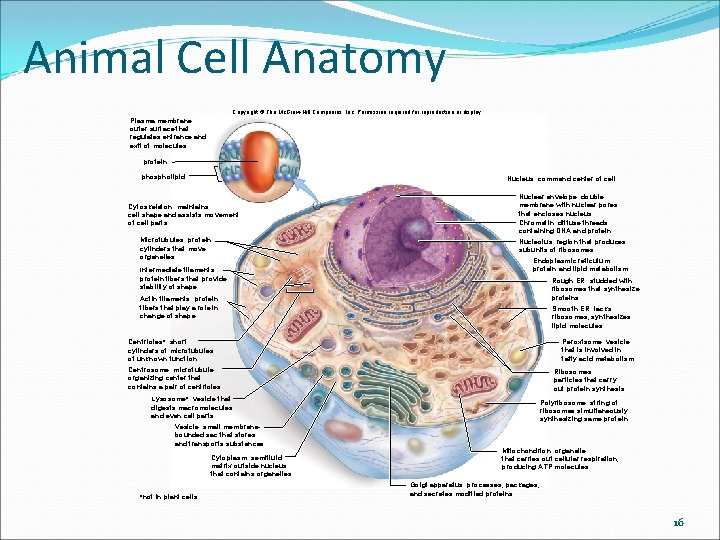
Animal Cell Anatomy Copyright © The Mc. Graw-Hill Companies, Inc. Permission required for reproduction or display. Plasma membrane: outer surface that regulates entrance and exit of molecules protein phospholipid Nucleus: command center of cell Cytoskeleton: maintains cell shape and assists movement of cell parts: Microtubules: protein cylinders that move organelles Intermediate filaments: protein fibers that provide stability of shape Nuclear envelope: double membrane with nuclear pores that encloses nucleus Chromatin: diffuse threads containing DNA and protein Nucleolus: region that produces subunits of ribosomes Endoplasmic reticulum: protein and lipid metabolism Rough ER: studded with ribosomes that synthesize proteins Actin filaments: protein fibers that play a role in change of shape Smooth ER: lacks ribosomes, synthesizes lipid molecules Peroxisome: vesicle that is involved in fatty acid metabolism Centrioles*: short cylinders of microtubules of unknown function Centrosome: microtubule organizing center that contains a pair of centrioles Ribosomes: particles that carry out protein synthesis Lysosome*: vesicle that digests macromolecules and even cell parts Vesicle: small membranebounded sac that stores and transports substances Cytoplasm: semifluid matrix outside nucleus that contains organelles *not in plant cells Polyribosome: string of ribosomes simultaneously synthesizing same protein Mitochondrion: organelle that carries out cellular respiration, producing ATP molecules Golgi apparatus: processes, packages, and secretes modified proteins 16
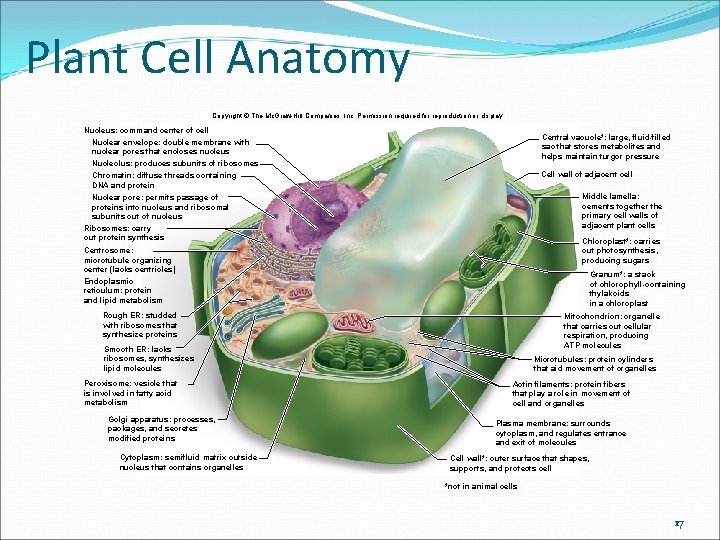
Plant Cell Anatomy Copyright © The Mc. Graw-Hill Companies, Inc. Permission required for reproduction or display. Nucleus: command center of cell Nuclear envelope: double membrane with nuclear pores that encloses nucleus Nucleolus: produces subunits of ribosomes Central vacuole*: large, fluid-filled sac that stores metabolites and helps maintain turgor pressure Cell wall of adjacent cell Chromatin: diffuse threads containing DNA and protein Middle lamella: cements together the primary cell walls of adjacent plant cells Nuclear pore: permits passage of proteins into nucleus and ribosomal subunits out of nucleus Ribosomes: carry out protein synthesis Chloroplast*: carries out photosynthesis, producing sugars Centrosome: microtubule organizing center (lacks centrioles) Endoplasmic reticulum: protein and lipid metabolism Granum*: a stack of chlorophyll-containing thylakoids in a chloroplast Rough ER: studded with ribosomes that synthesize proteins Mitochondrion: organelle that carries out cellular respiration, producing ATP molecules Smooth ER: lacks ribosomes, synthesizes lipid molecules Peroxisome: vesicle that is involved in fatty acid metabolism Golgi apparatus: processes, packages, and secretes modified proteins Cytoplasm: semifluid matrix outside nucleus that contains organelles Microtubules: protein cylinders that aid movement of organelles Actin filaments: protein fibers that play a role in movement of cell and organelles Plasma membrane: surrounds cytoplasm, and regulates entrance and exit of molecules Cell wall*: outer surface that shapes, supports, and protects cell *not in animal cells 17
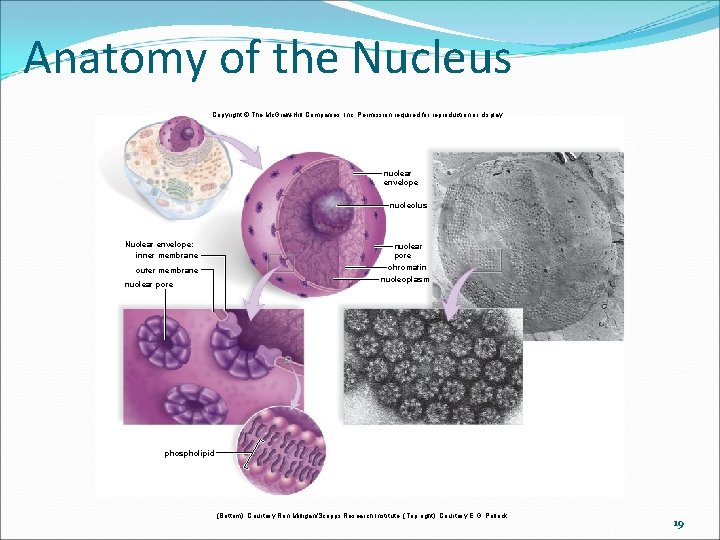
Nucleus Command center of cell, usually near center Separated from cytoplasm by nuclear envelope Consists of double layer of membrane Nuclear pores permit exchange between nucleoplasm & cytoplasm Contains chromatin in semifluid nucleoplasm Chromatin contains DNA of genes, and proteins Condenses to form chromosomes Chromosomes are formed during cell division Dark nucleolus composed of r. RNA Produces subunits of ribosomes 18
Anatomy of the Nucleus Copyright © The Mc. Graw-Hill Companies, Inc. Permission required for reproduction or display. nuclear envelope nucleolus Nuclear envelope: inner membrane outer membrane nuclear pore chromatin nucleoplasm phospholipid (Bottom): Courtesy Ron Milligan/Scripps Research Institute; (Top right): Courtesy E. G. Pollock 19
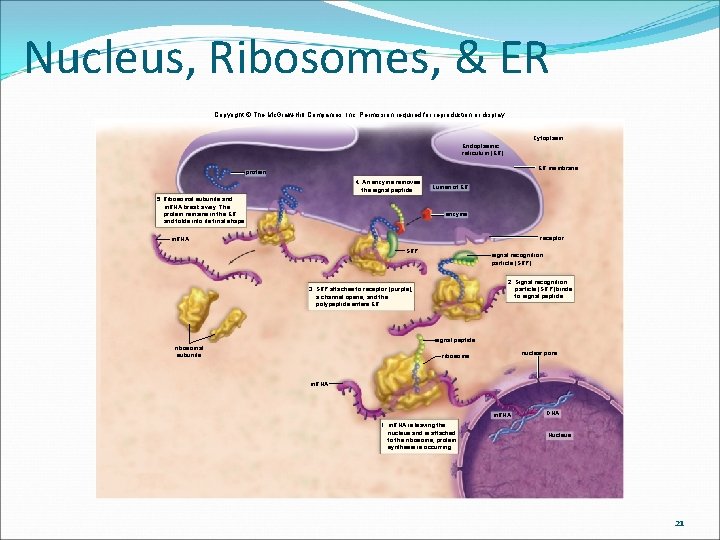
Ribosomes Are the site of protein synthesis in the cell Composed of r. RNA Consists of a large subunit and a small subunit Subunits made in nucleolus May be located: On the endoplasmic reticulum (thereby making it “rough”), or Free in the cytoplasm, either singly or in groups, called polyribosomes 20
Nucleus, Ribosomes, & ER Copyright © The Mc. Graw-Hill Companies, Inc. Permission required for reproduction or display. Cytoplasm Endoplasmic reticulum (ER) ER membrane protein 4. An enzyme removes the signal peptide. 5. Ribosomal subunits and m. RNA break away. The protein remains in the ER and folds into its final shape. Lumen of ER enzyme receptor m. RNA SRP signal recognition particle (SRP) 2. Signal recognition particle (SRP) binds to signal peptide. 3. SRP attaches to receptor (purple); a channel opens; and the polypeptide enters ER. . signal peptide ribosomal subunits nuclear pore ribosome m. RNA 1. m. RNA is leaving the nucleus and is attached to the ribosome; protein synthesis is occurring. DNA Nucleus 21
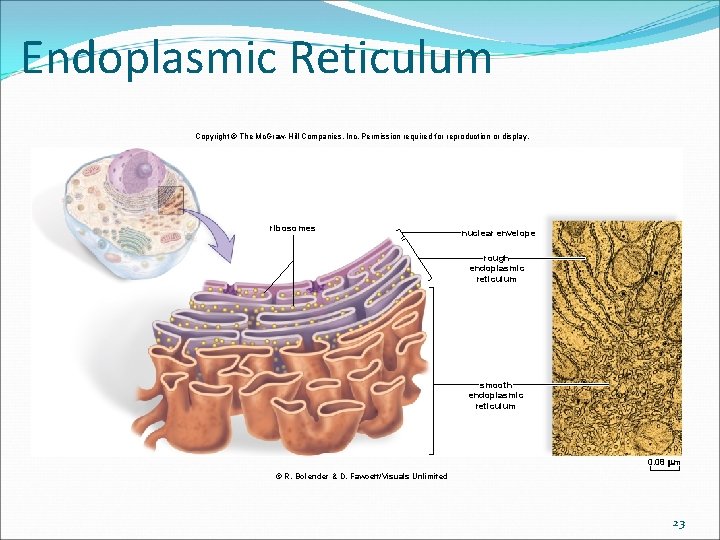
Endoplasmic Reticulum A system of membrane channels and saccules (flattened vesicles) continuous with the outer membrane of the nuclear envelope Rough ER Studded with ribosomes on cytoplasmic side Protein anabolism Synthesizes proteins Modifies and processes proteins Adds sugar to protein Results in glycoproteins Smooth ER No ribosomes Synthesis of lipids Site of various synthetic processes, detoxification, and storage Forms transport vesicles 22
Endoplasmic Reticulum Copyright © The Mc. Graw-Hill Companies, Inc. Permission required for reproduction or display. ribosomes nuclear envelope rough endoplasmic reticulum smooth endoplasmic reticulum 0. 08 m © R. Bolender & D. Fawcett/Visuals Unlimited 23
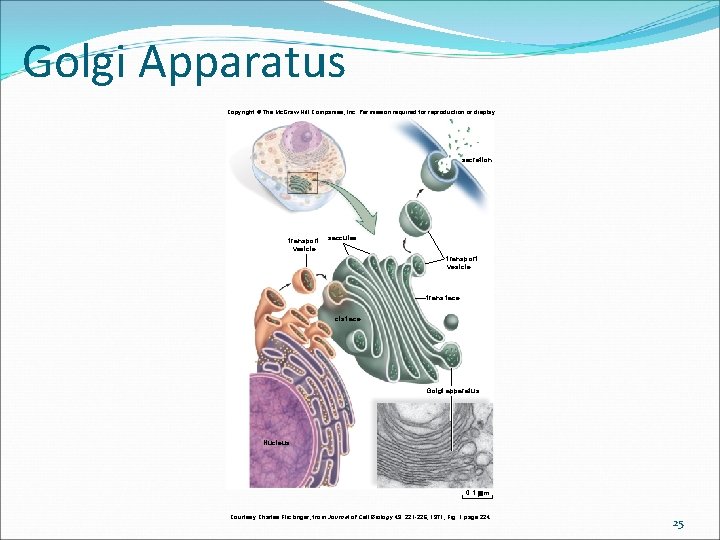
Golgi Apparatus Consists of 3 -20 flattened, curved saccules Resembles stack of hollow pancakes Modifies proteins and lipids Receives vesicles from ER on cis (or inner face) Packages them in vesicles Prepares for “shipment” in v Packages them in vesicles from trans (or outer face) Within Export cell from cell (secretion, exocytosis) 24
Golgi Apparatus Copyright © The Mc. Graw-Hill Companies, Inc. Permission required for reproduction or display. secretion transport vesicle saccules transport vesicle trans face cis face Golgi apparatus Nucleus 0. 1 m Courtesy Charles Flickinger, from Journal of Cell Biology 49: 221 -226, 1971, Fig. 1 page 224 25
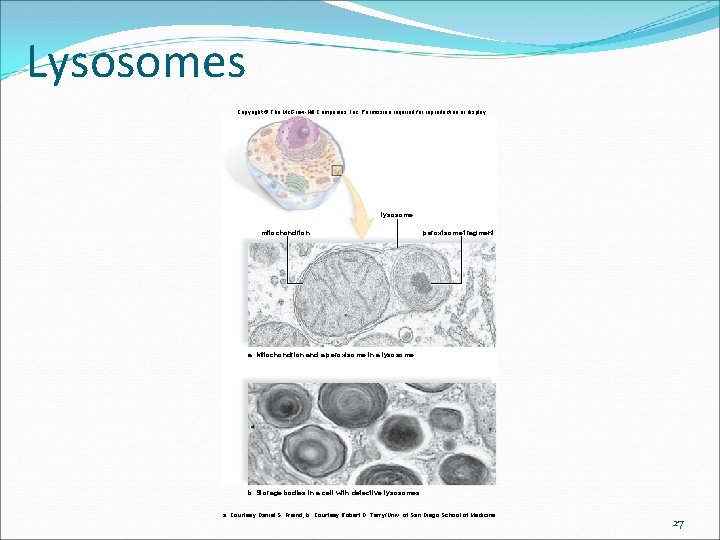
Endomembrane System: Lysosomes Membrane-bound vesicles (not in plants) Produced by the Golgi apparatus Contain powerful digestive enzymes and are highly acidic Digestion of large molecules Recycling of cellular resources Apoptosis (programmed cell death, like tadpole losing tail) Some genetic diseases Caused by defect in lysosomal enzyme Lysosomal storage diseases (Tay-Sachs) 26
Lysosomes Copyright © The Mc. Graw-Hill Companies, Inc. Permission required for reproduction or display. lysosome mitochondrion peroxisome fragment a. Mitochondrion and a peroxisome in a lysosome b. Storage bodies in a cell with defective lysosomes a: Courtesy Daniel S. Friend; b: Courtesy Robert D. Terry/Univ. of San Diego School of Medicine 27
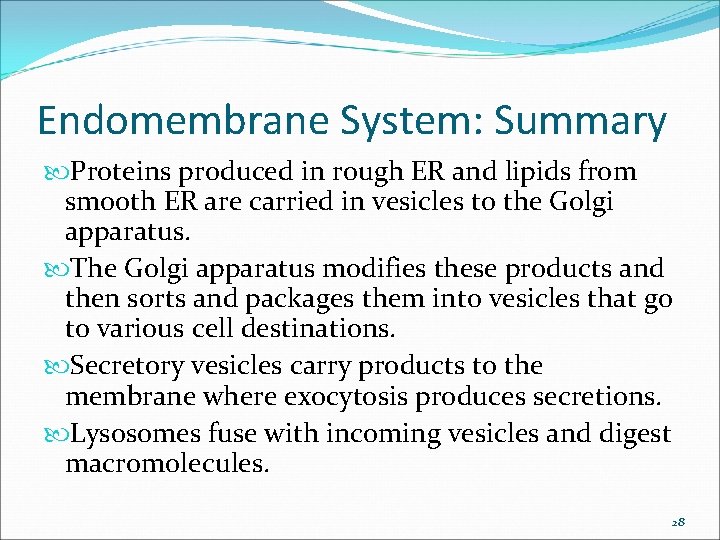
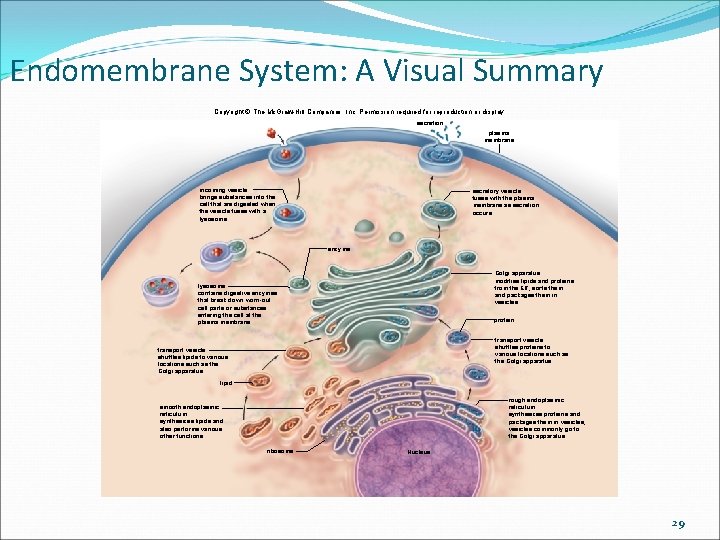
Endomembrane System: Summary Proteins produced in rough ER and lipids from smooth ER are carried in vesicles to the Golgi apparatus. The Golgi apparatus modifies these products and then sorts and packages them into vesicles that go to various cell destinations. Secretory vesicles carry products to the membrane where exocytosis produces secretions. Lysosomes fuse with incoming vesicles and digest macromolecules. 28
Endomembrane System: A Visual Summary Copyright © The Mc. Graw-Hill Companies, Inc. Permission required for reproduction or display. secretion plasma membrane incoming vesicle brings substances into the cell that are digested when the vesicle fuses with a lysosome secretory vesicle fuses with the plasma membrane as secretion occurs enzyme Golgi apparatus modifies lipids and proteins from the ER; sorts them and packages them in vesicles lysosome contains digestive enzymes that break down worn-out cell parts or substances entering the cell at the plasma membrane protein transport vesicle shuttles proteins to various locations such as the Golgi apparatus transport vesicle shuttles lipids to various locations such as the Golgi apparatus lipid rough endoplasmic reticulum synthesizes proteins and packages them in vesicles; vesicles commonly go to the Golgi apparatus smooth endoplasmic reticulum synthesizes lipids and also performs various other functions ribosome Nucleus 29
Peroxisomes Similar to lysosomes Membrane-bounded vesicles Enclose enzymes However Enzymes synthesized by free ribosomes in cytoplasm (instead of ER) Active in lipid metabolism Catalyze reactions that produce hydrogen peroxide H 2 O 2 Toxic Broken down to water & O 2 by catalase 30
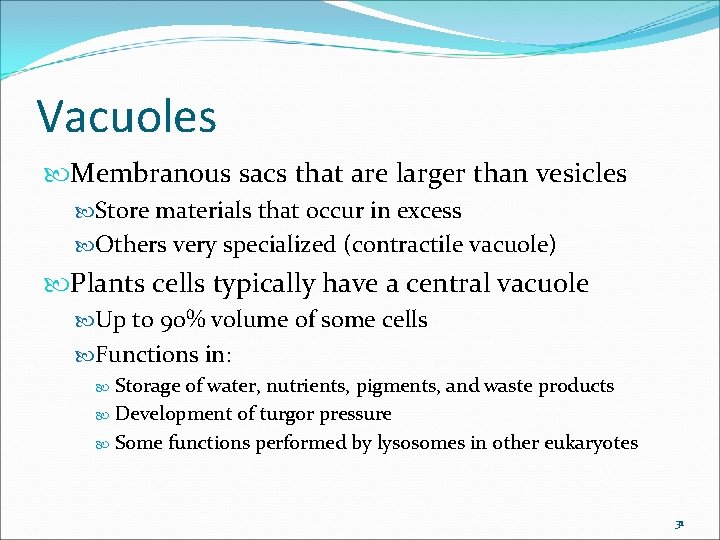
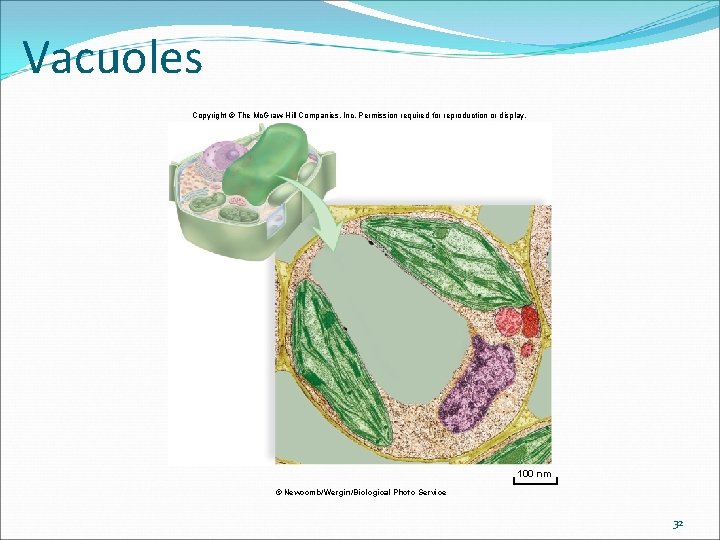
Vacuoles Membranous sacs that are larger than vesicles Store materials that occur in excess Others very specialized (contractile vacuole) Plants cells typically have a central vacuole Up to 90% volume of some cells Functions in: Storage of water, nutrients, pigments, and waste products Development of turgor pressure Some functions performed by lysosomes in other eukaryotes 31
Vacuoles Copyright © The Mc. Graw-Hill Companies, Inc. Permission required for reproduction or display. 100 nm © Newcomb/Wergin/Biological Photo Service 32
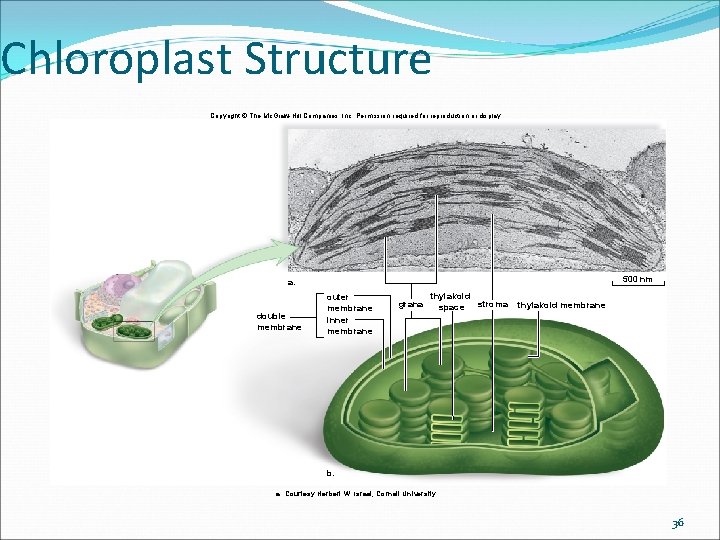
Chloroplast Structure Bounded by double membrane Inner membrane infolded Forms disc-like thylakoids, which are stacked to form grana Suspended in semi-fluid stroma Green due to chlorophyll Green photosynthetic pigment Found ONLY in inner membranes of chloroplast 33
Energy-Related Organelles: Chloroplasts Membranous organelles (a type of plastid) that serve as the site of photosynthesis Captures light energy to drive cellular machinery Photosynthesis Synthesizes carbohydrates from CO 2 & H 2 O Makes own food using CO 2 as only carbon source Energy-poor compounds converted to energy-rich compounds solar energy + carbon dioxide + water → carbohydrate + oxygen Only plants, algae, and certain bacteria are capable of conducting photosynthesis 34
Energy-Related Organelles: Chloroplasts Bound by a double membrane organized into flattened disc-like sacs called thylakoids Chlorophyll and other pigments capture solar energy Enzymes synthesize carbohydrates 35
Chloroplast Structure Copyright © The Mc. Graw-Hill Companies, Inc. Permission required for reproduction or display. 500 nm a. double membrane outer membrane inner membrane grana thylakoid space stroma thylakoid membrane b. a: Courtesy Herbert W. Israel, Cornell University 36
Energy-Related Organelles: Mitochondria Smaller than chloroplast Contain ribosomes and their own DNA Surrounded by a double membrane Inner membrane surrounds the matrix and is convoluted (folds) to form cristae. Matrix – Inner semifluid containing respiratory enzymes Break down carbohydrates Involved in cellular respiration Produce most of ATP utilized by the cell 37
Mitochondrial Structure Copyright © The Mc. Graw-Hill Companies, Inc. Permission required for reproduction or display. 200 nm a. double membrane outer membrane inner membrane cristae matrix b. a: Courtesy Dr. Keith Porter 38
Cytoskeleton Maintains cell shape Assists in movement of cell and organelles Three types of macromolecular fibers Actin Filaments Intermediate Filaments Microtubules Assemble and disassemble as needed 39
Thank You 40