
HDF Cloud Services Moving HDF 5 to the
- Slides: 31
HDF Cloud Services Moving HDF 5 to the Cloud John Readey The HDF Group jreadey@hdfgroup. org
Outline • • • Brief review of HDF 5 Motivation for HDF Cloud Services The HDF REST API H 5 serv – REST API reference implementation Storage for data in the cloud HDF Scalable Data Service (HSDS) – HDF at Cloud Scale
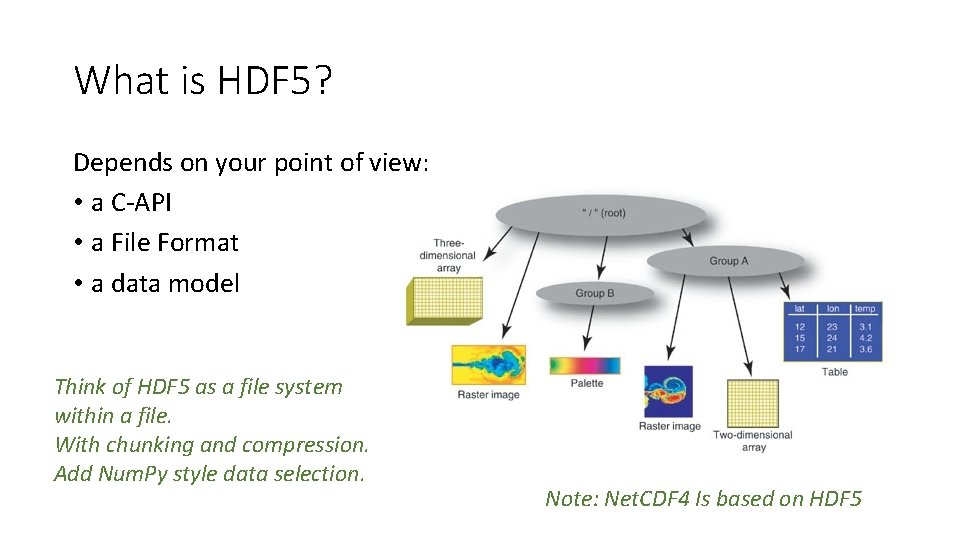
What is HDF 5? Depends on your point of view: • a C-API • a File Format • a data model Think of HDF 5 as a file system within a file. With chunking and compression. Add Num. Py style data selection. Note: Net. CDF 4 Is based on HDF 5
HDF 5 Features Some nice things about HDF 5: • Sophisticated type system • Highly portable binary format • Hierarchal objects (directed graph) • Compression • Fast data slicing/reduction • Attributes • Bindings for C, Fortran, Java, Python Things HDF 5 doesn’t do (out of the box): • • • Scalable analytics (other than MPI) Distributed Multiple writer/multiple reader Fine level access control Query/search Web accessible
Why HDF in the Cloud • It can provide a cost-effective infrastructure • Pay for what you use vs pay for what you may need • Lower overhead: no hard ware setup/network configuration, etc. • Potentially can benefit from cloud-based technologies: • Elastic compute – scale compute resources dynamically • Object based storage – low cost/built in redundancy • Community platform (potentially) • Enables interested users to bring their applications to the data
What do we need to bring HDF to the cloud? • Define a Web API for HDF • REST based API vs C API of HDF 5 • Determine storage medium • Disk? Object Storage? No. SQL? • Create Web Service that implements REST API • Preferably high performance and scalable REST API and Reference Service are available now (h 5 serv). Work on a scalable service used Object Based Storage has just started.
Why an HDF 5 Web API? Motivation to create a web API: • Anywhere reference-able data – ie URI • Network Transparency • Clients can be lighter weight • Support Multiple Writer/Multiple Reader • Enable Web UIs • Increased scope for features/performance boosters • E. g. in memory cache of recently used data • Transparently support parallelism (e. g. processing requests in a cluster) • Support alternative storage technologies (e. g. Object Storage)
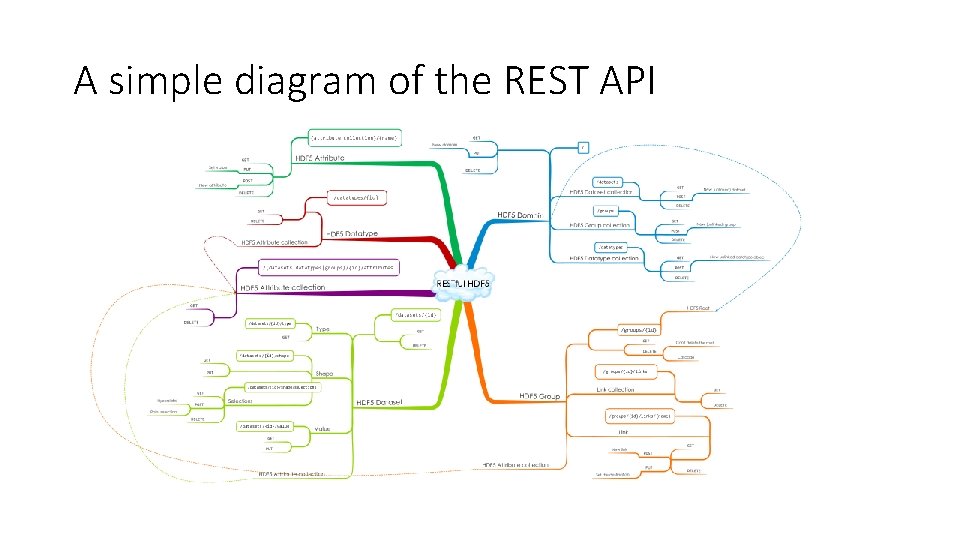
A simple diagram of the REST API
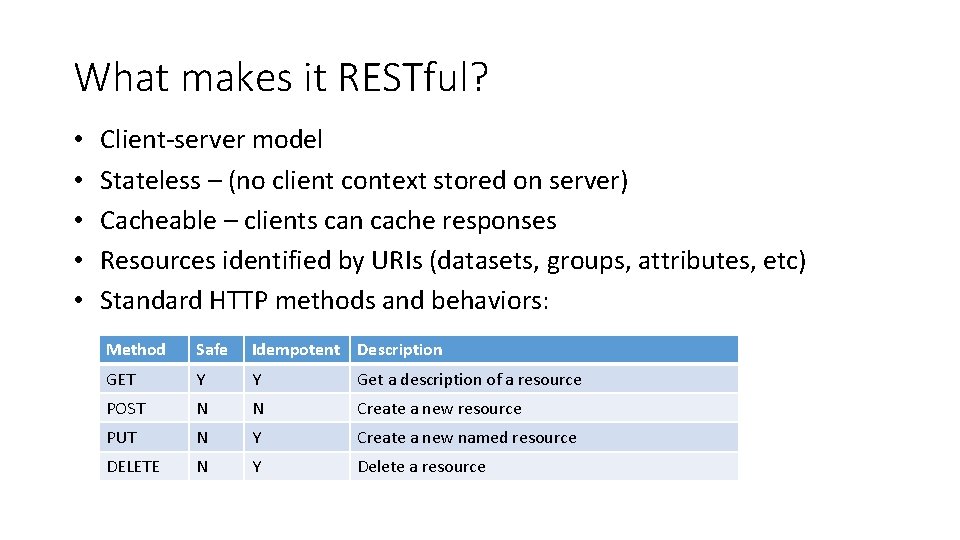
What makes it RESTful? • • • Client-server model Stateless – (no client context stored on server) Cacheable – clients can cache responses Resources identified by URIs (datasets, groups, attributes, etc) Standard HTTP methods and behaviors: Method Safe Idempotent Description GET Y Y Get a description of a resource POST N N Create a new resource PUT N Y Create a new named resource DELETE N Y Delete a resource
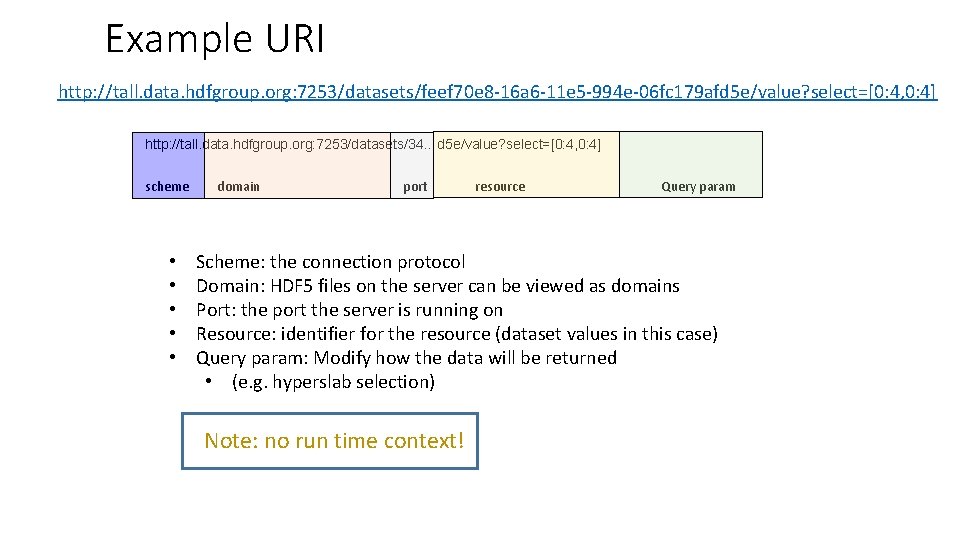
Example URI http: //tall. data. hdfgroup. org: 7253/datasets/feef 70 e 8 -16 a 6 -11 e 5 -994 e-06 fc 179 afd 5 e/value? select=[0: 4, 0: 4] http: //tall. data. hdfgroup. org: 7253/datasets/34…d 5 e/value? select=[0: 4, 0: 4] scheme • • • domain port resource Query param Scheme: the connection protocol Domain: HDF 5 files on the server can be viewed as domains Port: the port the server is running on Resource: identifier for the resource (dataset values in this case) Query param: Modify how the data will be returned • (e. g. hyperslab selection) Note: no run time context!
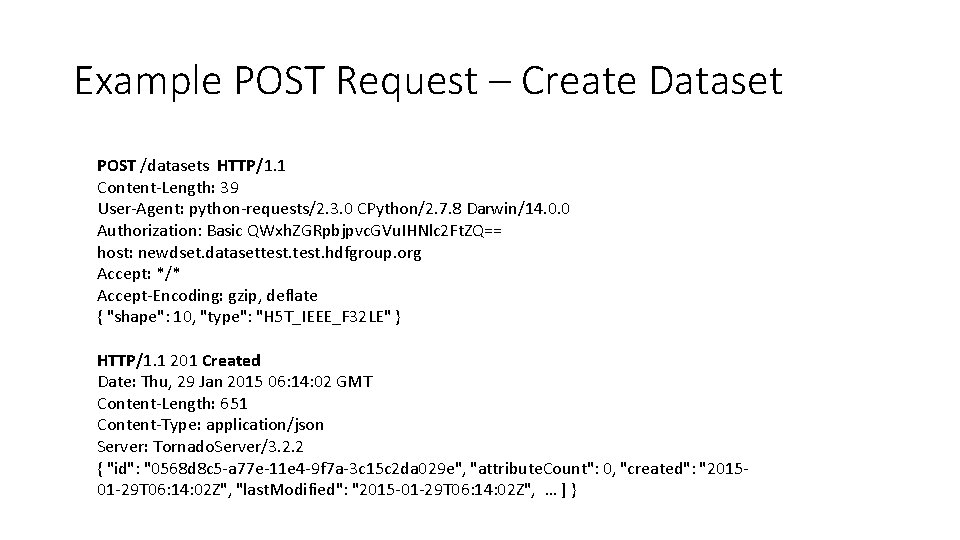
Example POST Request – Create Dataset POST /datasets HTTP/1. 1 Content-Length: 39 User-Agent: python-requests/2. 3. 0 CPython/2. 7. 8 Darwin/14. 0. 0 Authorization: Basic QWxh. ZGRpbjpvc. GVu. IHNlc 2 Ft. ZQ== host: newdset. datasettest. hdfgroup. org Accept: */* Accept-Encoding: gzip, deflate { "shape": 10, "type": "H 5 T_IEEE_F 32 LE" } HTTP/1. 1 201 Created Date: Thu, 29 Jan 2015 06: 14: 02 GMT Content-Length: 651 Content-Type: application/json Server: Tornado. Server/3. 2. 2 { "id": "0568 d 8 c 5 -a 77 e-11 e 4 -9 f 7 a-3 c 15 c 2 da 029 e", "attribute. Count": 0, "created": "201501 -29 T 06: 14: 02 Z", "last. Modified": "2015 -01 -29 T 06: 14: 02 Z", … ] }
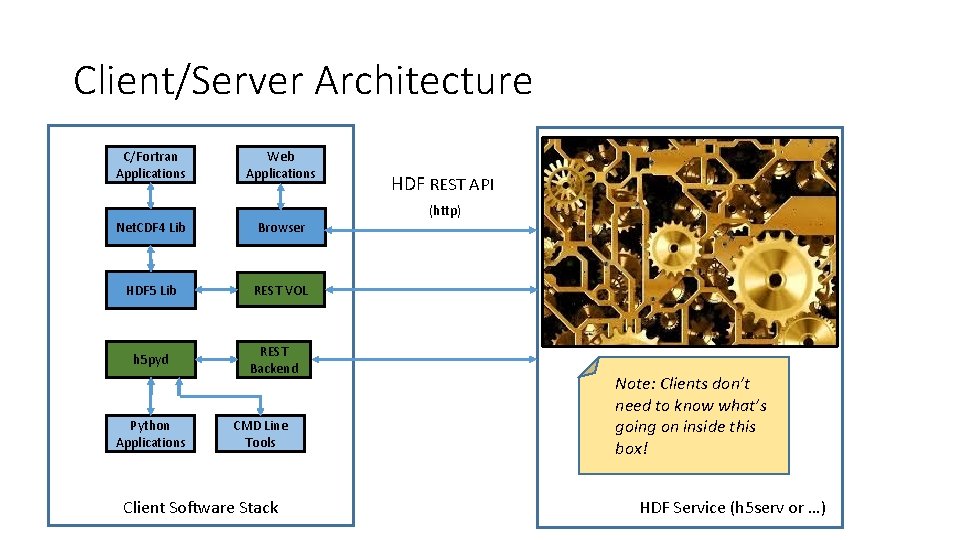
Client/Server Architecture C/Fortran Applications Web Applications Net. CDF 4 Lib Browser HDF 5 Lib REST VOL h 5 pyd Python Applications REST Backend CMD Line Tools Client Software Stack HDF REST API (http) Note: Clients don’t need to know what’s going on inside this box! HDF Service (h 5 serv or …)
Reference Implementation – h 5 serv • Open Source implementation of the HDF REST API • Get it at: https: //github. com/HDFGroup/h 5 serv • First release in 2015 – many features added since then • Easy to setup and configure • Runs on Windows/Linux/Mac • Not intended for heavy production use • Implementation is single threaded • Each request is completed before the next one is processed
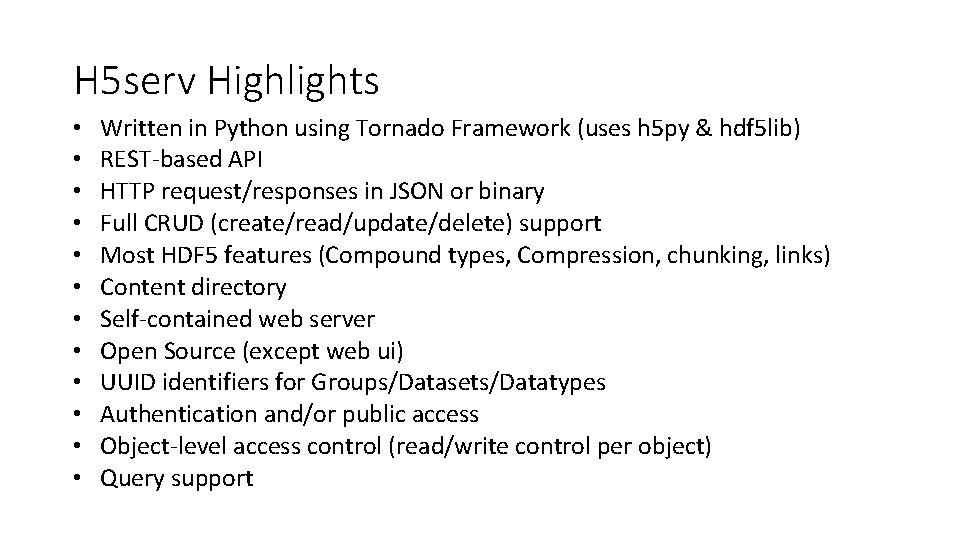
H 5 serv Highlights • • • Written in Python using Tornado Framework (uses h 5 py & hdf 5 lib) REST-based API HTTP request/responses in JSON or binary Full CRUD (create/read/update/delete) support Most HDF 5 features (Compound types, Compression, chunking, links) Content directory Self-contained web server Open Source (except web ui) UUID identifiers for Groups/Datasets/Datatypes Authentication and/or public access Object-level access control (read/write control per object) Query support
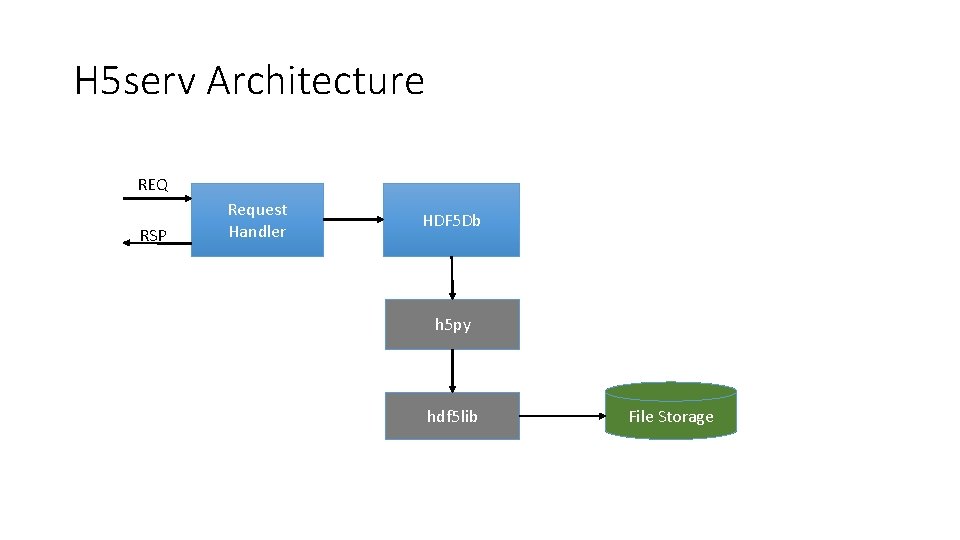
H 5 serv Architecture REQ RSP Request Handler HDF 5 Db h 5 py hdf 5 lib File Storage
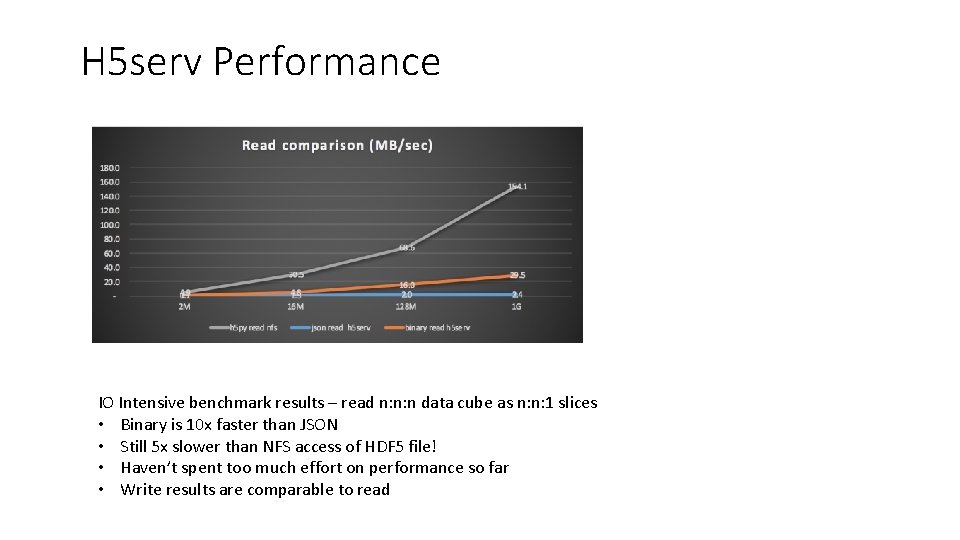
H 5 serv Performance IO Intensive benchmark results – read n: n: n data cube as n: n: 1 slices • Binary is 10 x faster than JSON • Still 5 x slower than NFS access of HDF 5 file! • Haven’t spent too much effort on performance so far • Write results are comparable to read
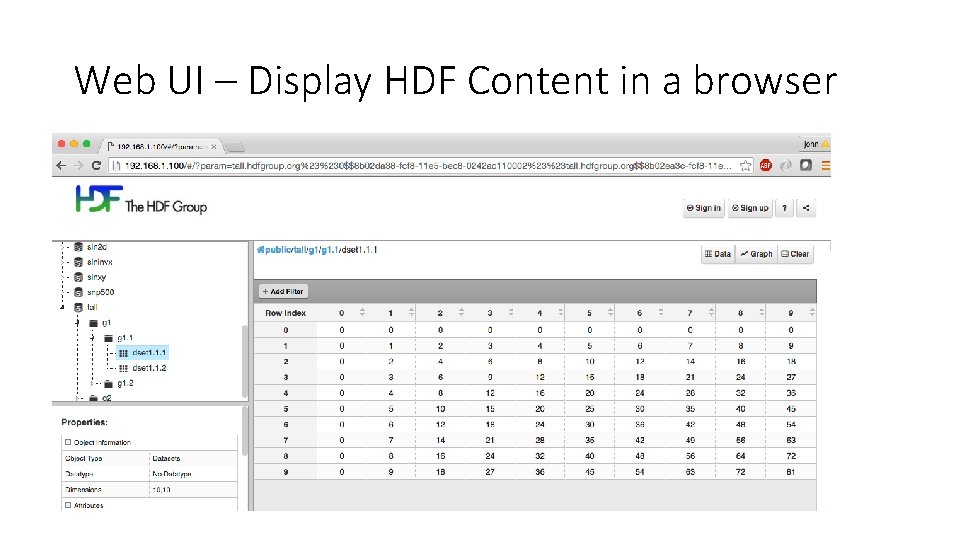
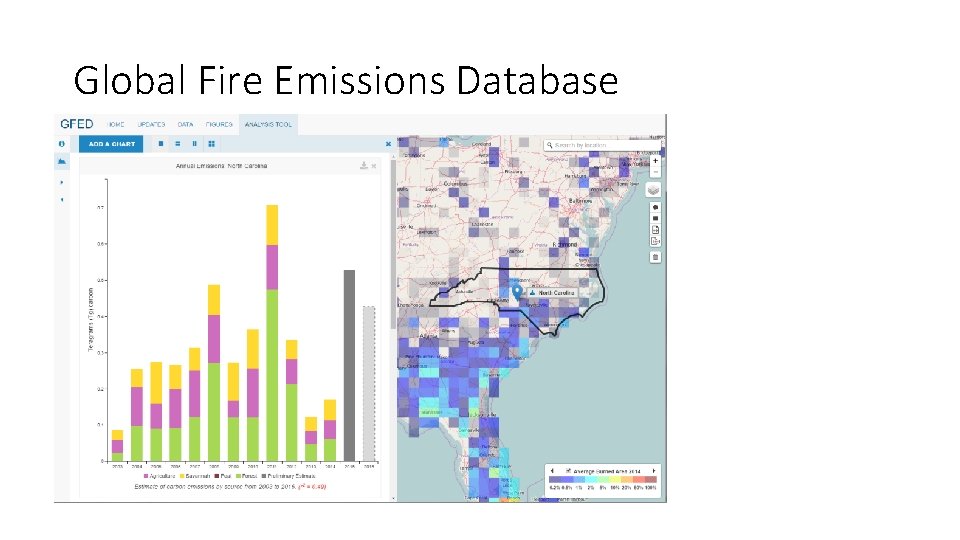
Sample Applications • Even though h 5 serv has limited scalability, there have been some interesting applications built using it… • A couple of examples… • The HDF Group is developing a AJAX-based HDF Viewer for the web • Anika Cartas at NASA Goddard developed a ”Global Fire Emissions Database” • This is a Web-based app as well • Ellen Johnson has created sample MATLAB scripts using the REST API • (stay tuned for her talk) • H 5 pyd – A h 5 py compatible Python SDK • See: https: //github. com/HDFGroup/h 5 pyd • CMD Line tools – coming soon
Web UI – Display HDF Content in a browser
Global Fire Emissions Database
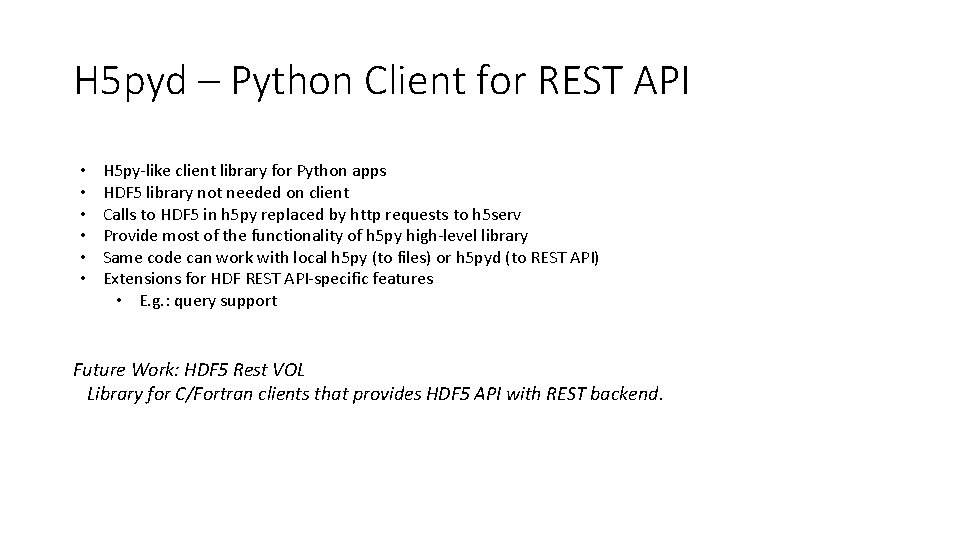
H 5 pyd – Python Client for REST API • • • H 5 py-like client library for Python apps HDF 5 library not needed on client Calls to HDF 5 in h 5 py replaced by http requests to h 5 serv Provide most of the functionality of h 5 py high-level library Same code can work with local h 5 py (to files) or h 5 pyd (to REST API) Extensions for HDF REST API-specific features • E. g. : query support Future Work: HDF 5 Rest VOL Library for C/Fortran clients that provides HDF 5 API with REST backend.
CMD Line Tools for common admin tasks: • List files (‘domains’ in HDF REST API parlance) hosted by service • Update permissions • Download content as local HDF 5 files • Upload local HDF 5 files • Output content of HDF 5 domain (similar to h 5 dump or h 5 ls cmd tools)
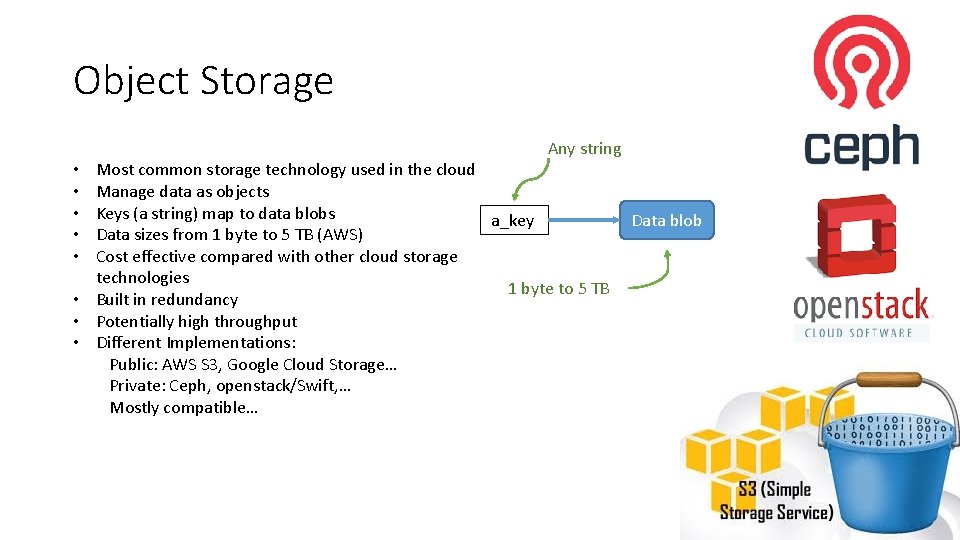
Object Storage Any string Most common storage technology used in the cloud Manage data as objects Keys (a string) map to data blobs a_key Data sizes from 1 byte to 5 TB (AWS) Cost effective compared with other cloud storage technologies 1 byte to 5 TB • Built in redundancy • Potentially high throughput • Different Implementations: Public: AWS S 3, Google Cloud Storage… Private: Ceph, openstack/Swift, … Mostly compatible… • • • Data blob
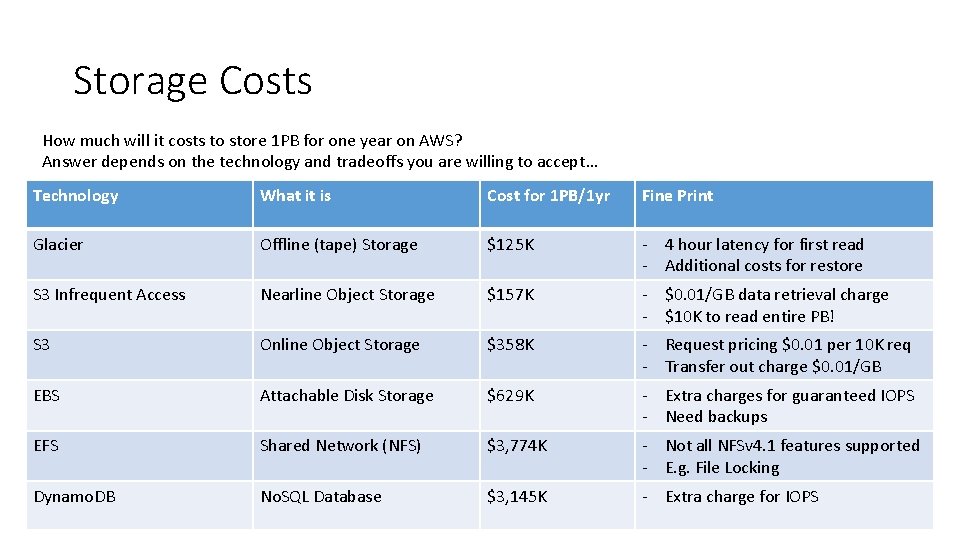
Storage Costs How much will it costs to store 1 PB for one year on AWS? Answer depends on the technology and tradeoffs you are willing to accept… Technology What it is Cost for 1 PB/1 yr Fine Print Glacier Offline (tape) Storage $125 K - 4 hour latency for first read - Additional costs for restore S 3 Infrequent Access Nearline Object Storage $157 K - $0. 01/GB data retrieval charge - $10 K to read entire PB! S 3 Online Object Storage $358 K - Request pricing $0. 01 per 10 K req - Transfer out charge $0. 01/GB EBS Attachable Disk Storage $629 K - Extra charges for guaranteed IOPS - Need backups EFS Shared Network (NFS) $3, 774 K - Not all NFSv 4. 1 features supported - E. g. File Locking Dynamo. DB No. SQL Database $3, 145 K - Extra charge for IOPS
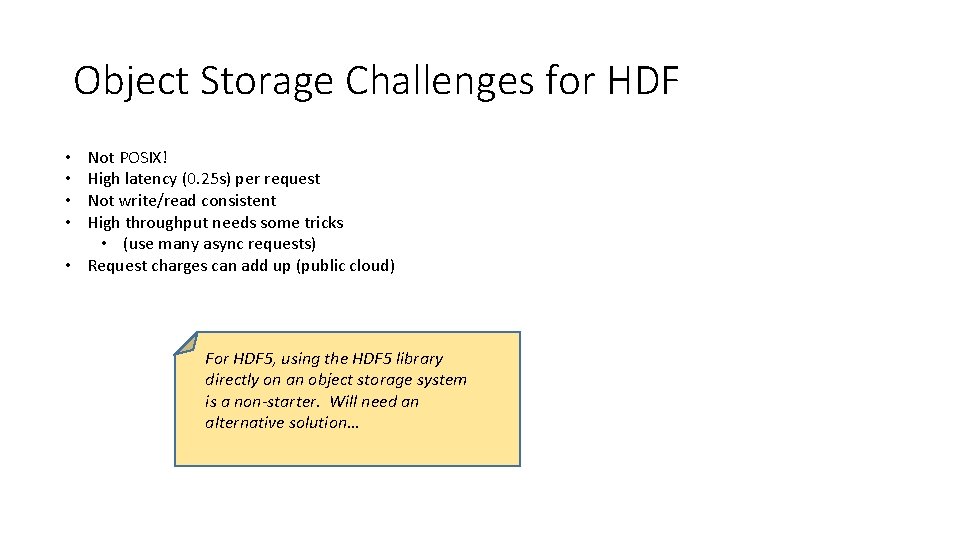
Object Storage Challenges for HDF Not POSIX! High latency (0. 25 s) per request Not write/read consistent High throughput needs some tricks • (use many async requests) • Request charges can add up (public cloud) • • For HDF 5, using the HDF 5 library directly on an object storage system is a non-starter. Will need an alternative solution…
How to store HDF 5 data in an object store? Store each HDF 5 file as an object store object? • • Idea: • Store each HDF 5 file as an object • Read on demand • Update locally – write back entire file to store But. . • Slow – need to read entire file for each read • Consistency issues for updates • Limit to max file size (AWS = 5 TB)
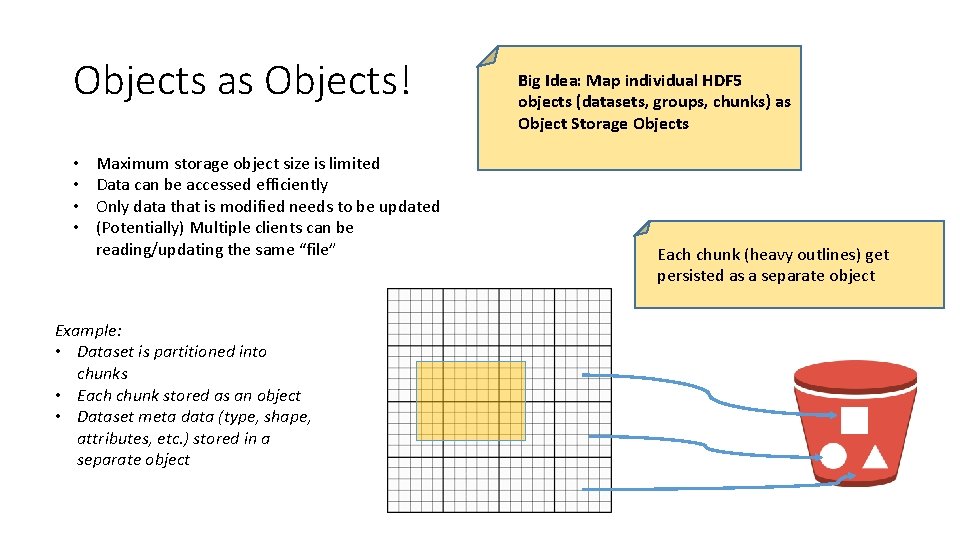
Objects as Objects! • • Maximum storage object size is limited Data can be accessed efficiently Only data that is modified needs to be updated (Potentially) Multiple clients can be reading/updating the same “file” Example: • Dataset is partitioned into chunks • Each chunk stored as an object • Dataset meta data (type, shape, attributes, etc. ) stored in a separate object Big Idea: Map individual HDF 5 objects (datasets, groups, chunks) as Object Storage Objects Each chunk (heavy outlines) get persisted as a separate object
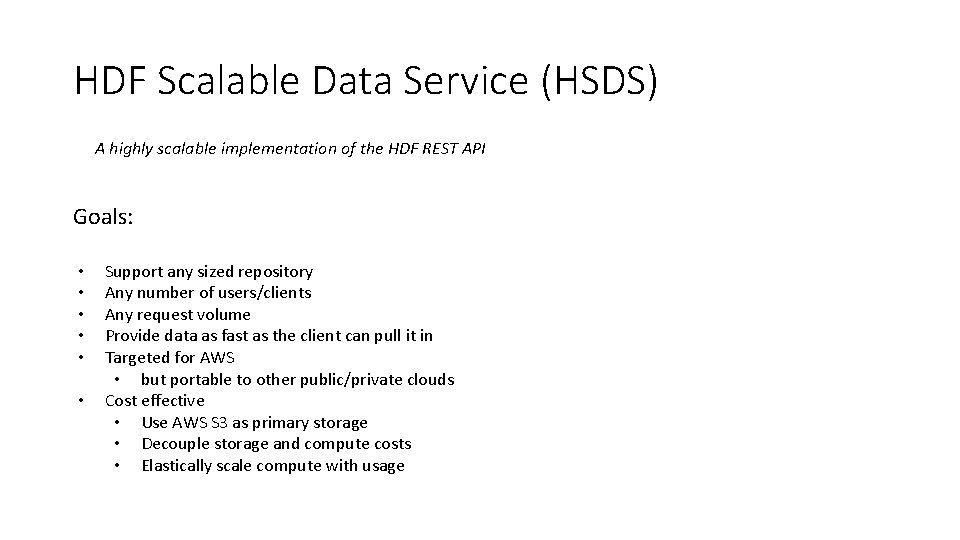
HDF Scalable Data Service (HSDS) A highly scalable implementation of the HDF REST API Goals: • • • Support any sized repository Any number of users/clients Any request volume Provide data as fast as the client can pull it in Targeted for AWS • but portable to other public/private clouds Cost effective • Use AWS S 3 as primary storage • Decouple storage and compute costs • Elastically scale compute with usage
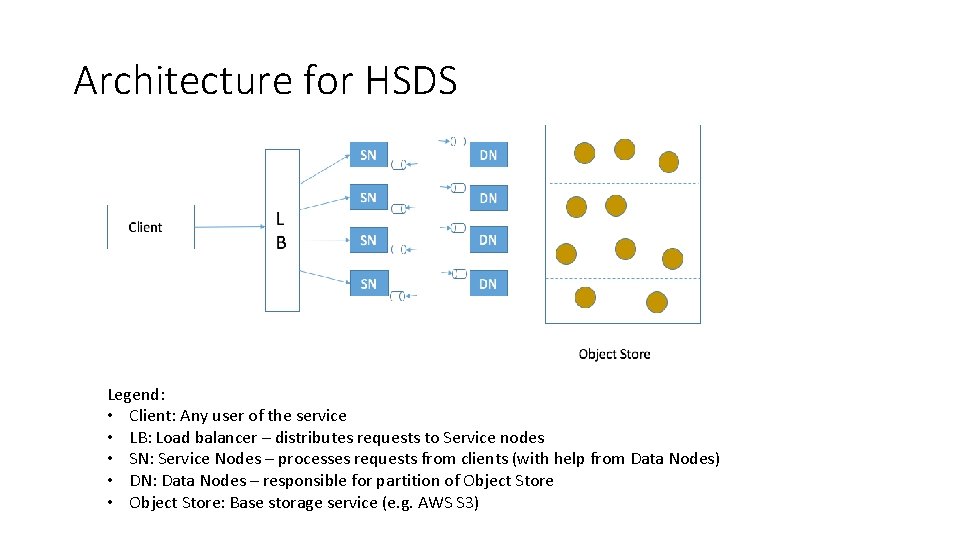
Architecture for HSDS Legend: • Client: Any user of the service • LB: Load balancer – distributes requests to Service nodes • SN: Service Nodes – processes requests from clients (with help from Data Nodes) • DN: Data Nodes – responsible for partition of Object Store • Object Store: Base storage service (e. g. AWS S 3)
HSDS Architecture Highlights • DN’s provide read/write consistent layer on top of AWS S 3 • DN’s also serve as data cache (improve performance and lower S 3 request cost) • SN’s deterministically know which DN’s are needed to server a given request • Number of DN’s/SN’s can grow or shrink depending on demand • Minimal operational costs would be 1 SN, 1 DN and data storage costs for S 3 • Query operations can run across all data nodes in parallel
HSDS Timeline and next steps • Work just started July 1, 2016 • This work is being supported by NASA Cooperative Agreement NNX 16 AL 91 A • Working with NASA Open. NEX team • Also included client components: • HDF REST VOL • H 5 pyd • CMD line tools • Scope of project is for the next two years, but hoping to have prototype available sooner • Would love feedback on design, use cases, or additional features you’d like to see
To Find out More: H 5 serv: https: //github. com/HDFGroup/h 5 serv Documentation: http: //h 5 serv. readthedocs. io/ H 5 pyd: https: //github. com/HDFGroup/h 5 pyd RESTful HDF 5 White Paper: https: //www. hdfgroup. org/pubs/papers/RESTful_HDF 5. pdf • Open. Nex: https: //nex. nasa. gov/nex/static/htdocs/site/extra/opennex/ • Blog articles: • https: //hdfgroup. org/wp/2015/04/hdf 5 -for-the-web-hdf-server/ • https: //hdfgroup. org/wp/2015/12/serve-protect-web-security-hdf 5/ • •