
HD 372 Compressor This presentation is a simplified

- Slides: 64
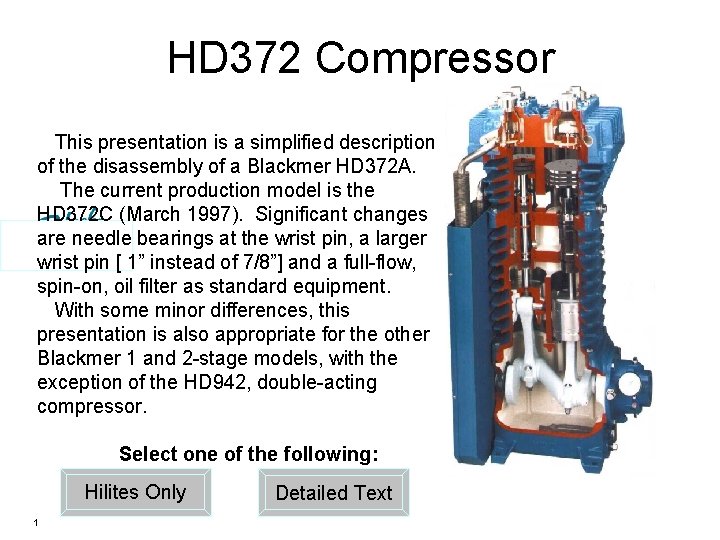
HD 372 Compressor This presentation is a simplified description of the disassembly of a Blackmer HD 372 A. The current production model is the HD 372 C (March 1997). Significant changes are needle bearings at the wrist pin, a larger wrist pin [ 1” instead of 7/8”] and a full-flow, spin-on, oil filter as standard equipment. With some minor differences, this presentation is also appropriate for the other Blackmer 1 and 2 -stage models, with the exception of the HD 942, double-acting compressor. Select one of the following: Hilites Only 1 Detailed Text
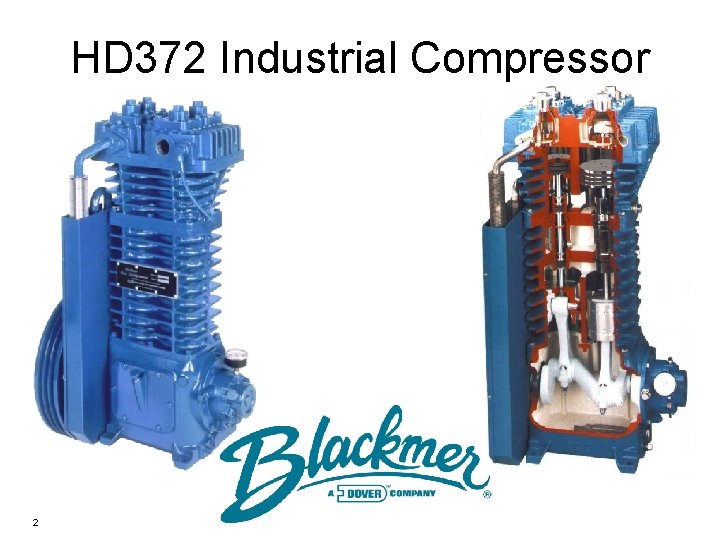
HD 372 Industrial Compressor 2
LITERATURE Have the literature for your machine at hand • Parts lists • Installation, Operation and Maintenance manual Call your Blackmer distributor for literature 3
LITERATURE Be sure that you have the literature you require before starting to work on the compressor. Locate the parts list and Installation, Operation and Maintenance instructions. In addition, you may have received additional instruction sheets with your machine that further describe such items as valves and packing. If you do not have all of the necessary information, call your Blackmer distributor. 4
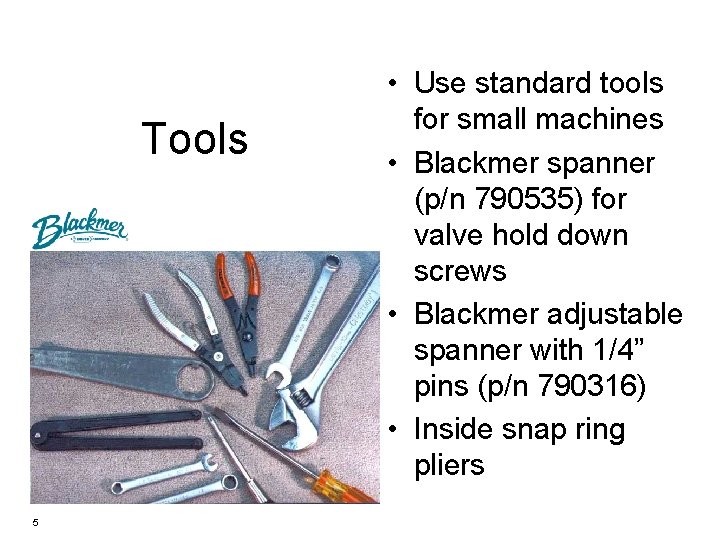
Tools 5 • Use standard tools for small machines • Blackmer spanner (p/n 790535) for valve hold down screws • Blackmer adjustable spanner with 1/4” pins (p/n 790316) • Inside snap ring pliers
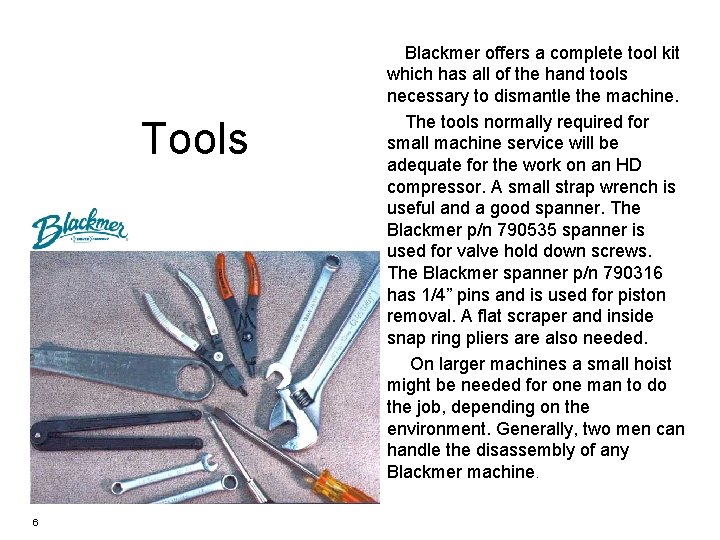
Tools 6 Blackmer offers a complete tool kit which has all of the hand tools necessary to dismantle the machine. The tools normally required for small machine service will be adequate for the work on an HD compressor. A small strap wrench is useful and a good spanner. The Blackmer p/n 790535 spanner is used for valve hold down screws. The Blackmer spanner p/n 790316 has 1/4” pins and is used for piston removal. A flat scraper and inside snap ring pliers are also needed. On larger machines a small hoist might be needed for one man to do the job, depending on the environment. Generally, two men can handle the disassembly of any Blackmer machine.
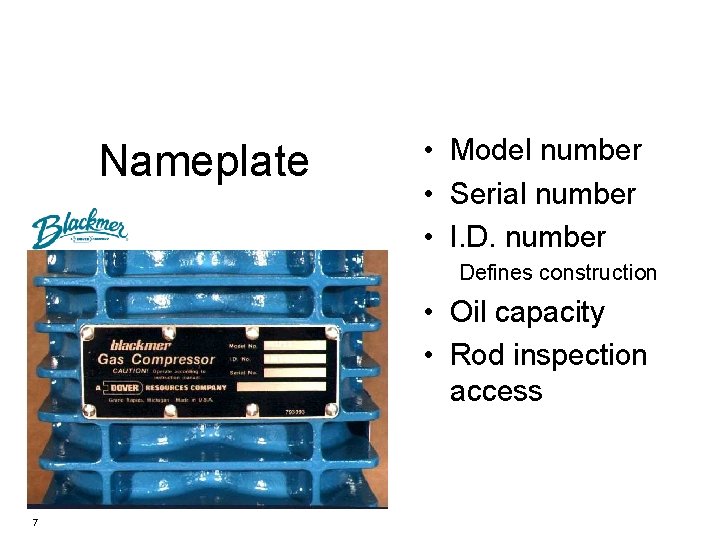
Nameplate • Model number • Serial number • I. D. number Defines construction • Oil capacity • Rod inspection access 7
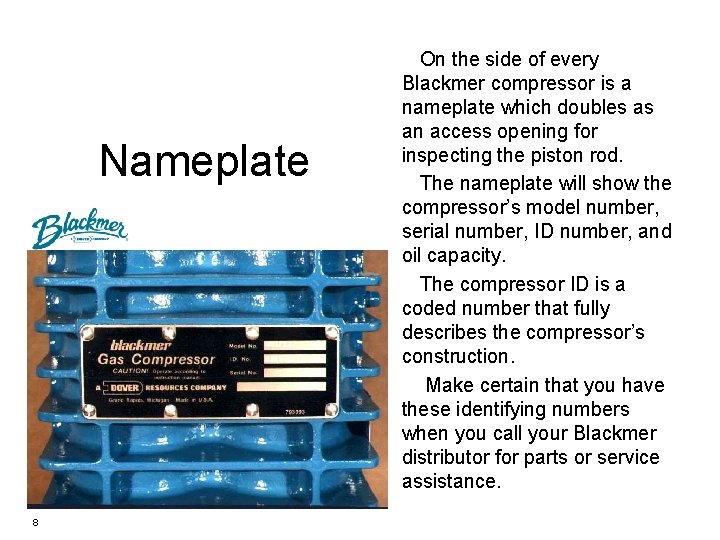
Nameplate 8 On the side of every Blackmer compressor is a nameplate which doubles as an access opening for inspecting the piston rod. The nameplate will show the compressor’s model number, serial number, ID number, and oil capacity. The compressor ID is a coded number that fully describes the compressor’s construction. Make certain that you have these identifying numbers when you call your Blackmer distributor for parts or service assistance.
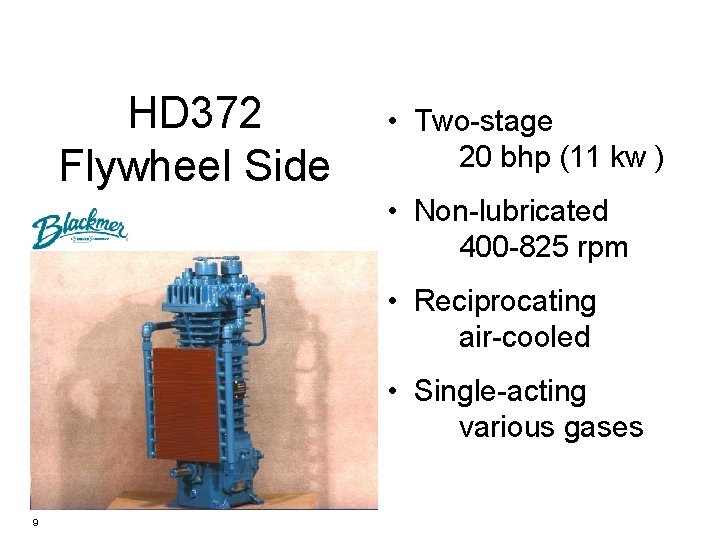
HD 372 Flywheel Side • Two-stage 20 bhp (11 kw ) • Non-lubricated 400 -825 rpm • Reciprocating air-cooled • Single-acting various gases 9
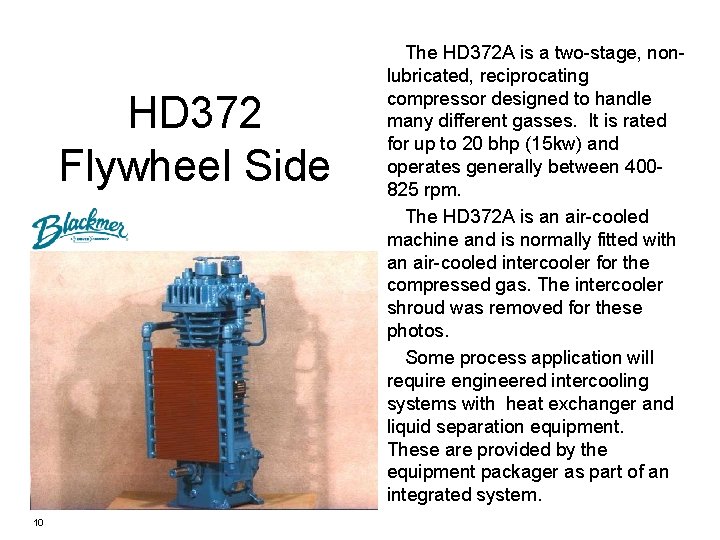
HD 372 Flywheel Side 10 The HD 372 A is a two-stage, nonlubricated, reciprocating compressor designed to handle many different gasses. It is rated for up to 20 bhp (15 kw) and operates generally between 400825 rpm. The HD 372 A is an air-cooled machine and is normally fitted with an air-cooled intercooler for the compressed gas. The intercooler shroud was removed for these photos. Some process application will require engineered intercooling systems with heat exchanger and liquid separation equipment. These are provided by the equipment packager as part of an integrated system.
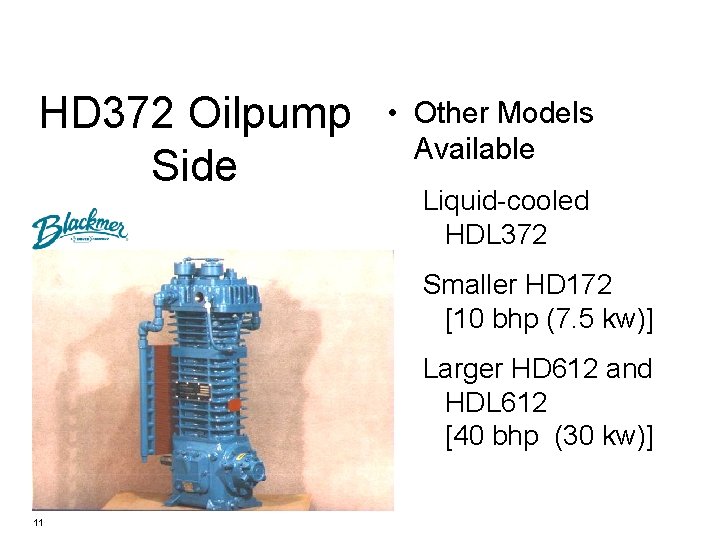
HD 372 Oilpump Side • Other Models Available Liquid-cooled HDL 372 Smaller HD 172 [10 bhp (7. 5 kw)] Larger HD 612 and HDL 612 [40 bhp (30 kw)] 11
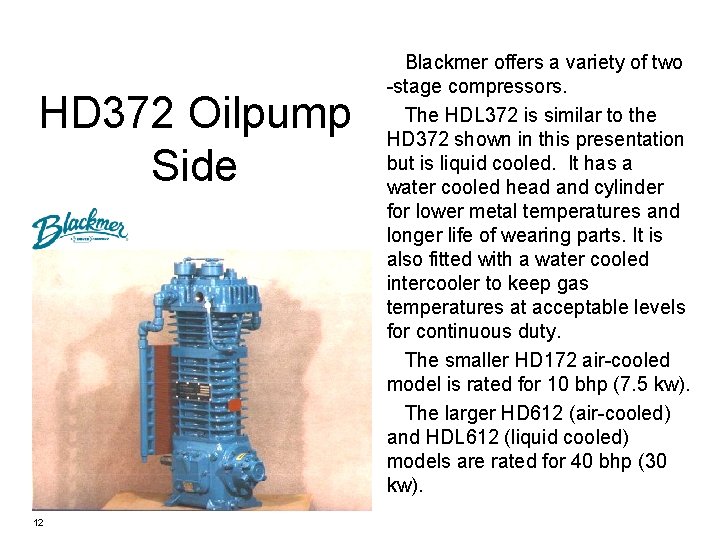
HD 372 Oilpump Side 12 Blackmer offers a variety of two -stage compressors. The HDL 372 is similar to the HD 372 shown in this presentation but is liquid cooled. It has a water cooled head and cylinder for lower metal temperatures and longer life of wearing parts. It is also fitted with a water cooled intercooler to keep gas temperatures at acceptable levels for continuous duty. The smaller HD 172 air-cooled model is rated for 10 bhp (7. 5 kw). The larger HD 612 (air-cooled) and HDL 612 (liquid cooled) models are rated for 40 bhp (30 kw).
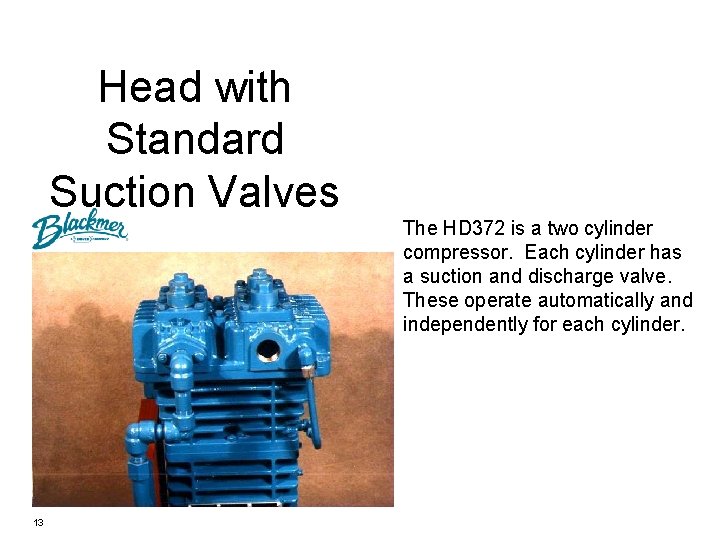
Head with Standard Suction Valves The HD 372 is a two cylinder compressor. Each cylinder has a suction and discharge valve. These operate automatically and independently for each cylinder. 13
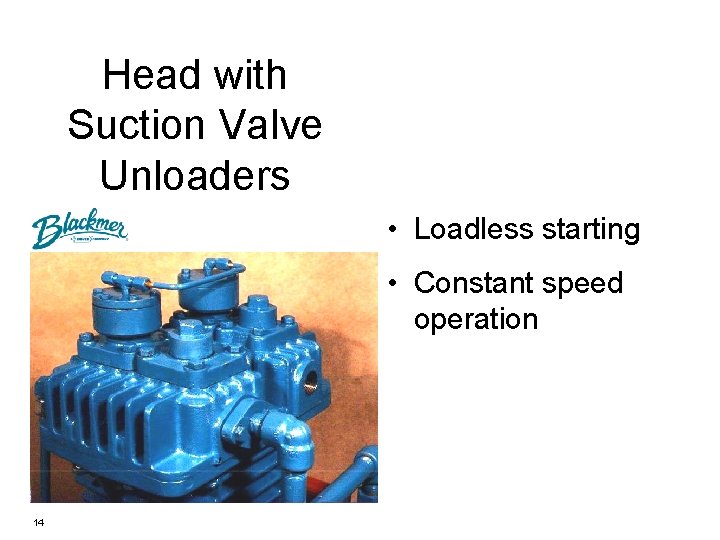
Head with Suction Valve Unloaders • Loadless starting • Constant speed operation 14
Head with Suction Valve Unloaders 15 Optional suction valve unloaders allow the compressor to be deactivated in service. That is, gas that is drawn into the cylinder during the suction stroke is expelled through the suction valve on the discharge stroke and does not pas through the machine into the discharge line. This is accomplished by holding the compressor suction valve plates open throughout the full cycle. The unloader mechanism does this mechanically and can be powered by compressed gas from the discharge storage or an independent source, as required. The suction valves can be unloaded to produce no-load starts or reduced capacity operation on demand.
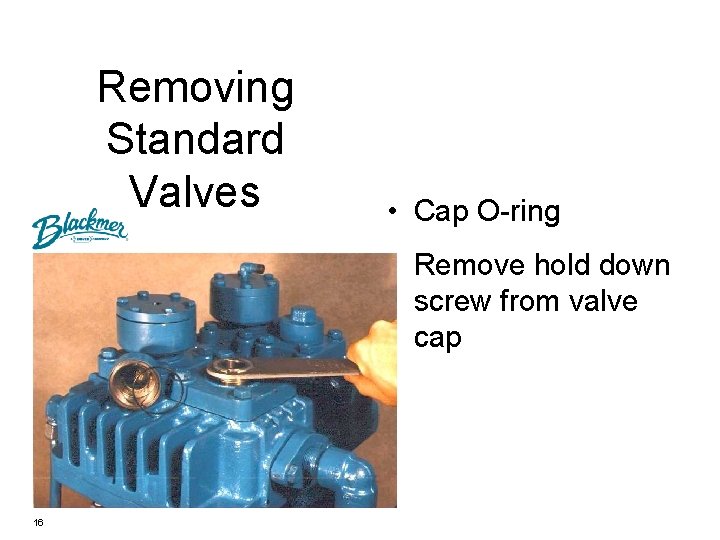
Removing Standard Valves • Cap O-ring • Remove hold down screw from valve cap 16
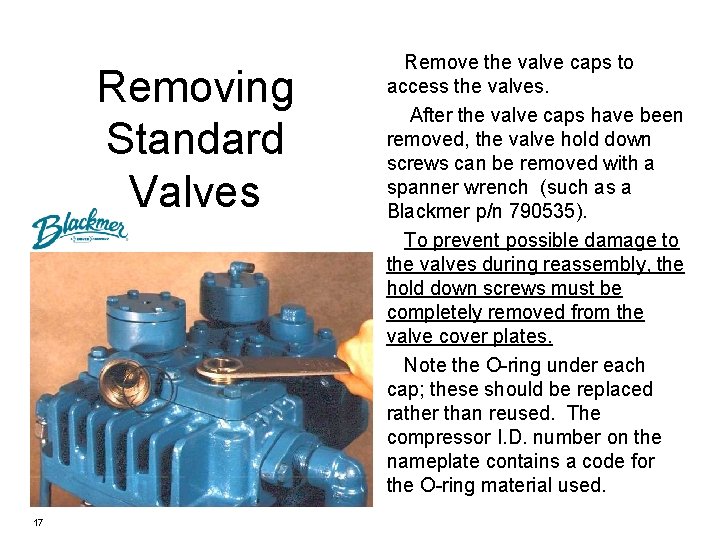
Removing Standard Valves 17 Remove the valve caps to access the valves. After the valve caps have been removed, the valve hold down screws can be removed with a spanner wrench (such as a Blackmer p/n 790535). To prevent possible damage to the valves during reassembly, the hold down screws must be completely removed from the valve cover plates. Note the O-ring under each cap; these should be replaced rather than reused. The compressor I. D. number on the nameplate contains a code for the O-ring material used.
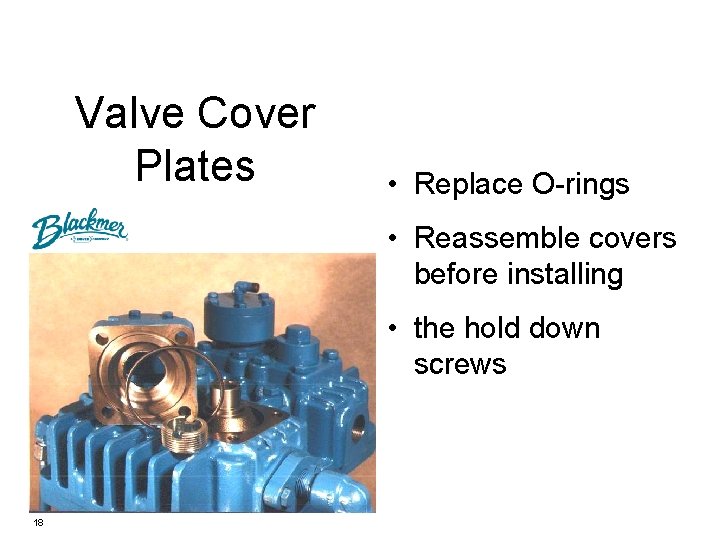
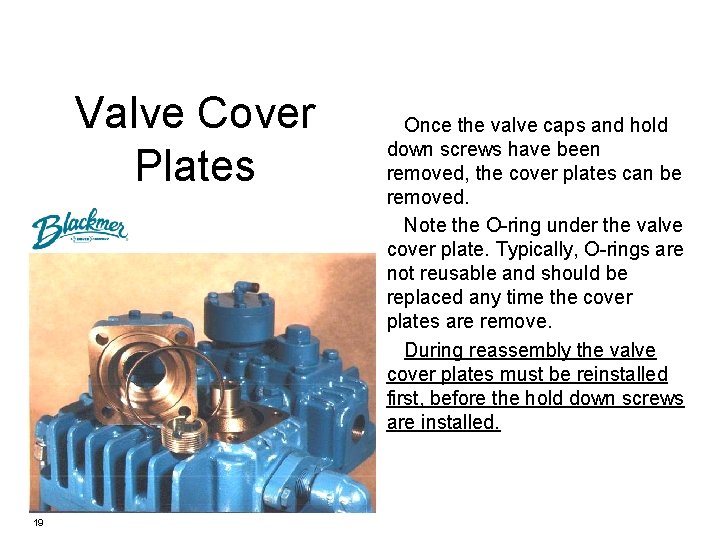
Valve Cover Plates • Replace O-rings • Reassemble covers before installing • the hold down screws 18
Valve Cover Plates 19 Once the valve caps and hold down screws have been removed, the cover plates can be removed. Note the O-ring under the valve cover plate. Typically, O-rings are not reusable and should be replaced any time the cover plates are remove. During reassembly the valve cover plates must be reinstalled first, before the hold down screws are installed.
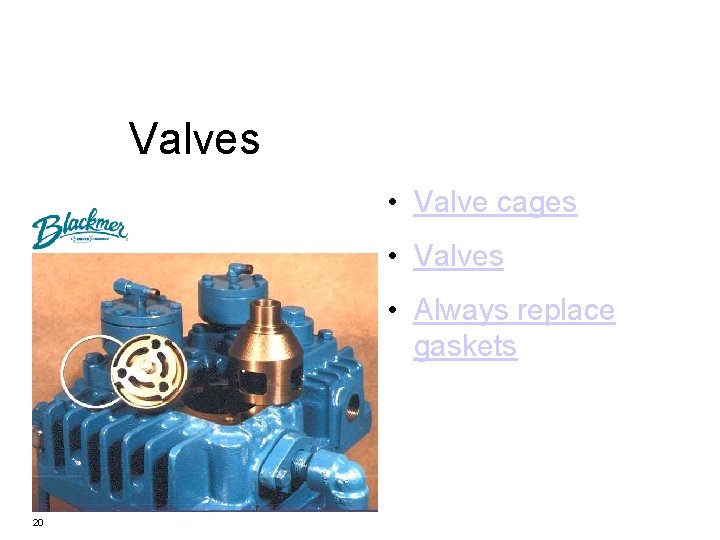
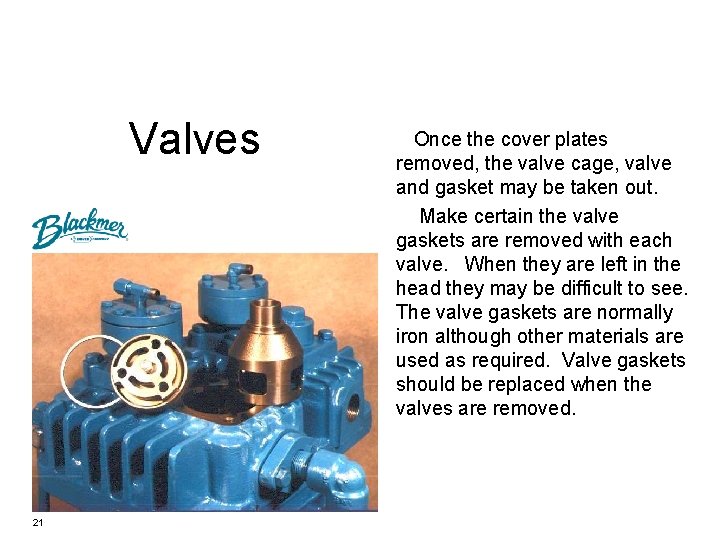
Valves • Valve cages • Valves • Always replace gaskets 20
Valves 21 Once the cover plates removed, the valve cage, valve and gasket may be taken out. Make certain the valve gaskets are removed with each valve. When they are left in the head they may be difficult to see. The valve gaskets are normally iron although other materials are used as required. Valve gaskets should be replaced when the valves are removed.
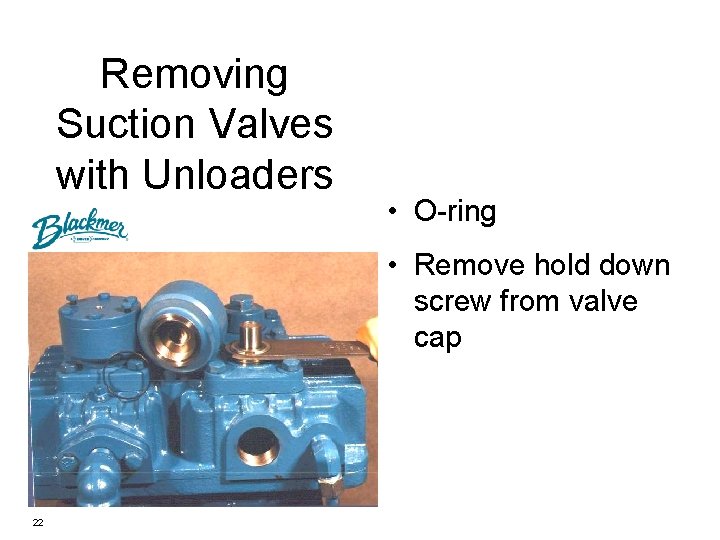
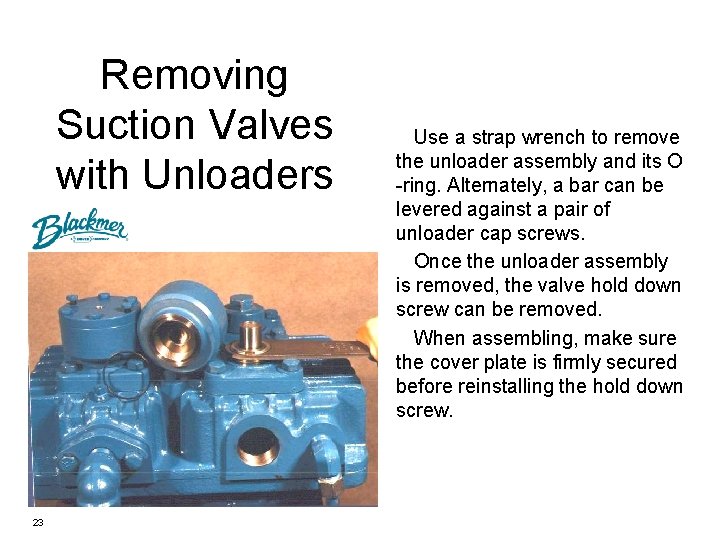
Removing Suction Valves with Unloaders • O-ring • Remove hold down screw from valve cap 22
Removing Suction Valves with Unloaders 23 Use a strap wrench to remove the unloader assembly and its O -ring. Alternately, a bar can be levered against a pair of unloader cap screws. Once the unloader assembly is removed, the valve hold down screw can be removed. When assembling, make sure the cover plate is firmly secured before reinstalling the hold down screw.
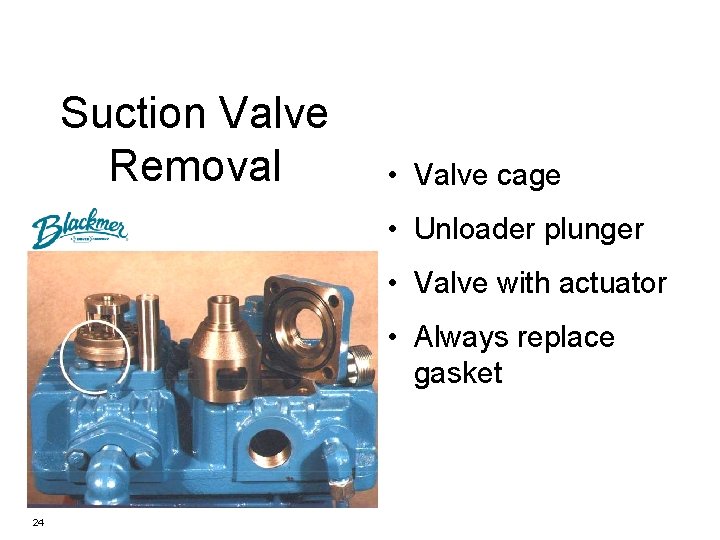
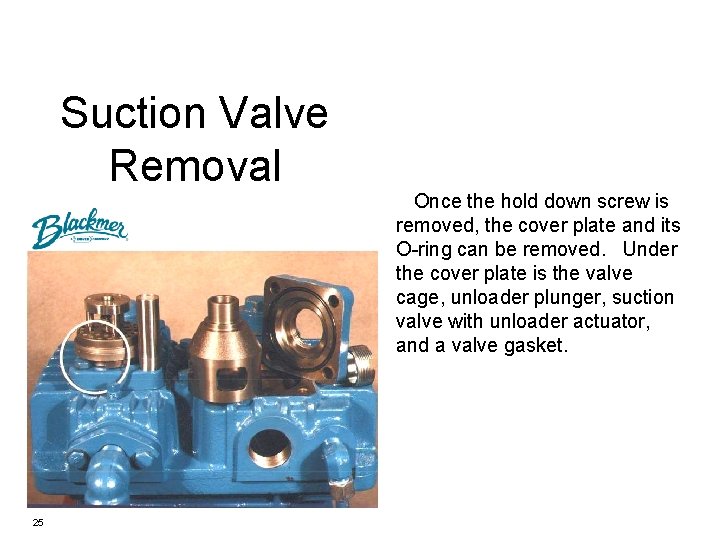
Suction Valve Removal • Valve cage • Unloader plunger • Valve with actuator • Always replace gasket 24
Suction Valve Removal Once the hold down screw is removed, the cover plate and its O-ring can be removed. Under the cover plate is the valve cage, unloader plunger, suction valve with unloader actuator, and a valve gasket. 25
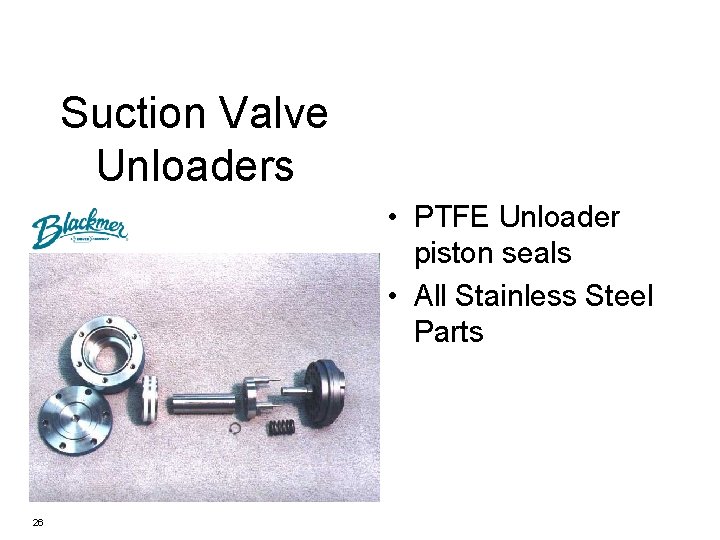
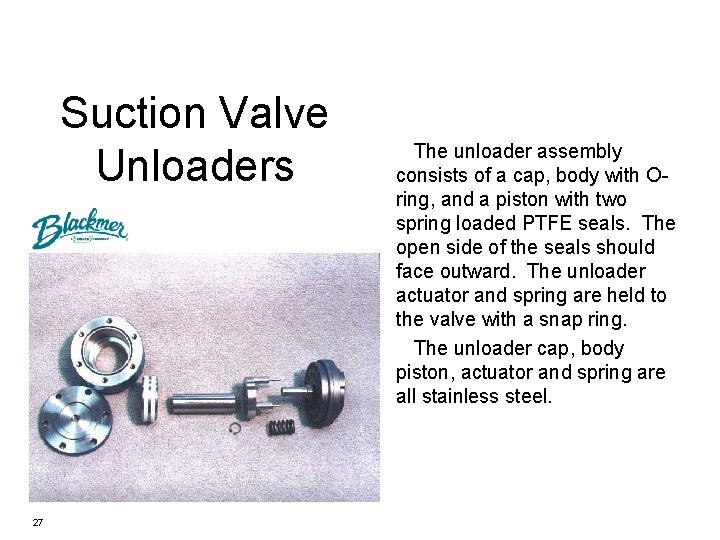
Suction Valve Unloaders • PTFE Unloader piston seals • All Stainless Steel Parts 26
Suction Valve Unloaders 27 The unloader assembly consists of a cap, body with Oring, and a piston with two spring loaded PTFE seals. The open side of the seals should face outward. The unloader actuator and spring are held to the valve with a snap ring. The unloader cap, body piston, actuator and spring are all stainless steel.
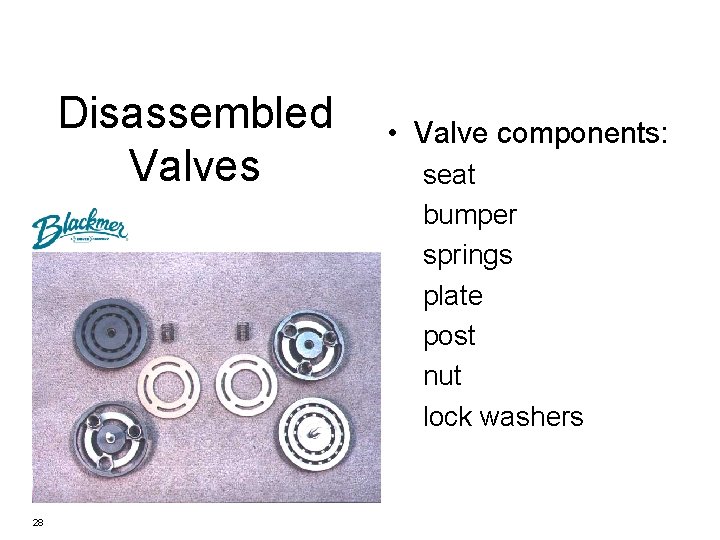
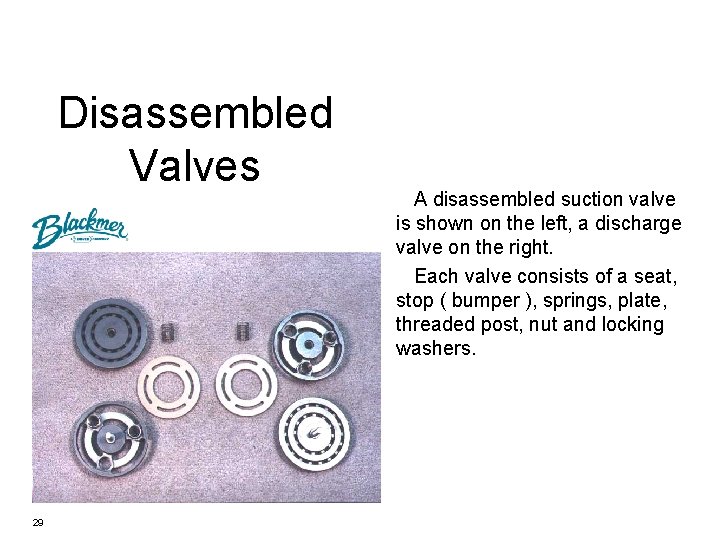
Disassembled Valves 28 • Valve components: seat bumper springs plate post nut lock washers
Disassembled Valves 29 A disassembled suction valve is shown on the left, a discharge valve on the right. Each valve consists of a seat, stop ( bumper ), springs, plate, threaded post, nut and locking washers.
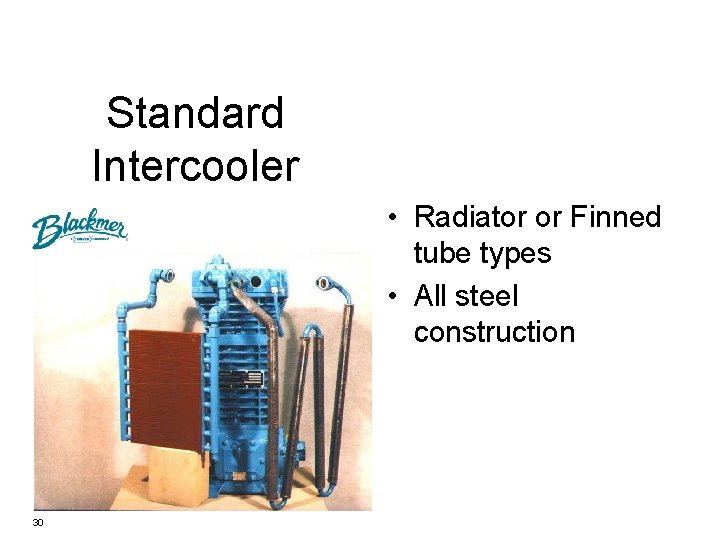
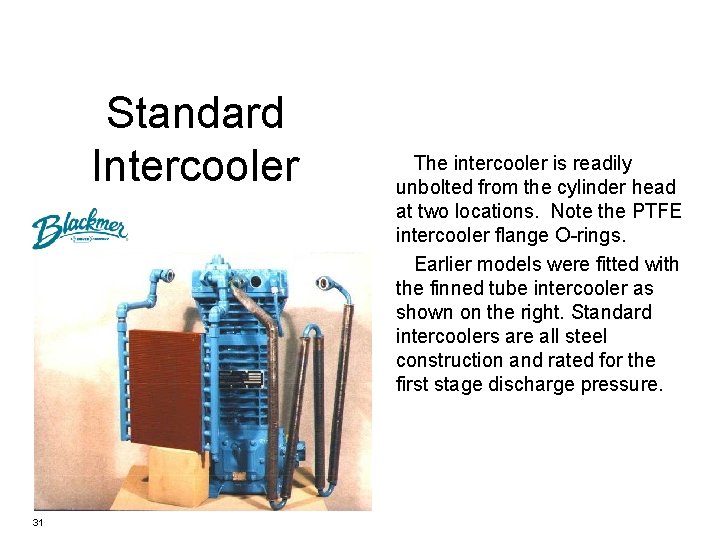
Standard Intercooler • Radiator or Finned tube types • All steel construction 30
Standard Intercooler 31 The intercooler is readily unbolted from the cylinder head at two locations. Note the PTFE intercooler flange O-rings. Earlier models were fitted with the finned tube intercooler as shown on the right. Standard intercoolers are all steel construction and rated for the first stage discharge pressure.
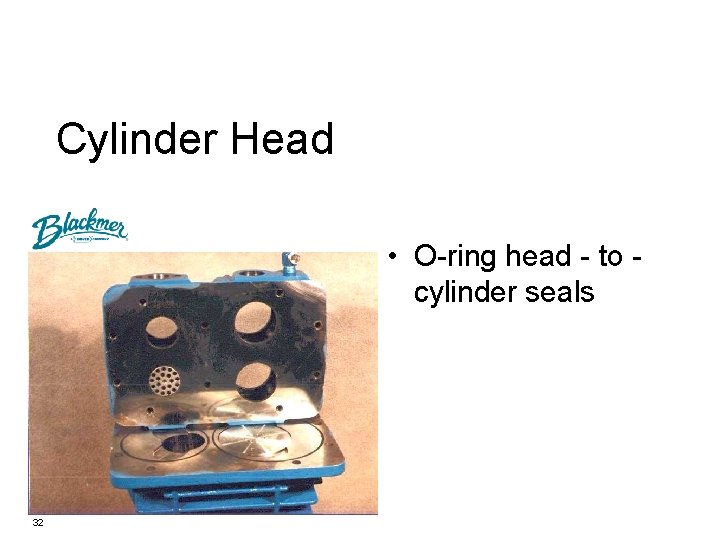
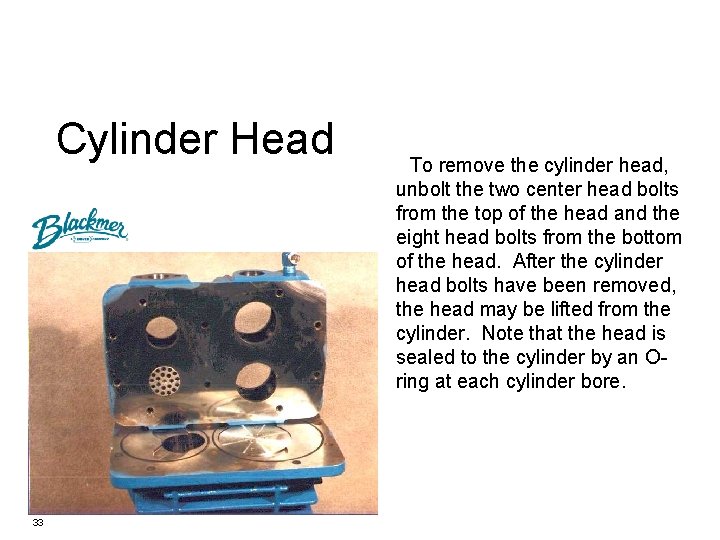
Cylinder Head • O-ring head - to cylinder seals 32
Cylinder Head 33 To remove the cylinder head, unbolt the two center head bolts from the top of the head and the eight head bolts from the bottom of the head. After the cylinder head bolts have been removed, the head may be lifted from the cylinder. Note that the head is sealed to the cylinder by an Oring at each cylinder bore.
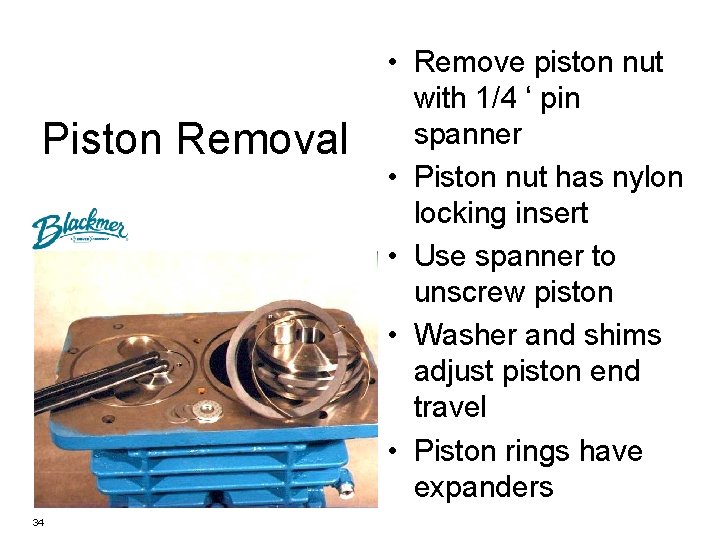
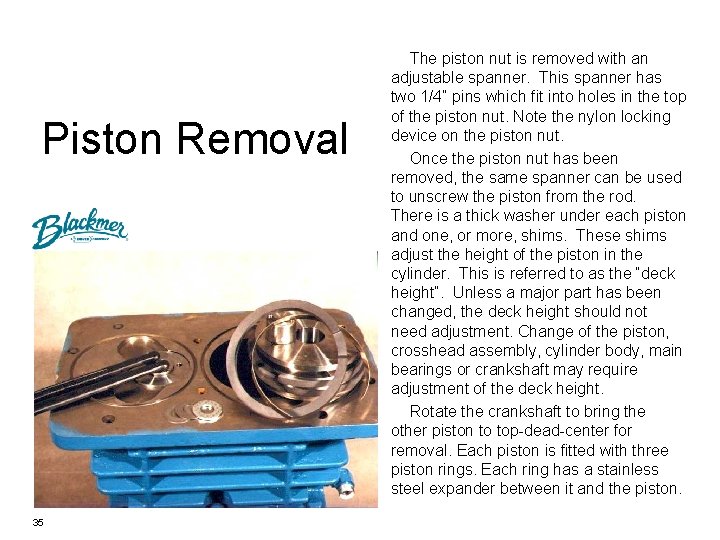
Piston Removal 34 • Remove piston nut with 1/4 ‘ pin spanner • Piston nut has nylon locking insert • Use spanner to unscrew piston • Washer and shims adjust piston end travel • Piston rings have expanders
Piston Removal 35 The piston nut is removed with an adjustable spanner. This spanner has two 1/4” pins which fit into holes in the top of the piston nut. Note the nylon locking device on the piston nut. Once the piston nut has been removed, the same spanner can be used to unscrew the piston from the rod. There is a thick washer under each piston and one, or more, shims. These shims adjust the height of the piston in the cylinder. This is referred to as the “deck height”. Unless a major part has been changed, the deck height should not need adjustment. Change of the piston, crosshead assembly, cylinder body, main bearings or crankshaft may require adjustment of the deck height. Rotate the crankshaft to bring the other piston to top-dead-center for removal. Each piston is fitted with three piston rings. Each ring has a stainless steel expander between it and the piston.
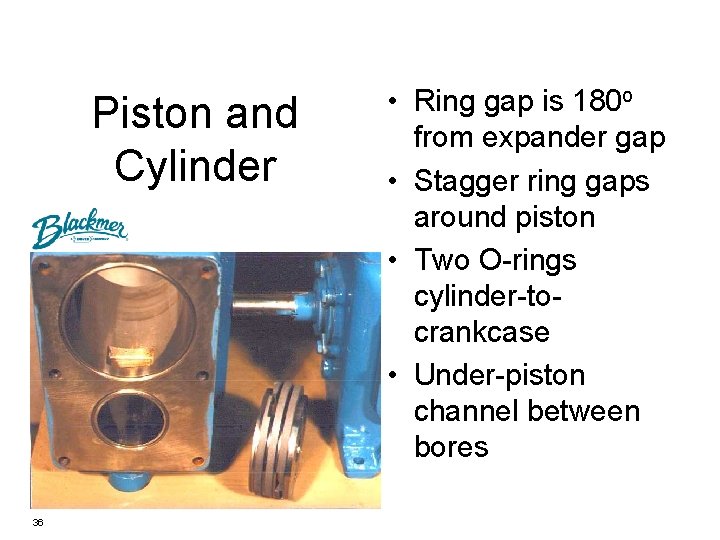
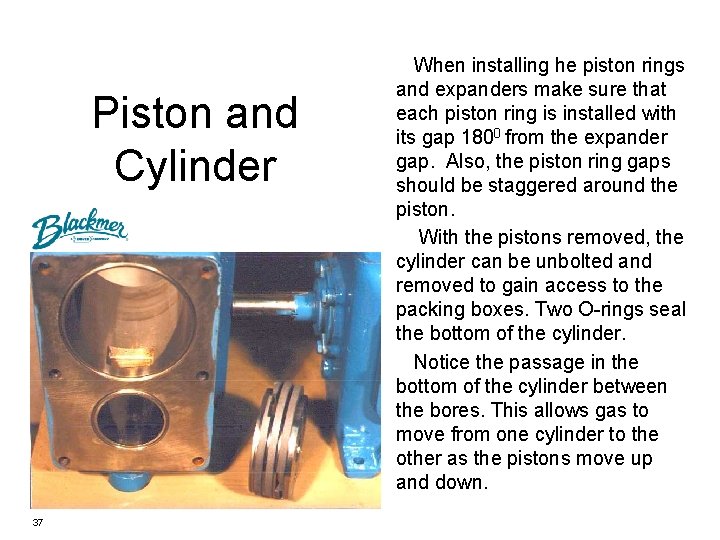
Piston and Cylinder 36 • Ring gap is 180 o from expander gap • Stagger ring gaps around piston • Two O-rings cylinder-tocrankcase • Under-piston channel between bores
Piston and Cylinder 37 When installing he piston rings and expanders make sure that each piston ring is installed with its gap 1800 from the expander gap. Also, the piston ring gaps should be staggered around the piston. With the pistons removed, the cylinder can be unbolted and removed to gain access to the packing boxes. Two O-rings seal the bottom of the cylinder. Notice the passage in the bottom of the cylinder between the bores. This allows gas to move from one cylinder to the other as the pistons move up and down.
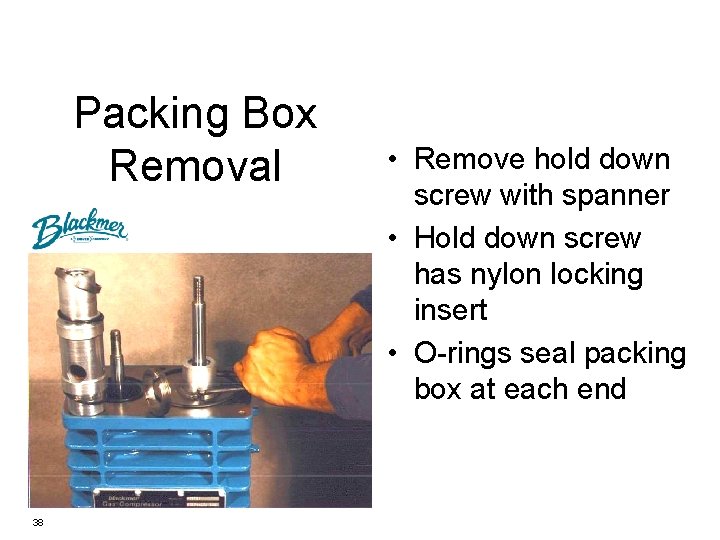
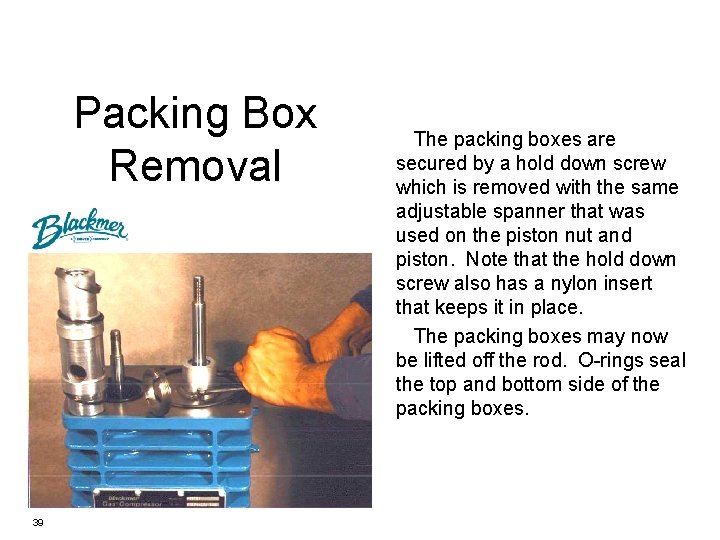
Packing Box Removal 38 • Remove hold down screw with spanner • Hold down screw has nylon locking insert • O-rings seal packing box at each end
Packing Box Removal 39 The packing boxes are secured by a hold down screw which is removed with the same adjustable spanner that was used on the piston nut and piston. Note that the hold down screw also has a nylon insert that keeps it in place. The packing boxes may now be lifted off the rod. O-rings seal the top and bottom side of the packing boxes.
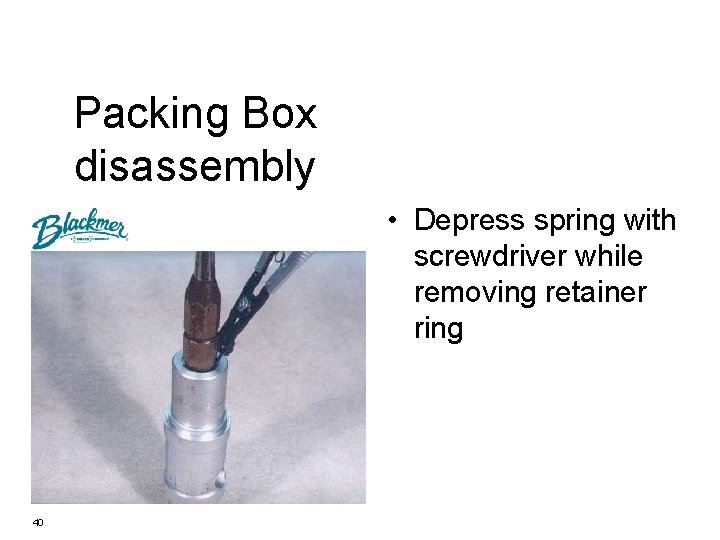
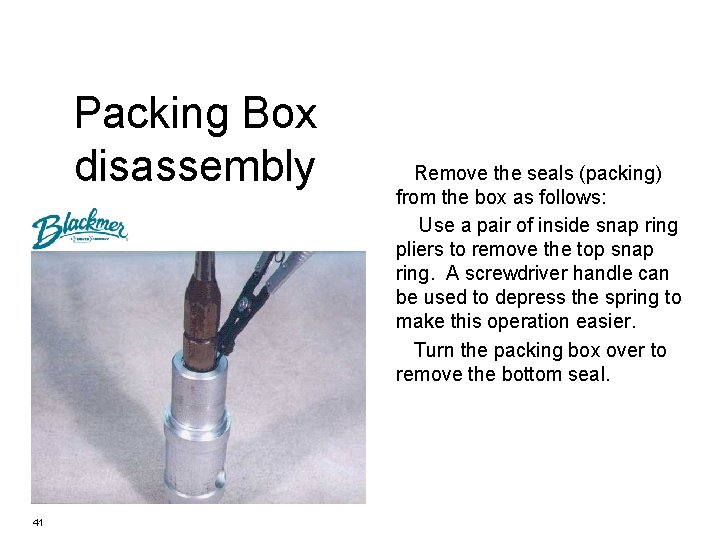
Packing Box disassembly • Depress spring with screwdriver while removing retainer ring 40
Packing Box disassembly 41 Remove the seals (packing) from the box as follows: Use a pair of inside snap ring pliers to remove the top snap ring. A screwdriver handle can be used to depress the spring to make this operation easier. Turn the packing box over to remove the bottom seal.
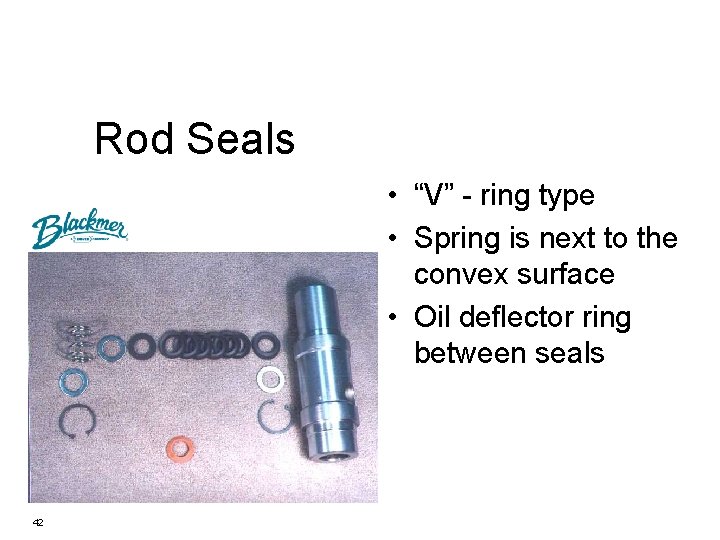
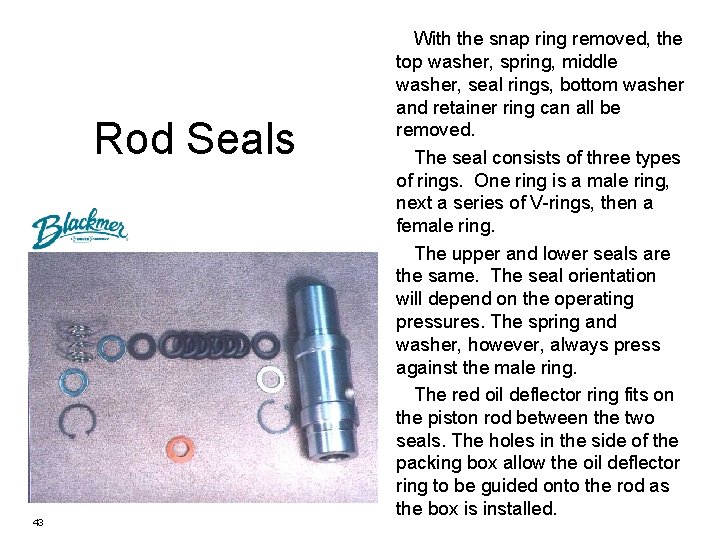
Rod Seals • “V” - ring type • Spring is next to the convex surface • Oil deflector ring between seals 42
Rod Seals 43 With the snap ring removed, the top washer, spring, middle washer, seal rings, bottom washer and retainer ring can all be removed. The seal consists of three types of rings. One ring is a male ring, next a series of V-rings, then a female ring. The upper and lower seals are the same. The seal orientation will depend on the operating pressures. The spring and washer, however, always press against the male ring. The red oil deflector ring fits on the piston rod between the two seals. The holes in the side of the packing box allow the oil deflector ring to be guided onto the rod as the box is installed.
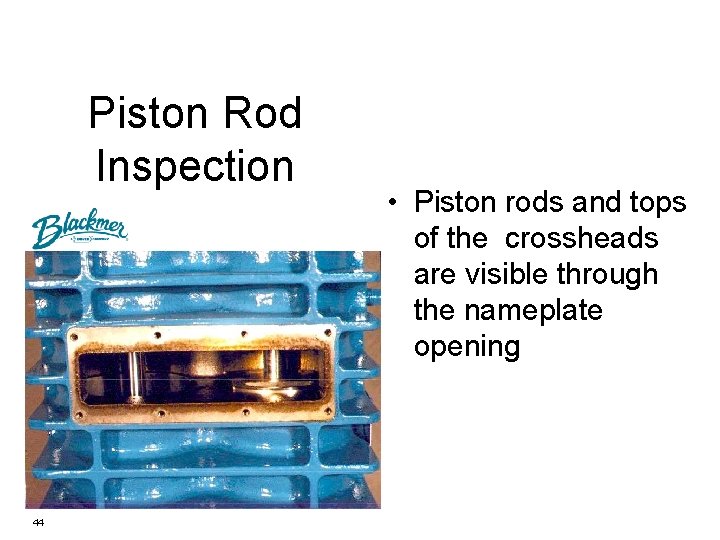
Piston Rod Inspection 44 • Piston rods and tops of the crossheads are visible through the nameplate opening
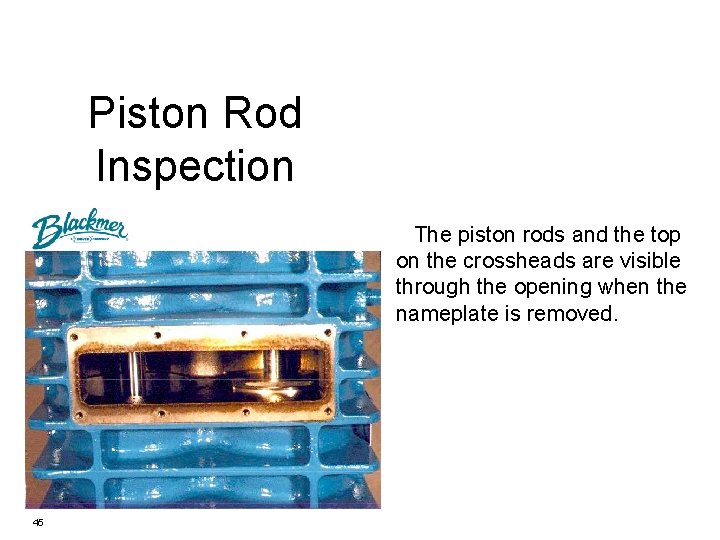
Piston Rod Inspection The piston rods and the top on the crossheads are visible through the opening when the nameplate is removed. 45
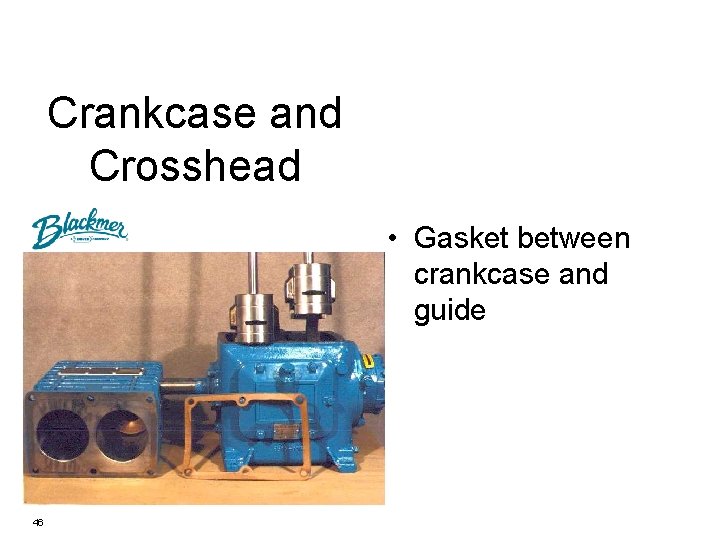
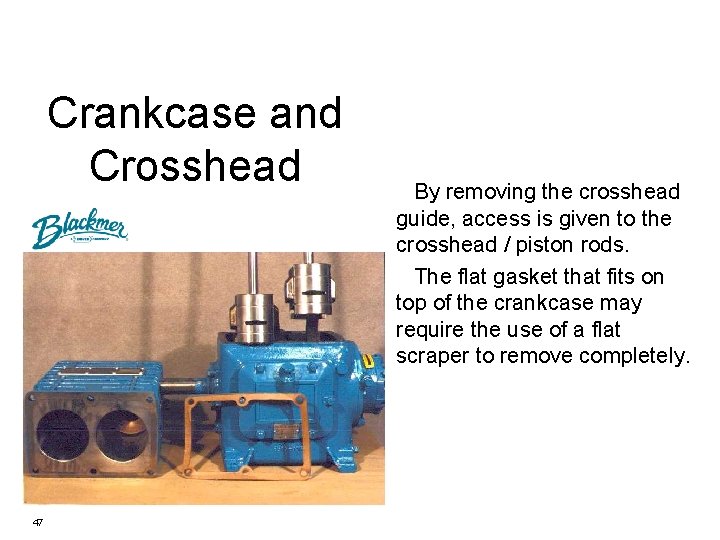
Crankcase and Crosshead • Gasket between crankcase and guide 46
Crankcase and Crosshead 47 By removing the crosshead guide, access is given to the crosshead / piston rods. The flat gasket that fits on top of the crankcase may require the use of a flat scraper to remove completely.
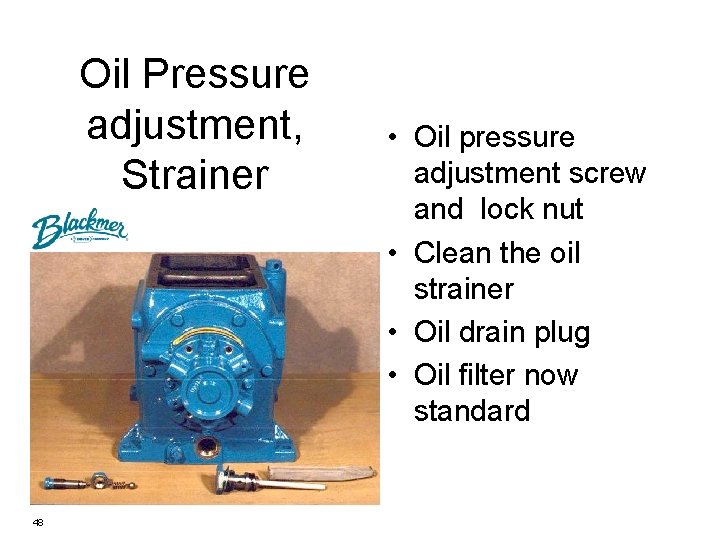
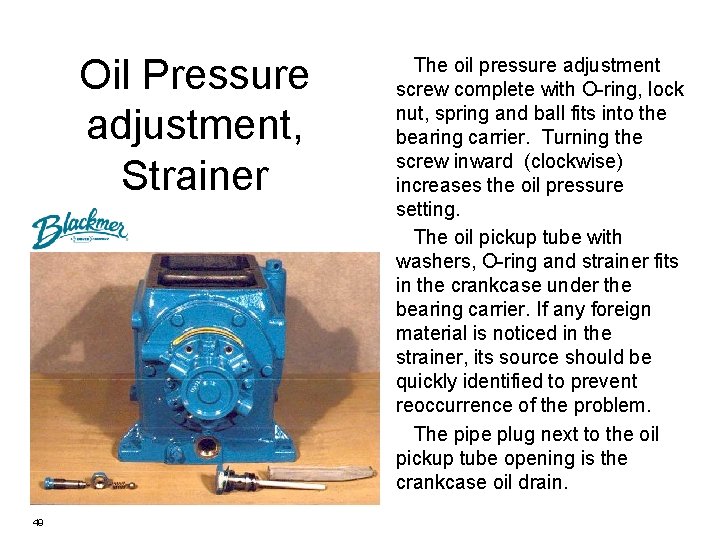
Oil Pressure adjustment, Strainer 48 • Oil pressure adjustment screw and lock nut • Clean the oil strainer • Oil drain plug • Oil filter now standard
Oil Pressure adjustment, Strainer 49 The oil pressure adjustment screw complete with O-ring, lock nut, spring and ball fits into the bearing carrier. Turning the screw inward (clockwise) increases the oil pressure setting. The oil pickup tube with washers, O-ring and strainer fits in the crankcase under the bearing carrier. If any foreign material is noticed in the strainer, its source should be quickly identified to prevent reoccurrence of the problem. The pipe plug next to the oil pickup tube opening is the crankcase oil drain.
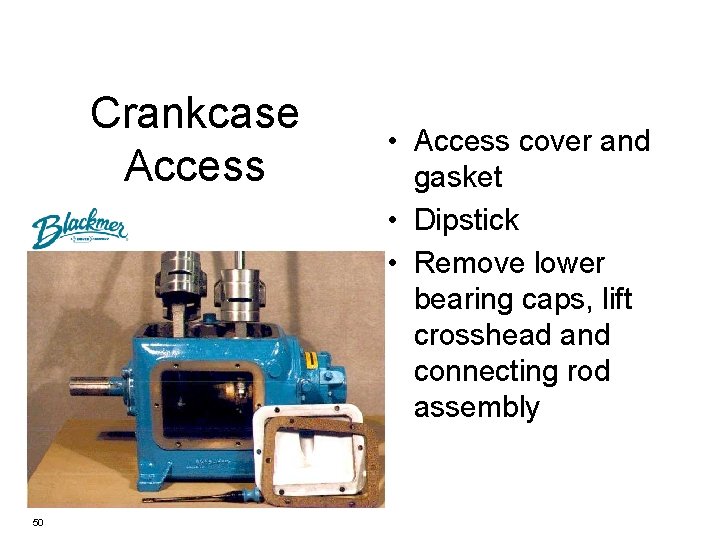
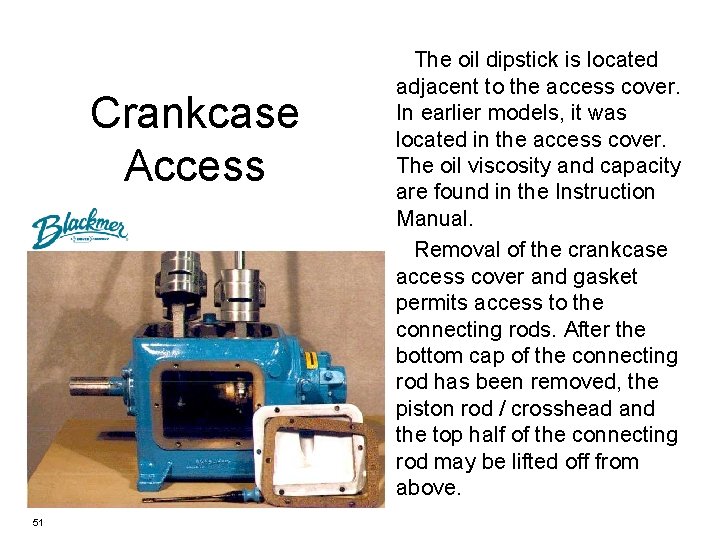
Crankcase Access 50 • Access cover and gasket • Dipstick • Remove lower bearing caps, lift crosshead and connecting rod assembly
Crankcase Access 51 The oil dipstick is located adjacent to the access cover. In earlier models, it was located in the access cover. The oil viscosity and capacity are found in the Instruction Manual. Removal of the crankcase access cover and gasket permits access to the connecting rods. After the bottom cap of the connecting rod has been removed, the piston rod / crosshead and the top half of the connecting rod may be lifted off from above.
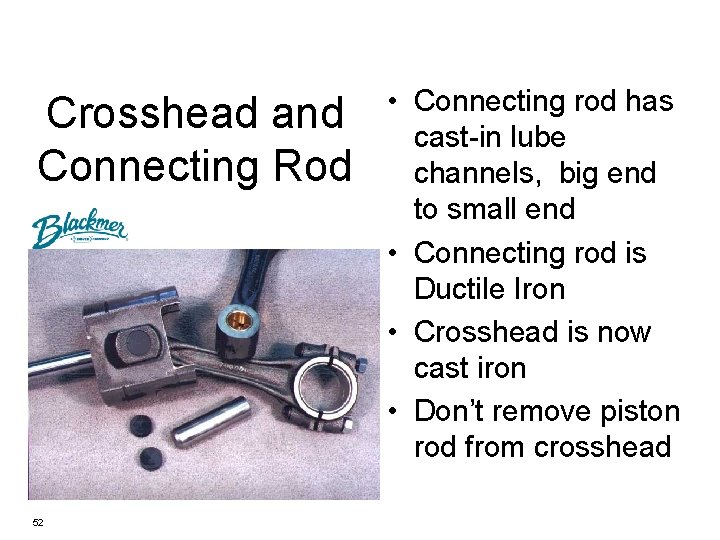
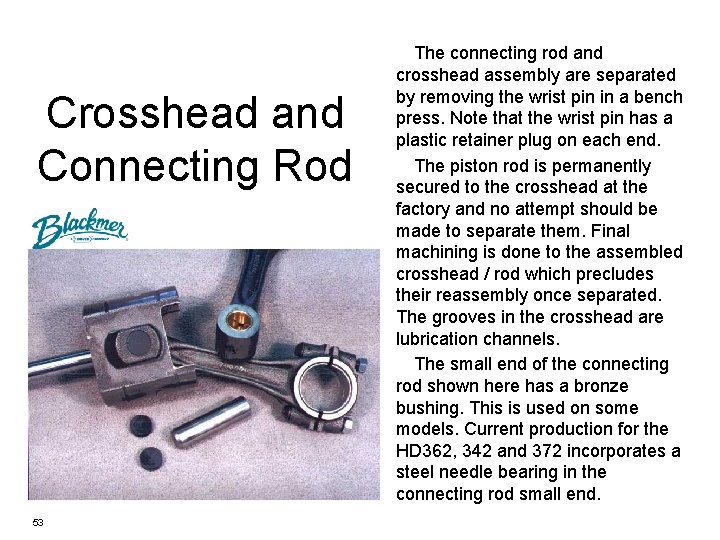
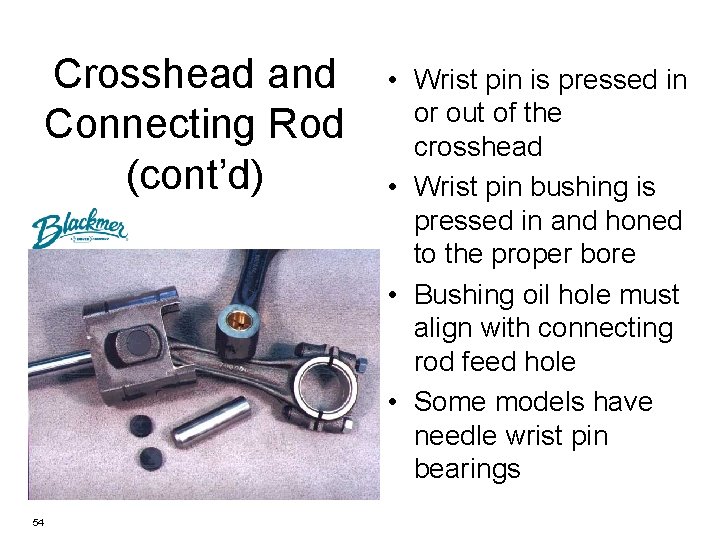
Crosshead and Connecting Rod 52 • Connecting rod has cast-in lube channels, big end to small end • Connecting rod is Ductile Iron • Crosshead is now cast iron • Don’t remove piston rod from crosshead
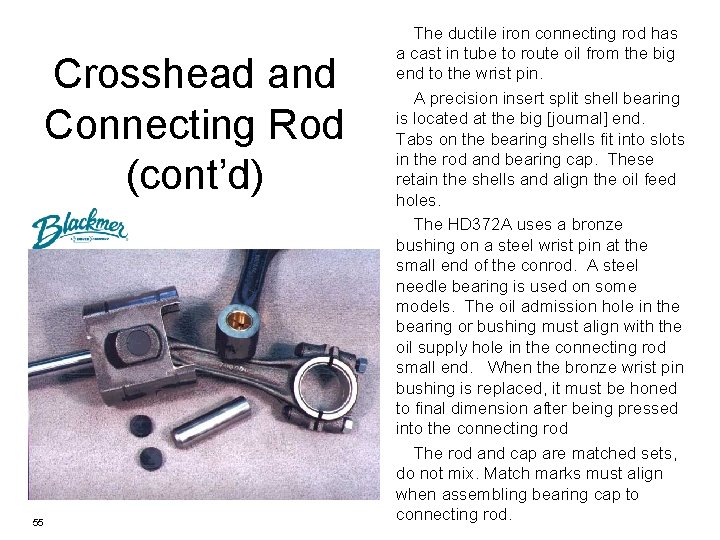
Crosshead and Connecting Rod 53 The connecting rod and crosshead assembly are separated by removing the wrist pin in a bench press. Note that the wrist pin has a plastic retainer plug on each end. The piston rod is permanently secured to the crosshead at the factory and no attempt should be made to separate them. Final machining is done to the assembled crosshead / rod which precludes their reassembly once separated. The grooves in the crosshead are lubrication channels. The small end of the connecting rod shown here has a bronze bushing. This is used on some models. Current production for the HD 362, 342 and 372 incorporates a steel needle bearing in the connecting rod small end.
Crosshead and Connecting Rod (cont’d) 54 • Wrist pin is pressed in or out of the crosshead • Wrist pin bushing is pressed in and honed to the proper bore • Bushing oil hole must align with connecting rod feed hole • Some models have needle wrist pin bearings
Crosshead and Connecting Rod (cont’d) 55 The ductile iron connecting rod has a cast in tube to route oil from the big end to the wrist pin. A precision insert split shell bearing is located at the big [journal] end. Tabs on the bearing shells fit into slots in the rod and bearing cap. These retain the shells and align the oil feed holes. The HD 372 A uses a bronze bushing on a steel wrist pin at the small end of the conrod. A steel needle bearing is used on some models. The oil admission hole in the bearing or bushing must align with the oil supply hole in the connecting rod small end. When the bronze wrist pin bushing is replaced, it must be honed to final dimension after being pressed into the connecting rod The rod and cap are matched sets, do not mix. Match marks must align when assembling bearing cap to connecting rod.
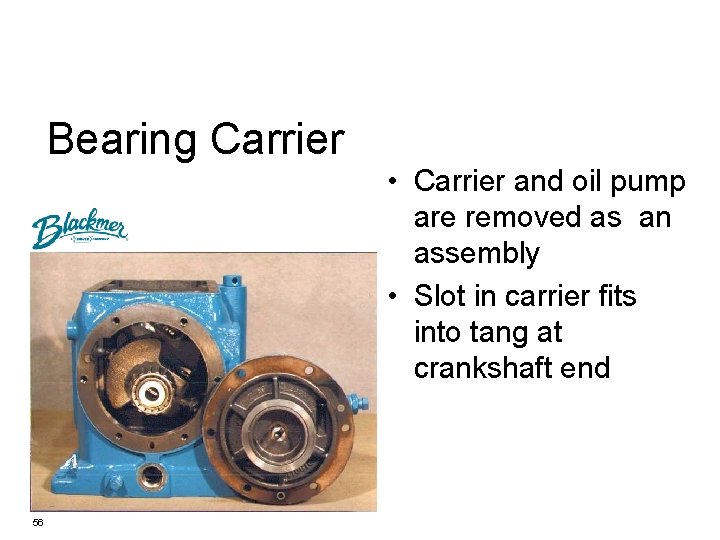
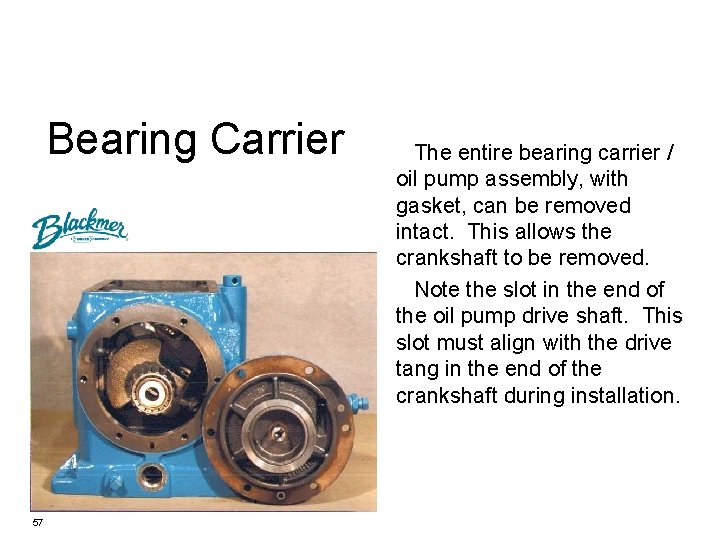
Bearing Carrier 56 • Carrier and oil pump are removed as an assembly • Slot in carrier fits into tang at crankshaft end
Bearing Carrier 57 The entire bearing carrier / oil pump assembly, with gasket, can be removed intact. This allows the crankshaft to be removed. Note the slot in the end of the oil pump drive shaft. This slot must align with the drive tang in the end of the crankshaft during installation.
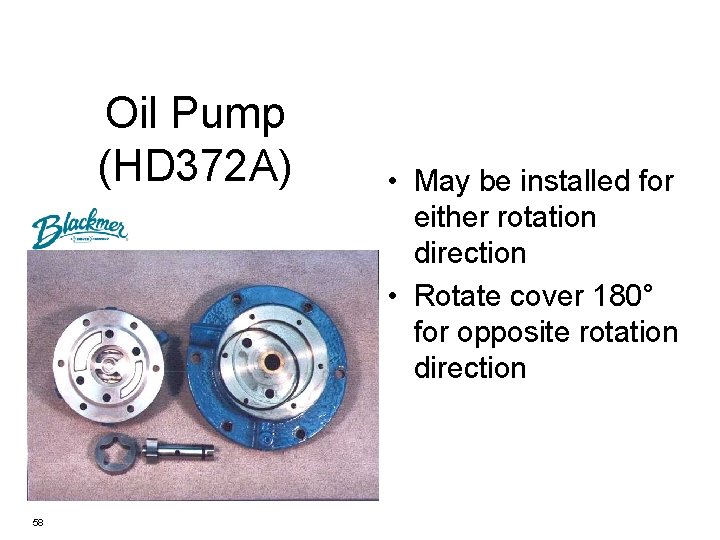
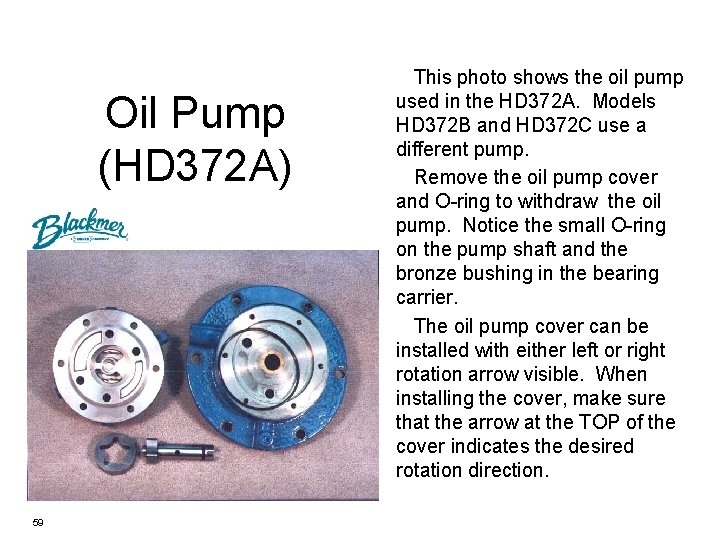
Oil Pump (HD 372 A) 58 • May be installed for either rotation direction • Rotate cover 180° for opposite rotation direction
Oil Pump (HD 372 A) 59 This photo shows the oil pump used in the HD 372 A. Models HD 372 B and HD 372 C use a different pump. Remove the oil pump cover and O-ring to withdraw the oil pump. Notice the small O-ring on the pump shaft and the bronze bushing in the bearing carrier. The oil pump cover can be installed with either left or right rotation arrow visible. When installing the cover, make sure that the arrow at the TOP of the cover indicates the desired rotation direction.
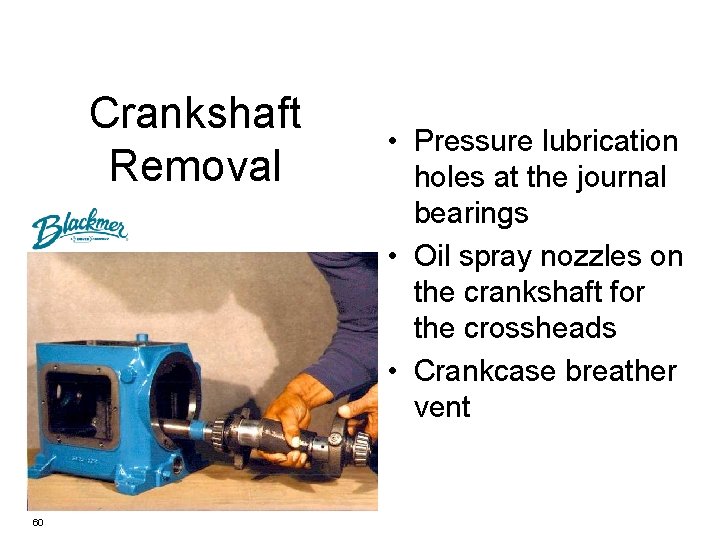
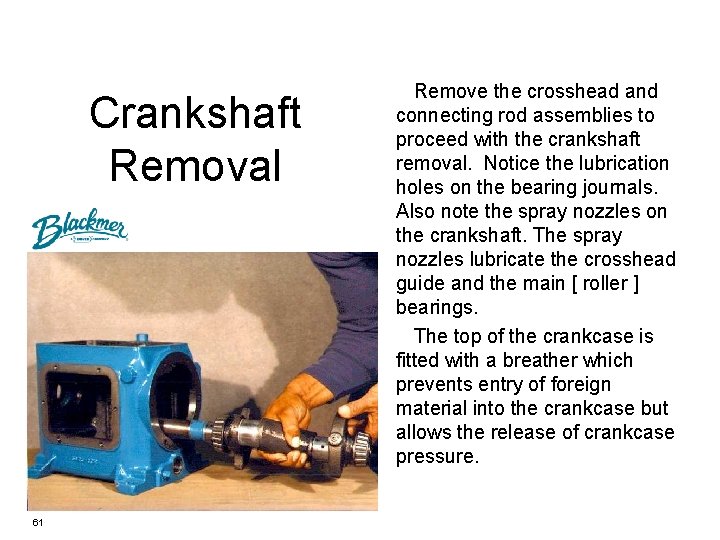
Crankshaft Removal 60 • Pressure lubrication holes at the journal bearings • Oil spray nozzles on the crankshaft for the crossheads • Crankcase breather vent
Crankshaft Removal 61 Remove the crosshead and connecting rod assemblies to proceed with the crankshaft removal. Notice the lubrication holes on the bearing journals. Also note the spray nozzles on the crankshaft. The spray nozzles lubricate the crosshead guide and the main [ roller ] bearings. The top of the crankcase is fitted with a breather which prevents entry of foreign material into the crankcase but allows the release of crankcase pressure.
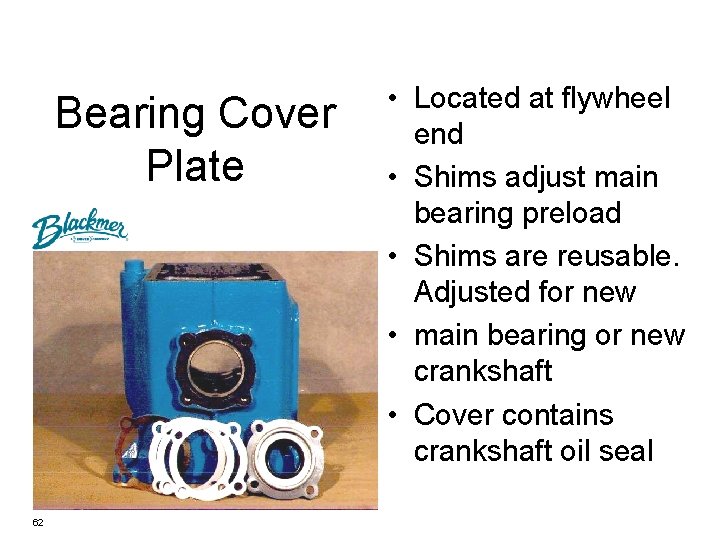
Bearing Cover Plate 62 • Located at flywheel end • Shims adjust main bearing preload • Shims are reusable. Adjusted for new • main bearing or new crankshaft • Cover contains crankshaft oil seal
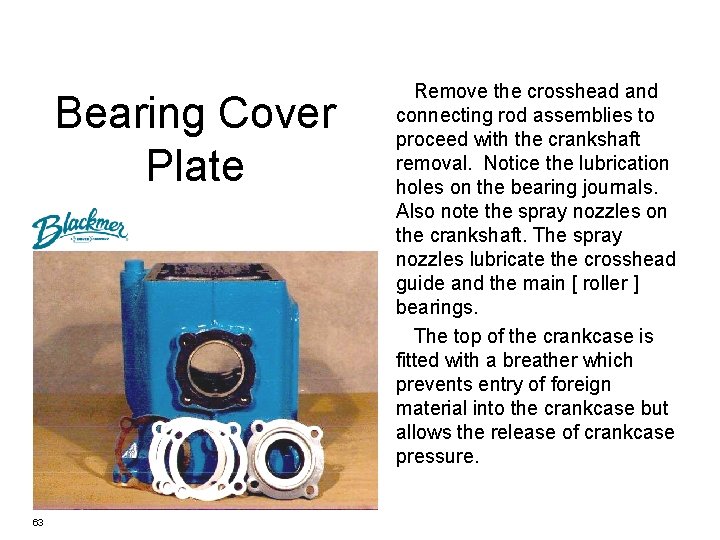
Bearing Cover Plate 63 Remove the crosshead and connecting rod assemblies to proceed with the crankshaft removal. Notice the lubrication holes on the bearing journals. Also note the spray nozzles on the crankshaft. The spray nozzles lubricate the crosshead guide and the main [ roller ] bearings. The top of the crankcase is fitted with a breather which prevents entry of foreign material into the crankcase but allows the release of crankcase pressure.
End of Presentation 1809 Century Avenue Grand Rapids, MI, USA 49503 Ph: 616 -241 -1611 Fax: 616 -241 -3752 www. blackmer. com 64