
HBM 4 EU project Establishing HBM Guidance Values
HBM 4 EU project Establishing HBM Guidance Values (HBM-GV) Concept and additional benefit – here general population Petra Apel 3 rd HBM 4 EU Training School 2019
Overview 1. Current situation – Where do we stand with HBM? 2. HBM-GV derivation - Approach within HBM 4 EU task 5. 2 3. Definition of HBM-GVs 4. Prerequisites and Methodology for deriving HBM-GVs 5. Limitations and Uncertainties – Level of Confidence 6. Benefits of HBM-GVs use 3 rd HBM 4 EU Training School, Brno, June 17 -21, 2019 2

Current situation – Where do we stand with HBM? What do we have? - Growing number of survey data on internal exposures to various chemicals, measured in human blood or urine, integrating all routes of exposure - But mainly guidance values for external exposure via a single path (e. g. TDI) Source: angellodeco / Fotolia. com What do we need Tools and guidance for harmonized and comparable evaluation of internal burden Statistically derived reference values Health-related Human Biomonitoring guidance values Source: www. europakarte. org 3 rd HBM 4 EU Training School, Brno, June 17 -21, 2019 3
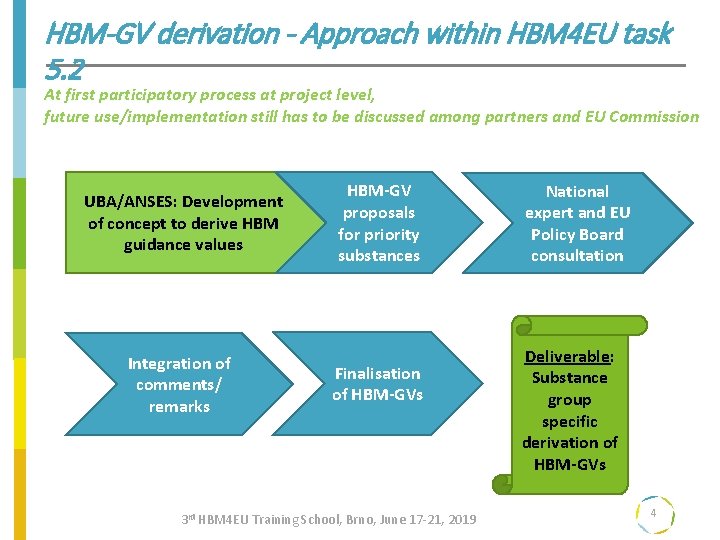
HBM-GV derivation - Approach within HBM 4 EU task 5. 2 At first participatory process at project level, future use/implementation still has to be discussed among partners and EU Commission UBA/ANSES: Development of concept to derive HBM guidance values Integration of comments/ remarks HBM-GV proposals for priority substances Finalisation of HBM-GVs 3 rd HBM 4 EU Training School, Brno, June 17 -21, 2019 National expert and EU Policy Board consultation Deliverable: Substance group specific derivation of HBM-GVs 4

Definition of HBM-GVs HBM-GVGen. Pop Concentration of a substance or its metabolites in human biological material at and below which there is no risk of health impairment anticipated for a lifetime exposure* Not possible for endpoint “sensitization” Not for non-threshold carcinogens - Equates to the HBM-I value of the German Biomonitoring Commission - Functionally similar to the American BE value referring to an existing exposure guidance value HBM-GVWorker Concentration of a substance or its metabolites in human biological material aiming to protect workers exposed regularly and over the course of a working life from the adverse effects related to medium- and long-term exposure* also possible to derive for nonthreshold carcinogens as additional life time risks (10 -4; 10 -5, 10 -6) - Similar to the Biological Limit Value (BLV) from ANSES * based on updated state of knowledge 3 rd HBM 4 EU Training School, Brno, June 17 -21, 2019 5
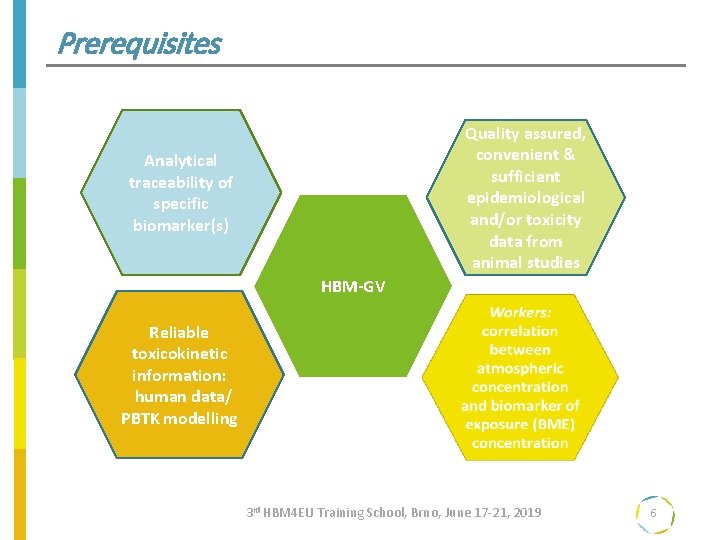
Prerequisites Quality assured, convenient & sufficient epidemiological and/or toxicity data from animal studies Analytical traceability of specific biomarker(s) HBM-GV Reliable toxicokinetic information: human data/ PBTK modelling 3 rd HBM 4 EU Training School, Brno, June 17 -21, 2019 6
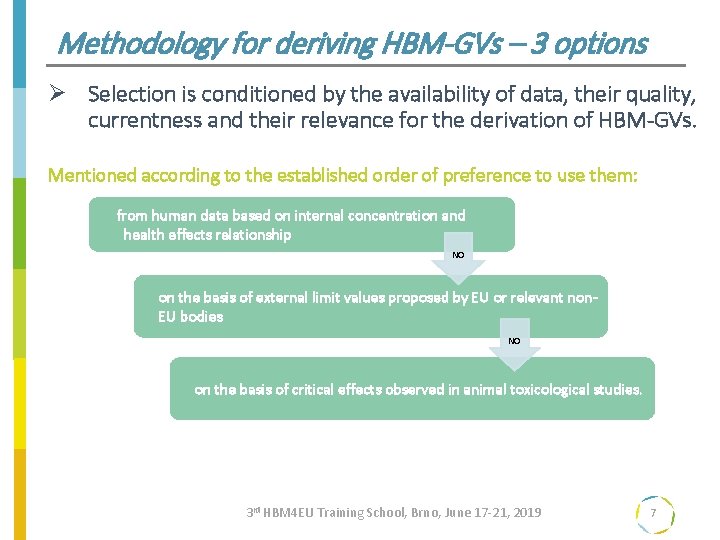
Methodology for deriving HBM-GVs – 3 options Ø Selection is conditioned by the availability of data, their quality, currentness and their relevance for the derivation of HBM-GVs. Mentioned according to the established order of preference to use them: from human data based on internal concentration and health effects relationship NO on the basis of external limit values proposed by EU or relevant non. EU bodies NO on the basis of critical effects observed in animal toxicological studies. 3 rd HBM 4 EU Training School, Brno, June 17 -21, 2019 7
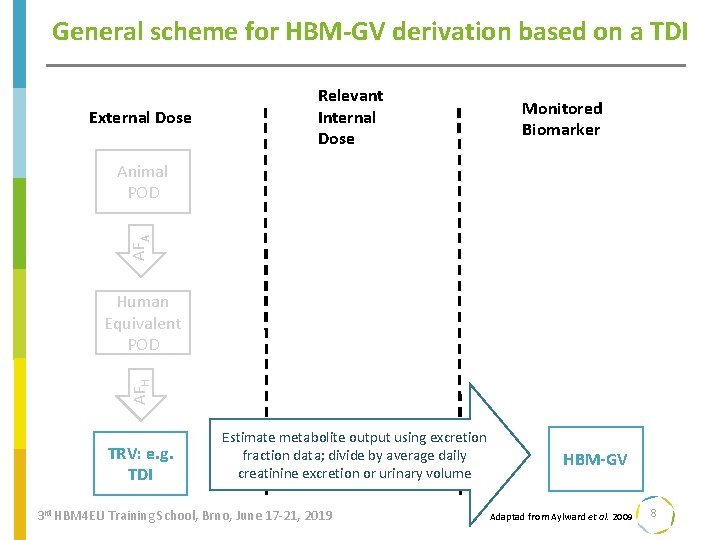
General scheme for HBM-GV derivation based on a TDI External Dose Relevant Internal Dose Monitored Biomarker AFA Animal POD AFH Human Equivalent POD TRV: e. g. TDI Estimate metabolite output using excretion fraction data; divide by average daily creatinine excretion or urinary volume 3 rd HBM 4 EU Training School, Brno, June 17 -21, 2019 HBM-GV Adaptad from Aylward et al. 2009 8
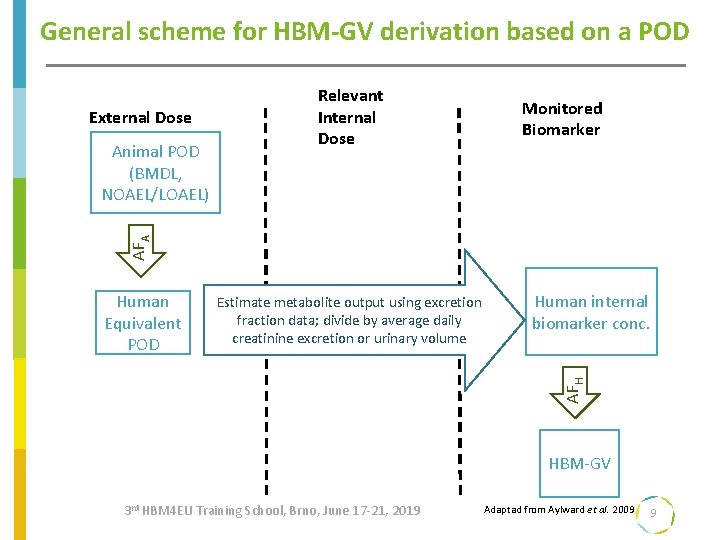
General scheme for HBM-GV derivation based on a POD External Dose Monitored Biomarker AFA Animal POD (BMDL, NOAEL/LOAEL) Relevant Internal Dose Estimate metabolite output using excretion fraction data; divide by average daily creatinine excretion or urinary volume Human internal biomarker conc. AFH Human Equivalent POD HBM-GV 3 rd HBM 4 EU Training School, Brno, June 17 -21, 2019 Adaptad from Aylward et al. 2009 9
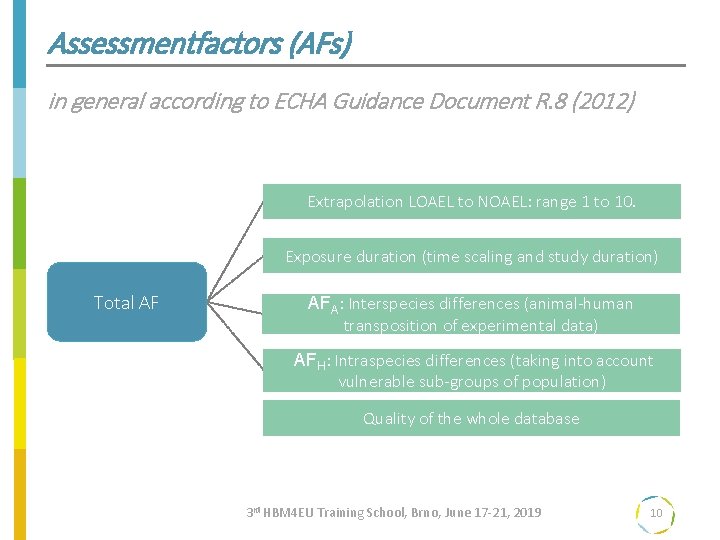
Assessmentfactors (AFs) in general according to ECHA Guidance Document R. 8 (2012) Extrapolation LOAEL to NOAEL: range 1 to 10. Exposure duration (time scaling and study duration) Total AF AFA: Interspecies differences (animal-human transposition of experimental data) AFH: Intraspecies differences (taking into account vulnerable sub-groups of population) Quality of the whole database 3 rd HBM 4 EU Training School, Brno, June 17 -21, 2019 10
Limitations and Uncertainties Ø Data from epidemiological and animal studies vary in quality and focus Ø Data on metabolite excretion come often only from few volunteers, sex or age-specific differences or potential dependency on exposure levels are often not considered. PBTK models are not always available. Ø Urinary volume or creatinine excretion rates vary intra- and interindividually Ø Protective values: derived for life long or working life exposure Source: realbuisiness. co. uk 3 rd HBM 4 EU Training School, Brno, June 17 -21, 2019 11
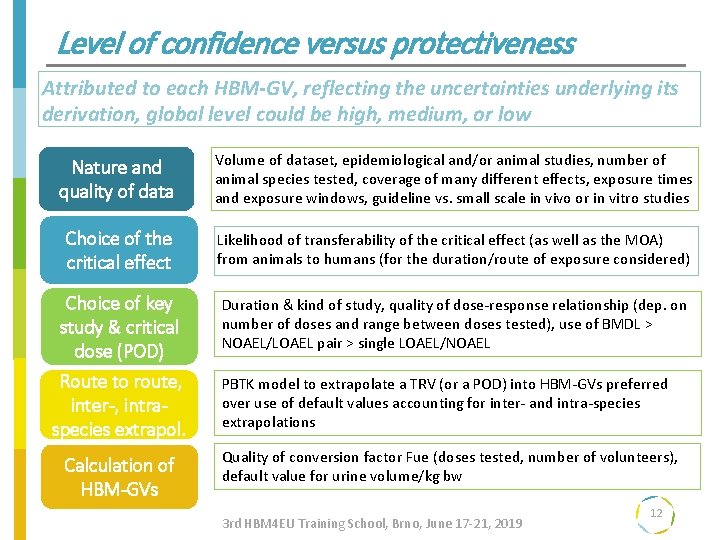
Level of confidence versus protectiveness Attributed to each HBM-GV, reflecting the uncertainties underlying its derivation, global level could be high, medium, or low Nature and Prioritisation quality of data Choice of the critical effect Volume of dataset, epidemiological and/or animal studies, number of animal species tested, coverage of many different effects, exposure times and exposure windows, guideline vs. small scale in vivo or in vitro studies Likelihood of transferability of the critical effect (as well as the MOA) from animals to humans (for the duration/route of exposure considered) Choice of key Duration & kind of study, quality of dose-response relationship (dep. on study & criticalresultsnumber of doses and range between doses tested), use of BMDL > Translating NOAEL/LOAEL pair > single LOAEL/NOAEL dose (POD) into policy Route to route, inter-, intraspecies extrapol. step 3 Calculation of HBM-GVs PBTK model to extrapolate a TRV (or a POD) into HBM-GVs preferred over use of default values accounting for inter- and intra-species extrapolations Quality of conversion factor Fue (doses tested, number of volunteers), default value for urine volume/kg bw 3 rd HBM 4 EU Training School, Brno, June 17 -21, 2019 12
Benefits of HBM-GVs use Improvement of chemicals risk assessment by integrating HBM data, thereby complementing current evaluations Harmonised and consistent performance of this HBM-based risk assessment within different countries Support to policy makers to prioritise action Indication of the necessity for risk management Easy-to-use screening tool, but should be used with reasonable care at the individual level 3 rd HBM 4 EU Training School, Brno, June 17 -21, 2019 13 Source: divassoftware. com

Thanks to my colleagues within task 5. 2: Rosa Lange (UBA), Eva Ougier & Christophe Rousselle (ANSES) Contact: petra. apel@uba. de Speaker’s information This project has received funding from the European Union’s Horizon 2020 research and innovation programme under grant agreement No 733032. Petra Apel, graduated biologist with additional qualification in toxicology, works as scientific associate at the German Environment Agency, Section II 1. 2 Toxicology, Health Related Environmental Monitoring. In HBM 4 EU she is responsible for task 5. 2 as task lead and also for the task of the NHCP.
- Slides: 14