
HBEC 3503 The Effective Practitioner in Early Childhood
HBEC 3503 The Effective Practitioner in Early Childhood Education
Topic 10 : Promoting Professionalism LEARNING OUTCOMES By the end of this topic, you should be able to: 1. Explain the concept of professionalism; 2. Identify who is an early childhood professional; 3. Discuss the six standards of professional development; and 4. Discuss the importance of professional development to early childhood practitioners.
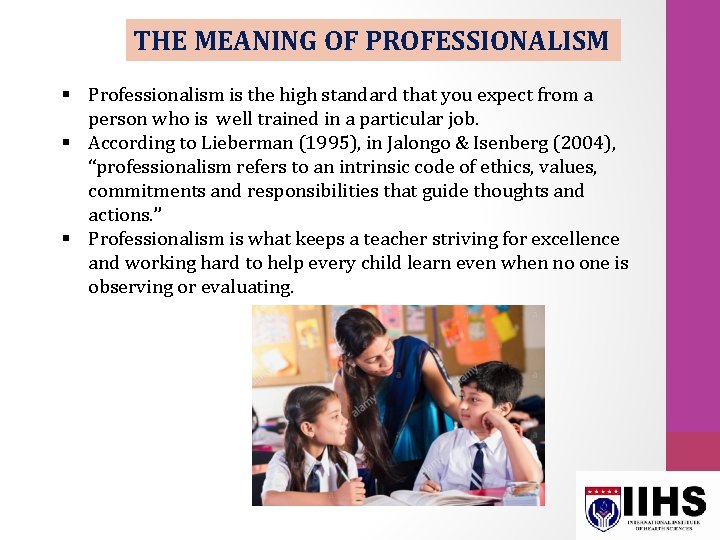
THE MEANING OF PROFESSIONALISM § Professionalism is the high standard that you expect from a person who is well trained in a particular job. § According to Lieberman (1995), in Jalongo & Isenberg (2004), “professionalism refers to an intrinsic code of ethics, values, commitments and responsibilities that guide thoughts and actions. ” § Professionalism is what keeps a teacher striving for excellence and working hard to help every child learn even when no one is observing or evaluating.

What does “Professional” Mean in Early Childhood Education? An early childhood professional teaches children from birth to eight years old. The following are some of the characteristics of an early childhood professional: (a) A high-quality early childhood professional has the professional characteristics, knowledge and skills to teach and conduct programmes so that all young children learn effectively. (b) Early childhood professionals are those who promote high standards for themselves, their colleagues and their children. They are continually improving and expanding their skills and knowledge. (c) Professionals reflect on their teaching and collaborations with colleagues and families.
PROFESSIONAL DEVELOPMENT § Professional development refers to the acquisition of skills and knowledge, both for personal development and for career advancement. § Professional development encompasses all types of facilitated learning opportunities, ranging from college degrees to formal coursework, conferences and informal learning opportunities situated in practice. § NAEYC divides professional development into two: preservice as initial preparation and in- service as learning experiences designed to improve the knowledge, skills/behaviour, and attitudes/values of the early childhood workforce.
According to Knowles (1975) in Jalongo and Isenberg ( 2004), some of the ways of supporting professional development are as follows: (a) Pursue information today about what will help them to teach better tomorrow; (b) Learn from tapping into their experiences and reflecting upon them; (c) Work hard to fulfil the professional roles they have chosen for themselves; and (d) Move from dependence on others to greater self-direction and self- evaluation.
The Six Standards of Professional Development High quality professionalism in early childhood education has six integrated standards, all of which are important and necessary dimensions of your professional experience. Standard 1: Promoting Child Development and Learning Description As an early childhood professional, you will need to know how to promote child development and learning. Learning how to do this includes knowledge and understanding of young children’s characteristics, needs and the multiple influences on their development and learning.
Standard 2: Building Family and Community Relationships You need to know and understand the characteristics of ‘families and the communities in which they live and become an advocate for parents and families. Your collaboration with families will also involve supporting and empowering them. In addition, you will need to know how to involve families and communities in all aspects of children’s development and learning. It is very important to be respectful of children and their families in order to build strong relationships.

Standard 3: Observing, Documenting, and Assessing to Support Children and Families One of the most important responsibilities of an early childhood professional is to observe, document and assess children’s learning. The outcomes of these assessments will help and guide teachers in making decisions about what and how to teach young children. You must also share this information with parents and families. Standard 4: Using Developmentally Effective Approaches to Connect with Children and Families As an early childhood professional, you must understand positive relationships and supportive interactions as the foundation of your work with children. Knowing and understanding effective strategies and tools for early education must be instituted. You are encouraged to use a broad repertoire of developmentally appropriate teaching/learning approaches. Lastly, you should reflect on your own practice to promote positive outcomes for each child. Source: Morrison (2012)
Standard 5: Using Content Knowledge to Build Meaningful Curriculum As an early childhood professional, you should master the four types of knowledge: content knowledge, pedagogical content knowledge, general pedagogical knowledge and knowledge of learners and learning. 1 of this module for elaboration. Standard 6: Becoming a Professional As early as childhood professional, you must identify and involve with the early childhood field. You should know about and uphold ethical standards and other professional guidelines, engage in continuous lifelong learning and professional development, collaborate with colleagues, parents, families and community partners, engage in reflective practice; and lastly, advocate on behalf of children, families and the profession.
TRAINING OPPORTUNITIES IN ECE § Professionals in every field must complete some type of formal training. § Childcare workers require 12 to 18 credit hours of courses in early childhood. § Early childhood practitioners may be required to have a two -year or four-year college degree (Beaty, 2008). § A professional is never a “finished” product; you will always be involved in professional development, a process of studying, learning, changing and becoming more professional.

- Slides: 12