
Hazards Take Control Floods By NEMO Saint Lucia
Hazards: Take Control Floods By NEMO Saint Lucia

DISASTER RISKS FACED BY THE CARIBBEAN Source: Primer Series by the Global Alliance for Disaster Reduction EARTHQUAKES FIRES GOAL: REDUCE DISASTER RISK DEVELOP POLICIES FOR ACTIONS HAVING HIGH BENEFIT/COST FOR THE CARIBBEAN REGION F D S HURRICANES L O O VOLCANOES FLOODS LANDSLIDES MEDICAL EMERGENCIES ENVIRONMENTAL IMPACTS GLOBAL CLIMATE CHANGE

Hazard: Floods Abnormal progressive rise in the water level of streams or rivers which may result in overflowing. TYPES OF FLOODS • Flash Floods • River Floods • Coastal Floods
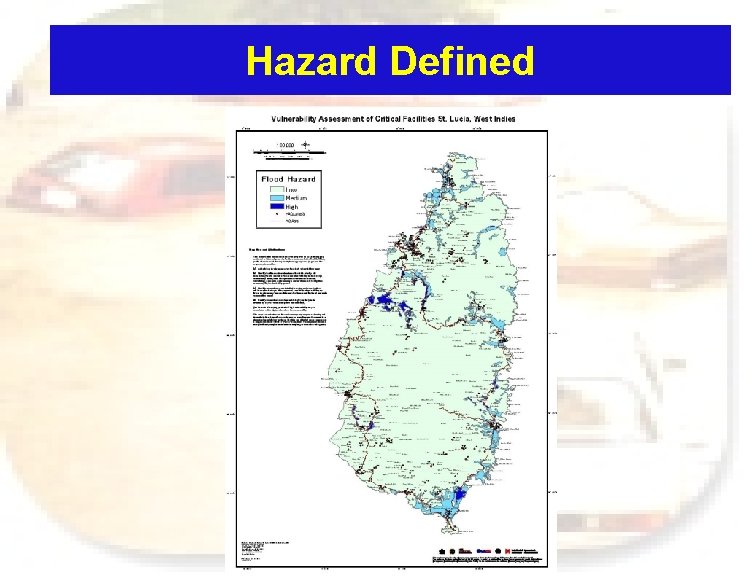
Hazard Defined
Preparing for Floods THE KEY IS: 1) KNOW THE DISASTER HISTORY OF YOUR REGION 2) KNOW YOUR COMMUNITY
Preparing for Floods • • • Discuss the hazard with your family. Prepare a disaster plan. Know the safe zones. Prepare an evacuation plan. Don’t forget your pets!
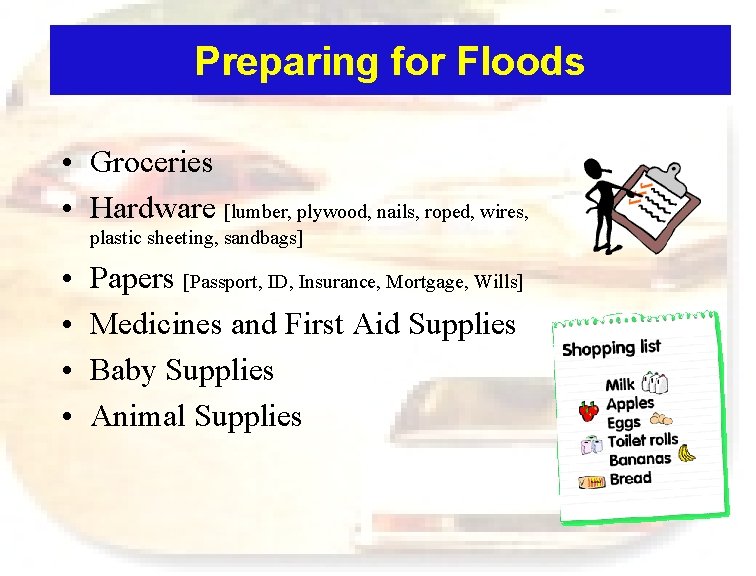
Preparing for Floods • Groceries • Hardware [lumber, plywood, nails, roped, wires, plastic sheeting, sandbags] • • Papers [Passport, ID, Insurance, Mortgage, Wills] Medicines and First Aid Supplies Baby Supplies Animal Supplies
Preparing for Floods Livestock Protection Animals can swim well. DO NOT leave them in confined areas or pens. Open gates so that animals can escape. Remove ropes so that they don’t become entangled.
Preparing for Floods • Listen for emergency instructions • Watch for rapidly rising water • Store drinking water in sealed plastic containers as water service may be interrupted. • Move household items to higher levels • Get livestock to higher ground • Evacuate if necessary when it is safe to do so, don't move quickly. • Turn off electricity at the main switch before evacuating
Preparing for Floods IF YOU CHOOSE NOT TO EVACUATE, YOU MUST PREPARE TO FIGHT THE RISING AND RUSHING WATER, DOWNED TREES, AND MUDSLIDES THAT ARE COMING
Preparing for Floods YOU MUST FIGHT THE RIVER BY YOURSELF IF YOU CHOOSE NOT TO EVACUATE AT THE SAFE TIME
Preparing for Hurricanes ? n o “It is generally accepted that disaster 0 0 mitigation pays. For example, the . 1 $ World Bank and United States r u Geological Survey once calculated o y that economic losses worldwide d n from natural disasters during the e p s 1990 s could be reduced by $280 u billion if $30 billion were invested o y in disaster mitigation and li l w preparedness — a ratio of $7 saved t a for every $1 spent. ” h W Twigg 2001, p. 3.
Preparing for Floods I want to urge you to act now in getting the insured household percentage up from 35%. I want to challenge you to strive at a 60% figure for this year, no matter how painful the financial cost Dr. Kenny D. Anthony Prime Minister of Saint Lucia January 16, 2005

Early Warning Systems The four components of an early warning system: 1. Monitor the hazard; 2. Quantify the hazard; 3. A disaster plan to address the hazard; [Flood Response Plan] 4. Effective communications for warning.
Early Warning Systems Official announcements are issued before during and after the occurrence of floods. These are intended to appraise the public in the affected area of the present and projected flood situation.
Effects of Floods Flood waters can destroy infrastructure, particularly those at ground level, Crops and livestock can also be destroyed and considerable water damage to critical assets will occur in the path of flood waters. Many persons may be killed especially when flash floods occur but the injuries are few. Food supply may become an issue.
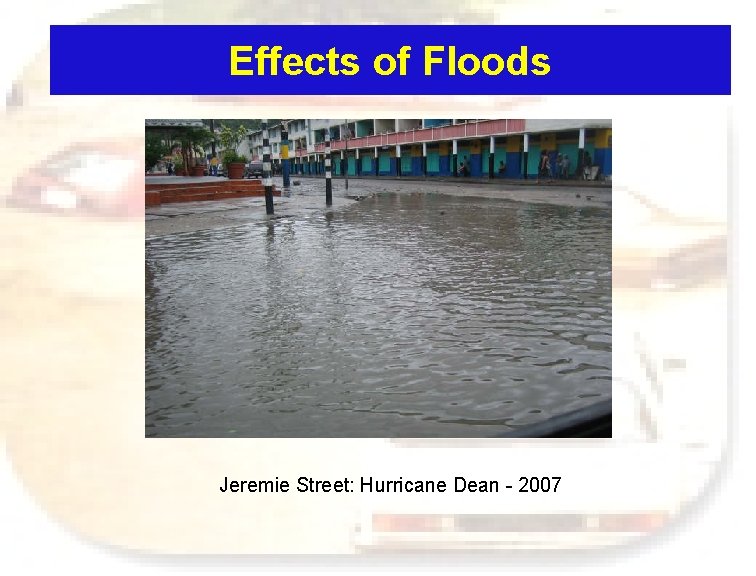
Effects of Floods Jeremie Street: Hurricane Dean - 2007
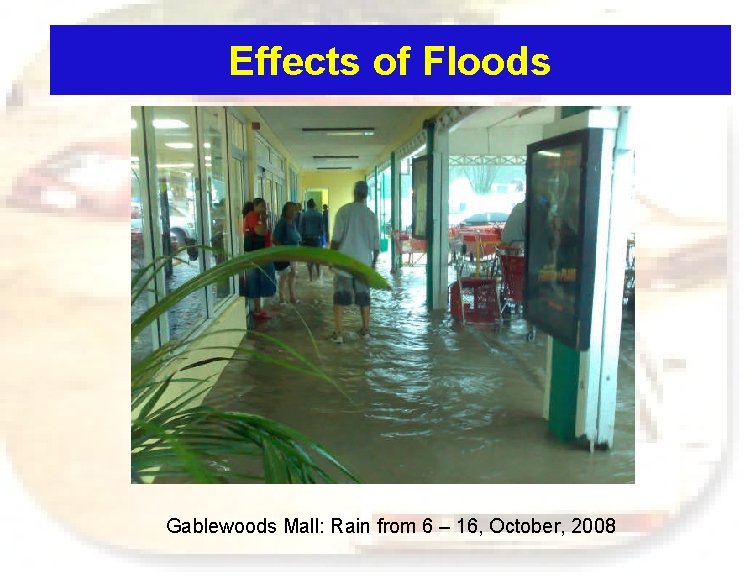
Effects of Floods Gablewoods Mall: Rain from 6 – 16, October, 2008
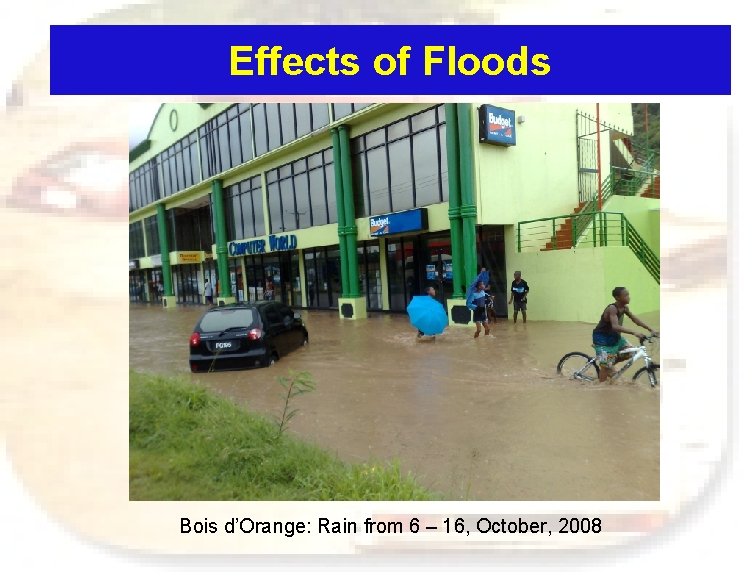
Effects of Floods Bois d’Orange: Rain from 6 – 16, October, 2008

After the Flood • Re-enter buildings with caution. Use flashlights, not lanterns or torches as flammables may be inside. • Be alert for fire hazards such as broken electrical wires. • If the building has been under water, do not switch on the main, wait for professional assistance. Never touch electrical switches while wet or standing in water
After the Flood • Don't use appliances or equipment until they have been cleaned, dried and thoroughly checked for damage. • Report utility lines (electricity, water, LPG gas and telephone) to the appropriate authorities. • Boil all water and don't eat left-over food until it is checked for contamination • Keep away from disaster areas as your presence may hamper rescue efforts
ALL CLEAR • “All Clear” announcements are not given for Floods. • If the flood is caused by a passing storm the all clear will be announced for the storm. • BE CAREFUL the rain may have stopped by the river will still be raging.

Online Resources National Emergency Management Plan http: //stlucia. gov. lc/nemp Family Disaster Plan http: //www. cdera. org/doccentre/familyplan. html Family Evacuation Plan http: //stlucia. gov. lc/nemp/plans/Evac. Template. doc Family Disaster Supplies List http: //www. stlucia. gov. lc/docs/nemo/Family. Disaster. Sup plies. Calendar. pdf
- Slides: 24