
Hazards in Process Industries DR AA Hazards in

- Slides: 37
Hazards in Process Industries DR. AA
Hazards in Process Industries • There are Three Major Hazards: Toxic Release, Fire, Explosion • Toxic Release – Impacts of people and environment. e. g. Bhopal • Fire – Impacts on plant, people and environment – May also followed by toxic release • Explosion – Same as fire but more severe
Toxic Substances
Hazard from Toxic Substances • There are no harmless substance, only harmless ways of using substances • Toxicants – A chemical agents – A physical (dusts, fibers, noise, and radiation) agents, e. g. asbestos – Toxicity is a property of toxicant that describe its effect on biological organism. – Toxic hazards is the likelihood of damage to biological organism based on exposure resulting from the use/transport/storage of the toxicants (hazardous material).
Hazard from Toxic Substances • Source of Toxicants – Toxic Release – Fire and Explosion • Route of Entry – Injection: through cuts or hypodermic needles into the skin, usually cause highest blood level concentration. – Inhalation: through mouth/nose into the lungs – Ingestion: through mouth into stomach and gastrointestinal tract, – Dermal (Skin) absorption: through skin membrane 5
Classification of Chemical Hazardous to Health § § § Very Toxic Corrosive Harmful Irritant Sensitizer § Carcinogenic – Category 1, 2, 3 § Mutagenic – Category 1, 2, 3 § Teratogenic – Category 1, 2 Data on toxicity can be found on Chemical Safety Data Sheet (CSDS) 6
Hazard from Toxic Substances • Effects that are Irreversible – Carcinogen-cause cancer – Mutagen-cause chromosome (gene) damage – Teratogen- cause birth defects • Effects that may or may not be irreversible – – – Dermatotoxic – affects skin Hemotoxic – affects blood Hepatotoxic- affects liver Nephrotoxic – affects kidneys Neutotoxic – affects nervous system Pulmonotoxic- affects lungs
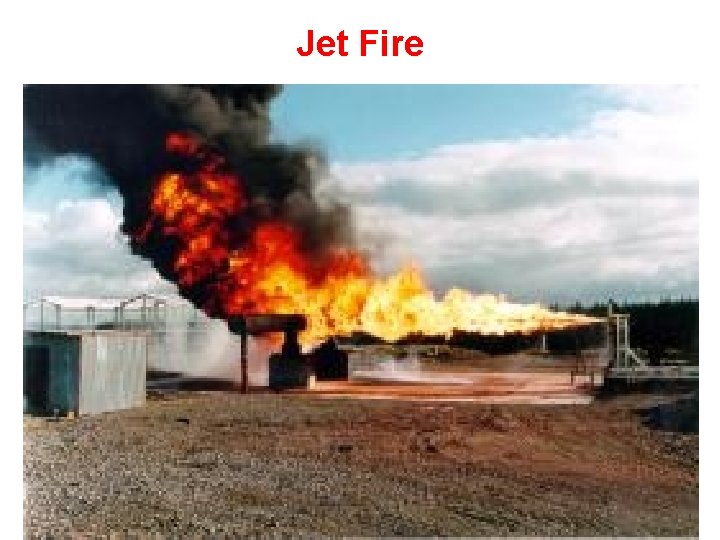
2. Fire • • • Jet Fire Flash Fire Pool Fire
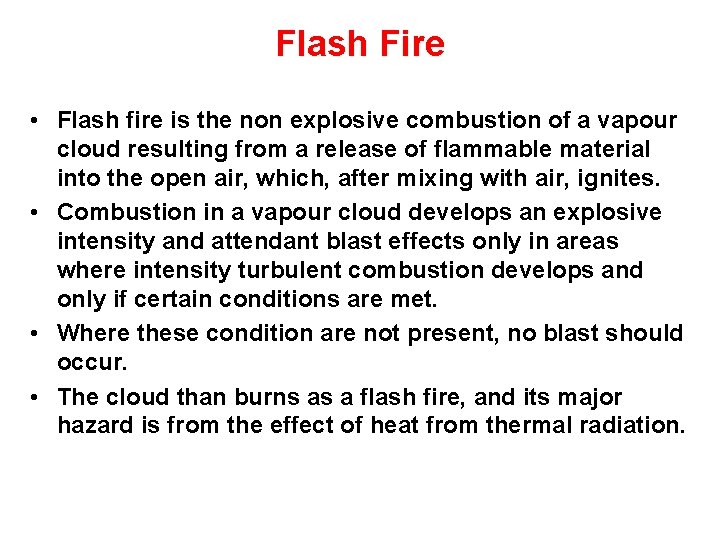
Flash Fire • Flash fire is the non explosive combustion of a vapour cloud resulting from a release of flammable material into the open air, which, after mixing with air, ignites. • Combustion in a vapour cloud develops an explosive intensity and attendant blast effects only in areas where intensity turbulent combustion develops and only if certain conditions are met. • Where these condition are not present, no blast should occur. • The cloud than burns as a flash fire, and its major hazard is from the effect of heat from thermal radiation.
Jet Fire
Pool Fire
Explosion
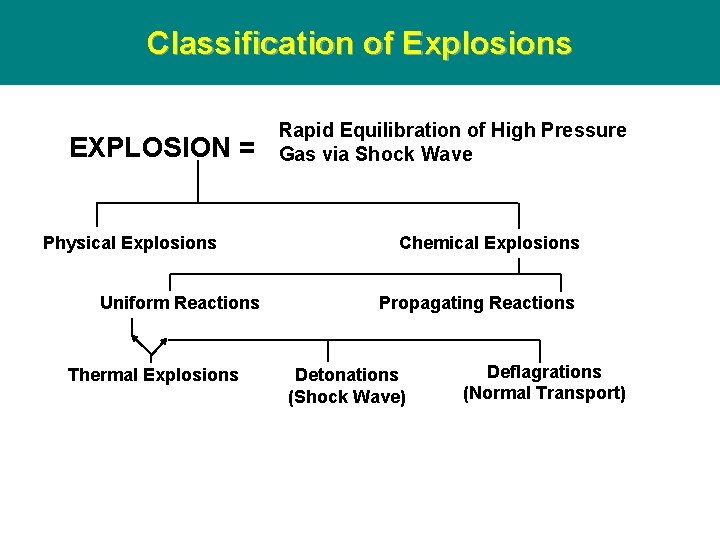
Classification of Explosions EXPLOSION = Physical Explosions Uniform Reactions Thermal Explosions Rapid Equilibration of High Pressure Gas via Shock Wave Chemical Explosions Propagating Reactions Detonations (Shock Wave) Deflagrations (Normal Transport)
Types of Explosion • Vapour Cloud Explosion – Confined – Unconfined • BLEVE • Mechanical Explosion • Chemical Explosion
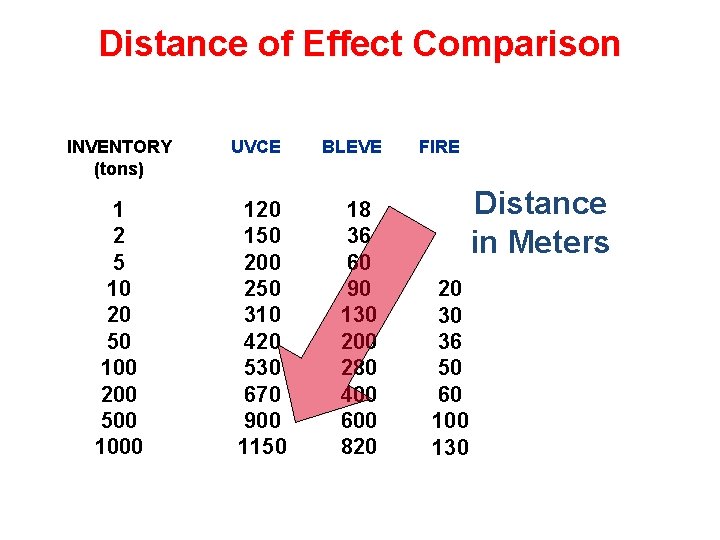
Distance of Effect Comparison INVENTORY (tons) 1 2 5 10 20 50 100 200 500 1000 UVCE 120 150 200 250 310 420 530 670 900 1150 BLEVE 18 36 60 90 130 200 280 400 600 820 FIRE Distance in Meters 20 30 36 50 60 100 130
Physical Explosion • Explosion due to overpressure of materials stored in a container.
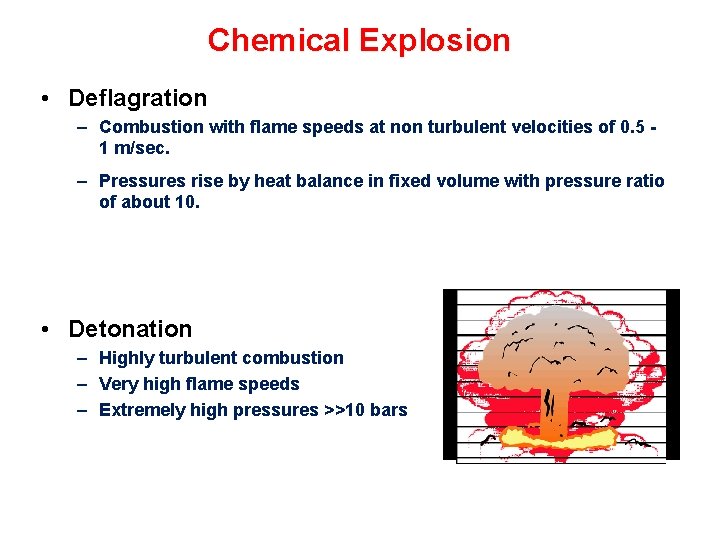
Chemical Explosion • Deflagration – Combustion with flame speeds at non turbulent velocities of 0. 5 1 m/sec. – Pressures rise by heat balance in fixed volume with pressure ratio of about 10. • Detonation – Highly turbulent combustion – Very high flame speeds – Extremely high pressures >>10 bars
Vapor Cloud Explosion • Cloud will spread from too rich, through flammable range to too lean. • Edges start to burn through deflagration (steady state combustion). • Cloud will disperse through natural convection. • Flame velocity will increase with containment and turbulence. • If velocity is high enough cloud will detonate. • If cloud is small enough with little confinement it cannot explode.
Factors Favoring Overpressures of Vapor Cloud 1. Confinement – Prevents combustion products escaping, giving higher local pressures even with deflagration. – Creates turbulence, a precursor for detonation. – Terrain cause confinement. – Onsite leaks have a much higher potential for UVCE than offset leaks. 2. Cloud composition – Highly unsaturated molecules are bad due to high flammable range, low ignition energy, high flame speed etc. 3. Weather – Stable atmospheres lead to large clouds. – Low wind speed encourages large clouds.
Factors Favoring Overpressures of Vapor Cloud 4. Vapor Cloud Size impacts on: – probability of finding ignition source – likelihood of generating any overpressure – magnitude of overpressure 5. Source – flashing liquids seem to give high overpressure – vapor systems need very large failures to cause UVCE – slow leaks give time for cloud to disperse naturally without finding an ignition source – high pressure gives premixing required for large combustion – equipment failures where leak is not vertically upwards increases likelihood of large cloud
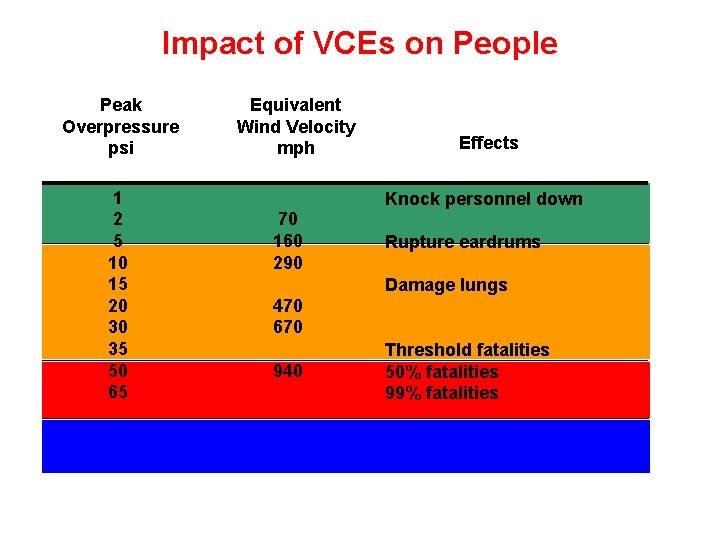
Impact of VCEs on People Peak Overpressure psi 1 2 5 10 15 20 30 35 50 65 Equivalent Wind Velocity mph Effects Knock personnel down 70 160 290 Rupture eardrums Damage lungs 470 670 940 Threshold fatalities 50% fatalities 99% fatalities
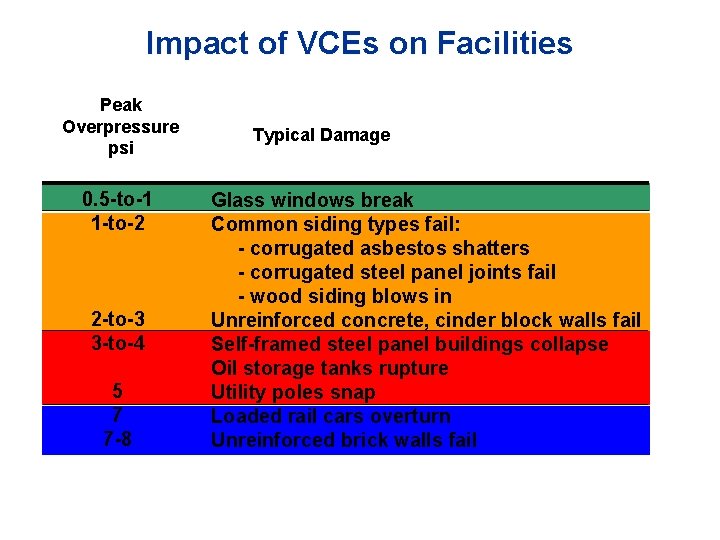
Impact of VCEs on Facilities Peak Overpressure psi 0. 5 -to-1 1 -to-2 2 -to-3 3 -to-4 5 7 7 -8 Typical Damage Glass windows break Common siding types fail: - corrugated asbestos shatters - corrugated steel panel joints fail - wood siding blows in Unreinforced concrete, cinder block walls fail Self-framed steel panel buildings collapse Oil storage tanks rupture Utility poles snap Loaded rail cars overturn Unreinforced brick walls fail
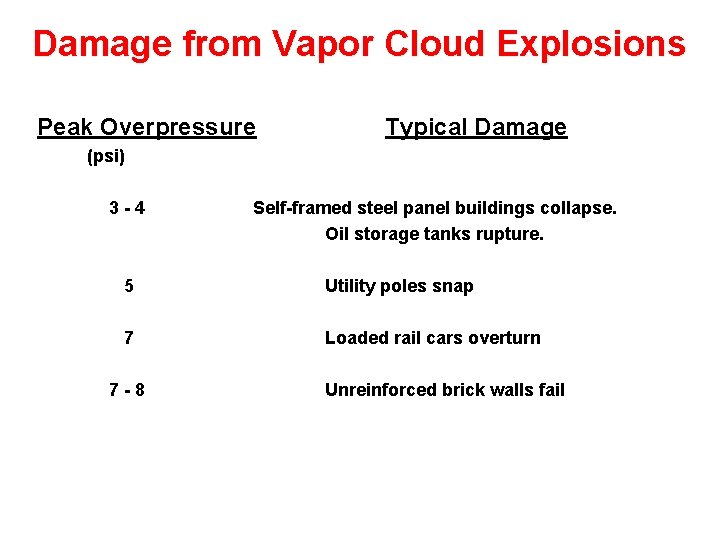
Damage from Vapor Cloud Explosions Peak Overpressure Typical Damage (psi) 3 -4 Self-framed steel panel buildings collapse. Oil storage tanks rupture. 5 Utility poles snap 7 Loaded rail cars overturn 7 -8 Unreinforced brick walls fail
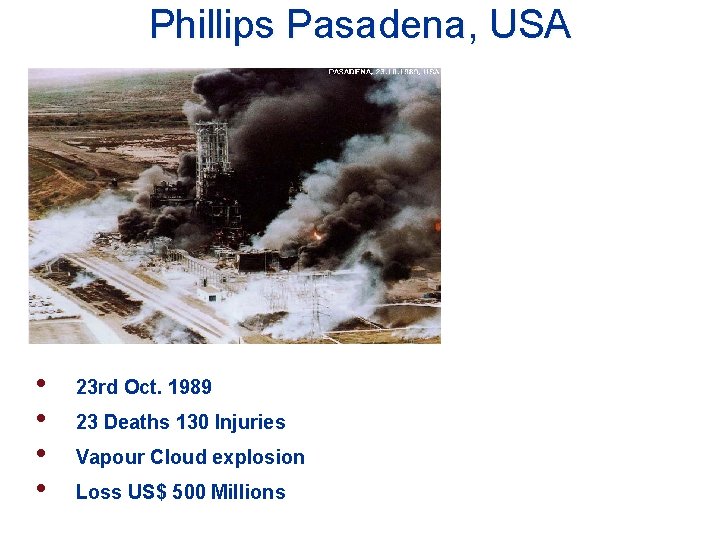
Phillips Pasadena, USA • • 23 rd Oct. 1989 23 Deaths 130 Injuries Vapour Cloud explosion Loss US$ 500 Millions
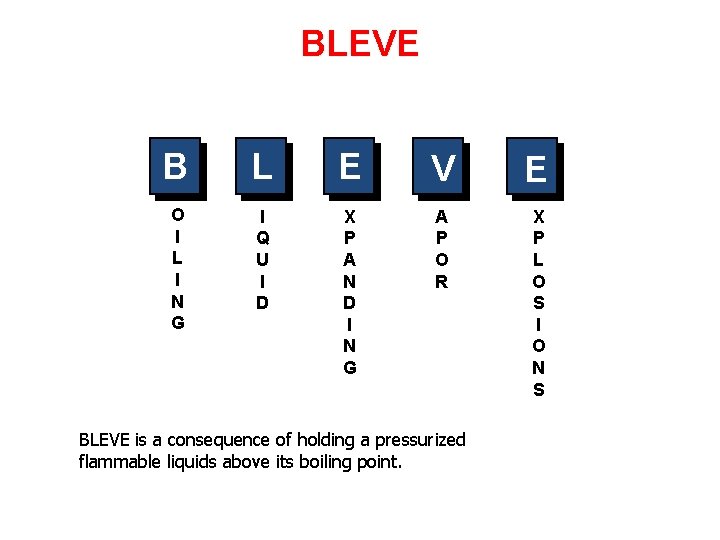
BLEVE B L E V E O I L I N G I Q U I D X P A N D I N G A P O R X P L O S I O N S BLEVE is a consequence of holding a pressurized flammable liquids above its boiling point.
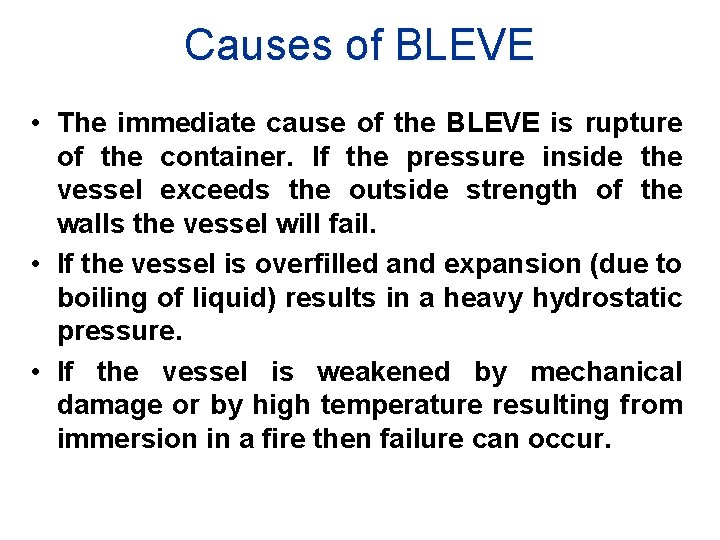
Causes of BLEVE • The immediate cause of the BLEVE is rupture of the container. If the pressure inside the vessel exceeds the outside strength of the walls the vessel will fail. • If the vessel is overfilled and expansion (due to boiling of liquid) results in a heavy hydrostatic pressure. • If the vessel is weakened by mechanical damage or by high temperature resulting from immersion in a fire then failure can occur.
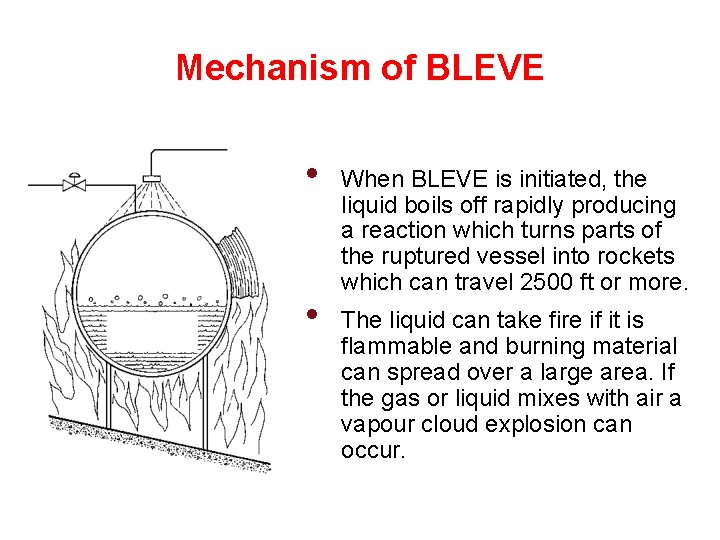
Mechanism of BLEVE • • When BLEVE is initiated, the liquid boils off rapidly producing a reaction which turns parts of the ruptured vessel into rockets which can travel 2500 ft or more. The liquid can take fire if it is flammable and burning material can spread over a large area. If the gas or liquid mixes with air a vapour cloud explosion can occur.
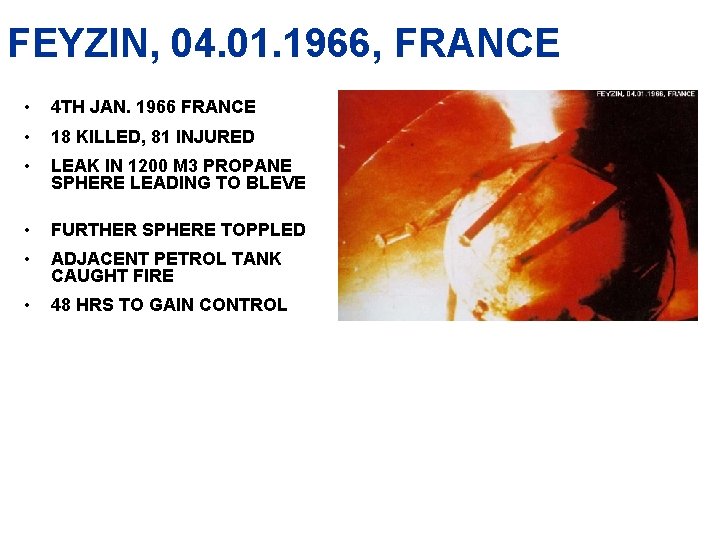
FEYZIN, 04. 01. 1966, FRANCE • 4 TH JAN. 1966 FRANCE • 18 KILLED, 81 INJURED • LEAK IN 1200 M 3 PROPANE SPHERE LEADING TO BLEVE • FURTHER SPHERE TOPPLED • ADJACENT PETROL TANK CAUGHT FIRE • 48 HRS TO GAIN CONTROL
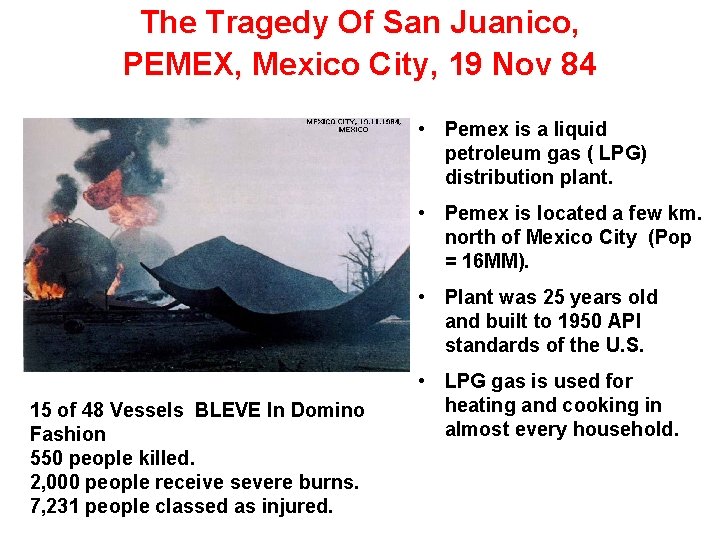
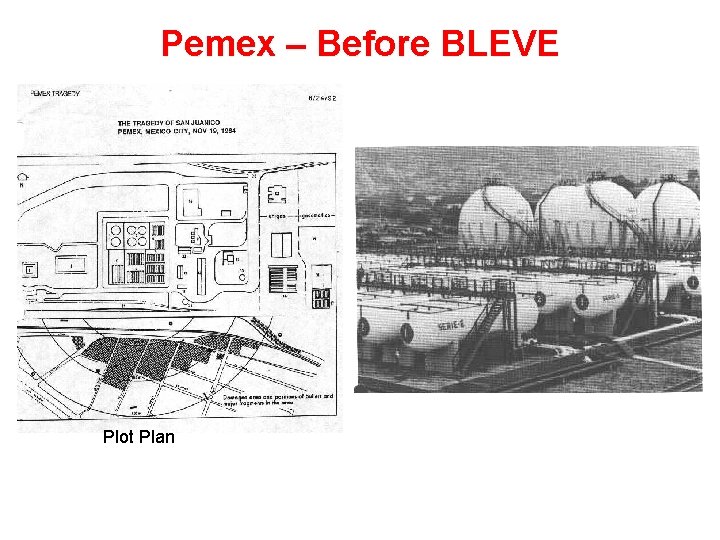
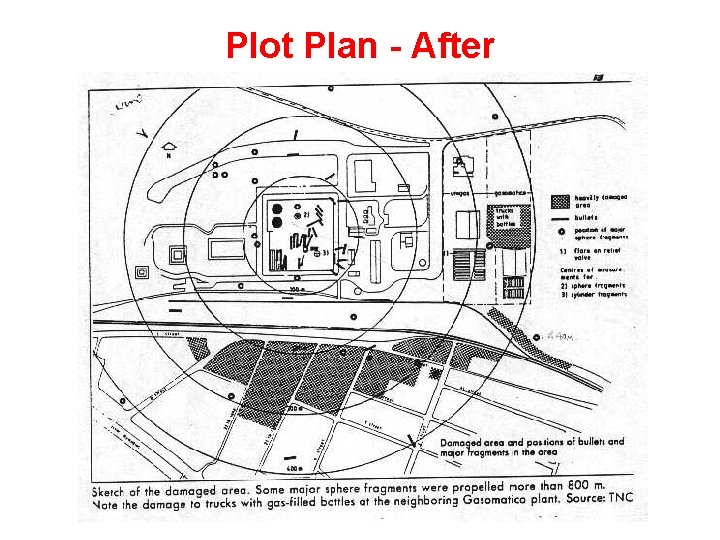
The Tragedy Of San Juanico, PEMEX, Mexico City, 19 Nov 84 • Pemex is a liquid petroleum gas ( LPG) distribution plant. • Pemex is located a few km. north of Mexico City (Pop = 16 MM). • Plant was 25 years old and built to 1950 API standards of the U. S. 15 of 48 Vessels BLEVE In Domino Fashion 550 people killed. 2, 000 people receive severe burns. 7, 231 people classed as injured. • LPG gas is used for heating and cooking in almost every household.
Pemex – Before BLEVE Plot Plan
Plot Plan - After
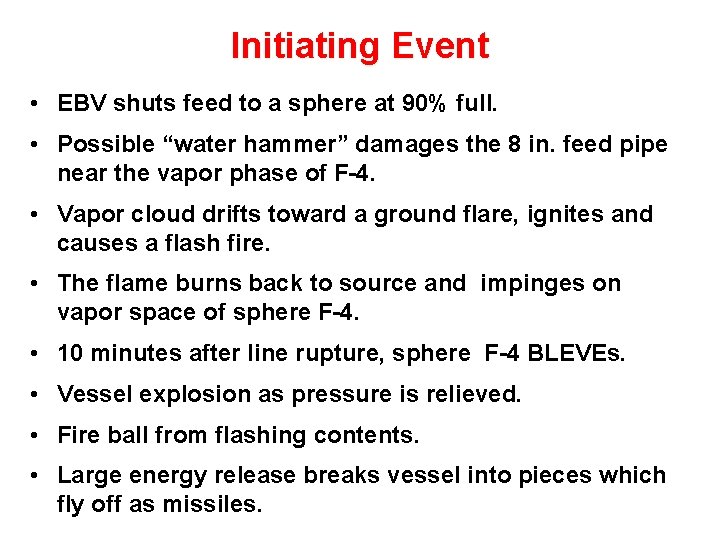
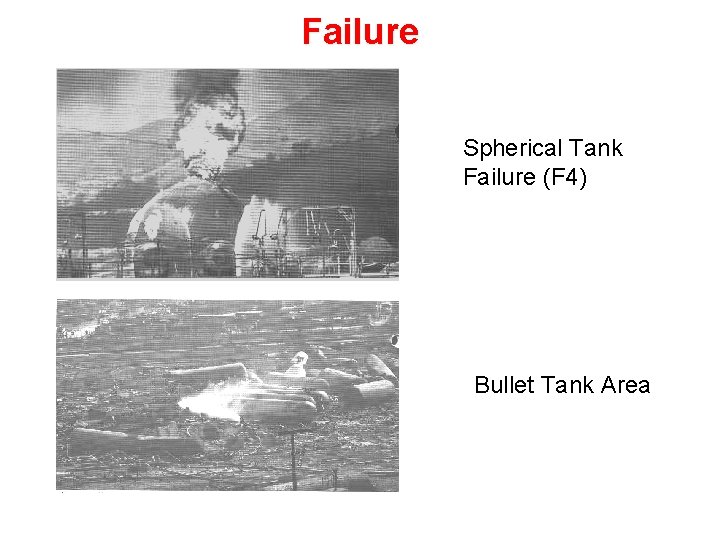
Initiating Event • EBV shuts feed to a sphere at 90% full. • Possible “water hammer” damages the 8 in. feed pipe near the vapor phase of F-4. • Vapor cloud drifts toward a ground flare, ignites and causes a flash fire. • The flame burns back to source and impinges on vapor space of sphere F-4. • 10 minutes after line rupture, sphere F-4 BLEVEs. • Vessel explosion as pressure is relieved. • Fire ball from flashing contents. • Large energy release breaks vessel into pieces which fly off as missiles.
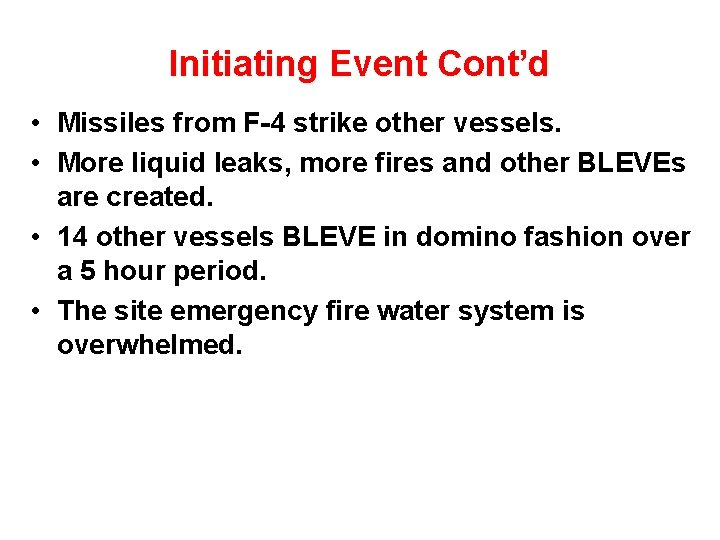
Initiating Event Cont’d • Missiles from F-4 strike other vessels. • More liquid leaks, more fires and other BLEVEs are created. • 14 other vessels BLEVE in domino fashion over a 5 hour period. • The site emergency fire water system is overwhelmed.
Failure Spherical Tank Failure (F 4) Bullet Tank Area
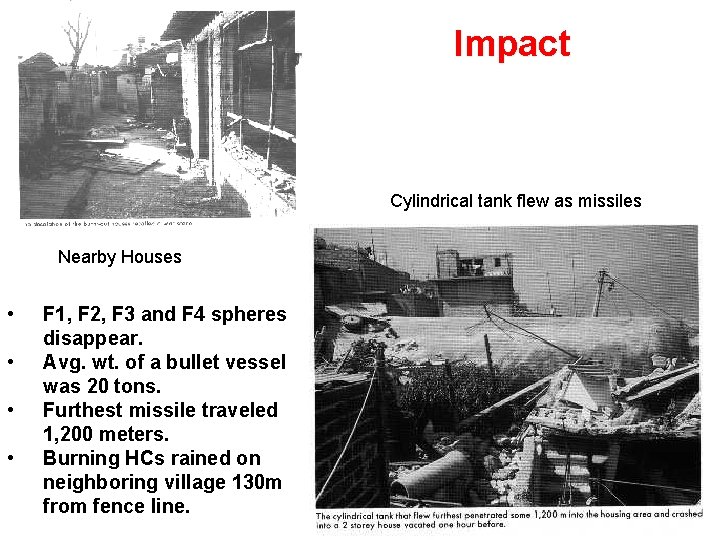
Impact Cylindrical tank flew as missiles Nearby Houses • • F 1, F 2, F 3 and F 4 spheres disappear. Avg. wt. of a bullet vessel was 20 tons. Furthest missile traveled 1, 200 meters. Burning HCs rained on neighboring village 130 m from fence line.
Emergency Response • First firefighters arrive 15 minutes after F-4 BLEVE. • 100 ambulances and 200 firefighters involved. • 985 medics and 1, 780 paramedics involved. • 1, 332 medical volunteers in 33 hospitals involved.
Lessons Learned • Old plant, too congested, poor maintenance & poor operator training were cited. • Village should have been 1, 500 meters from terminal (determined by QRA analysis). • Require many gas detectors and alarms. • EBV closure rates need adjustment. • Emergency plan required.