
Hazardous Waste Determination The Cornerstone of Hazardous Waste










- Slides: 39
Hazardous Waste Determination The Cornerstone of Hazardous Waste Management John Dotterweich NJDEP Bureau of Hazardous Waste Compliance & Enforcement 1
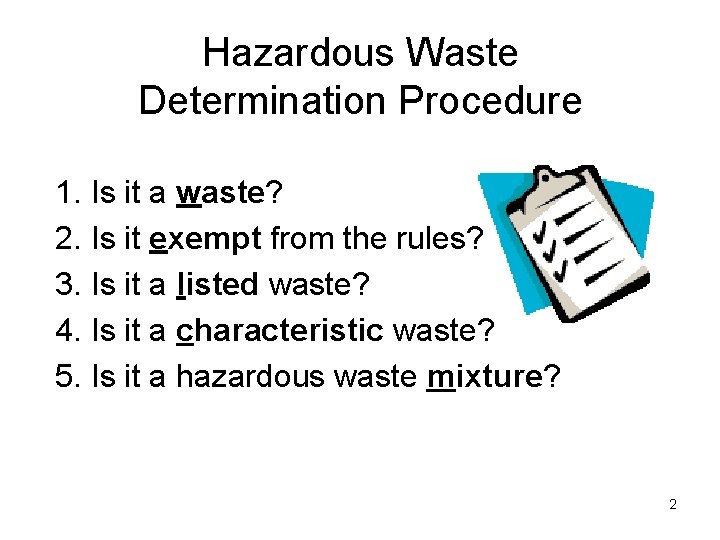
Hazardous Waste Determination Procedure 1. Is it a waste? 2. Is it exempt from the rules? 3. Is it a listed waste? 4. Is it a characteristic waste? 5. Is it a hazardous waste mixture? 2
Hazardous Waste- What is it? Waste Anything that is SPENT, DISCARDED or ABANDONED Hazardous Potential Threat to Human Health or the Environment A material must first be a waste before it can be classified a hazardous waste 3
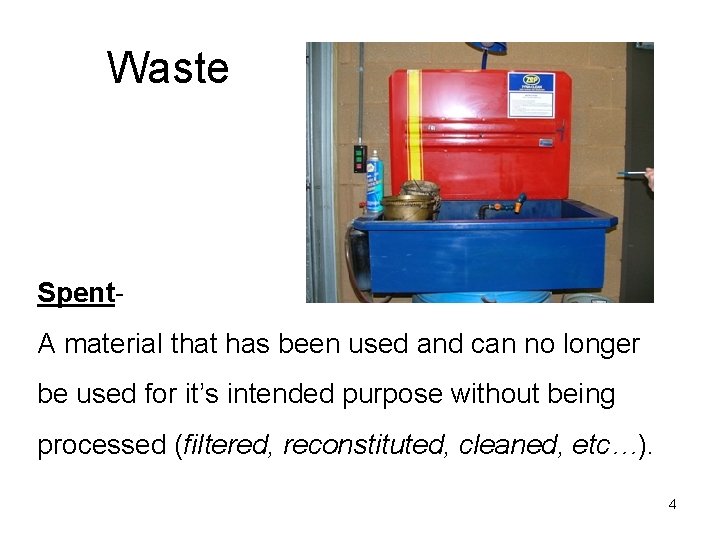
Waste Spent. A material that has been used and can no longer be used for it’s intended purpose without being processed (filtered, reconstituted, cleaned, etc…). 4
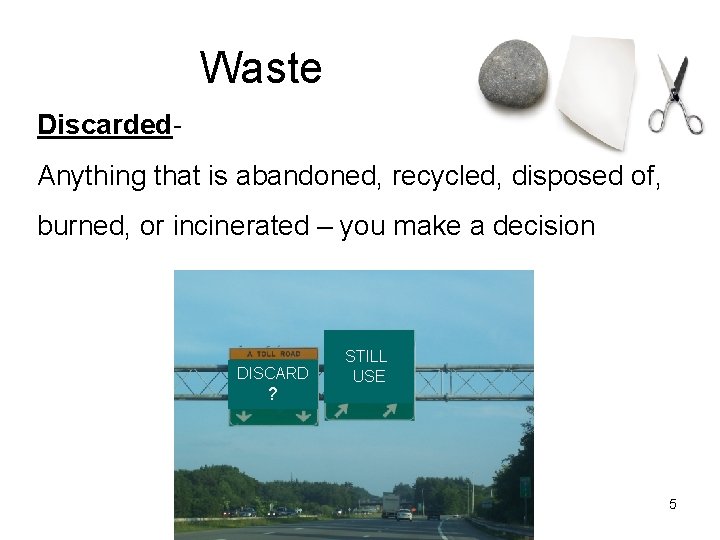
Waste Discarded. Anything that is abandoned, recycled, disposed of, burned, or incinerated – you make a decision DISCARD ? STILL USE 5
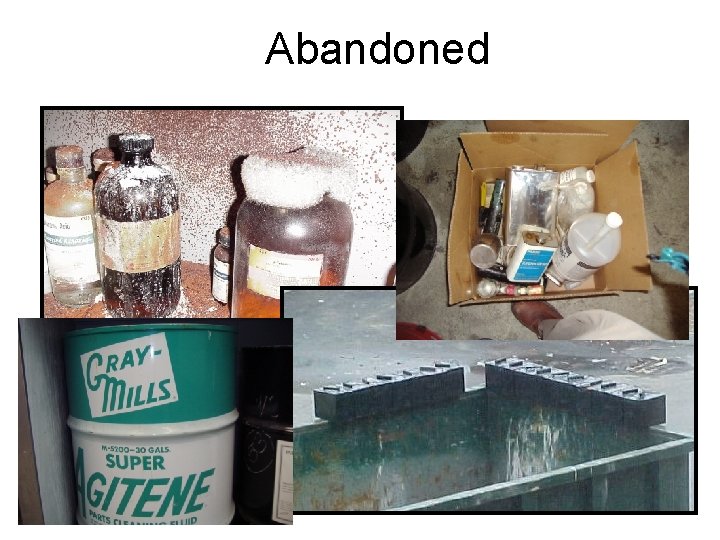
Waste Abandoned- Anything that is disposed of, burned or incinerated; OR Anything that is accumulated, stored or treated (but not recycled) before being disposed of, burned, or incinerated. 6
Abandoned 7
Exemptions Not Regulated as Hazardous Waste • Certain specific wastes are not regulated for various reasons Examples: Wastewater discharges regulated by other programs Medicinal nitroglycerine Scrap metal Used CFC refrigerants (if refrigerant is reclaimed) Empty Containers 8
Waste Numbers (“codes”) All hazardous wastes are identified by either an EPA or state waste code: EPA Waste Codes P, U, F, K, or D followed by 3 numbers “D 001”, “F 003”, K 051 etc… 9
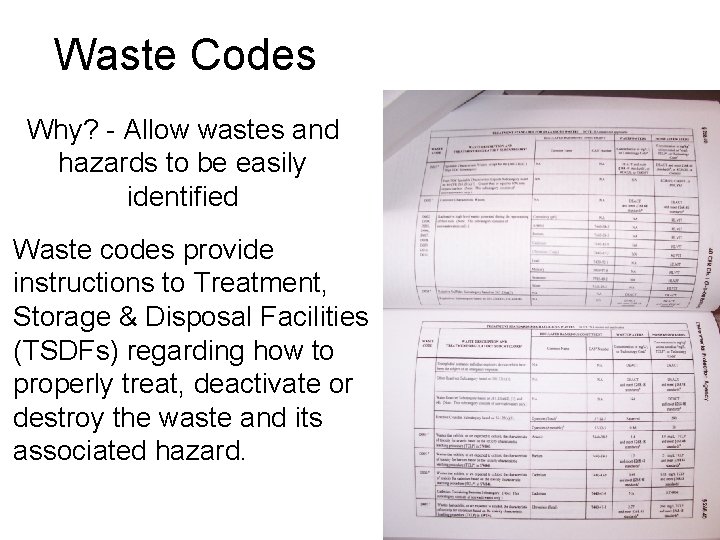
Waste Codes Why? - Allow wastes and hazards to be easily identified Waste codes provide instructions to Treatment, Storage & Disposal Facilities (TSDFs) regarding how to properly treat, deactivate or destroy the waste and its associated hazard. 10
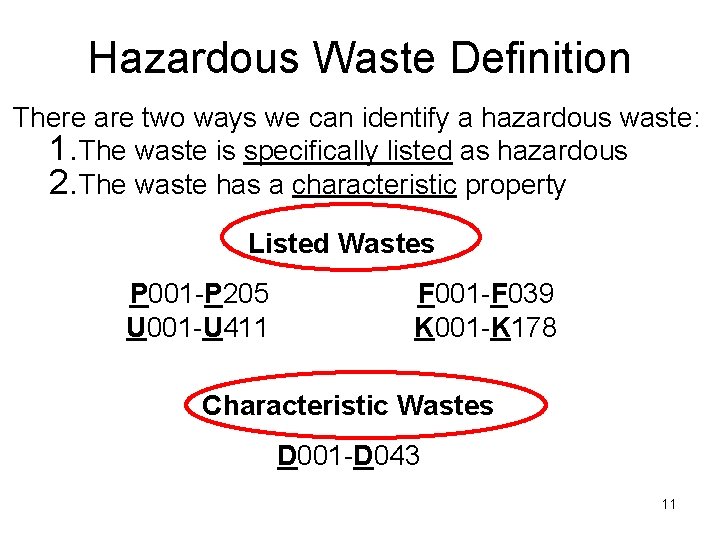
Hazardous Waste Definition There are two ways we can identify a hazardous waste: 1. The waste is specifically listed as hazardous 2. The waste has a characteristic property Listed Wastes P 001 -P 205 U 001 -U 411 F 001 -F 039 K 001 -K 178 Characteristic Wastes D 001 -D 043 11
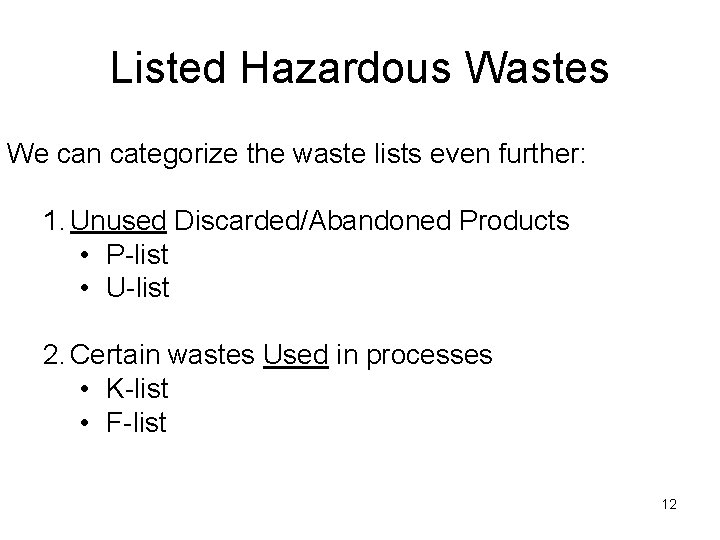
Listed Hazardous Wastes We can categorize the waste lists even further: 1. Unused Discarded/Abandoned Products • P-list • U-list 2. Certain wastes Used in processes • K-list • F-list 12
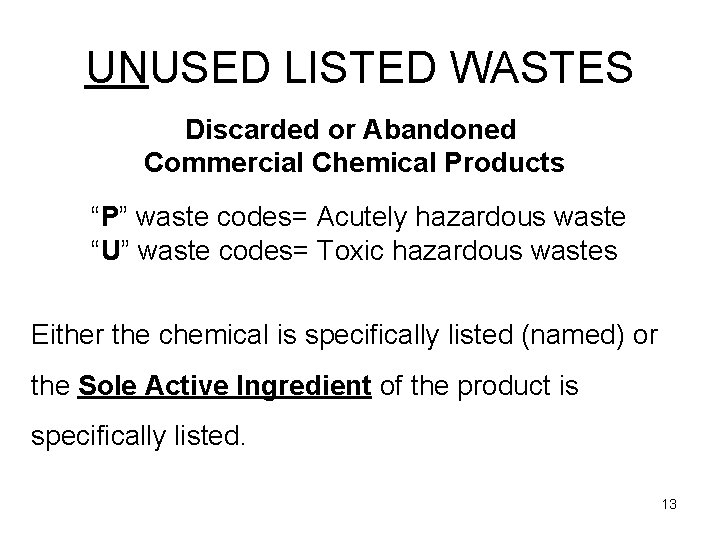
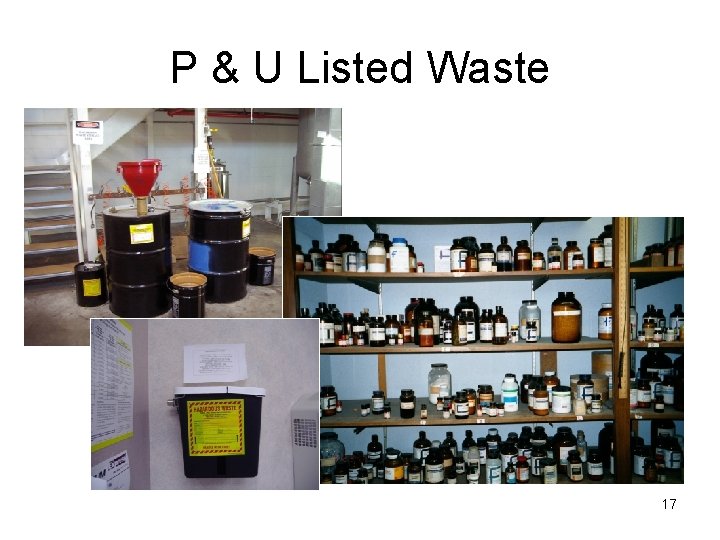
UNUSED LISTED WASTES Discarded or Abandoned Commercial Chemical Products “P” waste codes= Acutely hazardous waste “U” waste codes= Toxic hazardous wastes Either the chemical is specifically listed (named) or the Sole Active Ingredient of the product is specifically listed. 13
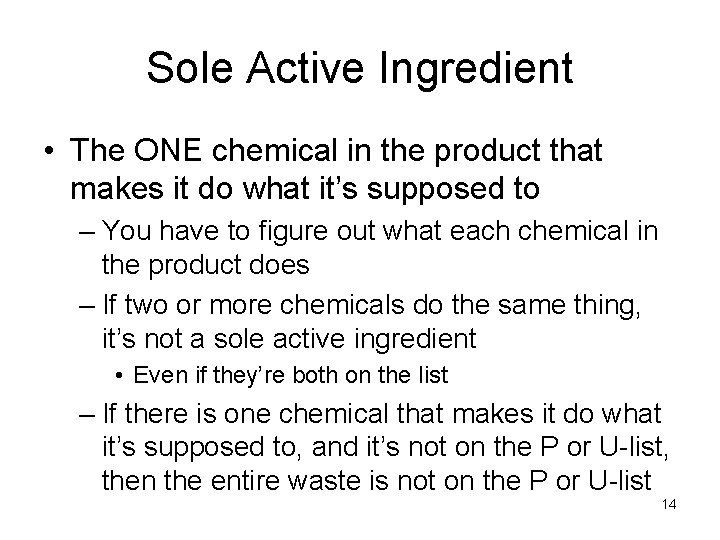
Sole Active Ingredient • The ONE chemical in the product that makes it do what it’s supposed to – You have to figure out what each chemical in the product does – If two or more chemicals do the same thing, it’s not a sole active ingredient • Even if they’re both on the list – If there is one chemical that makes it do what it’s supposed to, and it’s not on the P or U-list, then the entire waste is not on the P or U-list 14
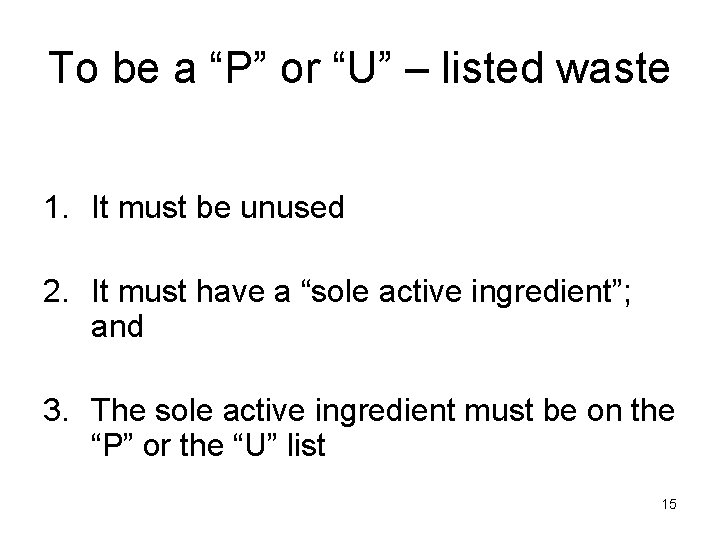
To be a “P” or “U” – listed waste 1. It must be unused 2. It must have a “sole active ingredient”; and 3. The sole active ingredient must be on the “P” or the “U” list 15
Are these “P” or “U” –listed? • Pure acetone getting thrown out • A product blend of acetone (solvent), xylene (solvent), and orange scent getting thrown out • A blend of acetone solvent and blue dye #2 colorant getting thrown out • Pure 1, 3, 7 -trimethylxanthine getting thrown out 16
P & U Listed Waste 17
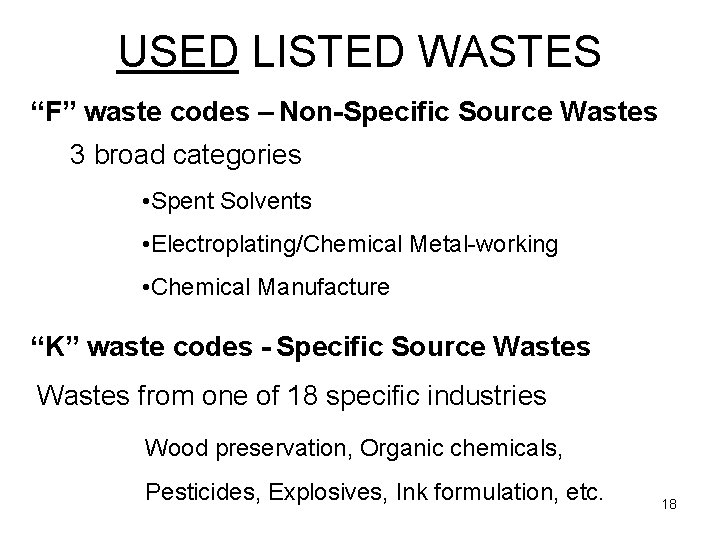
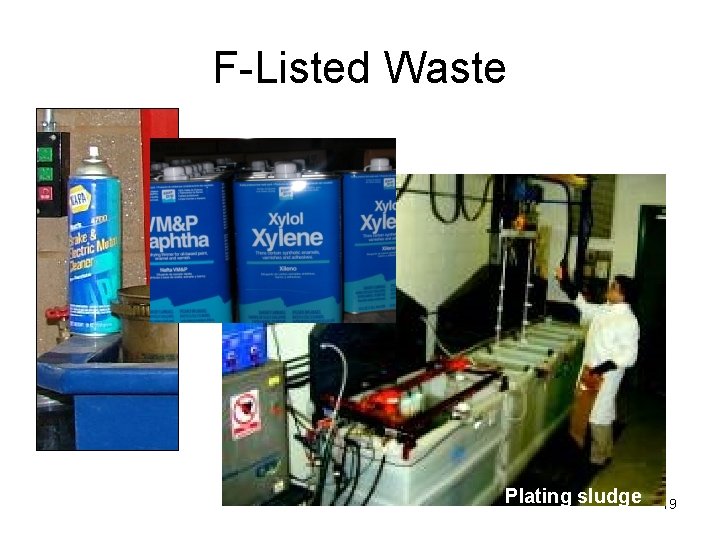
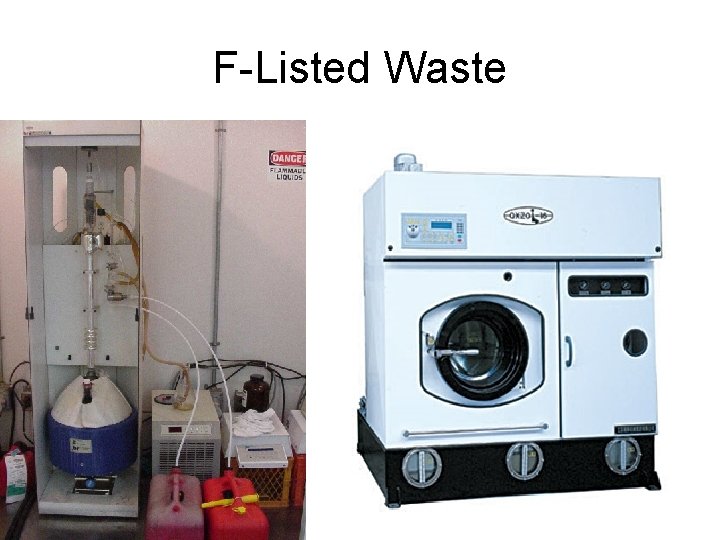
USED LISTED WASTES “F” waste codes – Non-Specific Source Wastes 3 broad categories • Spent Solvents • Electroplating/Chemical Metal-working • Chemical Manufacture “K” waste codes - Specific Source Wastes from one of 18 specific industries Wood preservation, Organic chemicals, Pesticides, Explosives, Ink formulation, etc. 18
F-Listed Waste Plating sludge 19
F-Listed Waste 20
K-Listed Waste Iron & Steel Industry 21
With LISTED wastes… The concentration of the bad stuff in the waste doesn’t matter P 081 22
Characteristic Wastes • Exhibit a hazardous waste property – Ignitable– D 001 – Corrosive – D 002 – Reactive – D 003 – Toxic – D 004 -D 043 • I Can Remember That! 23
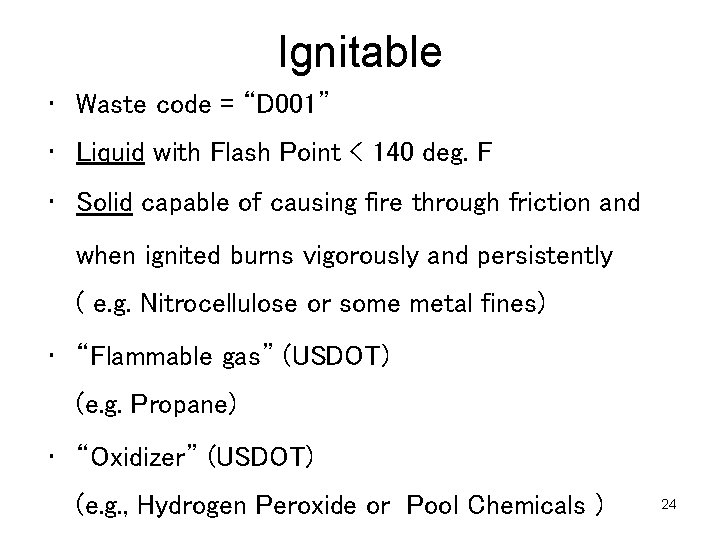
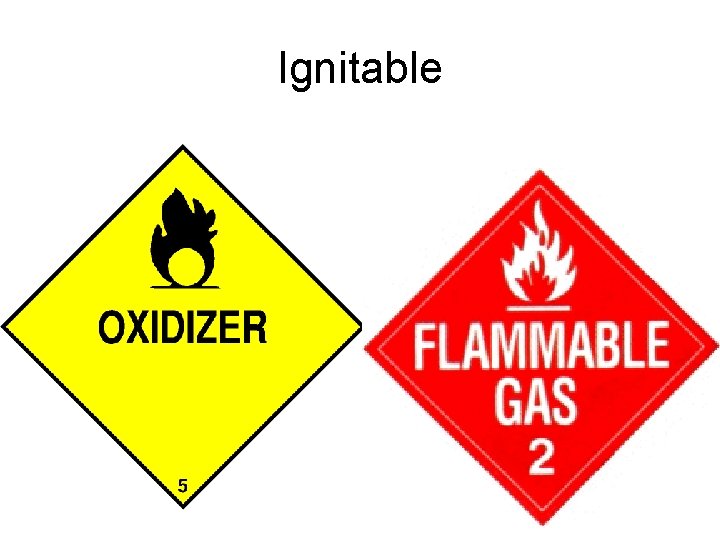
Ignitable • Waste code = “D 001” • Liquid with Flash Point < 140 deg. F • Solid capable of causing fire through friction and when ignited burns vigorously and persistently ( e. g. Nitrocellulose or some metal fines) • “Flammable gas” (USDOT) (e. g. Propane) • “Oxidizer” (USDOT) (e. g. , Hydrogen Peroxide or Pool Chemicals ) 24
Ignitable 25
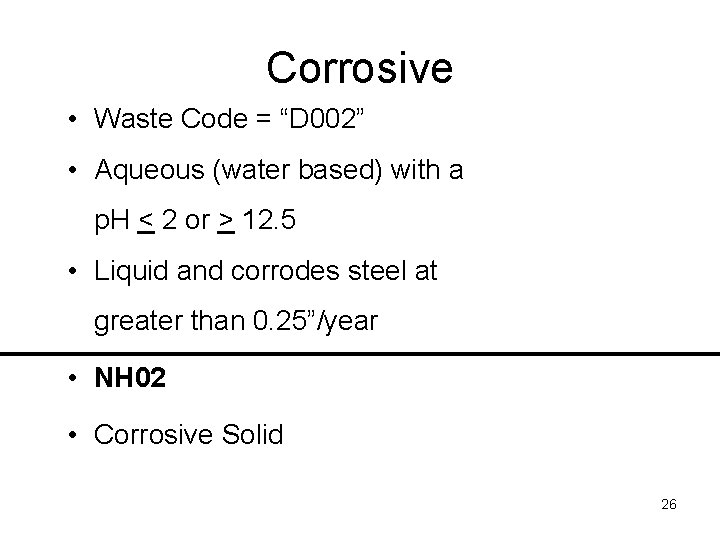
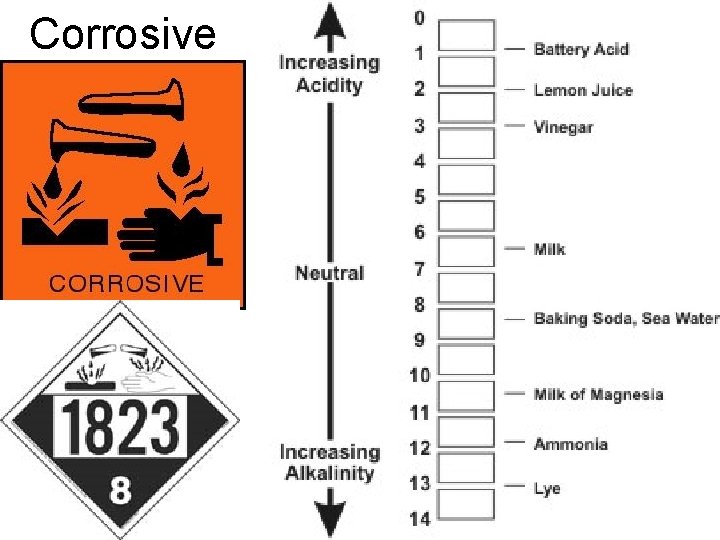
Corrosive • Waste Code = “D 002” • Aqueous (water based) with a p. H < 2 or > 12. 5 • Liquid and corrodes steel at greater than 0. 25”/year • NH 02 • Corrosive Solid 26
Corrosive 27
Reactive • Waste Code = “D 003” • Normally unstable • Reacts violently with water/air • Forms potentially explosive mixtures with water/air • Toxic vapors in contact with water/air • Cyanide or sulfide bearing waste • Capable of detonation or explosive reaction • It is a DOT “Forbidden” Explosive (49 CFR) 28
Reactive http: //www. cameochemicals. noaa. gov/ 29
Toxic le b a • Waste codes = “D 004” – “D 043” T • Requires a lab test called the “Toxicity Characteristic Leaching Procedure” (“TCLP”) • Simulates leaching activity of landfills • 8 metals, 6 pesticides, 25 organics 9. 4 Must be above a minimum concentration to be a toxicity characteristic waste 30
Toxicity Characteristic 1. Is there any possibility that a chemical in 40 CFR 261. 24 Table 1 is in your waste? 1. What is in the products you use? 2. What things might be contaminants in your process? 3. How about trace wear metals in the equipment you use? 2. If there is a possibility that a chemical in Table 1 is in your waste, what is its concentration? 31
Hazardous Waste Mixtures • “Waste” or “material” mixed with: – A Listed waste (P, U, F, K) is a hazardous waste – A Characteristic waste, and the mixture still exhibits the characteristic is a hazardous waste Also, – Spill residues, soil, water, debris that are mixed with listed wastes 32
Hazardous Waste Determination • Responsibility of the Generator! Once it is a waste you must decide if it is a hazardous waste 33
How do I know if my waste is hazardous? GENERATOR KNOWLEDGE 34
Some Generator Knowledge of materials and processes is inherent • • Water doesn’t burn Granite isn’t reactive Stirring paint doesn’t make it more toxic Pouring something doesn’t make it more corrosive 35
Some generator knowledge is researched Gather existing information that enables you to increase generator knowledge Process Knowledge What happens to the materials I use? Material Composition – What’s IN this stuff? MSDS labels profiles manufacturer information, product specs. previous analyses… 36
Some generator knowledge has to be acquired through Testing What you are testing is called a representative sample There are specific tests to determine if: 1. Your liquid waste is ignitable 2. Your waste is corrosive 3. Your waste has a toxicity characteristic (D 004 -D 043) There additional tests to help build or confirm your generator knowledge Testing - lab analysis (“SW-846”) 37
Documentation You must do a waste determination on all of your industrial waste streams You must maintain documents that indicate how you arrived at your conclusion These documents may include: Waste profiles Characterization documents MSDSs Test Results You will be asked for waste determination documentation during a hazardous waste inspection 38 Take credit for your hard work, write it down!
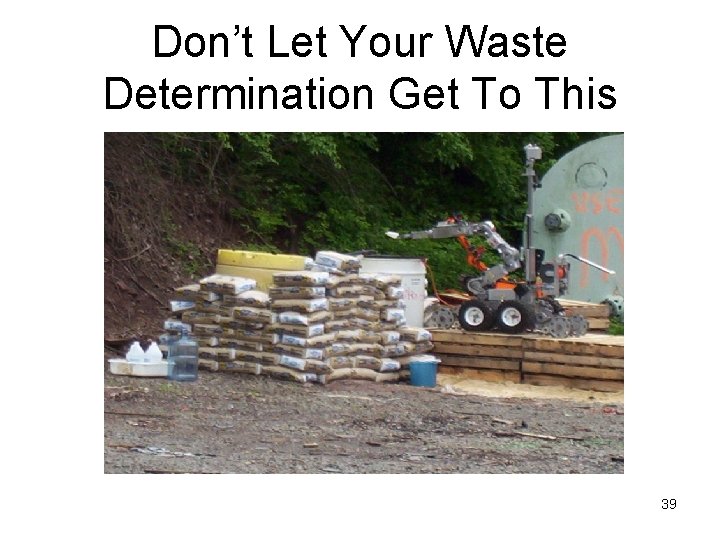
Don’t Let Your Waste Determination Get To This 39