
Hazardous substances briefing COSHH The aim of this
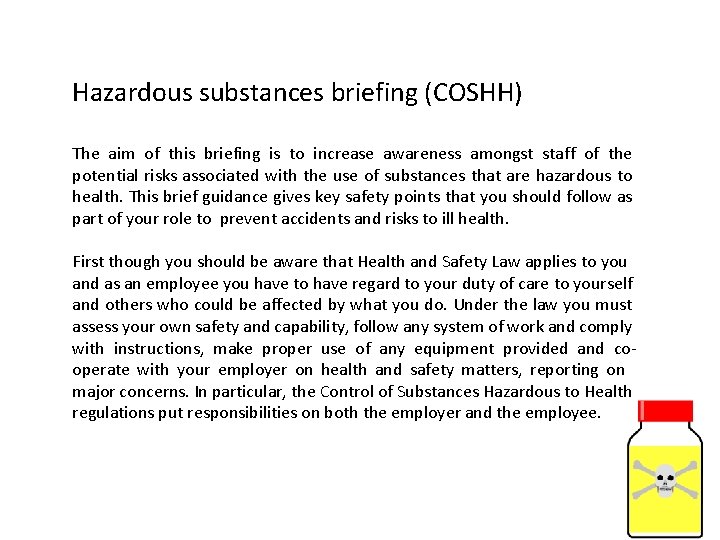
Hazardous substances briefing (COSHH) The aim of this briefing is to increase awareness amongst staff of the potential risks associated with the use of substances that are hazardous to health. This brief guidance gives key safety points that you should follow as part of your role to prevent accidents and risks to ill health. First though you should be aware that Health and Safety Law applies to you and as an employee you have to have regard to your duty of care to yourself and others who could be affected by what you do. Under the law you must assess your own safety and capability, follow any system of work and comply with instructions, make proper use of any equipment provided and cooperate with your employer on health and safety matters, reporting on major concerns. In particular, the Control of Substances Hazardous to Health regulations put responsibilities on both the employer and the employee.
What are hazardous substances? There are many different types used at work. The fact that they are hazardous means that if they are not controlled adequately then staff are at risk of injury or ill health when using or being exposed to them. Suppliers must by law give the purchaser a materials safety data sheet. This will list health risks and the required precautions to be referred to whilst carrying out the required COSHH risk assessment. All such substances must have by law a ‘hazard symbol’ (sometimes more than one symbol) on the supply label. This is the label on the original container when it was supplied and the substance should only be kept in a properly labelled container.
Duties: The Employers must prevent or control exposure of staff to any hazardous substance to ensure safe use as far as is reasonably practicable. Employers must carry out a risk assessment (COSHH assessment) and keep a record of the way in which any hazardous substances are used in their workplace. This will identify the risks to people or the environment and the precautions that must be taken, such as workplace control measures and safe methods, including supervision to ensure controls are being used in practice. This might include instruction and training, rules for safe use, storage, containment, ventilation, signage, any PPE required and emergency procedures. Staff must be consulted and informed of these requirements.
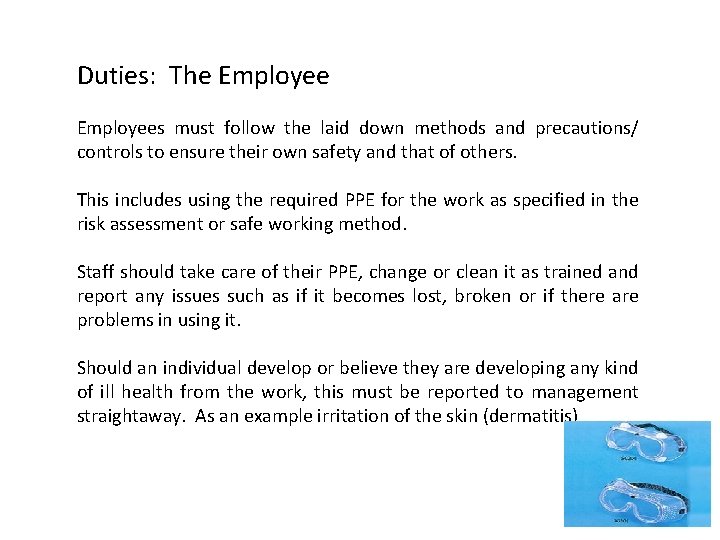
Duties: The Employees must follow the laid down methods and precautions/ controls to ensure their own safety and that of others. This includes using the required PPE for the work as specified in the risk assessment or safe working method. Staff should take care of their PPE, change or clean it as trained and report any issues such as if it becomes lost, broken or if there are problems in using it. Should an individual develop or believe they are developing any kind of ill health from the work, this must be reported to management straightaway. As an example irritation of the skin (dermatitis)

Types of hazardous substances These may be present in the workplace in the form of liquids, solids, powders, dusts, gases or biological. Some materials are flammable. Substances can cause harm by entering the body through: • Absorption- e. g. contact with skin • Through the eyes e. g. splashes/spillages • Ingestion e. g. eating and drinking where substances are used or through poor hand hygiene causing material to be swallowed • Injection e. g. by entering through broken skin / open wounds • Inhalation e. g. by breathing in dusts or fumes
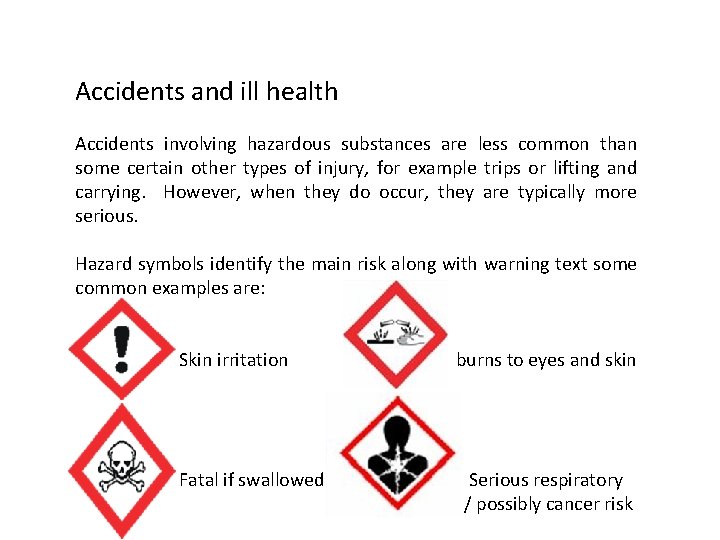
Accidents and ill health Accidents involving hazardous substances are less common than some certain other types of injury, for example trips or lifting and carrying. However, when they do occur, they are typically more serious. Hazard symbols identify the main risk along with warning text some common examples are: Skin irritation Fatal if swallowed burns to eyes and skin Serious respiratory / possibly cancer risk
Controlling hazards There is a hierarchy of risk control that is followed as to what type of control is the best - if reasonably practicable to do so: 1) Elimination is the best control e. g. remove the substance altogether from the workplace 2) Substitution e. g. use something less hazardous 3) Engineering controls e. g. containment, physical separation, LEV 4) Administrative controls e. g. signage, training, safe procedures 5) PPE – personal protective equipment, although important to wear when specified, is the weakest control since it relies on it being used and does not, on its own, reduce the danger from the hazard
Maintaining a safe working environment The majority of COSHH legal obligations fall on the employer to put into practice and maintain. However, employees also have some legal obligations which are necessary in order to support the employer’s safe system of work. Sometimes the employer may need to carry out health checks in order to ensure that the controls are working effectively. For example, a respiratory check from time to time by an Occupational Health professional may be required for staff who work in a very dusty area such as a carpentry workshop. This is called Health Surveillance and if this is required in your role your employer will discuss this with you.
Finally Never bring in hazardous substances from home to use at work or vice versa. Do not use any hazardous substances if you have not received the required instruction and training Always wear the specified PPE and report its loss or malfunction Report any ill health effects straightaway if you think they are related to the substances being used Ensure you know the emergency arrangements for obtaining first aid should an injury occur. Don’t take chances, get help or advice from your supervisor
- Slides: 9