
Hazardous Materials Performance Packaging Beth Powell Business Platform
Hazardous Materials Performance Packaging Beth Powell Business Platform Leader www. newpig. com/shalegas
Disclaimers This presentation is for general guidance only and must not be used to determine compliance with 49 CFR Parts 100 -185. This presentation does not satisfy the Training Requirements (49 CFR 172. 704) for hazmat employees. If you need this training, please contact your nearest Safety-Kleen branch.
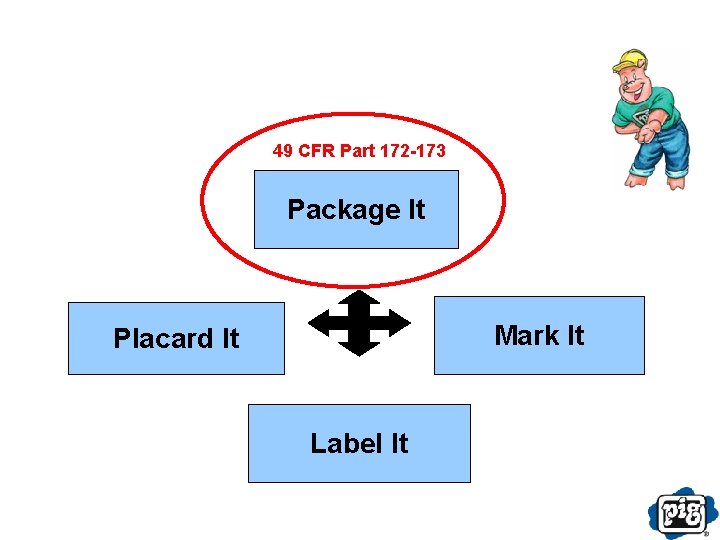
Basic Necessities 49 CFR Part 172 -173 Package It Mark It Placard It Label It
Hazardous Materials Table HMT A list of all the proper shipping names that can be used to describe hazardous material for transportation in the U. S. Do not assume a substance is not hazardous if you do not find it listed in the HMT
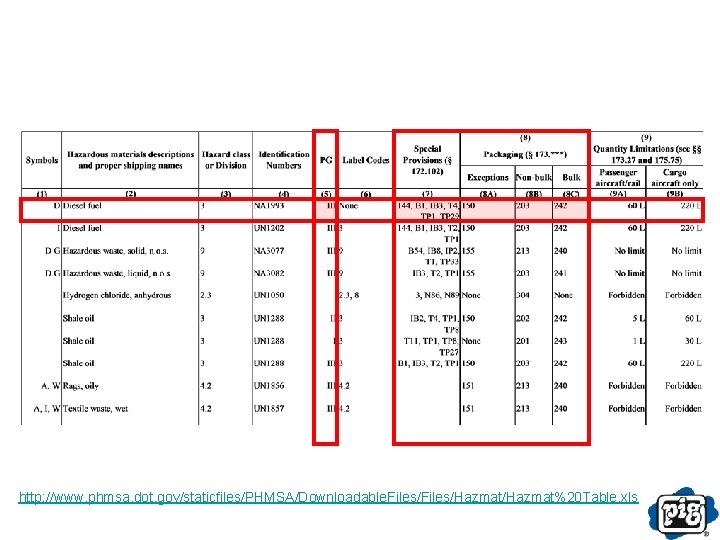
Hazardous Materials Table http: //www. phmsa. dot. gov/staticfiles/PHMSA/Downloadable. Files/Hazmat/Hazmat%20 Table. xls
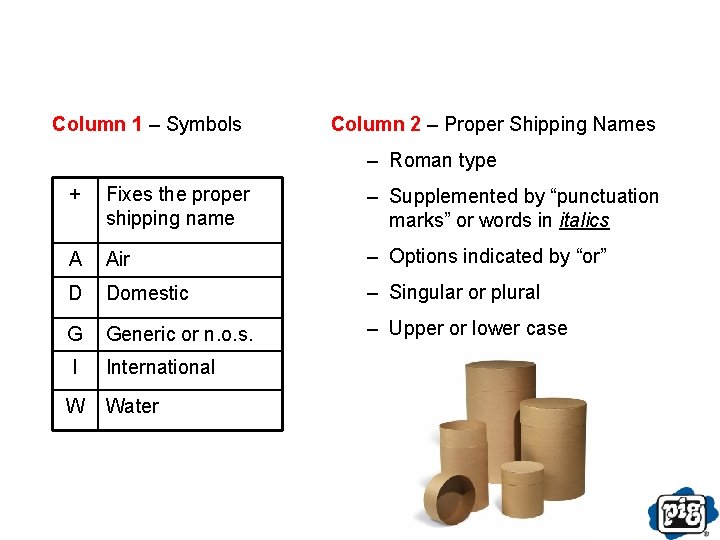
Columns 1 & 2 Column 1 – Symbols Column 2 – Proper Shipping Names – Roman type + Fixes the proper shipping name – Supplemented by “punctuation marks” or words in italics A Air – Options indicated by “or” D Domestic – Singular or plural G Generic or n. o. s. – Upper or lower case I International W Water
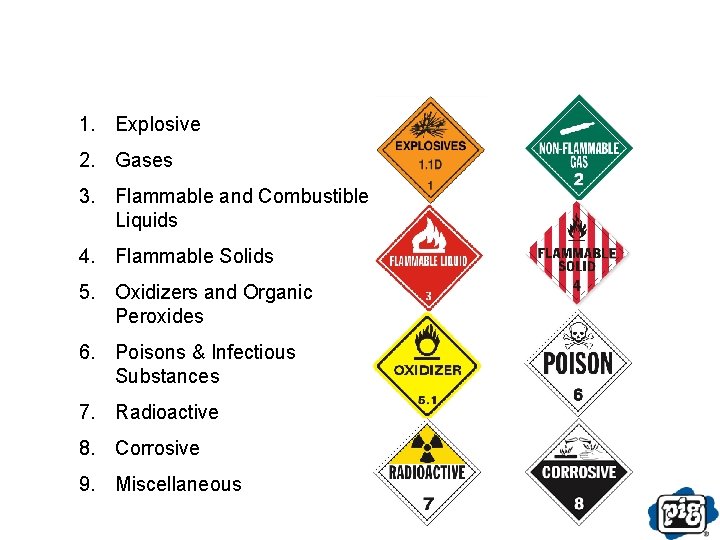
Column 3 – Hazard Class 1. Explosive 2. Gases 3. Flammable and Combustible Liquids 4. Flammable Solids 5. Oxidizers and Organic Peroxides 6. Poisons & Infectious Substances 7. Radioactive 8. Corrosive 9. Miscellaneous
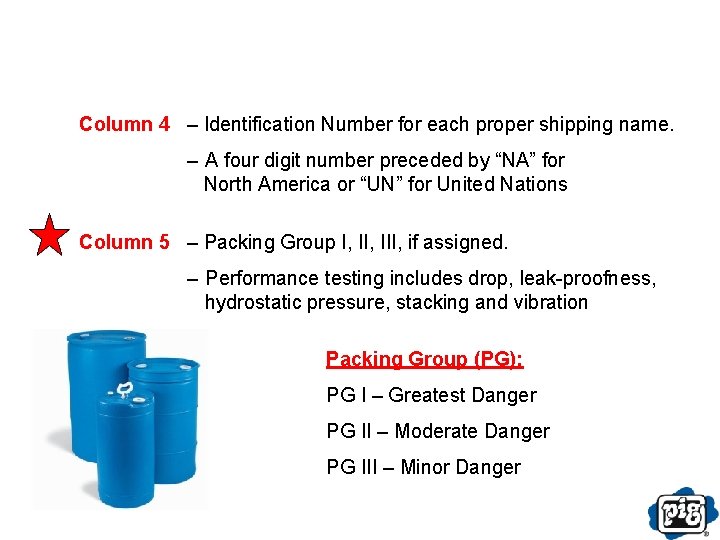
Columns 4 & 5 Column 4 – Identification Number for each proper shipping name. – A four digit number preceded by “NA” for North America or “UN” for United Nations Column 5 – Packing Group I, III, if assigned. – Performance testing includes drop, leak-proofness, hydrostatic pressure, stacking and vibration Packing Group (PG): PG I – Greatest Danger PG II – Moderate Danger PG III – Minor Danger
Columns 6 & 7 Column 6 – Label Codes – Indicates the primary hazard label – Indicate subsidiary hazard labels Column 7 – Special Provisions (§ 172. 102) – Includes packaging provisions, prohibitions and exceptions Transported By: A – Air H – Highway R – Rail W – Water Transported In: B – Bulk N – Non-Bulk T – Intermodal TP – Portable Tanks
Columns 8, 9 & 10 Column 8 – Packaging Authorizations (§ 173. ***) – Exceptions (8 A) – Non-bulk specification packaging (8 B) – Bulk specification packaging (8 C) Column 9 – Quantity Limitations – Passenger Aircraft/Rail (9 A) – Cargo Aircraft Only (9 B) Column 10 – Vessel Stowage Requirements – Cargo and passenger vessels (10 A) – Specific hazardous materials (10 B)
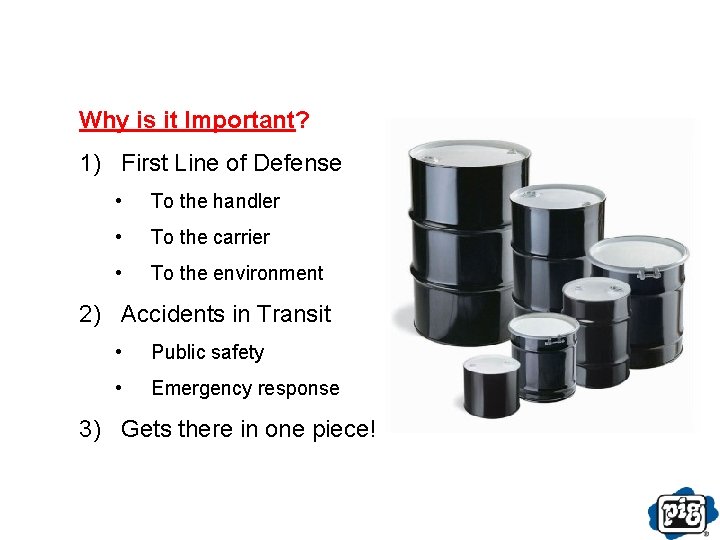
Packaging Why is it Important? 1) First Line of Defense • To the handler • To the carrier • To the environment 2) Accidents in Transit • Public safety • Emergency response 3) Gets there in one piece!
Packaging Selection Steps 1. Identify the Hazardous Material 2. Determine the Packing Group (Column 5) 3. Understand Special Provisions (Column 7) 1. 4. Identify the Packaging Exceptions (Column 8 A) 1. 5. Exceptions are relief from the more stringent packaging requirements Determine Bulk or Non-Bulk (Column 8 B or 8 C) 1. 6. You must always check! Look up the 173. *** for the approved packaging Understand Packaging ID Codes
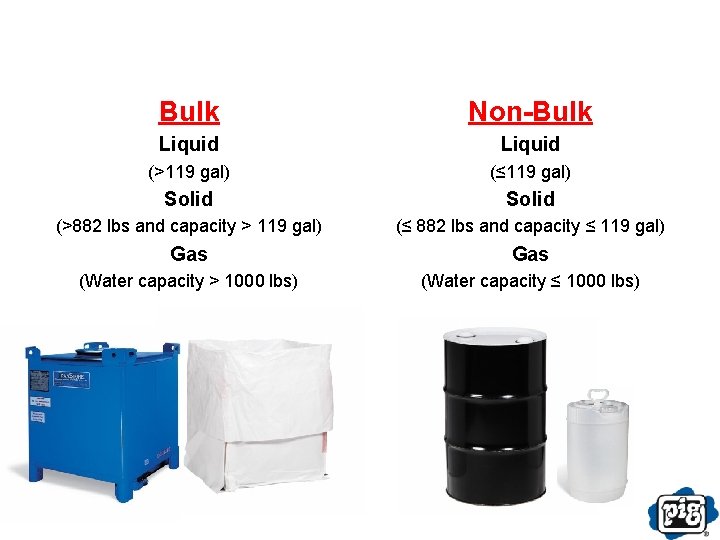
Bulk vs. Non-Bulk Liquid (>119 gal) (≤ 119 gal) Solid (>882 lbs and capacity > 119 gal) (≤ 882 lbs and capacity ≤ 119 gal) Gas (Water capacity > 1000 lbs) (Water capacity ≤ 1000 lbs)
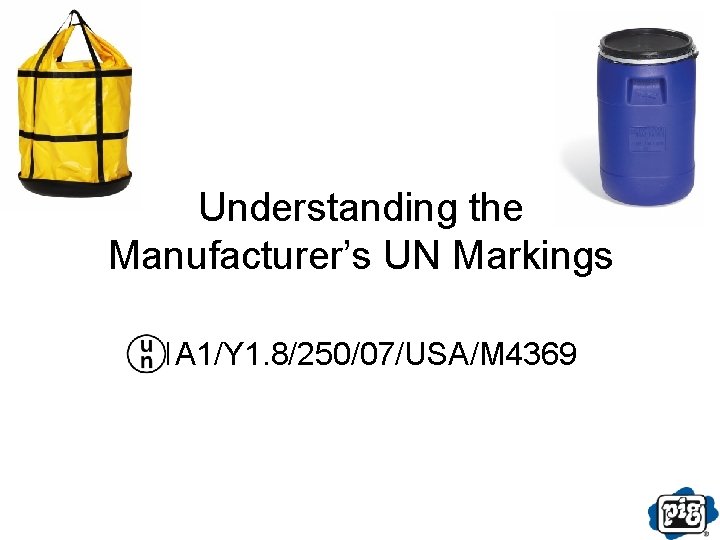
Understanding the Manufacturer’s UN Markings 1 A 1/Y 1. 8/250/07/USA/M 4369
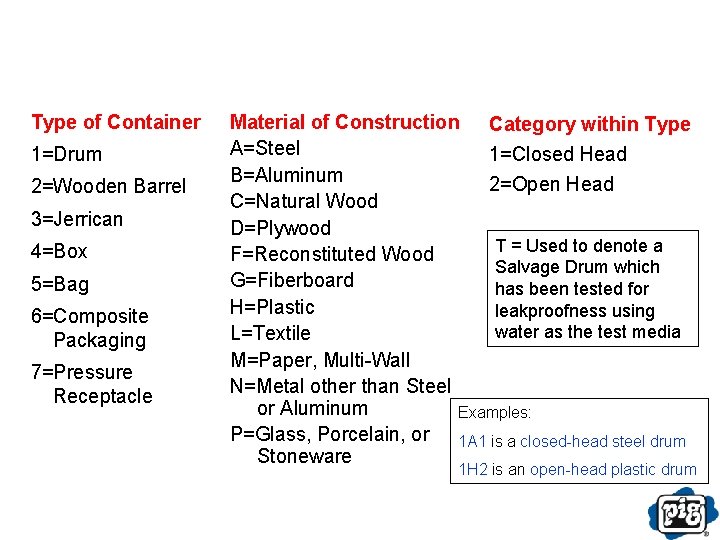
Non-Bulk Packaging Codes Type of Container 1=Drum 2=Wooden Barrel 3=Jerrican 4=Box 5=Bag 6=Composite Packaging 7=Pressure Receptacle Material of Construction Category within Type A=Steel 1=Closed Head B=Aluminum 2=Open Head C=Natural Wood D=Plywood T = Used to denote a F=Reconstituted Wood Salvage Drum which G=Fiberboard has been tested for H=Plastic leakproofness using water as the test media L=Textile M=Paper, Multi-Wall N=Metal other than Steel or Aluminum Examples: P=Glass, Porcelain, or 1 A 1 is a closed-head steel drum Stoneware 1 H 2 is an open-head plastic drum
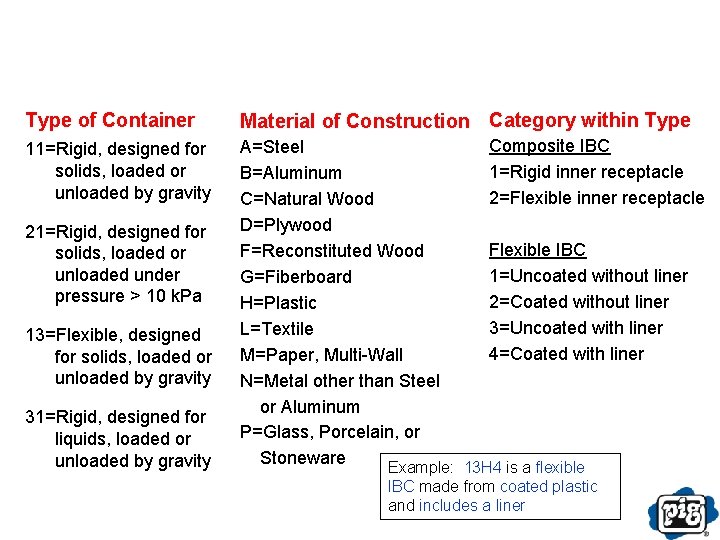
IBC Packaging Codes Type of Container Material of Construction Category within Type 11=Rigid, designed for solids, loaded or unloaded by gravity Composite IBC A=Steel 1=Rigid inner receptacle B=Aluminum 2=Flexible inner receptacle C=Natural Wood D=Plywood Flexible IBC F=Reconstituted Wood 1=Uncoated without liner G=Fiberboard 2=Coated without liner H=Plastic 3=Uncoated with liner L=Textile 4=Coated with liner M=Paper, Multi-Wall N=Metal other than Steel or Aluminum P=Glass, Porcelain, or Stoneware Example: 13 H 4 is a flexible 21=Rigid, designed for solids, loaded or unloaded under pressure > 10 k. Pa 13=Flexible, designed for solids, loaded or unloaded by gravity 31=Rigid, designed for liquids, loaded or unloaded by gravity IBC made from coated plastic and includes a liner
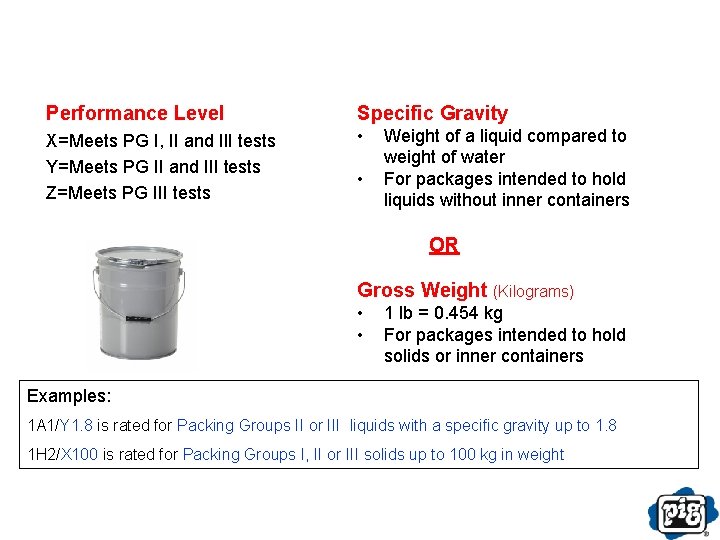
Second Set of Manufacturer’s Markings Performance Level Specific Gravity X=Meets PG I, II and III tests Y=Meets PG II and III tests Z=Meets PG III tests • • Weight of a liquid compared to weight of water For packages intended to hold liquids without inner containers OR Gross Weight (Kilograms) • • 1 lb = 0. 454 kg For packages intended to hold solids or inner containers Examples: 1 A 1/Y 1. 8 is rated for Packing Groups II or III liquids with a specific gravity up to 1. 8 1 H 2/X 100 is rated for Packing Groups I, II or III solids up to 100 kg in weight
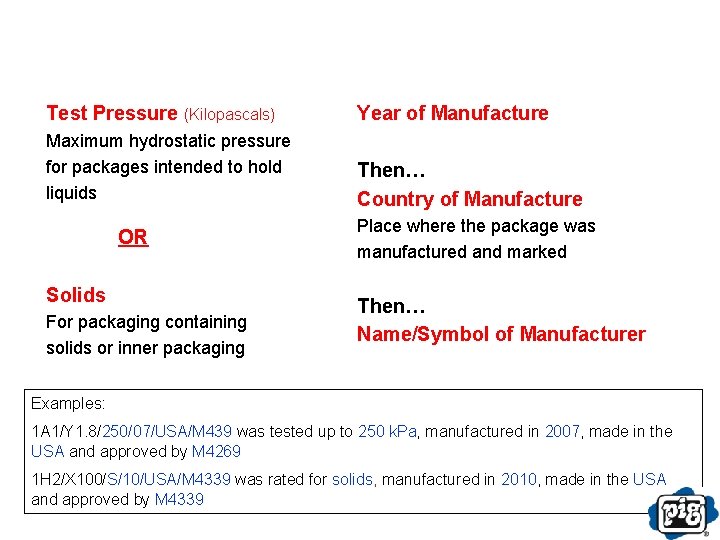
Last Set of Manufacturer’s Markings Test Pressure (Kilopascals) Year of Manufacture Maximum hydrostatic pressure for packages intended to hold liquids Then… Country of Manufacture OR Solids For packaging containing solids or inner packaging Place where the package was manufactured and marked Then… Name/Symbol of Manufacturer Examples: 1 A 1/Y 1. 8/250/07/USA/M 439 was tested up to 250 k. Pa, manufactured in 2007, made in the USA and approved by M 4269 1 H 2/X 100/S/10/USA/M 4339 was rated for solids, manufactured in 2010, made in the USA and approved by M 4339
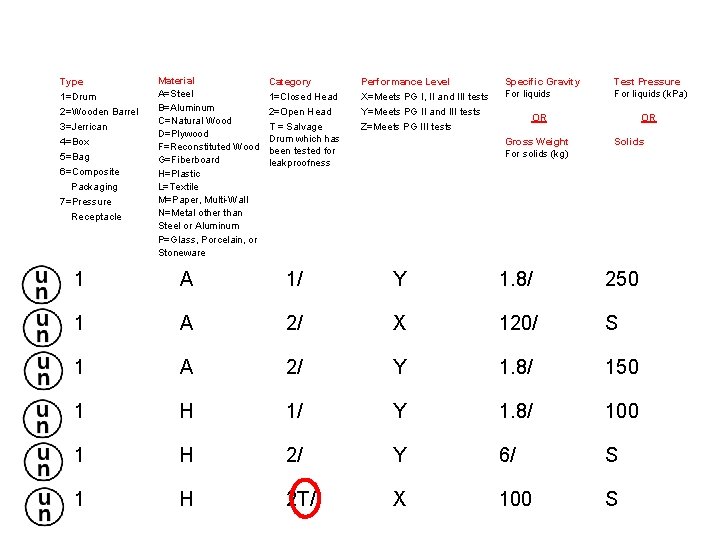
All Together Type 1=Drum 2=Wooden Barrel 3=Jerrican 4=Box 5=Bag 6=Composite Packaging 7=Pressure Receptacle Material A=Steel B=Aluminum C=Natural Wood D=Plywood F=Reconstituted Wood G=Fiberboard H=Plastic L=Textile M=Paper, Multi-Wall N=Metal other than Steel or Aluminum P=Glass, Porcelain, or Stoneware Category 1=Closed Head Performance Level X=Meets PG I, II and III tests 2=Open Head T = Salvage Drum which has been tested for leakproofness Y=Meets PG II and III tests Z=Meets PG III tests Specific Gravity For liquids Test Pressure For liquids (k. Pa) OR Gross Weight For solids (kg) OR Solids 1 A 1/ Y 1. 8/ 250 1 A 2/ X 120/ S 1 A 2/ Y 1. 8/ 150 1 H 1/ Y 1. 8/ 100 1 H 2/ Y 6/ S 1 H 2 T/ X 100 S
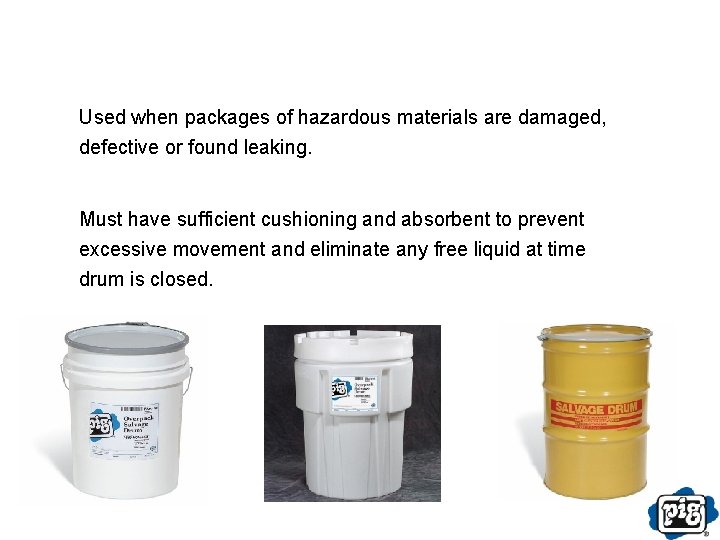
Salvage Drums Used when packages of hazardous materials are damaged, defective or found leaking. Must have sufficient cushioning and absorbent to prevent excessive movement and eliminate any free liquid at time drum is closed.
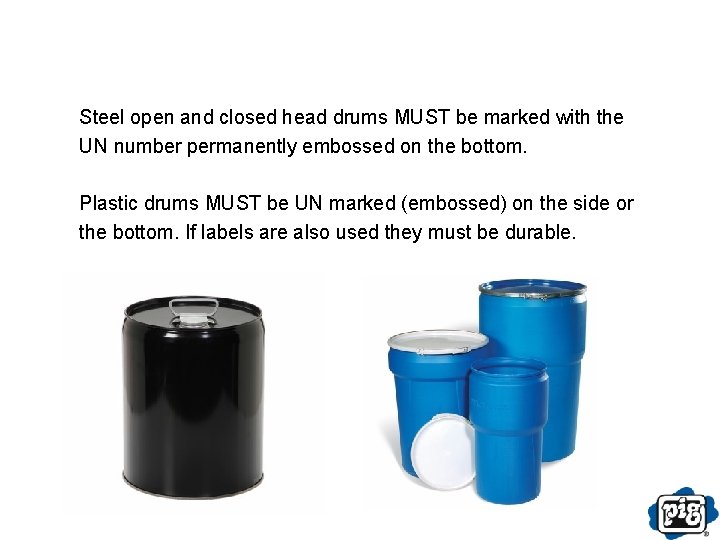
Marking Placement Steel open and closed head drums MUST be marked with the UN number permanently embossed on the bottom. Plastic drums MUST be UN marked (embossed) on the side or the bottom. If labels are also used they must be durable.
Questions? 1 -800 -HOT-HOGS
- Slides: 22