
Hazardous Materials Decontamination Joe Elliot Joe Hansen Craig
- Slides: 45
Hazardous Materials – Decontamination Joe Elliot Joe Hansen Craig Duck 1
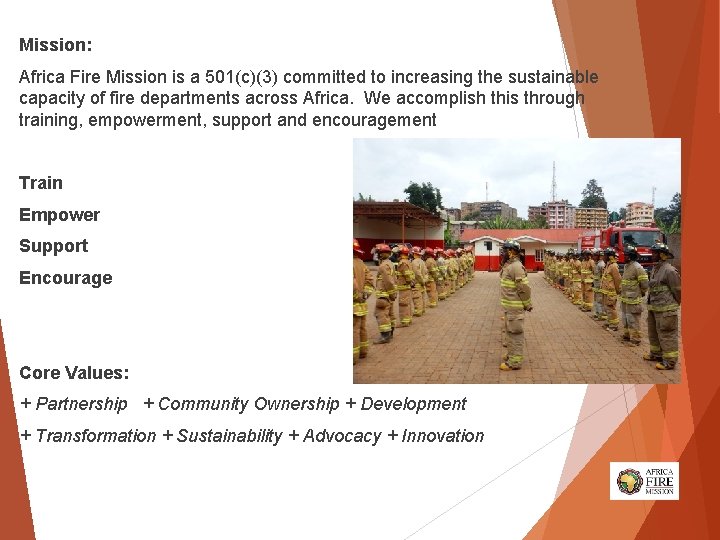
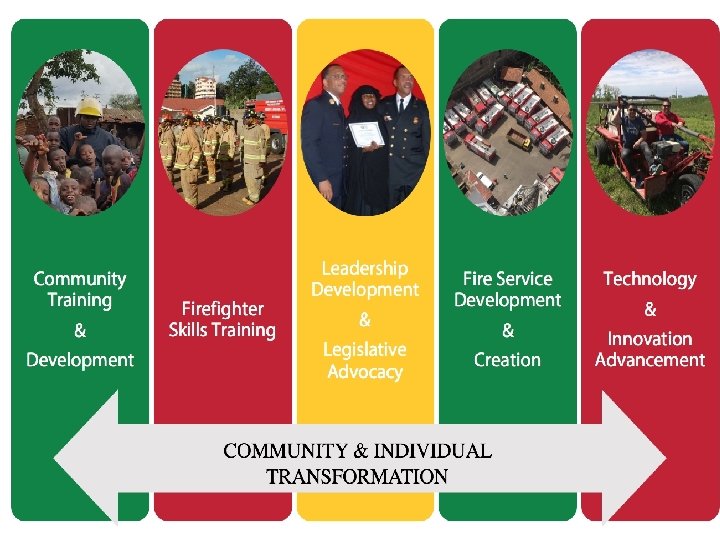
Mission: Africa Fire Mission is a 501(c)(3) committed to increasing the sustainable capacity of fire departments across Africa. We accomplish this through training, empowerment, support and encouragement Train Empower Support Encourage Core Values: + Partnership + Community Ownership + Development + Transformation + Sustainability + Advocacy + Innovation
Introductions –AFM Team Nancy Moore � Craig Duck � Joe Elliott � Joe Hansen � Donovan Weber � Adam Wolf �
Introductions � Name � Rank � What has been your experience with Hazardous Materials? � Is there any specific Technique or Skill that you would like to learn or practice today?
Objectives � Describe how the potential for secondary contamination determines the need for emergency decontamination. � Identify the types of decontamination. � Identify emergency decontamination procedures. � Identify where and how decontamination takes place. 6
Introduction � The fire service responds to the release of hazardous chemicals and agents. � Some chemicals and agents can injure or kill. � Proper decontamination reduces the possibility of injury or death from exposure to these substances. 7
What is Decontamination? � The physical or chemical process of reducing and preventing the spread of hazardous materials by persons and equipment 8
Contamination � Process of transferring a hazardous material from its source to people, animals, the environment, or equipment, which may act as carriers of the contaminant 9
Secondary Contamination (1 of 2) � Occurs when a contaminated person or object comes into direct contact with another person or object � Also known as cross contamination 10
Secondary Contamination (2 of 2) � Can occur when: �Contaminated victim comes into contact with a fire fighter �Bystander comes into contact with a contaminated object �Decontaminated fire fighter reenters the decontamination area and comes into contact with a contaminated person or object 11
Decontamination � Government and industrial agencies responsible for decontaminating the environment � Fire fighters responsible for establishing decontamination corridor for crews and victims 12
Types of Decontamination � Major categories of decontamination: �Emergency �Gross decontamination �Formal �Fine decontamination �Rapid decontamination 13
Emergency Decontamination � Used in potentially life-threatening situations, regardless of a formal decontamination corridor � Formal decontamination process may follow later. � Involves rapid removal of contaminants �Remove contaminated clothing. �Douse victim with large quantities of water. 14
Gross Decontamination (1 of 2) � Controlled through the decontamination corridor � Reduces surface contamination by a continuous shower of water and removal of outer clothing � High-pressure, low-volume water flow used to rinse off and dilute contaminants 15
Gross Decontamination (2 of 2) � Removal of outer clothing before proceeding to the next step �Fire fighters wearing fully encapsulated PPE should continue to wear SCBA. � Proceed to formal decontamination 16
Formal Decontamination � Performed after gross decontamination and is a more thorough cleaning � May involve several stations or steps � Cleaning �Water process spray �Cleaning solution �Scrubbing with brushes or swabs 17
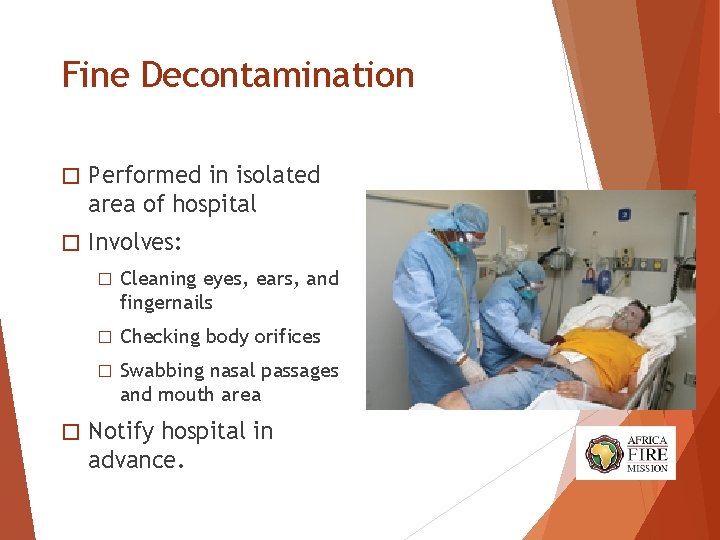
Fine Decontamination � Performed in isolated area of hospital � Involves: � � Cleaning eyes, ears, and fingernails � Checking body orifices � Swabbing nasal passages and mouth area Notify hospital in advance. 18
Rapid Mass Decontamination (1 of 2) � Used in incidents involving unknown agents and large groups of people � Quick performance of gross decontamination � Washing off as much contaminant as possible with a massive water spray is the best and quickest method. 19
Rapid Mass Decontamination (2 of 2) � Primary concern is to remove contaminant from a large number of victims. � Environmental concerns are secondary; usually not time to build structures to contain runoff. � Victims will need further decontamination 20
Methods of Decontamination � Absorption � Solidification � Adsorption � Emulsification � Dilution � Vapor � Disinfection � Disposal dispersion � Removal � Vacuuming 21
Absorption � Spongy material mixed with liquid hazardous material � Contaminated mixture is collected for disposal. � Used to decontaminate equipment and property � Effective only on flat surfaces 22
Adsorption � Contaminant sticks to surface of added material, rather than combines with it. 23
Dilution (1 of 2) � Uses plain water or a soap-andwater mixture � Fast and economical � Used in: �Gross decontamination �Formal �Mass decontamination rapid decontamination 24
Dilution (2 of 2) � Considerations �Will contaminant react with water? �Is contaminant soluble in water? �Will contaminant spread to a larger area? � Water �Increases the hazardous waste generated, complicating safe disposal 25
Disinfection (1 of 2) � Destroys disease-carrying microorganisms � Commercial disinfectants available �Consult product information for capabilities and limitations. 26
Disinfection (2 of 2) � Familiarize yourself with facilities having possible biological hazards. �Research labs �Hospitals �Clinics �Mortuaries �Universities �Medical waste disposal facilities 27
Disposal (1 of 2) � Two-step process for items that cannot be properly decontaminated � Contaminated item is removed and isolated, then packaged and transported to an approved facility. 28
Disposal (2 of 2) � Contaminated �Should disposable coveralls be collected, bagged, and tagged � Contaminated tools and equipment �Should be placed in bags, barrels, or buckets 29
The Decontamination Process (1 of 2) � All personnel leaving hot zone must be decontaminated. � Takes place in decontamination corridor �Between hot zone and warm zone �Clearly marked entry point �Well-lit at night 30
The Decontamination Process (2 of 2) � The decontamination team: �Must wear SCBA �Must wear a level of PPE equal to those being decontaminated �Must undergo decontamination themselves before leaving area 31
Steps in Decontamination (1 of 7) 1. 2. Tools placed in tool drop area � Container � Recovery drum � Special tarp Gross decontamination � Water shower (high-pressure, low-volume water flow) 32
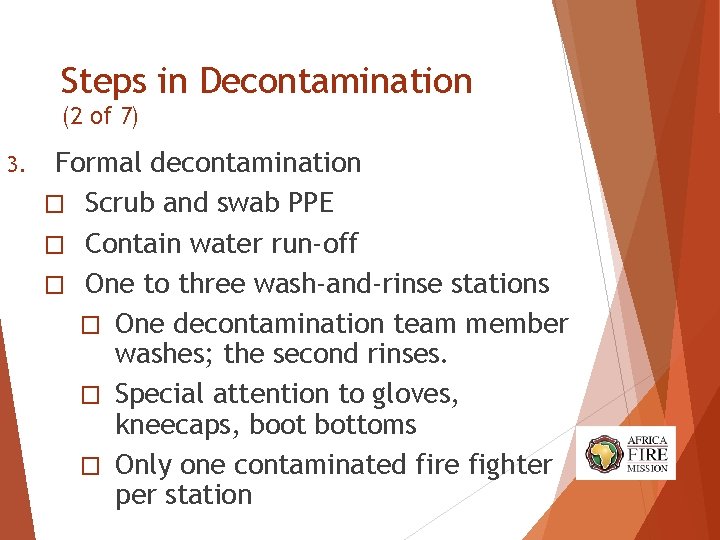
Steps in Decontamination (2 of 7) 3. Formal decontamination � Scrub and swab PPE � Contain water run-off � One to three wash-and-rinse stations � One decontamination team member washes; the second rinses. � Special attention to gloves, kneecaps, boot bottoms � Only one contaminated fire fighter 33 per station
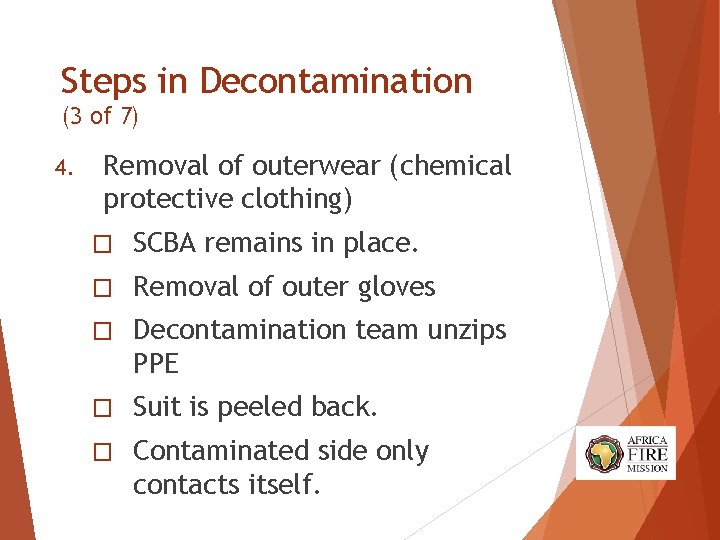
Steps in Decontamination (3 of 7) 4. Removal of outerwear (chemical protective clothing) � SCBA remains in place. � Removal of outer gloves � Decontamination team unzips PPE � Suit is peeled back. � Contaminated side only contacts itself. 34
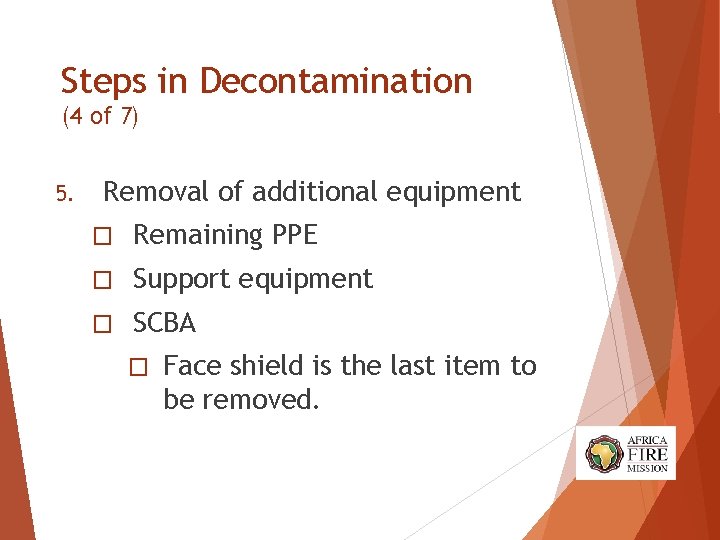
Steps in Decontamination (4 of 7) 5. Removal of additional equipment � Remaining PPE � Support equipment � SCBA � Face shield is the last item to be removed. 35
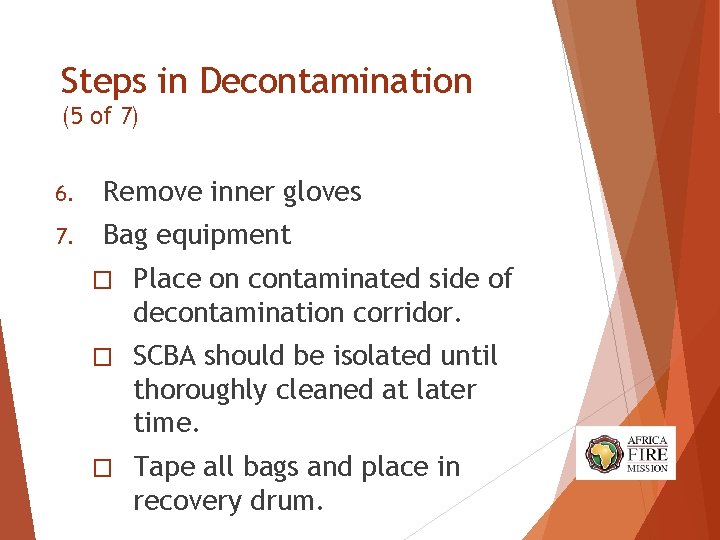
Steps in Decontamination (5 of 7) 6. Remove inner gloves 7. Bag equipment � Place on contaminated side of decontamination corridor. � SCBA should be isolated until thoroughly cleaned at later time. � Tape all bags and place in recovery drum. 36
Steps in Decontamination (6 of 7) 8. Remove personal clothing. 9. Wash entire body. � Overhead shower is more effective than hose line. � Use small brushes and sponges. � Liquid surgical soaps in plastic squeeze bottles give best results. � Special attention to head and groin 37
Steps in Decontamination (7 of 7) 10. 11. Dry using towel or sheet. � Towels used only once � Place dirty towels in bags on contaminated side. Don clean clothes. � Cotton coveralls or hospital gowns � Hospital booties, slippers, or flipflops 38
Medical Follow-up � Medical evaluation following decontamination �Vital signs compared with baseline data � Note and report any open wounds or breaks in skin surface. �Clean and treat appropriately. 39
Summary (1 of 4) � Proper decontamination reduces the possibility of injury or death from exposure to hazardous substances. � Decontamination is the physical or chemical process of reducing and preventing the spread of hazardous materials by persons and equipment. 40
Summary � Five (2 of 4) types of decontamination: �Emergency �Gross �Formal �Fine �Rapid mass 41
Summary (3 of 4) • Ten methods of decontamination: – Absorption – Solidification – Adsorption – Emulsification – Dilution – Vapor dispersion – Disinfection – Removal – Disposal – Vacuuming 42
Summary (4 of 4) � Decontamination corridor established between hot zone and warm zone � All personnel leaving the hot zone must be decontaminated. 43
www. africafiremission. org
33 Hazardous Materials: Decontamination Techniques