
Hazardous Materials Communication Program Employee RighttoKnow Background History
Hazardous Materials Communication Program (Employee Right-to-Know)

Background
History • Issued by OSHA November 25, 1983. • First issued for companies in SIC codes 20 -39. • Applies to manufacturers and importers.
Hazardous Material Defined • Any material that, because of its quantity, concentration, or physical or chemical characteristics, may pose a substantial hazard to human health or the environment when incorrectly used, purposefully released, or accidentally spilled.
What Makes a Substance Hazardous ? • A material is considered hazardous if it exhibits any of the following characteristics beyond predefined levels Toxicity Reactivity Ignitability Corrosivity Bioaccummulative
Mixture Rule • If a mixture has not been tested as a whole, the mixture is assumed to present the same health hazards of hazardous ingredients which compromise more than one percent (0. 01) of the whole. • A mixture is considered to be a carcinogen if any component in concentrations of 0. 10 %, or greater are carcinogenic.
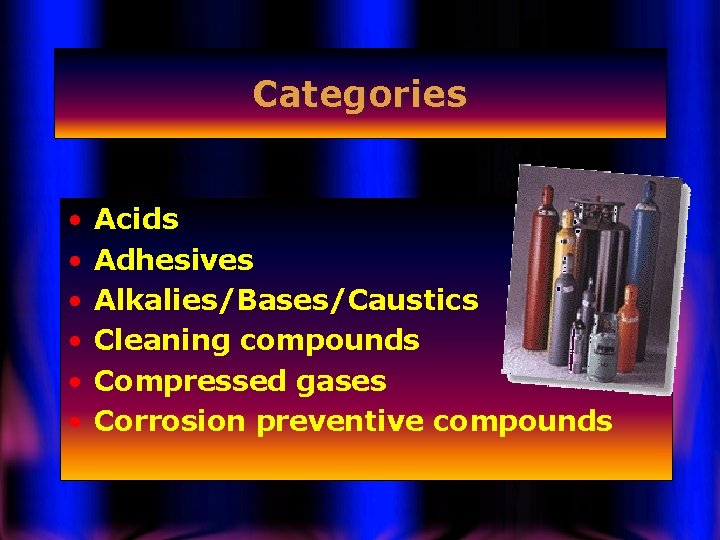
Categories • • • Acids Adhesives Alkalies/Bases/Caustics Cleaning compounds Compressed gases Corrosion preventive compounds
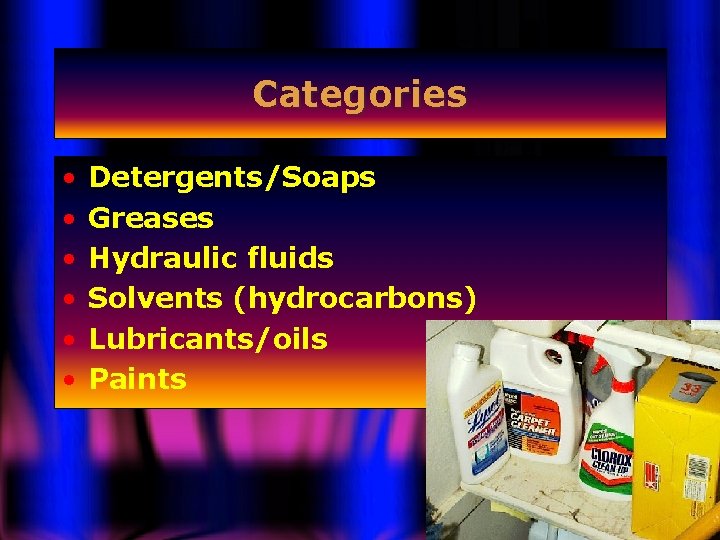
Categories • • • Detergents/Soaps Greases Hydraulic fluids Solvents (hydrocarbons) Lubricants/oils Paints
Categories • • • Water treatment chemicals Oxidizers Fuels Heavy metals Batteries Pesticides
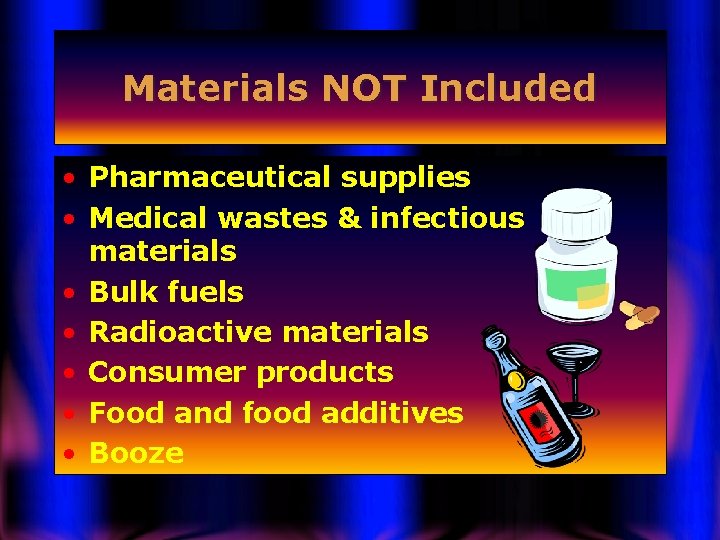
Materials NOT Included • Pharmaceutical supplies • Medical wastes & infectious materials • Bulk fuels • Radioactive materials • Consumer products • Food and food additives • Booze
Employee Rights • The right to receive information regarding hazardous substances. • Your physician or collective bargaining agent may also receive this same information. • Review new or revised MSDS within 30 days of receipt and prior to using those materials.
Scope • Manufacturers must properly label hazardous materials & provide Material Safety Data Sheets (MSDS) for each hazardous material produced • The hazardous materials user-– Must be familiar with hazards & precautions – Must be familiar with MSDSs – Must use and understand hazardous materials labels
Hazardous Materials Labeling
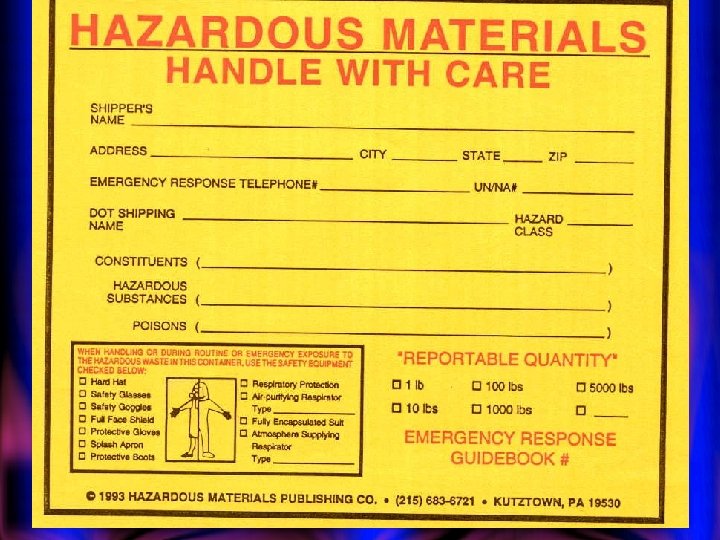
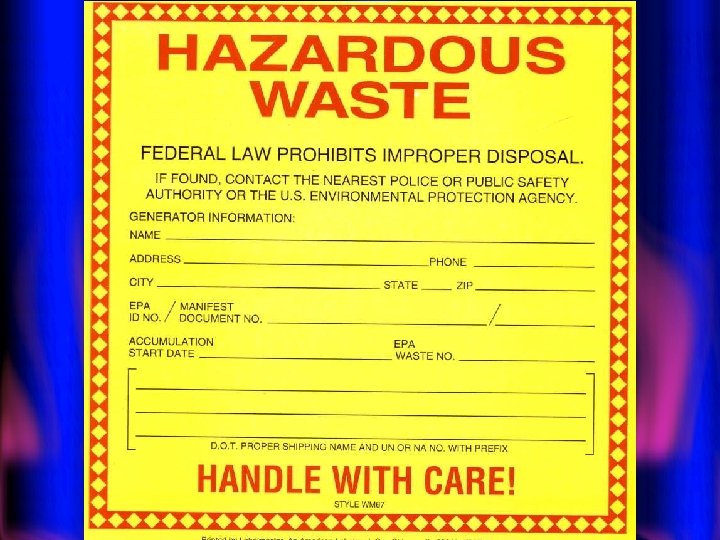
Original Container Labels • Manufacturer must provide shipper/handler/user with information on hazardous materials • Every container of hazardous materials must be labeled • Label requirements-– Identity of material or chemical – Name & address of manufacturer or responsible party – Appropriate hazard warning – Target organ

Secondary Containers • If hazardous material is dispensed into an unmarked container, the container must be labeled with the following information: – Identity of material or chemical – Appropriate hazard warning

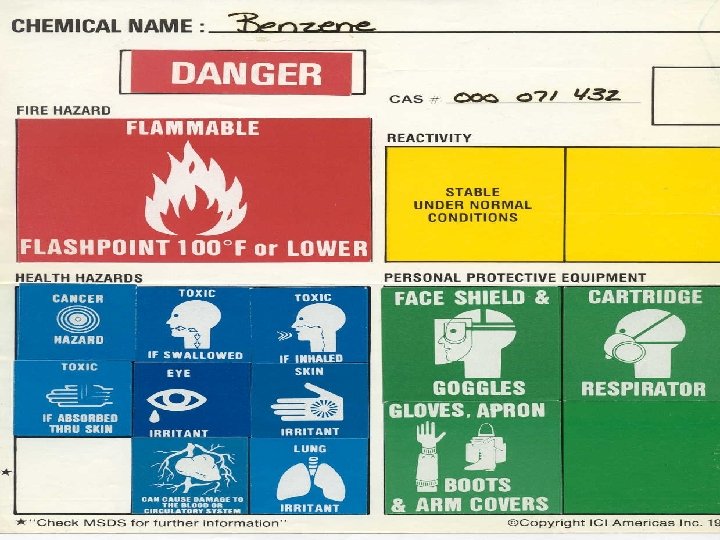
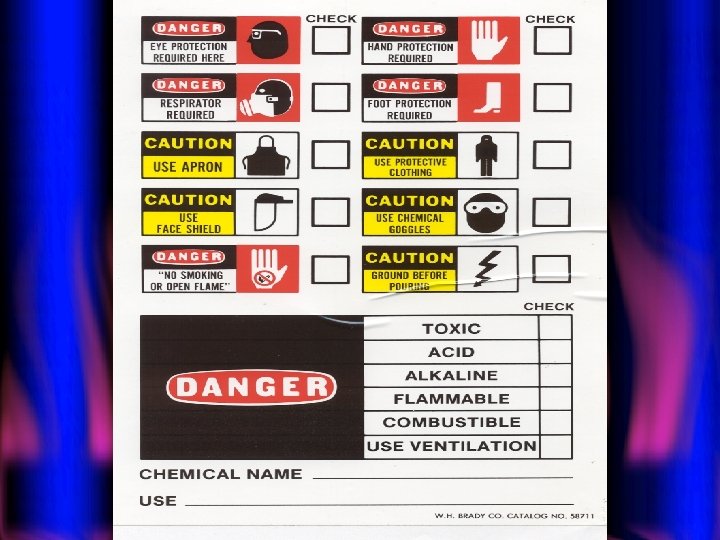
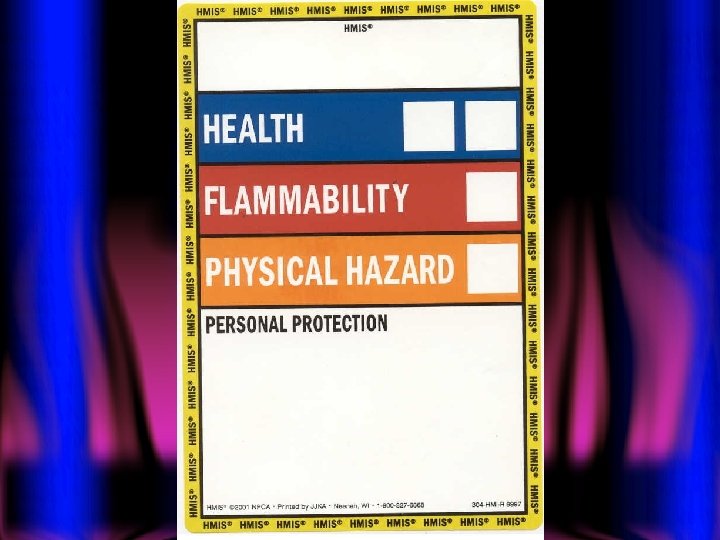
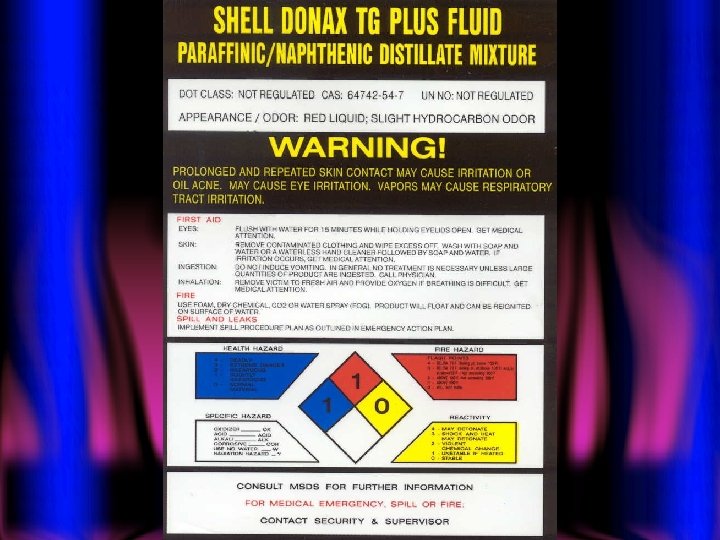
Hazardous Material Information Guide (HMIG) • Acuity’s system for labeling? • Replaces illegible and/or damaged labels • Labels for secondary containers

Wallet Card • Quick reference guide • Icon depiction of PPE • Letters refer to groups of needed PPE
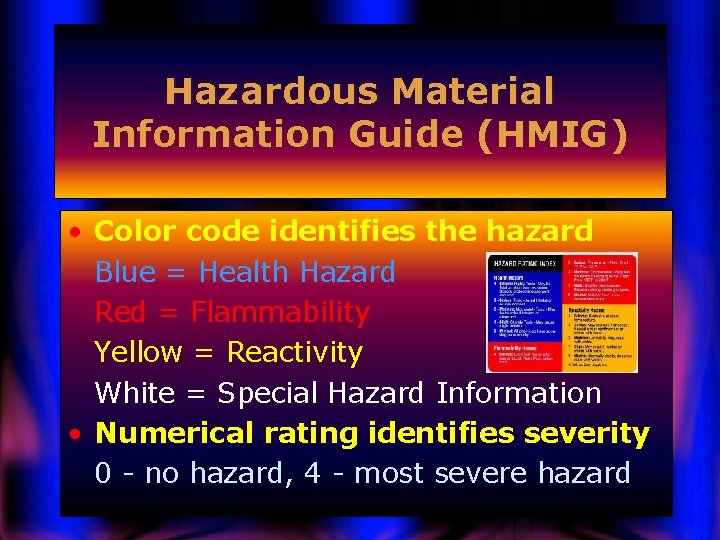
Hazardous Material Information Guide (HMIG) • Color code identifies the hazard Blue = Health Hazard Red = Flammability Yellow = Reactivity White = Special Hazard Information • Numerical rating identifies severity 0 - no hazard, 4 - most severe hazard
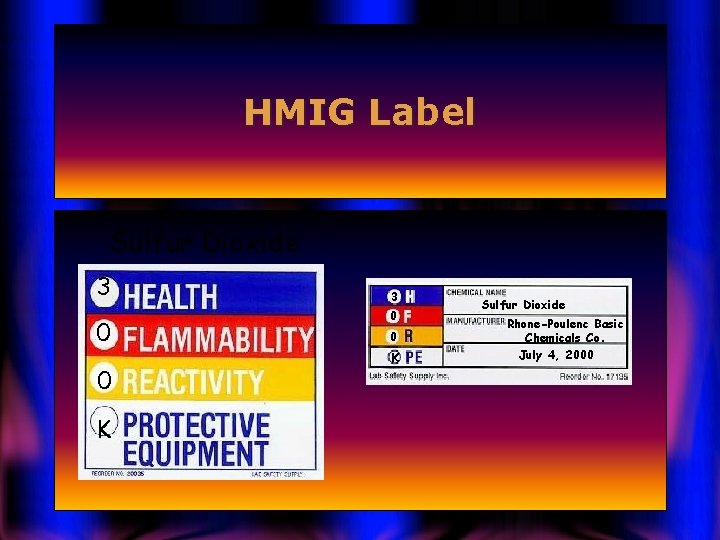
HMIG Label Sulfur Dioxide 3 0 0 K Sulfur Dioxide Rhone-Poulenc Basic Chemicals Co. July 4, 2000
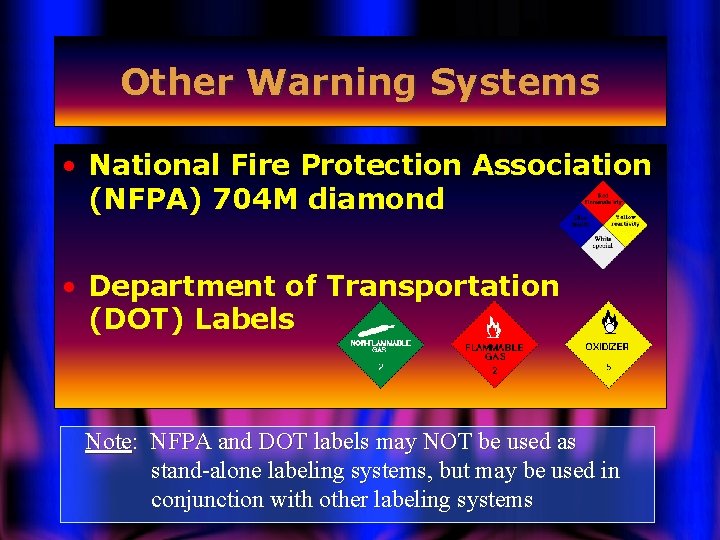
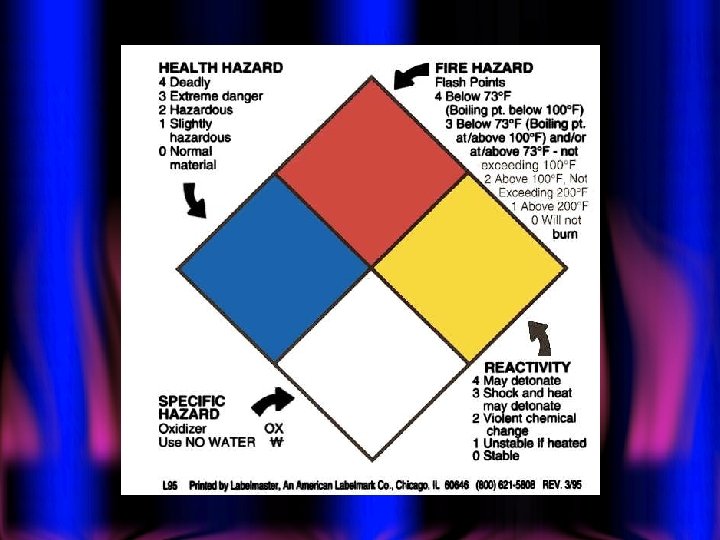
Other Warning Systems • National Fire Protection Association (NFPA) 704 M diamond • Department of Transportation (DOT) Labels Note: NFPA and DOT labels may NOT be used as stand-alone labeling systems, but may be used in conjunction with other labeling systems
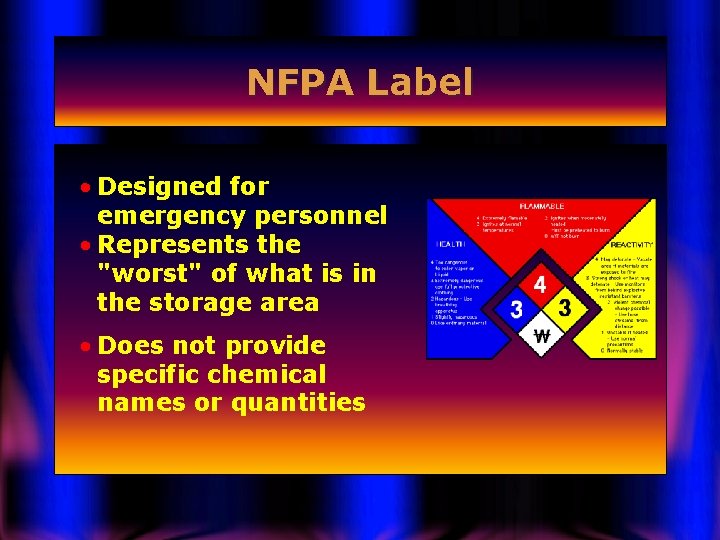
NFPA Label • Designed for emergency personnel • Represents the "worst" of what is in the storage area • Does not provide specific chemical names or quantities

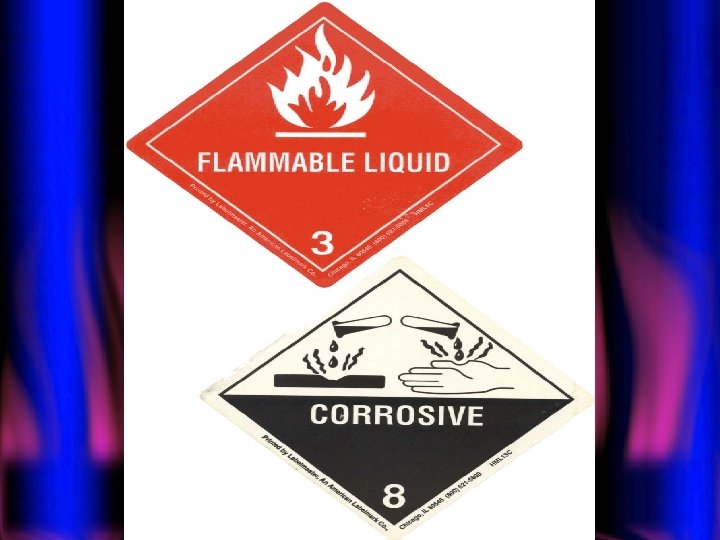
DOT Warning System DOT uses a system of • • Numbers Labels Symbols, and Classes to identify the hazardous material and its hazardous characteristics System is used for shipping of hazardous materials
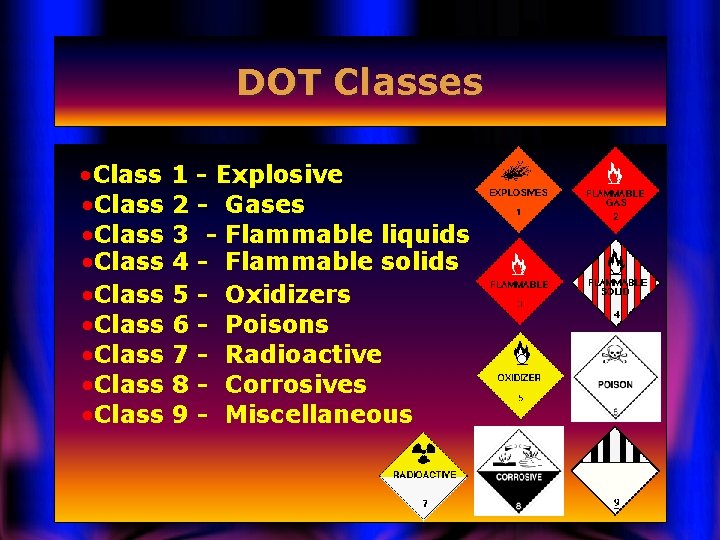
DOT Classes • Class 1 - Explosive • Class 2 - Gases • Class 3 - Flammable liquids • Class 4 - Flammable solids • Class 5 - Oxidizers • Class 6 - Poisons • Class 7 - Radioactive • Class 8 - Corrosives • Class 9 - Miscellaneous

Material Safety Data Sheets (MSDS)
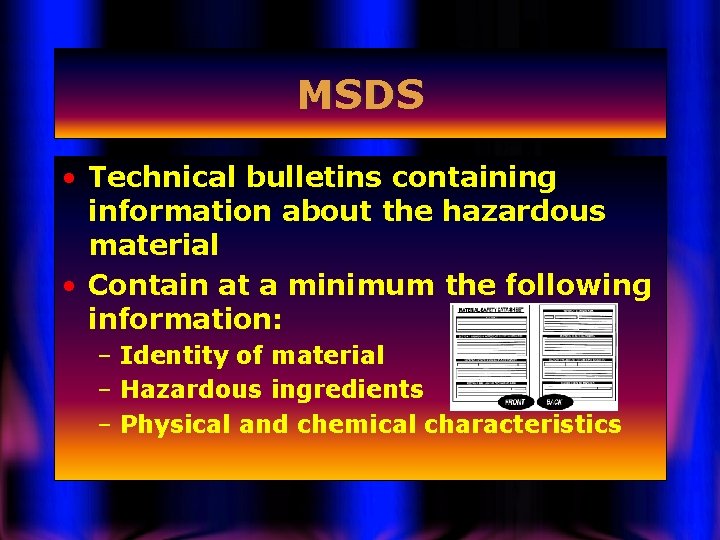
MSDS • Technical bulletins containing information about the hazardous material • Contain at a minimum the following information: – Identity of material – Hazardous ingredients – Physical and chemical characteristics
MSDS Information – Physical hazards (fire, explosion, reactivity) – Health hazards (routes of entry, exposure limits, and cancer potential) – Precautions for safe handling & use – Emergency first aid procedures – MSDS preparation date – Name, address & phone number of chemical manufacturer, importer, employer who can provide additional information
MSDS Requirements • Maintained for every item of hazardous material in the work area • Readily accessible to personnel who use hazardous materials • Supervisors provide instruction in understanding and use • All personnel trained on dangers and precautions of hazardous materials prior to use

Responsibilities
Superintendents Supervisors • Ensure PPE available for hazardous material operations and personnel trained on use • Make personnel available to receive hazardous material training • Ensure use of approved storage containers
Superintendents Supervisors • Provide control and management of the hazardous materials • Maintain MSDS • Ensure personnel are trained • Ensure hazardous materials are labeled when dispensed into other containers
All Staff • Properly use and handle hazardous materials • Report spills to supervisor • Label hazardous materials when dispensed into other containers
Hazardous Materials Handling
General Requirements • Handle incompatible materials in separate compartments to prevent mixing • Never mix incompatible materials in the same collection containers • Avoid breathing vapors or dust from hazardous materials • Avoid contact with eyes and skin
General Requirements • Do not smoke, eat, or drink where hazardous materials are used • Use appropriate PPE • Use appropriately selected & fitted respirator
Hazardous Materials Storage
Storage Materials normally thought to be safe may become hazardous under certain conditions. When containers leak or are heated, chemical reactions may result, leading to fire, explosion, or release of toxic reaction products.
Determining Storage Requirements • Is the hazardous material compatible with other chemicals? • What is the hazard classification? – Oxidizer, acid, flammable, base, etc. • Any special storage requirements on MSDS? • What is the flash point of the material?
Storage Requirements • Hazardous materials storage locations must be posted with caution signs • Ensure lockers and cabinets used for in-use flammable storage labeled
Storage Requirements • Storage areas must be properly marked • Do not transfer material to any container used for a different material – Some materials might be incompatible! • Store incompatible materials in separate compartments to prevent mixing if spilled
Storage Requirements • Store hazardous materials in compatible containers – No corrosives in metal drums! • Stack containers so as to avoid crushing lower containers, or access difficulty • Do not eat, smoke, or drink in storage locations
Storage Requirements • No open flames or other ignitions sources in storage areas • Use only explosion-proof devices in potentially explosive environments • Maintain explosion-proof fixtures in proper condition • Seal & protect containers against physical damage
Storage Requirements • Only store hazardous materials in areas designated for hazardous materials storage
Storage Requirements • Only store hazardous materials in areas designated for hazardous materials storage
Health Hazards
Toxicity • The quality of being poisonous; having harmful effects. • "Everything is a poison, nothing is a poison, the dose alone makes the poison. ” -Paracelsus, 1493 -1541 • The toxicity of a substance is due to its ability to damage or disrupt the metabolism of living tissue.
Routes of Entry Oral = Ingestion by mouth Dermal = Skin exposure Inhalation = Absorbed by lungs Ocular = Eye exposure
Toxic Effects May Occur: • During or soon after exposure (acute), and • After repeated exposures over a long time (chronic). In addition, some people may be especially sensitive (allergic) to a substance.
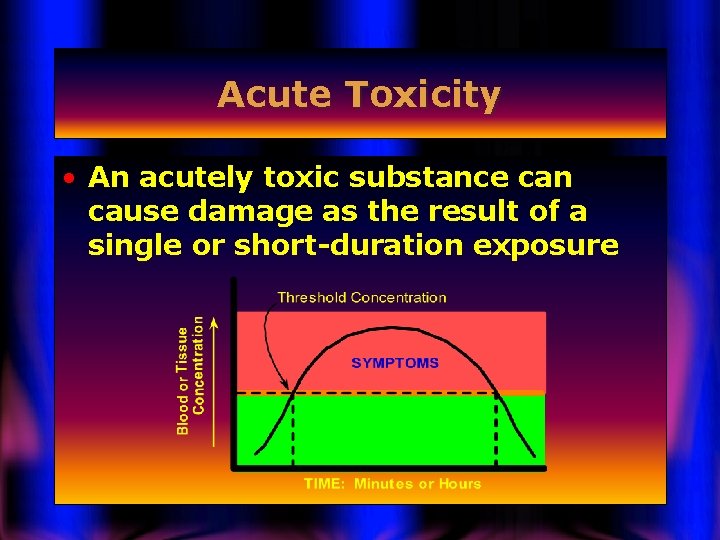
Acute Toxicity • An acutely toxic substance can cause damage as the result of a single or short-duration exposure
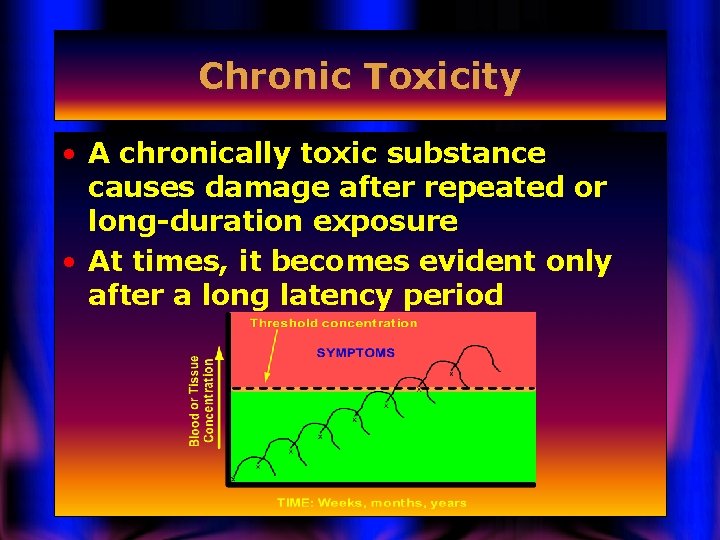
Chronic Toxicity • A chronically toxic substance causes damage after repeated or long-duration exposure • At times, it becomes evident only after a long latency period
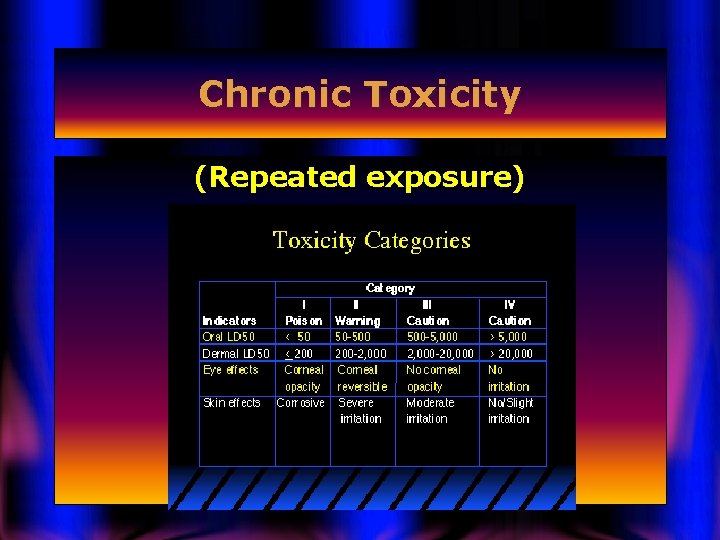
Chronic Toxicity (Repeated exposure)
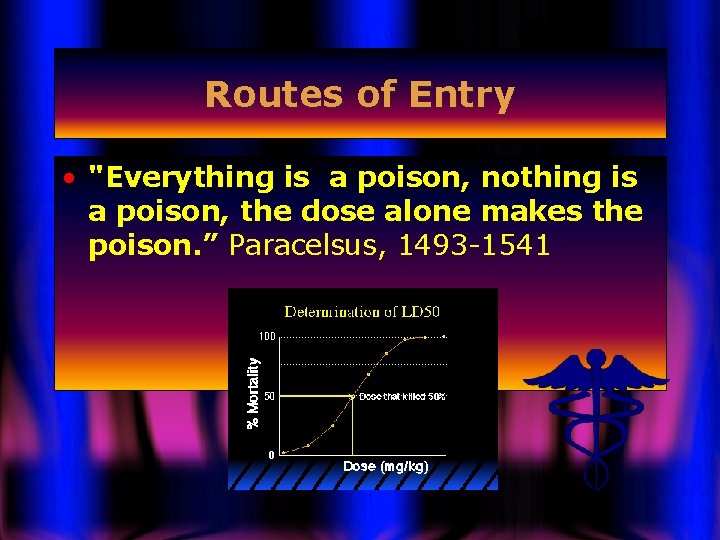
Routes of Entry • "Everything is a poison, nothing is a poison, the dose alone makes the poison. ” Paracelsus, 1493 -1541
GENERAL CONCEPTS OF TOXICOLOGY EVERYTHING IS TOXIC; IT ALL DEPENDS ON THE DOSE How Well the Body Accepts a Substance Depends on: þ þ The Type of Substance. The Amount (Dose) Absorbed. The Period of Time Over Which It Is Absorbed. The Susceptibility/Sensitivity of the Person Exposed.
GENERAL CONCEPTS OF TOXICOLOGY EXPOSURE TERMINOLOGY þ Local Effect. Damage to Body Parts That Actually Contact The Harmful Substance (Acid on a Hand). þ Systemic Effect. Damage to an Area of the Body After The Substance Is Absorbed (Liver Damage). þ Individual Susceptibility. Some People Are Naturally Sensitive or Can Develop Sensitivity to a Substance. þ Dose. Combination of Concentration and Length of Bodily Exposure to a Specific Material.
GENERAL CONCEPTS OF TOXICOLOGY EXPOSURE TERMINOLOGY Hazardous Material. A Material That Falls Into One or More Of the Following Categories. þ Ignitability Is Flammable or Combustible. þ Reactivity Can React With Itself or Other Materials. þ Corrosivity Can Deteriorate Another Substance. þ Toxicity In Its Normal State Is Harmful to Living Things.
GENERAL CONCEPTS OF TOXICOLOGY EXPOSURE LIMITS SOURCES INCLUDE: þ American Conference of Gov. Industrial Hygienists (ACGIH) þ Occupational Safety and Health Administration (OSHA þ National Institute for Occupational Safety and Health (NIOSH
GENERAL CONCEPTS OF TOXICOLOGY EXPOSURE LIMITS þ American Conference of Government Industrial Hygienists: ü Threshold Limit Values (TLV). (Respiratory) ü Biological Exposure Indices (BEI). (Dermal) ü 8 Hour Time Weighted Averages (TWA). - How Much a Worker Can Be Exposed to in an 8 Hr. Shift. ü Published by ACGIH Annually, Provides Exposure Levels. ü Legally Enforceable.
GENERAL CONCEPTS OF TOXICOLOGY EXPOSURE LIMITS þ Occupational Safety and Health Administration (OSHA): ü ü Permissible Exposure Limits (PEL’s) Found in 29 CFR 1910. 1000 (The “Z” Tables) Establishes OSHA’s Exposure Levels Legally Enforceable
GENERAL CONCEPTS OF TOXICOLOGY EXPOSURE LIMITS þ National Institute for Occupational Safety And Health (NIOSH): ü Recommended Exposure Limits (REL’s) ü Used to Develop New OSHA Standards ü Found in: “NIOSH Recommendations for Occupational Health Standards”
SPECIFIC TYPES OF HAZARDS AIR CONTAMINANTS þ Gases. Generally Used in a Compressed Form. Can Effect All Routes of Entry. þ Vapors. Formed by Evaporation of Liquids or Solids. Amount Usually Depends Upon Exposed Surface Area, Temperature, and Vapor Pressure Of Substance. Can Be Deadly.
SPECIFIC TYPES OF HAZARDS AIR CONTAMINANTS þ Fumes. Usually Metallic and Formed by Welding, Cutting, or Brazing Operations. Extremely Hazardous to Inhale. þ Particulates. Composed of Solid or Liquid Particles That Are Suspended or Dispersed in Air. Such As Dust, Mists, or Smokes. Can Be Explosive And Hazardous to Breath.
SPECIFIC TYPES OF HAZARDS ACIDS AND BASES - Ph. The p. H of a Liquid Is the Numerical Measure Of Its Relative Acidity or Alkalinity. The Range Is From 0 - 14 With a Neutral Level Expressed As A p. H of 7. 0. þ Above 7. 0 The Liquid Is More Alkaline or Basic. þ Below 7. 0 The Liquid Is More Acidic.
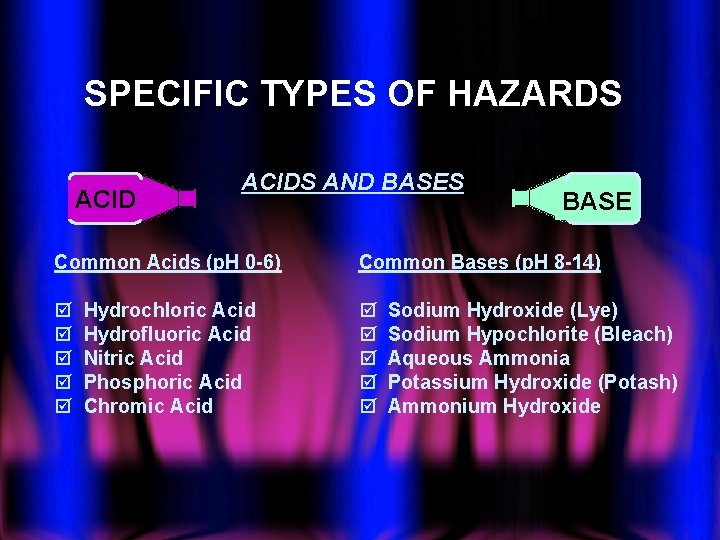
SPECIFIC TYPES OF HAZARDS ACIDS AND BASES BASE Common Acids (p. H 0 -6) Common Bases (p. H 8 -14) þ þ þ þ þ Hydrochloric Acid Hydrofluoric Acid Nitric Acid Phosphoric Acid Chromic Acid Sodium Hydroxide (Lye) Sodium Hypochlorite (Bleach) Aqueous Ammonia Potassium Hydroxide (Potash) Ammonium Hydroxide
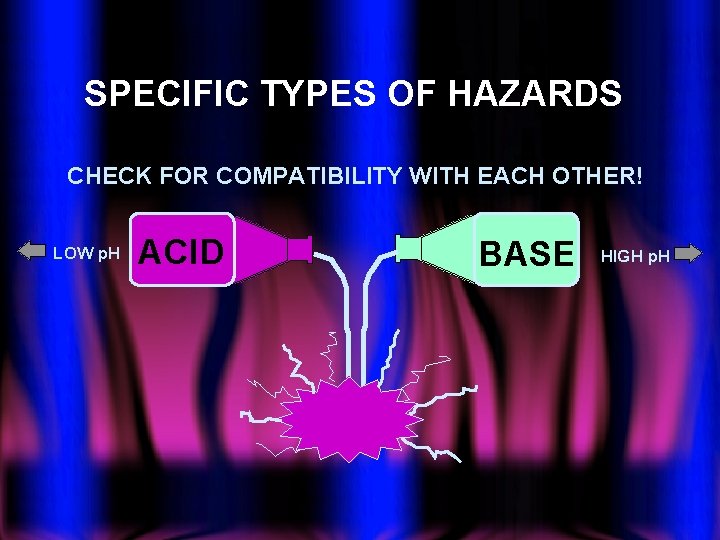
SPECIFIC TYPES OF HAZARDS CHECK FOR COMPATIBILITY WITH EACH OTHER! LOW p. H ACID BASE HIGH p. H
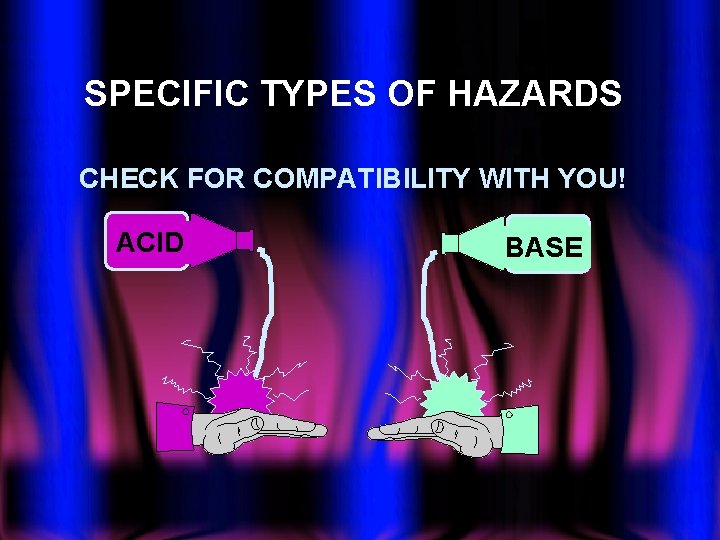
SPECIFIC TYPES OF HAZARDS CHECK FOR COMPATIBILITY WITH YOU! ACID BASE
SPECIFIC TYPES OF HAZARDS ACIDS and BASES - GENERAL PRECAUTIONS þ þ þ þ If You’re Not Familiar With the Chemical, Find Out! Read the Material Safety Data Sheet! Read the Labels on Containers. Observe Written Warnings! Don’t Eat, Drink, or Smoke Around Chemicals. Change Your Cloths! Don’T Take It Home! Ensure Work Area Is Ventilated. Wear Appropriate Protective Equipment.
SPECIFIC TYPES OF HAZARDS ACIDS and BASES - GENERAL PRECAUTIONS þ þ þ Wear Appropriate Protective Equipment. Clean up Small Spills to Prevent Being Mistaken For Water. For Large Spills, Contact Safety Officer. Store Acids From Bases to Prevent Reactions. Know the Reactions That Can Occur From Other Materials. Always Add Acid to Water, Never Water to Acid!
SPECIFIC TYPES OF HAZARDS CLASSES OF SOLVENTS ORGANIC (CARBON BEARING) SOLVENTS: þ Organic Solvents Contain Carbon. þ Organic Solvents Include: Acetone, Gasoline, Stoddard Solvent, and Trichloroethylene. þ Drastic Effects on the Central Nervous System Can Occur If Proper Ventilation Is Not Used.
SPECIFIC TYPES OF HAZARDS ROUTES OF ENTRY FOR SOLVENTS INHALATION: þ þ þ Most Common Route of Entry. Causes Headache, Dizziness, Confusion, And Drowsiness. Odor Intensity is Usually Not a Good Determination Of Toxicity. Odors - More Could Mean Less, Less Could Mean More. Different Solvents Seek Different Target Organs In the Body.
SPECIFIC TYPES OF HAZARDS ROUTES OF ENTRY FOR SOLVENTS INGESTION: þ þ Eating, Drinking, or Smoking Without Washing Hands First. Eating, Drinking, or Smoking Contaminated Consumables. Can Cause Severe Irritation of Gastro-Intestinal Tract. Easily Penetrates Mucous Membranes to Enter The Blood Stream.
SPECIFIC TYPES OF HAZARDS ROUTES OF ENTRY FOR SOLVENTS ABSORPTION: þ þ þ Prevent Skin Contact, Wear Gloves, Aprons, Etc. Can Occur Through Unbroken Skin or Mucous Membranes. Any Absorption Generally Will Cause Irritation Of Skin. Flush Skin for at Least Fifteen Minutes, Seek Medical Help. Never Wash Exposed Skin With Any Solvent.
SPECIFIC TYPES OF HAZARDS ROUTES OF ENTRY FOR SOLVENTS INJECTION: þ þ Usually Caused by Puncture Wounds. Compressed Air Can Also Cause Injection of Solvents. Rapid Introduction of Solvents Into Bloodstream. May Inject Other Debris in Wound Causing Concern.
SPECIFIC TYPES OF HAZARDS SOLVENTS - GENERAL PRECAUTIONS þ IF YOU’RE NOT FAMILIAR WITH THE SOLVENT, FIND OUT! þ READ THE MATERIAL SAFETY DATA SHEET! þ READ THE LABELS ON CONTAINERS. þ OBSERVE WRITTEN WARNINGS! þ DON’T EAT, DRINK, OR SMOKE AROUND SOLVENTS. þ CHANGE YOUR CLOTHS! DON’T TAKE IT HOME! þ ENSURE WORK AREA IS WELL VENTILATED.
SPECIFIC TYPES OF HAZARDS SOLVENTS - GENERAL PRECAUTIONS (CONTINUED) þ WEAR APPROPRIATE PROTECTIVE EQUIPMENT. þ USE A BARRIER CREAM, IF YOU’RE SOLVENT SENSITIVE. þ SPILLS MUST BE CONTAINED, IMMEDIATELY! þ FOR LARGE SPILLS, CONTACT SAFETY OFFICER. þ KNOW THE REACTIONS THAT CAN OCCUR. þ NEVER DISCOUNT ANY ROUTE-OF-ENTRY!
SPECIFIC TYPES OF HAZARDS TERATOGEN: (Latin - “The Study of Monsters”) ü ü The Study of Congenital Malformations Relatively New Discipline (1941) First Correlated German Measles to Birth Defects Causes of Congenital Malformations - Heredity - Maternal Diseases Like German Measles - Maternal Viral Infections During Pregnancy - Maternal Malnutrition - Physical Injury - Ionizing Radiation Exposure - Chemical Exposure
SPECIFIC TYPES OF HAZARDS TERATOGEN AFFECTS IN LAB ANIMALS: ü Review the Respective Material Safety Data Sheet ü Chemicals Having Potential Teratogenic Effects - Quinine - Boric Acid - Insecticides - Pesticides - Chloroform - Carbon Tetrachloride - Benzene - Xylene - Propylene Glycol
SPECIFIC TYPES OF HAZARDS TERATOGEN AFFECTS IN HUMANS: ü Review the Respective Material Safety Data Sheet ü Agents Having Conclusive Teratogenic Effects - Anesthetic Gases - Organic Mercury Compounds - Ionizing Radiation - German Measles - Thalidomide
SPECIFIC TYPES OF HAZARDS MUTAGENIC: ü ü Potential to Cause Mutation in the Genetic Code Can Cause Changes in Chromosomes Review the Respective Material Safety Data Sheet Agents Shown to Cause Potential Mutagenic Effects - Hydrogen Peroxide (a Bleaching Agent) - Ethyleneimine (an Alkylating Agent) - Ethylene Oxide (Hospital Sterilant) - Hydrazine (Used in Rocket Fuel) - Ionizing Radiation Exposure - Benzene
SPECIFIC TYPES OF HAZARDS CARCINOGENIC: ü ü Can Induce a Malignant Tumor in Humans Has a Potential to Cause Cancer Can Cause or Accelerate Tumors Some Confirmed or Suspected Human Carcinogens - Acrylimide - Acrylonitrile - 4 -Aminodiphenyl - Arsenic - Benzine - Benzidine - Beryllium - Calcium Chromate - Chromium (Vi) - Ethylene Dichloride - Ethylene Oxide - Lead Chromate - Nickel Sulfide - Tetranitromethane - O-Tolidine - Vinyl Bromide - Xylidine - Zinc Chromates
CHEMICAL HAZARDS • • • Fire Hazards Explosive Hazards Toxic Hazards Corrosive Hazards Chemical Reactivity Physical Properties
Fire Hazards • • Combustibility Flammability Pyrophorics Gas or Vapor Explosions
Combustibility • • The ability of a material to act as a fuel OSHA says combustibles have flash point between 100° F and 200° F • Anything that can be readily ignited and sustain a fire • Anything that can’t is considered noncombustible
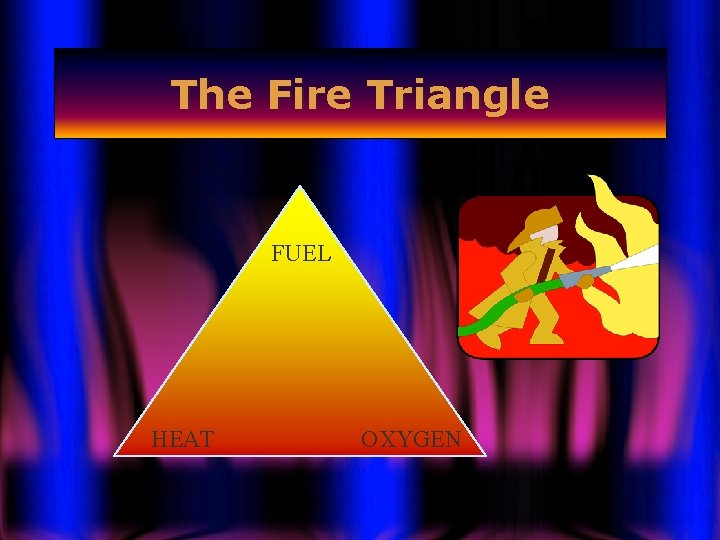
The Fire Triangle FUEL HEAT OXYGEN
Flammability • The ability of a material (gas or liquid) to produce sufficient vapors to be ignited and produce a flame under normal conditions. • There must be a proper fuel to air mixture to sustain combustion. Each material has its own mixture range called “Flammable Range”.
UFL and LFL • Concentrations < the LFL will not burn because they are too “lean”. • Concentrations > the UFL will not burn because they are too “rich”.
OSHA FLAMMABLE • OSHA considers anything flammable if it has a flash point below 100°F. • Flashpoint - See Section 2, page 14.
REGULATORY CONFUSION • OSHA-Flammable: < 100°F Combustible: 100 F-200°F Will Not Burn: > 200°F • DOT- Flammable: < 141°F Combustible: > 141°F but < 200°F Non-Hazardous: Anything > 200°F • EPA- Anything < 140°F is “Ignitable”
GAS OR VAPOR EXPLOSIONS • • A Rapid, Violent Release of Energy Large amounts of kinetic energy, heat and gaseous products are released. • The KEY is confinement of a Flammable Material. The combustion reaction is more rapid and confinement increases energy which enhances the explosive process.
UEL and LEL • Explosive gases and vapors exhibit an explosive range which is the same as the flammable range. • The UEL (Upper Explosive Limit) and the LEL (Lower Explosive Limit) are the same as UFL and LFL, but in confined areas. • Again, CONFINEMENT is the Key!
Dose - Response • Toxic effects on human beings depends on the length and amount of exposure and the level of toxicity (its lethal dose) of the material. HAZARD = EXPOSURE + TOXICITY • Therefore, as the dose (length of exposure and amount of exposure) increases the human response increases also.
IT’S MOVIE TIME! • “Introduction to Hazardous Chemicals” • The Emergency Film Group, Plymouth, MA • 508 -746 -0466
PHYSICAL PROPERTIES OF CHEMICALS • One of the most ignored parts of an MSDS is the part where Physical Properties of Chemicals are listed. • Most people do not understand Physical Properties. • Evaluating risk on an incident depends on understanding these properties.
Solubility/Miscibility • The amount of chemical (solid, liquid, gas or vapor) which can be dissolved in water at 68°F. Measured in percent, the higher the percentage, the more chemical that will dissolve in water. • Example: Sugar is 100% soluable. • Miscibility refers, specifically, to the solubility of a liquid.
Density and Specific Gravity • The Density of a substance is its mass per unit volume, commonly expressed in grams per cubic centimeter (g/cc). • The density of water is 1 g/cc. • Specific Gravity is the density of a chemical compared to that of water. If the Sp. G is less than 1 g/cc the chemical will float. If Sp. G is more than 1 g/cc it will sink.
Vapor Density • The Density of a gas or vapor can be compared to the ambient atmosphere. If the density of a vapor or gas is greater than ambient air, it will tend to settle. • If Vapor Density is close to, or less than, ambient air it will rise or disperse in the atmosphere. • Discuss hazards page 2 -13.
Vapor Density, continued • What are the hazards of a gas or vapor which will settle? Use Carbon Monoxide as an example. • How about Gasoline vapors?
Vapor Pressure • Pressure exerted, by a vapor, on the sides of a closed container. • It is Temperature Dependent. As temperature increases, so does Vapor Pressure. • The lower the boiling point of a liquid, the greater vapor pressure it will exert at a given temperature.
Vapor Pressure, continued • Values for Vapor Pressure are most often given as millimeters of mercury (mm Hg). • NIOSH Handbook • Examples: Ammonia- VP= 8. 5 atm (p. 262) Carbon Monoxide (p. 54) Methyl hydrazine (p. 210) Atmospheric Pressure - 760 mm Hg.
Boiling Point • Temperature at which liquid changes to vapor. The temperature where the pressure of the liquid equals atmospheric pressure (760 mm Hg). • What it the boiling point of Ammonia? • What is the boiling point of Sulfuric Acid? • What is the route of entry for each of these?
Melting Point • Temperature at which a solid changes to a liquid. It is also the freezing pointdepends on the direction of the change. • Example: Water (ice) = 32°F
Flash Point • The minimum temperature at which a substance produces sufficient flammable vapors to ignite: • Highly Flammable • Moderately Flammable • Relatively Inflammable
Odor Threshold • The minimum concentration of a substance in air that can be detected by the human sense of smell. • It is different for each person. Ammonia= 5 ppm Ethyl alcohol= 10 ppm • The ACGIH STEL for Ammonia 25 ppm. What does this mean?
IDENTIFYING HAZARDS Knowledge of the Hazards of various substance and an understanding of Physical Properties can be the difference between life and death.
HAZARD COMMUNICATION • This standard was created for you, because you have a “Right to Know” about hazardous materials you work with. • Do your part and learn all you can about hazardous materials in your work areas. • You know the sources of information. NOW USE THEM!
- Slides: 112