
HAZARDOUS DRINKING AND VIOLENCE IN THE U S

- Slides: 20
HAZARDOUS DRINKING AND VIOLENCE IN THE U. S. - MEXICO BORDER REGION LOWN EA, BORGES G, BOND, J, GREENFIELD T, ZEMORE S, CHERPITEL C.
TAKING CARE OF BUSINESS • This work was supported by the U. S. NIAAA grant R 01 AA 018365 & PO 50 AA 005595. • I have no personal financial relationships with commercial interests relevant to this presentation during the past 12 months or ever. • Contact information: Anne. Lown@ucsf. edu, University of California, San Francisco, Social and Behavioral Sciences
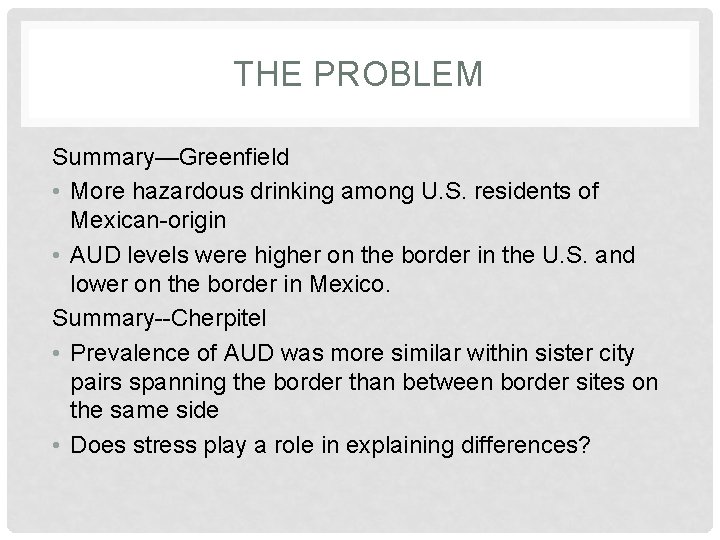
THE PROBLEM Summary—Greenfield • More hazardous drinking among U. S. residents of Mexican-origin • AUD levels were higher on the border in the U. S. and lower on the border in Mexico. Summary--Cherpitel • Prevalence of AUD was more similar within sister city pairs spanning the border than between border sites on the same side • Does stress play a role in explaining differences?
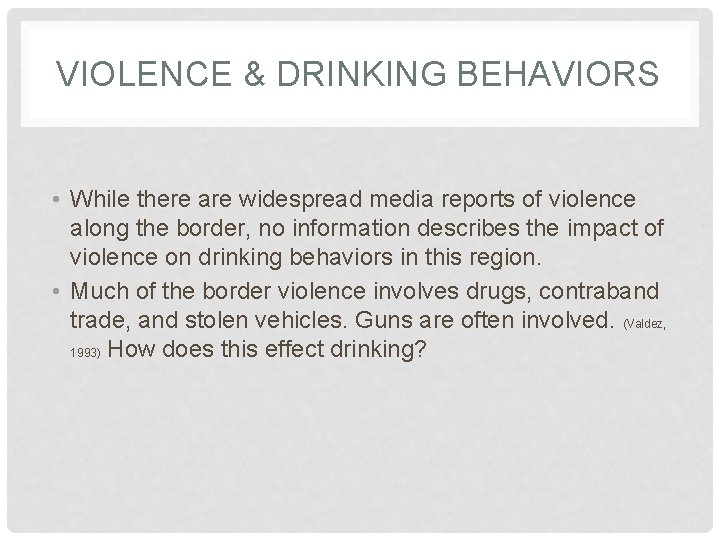
VIOLENCE & DRINKING BEHAVIORS • While there are widespread media reports of violence along the border, no information describes the impact of violence on drinking behaviors in this region. • Much of the border violence involves drugs, contraband trade, and stolen vehicles. Guns are often involved. (Valdez, 1993) How does this effect drinking?
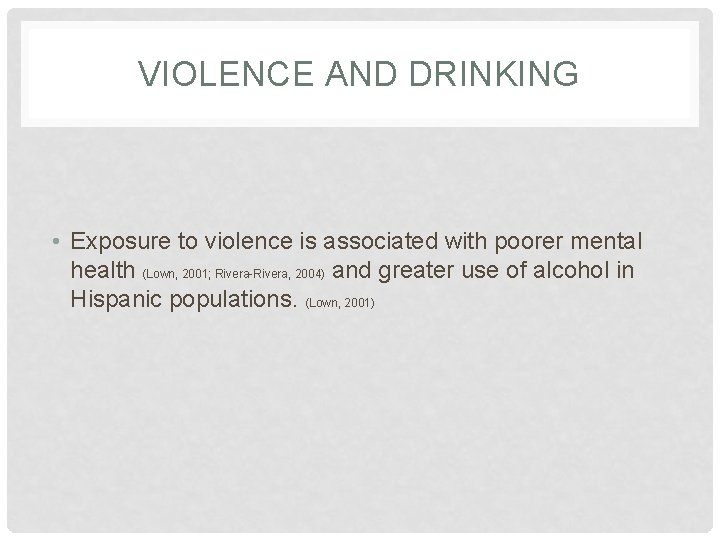
VIOLENCE AND DRINKING • Exposure to violence is associated with poorer mental health (Lown, 2001; Rivera-Rivera, 2004) and greater use of alcohol in Hispanic populations. (Lown, 2001)
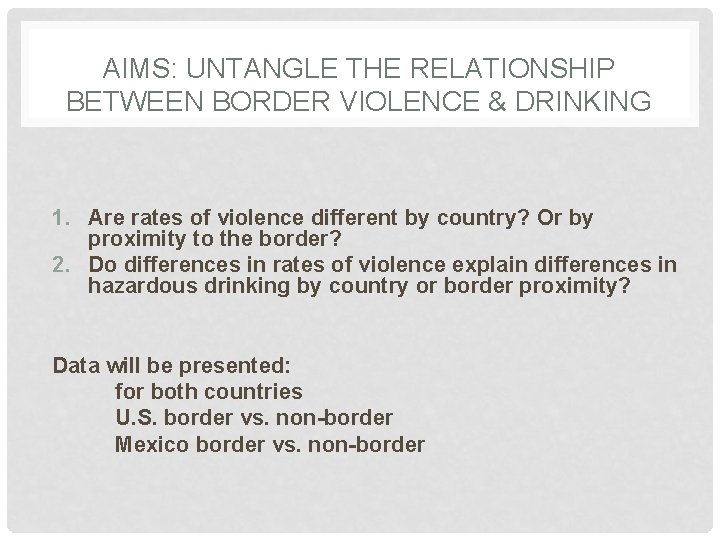
AIMS: UNTANGLE THE RELATIONSHIP BETWEEN BORDER VIOLENCE & DRINKING 1. Are rates of violence different by country? Or by proximity to the border? 2. Do differences in rates of violence explain differences in hazardous drinking by country or border proximity? Data will be presented: for both countries U. S. border vs. non-border Mexico border vs. non-border
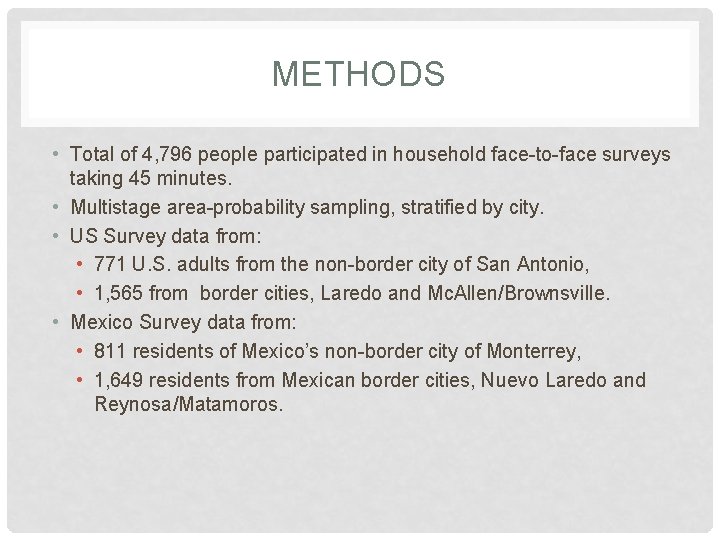
METHODS • Total of 4, 796 people participated in household face-to-face surveys taking 45 minutes. • Multistage area-probability sampling, stratified by city. • US Survey data from: • 771 U. S. adults from the non-border city of San Antonio, • 1, 565 from border cities, Laredo and Mc. Allen/Brownsville. • Mexico Survey data from: • 811 residents of Mexico’s non-border city of Monterrey, • 1, 649 residents from Mexican border cities, Nuevo Laredo and Reynosa/Matamoros.
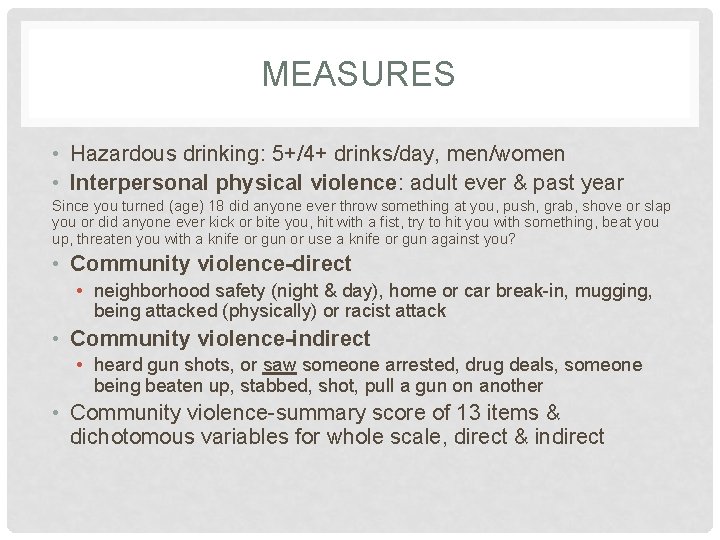
MEASURES • Hazardous drinking: 5+/4+ drinks/day, men/women • Interpersonal physical violence: adult ever & past year Since you turned (age) 18 did anyone ever throw something at you, push, grab, shove or slap you or did anyone ever kick or bite you, hit with a fist, try to hit you with something, beat you up, threaten you with a knife or gun or use a knife or gun against you? • Community violence-direct • neighborhood safety (night & day), home or car break-in, mugging, being attacked (physically) or racist attack • Community violence-indirect • heard gun shots, or saw someone arrested, drug deals, someone being beaten up, stabbed, shot, pull a gun on another • Community violence-summary score of 13 items & dichotomous variables for whole scale, direct & indirect
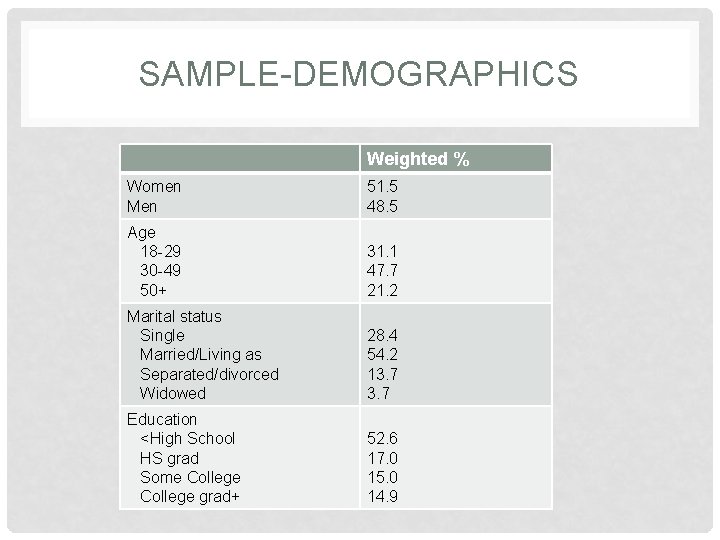
SAMPLE-DEMOGRAPHICS Weighted % Women Men 51. 5 48. 5 Age 18 -29 30 -49 50+ 31. 1 47. 7 21. 2 Marital status Single Married/Living as Separated/divorced Widowed 28. 4 54. 2 13. 7 Education <High School HS grad Some College grad+ 52. 6 17. 0 15. 0 14. 9
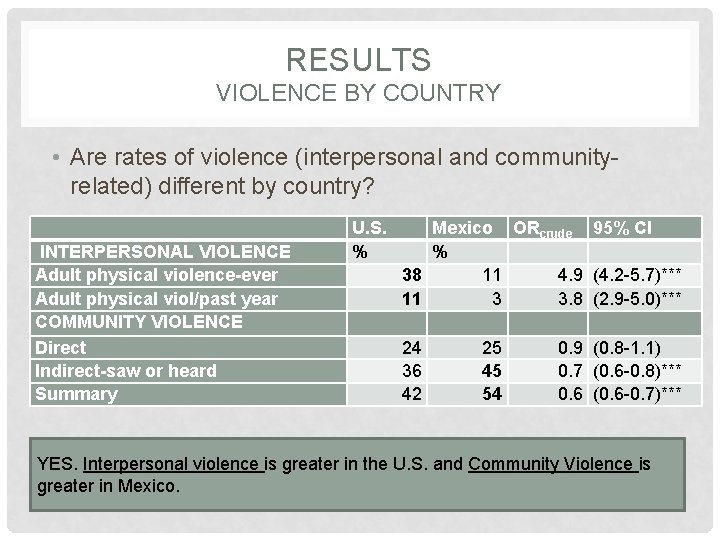
RESULTS VIOLENCE BY COUNTRY • Are rates of violence (interpersonal and communityrelated) different by country? INTERPERSONAL VIOLENCE Adult physical violence-ever Adult physical viol/past year COMMUNITY VIOLENCE Direct Indirect-saw or heard Summary U. S. % Mexico ORcrude 95% CI % 38 11 4. 9 (4. 2 -5. 7)*** 11 3 3. 8 (2. 9 -5. 0)*** 24 36 42 25 45 54 0. 9 (0. 8 -1. 1) 0. 7 (0. 6 -0. 8)*** 0. 6 (0. 6 -0. 7)*** YES. Interpersonal violence is greater in the U. S. and Community Violence is greater in Mexico.
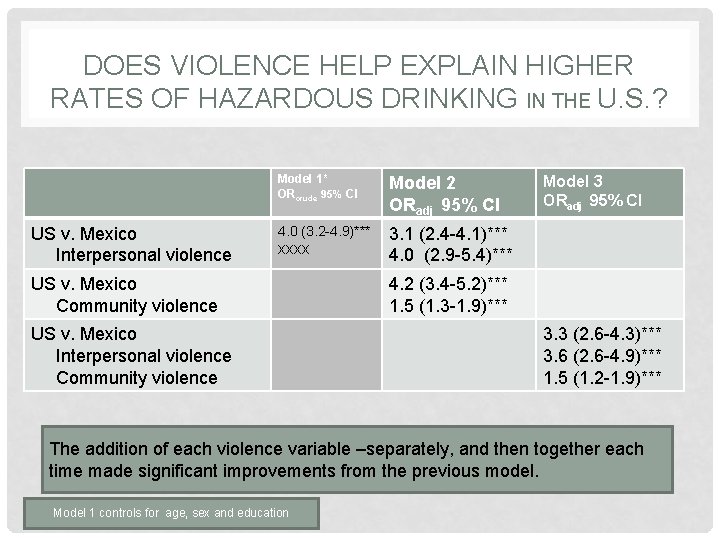
DOES VIOLENCE HELP EXPLAIN HIGHER RATES OF HAZARDOUS DRINKING IN THE U. S. ? US v. Mexico Interpersonal violence Model 1* ORcrude 95% CI Model 2 ORadj 95% CI 4. 0 (3. 2 -4. 9)*** 3. 1 (2. 4 -4. 1)*** 4. 0 (2. 9 -5. 4)*** xxxx US v. Mexico Community violence US v. Mexico Interpersonal violence Community violence Model 3 ORadj 95% CI 4. 2 (3. 4 -5. 2)*** 1. 5 (1. 3 -1. 9)*** 3. 3 (2. 6 -4. 3)*** 3. 6 (2. 6 -4. 9)*** 1. 5 (1. 2 -1. 9)*** The addition of each violence variable –separately, and then together each time made significant improvements from the previous model. Model 1 controls for age, sex and education
U. S.
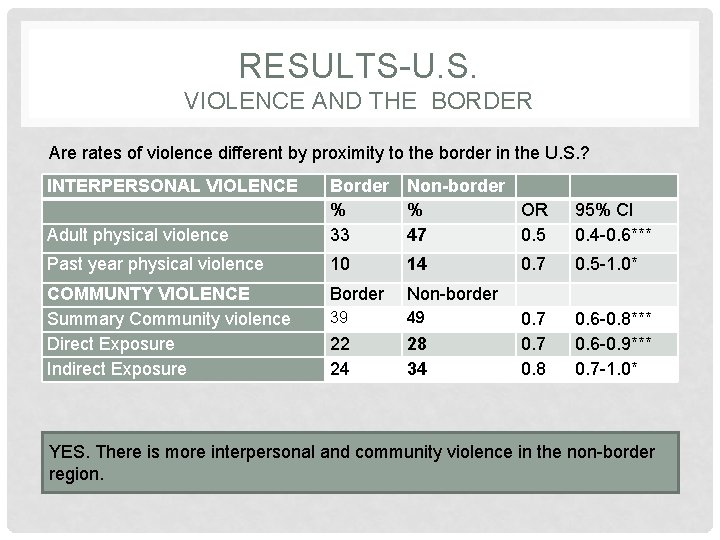
RESULTS-U. S. VIOLENCE AND THE BORDER Are rates of violence different by proximity to the border in the U. S. ? INTERPERSONAL VIOLENCE Adult physical violence Border % 33 Non-border % OR 47 0. 5 95% CI 0. 4 -0. 6*** Past year physical violence 10 14 0. 7 0. 5 -1. 0* COMMUNTY VIOLENCE Summary Community violence Direct Exposure Indirect Exposure Border Non-border 39 49 22 24 28 34 0. 7 0. 8 0. 6 -0. 8*** 0. 6 -0. 9*** 0. 7 -1. 0* YES. There is more interpersonal and community violence in the non-border region.
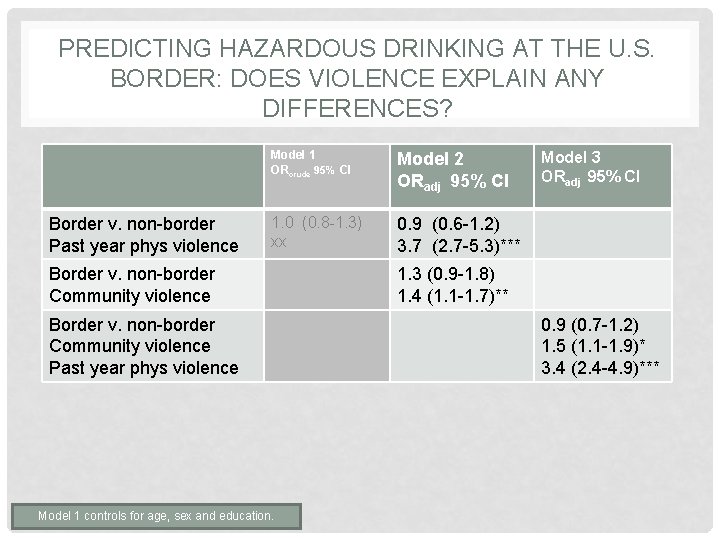
PREDICTING HAZARDOUS DRINKING AT THE U. S. BORDER: DOES VIOLENCE EXPLAIN ANY DIFFERENCES? Border v. non-border Past year phys violence Model 1 ORcrude 95% CI Model 2 ORadj 95% CI 1. 0 (0. 8 -1. 3) xx 0. 9 (0. 6 -1. 2) 3. 7 (2. 7 -5. 3)*** Border v. non-border Community violence Past year phys violence Model 1 controls for age, sex and education. Model 3 ORadj 95% CI 1. 3 (0. 9 -1. 8) 1. 4 (1. 1 -1. 7)** 0. 9 (0. 7 -1. 2) 1. 5 (1. 1 -1. 9)* 3. 4 (2. 4 -4. 9)***
MEXICO
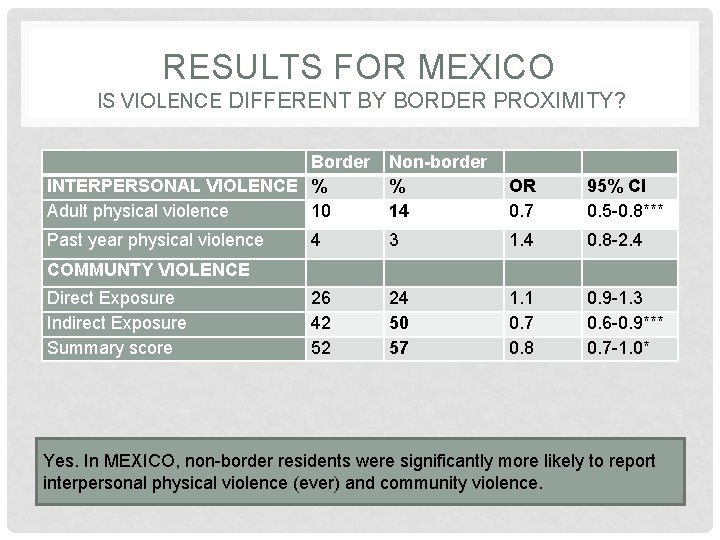
RESULTS FOR MEXICO IS VIOLENCE DIFFERENT BY BORDER PROXIMITY? Border INTERPERSONAL VIOLENCE % Adult physical violence 10 Non-border % 14 OR 0. 7 95% CI 0. 5 -0. 8*** Past year physical violence 4 3 1. 4 0. 8 -2. 4 26 42 52 24 50 57 1. 1 0. 7 0. 8 0. 9 -1. 3 0. 6 -0. 9*** 0. 7 -1. 0* COMMUNTY VIOLENCE Direct Exposure Indirect Exposure Summary score Yes. In MEXICO, non-border residents were significantly more likely to report interpersonal physical violence (ever) and community violence.
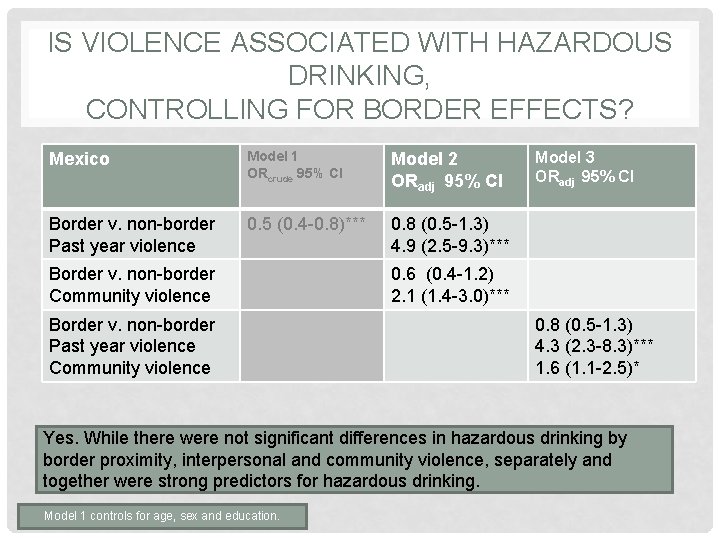
IS VIOLENCE ASSOCIATED WITH HAZARDOUS DRINKING, CONTROLLING FOR BORDER EFFECTS? Mexico Model 1 ORcrude 95% CI Model 2 ORadj 95% CI Border v. non-border Past year violence 0. 5 (0. 4 -0. 8)*** 0. 8 (0. 5 -1. 3) 4. 9 (2. 5 -9. 3)*** Border v. non-border Community violence Border v. non-border Past year violence Community violence Model 3 ORadj 95% CI 0. 6 (0. 4 -1. 2) 2. 1 (1. 4 -3. 0)*** 0. 8 (0. 5 -1. 3) 4. 3 (2. 3 -8. 3)*** 1. 6 (1. 1 -2. 5)* Yes. While there were not significant differences in hazardous drinking by border proximity, interpersonal and community violence, separately and together were strong predictors for hazardous drinking. Model 1 controls for age, sex and education.
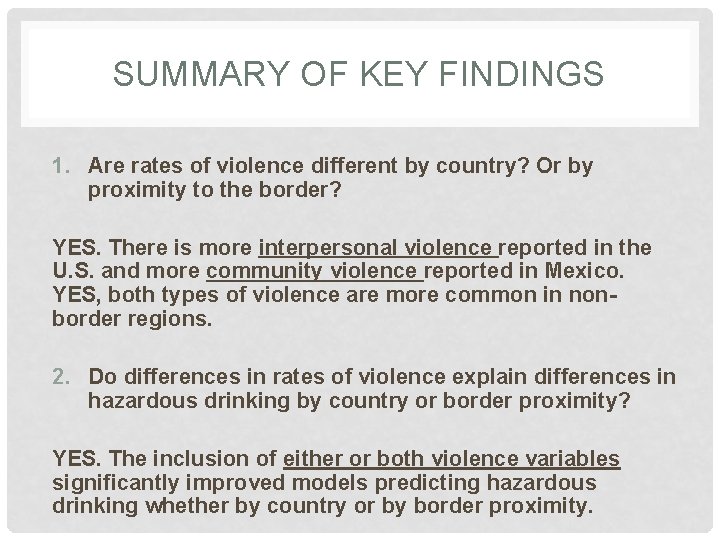
SUMMARY OF KEY FINDINGS 1. Are rates of violence different by country? Or by proximity to the border? YES. There is more interpersonal violence reported in the U. S. and more community violence reported in Mexico. YES, both types of violence are more common in nonborder regions. 2. Do differences in rates of violence explain differences in hazardous drinking by country or border proximity? YES. The inclusion of either or both violence variables significantly improved models predicting hazardous drinking whether by country or by border proximity.
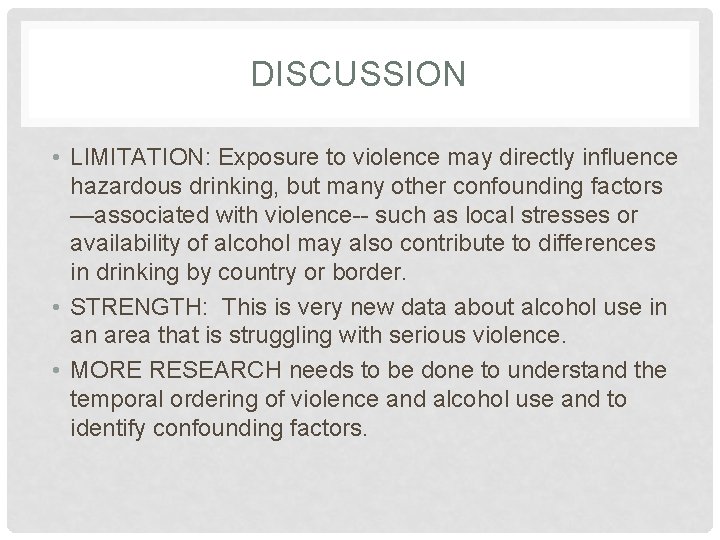
DISCUSSION • LIMITATION: Exposure to violence may directly influence hazardous drinking, but many other confounding factors —associated with violence-- such as local stresses or availability of alcohol may also contribute to differences in drinking by country or border. • STRENGTH: This is very new data about alcohol use in an area that is struggling with serious violence. • MORE RESEARCH needs to be done to understand the temporal ordering of violence and alcohol use and to identify confounding factors.
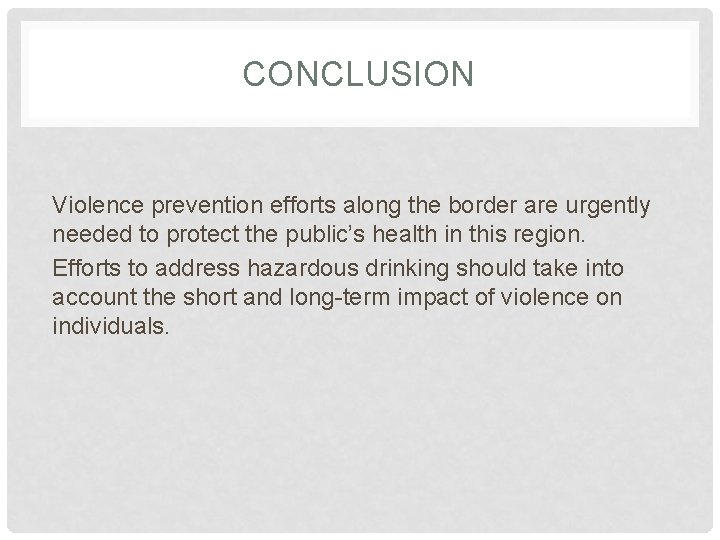
CONCLUSION Violence prevention efforts along the border are urgently needed to protect the public’s health in this region. Efforts to address hazardous drinking should take into account the short and long-term impact of violence on individuals.