
Hazard Identification and Risk Management April 2017 The

- Slides: 51
Hazard Identification and Risk Management April 2017
The Mining and Quarrying Occupational Health and Safety Committee Promoting Work Health and Safety in the Workplace This workplace industry safety presentation is developed and fully funded by the Mining and Quarrying Occupational Health and Safety Committee (MAQOHSC). ISBN 978 -1 -925361 -45 -2 2
Disclaimer 3 § IMPORTANT: The information in this presentation is of a general nature, and should not be relied upon as individual professional advice. If necessary, legal advice should be obtained from a legal practitioner with expertise in the field of Work Health and Safety law (SA). § Although every effort has been made to ensure that the information in this presentation is complete, current and accurate, the Mining and Quarrying Occupational Health and Safety Committee, any agent, author, contributor or the South Australian Government, does not guarantee that it is so, and the Committee accepts no responsibility for any loss, damage or personal injury that may result from the use of any material which is not complete, current and accurate. § Users should always verify historical material by making and relying upon their own separate inquiries prior to making any important decisions or taking any action on the basis of this information.
Creative Commons This creative commons licence allows you to copy, communicate and or adapt our work for non-commercial purposes only, as long as you attribute the work to Mining and Quarrying Occupational Health and Safety Committee and abide by all the other licence terms therein. 4
Session Overview 5 § Risk management definitions § Hazards § Why do we need to manage hazards § Who has a duty § Penalties § Tools to manage hazards § Hazard identification and risk management process § Generate procedures § Communicate, instruct and train § Inspections and audits § Information on hazards and risk controls § Summary
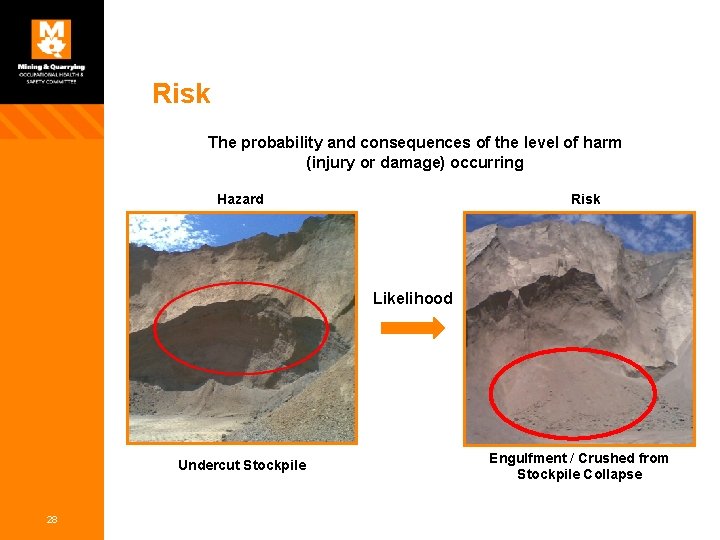
Risk Management Definitions Hazard § Something that has the potential to cause harm (injury or damage). Risk § The probability and consequences of the level of harm occurring. Risk assessment § The process of evaluating the likelihood and severity of harm arising from exposure to an identified hazard. Hierarchy of control § The tool used when determining how risks are to be managed. Risk control § The process of eliminating or minimising the risk of harm. 6
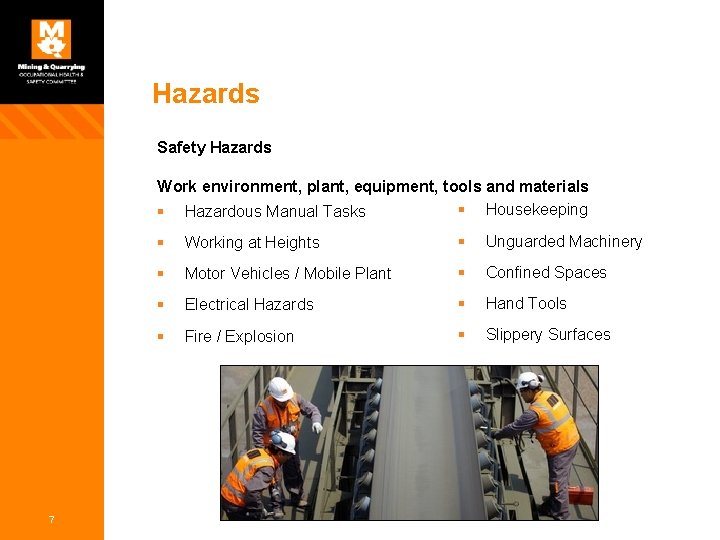
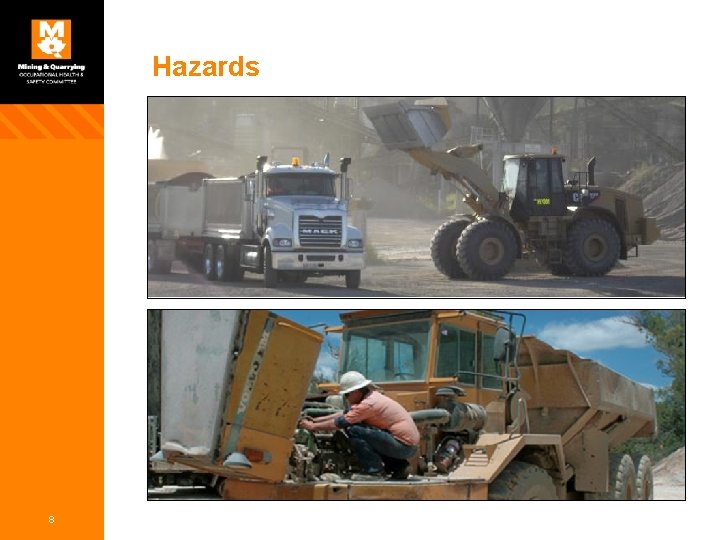
Hazards Safety Hazards Work environment, plant, equipment, tools and materials § Housekeeping § Hazardous Manual Tasks 7 § Working at Heights § Unguarded Machinery § Motor Vehicles / Mobile Plant § Confined Spaces § Electrical Hazards § Hand Tools § Fire / Explosion § Slippery Surfaces
Hazards 8
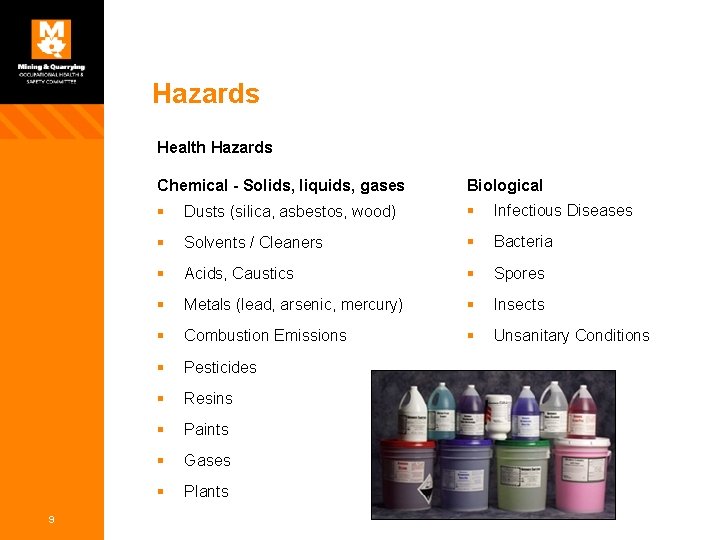
Hazards Health Hazards 9 Chemical - Solids, liquids, gases Biological § Dusts (silica, asbestos, wood) § Infectious Diseases § Solvents / Cleaners § Bacteria § Acids, Caustics § Spores § Metals (lead, arsenic, mercury) § Insects § Combustion Emissions § Unsanitary Conditions § Pesticides § Resins § Paints § Gases § Plants
Hazards 10
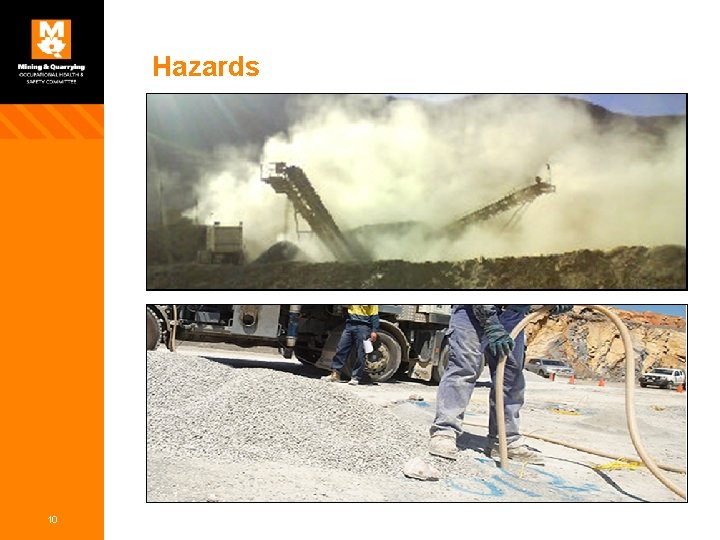
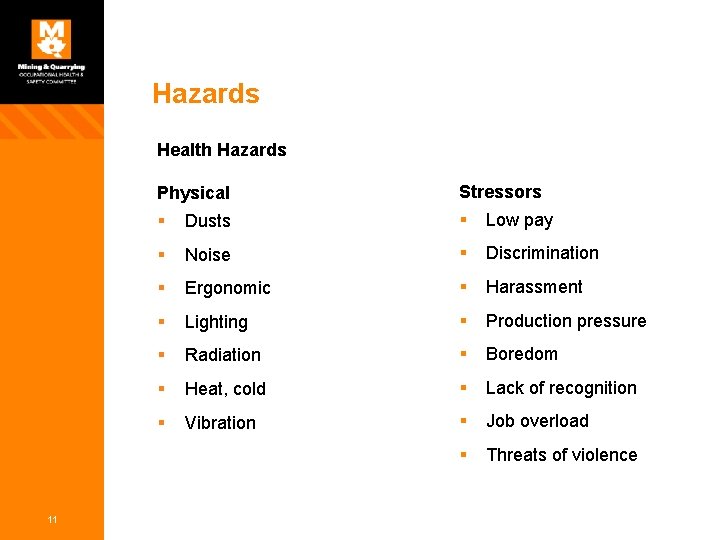
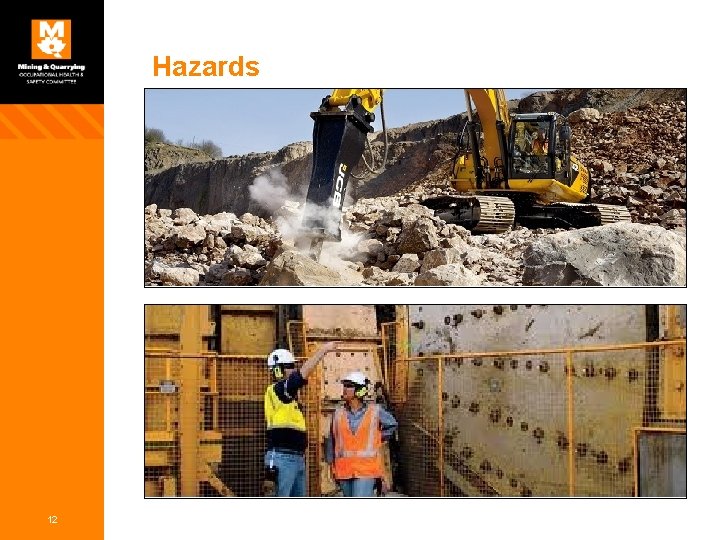
Hazards Health Hazards 11 Physical Stressors § Dusts § Low pay § Noise § Discrimination § Ergonomic § Harassment § Lighting § Production pressure § Radiation § Boredom § Heat, cold § Lack of recognition § Vibration § Job overload § Threats of violence
Hazards 12
Why do we need to manage Hazards? § It's a legal requirement - compliance with the legislation! § Keep workers safe from health risk while they at work § Prevent exposing others, plant and the environment to harm § Comply with company policy and procedural requirements § Promotes a safety culture at the workplace! § Demonstrates that a business is committed to addressing health and safety issues § Good business sense, it reduces financial risk § Morally, it’s the right thing to do! 13
Who has a Duty? Under the Work Health and Safety Act 2012 (SA) Section 17 - Management of risks A duty imposed on a person to ensure health and safety requires the person: § to eliminate risks to health and safety, so far as is reasonably practicable; and § if it is not reasonably practicable to eliminate risks to health and safety, to minimise those risks so far as is reasonably practicable. A person must comply with the above to the extent to which the person has the capacity to influence and control the matter. 14
Who has a Duty? Under the Work Health and Safety Act 2012 (SA) Section 19 - Primary Duty of Care A person conducting a business or undertaking (PCBU) must ensure, so far as is reasonably practicable, the health and safety of: 15 § workers engaged, or caused to be engaged § workers whose activities in carrying out work are influenced or directed while the workers are at work § other persons (visitors and volunteers) are not put at risk from work carried out as part of the business activities.
Who has a Duty? Under the Work Health and Safety Act 2012 (SA) Section 19 - Primary Duty of Care A PCBU must ensure, so far as is reasonably practicable the provision and maintenance of: 16 § a work environment without risks to health and safety § safe plant, structures and safe systems of work § the safe use, handling and storage of plant, structures and substances § provide any information, training, instruction or supervision that is necessary to protect all persons from risks to their health and safety.
Who has a Duty? Under the Work Health and Safety Act 2012 (SA) Section 27 - Officers All “Officers” of a PCBU are personally responsible for ensuring compliance with safety laws. An “Officer” means: § a director or secretary of the corporation § a person who makes decisions or who participates in making decisions that affect the whole or a substantial part, of the business of the corporation § a person who has the capacity to affect significantly the corporation’s financial standing. Officers must take reasonable steps to ensure the PCBU uses and applies appropriate resources, policies, procedures and health and safety practices in the workplace. 17
Who has a Duty? Under the Work Health and Safety Act 2012 (SA) Section 28 - Workers’ have a duty and obligation to: § take reasonable care his or her acts or omissions (actions or words), do not adversely affect the health and safety of other persons § comply, so far as the worker is reasonably able, with any reasonable instruction designed to protect their health and safety and, that of any other persons while at work § co-operate with any reasonable policy or procedure relating to health or safety at the workplace that they have been notified of. Managers, Supervisors and Team Leaders are also deemed as Workers! 18
Who has a Duty? Under the Work Health and Safety Regulations 2012 (SA) Regulation 34 - Duty to identify Hazards A duty holder, in managing risks to health and safety, must: § identify reasonably foreseeable hazards that could give rise to risks to health and safety. Regulation 35 - Managing risks to Health and Safety A duty holder, in managing risks to health and safety, must: 19 § eliminate risks to health and safety, so far as is reasonably practicable § where it is not reasonably practicable to eliminate risks to health and safety, to minimise those risks so far as is reasonably practicable.
Reasonably Practicable What is “Reasonably Practicable” in ensuring health and safety? Reasonably Practicable in relation to a duty to ensure health and safety, means: § that which is, or was at a particular time, reasonably able to be done in to ensuring health and safety. This includes, taking into account and weighing up all relevant matters about: 20 § the likelihood of the hazard or the risk concerned occurring § the degree of harm (injury or damage) that might result from the hazard or the risk § what the person concerned knows, or should reasonably know, about the hazard or the risk; and ways of eliminating or minimising the risk
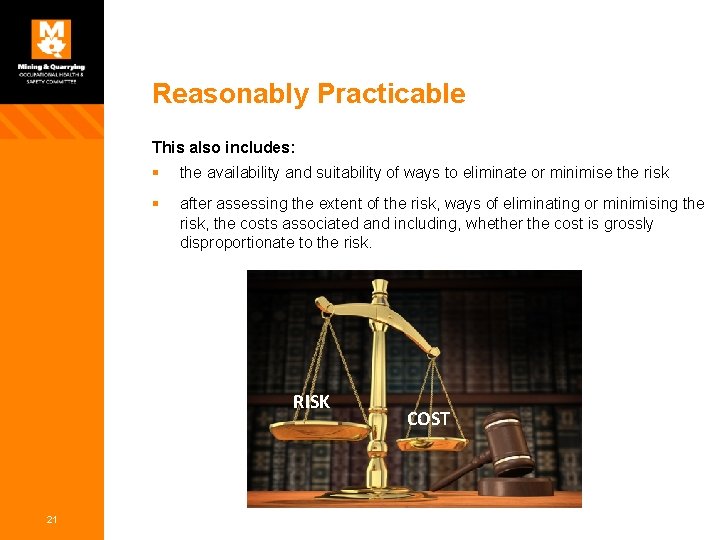
Reasonably Practicable This also includes: § the availability and suitability of ways to eliminate or minimise the risk § after assessing the extent of the risk, ways of eliminating or minimising the risk, the costs associated and including, whether the cost is grossly disproportionate to the risk. RISK 21 COST
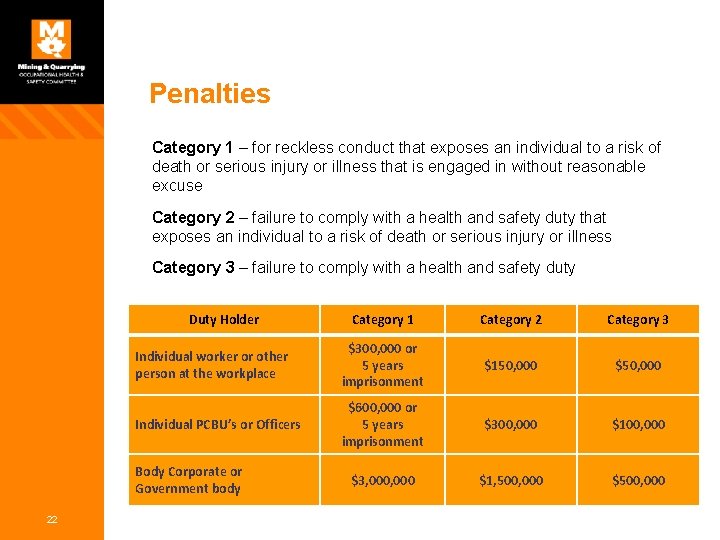
Penalties Category 1 – for reckless conduct that exposes an individual to a risk of death or serious injury or illness that is engaged in without reasonable excuse Category 2 – failure to comply with a health and safety duty that exposes an individual to a risk of death or serious injury or illness Category 3 – failure to comply with a health and safety duty Duty Holder Category 1 Category 2 Category 3 Individual worker or other person at the workplace $300, 000 or 5 years imprisonment $150, 000 $50, 000 Individual PCBU’s or Officers $600, 000 or 5 years imprisonment $300, 000 $100, 000 $3, 000 $1, 500, 000 $500, 000 Body Corporate or Government body 22
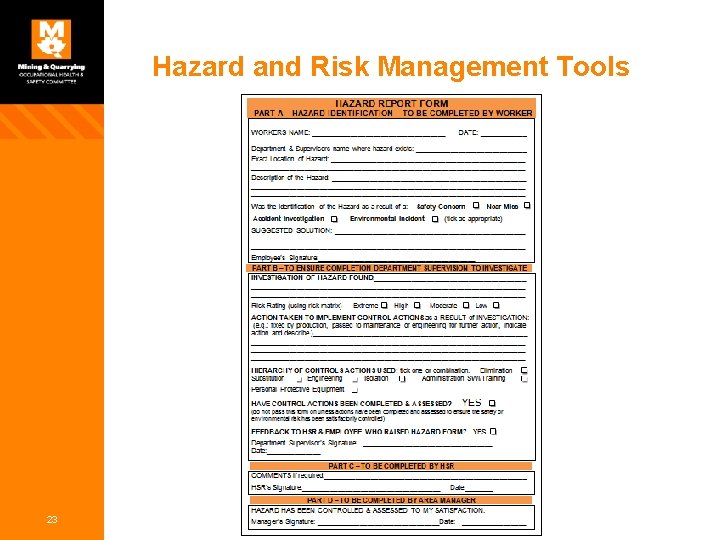
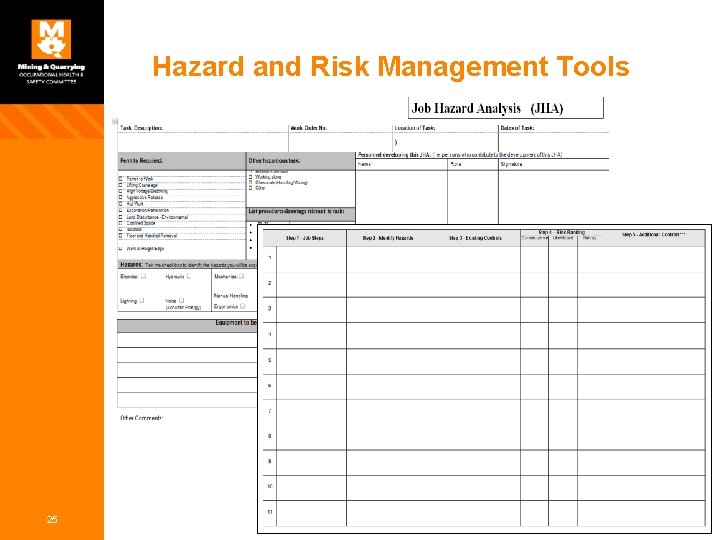
Hazard and Risk Management Tools 23
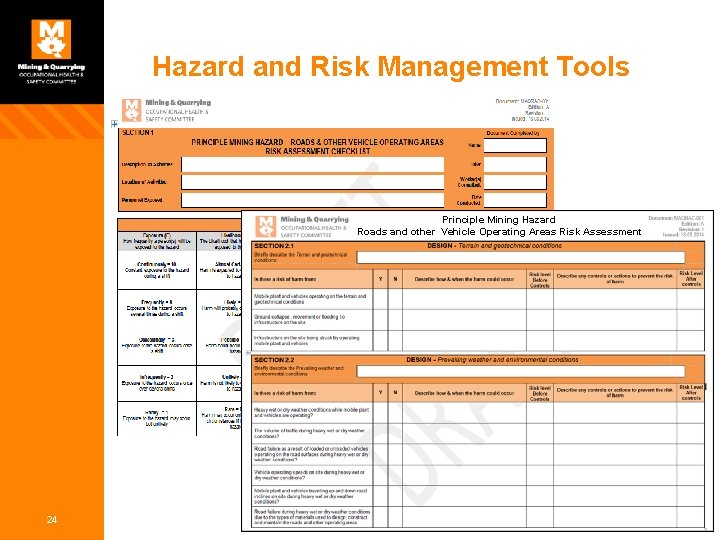
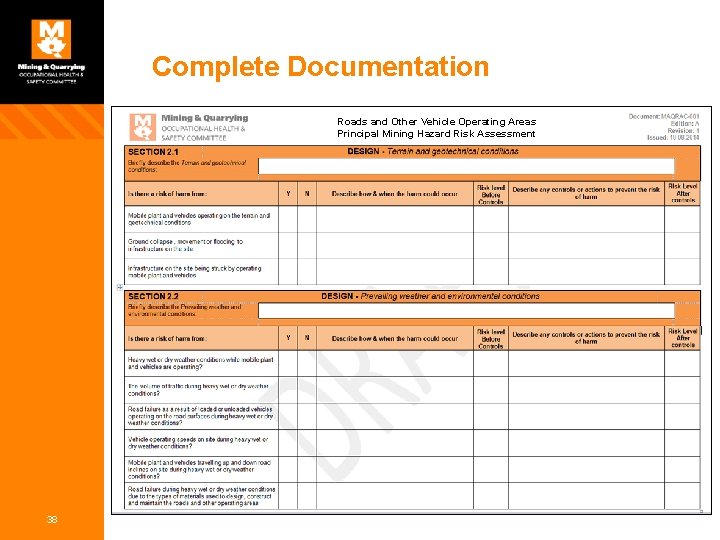
Hazard and Risk Management Tools Principle Mining Hazard Roads and other Vehicle Operating Areas Risk Assessment 24
Hazard and Risk Management Tools 25
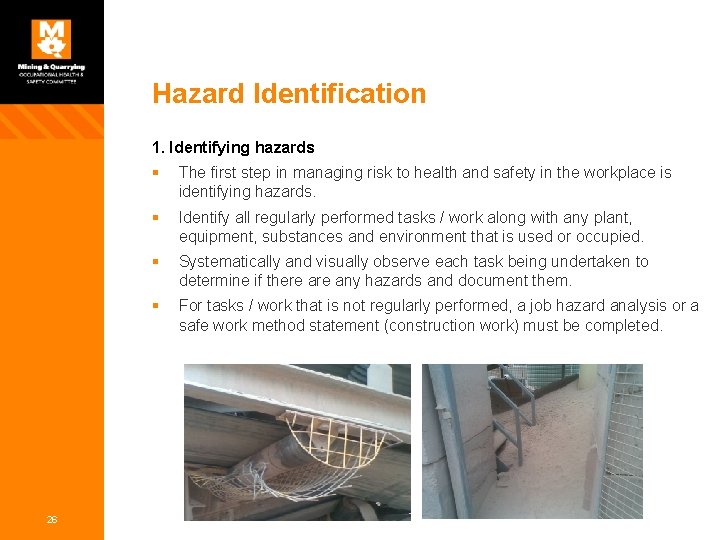
Hazard Identification 1. Identifying hazards 26 § The first step in managing risk to health and safety in the workplace is identifying hazards. § Identify all regularly performed tasks / work along with any plant, equipment, substances and environment that is used or occupied. § Systematically and visually observe each task being undertaken to determine if there any hazards and document them. § For tasks / work that is not regularly performed, a job hazard analysis or a safe work method statement (construction work) must be completed.
Areas to Consider Additionally, hazard identification must also be carried out before and during introduction of new plant or undertaking a new task i. e. maintenance or cleaning. Consideration should be given to: 27 § Hazardous substances exposure (silica, asbestos, chemicals) § Design or layout of the workplace § Potential to crush, puncture, stab or burn the operator § Actual or intended use of plant or equipment or potential misuse § Noise and electricity § Potential to bypass safety interlock systems § Ergonomics / hazardous manual tasks § Potential for falling objects § Working alone / isolated work § Before and during alterations to plant or associated systems of work.
Risk The probability and consequences of the level of harm (injury or damage) occurring Hazard Risk Likelihood Undercut Stockpile 28 Engulfment / Crushed from Stockpile Collapse
Risk Assessments MUST include one or more of the following: 29 § A visual inspection of the task / work § Formal documented risk assessment § Discussions with designers, manufacturers, suppliers, importers, workers or any other relevant parties § Testing (noise levels) § Measurement (silica levels) § A review of incident of harm and near miss data.
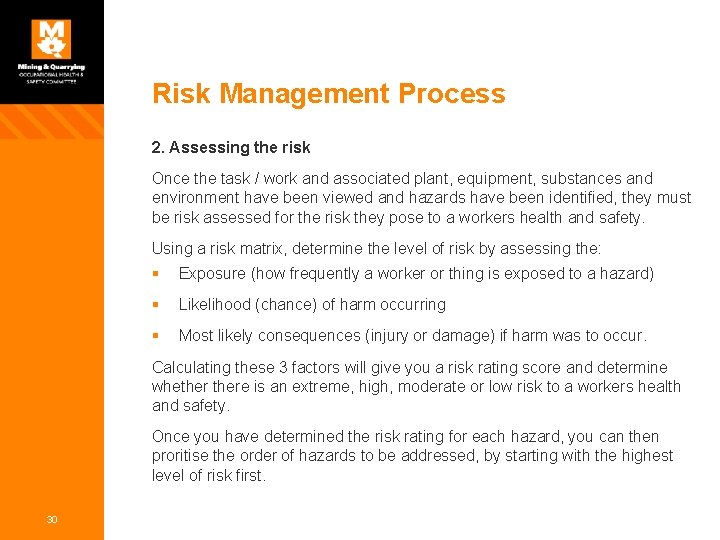
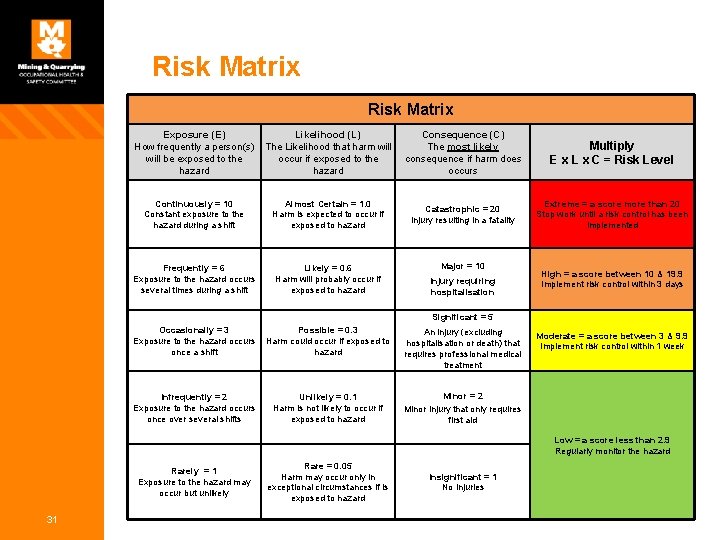
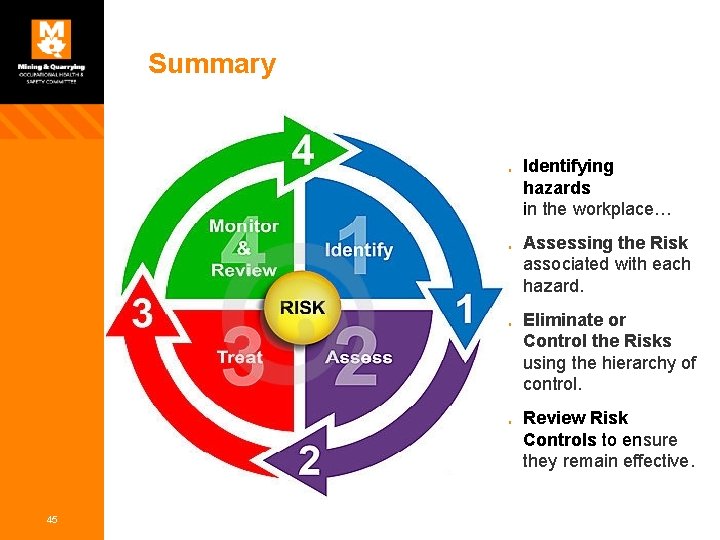
Risk Management Process 2. Assessing the risk Once the task / work and associated plant, equipment, substances and environment have been viewed and hazards have been identified, they must be risk assessed for the risk they pose to a workers health and safety. Using a risk matrix, determine the level of risk by assessing the: § Exposure (how frequently a worker or thing is exposed to a hazard) § Likelihood (chance) of harm occurring § Most likely consequences (injury or damage) if harm was to occur. Calculating these 3 factors will give you a risk rating score and determine whethere is an extreme, high, moderate or low risk to a workers health and safety. Once you have determined the risk rating for each hazard, you can then proritise the order of hazards to be addressed, by starting with the highest level of risk first. 30
Risk Matrix Exposure (E) How frequently a person(s) will be exposed to the hazard Likelihood (L) The Likelihood that harm will occur if exposed to the hazard Consequence (C) The most likely consequence if harm does occurs Multiply E x L x C = Risk Level Continuously = 10 Constant exposure to the hazard during a shift Almost Certain = 1. 0 Harm is expected to occur if exposed to hazard Catastrophic = 20 Injury resulting in a fatality Extreme = a score more than 20 Stop work until a risk control has been implemented Frequently = 6 Exposure to the hazard occurs several times during a shift Likely = 0. 6 Harm will probably occur if exposed to hazard Occasionally = 3 Exposure to the hazard occurs once a shift Possible = 0. 3 Harm could occur if exposed to hazard An injury (excluding hospitalisation or death) that requires professional medical treatment Infrequently = 2 Exposure to the hazard occurs once over several shifts Unlikely = 0. 1 Harm is not likely to occur if exposed to hazard Minor = 2 Minor injury that only requires first aid Major = 10 Injury requiring hospitalisation High = a score between 10 & 19. 9 Implement risk control within 3 days Significant = 5 Moderate = a score between 3 & 9. 9 Implement risk control within 1 week Low = a score less than 2. 9 Regularly monitor the hazard Rarely = 1 Exposure to the hazard may occur but unlikely 31 Rare = 0. 05 Harm may occur only in exceptional circumstances if is exposed to hazard Insignificant = 1 No injuries
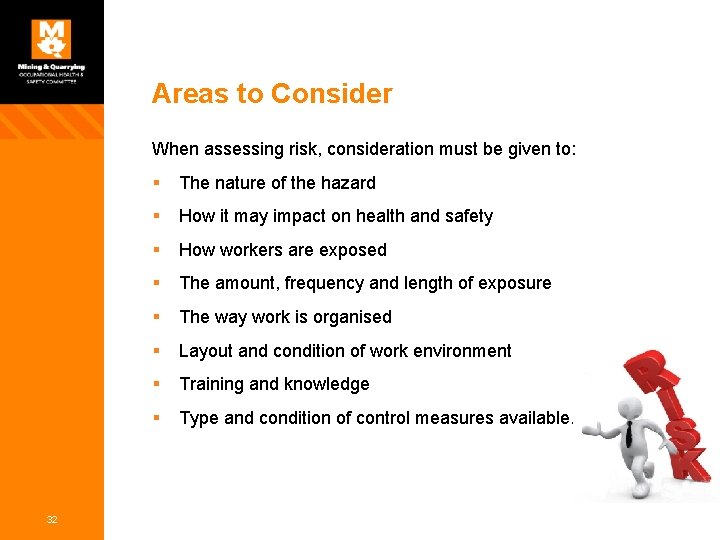
Areas to Consider When assessing risk, consideration must be given to: 32 § The nature of the hazard § How it may impact on health and safety § How workers are exposed § The amount, frequency and length of exposure § The way work is organised § Layout and condition of work environment § Training and knowledge § Type and condition of control measures available.
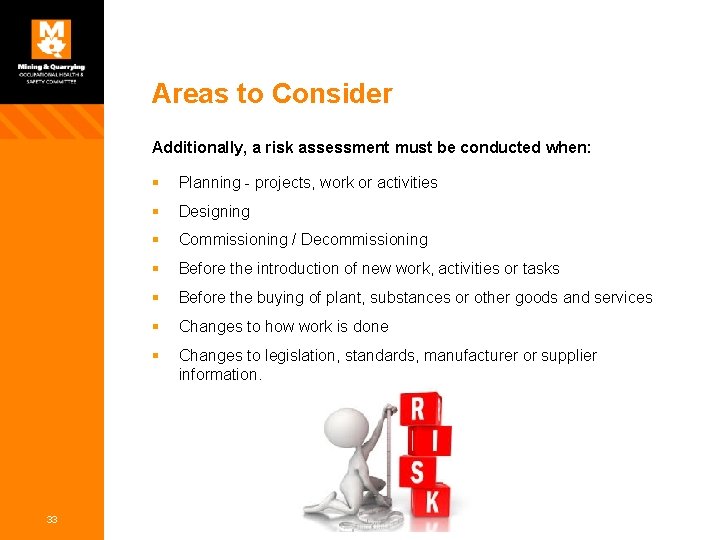
Areas to Consider Additionally, a risk assessment must be conducted when: 33 § Planning - projects, work or activities § Designing § Commissioning / Decommissioning § Before the introduction of new work, activities or tasks § Before the buying of plant, substances or other goods and services § Changes to how work is done § Changes to legislation, standards, manufacturer or supplier information.
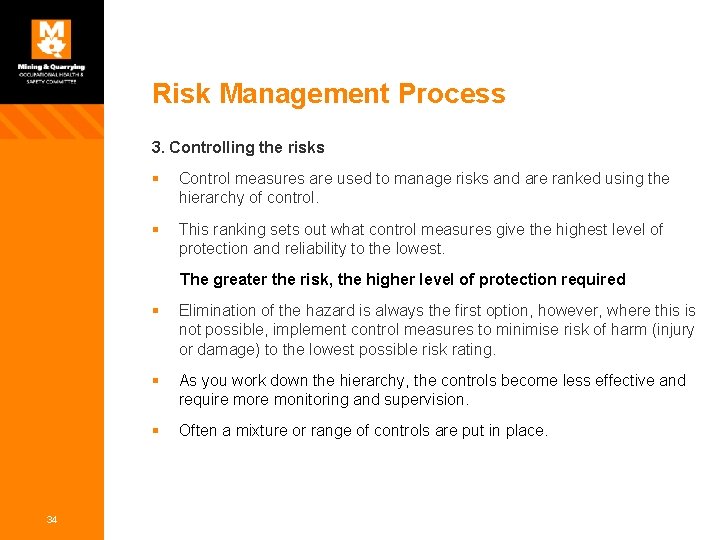
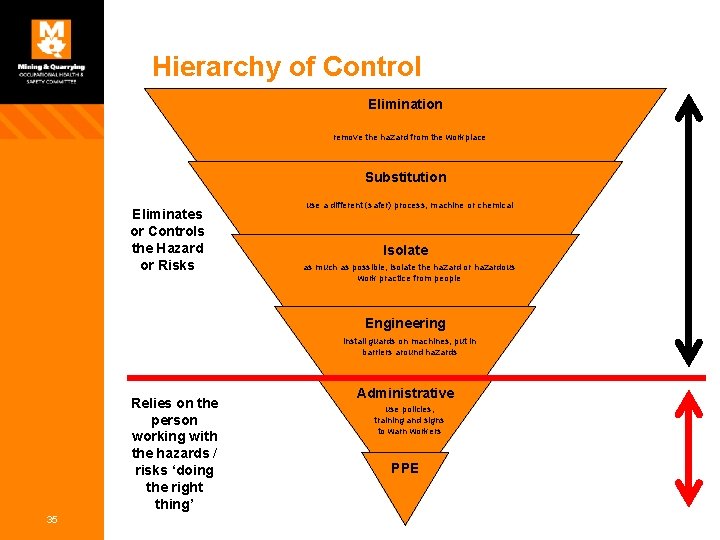
Risk Management Process 3. Controlling the risks § Control measures are used to manage risks and are ranked using the hierarchy of control. § This ranking sets out what control measures give the highest level of protection and reliability to the lowest. The greater the risk, the higher level of protection required 34 § Elimination of the hazard is always the first option, however, where this is not possible, implement control measures to minimise risk of harm (injury or damage) to the lowest possible risk rating. § As you work down the hierarchy, the controls become less effective and require monitoring and supervision. § Often a mixture or range of controls are put in place.
Hierarchy of Control Elimination remove the hazard from the workplace Substitution Eliminates or Controls the Hazard or Risks use a different (safer) process, machine or chemical Isolate as much as possible, isolate the hazard or hazardous work practice from people Engineering install guards on machines, put in barriers around hazards Relies on the person working with the hazards / risks ‘doing the right thing’ 35 Administrative use policies, training and signs to warn workers PPE
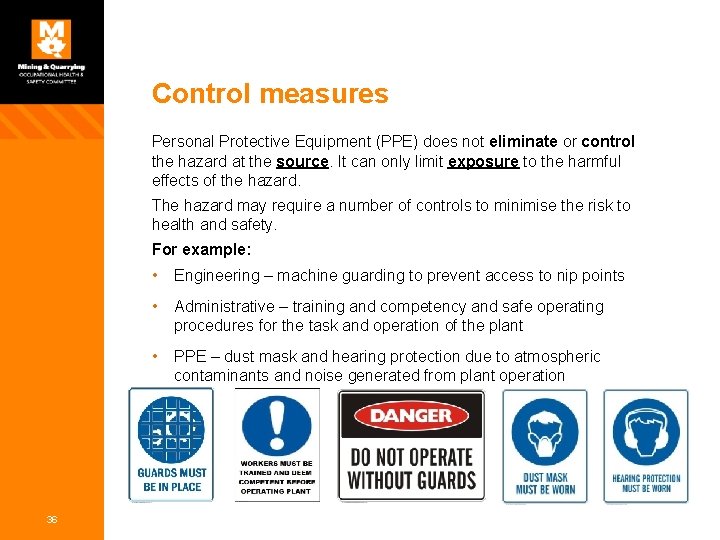
Control measures Personal Protective Equipment (PPE) does not eliminate or control the hazard at the source. It can only limit exposure to the harmful effects of the hazard. The hazard may require a number of controls to minimise the risk to health and safety. For example: 36 • Engineering – machine guarding to prevent access to nip points • Administrative – training and competency and safe operating procedures for the task and operation of the plant • PPE – dust mask and hearing protection due to atmospheric contaminants and noise generated from plant operation
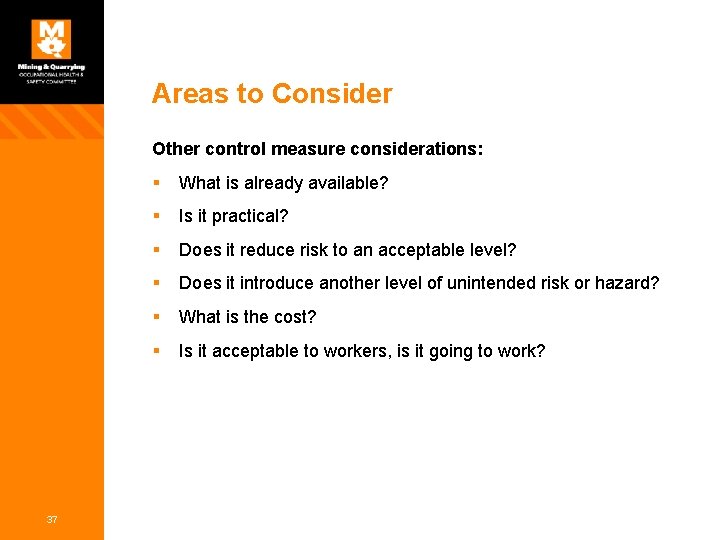
Areas to Consider Other control measure considerations: 37 § What is already available? § Is it practical? § Does it reduce risk to an acceptable level? § Does it introduce another level of unintended risk or hazard? § What is the cost? § Is it acceptable to workers, is it going to work?
Complete Documentation Roads and Other Vehicle Operating Areas Principal Mining Hazard Risk Assessment 38
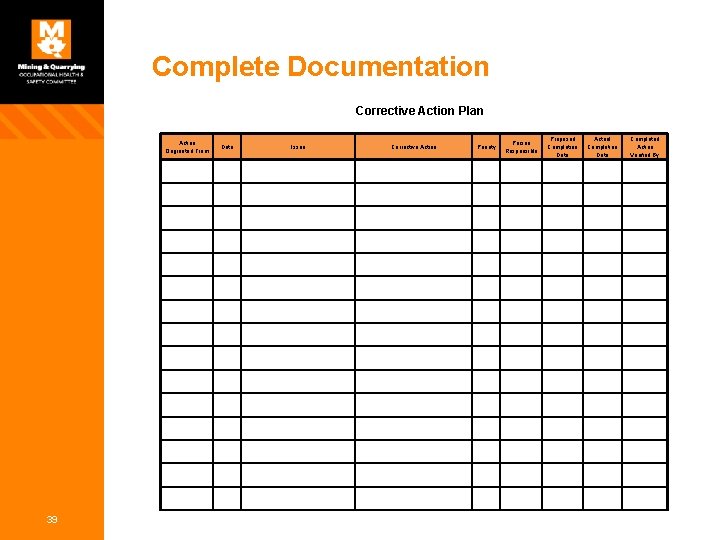
Complete Documentation Corrective Action Plan Action Originated From 39 Date Issue Corrective Action Priority Person Responsible Proposed Completion Date Actual Completion Date Completed Action Verified By
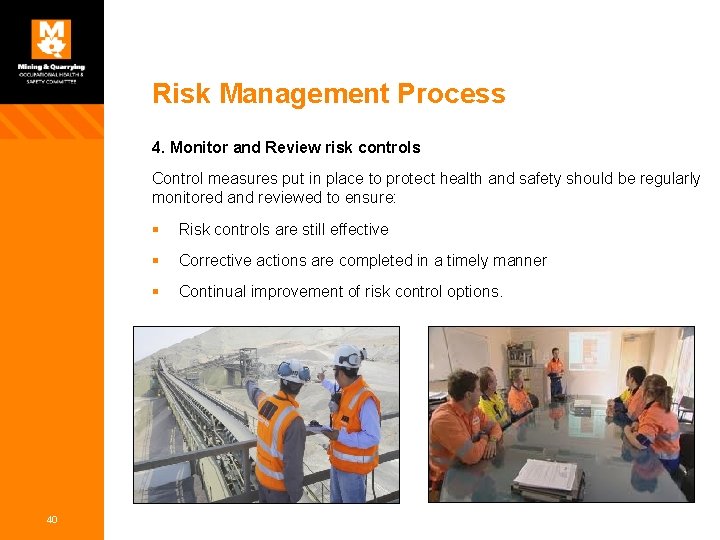
Risk Management Process 4. Monitor and Review risk controls Control measures put in place to protect health and safety should be regularly monitored and reviewed to ensure: 40 § Risk controls are still effective § Corrective actions are completed in a timely manner § Continual improvement of risk control options.
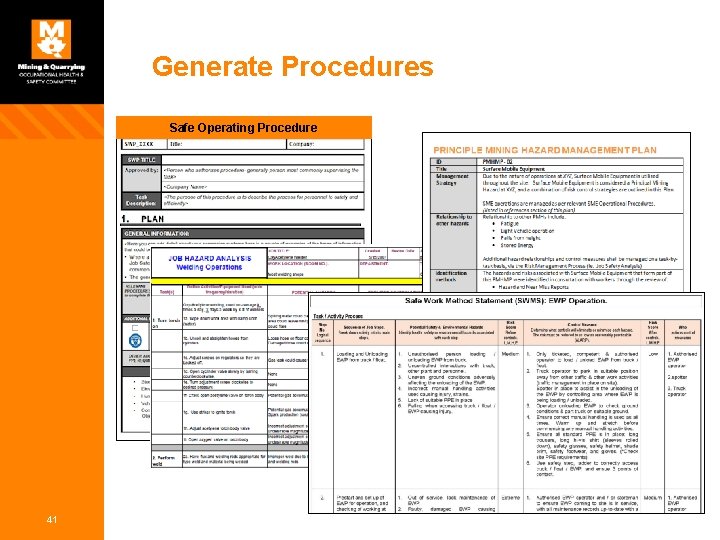
Generate Procedures Safe Operating Procedure 41
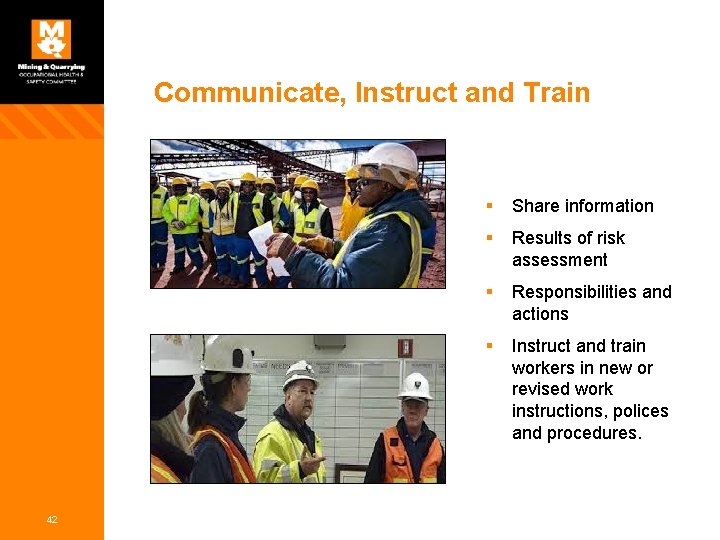
Communicate, Instruct and Train 42 § Share information § Results of risk assessment § Responsibilities and actions § Instruct and train workers in new or revised work instructions, polices and procedures.
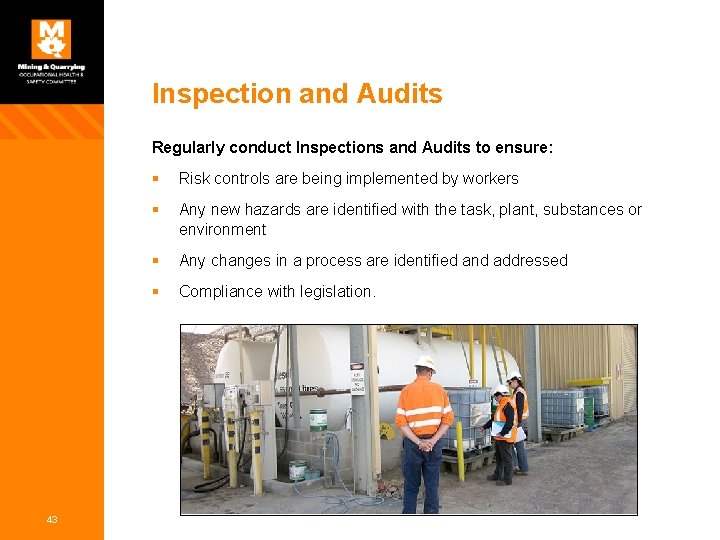
Inspection and Audits Regularly conduct Inspections and Audits to ensure: 43 § Risk controls are being implemented by workers § Any new hazards are identified with the task, plant, substances or environment § Any changes in a process are identified and addressed § Compliance with legislation.
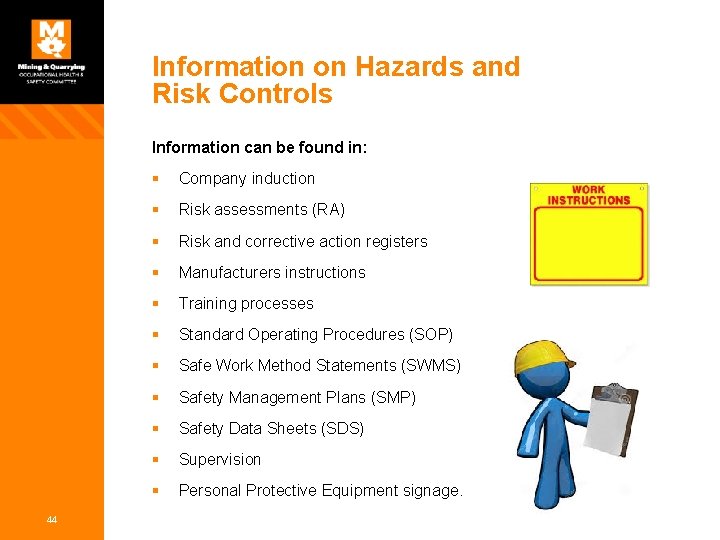
Information on Hazards and Risk Controls Information can be found in: 44 § Company induction § Risk assessments (RA) § Risk and corrective action registers § Manufacturers instructions § Training processes § Standard Operating Procedures (SOP) § Safe Work Method Statements (SWMS) § Safety Management Plans (SMP) § Safety Data Sheets (SDS) § Supervision § Personal Protective Equipment signage.
Summary 1. Identifying hazards in the workplace… 2. Assessing the Risk associated with each hazard. 3. Eliminate or Control the Risks using the hierarchy of control. 4. Review Risk Controls to ensure they remain effective 45
Summary PCBU § Primary duty of care to all workers on site by providing a working environment without risks to health and safety § Duty to identify hazards and assess the risk to health and safety of workers § Duty to eliminate the risk where possible or minimise the risk of harm (injury or damage) using reasonably practicable control measures § Duty to provide information, instruction and training as reasonably practicable to ensure the health and safety of all persons on site. Supervisors and Team Leaders 46 § Responsible for the day to day operations to ensure workers have received appropriate instruction, training, are adequately supervised and working safely § Hazards are reported and recorded and risks are controlled within their limits of their role.
Summary Workers 47 § Inform their supervision when a hazard has been identified § Not damage, remove or modify any plant, substance or thing that has been designed to protect his or health and safety and the health and safety of others § Follow any reasonable instruction from supervision while at work § Not place themselves or any one else at risk of harm through his or her acts or omissions (actions or words) § Wear supplied Personal Protective Equipment identified to protect them from hazards and risks associate with their work.
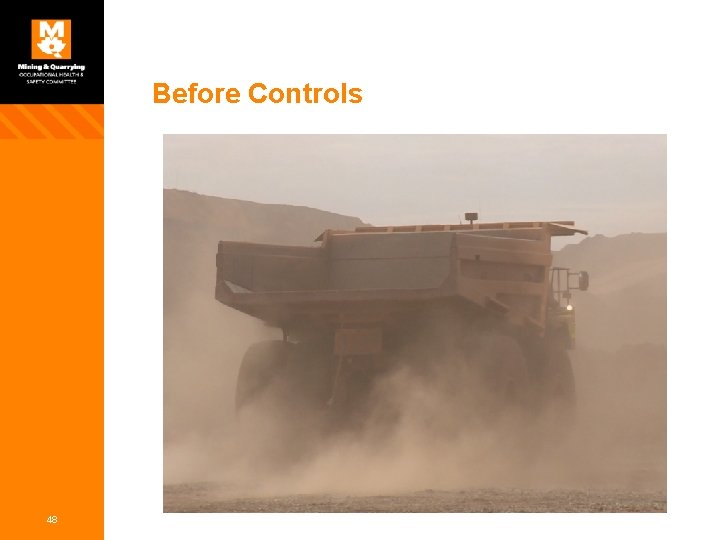
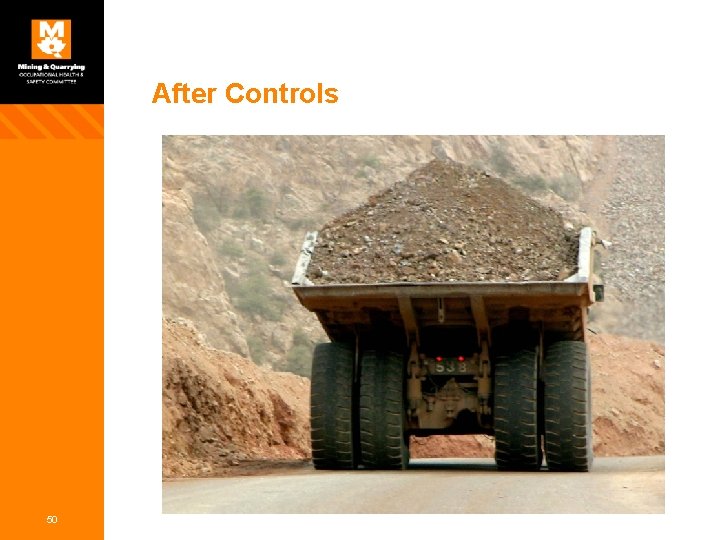
Before Controls 48
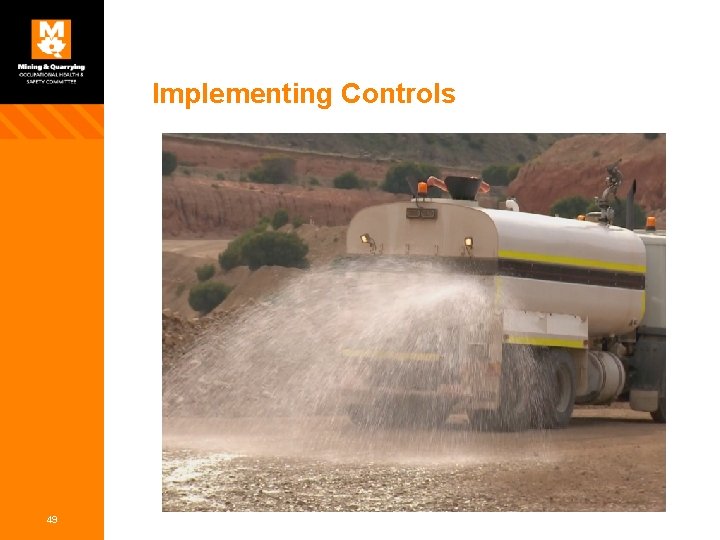
Implementing Controls 49
After Controls 50
Further Assistance MAQOHSC Work Health and Safety Specialists are available to provide further on-site support and assistance on all Work Health and Safety matters. MAQOHSC Work Health and Safety Specialists can be contacted via our online support request form available on our website at www. maqohsc. sa. gov. au or email maqohsc@sa. gov. au. Work Health and Safety Legislation, Codes of Practice, fact sheets, Health and Safety Representatives (HSR) information and guides can be found at the following websites: Safe. Work SA – www. safework. sa. gov. au or call 1300 365 255 Safe Work Australia – www. safeworkaustralia. gov. au or call 1300 551 832 51