
Hazard Communication Training Program Prepared by CSU Health
Hazard Communication Training Program Prepared by CSU Health & Safety Consultation 1681 Campus Delivery Ft. Collins, CO 80523 -1681 (970) 491 -6151
OBJECTIVES: Review Hazard Communication (Haz. Com) program requirements Employee training on OSHA’s Hazard Communication (Haz. Com) Standard (29 CFR 1910. 1200) Overview of the changes to the Haz. Com standard enacted by Globally Harmonized System (GHS) Label requirments Pictograms New safety data sheet (SDS) format
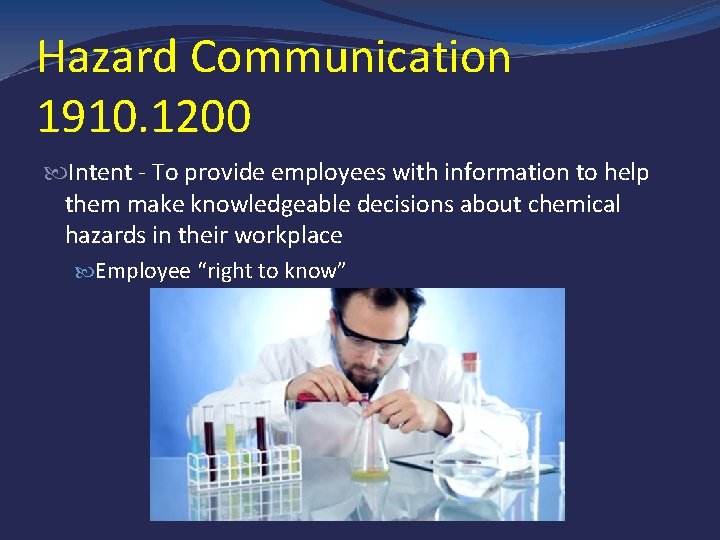
Hazard Communication 1910. 1200 Intent - To provide employees with information to help them make knowledgeable decisions about chemical hazards in their workplace Employee “right to know”
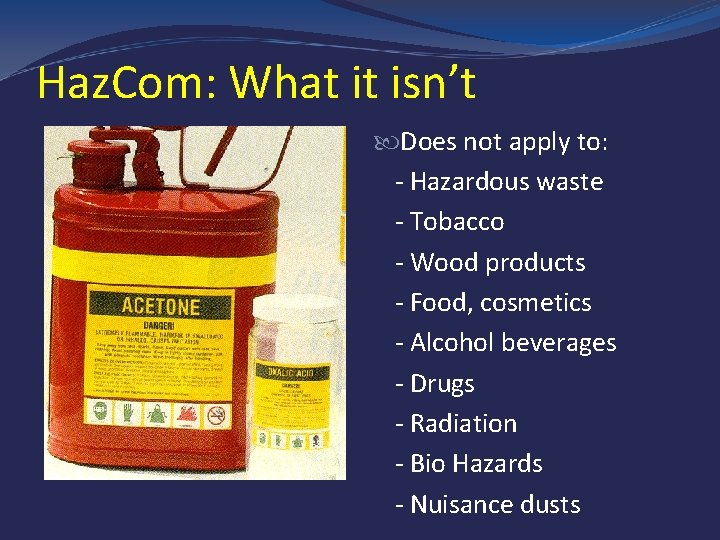
Haz. Com: What it isn’t Does not apply to: - Hazardous waste - Tobacco - Wood products - Food, cosmetics - Alcohol beverages - Drugs - Radiation - Bio Hazards - Nuisance dusts
What about Consumer Products in the Workplace? OSHA does not require employers to maintain SDSs for household chemicals (i. e. consumer products) if they are used in the quantity and manner of normal household use Ex. Ajax, Simple Green, Whiteout, floorwax, Tide, WD -40, etc.
Standard Requirements • Written program for each location to cover issues of chemical safety and hazard communication (Haz. Com) • Labels to identify each chemical • Material Safety Data Sheets (MSDSs) now SDSs under the Globally Harmonized System (GHS) • Safe work procedures/practices • Employee training on SDS information and safe chemical procedures and practices
Hazard Communication Manufacturer’s Responsibilities • Evaluate their chemicals for any potential hazard • Produce Safety Data Sheets (SDS) • Provide SDSs to distributors and importers of chemicals • Provide SDSs to Wholesalers & Retailers
Hazard Communication Employer Responsibilities • Inform Employees about any potential chemical hazards • Develop a written Haz. Com program: - Program Coordinator - List of Hazardous Chemicals - Safety Data Sheets - Container Labeling • Non-Routine Tasks • Training & Information • Contractors
Employee Training is Required • Upon initial employment • When a new hazardous product/chemical is introduced into the workplace • Change in process • As deemed necessary by supervision/management
Training Requirements Location of written plan & SDSs Methods to detect release of hazardous chemicals Physical & health hazards Measures employees can take to protect themselves Details of company Haz. Com program Labeling elements, SDS formatting, and pictograms
Hazard Communication for Multi. Employer Worksites Describe how employer will provide other employers with data on chemicals to which their employees may be exposed Methods to inform other employees of precautions to be taken Methods the employer will use to inform other employers of the labeling system used in the workplace
Hazard Communication Employee Responsibilities Follow safe practices Read labels & SDSs Wear appropriate PPE Follow specific requirements of company’s Haz. Com program Know emergency procedures
Chemical Classifications Chemicals are classified using a harmonized system that provides standardized language for: Health Hazard Categories Physical Hazard Categories Environmental Hazard Categories* *Not regulated by OSHA
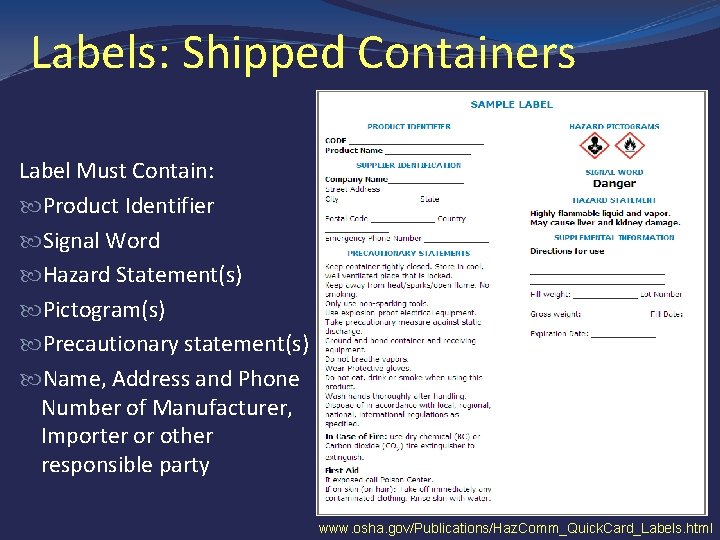
Labels: Shipped Containers Label Must Contain: Product Identifier Signal Word Hazard Statement(s) Pictogram(s) Precautionary statement(s) Name, Address and Phone Number of Manufacturer, Importer or other responsible party www. osha. gov/Publications/Haz. Comm_Quick. Card_Labels. html
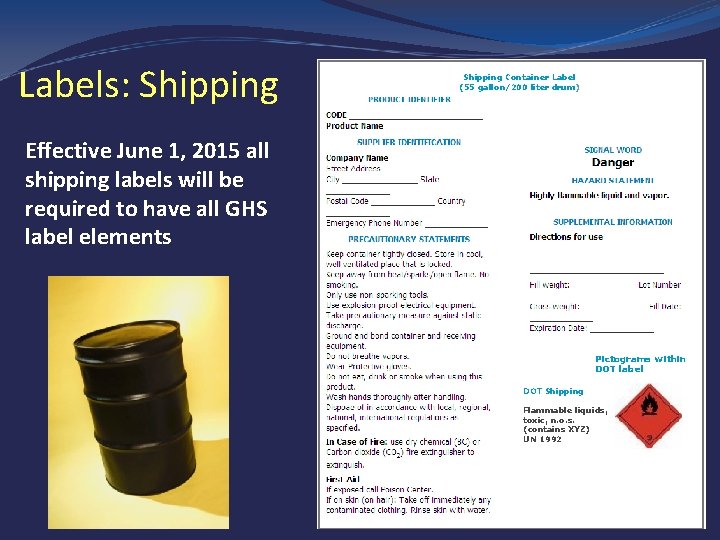
Labels: Shipping Container Label (55 gallon/200 liter drum) Effective June 1, 2015 all shipping labels will be required to have all GHS label elements Pictograms within DOT label DOT Shipping Flammable liquids, toxic, n. o. s. (contains XYZ) UN 1992
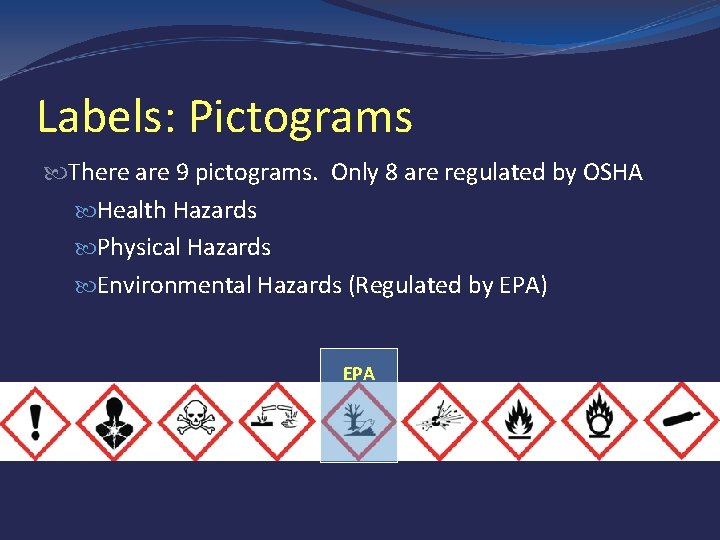
Labels: Pictograms There are 9 pictograms. Only 8 are regulated by OSHA Health Hazards Physical Hazards Environmental Hazards (Regulated by EPA) EPA
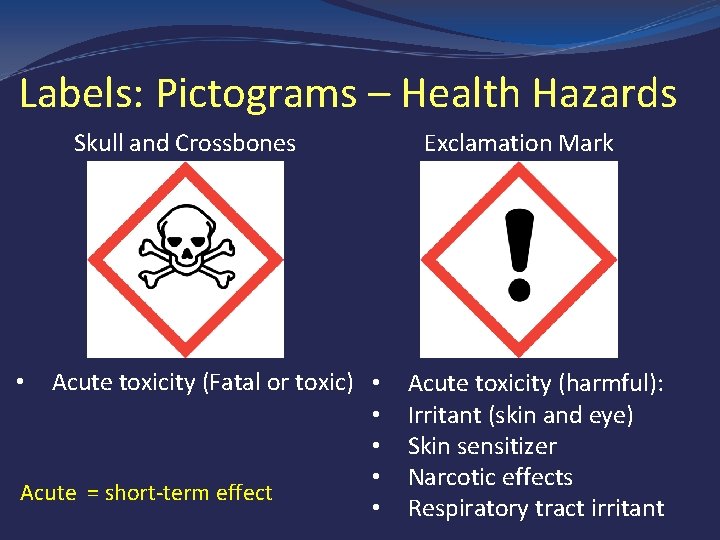
Labels: Pictograms – Health Hazards Skull and Crossbones Acute toxicity (Fatal or toxic) • • Acute = short-term effect • • Exclamation Mark Acute toxicity (harmful): Irritant (skin and eye) Skin sensitizer Narcotic effects Respiratory tract irritant
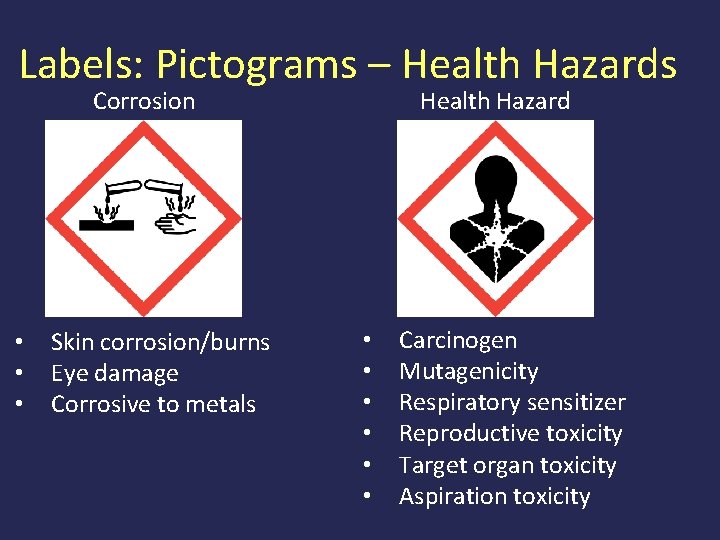
Labels: Pictograms – Health Hazards Corrosion • • • Skin corrosion/burns Eye damage Corrosive to metals Health Hazard • • • Carcinogen Mutagenicity Respiratory sensitizer Reproductive toxicity Target organ toxicity Aspiration toxicity
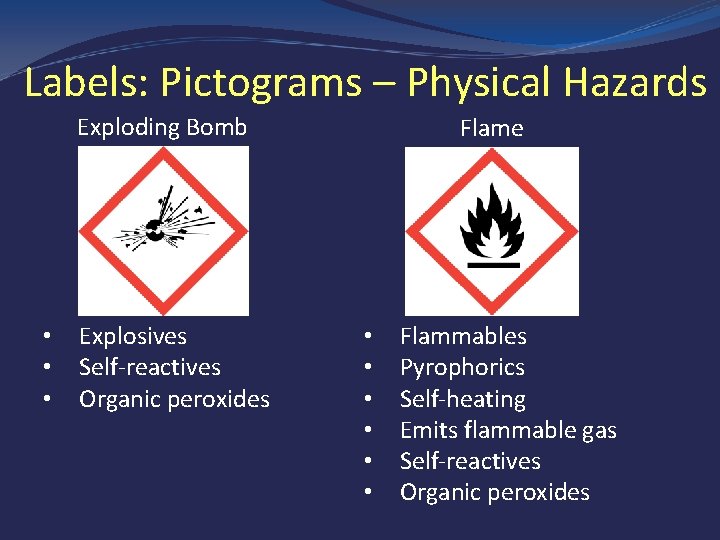
Labels: Pictograms – Physical Hazards Exploding Bomb • • • Explosives Self-reactives Organic peroxides Flame • • • Flammables Pyrophorics Self-heating Emits flammable gas Self-reactives Organic peroxides
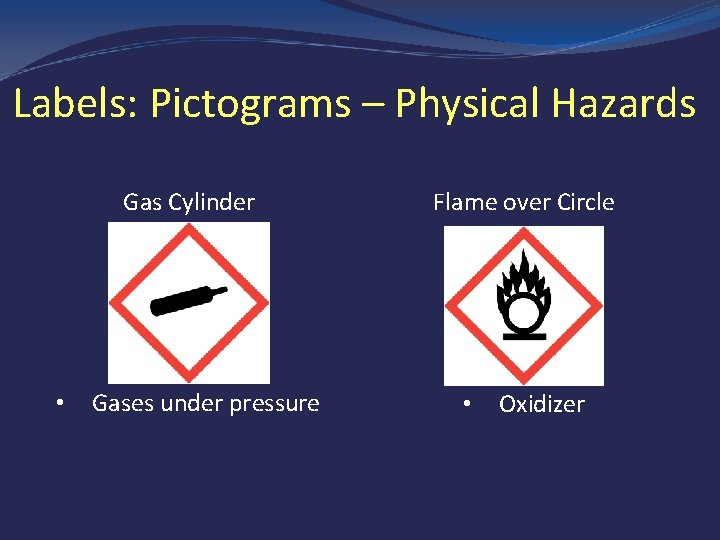
Labels: Pictograms – Physical Hazards Gas Cylinder • Gases under pressure Flame over Circle • Oxidizer
Labels: Signal Word These are words used to indicate the severity of the hazard and alert employees to the potential hazard Only 2 signal words will appear: “DANGER” (more severe hazard) “WARNING” (less severe hazard) Not all labels will have a signal word Some chemicals are not hazardous enough to require that a signal word appear on the label
Labels: Hazard Statement Describes the nature of the hazard(s) of a chemical, including, where appropriate, the degree of hazard For example: “Causes damage to kidneys through prolonged or repeated exposure when absorbed through the skin. ” All of the applicable hazard statements must appear on the label Hazard statements are specific to the hazard classification categories; chemical users should always see the same statement for the same hazards no matter what the chemical is or who produces it
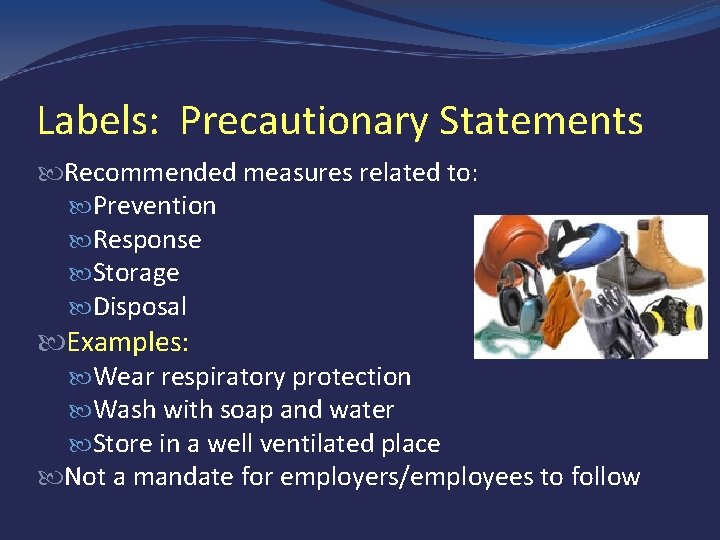
Labels: Precautionary Statements Recommended measures related to: Prevention Response Storage Disposal Examples: Wear respiratory protection Wash with soap and water Store in a well ventilated place Not a mandate for employers/employees to follow
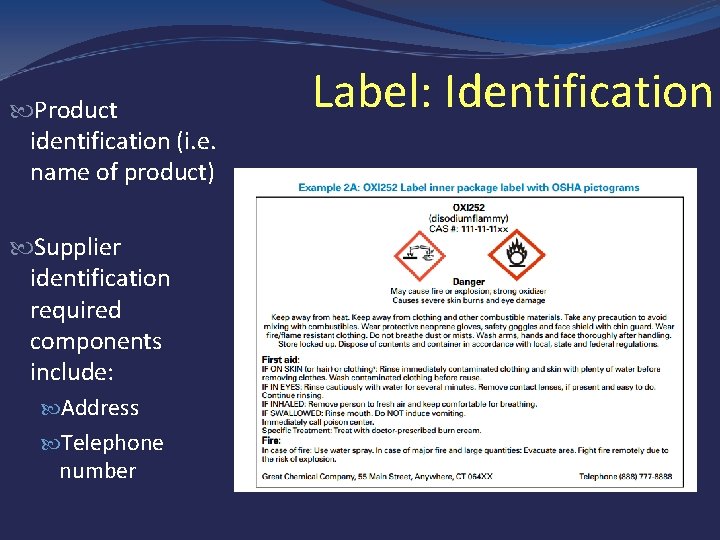
Product identification (i. e. name of product) Supplier identification required components include: Address Telephone number Label: Identification
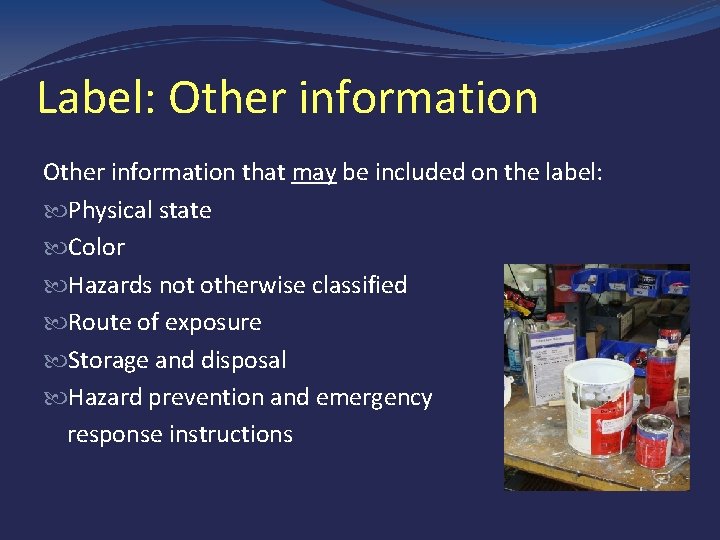
Label: Other information that may be included on the label: Physical state Color Hazards not otherwise classified Route of exposure Storage and disposal Hazard prevention and emergency response instructions
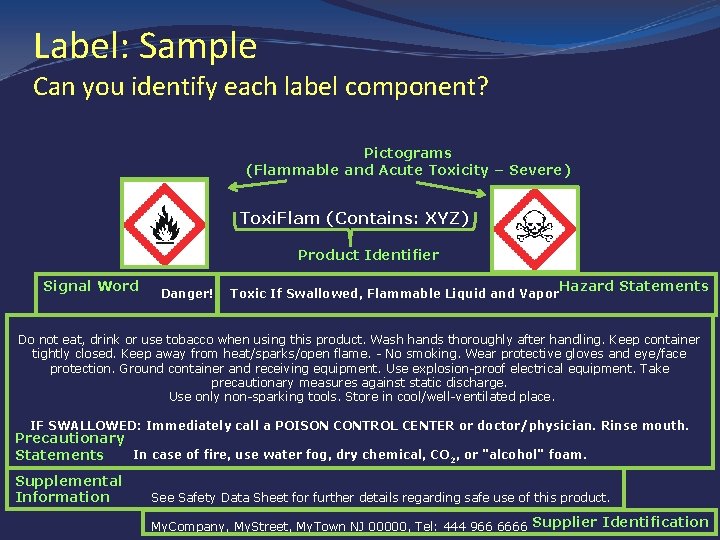
Label: Sample Can you identify each label component? Pictograms (Flammable and Acute Toxicity – Severe) Toxi. Flam (Contains: XYZ) Product Identifier Signal Word Danger! Hazard Statements Toxic If Swallowed, Flammable Liquid and Vapor Do not eat, drink or use tobacco when using this product. Wash hands thoroughly after handling. Keep container tightly closed. Keep away from heat/sparks/open flame. - No smoking. Wear protective gloves and eye/face protection. Ground container and receiving equipment. Use explosion-proof electrical equipment. Take precautionary measures against static discharge. Use only non-sparking tools. Store in cool/well-ventilated place. IF SWALLOWED: Immediately call a POISON CONTROL CENTER or doctor/physician. Rinse mouth. Precautionary In case of fire, use water fog, dry chemical, CO 2, or "alcohol" foam. Statements Supplemental Information See Safety Data Sheet for further details regarding safe use of this product. My. Company, My. Street, My. Town NJ 00000, Tel: 444 966 6666 Supplier Identification
Labels: Secondary Containers Must be consistent with the revised Haz. Com standard No conflicting hazard warnings or pictograms May use written materials (e. g. , signs, placards, etc. ) in lieu of affixing labels to individual stationary process containers Employer can use GHS compliant labels (same as shipping)
Labels: Secondary Containers Workplace labels for secondary containers do not need to include all of the information required for manufacturer labels At a minimum secondary labels should contain the following: Identity of the hazardous chemical(s) contained therein; and An appropriate hazard warning
Labels: Secondary Containers The following are examples of appropriate hazard warnings: Hazard statement Precautionary statement Signal word Pictures Symbols Pictograms Or a combination thereof
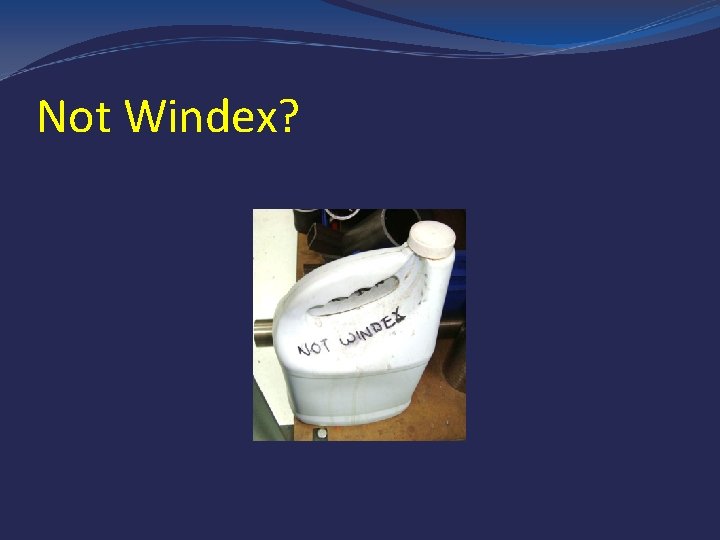
Not Windex?
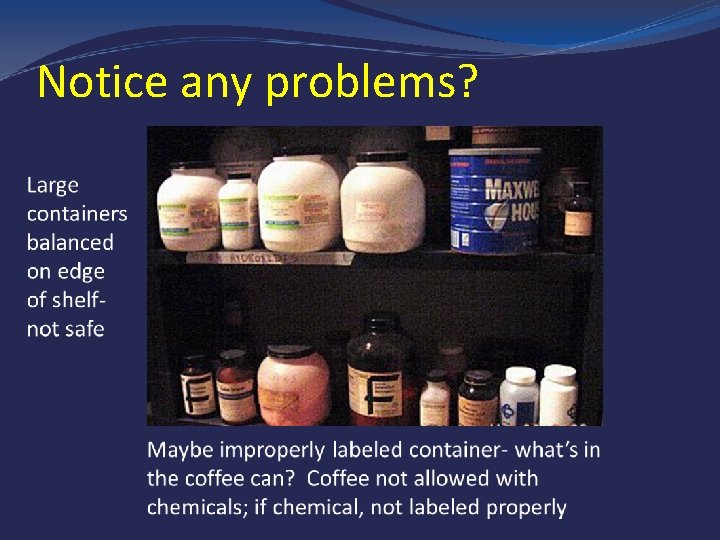
Notice any problems?
Safety Data Sheets Under the new Haz. Com Standard, Material Safety Data Sheets (MSDSs) are now called Safety Data Sheets (SDSs) All SDSs will have a consistent 16 -section format Employers must ensure that SDSs are readily accessible to employees Safety Material Data Safety Sheets Data Sheets
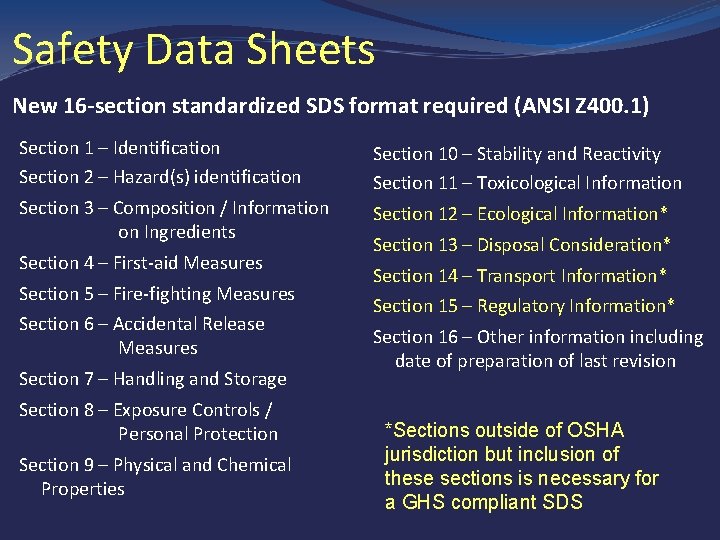
Safety Data Sheets New 16 -section standardized SDS format required (ANSI Z 400. 1) Section 1 – Identification Section 2 – Hazard(s) identification Section 10 – Stability and Reactivity Section 11 – Toxicological Information Section 3 – Composition / Information on Ingredients Section 12 – Ecological Information* Section 4 – First-aid Measures Section 5 – Fire-fighting Measures Section 6 – Accidental Release Measures Section 7 – Handling and Storage Section 8 – Exposure Controls / Personal Protection Section 9 – Physical and Chemical Properties Section 13 – Disposal Consideration* Section 14 – Transport Information* Section 15 – Regulatory Information* Section 16 – Other information including date of preparation of last revision *Sections outside of OSHA jurisdiction but inclusion of these sections is necessary for a GHS compliant SDS
Safety Data Sheets Section 1 – Identification: Identifies the chemical on the SDS as well as the recommended uses. It also provides the essential contact information of the supplier Section 2 - Hazards Identification: Hazards of the chemical presented on the SDS Appropriate warning information associated with those hazards
Safety Data Sheets Section 3 – Composition / Ingredients: Identifies the ingredient(s) contained in the product indicated on the SDS, including: impurities and stabilizing additives information on substances, mixtures, and all chemicals where a trade secret is claimed Section 4 - First-Aid Measures: Describes the initial care that should be given by untrained responders to an individual who has been exposed to the chemical.
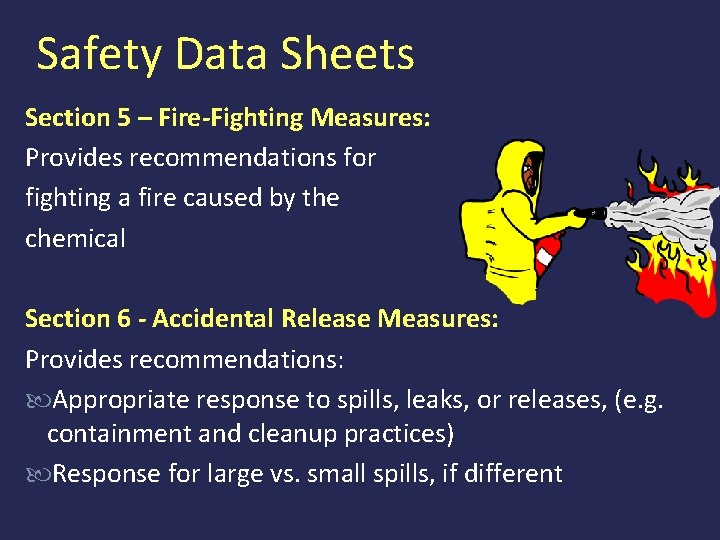
Safety Data Sheets Section 5 – Fire-Fighting Measures: Provides recommendations for fighting a fire caused by the chemical Section 6 - Accidental Release Measures: Provides recommendations: Appropriate response to spills, leaks, or releases, (e. g. containment and cleanup practices) Response for large vs. small spills, if different
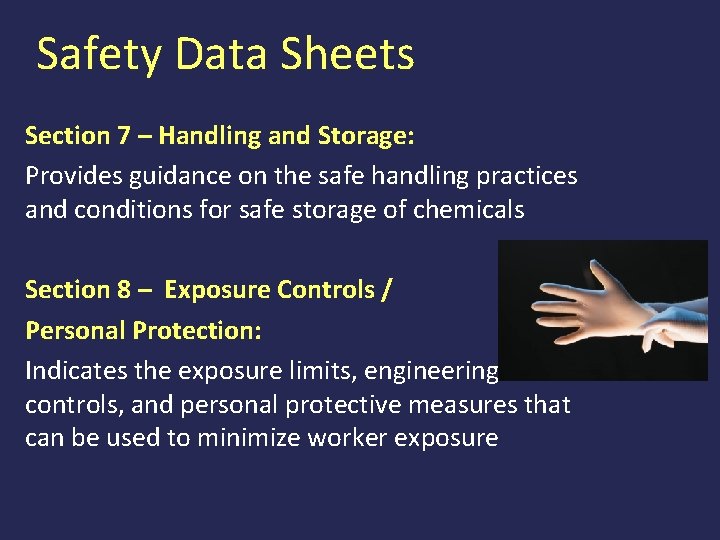
Safety Data Sheets Section 7 – Handling and Storage: Provides guidance on the safe handling practices and conditions for safe storage of chemicals Section 8 – Exposure Controls / Personal Protection: Indicates the exposure limits, engineering controls, and personal protective measures that can be used to minimize worker exposure
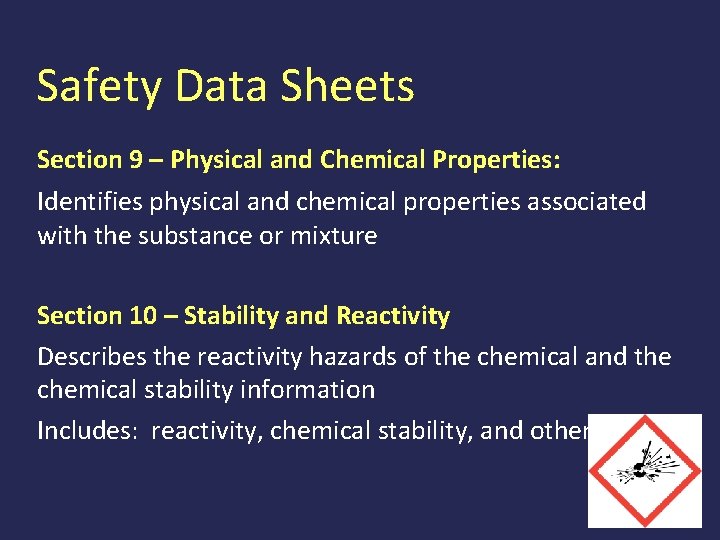
Safety Data Sheets Section 9 – Physical and Chemical Properties: Identifies physical and chemical properties associated with the substance or mixture Section 10 – Stability and Reactivity Describes the reactivity hazards of the chemical and the chemical stability information Includes: reactivity, chemical stability, and other
Safety Data Sheets Section 11 - Toxicological Information: Identifies toxicological and health effects information or indicates if data unavailable Section 12 – Ecological Information* Section 13 – Disposal Consideration* Section 14 – Transport Information* Section 15 – Regulatory Information* *Sections are outside of OSHA jurisdiction but must be included for a GHS compliant SDS
Safety Data Sheets Section 16 – Other Information Indicates when the SDS was prepared or when the last known revision was made The SDS may also state where the changes have been made to the previous version
Summary All facilities should have a hazard communication plan in a location that is accessible to all employees Hazardous chemicals should be labeled SDSs should be available and accessible for all hazardous products Employees should be trained on the specifics of your company’s Haz. Com program
Federal OSHA Resources Haz. Com Web Page - www. osha. gov/dsg/hazcom/index. html Regulatory Haz. Com 2012 Final Rule Haz. Comparison: Haz. Com 1994 and 2012 Side-by-side Redline Strikeout of the Regulatory Text FAQs Guidance OSHA Briefs Fact Sheet Quick Cards Labeling Safety Data Sheets Pictograms Effective Dates OSHA Guide to GHS www. osha. gov/dsg/hazcom/ghs. html GHS documents (links to purple book)
Questions Contact Colorado State University, Health & Safety Consultation for information or assistance: CSU Health & Safety Consultation 1681 Campus Delivery Ft. Collins, CO 80523 -1681 (970) 491 -6151
- Slides: 43