
Hazard Communication GENERAL Introduction Lesson objectives 1 Identify
Hazard Communication GENERAL
Introduction Lesson objectives: 1. Identify the employer’s responsibilities under the HCS, including training requirements. 2. Identify components of a Hazard Communication program. 3. Describe requirements of the different types of Hazard Communication labels. 4. Locate pertinent information about chemicals on labels, including other forms of hazard communication, to ensure “right to understanding” provisions of GHS requirements.
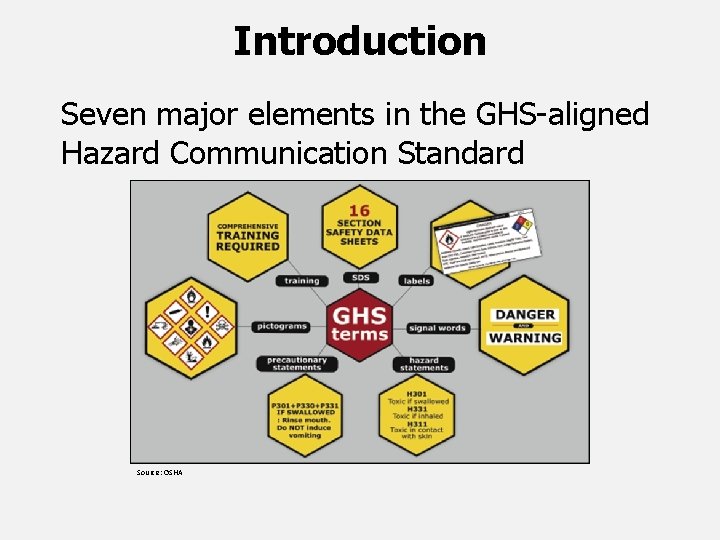
Introduction Seven major elements in the GHS-aligned Hazard Communication Standard Source: OSHA
Employer Responsibilities Employer responsibilities under the HCS: • Ensure labels are on incoming labels and not defaced • Maintain SDSs from shipments • Obtain SDSs if not received • Ensure SDSs are readily accessible • Ensure chemicals in workplace are properly labeled, tagged, or marked • Provide information and training to employees • Provide information/access for employees in multi-employer workplaces • Develop, implement, and maintain a written hazard communication program
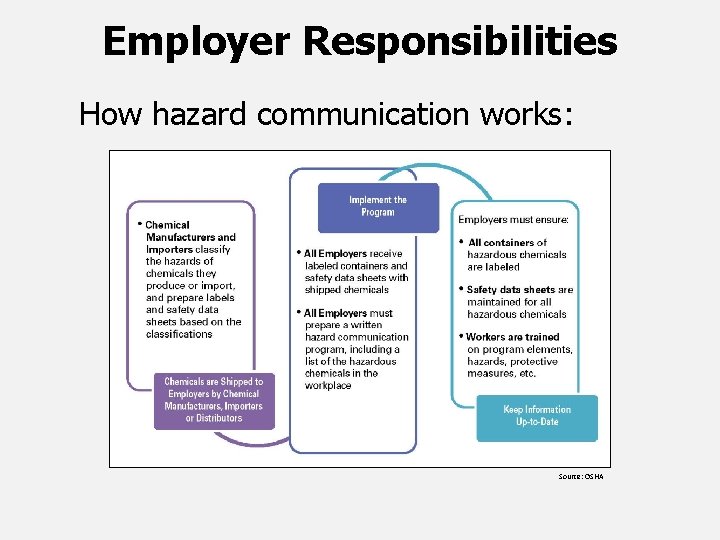
Employer Responsibilities How hazard communication works: Source: OSHA
Hazard Communication Program Requirements for a written program: • Develop, implement, and maintain a written hazard communication program • Main intent is to ensure compliance with standard in a systematic way that coordinates all elements
Hazard Communication Program Components of written program: • Lists of hazardous chemicals present at worksite • Availability of SDSs to employees and downstream employers • Labeling of chemical containers • Training programs regarding hazards of chemicals and protective measures
Hazard Communication Program List of hazardous chemicals: • Use product identifier – Product name, common name or chemical name – Same as name used on SDS and label • Inventory of chemicals – employer must have available an SDS for each • Covers all chemicals in all forms, whether contained or not • Include chemicals in containers, pipes, and those generated by work operations
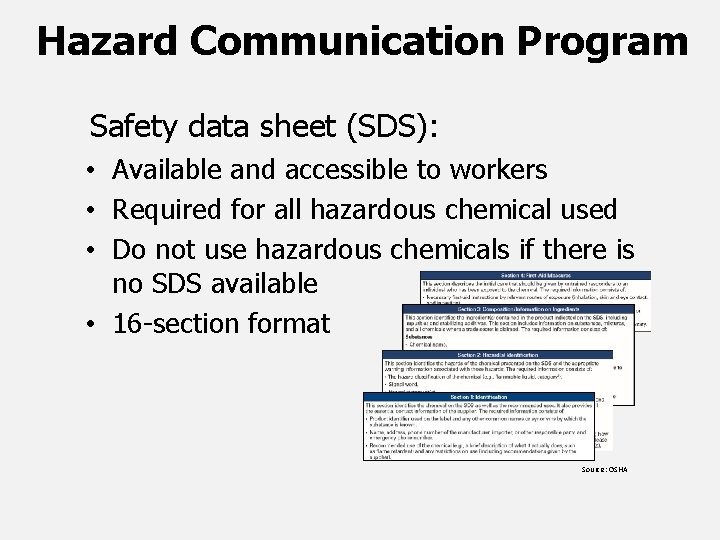
Hazard Communication Program Safety data sheet (SDS): • Available and accessible to workers • Required for all hazardous chemical used • Do not use hazardous chemicals if there is no SDS available • 16 -section format Source: OSHA
Hazard Communication Program SDS documentation: • Designate person(s) responsible for obtaining and maintaining SDSs • Describe how SDSs are maintained and how employees can access them • Procedures if SDS is not received with first shipment • Must have SDS for each chemical; train workers on SDS format and use Source: OSHA
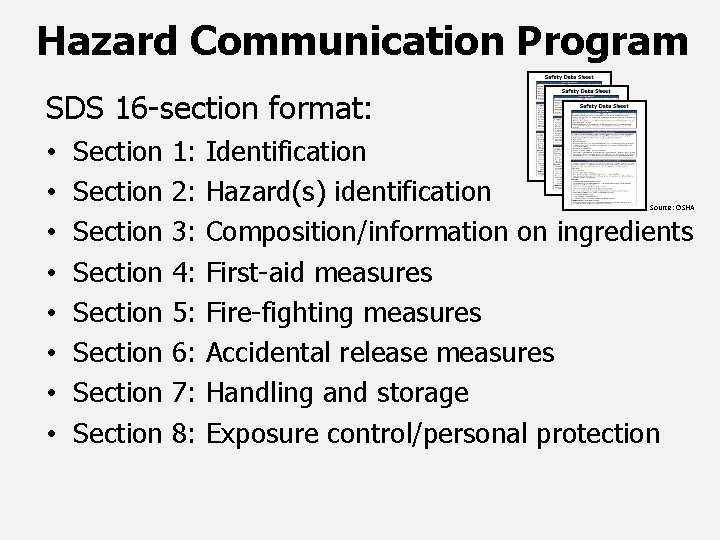
Hazard Communication Program SDS 16 -section format: • • Section Section 1: 2: 3: 4: 5: 6: 7: 8: Identification Hazard(s) identification Composition/information on ingredients First-aid measures Fire-fighting measures Accidental release measures Handling and storage Exposure control/personal protection Source: OSHA
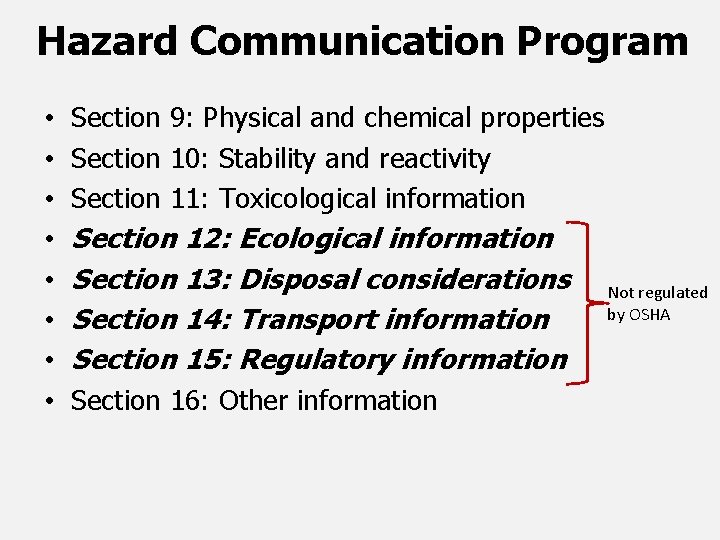
Hazard Communication Program • • Section 9: Physical and chemical properties Section 10: Stability and reactivity Section 11: Toxicological information Section 12: Ecological information Section 13: Disposal considerations Section 14: Transport information Section 15: Regulatory information Section 16: Other information Not regulated by OSHA
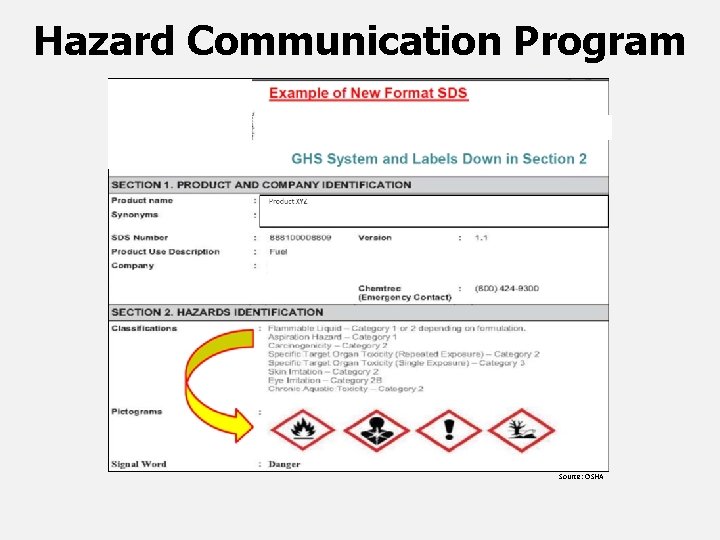
Hazard Communication Program Source: OSHA
Hazard Communication Program Labeling: • All containers of hazardous materials must be labeled • Immediate warning • Snapshot of hazards and protective information
Hazard Communication Program Documentation for labeling: • Designate person(s) responsible for labeling compliance • Describe alternatives to labeling of stationary process containers • Ensure all workplace containers are labeled appropriately • Labels included in training (shipping and workplace containers) • Procedures for reviewing/updating workplace label information
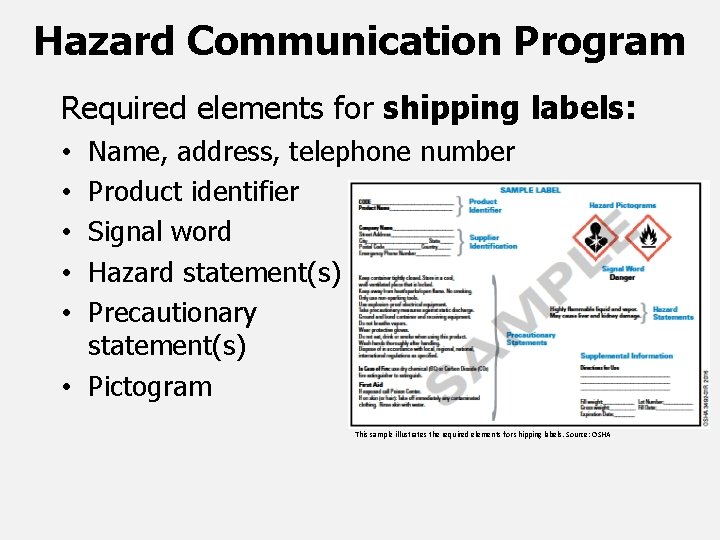
Hazard Communication Program Required elements for shipping labels: Name, address, telephone number Product identifier Signal word Hazard statement(s) Precautionary statement(s) • Pictogram • • • This sample illustrates the required elements for shipping labels. Source: OSHA
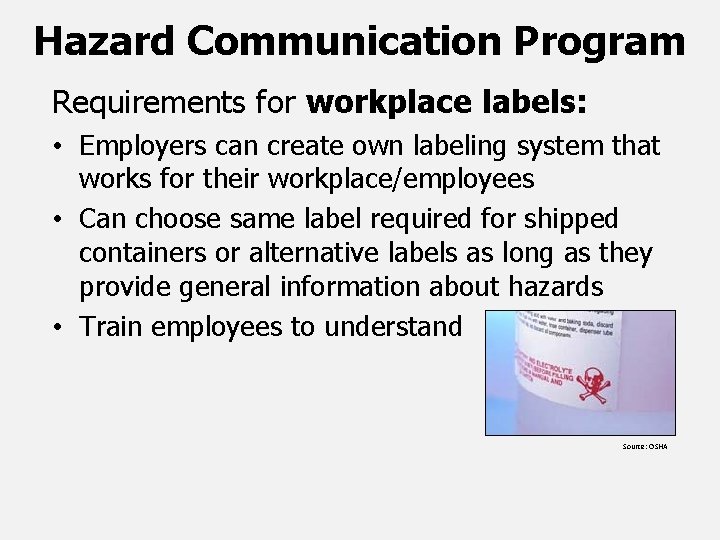
Hazard Communication Program Requirements for workplace labels: • Employers can create own labeling system that works for their workplace/employees • Can choose same label required for shipped containers or alternative labels as long as they provide general information about hazards • Train employees to understand Source: OSHA
Hazard Communication Program Training requirements: • Train employees on hazardous chemicals in their work area – Before initial assignment – When new hazards are introduced – Nonroutine tasks • Include in training – Methods/observations to determine presence/release of chemical in work area – Hazards of chemicals – Appropriate protective measures – Where and how to obtain additional information Source: OSHA
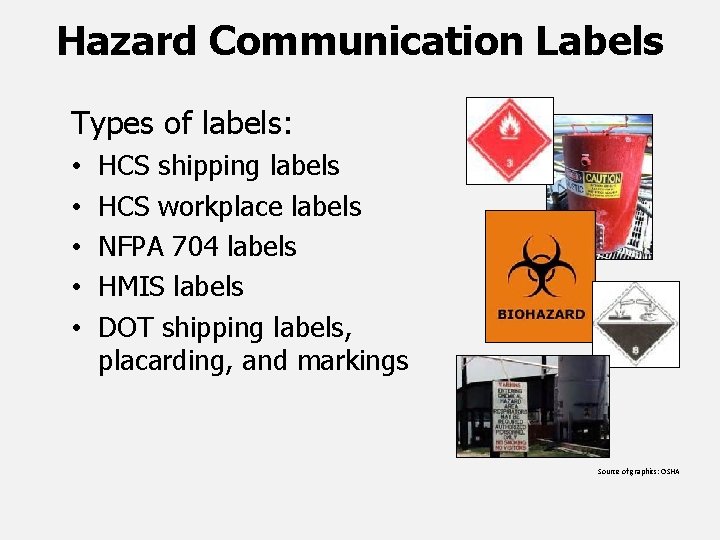
Hazard Communication Labels Types of labels: • • • HCS shipping labels HCS workplace labels NFPA 704 labels HMIS labels DOT shipping labels, placarding, and markings Source of graphics: OSHA

Hazard Communication Labels Required elements for HCS shipping labels: Product identifier Signal word Hazard statement(s) Precautionary statement(s) • Pictogram • Name, address, telephone number • • Source: OSHA
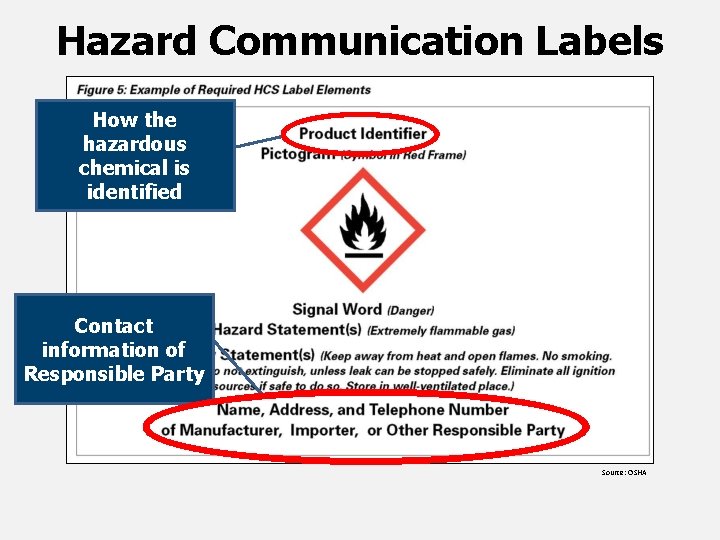
Hazard Communication Labels How the hazardous chemical is identified Contact information of Responsible Party Source: OSHA
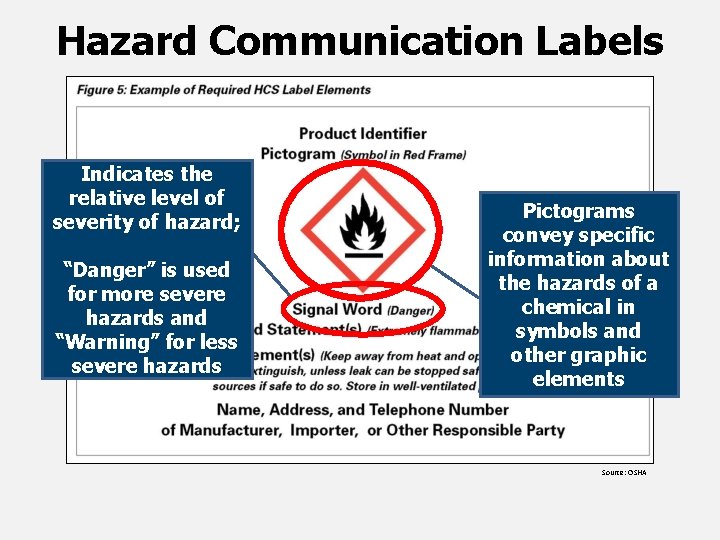
Hazard Communication Labels Indicates the relative level of severity of hazard; “Danger” is used for more severe hazards and “Warning” for less severe hazards Pictograms convey specific information about the hazards of a chemical in symbols and other graphic elements Source: OSHA
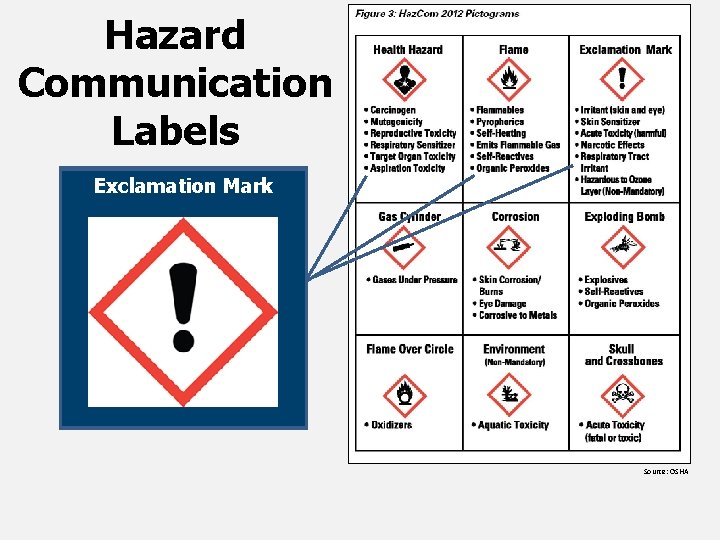
Hazard Communication Labels Health Hazard Exclamation Mark Flame Source: OSHA
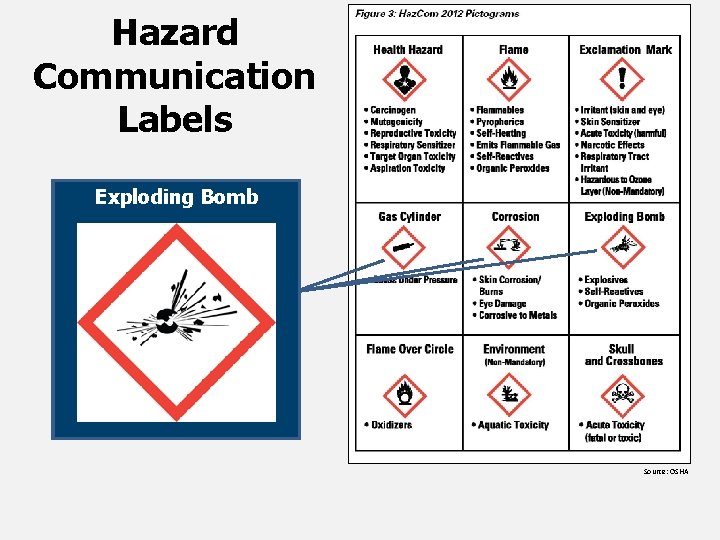
Hazard Communication Labels Gas Cylinder Exploding Corrosion Bomb Source: OSHA
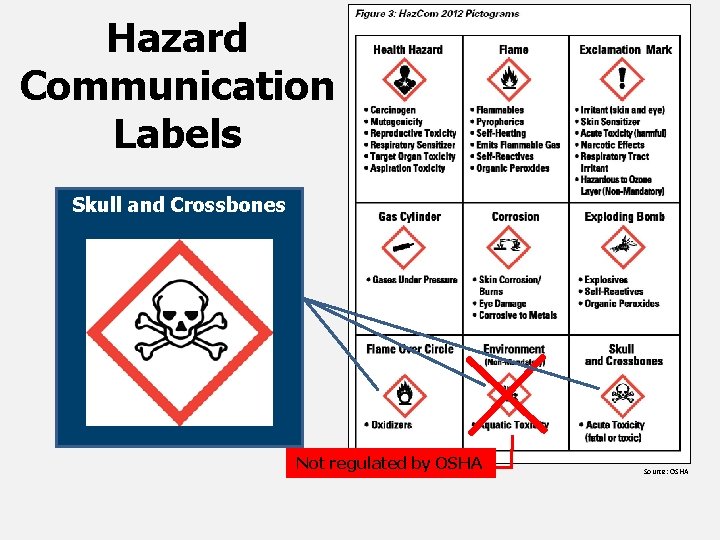
Hazard Communication Labels Environmental Skull Flame and. Over Crossbones Circle (Non-Mandatory) Not regulated by OSHA Source: OSHA
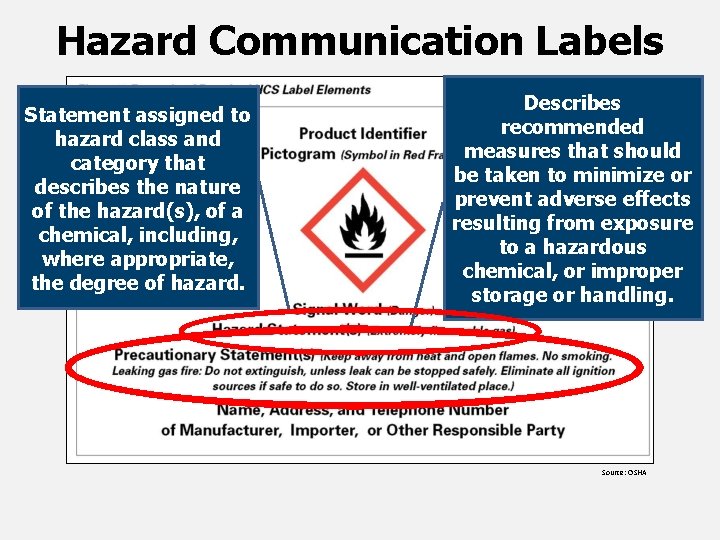
Hazard Communication Labels Statement assigned to hazard class and category that describes the nature of the hazard(s), of a chemical, including, where appropriate, the degree of hazard. Describes recommended measures that should be taken to minimize or prevent adverse effects resulting from exposure to a hazardous chemical, or improper storage or handling. Source: OSHA
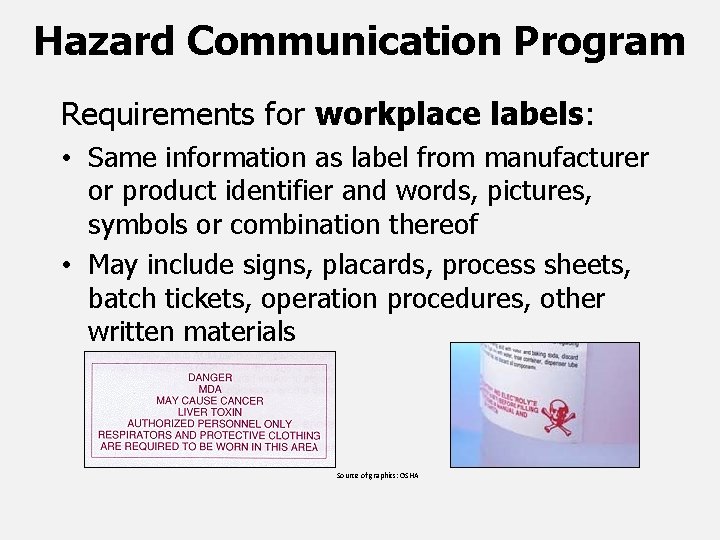
Hazard Communication Program Requirements for workplace labels: • Same information as label from manufacturer or product identifier and words, pictures, symbols or combination thereof • May include signs, placards, process sheets, batch tickets, operation procedures, other written materials Source of graphics: OSHA
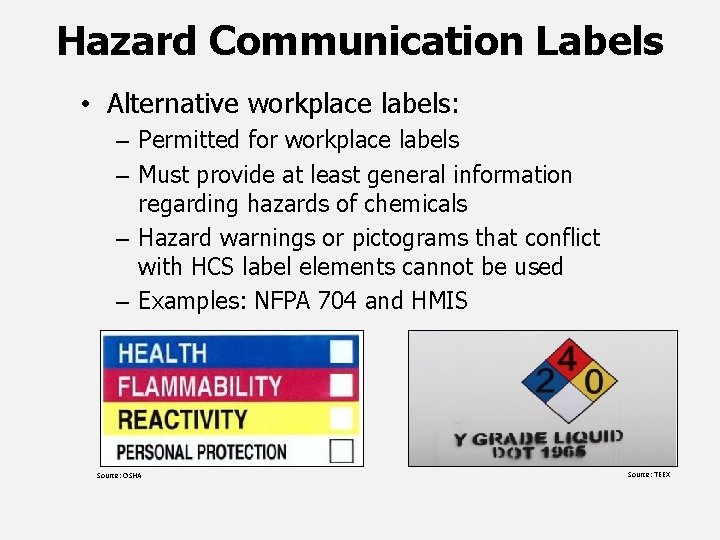
Hazard Communication Labels • Alternative workplace labels: – Permitted for workplace labels – Must provide at least general information regarding hazards of chemicals – Hazard warnings or pictograms that conflict with HCS label elements cannot be used – Examples: NFPA 704 and HMIS Source: OSHA Source: TEEX
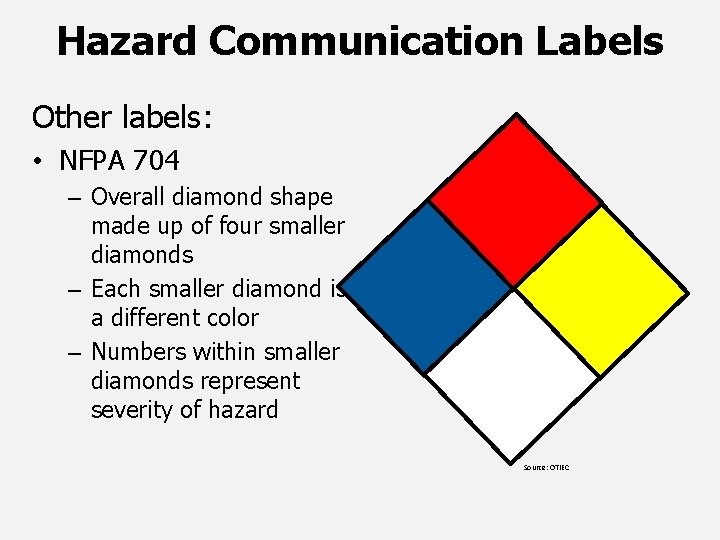
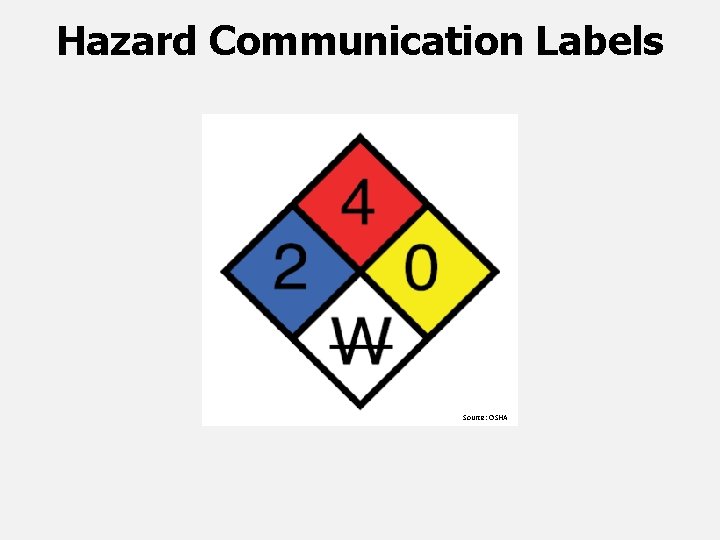
Hazard Communication Labels Other labels: • NFPA 704 – Overall diamond shape made up of four smaller diamonds – Each smaller diamond is a different color – Numbers within smaller diamonds represent severity of hazard Source: OTIEC
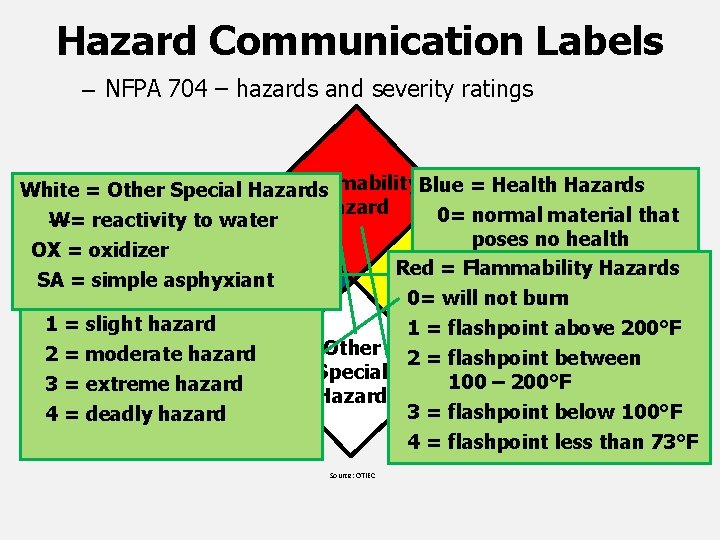
Hazard Communication Labels – NFPA 704 – hazards and severity ratings Flammability. Blue = Health Hazards White = Other Special Hazards Hazard 0= normal material that W= reactivity to water poses no health OX = oxidizer Yellow = Instability Hazards Red 1==Flammability Health slight hazard. Hazards Instability SA = simple asphyxiant 0= normally stable. Hazard 0=2 will not burn hazard = moderate 1 = slight hazard 1 =3 flashpoint 200°F = extremeabove hazard Other 2 = flashpoint between 2 = moderate hazard 4 = deadly hazard Special 100 – 200°F 3 = extreme hazard Hazard 3 = flashpoint below 100°F 4 = deadly hazard 4 = flashpoint less than 73°F Source: OTIEC
Hazard Communication Labels Source: OSHA
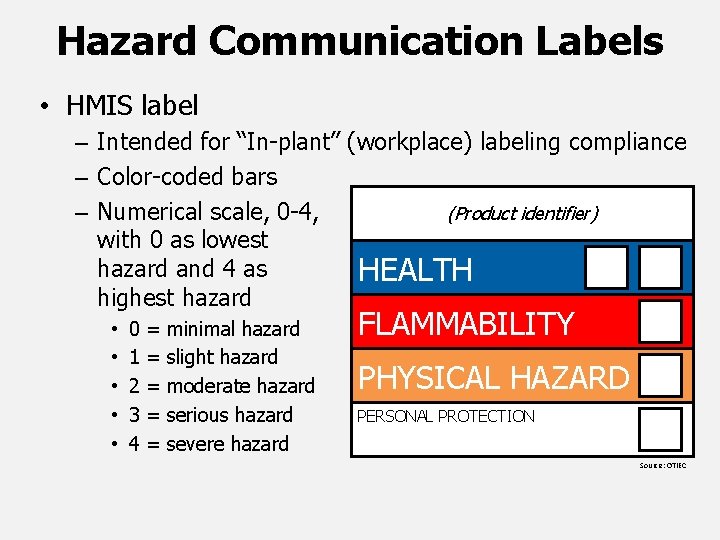
Hazard Communication Labels • HMIS label – Intended for “In-plant” (workplace) labeling compliance – Color-coded bars – Numerical scale, 0 -4, (Product identifier) with 0 as lowest hazard and 4 as HEALTH highest hazard • • • 0 1 2 3 4 = = = minimal hazard slight hazard moderate hazard serious hazard severe hazard FLAMMABILITY PHYSICAL HAZARD PERSONAL PROTECTION Source: OTIEC
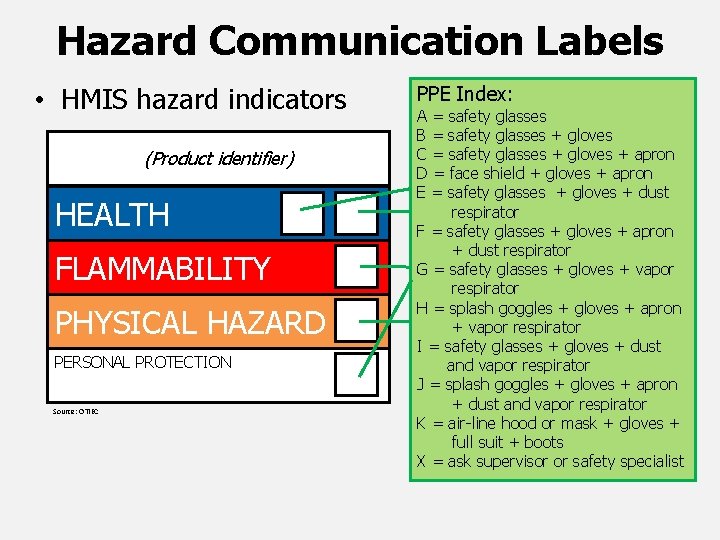
Hazard Communication Labels • HMIS hazard indicators (Product identifier) HEALTH FLAMMABILITY PHYSICAL HAZARD PERSONAL PROTECTION Source: OTIEC PPE Index: A = safety glasses B= safety glasses + gloves Flammability ratings: Health ratings: C = safety glasses + gloves + apron 0 face = no will not+space burn The second signifies = significant D 0 = shield gloves risk + apron 1 safety = irritation/minor flashpoint >200°F E= glasses gloves +with dust chronic health+hazard 1 = injury respirator 2= =asterisk flashpoint an (*) ≥ 100°F, 2 temporary/minor injury F = safety glasses + gloves + apron but <200°F Hazard ratings: 3 Physical = major injury + dust respirator 3 = life-threatening flashpoint <73°F and 0 safety normally stable = G 4 = glasses + gloves + vapor boiling point >100°F, respirator 1= normally stable, but H = splash goggles + gloves + apron or flashpoint between can become unstable + vapor 73°Frespirator and 100°F 2 = unstable I = safety glasses + gloves + dust = explosive flashpoint <73°F and 34 and = vapor respirator boiling point <100°F J =4 splash goggles + gloves + apron = readily explosive + dust and vapor respirator K = air-line hood or mask + gloves + full suit + boots X = ask supervisor or safety specialist
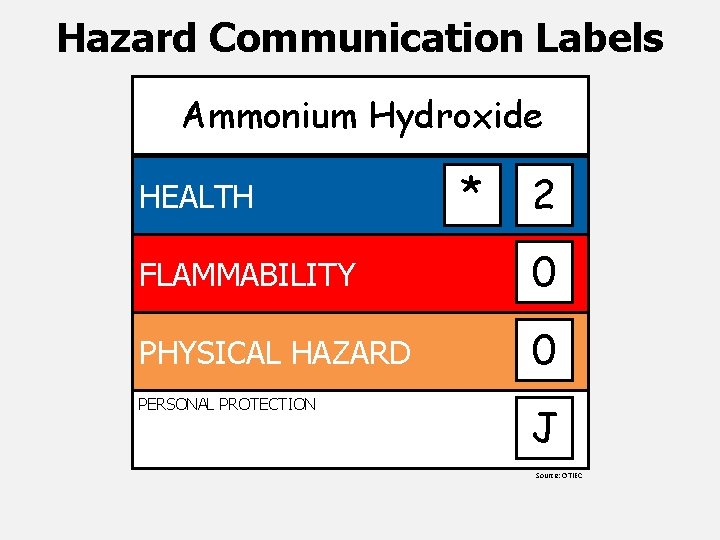
Hazard Communication Labels Ammonium Hydroxide HEALTH * 2 FLAMMABILITY 0 PHYSICAL HAZARD 0 PERSONAL PROTECTION J Source: OTIEC
Hazard Communication Labels • DOT shipping containers – marking, labeling, and placarding – Uses graphic elements on square-on-point placards or labels to identify shipments of hazardous materials – Square-on-points have backgrounds of various colors – Where shipping container is also container used in workplace, workers must be made aware of DOT pictograms – DOT Classification – groups hazardous materials based on dangers posed in transportation; 9 classes
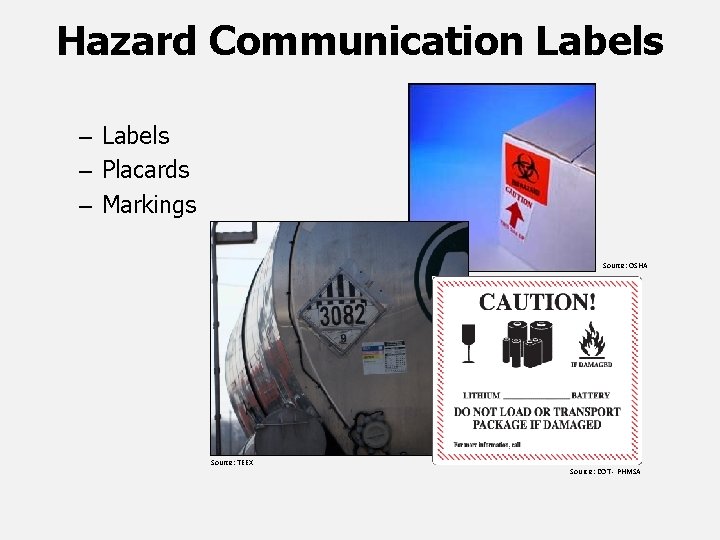
Hazard Communication Labels – Placards – Markings Source: OSHA Source: TEEX Source: DOT - PHMSA
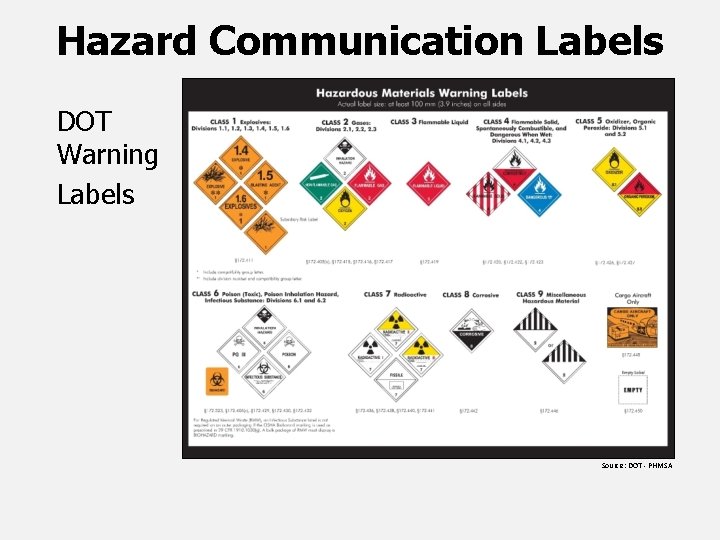
Hazard Communication Labels DOT Warning Labels Source: DOT - PHMSA
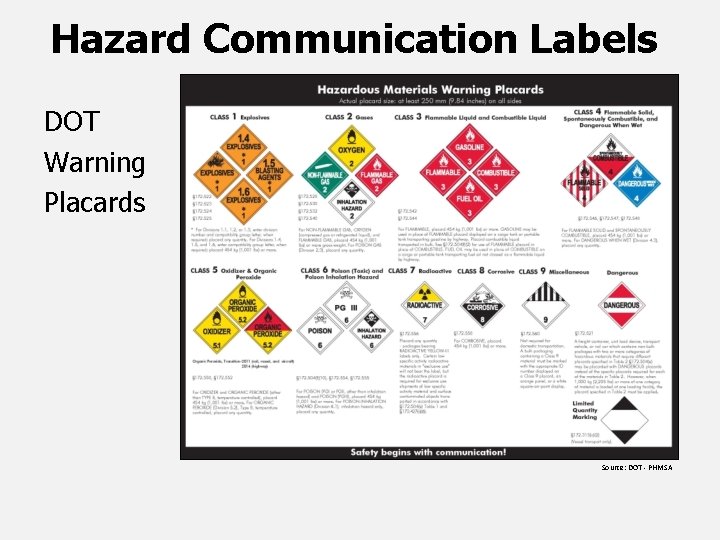
Hazard Communication Labels DOT Warning Placards Source: DOT - PHMSA
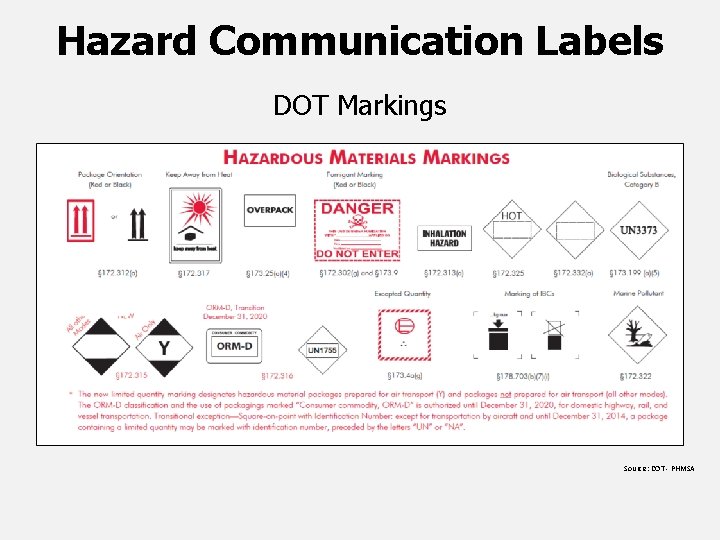
Hazard Communication Labels DOT Markings Source: DOT - PHMSA
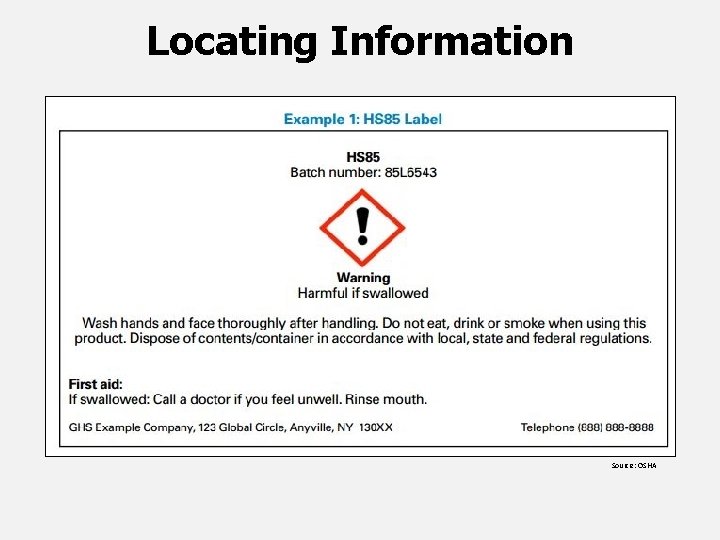
Locating Information Source: OSHA
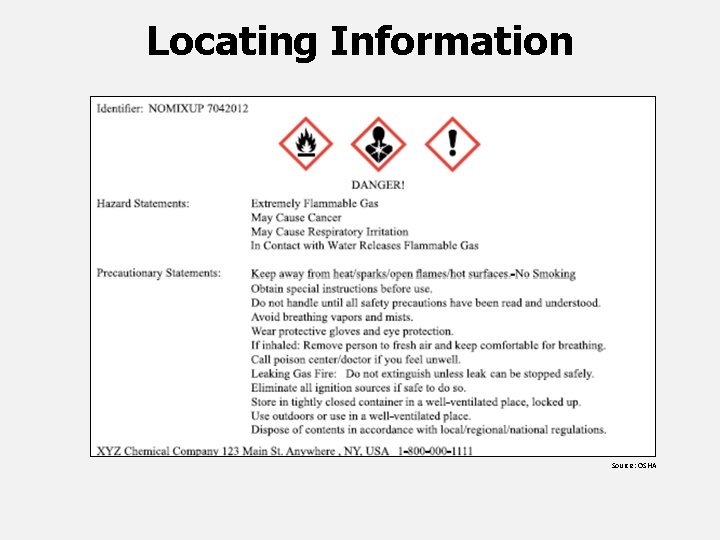
Locating Information Source: OSHA
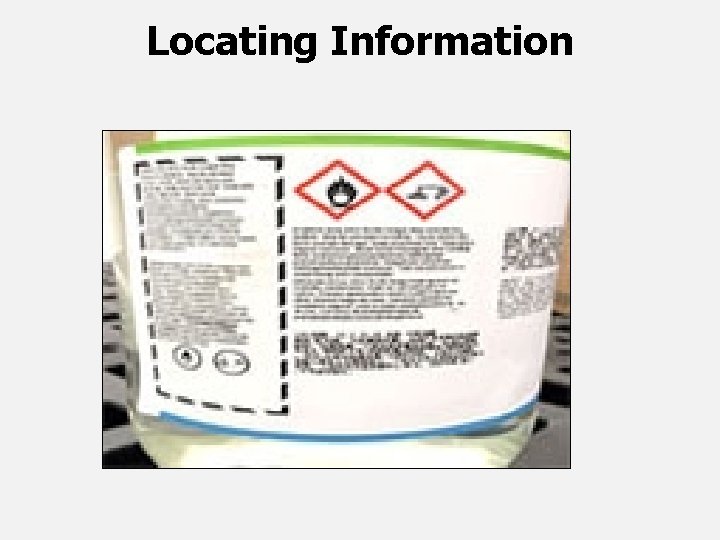
Locating Information Source: OSHA
Locating Information In which section of an SDS would you find the following information: 1. Hazard identification such as hazard classification, signal word, and precautionary statements Section 2: Hazard(s) Identification 2. Initial care instructions for untrained responders attending to an individual who has been exposed to the chemical Section 4: First-Aid Measures 3. Recommendations for PPE Section 8: Exposure Controls/Personal Protection
Summary In this module we discussed: • Employer’s responsibilities under HCS • Components of a Hazard Communication Program • Requirements of different types of Hazard Communication labels • How to locate pertinent information
Knowledge Check 1. A hazard communication program requires which of the following components? a. b. c. d. Written program SDS/Labeling Training All of the Above Answer: d. All of the above
Knowledge Check 2. How many sections are required on an SDS? a. b. c. d. 11 sections 16 sections 4 sections As many as necessary to convey understanding Answer: b. 16 sections
Knowledge Check 3. Which of the following statements is true of the pictograms on HCS labels? a. Pictograms on HCS labels are identical to those used on DOT transport labels and may have various background colors. b. Consist of four bars that are color-coded as blue, red, yellow, and white to match hazard. c. HCS pictograms are required and standardized red square-on-points with black hazard symbols and white backgrounds. d. All of the Above Answer: c. HCS pictograms are required and standardized red square-on-points with black hazard symbols and white backgrounds.
SUMMARY § § § Read labels of the containers Read and understand SDS’s Wear all protective equipment and keep it in good condition. Take part in all chemical safety training opportunities. If you have question ask your supervisor or EH&S
- Slides: 48