
Hazard Classifications and PlacardsLabels z The color coding
Hazard Classifications and Placards/Labels z. The color coding and distinctive graphics of a placard or label are based on the hazard classification z. The hazard classifications are established to group materials based on their characteristics. z. There are nine hazard classes
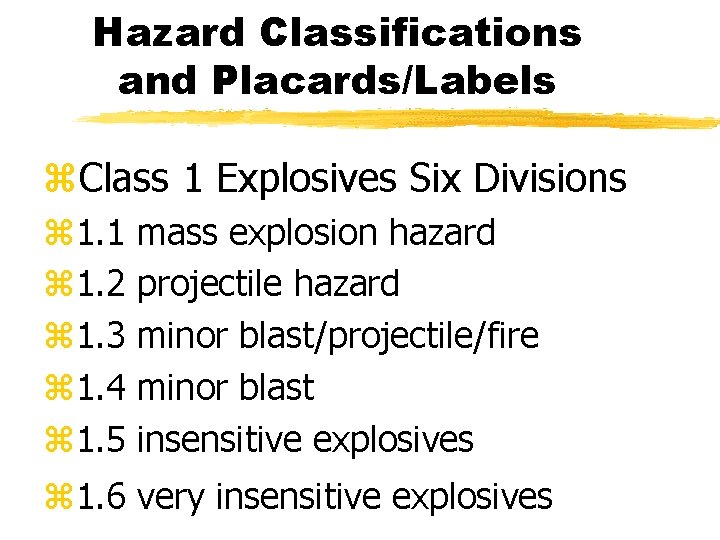
Hazard Classifications and Placards/Labels z. Class 1 Explosives Six Divisions z 1. 1 z 1. 2 z 1. 3 z 1. 4 z 1. 5 mass explosion hazard projectile hazard minor blast/projectile/fire minor blast insensitive explosives z 1. 6 very insensitive explosives
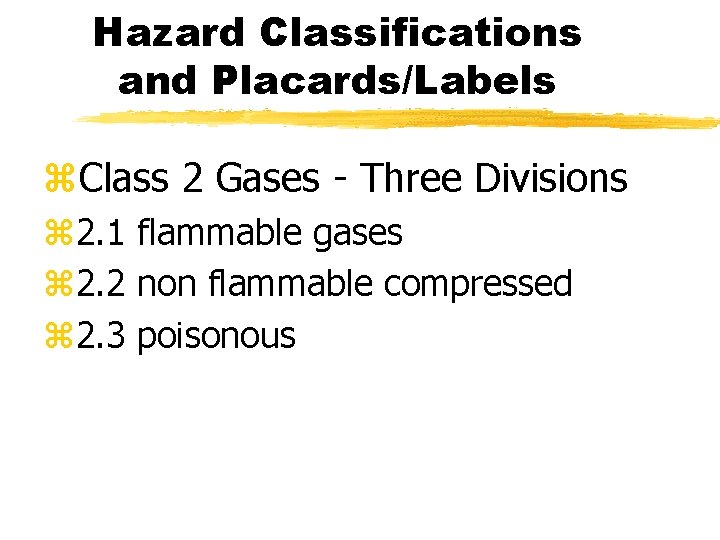
Hazard Classifications and Placards/Labels z. Class 2 Gases - Three Divisions z 2. 1 flammable gases z 2. 2 non flammable compressed z 2. 3 poisonous
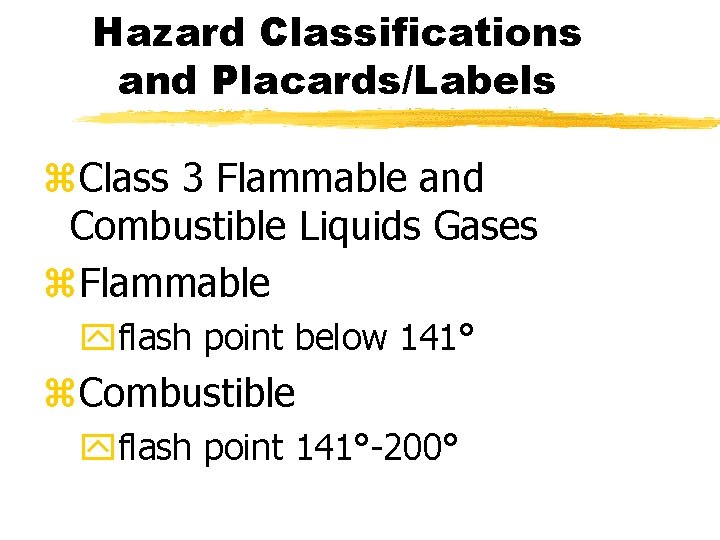
Hazard Classifications and Placards/Labels z. Class 3 Flammable and Combustible Liquids Gases z. Flammable yflash point below 141° z. Combustible yflash point 141°-200°
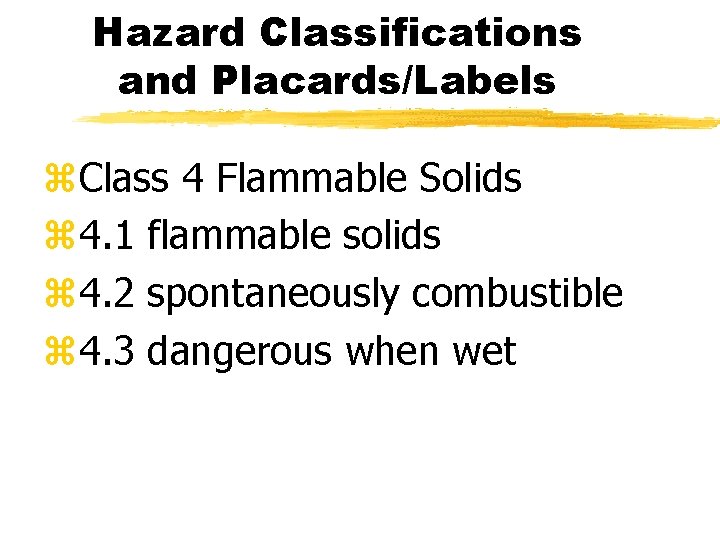
Hazard Classifications and Placards/Labels z. Class 4 Flammable Solids z 4. 1 flammable solids z 4. 2 spontaneously combustible z 4. 3 dangerous when wet
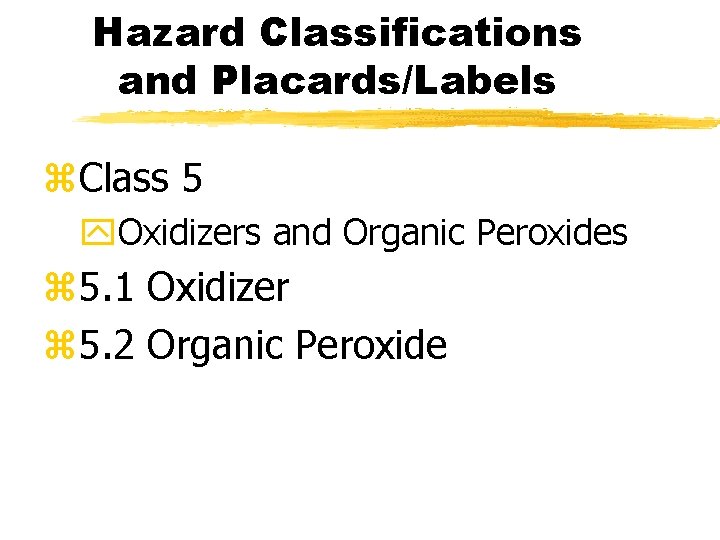
Hazard Classifications and Placards/Labels z. Class 5 y. Oxidizers and Organic Peroxides z 5. 1 Oxidizer z 5. 2 Organic Peroxide
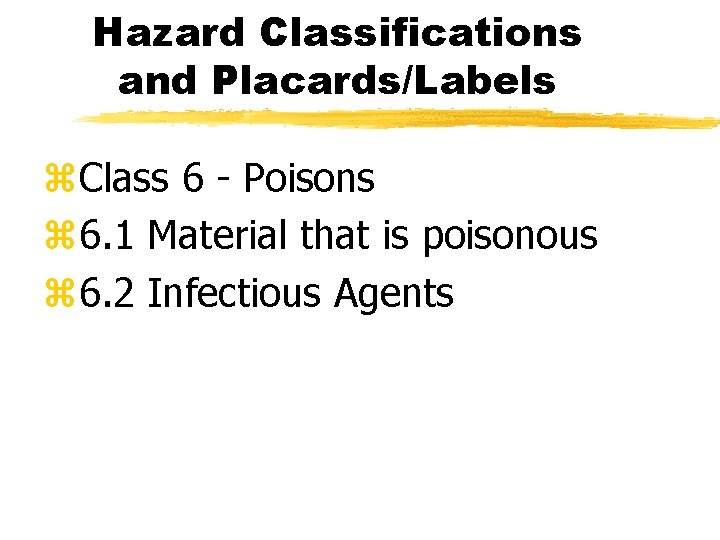
Hazard Classifications and Placards/Labels z. Class 6 - Poisons z 6. 1 Material that is poisonous z 6. 2 Infectious Agents
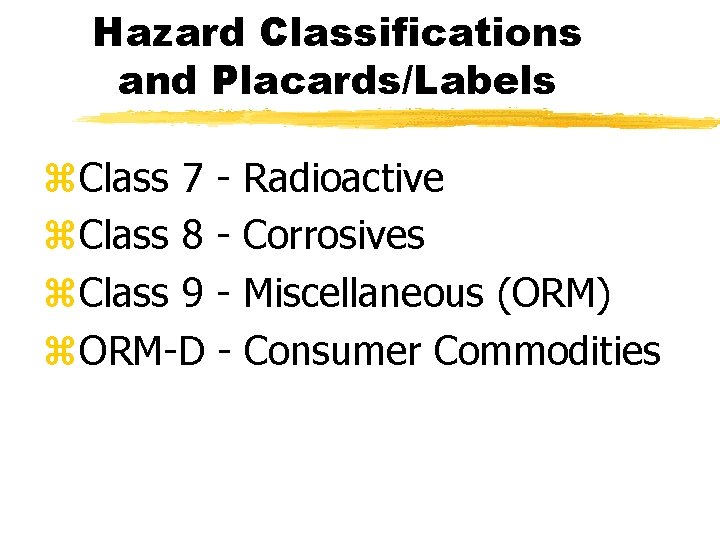
Hazard Classifications and Placards/Labels z. Class 7 - Radioactive z. Class 8 - Corrosives z. Class 9 - Miscellaneous (ORM) z. ORM-D - Consumer Commodities
Hazard Classifications Discussion Points z. What are the characteristics of the 6 divisions of Class 1 explosives? z. What are the characteristics of the 3 divisions of Class 2 gases? z. What class is a explosive/poison?
Hazard Classifications Discussion Points z. What are the characteristics of the 6 divisions of Class 1 explosives? z. What are the characteristics of the 3 divisions of Class 2 gases? z. What class is a explosive/poison?
Hazard Classifications Discussion Points z. What part of the CFR contains the Classification of Materials z. Without looking, describe the placard for a 5. 1 oxidizer? z. What are some common examples of each class of Haz. Mat?
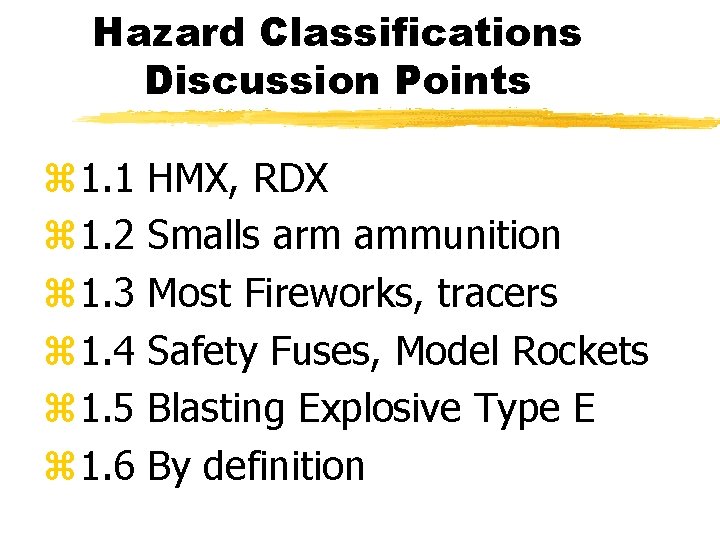
Hazard Classifications Discussion Points z 1. 1 z 1. 2 z 1. 3 z 1. 4 z 1. 5 z 1. 6 HMX, RDX Smalls arm ammunition Most Fireworks, tracers Safety Fuses, Model Rockets Blasting Explosive Type E By definition
Hazard Classifications Discussion Points z 2. 1 Acetylene, Vinyl chloride z 2. 2 Oxygen, CO 2, Nitrogen z 2. 3 Phosgene, Methyl Mercaptan z 3 Diesel Fuel, Ethanol, JP-5
Hazard Classifications Discussion Points z 4. 1 Matches, Naphthalene z 4. 2 White Phosphorous z 4. 3 Lithium, Safety z 5. 1 Hydrogen Peroxide z 5. 2 Generic Types A-G

Hazard Classifications Discussion Points z 6. 1 Pesticides (OP, carbamates) z 6. 2 Botulin, Anthrax z 7 Radioactive Material z 8 Sodium Hydroxide, Acids
Hazard Classifications Discussion Points z 9 PCBs, Dry Ice(A/W), Hot Matls z. ORM-D Consumer Commodities
- Slides: 16