
HAZARD ANALYSIS The process of defining a hazard

![QUALITATIVE ANALYSIS [1] Define the levels [2] Accumulate information [3] Invite participation by experts](https://slidetodoc.com/presentation_image/14101be8eb1f826e7a414892ee1031c8/image-13.jpg "QUALITATIVE ANALYSIS [1] Define the levels [2] Accumulate information [3] Invite participation by experts")
- Slides: 24
HAZARD ANALYSIS The process of defining a hazard … Walter G. Green III, Ph. D. , CEM Emergency Management Process Series No. 1 Copyright 2008 by Walter G. Green III
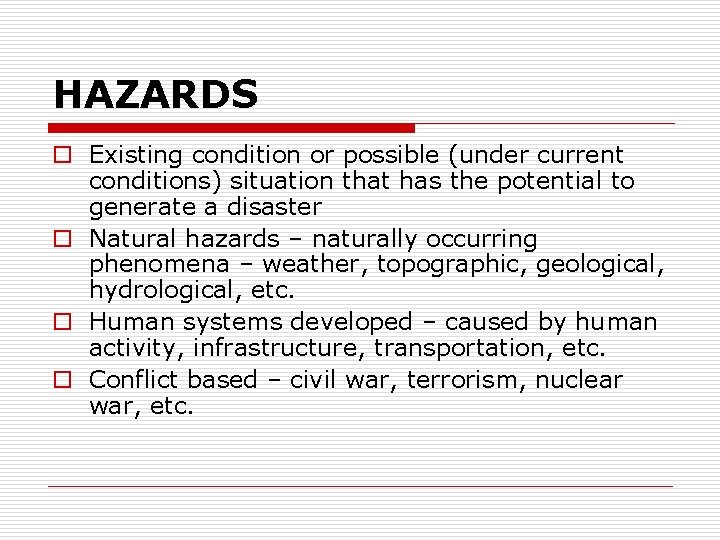
HAZARDS o Existing condition or possible (under current conditions) situation that has the potential to generate a disaster o Natural hazards – naturally occurring phenomena – weather, topographic, geological, hydrological, etc. o Human systems developed – caused by human activity, infrastructure, transportation, etc. o Conflict based – civil war, terrorism, nuclear war, etc.
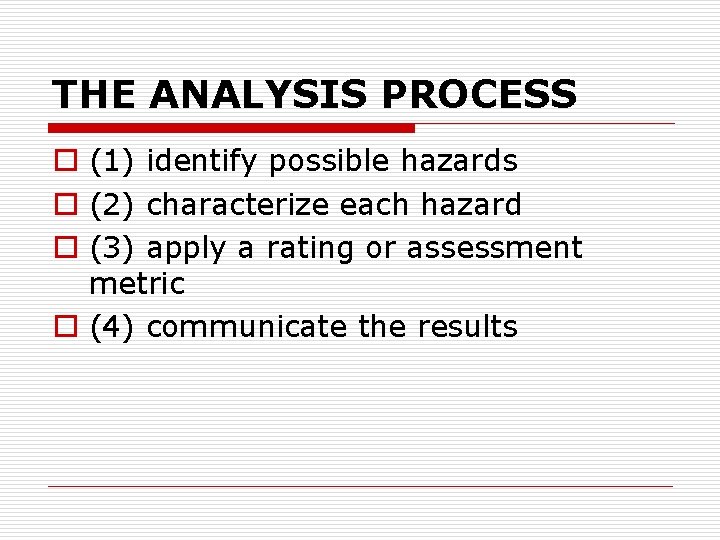
THE ANALYSIS PROCESS o (1) identify possible hazards o (2) characterize each hazard o (3) apply a rating or assessment metric o (4) communicate the results
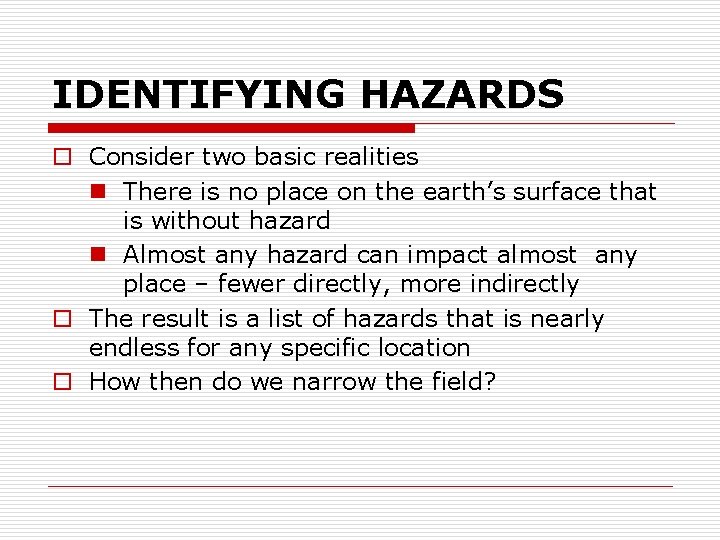
IDENTIFYING HAZARDS o Consider two basic realities n There is no place on the earth’s surface that is without hazard n Almost any hazard can impact almost any place – fewer directly, more indirectly o The result is a list of hazards that is nearly endless for any specific location o How then do we narrow the field?
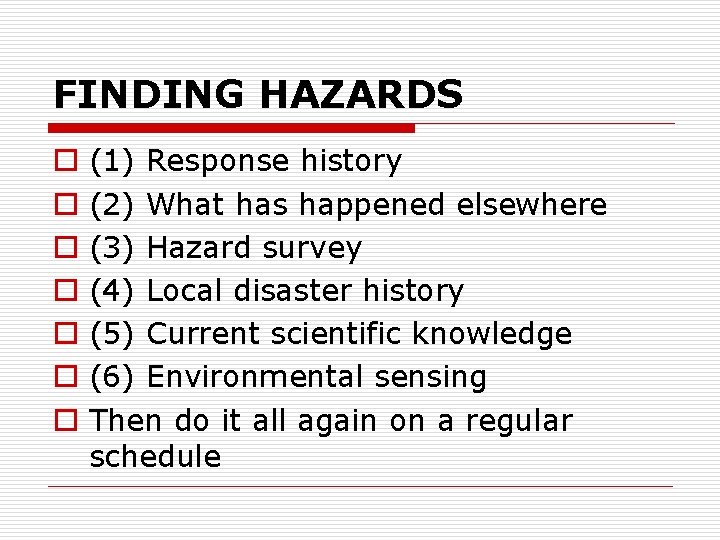
FINDING HAZARDS o o o o (1) Response history (2) What has happened elsewhere (3) Hazard survey (4) Local disaster history (5) Current scientific knowledge (6) Environmental sensing Then do it all again on a regular schedule
CHARACTERIZING HAZARDS o It should be obvious that hazards are not identical, not uniform, not exclusive, and not transposable o This means that we have to understand each hazard in the context of its time and place
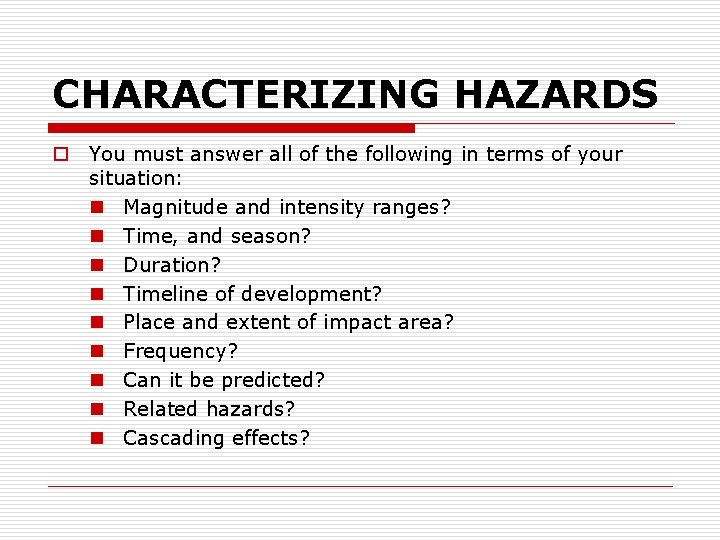
CHARACTERIZING HAZARDS o You must answer all of the following in terms of your situation: n Magnitude and intensity ranges? n Time, and season? n Duration? n Timeline of development? n Place and extent of impact area? n Frequency? n Can it be predicted? n Related hazards? n Cascading effects?
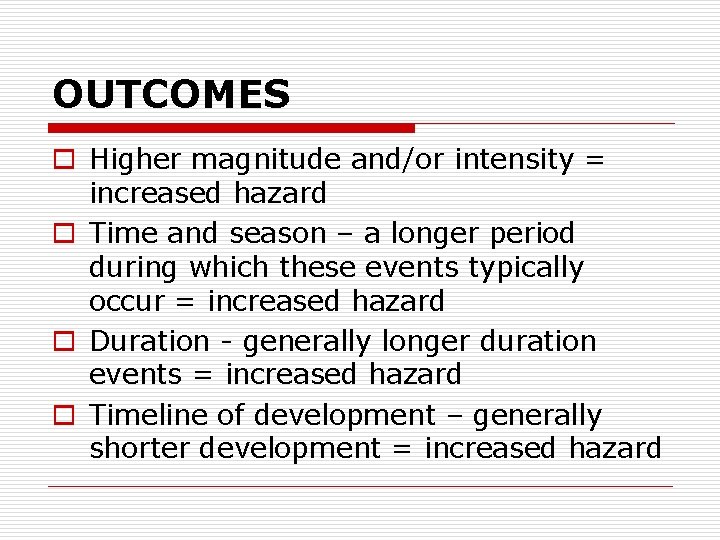
OUTCOMES o Higher magnitude and/or intensity = increased hazard o Time and season – a longer period during which these events typically occur = increased hazard o Duration - generally longer duration events = increased hazard o Timeline of development – generally shorter development = increased hazard
OUTCOMES o A critical location at risk or a widearea impact = increased hazard o Higher frequency = increased hazard o Events that can be predicted only with difficulty = higher hazard o Events that are related to and can be triggered by or trigger other events = higher hazard
THE TIME HORIZON o Very important to determine what the time horizon of your assessment is o A short time period (“in the next 2 years”) n Infrequent events become low hazard n Frequent events become high hazard o A longer time period (“in the next 100 years”) n Infrequent events increase in hazard o A very long time period (“the next 500 years”) n Infrequent catastrophic events become higher hazard
ASSESSMENT o Assessing hazards is a very difficult process n Wide range of variability in the where, when, what, and how bad of events o In many cases we have insufficient data or understanding to make highly accurate assessments o In other cases time precludes in depth analysis
TWO APPROACHES o Qualitative n Assesses using fuzzy judgment n Communicates in broad categories o Quantitative n Assesses using defined criteria n Communicates using numbers
QUALITATIVE ANALYSIS [1] Define the levels [2] Accumulate information [3] Invite participation by experts [4] Describe the process and provide an overview o [5] Develop consensus o o
QUALITATIVE TERMS o A possible standard: n Extreme - community can no longer function n High – large number of deaths, similar number of injuries, wide property damage, function difficult n Moderate – small number of deaths, larger number of injuries, wide property damage, function under strain n Low – no deaths, few injuries, little property damage, community services function close to normal
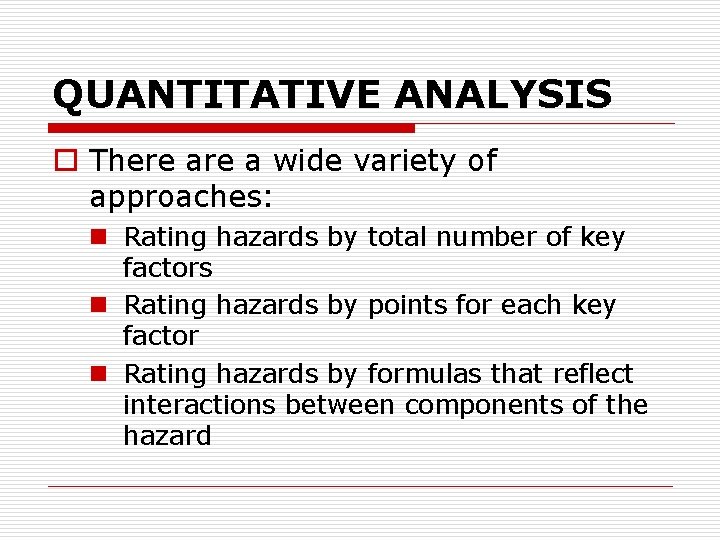
QUANTITATIVE ANALYSIS o There a wide variety of approaches: n Rating hazards by total number of key factors n Rating hazards by points for each key factor n Rating hazards by formulas that reflect interactions between components of the hazard
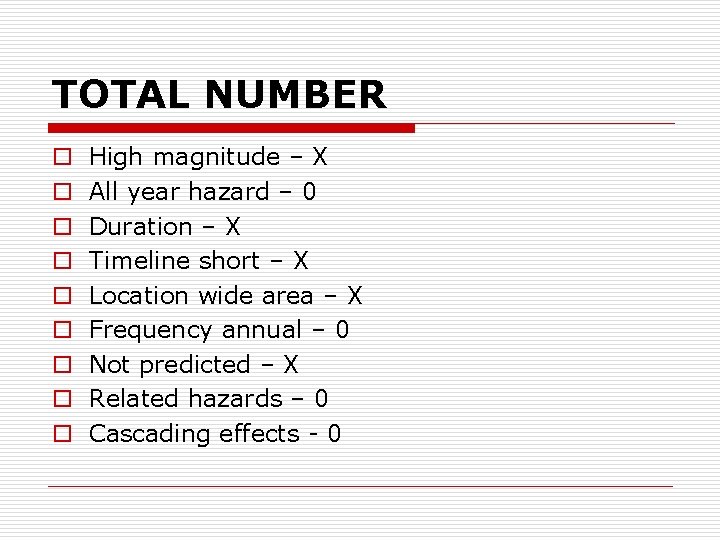
TOTAL NUMBER o o o o o High magnitude – X All year hazard – 0 Duration – X Timeline short – X Location wide area – X Frequency annual – 0 Not predicted – X Related hazards – 0 Cascading effects - 0
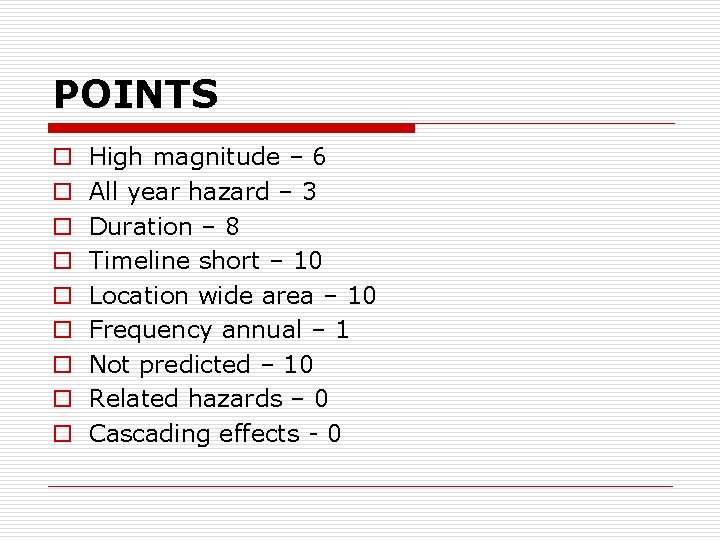
POINTS o o o o o High magnitude – 6 All year hazard – 3 Duration – 8 Timeline short – 10 Location wide area – 10 Frequency annual – 1 Not predicted – 10 Related hazards – 0 Cascading effects - 0
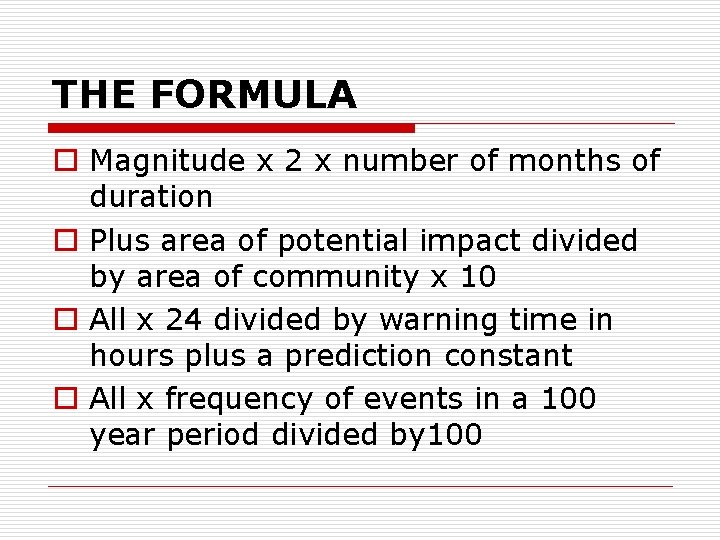
THE FORMULA o Magnitude x 2 x number of months of duration o Plus area of potential impact divided by area of community x 10 o All x 24 divided by warning time in hours plus a prediction constant o All x frequency of events in a 100 year period divided by 100
THE FORMULA PROBLEM o Some quantitative analyses use formulas to arrive at numerical values for the hazard level o Check to make sure the mathematics really measure what they say they measure o Common errors are to: n add factors that should be multiplied, or vice versa, n apply constants that are not constant, and n mix values that are unrelated
FORMULA EXAMPLE o Your locality has hurricanes and tornadoes as its two primary natural disaster hazards o Which of the following is the best formula to express that relationship? n n Hurricanes + tornadoes = hazard x tornadoes = hazard or tornadoes = hazard and tornadoes = hazard
MIX TYPES? o Do we create one single list of all hazards, or o Separate lists of natural, human systems, or conflict based hazards? o And which goes first? o The answer depends on: n The function the analysis performs, n The programmatic structure of the organization, and/or n Current doctrine
PRIORITIZING o Ratings suggest we will rank order the outcomes o Highest to lowest, either overall or by class o Understand that the list is only a guide o But that decision makers will believe it is an absolute reflection of reality
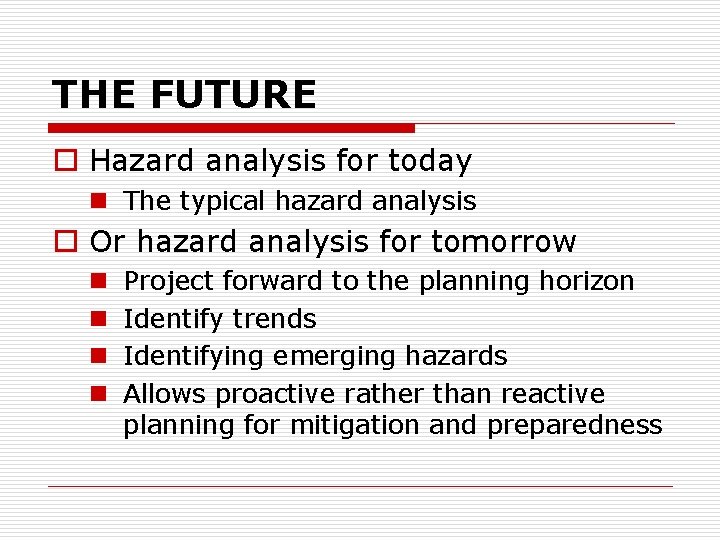
THE FUTURE o Hazard analysis for today n The typical hazard analysis o Or hazard analysis for tomorrow n n Project forward to the planning horizon Identify trends Identifying emerging hazards Allows proactive rather than reactive planning for mitigation and preparedness
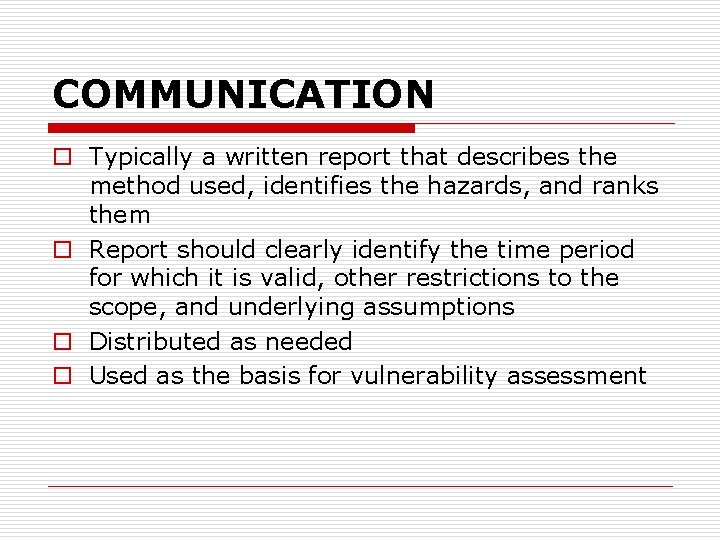
COMMUNICATION o Typically a written report that describes the method used, identifies the hazards, and ranks them o Report should clearly identify the time period for which it is valid, other restrictions to the scope, and underlying assumptions o Distributed as needed o Used as the basis for vulnerability assessment