
Hazard Analysis Lecture Topics l Hazards and Accidents
- Slides: 32
Hazard Analysis
Lecture Topics l Hazards and Accidents l Hazard Analysis 2
Hazards l l l An inherent physical or chemical characteristic that has the potential for causing harm to people, the environment, or property 1 Hazards are intrinsic to a material, or its conditions of use Examples – Hydrogen sulfide – toxic by inhalation – Gasoline – flammable – Moving machinery – kinetic energy, pinch points 1 AICHE Center for Chemical Process Safety 3
Hazard Management: The World as It Was Before l Good people l … doing good things 4/49
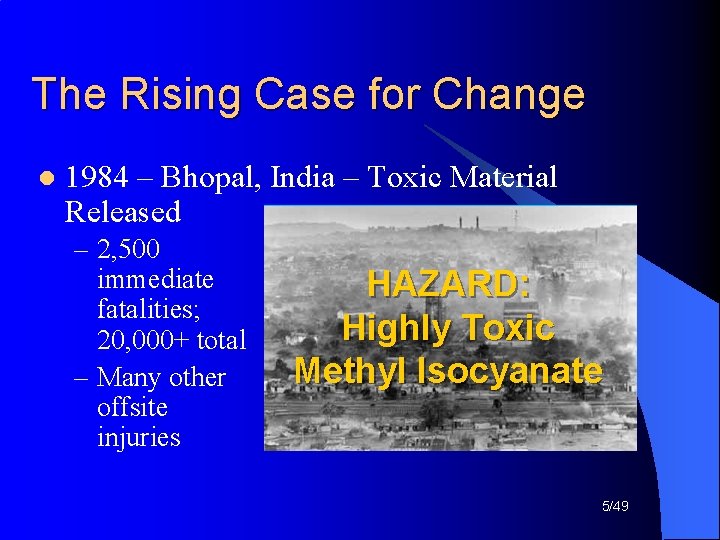
The Rising Case for Change l 1984 – Bhopal, India – Toxic Material Released – 2, 500 immediate fatalities; 20, 000+ total – Many other offsite injuries HAZARD: Highly Toxic Methyl Isocyanate 5/49
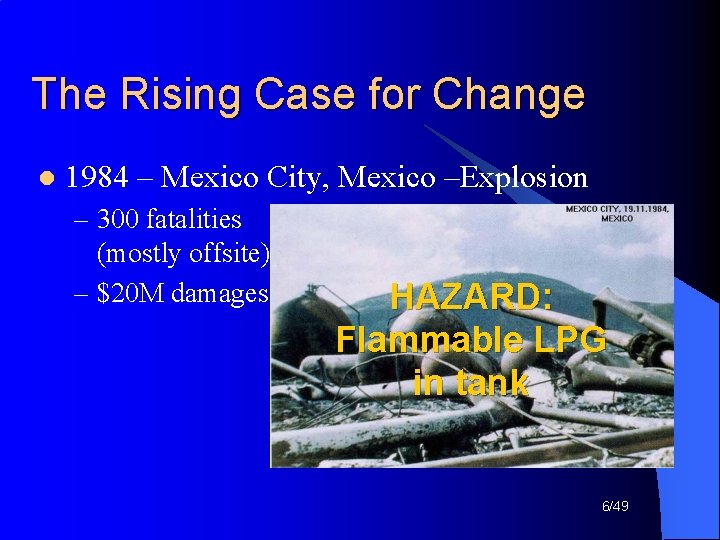
The Rising Case for Change l 1984 – Mexico City, Mexico –Explosion – 300 fatalities (mostly offsite) – $20 M damages HAZARD: Flammable LPG in tank 6/49
In a Few Words, What is PSM? l The proactive and systematic identification, evaluation, and mitigation or prevention of chemical releases that could occur as a result of failures in process, procedures, or equipment. 7/49
Hazard Analysis Simply, HA allows the employer to: l Determine locations of potential safety problems l Identify corrective measures to improve safety l Preplan emergency actions to be taken if safety controls fail 8/49
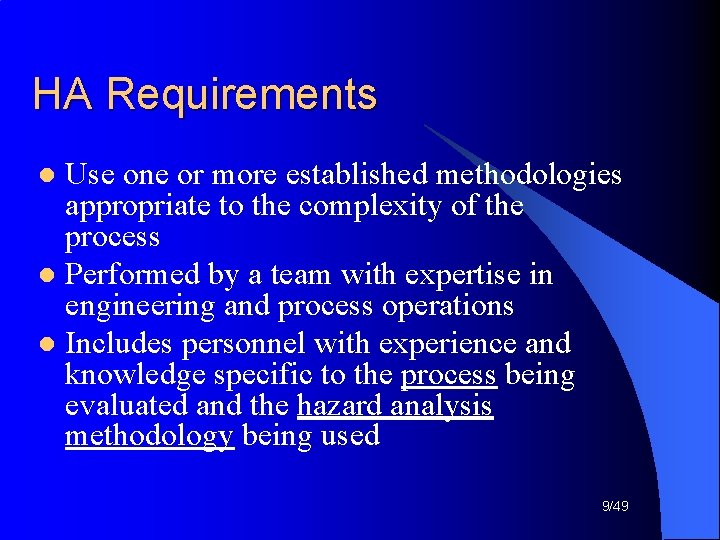
HA Requirements Use one or more established methodologies appropriate to the complexity of the process l Performed by a team with expertise in engineering and process operations l Includes personnel with experience and knowledge specific to the process being evaluated and the hazard analysis methodology being used l 9/49
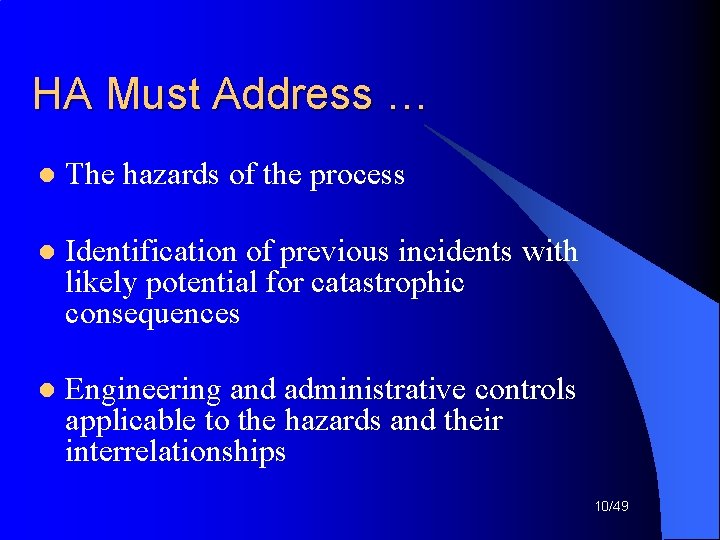
HA Must Address … l The hazards of the process l Identification of previous incidents with likely potential for catastrophic consequences l Engineering and administrative controls applicable to the hazards and their interrelationships 10/49
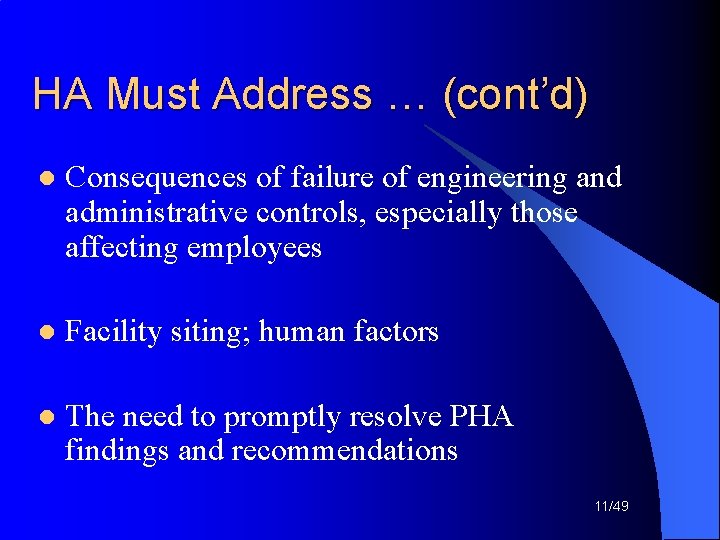
HA Must Address … (cont’d) l Consequences of failure of engineering and administrative controls, especially those affecting employees l Facility siting; human factors l The need to promptly resolve PHA findings and recommendations 11/49
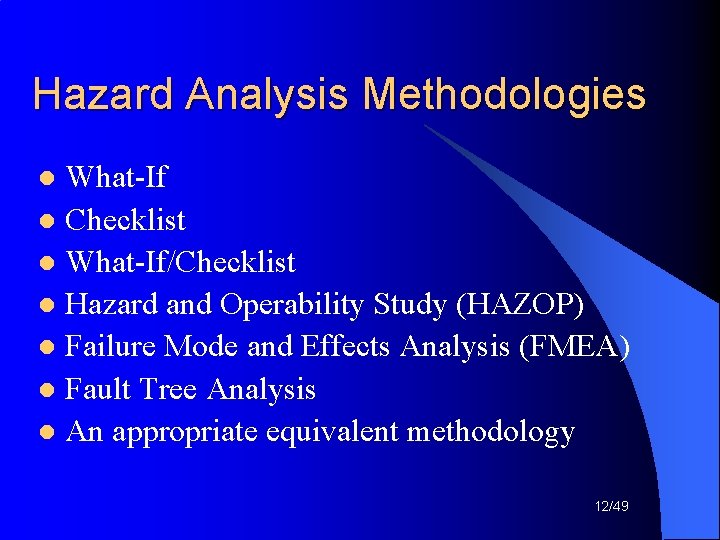
Hazard Analysis Methodologies What-If l Checklist l What-If/Checklist l Hazard and Operability Study (HAZOP) l Failure Mode and Effects Analysis (FMEA) l Fault Tree Analysis l An appropriate equivalent methodology l 12/49
What-If l Experienced personnel brainstorming a series of questions that begin, "What if…? ” l Each question represents a potential failure in the facility or misoperation of the facility 13/49
What-If l The response of the process and/or operators is evaluated to determine if a potential hazard can occur l If so, the adequacy of existing safeguards is weighed against the probability and severity of the scenario to determine whether modifications to the system should be recommended 14/49
What-If – Steps 1. 2. 3. 4. 5. Divide the system up into smaller, logical subsystems Identify a list of questions for a subsystem Select a question Identify hazards, consequences, severity, likelihood, and recommendations Repeat Step 2 through 4 until complete 15/49
What-If Question Areas l Equipment failures – What if … a valve leaks? l Human error – What if … operator fails to restart pump? l External events – What if … a very hard freeze persists? 16/49
What-If – Summary Perhaps the most commonly used method l One of the least structured methods l – Can be used in a wide range of circumstances – Success highly dependent on experience of the analysts Useful at any stage in the facility life cycle l Useful when focusing on change review l 17/49
Checklist l Consists of using a detailed list of prepared questions about the design and operation of the facility l Questions are usually answered “Yes” or “No” l Used to identify common hazards through compliance with established practices and standards 18/49
Checklist Question Categories l Causes of accidents – Process equipment – Human error – External events l Facility Functions – Alarms, construction materials, control systems, documentation and training, instrumentation, piping, pumps, vessels, etc. 19/49
Checklist Questions l Causes of accidents – – l Is process equipment properly supported? Is equipment identified properly? Are the procedures complete? Is the system designed to withstand hurricane winds? Facility Functions – – Is is possible to distinguish between different alarms? Is pressure relief provided? Is the vessel free from external corrosion? Are sources of ignition controlled? 20/49
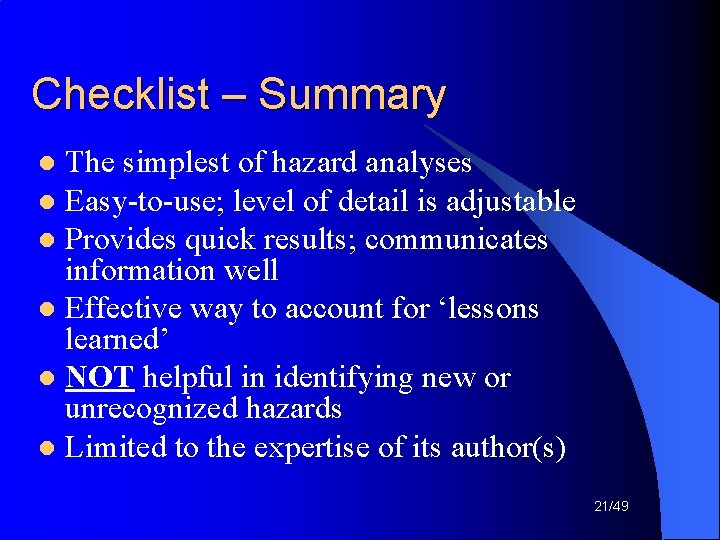
Checklist – Summary The simplest of hazard analyses l Easy-to-use; level of detail is adjustable l Provides quick results; communicates information well l Effective way to account for ‘lessons learned’ l NOT helpful in identifying new or unrecognized hazards l Limited to the expertise of its author(s) l 21/49
Checklist – Summary (cont’d) l Should be prepared by experienced engineers l Its application requires knowledge of the system/facility and its standard operating procedures l Should be audited and updated regularly 22/49
HAZOP Hazard and Operability Analysis l Identify hazards (safety, health, environmental), and l Problems which prevent efficient operation 23/49
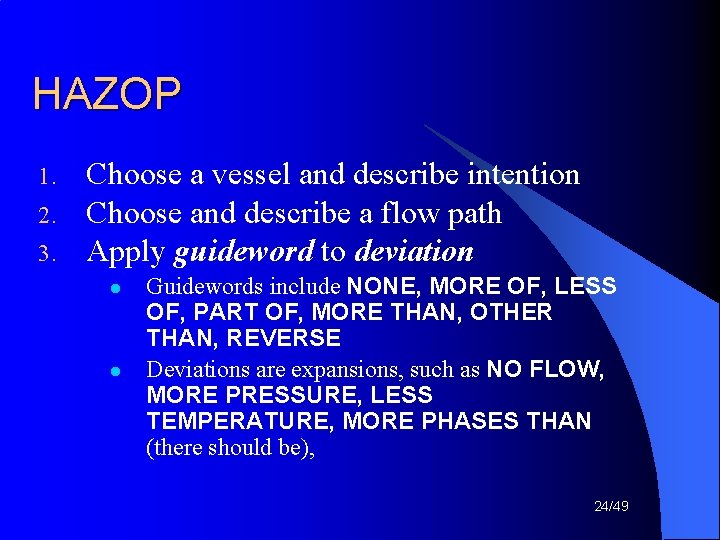
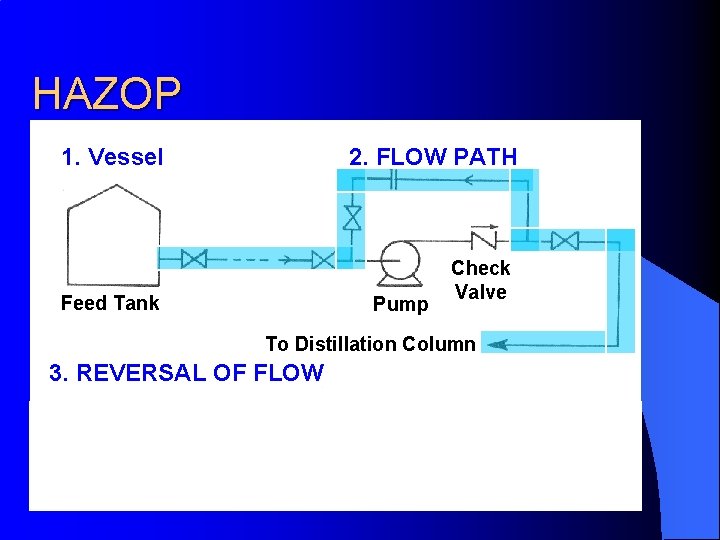
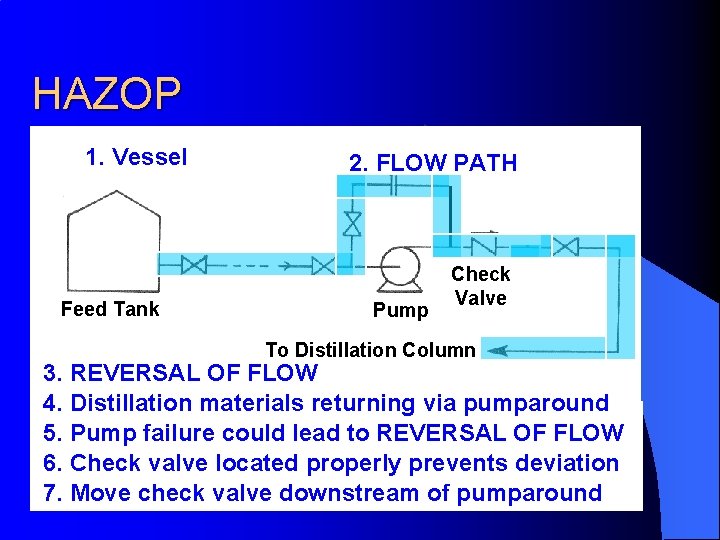
HAZOP 1. 2. 3. Choose a vessel and describe intention Choose and describe a flow path Apply guideword to deviation l l Guidewords include NONE, MORE OF, LESS OF, PART OF, MORE THAN, OTHER THAN, REVERSE Deviations are expansions, such as NO FLOW, MORE PRESSURE, LESS TEMPERATURE, MORE PHASES THAN (there should be), 24/49
HAZOP 1. Vessel l (Illustrative 2. FLOW PATH example of HAZOP) Feed Tank Pump Check Valve To Distillation Column 3. REVERSAL OF FLOW 25/49
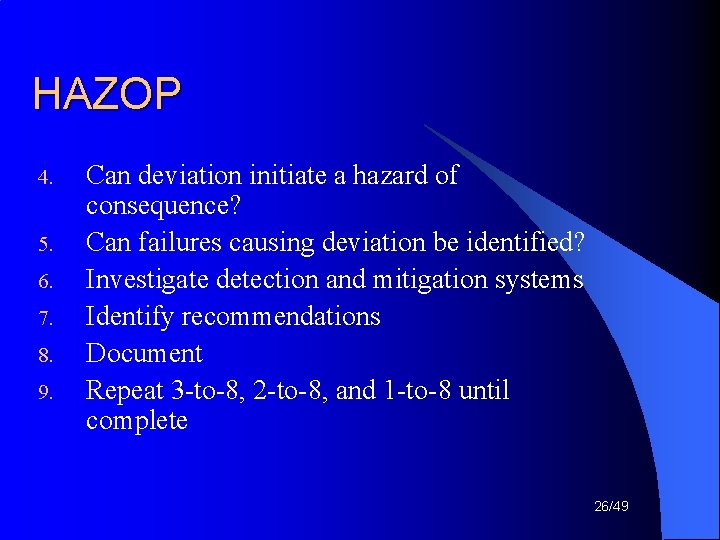
HAZOP 4. 5. 6. 7. 8. 9. Can deviation initiate a hazard of consequence? Can failures causing deviation be identified? Investigate detection and mitigation systems Identify recommendations Document Repeat 3 -to-8, 2 -to-8, and 1 -to-8 until complete 26/49
HAZOP 1. Vessel l (Illustrative Feed Tank 2. FLOW PATH example of HAZOP) Pump Check Valve To Distillation Column 3. REVERSAL OF FLOW 4. Distillation materials returning via pumparound 5. Pump failure could lead to REVERSAL OF FLOW 6. Check valve located properly prevents deviation 7. Move check valve downstream of pumparound 27/49
Loss of Containment Deviations Pressure too high l Pressure too low (vacuum) l Temperature too high l Temperature too low l Deterioration of equipment l 28/49
HAZOP’s Inherent Assumptions l Hazards are detectable by careful review l Plants designed, built and run to appropriate standards will not suffer catastrophic loss of containment if ops stay within design parameters l Hazards are controllable by a combination of equipment, procedures which are Safety Critical l HAZOP conducted with openness and good faith by competent parties 29/49
HAZOP – Pros and Cons l l l l Creative, open-ended Completeness – identifies all process hazards Rigorous, structured, yet versatile Identifies safety and operability issues Can be time-consuming (e. g. , includes operability) Relies on having right people in the room Does not distinguish between low probability, high consequence events (and vice versa) 30/49
Accident Scenarios May Be Missed by HA No HA method can identify all accidents that could occur in a process l A scenario may be excluded from the scope of the analysis l The team may be unaware of a scenario l The team consider the scenario but judge it not credible or significant l The team may overlook the scenario l 31/49
Summary Despite the aforementioned issues with HA: l Companies that rigorously exercise HA are seeing a continuing reduction is frequency and severity of industrial accidents l Process Hazard Analysis will continue to play an integral role in the design and continued examination of industrial processes 32/49