
Haz Com 2012 Employee Training Prepared by the
Haz. Com 2012 Employee Training Prepared by the Society for Chemical Hazard Communication Outreach and Communication Committee Intended for Training Public School Employees on the New Hazard Communication
Disclaimer These materials are provided “as is”. SCHC makes no warranties, expressed or implied, and hereby disclaims and negates all other warranties, including without limitation, implied warranties or conditions of merchantability, fitness for a particular purpose, or noninfringement of intellectual property or other violation of rights. Further, SCHC does not warrant or make any representations concerning the accuracy, likely results, or reliability of the use of these materials. Through the OSHA and SCHC Alliance, SCHC developed this presentation for informational purposes only. It does not necessarily reflect the views of OSHA or the U. S. Department of Labor.
Hazard Communication ( HAZCOM 2012 – 29 CFR 1910. 1200) and the Globally Harmonized System of Classification and Labeling of Chemicals (GHS)
OSHA Mandate The Occupational Safety and Health Administration (OSHA) requires employers to provide their employees with a safe and healthy workplace. ◦ OSHA sets standards for safety, chemical exposure and information on chemical hazards (right-to know). ◦ OSHA Standards are enforced in the private sector by Federal OSHA in some states and by State OSHA in other states. ◦ State OSHA enforces the OSHA regulations in the public sector, including public schools ◦ Enforcement is accomplished by inspection and penalties for noncompliance ◦ Employees can file complaints about unsafe conditions.
Haz. Com 2012 Standard The Occupational Safety and Administration’s (OSHA) previous Haz. Com standard gave you the right to know. Haz. Com 2012 gives you the right to understand: ◦ The possible dangers you could be exposed to by the hazardous materials you are coming into contact with. ◦ How to work with hazardous chemicals safely.

Purpose of Hazard Communication Update OSHA Updated the Hazcom Standard to conform to the Globally Harmonized System for the Classification and Labelling of Chemicals (GHS) The GHS is an international effort to standardize hazard communication. This update provides a common and coherent approach to classifying chemicals and communicating hazard information on labels and safety data sheets These new labeling elements and SDS requirements will improve worker understanding of the hazards associated with the chemicals in their workplace
Employer Requirements • Maintain a Haz. Com 2012 compliant Safety Data Sheet for each chemical used in the workplace • Ensure each hazardous chemical in the workplace is properly labeled. • Provide employees with training on hazardous chemicals used in their work area. • Develop, implement and maintain a written Haz. Com program that covers all the items listed above as well as includes a list of all hazardous chemicals in the workplace

What are Hazardous Chemicals? Physical Hazards Health Hazards • Fire Hazards • Explosion Hazards • Reactive Hazards • Local Effects (e. g. Irritants, Corrosives) • Systemic Effects (e. g. Carcinogens, Toxic agents, Sensitizers) • Target Organ Effects (e. g. Neurotoxins, Respiratory Toxins, Reproductive Toxins, etc. Simple Asphyxiants, Pyrophoric Gases or Hazards not otherwise classified
Safety Data Sheets (SDS) Previously known as Material Safety Data Sheets (MSDS) New uniformat including section number, heading and associated information Standardized placement of information Give necessary information about how to safely work with a chemical. Must be readily accessible. Must be written in English.
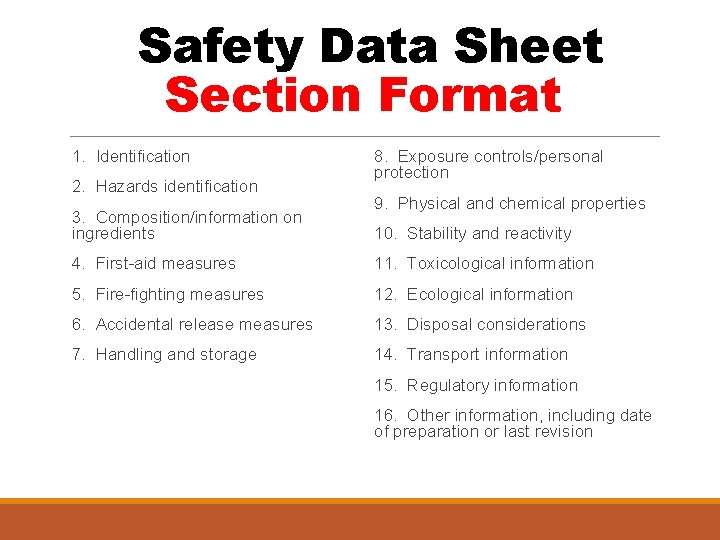
Safety Data Sheet Section Format 1. Identification 2. Hazards identification 3. Composition/information on ingredients 8. Exposure controls/personal protection 9. Physical and chemical properties 10. Stability and reactivity 4. First-aid measures 11. Toxicological information 5. Fire-fighting measures 12. Ecological information 6. Accidental release measures 13. Disposal considerations 7. Handling and storage 14. Transport information 15. Regulatory information 16. Other information, including date of preparation or last revision
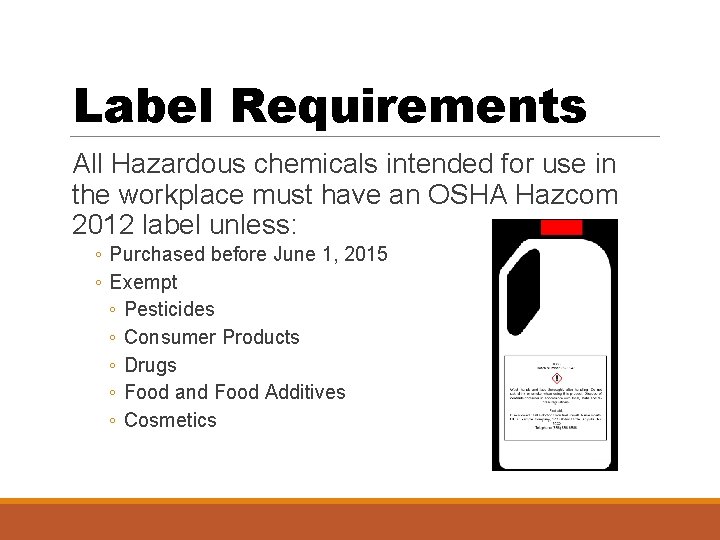
Label Requirements All Hazardous chemicals intended for use in the workplace must have an OSHA Hazcom 2012 label unless: ◦ Purchased before June 1, 2015 ◦ Exempt ◦ Pesticides ◦ Consumer Products ◦ Drugs ◦ Food and Food Additives ◦ Cosmetics
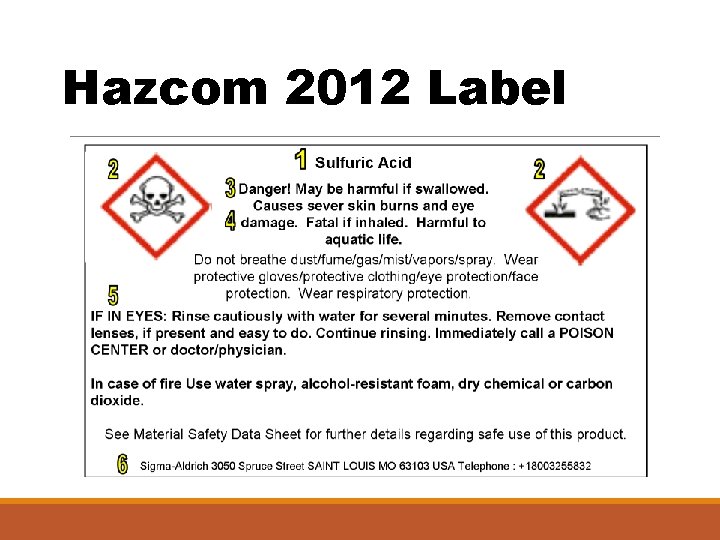
Hazcom 2012 Label
Product Identifier How the hazardous chemical is identified. This can be (but is not limited to) the chemical name, code number or batch number. The manufacturer, importer or distributor can decide the appropriate product identifier The same product identifier must be both on the label and in section 1 of the SDS
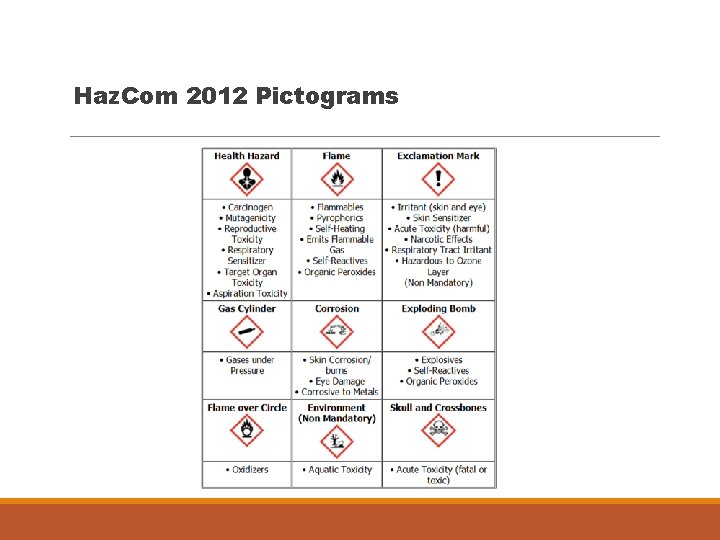
Haz. Com 2012 Pictograms

Signal Words Used to indicate the relative level of severity of hazard and alert the reader to a potential hazard on the label There are now only two signal words that are recognized under OSHA’s Haz. Com 2012. “Danger” is used for the more severe hazards “Warning” is used for the less severe hazards Danger May cause fire or explosion; strong oxidizer Causes severe skin burns and eye damage Warning Harmful if swallowed
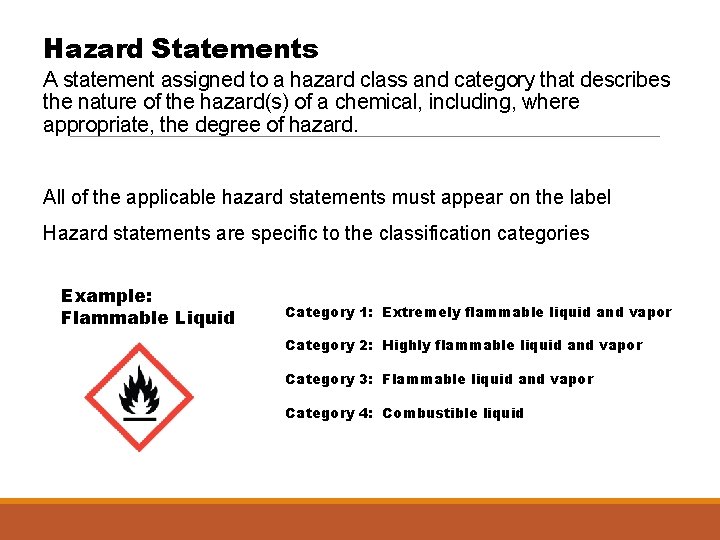
Hazard Statements A statement assigned to a hazard class and category that describes the nature of the hazard(s) of a chemical, including, where appropriate, the degree of hazard. All of the applicable hazard statements must appear on the label Hazard statements are specific to the classification categories Example: Flammable Liquid Category 1: Extremely flammable liquid and vapor Category 2: Highly flammable liquid and vapor Category 3: Flammable liquid and vapor Category 4: Combustible liquid
Precautionary Statements A phrase that describes recommended measures to be taken to minimize or prevent adverse effects resulting from exposure to a hazardous chemical, or improper storage or handling of a hazardous chemical Examples of Precautionary Phrases: Keep away from heat, sparks, and open flame. No smoking. Wash hands thoroughly after handling. Wear protective gloves and eye protection. Store in a well-ventilated place. Keep cool.
Workplace Labeling • All chemical containers must be labeled. • Do not use a chemical if a label has been destroyed or defaced. • Some chemicals are broken down into smaller containers. Any small container must have a label to protect yourself and your coworkers.
Training • Employees must receive information and training regarding: • The requirements of Haz. Com 2012 • Locations where hazardous chemicals are present • Haz. Com 2012 compliant Safety Data Sheets • Haz. Com 2012 compliant Labels • The school’s Written Haz. Com Program • Information on the hazards of the specific chemicals used in our school.
Written Haz. Com Program • Informs employees of their employer’s plan for complying with Haz. Com 2012. • Safety Data Sheets • Labels • Training Requirements • The Written Haz. Com Program should always be available by request. • Should include a list of hazardous materials known to be present in the school.
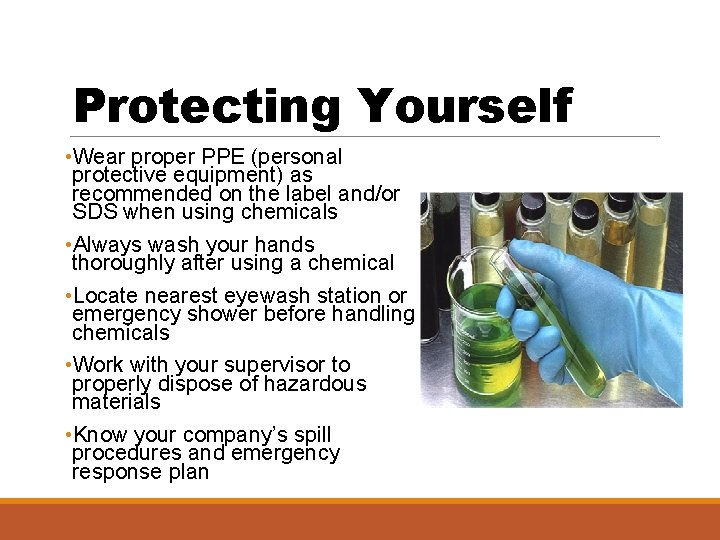
Protecting Yourself • Wear proper PPE (personal protective equipment) as recommended on the label and/or SDS when using chemicals • Always wash your hands thoroughly after using a chemical • Locate nearest eyewash station or emergency shower before handling chemicals • Work with your supervisor to properly dispose of hazardous materials • Know your company’s spill procedures and emergency response plan
For More Information OSHA Webpages www. osha. gov ◦ Hazcom https: //www. osha. gov/dsg/hazcom/index. html ◦ Personal Protective Equipment https: //www. osha. gov/SLTC/personalprotectiveequipment/index. html ◦ Chemical Hazards https: //www. osha. gov/SLTC/hazardoustoxicsubstances/index. html The Society for Chemical Hazard Communication (SCHC) in alliance with OSHA has developed information sheets on the GHS and Hazcom 2012 https: //www. osha. gov/dcsp/alliances/schc. html#!5 B The Consumer Product Safety Commission regulates consumer chemical labeling http: //www. cpsc. gov/ The EPA regulates pesticide labeling https: //www. epa. gov/scienceand-technology/pesticides-science

Thank you Additional Questions Contact: OSHA: 1 -800 -321 -OSHA (6742) Kimball Midwest Quality Assurance Ext: 2590
- Slides: 23