
Hay palabras que indican el uso del pretrito
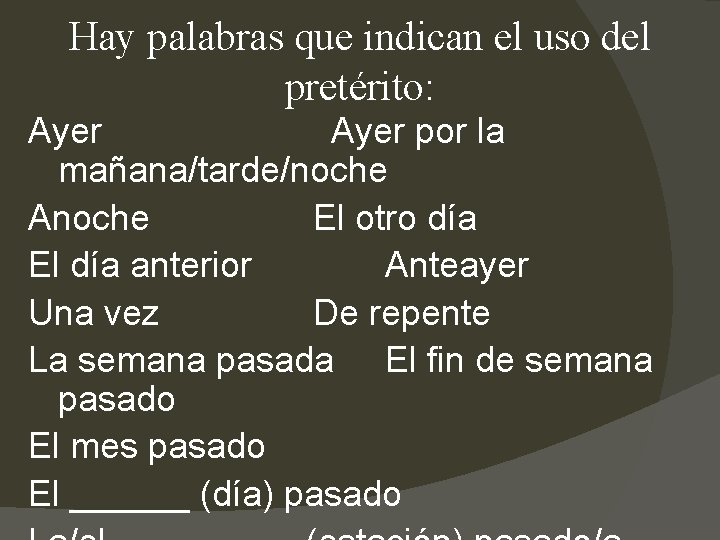
Hay palabras que indican el uso del pretérito: Ayer Ayer por la mañana/tarde/noche Anoche El otro día El día anterior Anteayer Una vez De repente La semana pasada El fin de semana pasado El mes pasado El ______ (día) pasado
LOS IRREGULARES EN EL PRETÉRITO
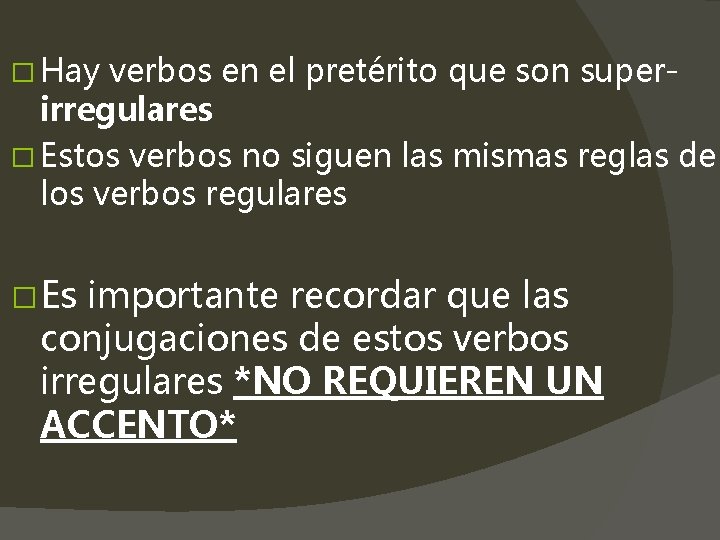
� Hay verbos en el pretérito que son superirregulares � Estos verbos no siguen las mismas reglas de los verbos regulares � Es importante recordar que las conjugaciones de estos verbos irregulares *NO REQUIEREN UN ACCENTO*

Algunos verbos irregulares Andar Tener Estar Ir Ser Poder Poner Saber Caber Traer Decir Conducir Querer Hacer Venir Dar Ver
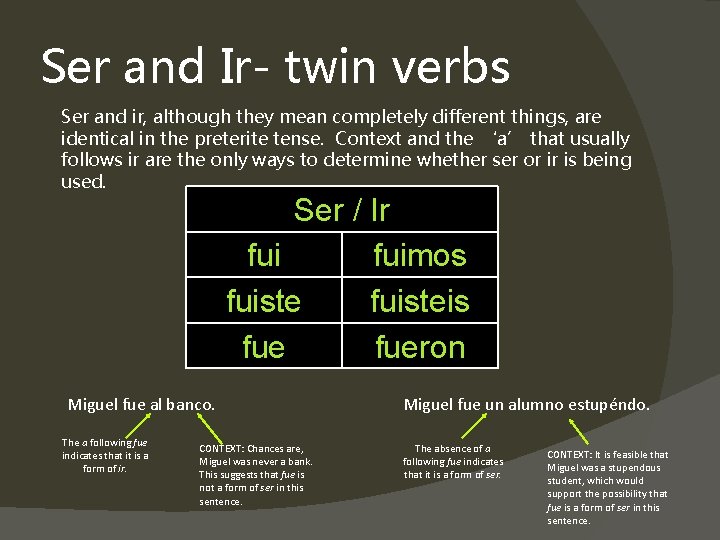
Ser and Ir- twin verbs Ser and ir, although they mean completely different things, are identical in the preterite tense. Context and the ‘a’ that usually follows ir are the only ways to determine whether ser or ir is being used. Ser / Ir fuimos fuisteis fueron Miguel fue al banco. The a following fue indicates that it is a form of ir. CONTEXT: Chances are, Miguel was never a bank. This suggests that fue is not a form of ser in this sentence. Miguel fue un alumno estupéndo. The absence of a following fue indicates that it is a form of ser. CONTEXT: It is feasible that Miguel was a stupendous student, which would support the possibility that fue is a form of ser in this sentence.
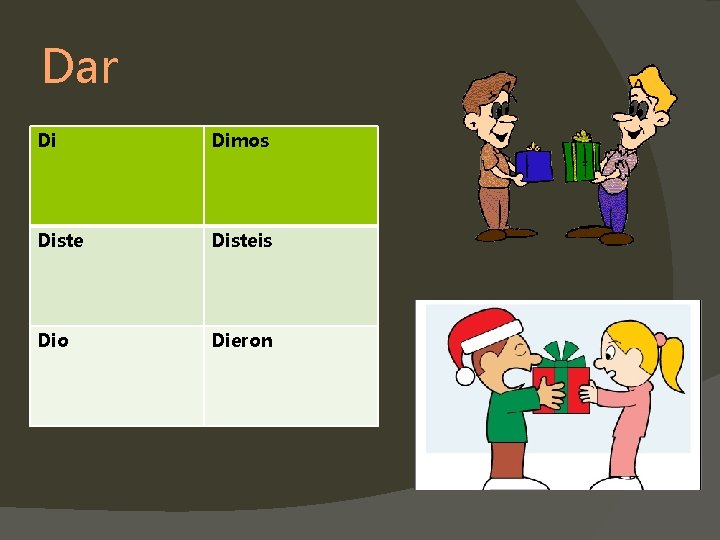
Dar Di Dimos Disteis Dio Dieron
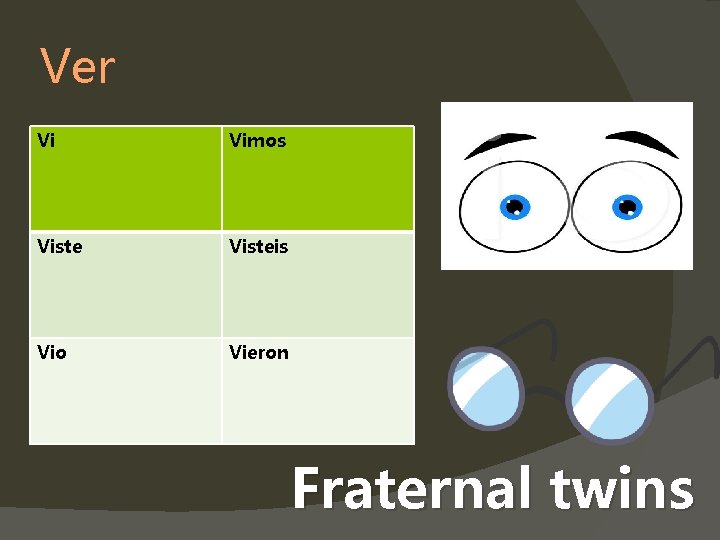
Ver Vi Vimos Visteis Vio Vieron Fraternal twins
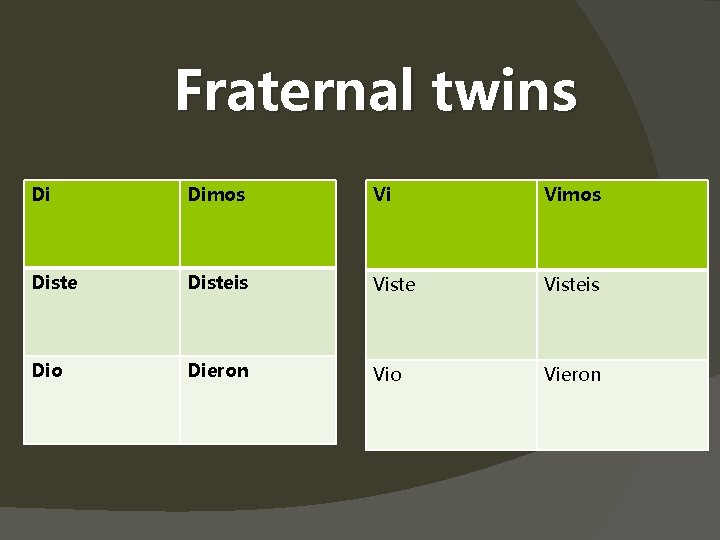
Fraternal twins Di Dimos Vi Vimos Disteis Visteis Dio Dieron Vio Vieron

Para practicar Conjuga los verbos en el pretérito. q Yo: ser q Tú: dar q Ella: ver q Ellos: ir q Nosotros: ir q Yo: dar q Vosotros: ser q Él: dar q Ustedes: ser ___________________ ___________________ __________

Many irregular preterite verbs share the same endings. Common Irregular Preterit Endings -e -iste -o -imos isteis -ieron Estar, tener, andar, poner, poder, saber, caber, hacer, querer, venir, decir, traer, and conducir all share these endings. However, their stems change before adding these endings.

Andar, estar y tener “Uve Verbs” ndar (to walk/go) y estar (to be temporary To isolate the yo form: � Drop uve the ending and add UVE: Tener (to have) uve To isolate the yo form: andar estar

Andar- to walk/go Yo anduve Nosotros anduvimos Tú anduviste Vosotros anduvisteis Él/ella/usted anduvo Ellos/ellas/ustedes anduvieron

Estar y Tener Estar – to be estuvimos estuvisteis e estuvo estuvieron Tener – to have tuvimos tuvisteis tuvo tuvieron

Para practicar Conjuga andar, estar o tener en el pretérito 1. 2. 3. 4. 5. 6. 7. Yo _________ por el parque ayer por la tarde. Nosotros _________enfermos el fin de semana pasado. El año pasado él __________ 33 años. Ellas __________ cansadas anoche. ¿Vosotros _________ a la escuela por 3 meses? Justin y Selena ________ enamorados en el pasado. Tú __________ al supermercado a las ocho de la noche.
Poder, poner, saber y caber � They are called “u” verbs, which means there will be a “u” in their stem in all forms.
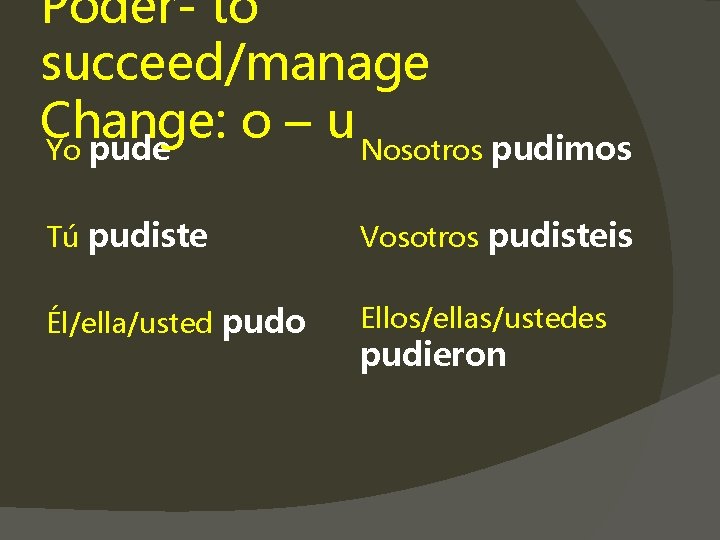
Poder- to succeed/manage Change: o – u Nosotros pudimos Yo pude Tú pudiste Vosotros pudisteis Él/ella/usted pudo Ellos/ellas/ustedes pudieron

Poner- to put Change: O-U/N-S Yo puse Nosotros pusimos Tú pusiste Vosotros pusisteis Él/ella/usted puso Ellos/ellas/ustedes pusieron
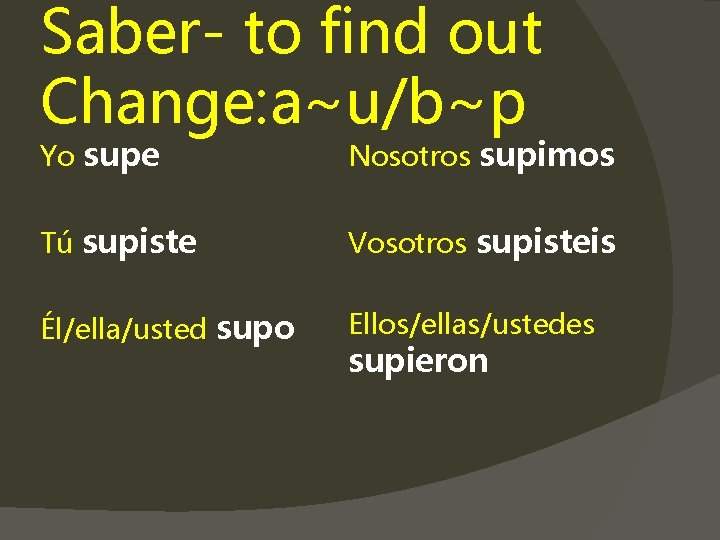
Saber- to find out Change: a~u/b~p Yo supe Nosotros supimos Tú supiste Vosotros supisteis Él/ella/usted supo Ellos/ellas/ustedes supieron
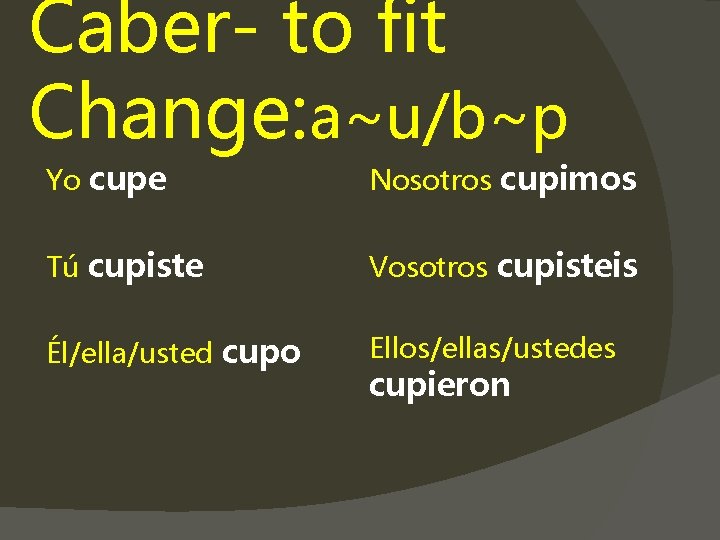
Caber- to fit Change: a~u/b~p Yo cupe Nosotros cupimos Tú cupiste Vosotros cupisteis Él/ella/usted cupo Ellos/ellas/ustedes cupieron

Para practicar Conjuga ir o ser en el pretérito q q q q q Yo: saber Tú: poder Ella: poner Ellos: poder Nosotros: caber Yo: poder Vosotros: saber Él: caber Usted: poner
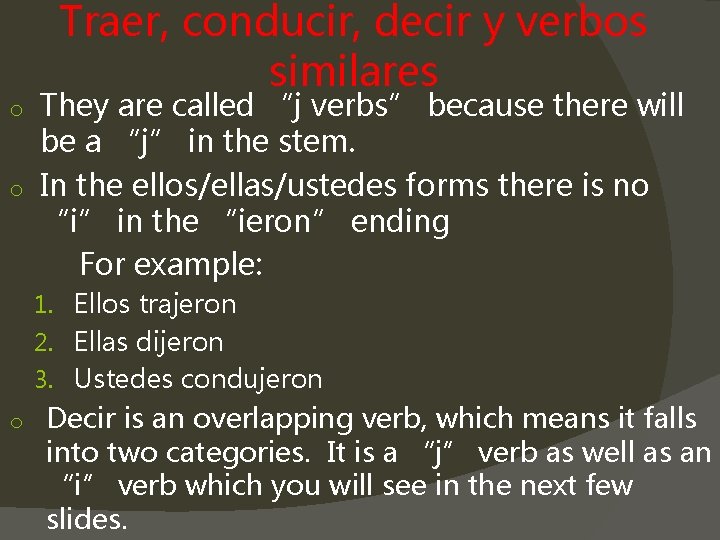
Traer, conducir, decir y verbos similares They are called “j verbs” because there will be a “j” in the stem. o In the ellos/ellas/ustedes forms there is no “i” in the “ieron” ending For example: o 1. Ellos trajeron 2. Ellas dijeron 3. Ustedes condujeron o Decir is an overlapping verb, which means it falls into two categories. It is a “j” verb as well as an “i” verb which you will see in the next few slides.

Traer-to bring Yo traje Nosotros trajimos Tú trajiste Vosotros trajisteis Él/ella/usted trajo Ellos/ellas/ustedes trajeron

Conducir- to drive Yo conduje Nosotros condujimos Tú condujiste Vosotros condujisteis Él/ella/usted condujo Ellos/ellas/ustedes condujeron

Yo dije Decir (J/I)- to say/tell Nosotros dijimos Tú dijiste Vosotros dijisteis Él/ella/usted dijo Ellos/ellas/ustedes dijeron
Querer, hacer y venir �These, along with DECIR, are called “i” verbs, because there will be an “i” in the stem. a
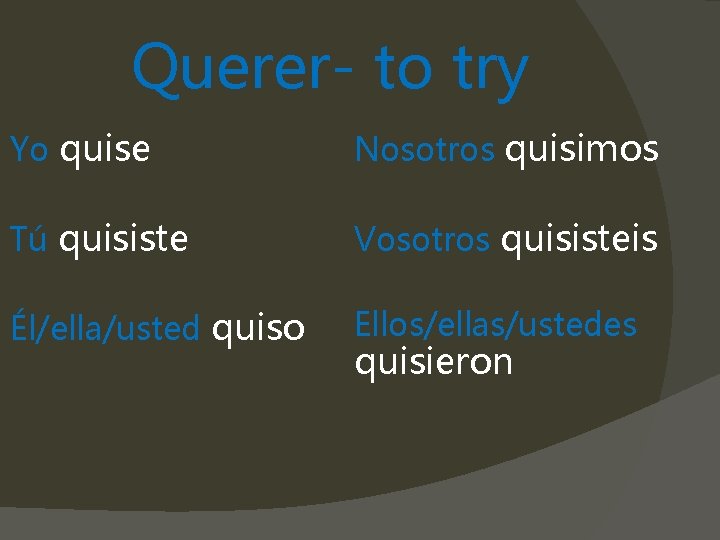
Querer- to try Yo quise Nosotros quisimos Tú quisiste Vosotros quisisteis Él/ella/usted quiso Ellos/ellas/ustedes quisieron

Yo hice Hacer- to do/make Nosotros hicimos Tú hiciste Vosotros hicisteis Él/ella/usted hizo Ellos/ellas/ustedes hicieron
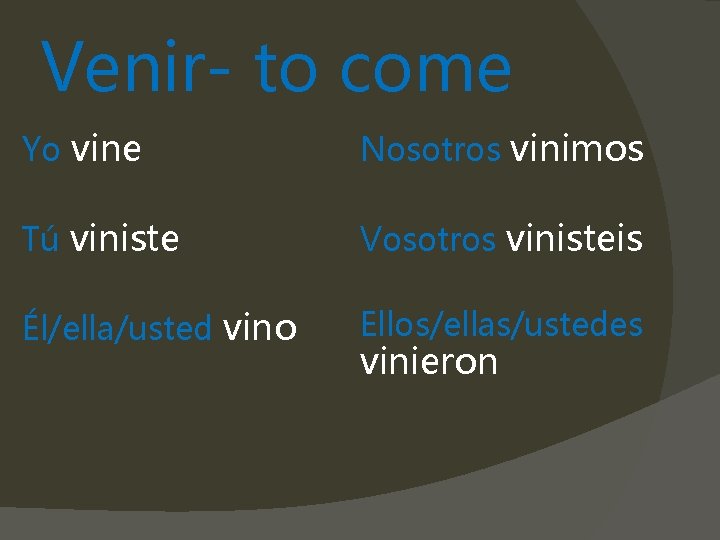
Venir- to come Yo vine Nosotros vinimos Tú viniste Vosotros vinisteis Él/ella/usted vino Ellos/ellas/ustedes vinieron

Some verbs change meaning in the preterite tense verus the present tense. Verb Present tense Preterite tense Querer Quiero "I want. . " Quise "I tried to. . " No Querer No quiero "I don't want. . " No quise "I refused to. . " Saber Sé "I know a fact. . " Supe "I found out. . , discovered" Poder Puedo "I can, am able Pude "I succeeded to, to" managed to. . " No Poder No puedo "I can't, I'm not able. . . " No pude "I failed to. . "
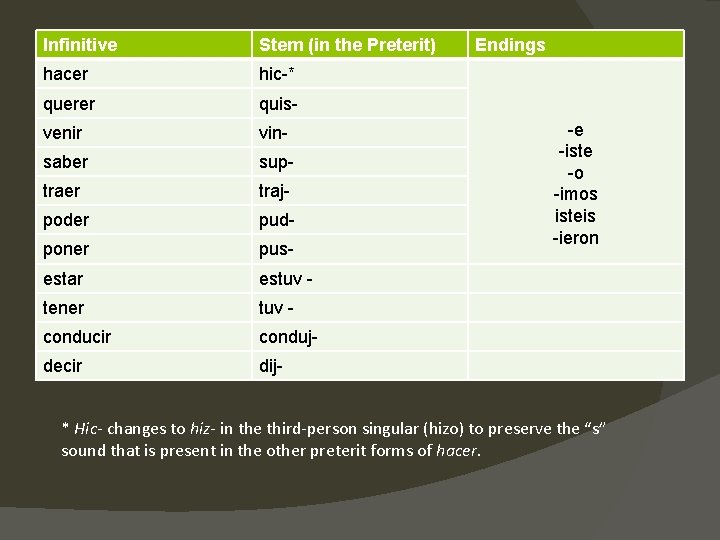
Infinitive Stem (in the Preterit) hacer hic-* querer quis- venir vin- saber sup- traer traj- poder pud- poner pus- estar estuv - tener tuv - conducir conduj- decir dij- Endings -e -iste -o -imos isteis -ieron * Hic- changes to hiz- in the third-person singular (hizo) to preserve the “s” sound that is present in the other preterit forms of hacer.


Para practicar Conjuga traer, conducir, o decir en el pretérito. Ø Yo ______la verdad a la profesora. Ø Nosotros ______el coche nuevo por primera vez. Ø Ella me _____ sopa cuando estuve enferma. Ø Ellos nos _____ la reglas al primer día de clases.

Para practicar Conjuga los verbos para cada oración: 1. La maleta no _______(caber) en el coche. 2. Ella no _______(poder) las flores en la mesa. 3. Mis hijas _______(poner) la cinturón de seguridad. 4. Gracias a su papa, nosotros ____(saber) hacerlo. 5. Tú no _______(saber) nada del accidente.
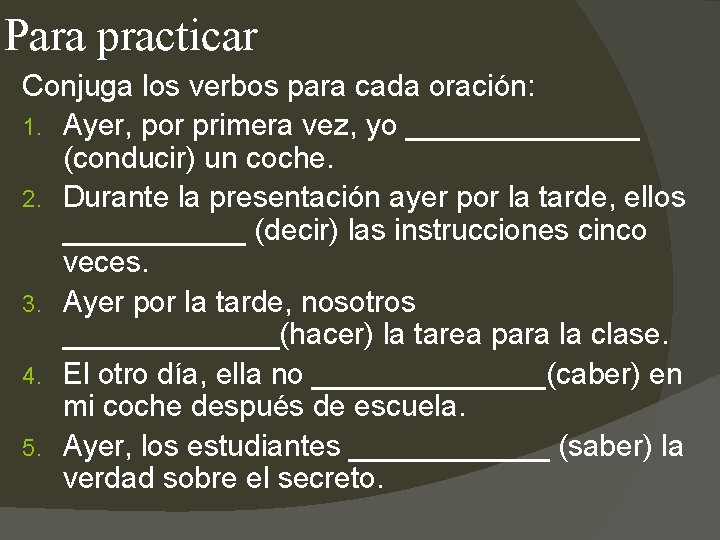
Para practicar Conjuga los verbos para cada oración: 1. Ayer, por primera vez, yo _______ (conducir) un coche. 2. Durante la presentación ayer por la tarde, ellos ______ (decir) las instrucciones cinco veces. 3. Ayer por la tarde, nosotros _______(hacer) la tarea para la clase. 4. El otro día, ella no _______(caber) en mi coche después de escuela. 5. Ayer, los estudiantes ______ (saber) la verdad sobre el secreto.
- Slides: 34