
HAVEGE HArdware Volatile Entropy Gathering and Expansion Unpredictable
HAVEGE HArdware Volatile Entropy Gathering and Expansion Unpredictable random number generation at user level André Seznec Nicolas Sendrier André Seznec Caps Team IRISA/INRIA
Unpredictable random numbers § Unpredictable = irreproducible + uniformly distributed § Needs for cryptographic purpose: è key generation, paddings, zero-knowledge protocols, . . § Previous solutions: è hardware: exploiting some non deterministic physical process • 10 -100 Kbits/s è software: exploiting the occurences of (pseudo) non deterministic external events • 10 -100 bits/s André Seznec Caps Team Irisa
Previous software entropy gathering techniques § Gather entropy from a few parameters on the occurences of various external events: è mouse, keyboard, disk, network, . . § But ignore the impacts of these external events in the processor states André Seznec Caps Team Irisa
HAVEGE: HArdware Volatile Entropy Gathering and Expansion Thousands of hardware states for performance improvement in modern processors These states are touched by all external events Might be a good source of entropy/uncertainty ! André Seznec Caps Team Irisa
HAVEGE: HArdware Volatile Entropy Gathering and Expansion HAVEGE combines in the same algorithm: - gathering uncertainty from hardware volatile states. a few 100 Kbits/s - pseudo-random number generation. more than 100 Mbits/s André Seznec Caps Team Irisa
Hardware Volatile States in a processor § States of many microarchitectural components: è caches: instructions, data, L 1 and L 2, TLBs è branch predictors: targets and directions è buffers: write buffers, victim buffers, prefetch buffers, . . è pipeline status A common point these states are volatile and not architectural: -the result of an application does not depend of these states -these states are unmonitorable from a user-level application André Seznec Caps Team Irisa
An example: the Alpha 21464 branch predictor § 352 Kbits of memory cells: è indexed by a function of the instruction address + the outcomes of more than 21 last branches § on any context switch: è inherits of the overall content of the branch predictor Any executed branch lets a footprint on the branch predictor André Seznec Caps Team Irisa
Gathering hardware volatile entropy/uncertainty ? Collecting the complete hardware state of a processor: • requires freezing the clock • not accessible on off-the-shelf PCs or workstations Indirect access through timing: • use of the hardware clock counter at a very low granularity • Heisenberg ’s criteria: indirect access to a particular state (e. g. status of a branch predictor entry) modifies many others ? André Seznec Caps Team Irisa
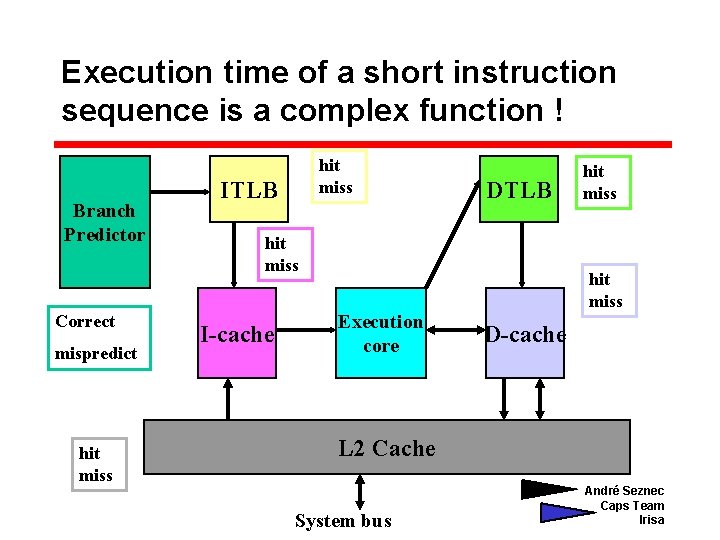
Execution time of a short instruction sequence is a complex function ! Branch Predictor Correct mispredict hit miss ITLB DTLB hit miss I-cache hit miss Execution core D-cache L 2 Cache System bus André Seznec Caps Team Irisa
Execution time of a short instruction sequence is a complex function (2) ! § state of the execution pipelines: è up to 80 instructions inflight on Alpha 21264, more than 100 on Pentium 4 § precise state of every buffer § occurrence on any access on the system bus André Seznec Caps Team Irisa
But a processor is built to be deterministic !? ! Yes but: • Not the response time ! • External events: peripherals , IOs • Operating System • Fault tolerance André Seznec Caps Team Irisa
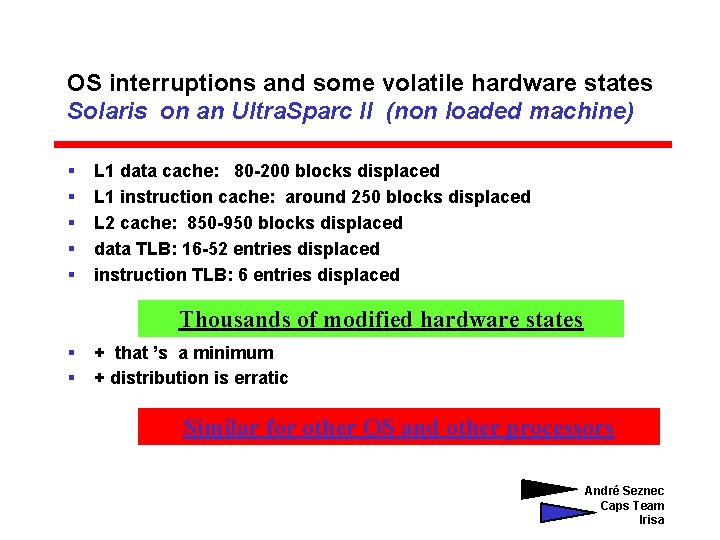
OS interruptions and some volatile hardware states Solaris on an Ultra. Sparc II (non loaded machine) § § § L 1 data cache: 80 -200 blocks displaced L 1 instruction cache: around 250 blocks displaced L 2 cache: 850 -950 blocks displaced data TLB: 16 -52 entries displaced instruction TLB: 6 entries displaced Thousands of modified hardware states § § + that ’s a minimum + distribution is erratic Similar for other OS and other processors André Seznec Caps Team Irisa
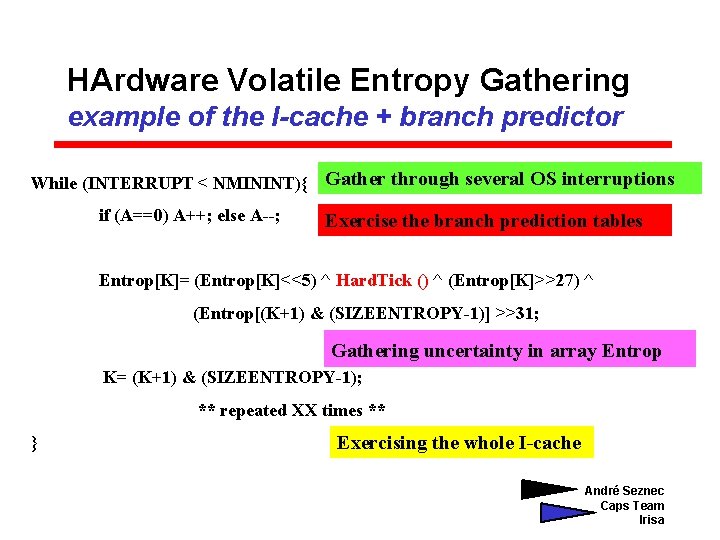
HArdware Volatile Entropy Gathering example of the I-cache + branch predictor While (INTERRUPT < NMININT){ Gather through several OS interruptions if (A==0) A++; else A--; Exercise the branch prediction tables Entrop[K]= (Entrop[K]<<5) ^ Hard. Tick () ^ (Entrop[K]>>27) ^ (Entrop[(K+1) & (SIZEENTROPY-1)] >>31; Gathering uncertainty in array Entrop K= (K+1) & (SIZEENTROPY-1); ** repeated XX times ** } Exercising the whole I-cache André Seznec Caps Team Irisa
HArdware Volatile Entropy Gathering I-cache + branch predictor (2) § The exact content of the Entrop array depends on the exact timing of each inner most iteration: è presence/absence of each instruction in the cache è status of branch prediction è status of data (L 1, L 2, TLB) è precise status of the pipeline è activity on the data bus è status of the buffers André Seznec Caps Team Irisa
Estimating the gathered uncertainty § The source is the OS interruption: è width of the source is thousands of bits è no practical standard evaluation if entropy is larger than 20 1 M samples of 8 words after a single interrupt were all distinct § Empirical evaluation: NIST suite + Diehard è consistantly passing the tests = uniform random André Seznec Caps Team Irisa
Uncertainty gathered with HAVEG on unloaded machines § Per OS interrupt in average and depending on OS + architecture è 8 K-64 K bits on the I-cache + branch predictor è 2 K-8 K bits on the D-cache § A few hundred of unpredictable Kbits/s è 100 -1000 times more than previous entropy gathering techniques on an unloaded machine André Seznec Caps Team Irisa
HAVEG algorithms and loaded machines § On a loaded machine: è more frequent OS interrupts: • less iterations between two OS interrupts è less uncertainty per interrupt • i. e. , more predictable states for data and inst. caches § But more uncertainty gathered for the same number of iterations : -) André Seznec Caps Team Irisa
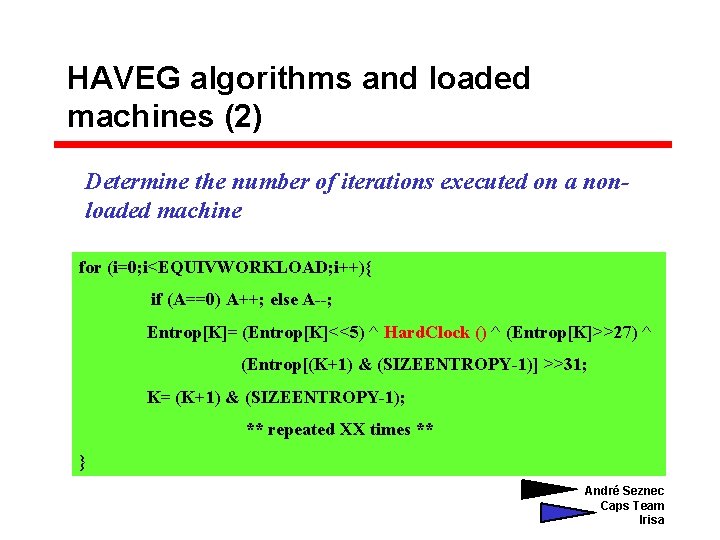
HAVEG algorithms and loaded machines (2) Determine the number of iterations executed on a nonloaded machine for (i=0; i<EQUIVWORKLOAD; i++){ if (A==0) A++; else A--; Entrop[K]= (Entrop[K]<<5) ^ Hard. Clock () ^ (Entrop[K]>>27) ^ (Entrop[(K+1) & (SIZEENTROPY-1)] >>31; K= (K+1) & (SIZEENTROPY-1); ** repeated XX times ** } André Seznec Caps Team Irisa
Reproducing HAVEG sequences ? André Seznec Caps Team Irisa
Security assumptions § An attacker has user-level access to the system running HAVEG è He/she cannot read the memory of the HAVEG process è He/she cannot freeze the hardware clock è He/she cannot hardware monitor the memory/system bus § An attacker has unlimited access to a similar system (hardware and software) André Seznec Caps Team Irisa
Heisenberg’s criteria Nobody, not even the user itself can access the internal volatile hardware state without modifying it André Seznec Caps Team Irisa
Passive attack: just observe, guess and reproduce (1) § Need to « guess » (reproduce) the overall initial internal state of HAVEG: è the precise hardware counter ? è the exact content of the memory system, disks included ! è the exact states of the pipelines, branch predictors, etc è the exact status of all operating system variables Without any internal dedicated hardware on the targeted system ? André Seznec Caps Team Irisa
Passive attack: just guessing and reproducing (2) § reproducing the exact sequence of external events on a cycle per cycle basis è network, mouse, variable I/O response times, … è internal errors ? Without any internal dedicated hardware on the targeted system ? André Seznec Caps Team Irisa
Active attack: setting the processor in a predetermined state § Load the processor with many copies of a process that: è flushes the caches (I, D, L 2 caches) è flushes the TLBs è sets the branch predictor in a predetermined state § HAVEG outputs were still unpredictable André Seznec Caps Team Irisa
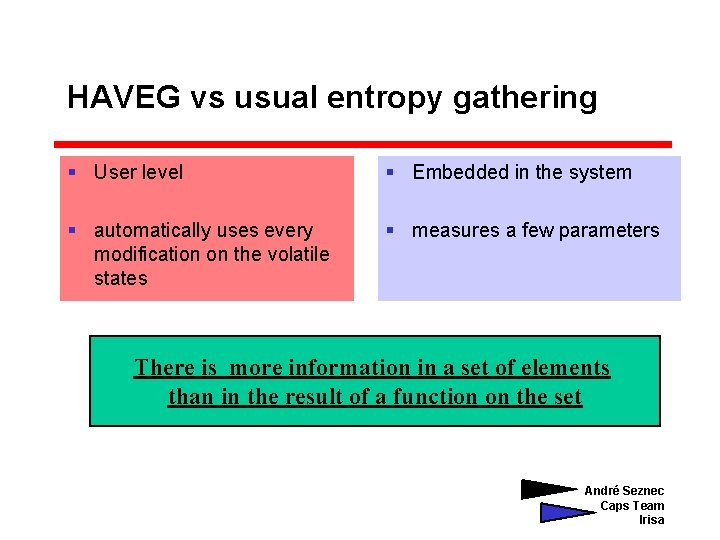
HAVEG vs usual entropy gathering § User level § Embedded in the system § automatically uses every modification on the volatile states § measures a few parameters There is more information in a set of elements than in the result of a function on the set André Seznec Caps Team Irisa
HAVEGE HAVEG and Expansion André Seznec Caps Team Irisa
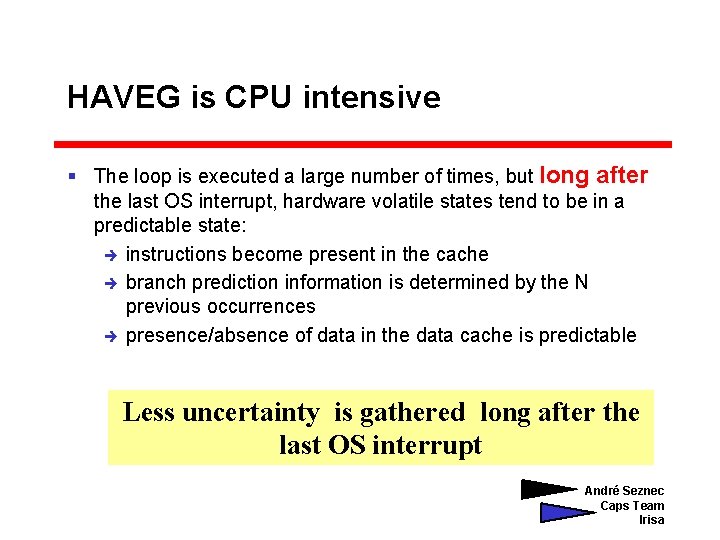
HAVEG is CPU intensive § The loop is executed a large number of times, but long after the last OS interrupt, hardware volatile states tend to be in a predictable state: è instructions become present in the cache è branch prediction information is determined by the N previous occurrences è presence/absence of data in the data cache is predictable Less uncertainty is gathered long after the last OS interrupt André Seznec Caps Team Irisa
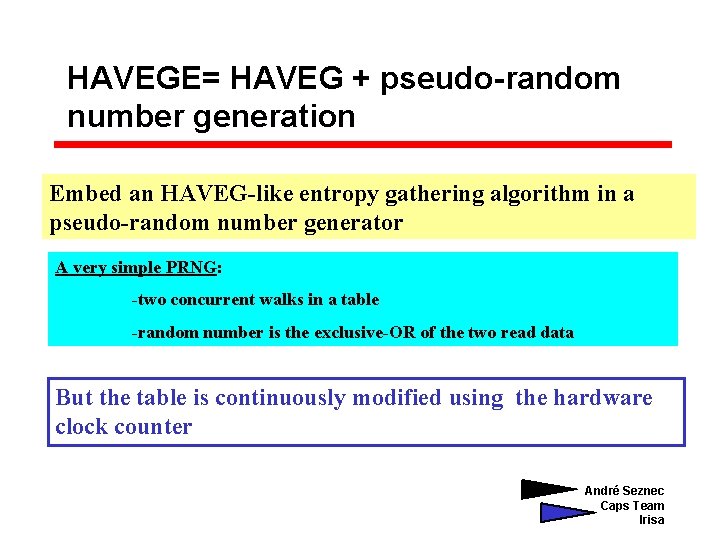
HAVEGE= HAVEG + pseudo-random number generation Embed an HAVEG-like entropy gathering algorithm in a pseudo-random number generator A very simple PRNG: -two concurrent walks in a table -random number is the exclusive-OR of the two read data But the table is continuously modified using the hardware clock counter André Seznec Caps Team Irisa
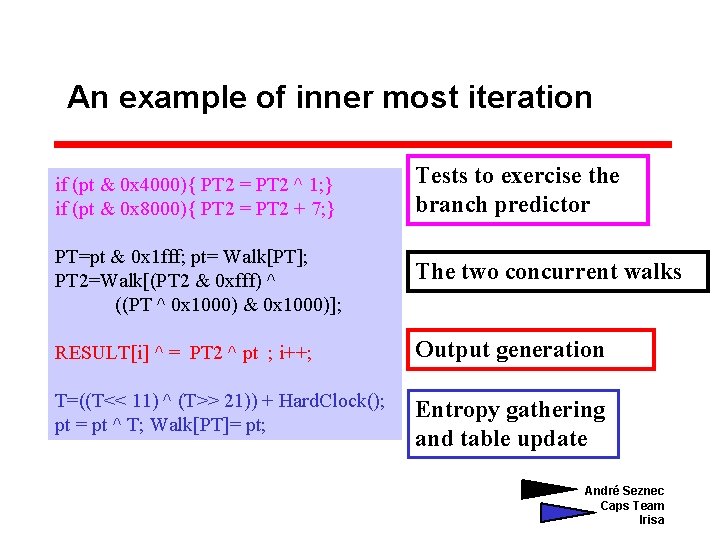
An example of inner most iteration if (pt & 0 x 4000){ PT 2 = PT 2 ^ 1; } if (pt & 0 x 8000){ PT 2 = PT 2 + 7; } Tests to exercise the branch predictor PT=pt & 0 x 1 fff; pt= Walk[PT]; PT 2=Walk[(PT 2 & 0 xfff) ^ ((PT ^ 0 x 1000) & 0 x 1000)]; The two concurrent walks RESULT[i] ^ = PT 2 ^ pt ; i++; Output generation T=((T<< 11) ^ (T>> 21)) + Hard. Clock(); pt = pt ^ T; Walk[PT]= pt; Entropy gathering and table update André Seznec Caps Team Irisa
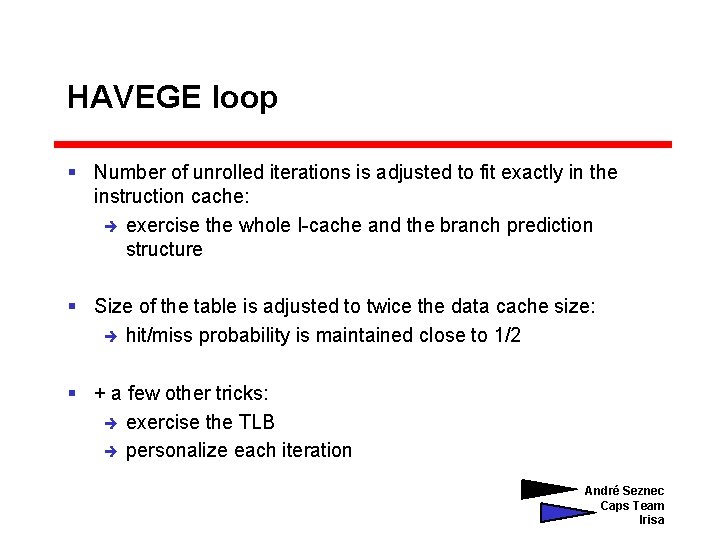
HAVEGE loop § Number of unrolled iterations is adjusted to fit exactly in the instruction cache: è exercise the whole I-cache and the branch prediction structure § Size of the table is adjusted to twice the data cache size: è hit/miss probability is maintained close to 1/2 § + a few other tricks: è exercise the TLB è personalize each iteration André Seznec Caps Team Irisa
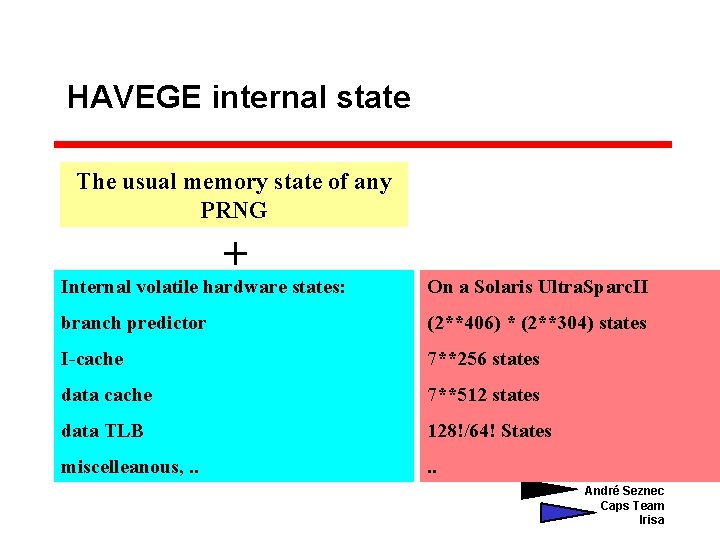
HAVEGE internal state The usual memory state of any PRNG + Internal volatile hardware states: On a Solaris Ultra. Sparc. II branch predictor (2**406) * (2**304) states I-cache 7**256 states data cache 7**512 states data TLB 128!/64! States miscelleanous, . . André Seznec Caps Team Irisa
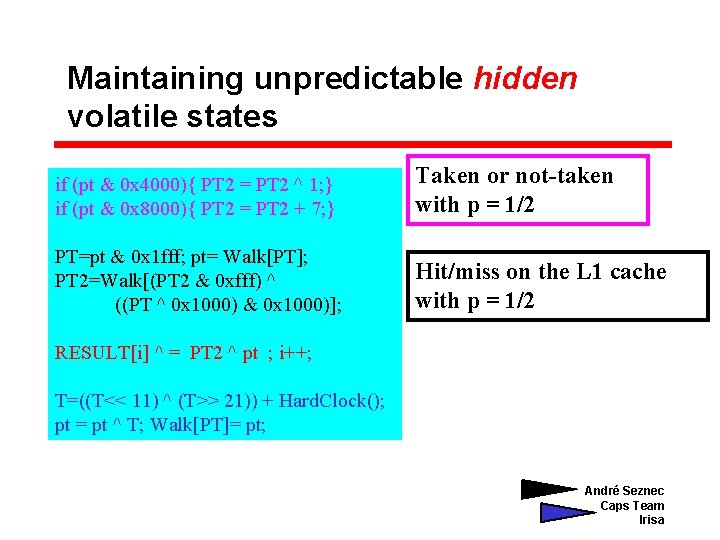
Maintaining unpredictable hidden volatile states if (pt & 0 x 4000){ PT 2 = PT 2 ^ 1; } if (pt & 0 x 8000){ PT 2 = PT 2 + 7; } Taken or not-taken with p = 1/2 PT=pt & 0 x 1 fff; pt= Walk[PT]; PT 2=Walk[(PT 2 & 0 xfff) ^ ((PT ^ 0 x 1000) & 0 x 1000)]; Hit/miss on the L 1 cache with p = 1/2 RESULT[i] ^ = PT 2 ^ pt ; i++; T=((T<< 11) ^ (T>> 21)) + Hard. Clock(); pt = pt ^ T; Walk[PT]= pt; André Seznec Caps Team Irisa
Security of HAVEGE= internal state § Reproducing HAVEGE sequences: è internal state is needed § Collecting the internal state is impossible: è destructive è or freezing the hardware clock ! § If an attacker was able to capture (guess) a valid internal state then he/she must also monitor (guess) all the new states continuously injected by external events Dealing with continuous and unmonitorable reseeding is not easy !! André Seznec Caps Team Irisa
HAVEGE continuous reseeding § On each OS interrupt: è internal state of the generator is modified • thousands of binary states are touched è complex interaction between internal general state and OS servicing: • service time of an OS interrupt depends on the initial hardware state § Any event on the memory system touches the state è asynchronous events on the memory bus ! André Seznec Caps Team Irisa
HAVEGE: uniform distribution and irreproducibility § When the Walk table is initialized with uniformly distributed random numbers, generated numbers are uniformly distributed è use of an initialization phase: HAVEG § Irreproducibility: è irreproducibility of the initial state ensures irreproducibility of the sequences è even, with the same initial Walk table content, rapid divergence of the result sequences: • collecting the ith to i+16 th results pass the tests for i= 100000 André Seznec Caps Team Irisa
HAVEGE 1. 0 § Initialization phase 1: è HAVEG on instruction cache and branch predictor § Initialization phase 2: è HAVEGE without result production One CPU second worth recommended per phase To our knowledge 1/20 s and a single phase is sufficient § HAVEGE main loop André Seznec Caps Team Irisa
Portability § User level è access to the hardware clock counter in user mode is needed § Just adapt a few parameters: è I and D cache size, branch predictor sizes è adjust the number of iterations in the loops to fit the I-cache André Seznec Caps Team Irisa
Performances HAVEGE 1. 0 § To collect 32 Mbytes on unloaded machines: è 570 million cycles on Ultra. Sparc II è 890 million cycles on Pentium III (gcc Linux and Windows) è 780 million cycles on Pentium III (Visual C++) è 1140 million cycles on Athlon (gcc Linux and Windows) è 1300 million cycles on Itanium over 100 Mbits/s on all platforms André Seznec Caps Team Irisa
HAVEGE 2. 0 § Reengineered for : è Simplicity: • A single loop for initialization and production è Portability: • Setting the data cache, TB sizes • Adapting the number of iterations è Performance for non-cryptographic applications André Seznec Caps Team Irisa
Performances HAVEGE 2. 0 (non cryptographic) § To collect 32 Mbytes on unloaded machines: è 260 million cycles on Ultra. Sparc II è 270 million cycles on Pentium 4 (gcc Linux and Windows) è 270 million cycles on Power. PC 7400 (Mac. OS 10) è 630 million cycles on Itanium Faster and more uniformally distributed than random( ) André Seznec Caps Team Irisa
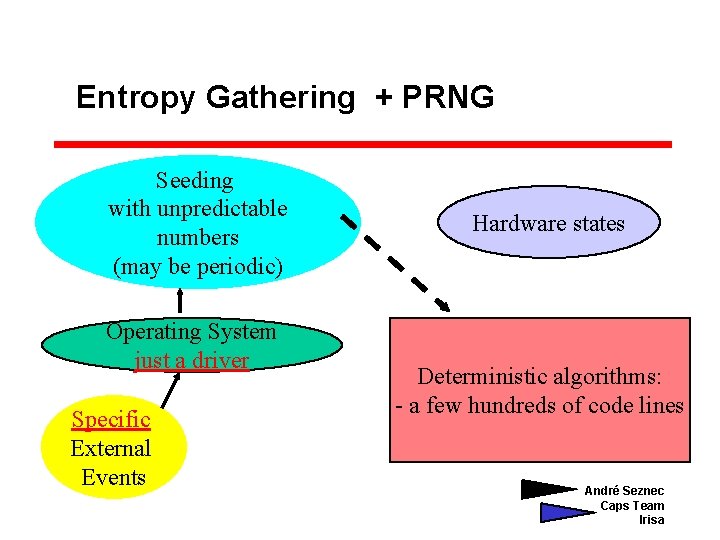
Entropy Gathering + PRNG Seeding with unpredictable numbers (may be periodic) Operating System just a driver Specific External Events Hardware states Deterministic algorithms: - a few hundreds of code lines André Seznec Caps Team Irisa
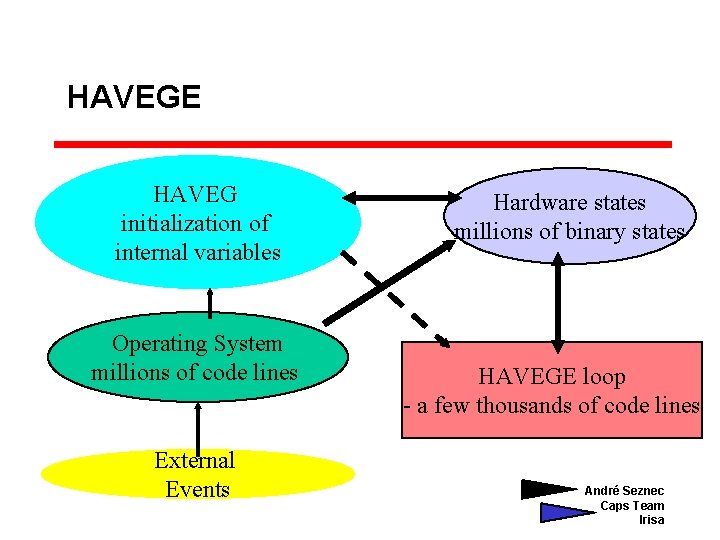
HAVEGE HAVEG initialization of internal variables Operating System millions of code lines External Events Hardware states millions of binary states HAVEGE loop - a few thousands of code lines André Seznec Caps Team Irisa
Further hiding of the internal state HAVEGE sequences are unpredictable but, one may want to use other tricks to further hide the internal state André Seznec Caps Team Irisa
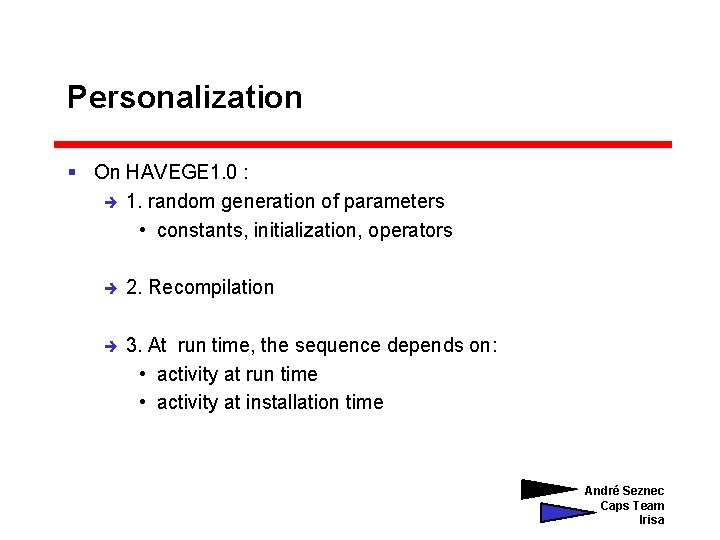
Personalization § On HAVEGE 1. 0 : è 1. random generation of parameters • constants, initialization, operators è 2. Recompilation è 3. At run time, the sequence depends on: • activity at run time • activity at installation time André Seznec Caps Team Irisa
Combining PRNGs with HAVEGE § Yes, but I was really confident in my favorite PRNG è just embed your favorite PRNG in Hard. Clock() : -) è and continuously reseed your second favorite with HAVEGE outputs ! § Reengineer HAVEGE with a robust PRNG: è take a robust PRNG code, add tests, unroll, etc to exercise hardware volatile states André Seznec Caps Team Irisa
Further possible tricks § Use of a multithreaded HAVEGE generator: è share tables, pointers, code, è but no synchronization !! § Use self-modifying code: è modify operators, constants on the fly with random values André Seznec Caps Team Irisa
Conclusion § The interaction between user applications, external events, and the operating systems creates a lot of uncertainty in the hardware volatile states in microprocessor: è orders of magnitude larger than was previously captured by entropy gathering techniques. § The hardware clock counter can be used at user level to gather (part of) this uncertainty: è HAVEG: a few 100 ’s Kbits/s § PRNG and volatile entropy gathering can be combined: è HAVEGE: > 100 Mbits/s • unaccessible internal state • continuous and unmonitorable reseeding André Seznec Caps Team Irisa
Still not convinced ? § Just test it: è http: //www. irisa. fr/caps/projects/hipsor/HAVEGE. html § Platforms: è Ultra. Sparc II and III, Solaris è Pentium III, Pentium 4, Athlon - Windows, Linux è Itanium, Linux è Power. PC G 4, Mac. OS 10 è Pocket. PC André Seznec Caps Team Irisa
- Slides: 48