
Have you compared Tense and aspect in Philippine








- Slides: 25
Have you compared? : Tense and aspect in Philippine English Ma. Althea T. Enriquez National University of Singapore
Philippine English (PE) § Product of a language contact ecology § American occupation in the 1 st half of the 20 th century § “New” Englishes § No sizable population of original English speakers settled § English through education
Philippine English (PE) § Transplanted § importation or introduction of a language to a new environment; new users, new uses § Indigenized § initially acquired through education, used as lingua franca, model for subsequent learners § Nativized § transmitted from parent to child
Research on PE § Standard Philippine English § Data from written materials and mass media § Approached from error analysis § Regular and widespread deviations from SAE are emergent features
Language contact approaches § Universalist – extensive similarities are outcome of the universal aspects of language § Superstratist – most features can be traced to lexifier language § Substratist – influence of dominant substrate or L 1 languages
Substrate approach § In pidgins and creoles, grammatical structure is largely determined by grammatical structure of substrate languages § Similarity with language learning: § Supplementation of grammatical structures by L 1 § Some features are retained even after shift
Scope (speech community) § Adult speakers who have had at least some college education § Employ English for various communicative purposes with other Filipinos § Bilinguals who acquire English normally in the classroom and Filipino in the home (or in the classroom/in media)
Scope and data § Spoken, interpersonal or in-group communication § Philippine component of the International Corpus of English (ICE) § Subset of the spoken texts: dialogue, direct conversations (S 1 A-001 to 020)
PE TMA emergent features § Progressive § Present perfect § Already
Tagalog as dominant substrate influence § Some phonological but more morphosyntactic features § Philippine languages are genetically related and typologically similar § PE is spoken more in the urban areas especially in Metro Manila § primary source of influence and locus where PE is used
Tagalog verb system § Verb composed of root with affixes corresponding to FMA § Time relations is expressed by adverbs; in SAE, verb tense markers § Overt aspect markers: perfective, imperfective, contemplative § Panahunan: pangnagdaan (past), pangkasalukuyan (present), panghinaharap (future)
The Progressive § Dynamic action in the process of happening § Dynamism is the crucial difference between states and activities § Only one viewpoint may be available for statives: § In SAE, it is the perfective § In Tagalog, it is the imperfective
§ Nagbasa ako ng libro. I read a book. § Nagbabasa ako ng libro. I am reading a book. § Magbabasa ako ng libro. I will read a book. I am going to read a book. § Nagbabasa ako ng libro (araw-araw). I read a book (everyday).
PE Progressive § Combines imperfective and present tense through the use of the progressive § Progressives are used in habitual and general stative sentences § Refers to future events which expresses intended events
1) Yeah something like I-, I’m also playing basketball and I’m trying to figure out how he does those things and he’s so great, he’s just so good to become… [S 1 A-001#95] 2) Uh, you just have to make some sacrifices and at the same time, right now, I’m just having a positive attitude to enjoy working there because at least, what makes it more bearable is I have good officemates. [S 1 A-006#35]
3) Yeah, nice. We went to Harvard. It was so cold and ka-cheap-an namin, we-, we were trying to find out where Sharon Cuneta was living. [S 1 A 002#39] 4) I’m leaving next-, next Monday. It’s on the twenty-sixth. [1] 5) Uhm, I know. I’m watching on the seventh. [73]
The (present) perfect § “Extended now” § Anteriority § situation prior to speech time § occuring at an indefinite or unspecified time in the past § Current relevance § In SAE, current relevance and definite past cannot be combined
6) How about you Candice? I’ve heard that you like Bacolod so much. [S 1 A 012#57] 7) I have written insights from planned language change and language shift and so on. [S 1 A-003#163] 8) Really? So you haven’t seen them for a long time. [S 1 A-002#180] 9) I’ve been to Iloilo like three years ago. [S 1 A-012#69]
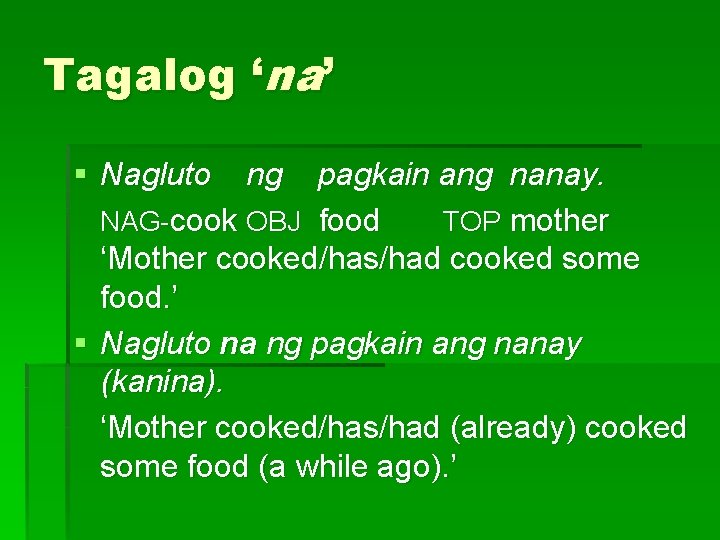
Tagalog ‘na’ § Nagluto ng pagkain ang nanay. NAG-cook OBJ food TOP mother ‘Mother cooked/has/had cooked some food. ’ § Nagluto na ng pagkain ang nanay (kanina). ‘Mother cooked/has/had (already) cooked some food (a while ago). ’
Already § Used with present perfect but in general American English, it occurs with simple past § ‘has happened before now’ or ‘has happened sooner than expected’ § ‘the situation exists at an earlier time than expected’
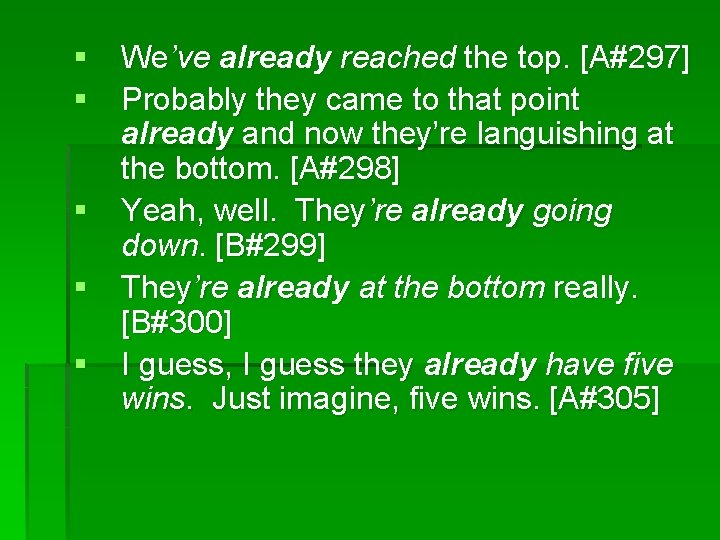
§ We’ve already reached the top. [A#297] § Probably they came to that point already and now they’re languishing at the bottom. [A#298] § Yeah, well. They’re already going down. [B#299] § They’re already at the bottom really. [B#300] § I guess, I guess they already have five wins. Just imagine, five wins. [A#305]
10) Nagluto (na) si nanay ng pagkain. ‘Mother has already cooked some food. ’ 11 a) Payat ang babae. ‘The woman is thin. ’ b) Payat na ang babae. ‘The woman is now thin. ’ 12 a) Pumayat ka. ‘You got thin. ’ b) Pumayat ka na. ‘You are now thin. ’
PE Already § § § We’ve already reached the top. They’re already going down. Focusing of the result to the beginning of the situation in its new state (inchoative) § Recentness or “now-ness” of the situation
Positioning in sentences § But I’ll be working already next month. § I think there were others but I forgot about them already. § But because uh it was time already to go and practice and uh it was a suggestion from my mom and okay we 'll try it and I did.
Summary and conclusion