
Haunted History of Fort Leavenworth Frontier Army Museum
- Slides: 29
Haunted History of Fort Leavenworth Frontier Army Museum Fort Leavenworth, KS Facebook: https: //www. facebook. com/Frontier. Army. Museum Webpage: https: //history. army. mil/museums/TRADOC/frontier-army-museum/index. html
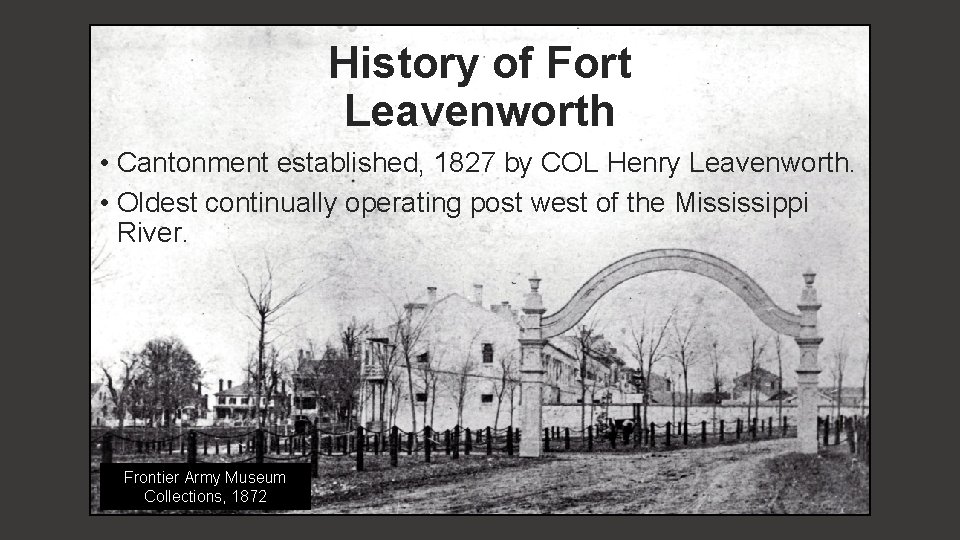
History of Fort Leavenworth • Cantonment established, 1827 by COL Henry Leavenworth. • Oldest continually operating post west of the Mississippi River. Frontier Army Museum Collections, 1872
Expansion into the west began in America with the Louisiana Purchase in 1803. President Thomas Jefferson authorized Captain Meriwether Lewis and Second Lieutenant William Clark to explore and map the newly acquired territory. Soon roads were created to link the east to the west. One such road was the Santa Fe Trail, a road that was used for economic purposes. Conflict with Native Americans on the trail led to forts being constructed. Colonel Henry Leavenworth was handpicked to establish a new post along the Missouri River. The post would provide an escort along the Santa Fe Trail, to protect the western frontier and be a show of force to the Native American tribes settled in the area. Colonel Leavenworth, with the officers and men of the 3 rd Infantry Regiment from Jefferson Barracks at St. Louis, Missouri were assigned to locate and establish a permanent cantonment. Leavenworth decided against the original location on the eastern side of the Missouri river because of potential flooding that could lead to disease. Instead he recommended a location 20 miles upstream on the west bank in the bluffs above the river. The west side of the river would later become the state of Kansas. The location of the post was selected in 1827 and it is currently the oldest continually operating post west of the Mississippi River.
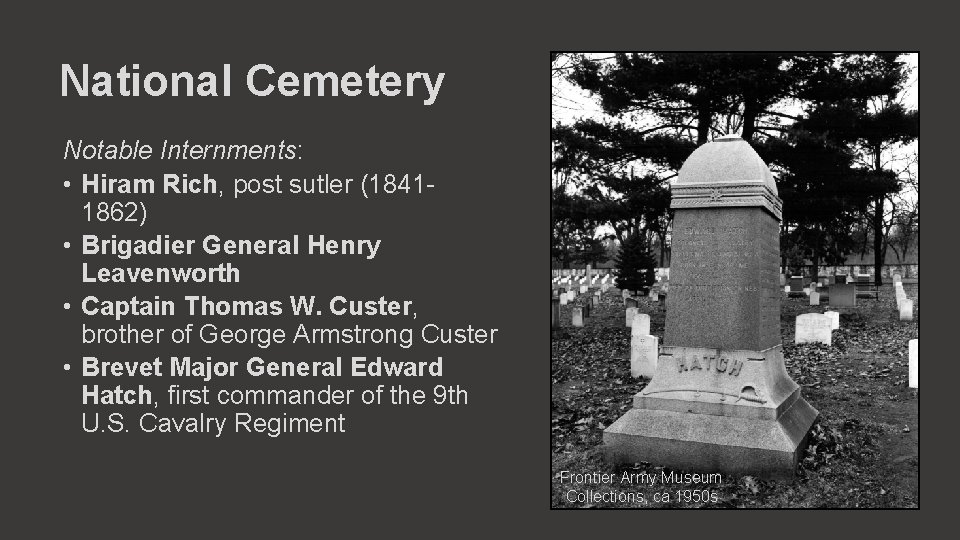
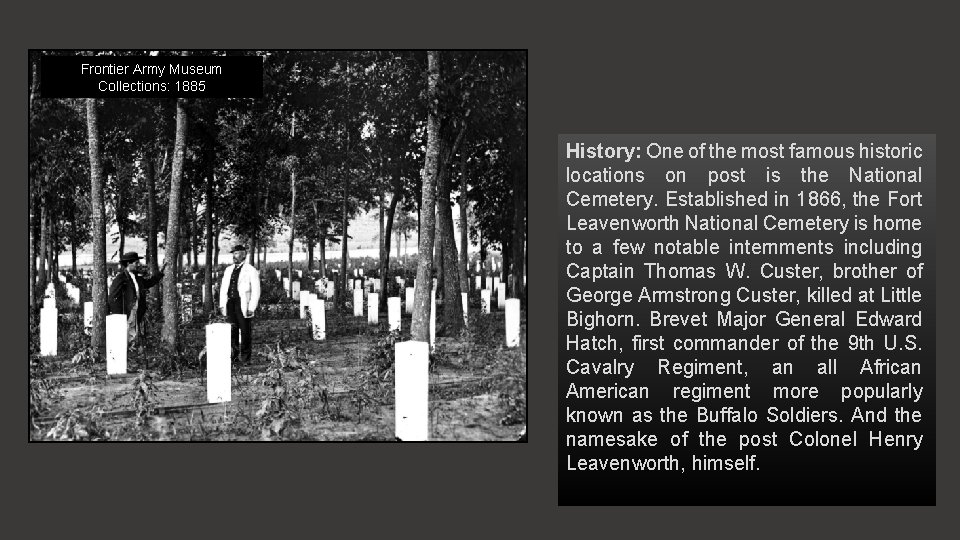
National Cemetery Notable Internments: • Hiram Rich, post sutler (18411862) • Brigadier General Henry Leavenworth • Captain Thomas W. Custer, brother of George Armstrong Custer • Brevet Major General Edward Hatch, first commander of the 9 th U. S. Cavalry Regiment Frontier Army Museum Collections, ca 1950 s
Frontier Army Museum Collections: 1885 History: One of the most famous historic locations on post is the National Cemetery. Established in 1866, the Fort Leavenworth National Cemetery is home to a few notable internments including Captain Thomas W. Custer, brother of George Armstrong Custer, killed at Little Bighorn. Brevet Major General Edward Hatch, first commander of the 9 th U. S. Cavalry Regiment, an all African American regiment more popularly known as the Buffalo Soldiers. And the namesake of the post Colonel Henry Leavenworth, himself.
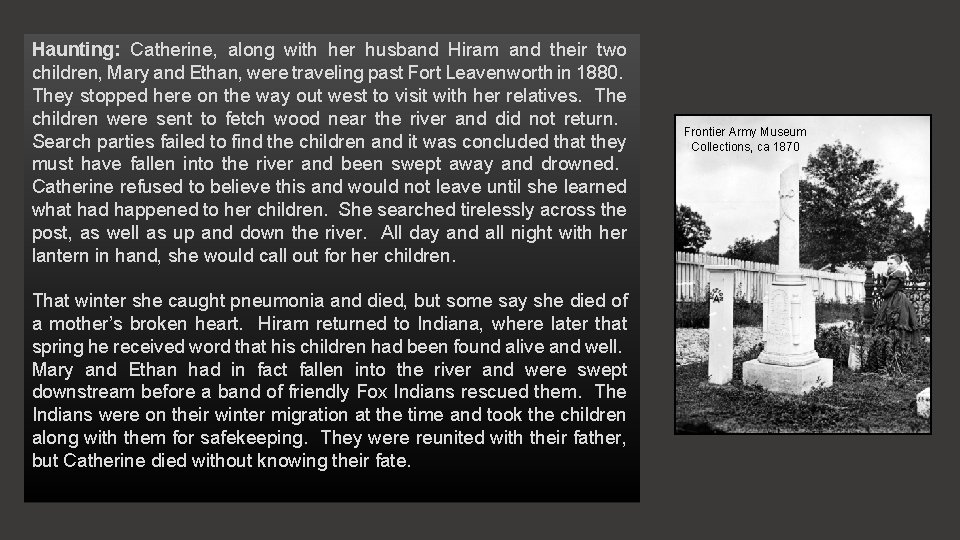
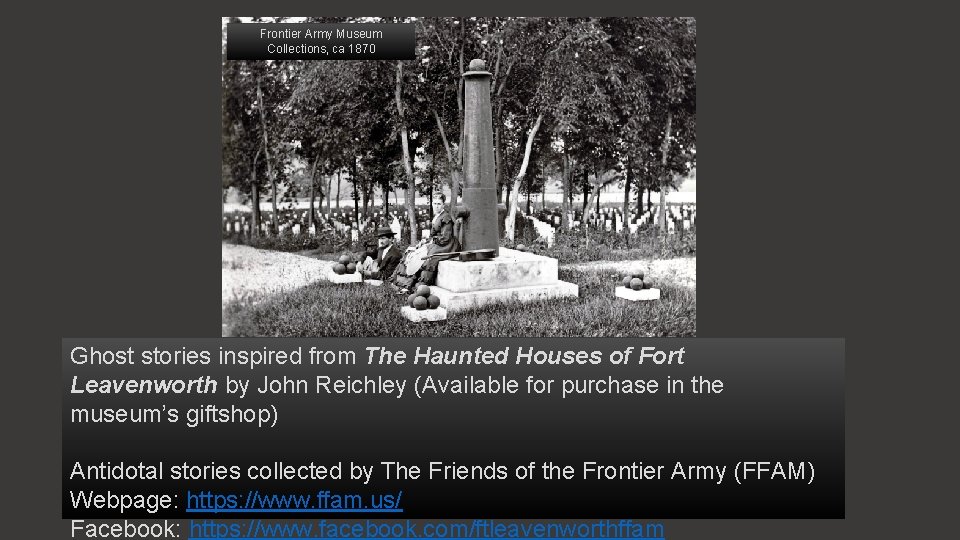
Haunting: Catherine, along with her husband Hiram and their two children, Mary and Ethan, were traveling past Fort Leavenworth in 1880. They stopped here on the way out west to visit with her relatives. The children were sent to fetch wood near the river and did not return. Search parties failed to find the children and it was concluded that they must have fallen into the river and been swept away and drowned. Catherine refused to believe this and would not leave until she learned what had happened to her children. She searched tirelessly across the post, as well as up and down the river. All day and all night with her lantern in hand, she would call out for her children. That winter she caught pneumonia and died, but some say she died of a mother’s broken heart. Hiram returned to Indiana, where later that spring he received word that his children had been found alive and well. Mary and Ethan had in fact fallen into the river and were swept downstream before a band of friendly Fox Indians rescued them. The Indians were on their winter migration at the time and took the children along with them for safekeeping. They were reunited with their father, but Catherine died without knowing their fate. Frontier Army Museum Collections, ca 1870
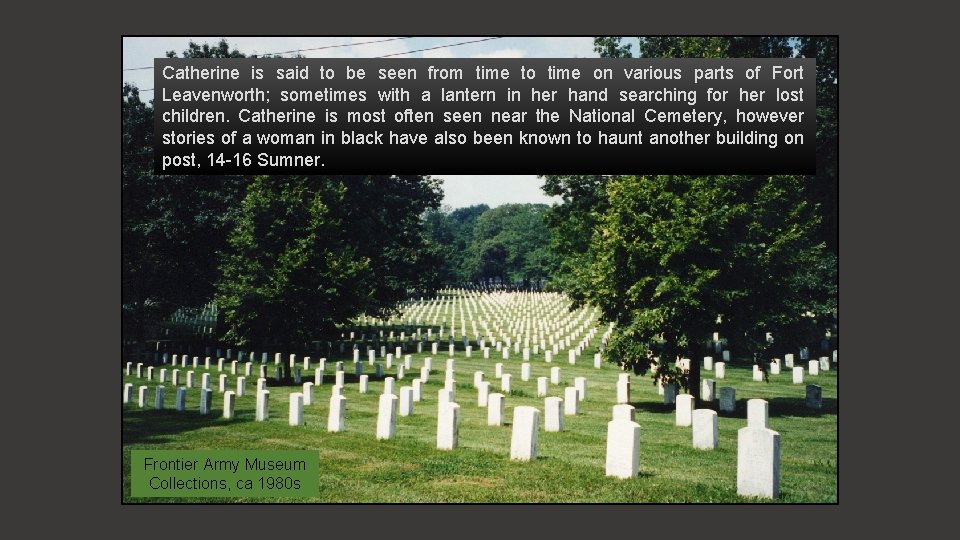
Catherine is said to be seen from time to time on various parts of Fort Leavenworth; sometimes with a lantern in her hand searching for her lost children. Catherine is most often seen near the National Cemetery, however stories of a woman in black have also been known to haunt another building on post, 14 -16 Sumner. Frontier Army Museum Collections, ca 1980 s
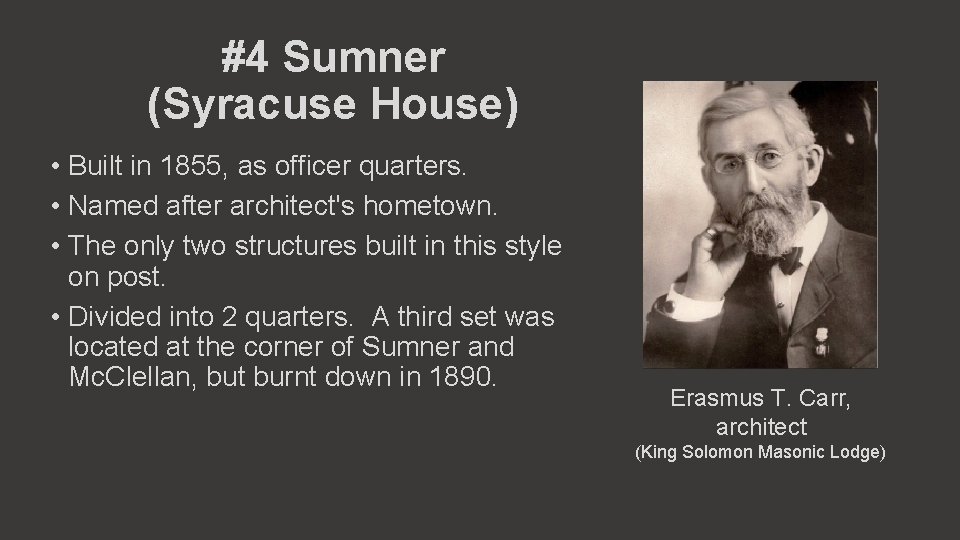
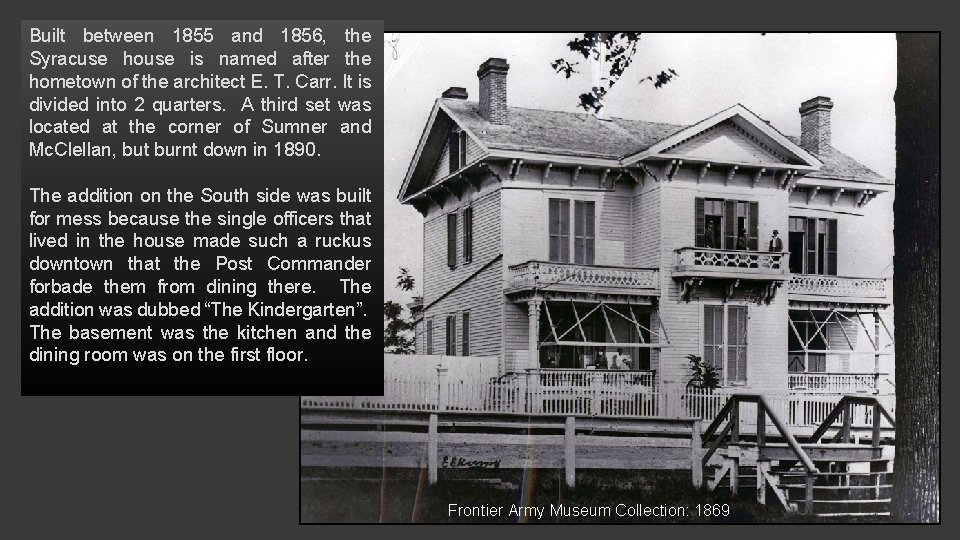
#4 Sumner (Syracuse House) • Built in 1855, as officer quarters. • Named after architect's hometown. • The only two structures built in this style on post. • Divided into 2 quarters. A third set was located at the corner of Sumner and Mc. Clellan, but burnt down in 1890. Erasmus T. Carr, architect (King Solomon Masonic Lodge)
Built between 1855 and 1856, the Syracuse house is named after the hometown of the architect E. T. Carr. It is divided into 2 quarters. A third set was located at the corner of Sumner and Mc. Clellan, but burnt down in 1890. The addition on the South side was built for mess because the single officers that lived in the house made such a ruckus downtown that the Post Commander forbade them from dining there. The addition was dubbed “The Kindergarten”. The basement was the kitchen and the dining room was on the first floor. Frontier Army Museum Collection: 1869
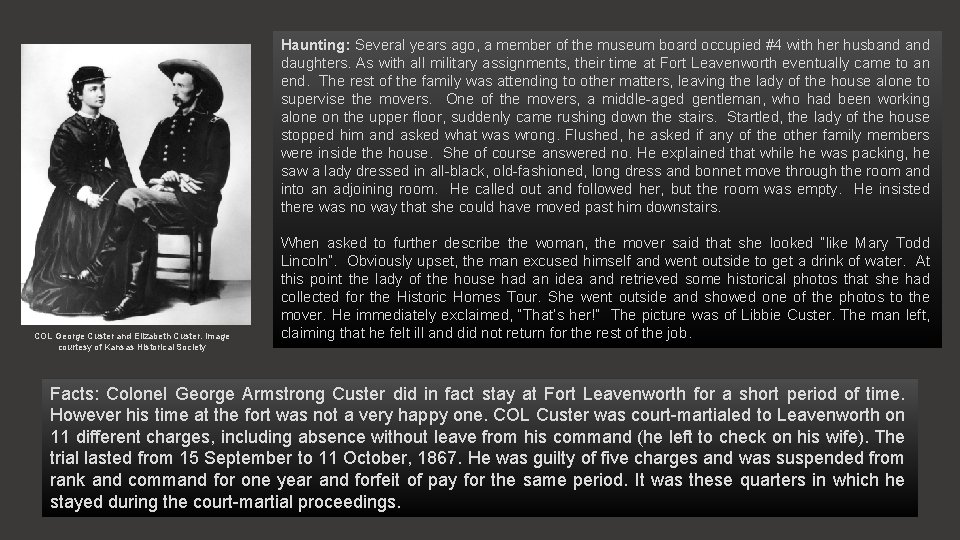
Haunting: Several years ago, a member of the museum board occupied #4 with her husband daughters. As with all military assignments, their time at Fort Leavenworth eventually came to an end. The rest of the family was attending to other matters, leaving the lady of the house alone to supervise the movers. One of the movers, a middle-aged gentleman, who had been working alone on the upper floor, suddenly came rushing down the stairs. Startled, the lady of the house stopped him and asked what was wrong. Flushed, he asked if any of the other family members were inside the house. She of course answered no. He explained that while he was packing, he saw a lady dressed in all-black, old-fashioned, long dress and bonnet move through the room and into an adjoining room. He called out and followed her, but the room was empty. He insisted there was no way that she could have moved past him downstairs. COL George Custer and Elizabeth Custer. Image courtesy of Kansas Historical Society When asked to further describe the woman, the mover said that she looked “like Mary Todd Lincoln”. Obviously upset, the man excused himself and went outside to get a drink of water. At this point the lady of the house had an idea and retrieved some historical photos that she had collected for the Historic Homes Tour. She went outside and showed one of the photos to the mover. He immediately exclaimed, “That’s her!” The picture was of Libbie Custer. The man left, claiming that he felt ill and did not return for the rest of the job. Facts: Colonel George Armstrong Custer did in fact stay at Fort Leavenworth for a short period of time. However his time at the fort was not a very happy one. COL Custer was court-martialed to Leavenworth on 11 different charges, including absence without leave from his command (he left to check on his wife). The trial lasted from 15 September to 11 October, 1867. He was guilty of five charges and was suspended from rank and command for one year and forfeit of pay for the same period. It was these quarters in which he stayed during the court-martial proceedings.
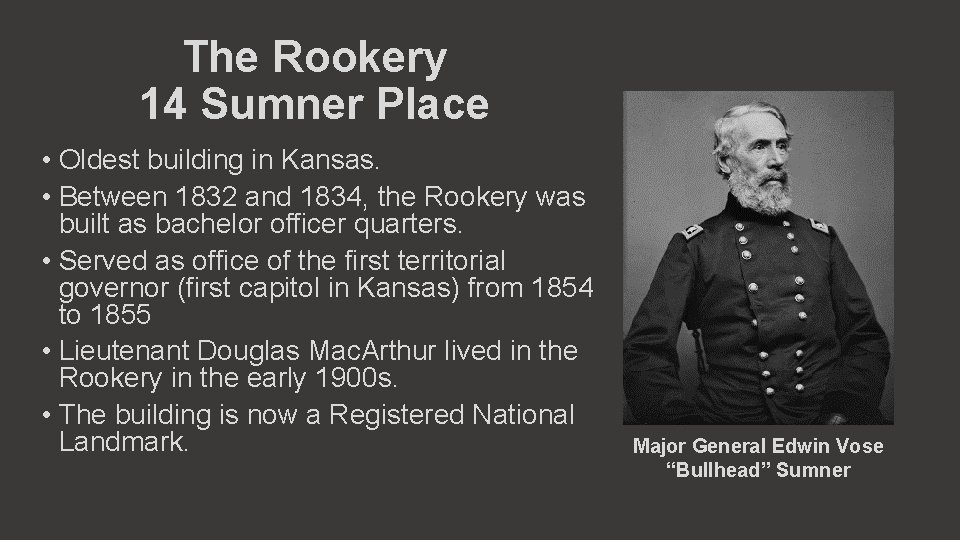
The Rookery 14 Sumner Place • Oldest building in Kansas. • Between 1832 and 1834, the Rookery was built as bachelor officer quarters. • Served as office of the first territorial governor (first capitol in Kansas) from 1854 to 1855 • Lieutenant Douglas Mac. Arthur lived in the Rookery in the early 1900 s. • The building is now a Registered National Landmark. Major General Edwin Vose “Bullhead” Sumner
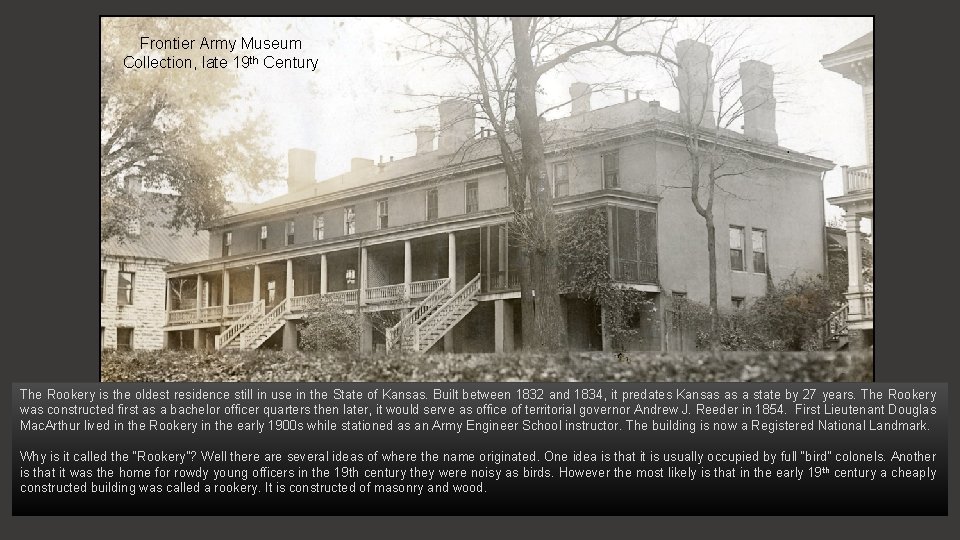
Frontier Army Museum Collection, late 19 th Century The Rookery is the oldest residence still in use in the State of Kansas. Built between 1832 and 1834, it predates Kansas as a state by 27 years. The Rookery was constructed first as a bachelor officer quarters then later, it would serve as office of territorial governor Andrew J. Reeder in 1854. First Lieutenant Douglas Mac. Arthur lived in the Rookery in the early 1900 s while stationed as an Army Engineer School instructor. The building is now a Registered National Landmark. Why is it called the “Rookery”? Well there are several ideas of where the name originated. One idea is that it is usually occupied by full “bird” colonels. Another is that it was the home for rowdy young officers in the 19 th century they were noisy as birds. However the most likely is that in the early 19 th century a cheaply constructed building was called a rookery. It is constructed of masonry and wood.
Hauntings: Considered the most haunted building on post, it is home to the spirit known as “the lady in white”. She is said to be the ghost of a young woman with unkempt, scraggly hair and long fingernails. She has been seen by several occupants as she flies through the house wearing a long white gown. The story that is told is that she was the young wife of an officer and lived near The Rookery. One day while the cavalry was away, Indians climbed the long fence protecting the fort and massacred the woman and her children. The person who became the female ghost was tortured and killed that day, and so her ghost remains. Although it makes another good story, there never was a log fence around the fort, nor did Indians ever attack it. Even today there are reports of mysterious things happening inside the Rookery. One family who lived in the Rookery in 2009 reported they've had so many occurrences they can't even remember them all. Sounds of a door opening and footsteps going up the stairs, sounds of furniture moving across the floor upstairs, doors that are locked open by themselves and lights turn on by themselves. The strangest occurrences however happened with the house pets. The family reported their cats being let outside when no one was home. When their small cat, Lucy, tried to sleep on the bed one night they heard loud banging for hours. They also reported an instance in which their cat was at the top of the stairs not moving, as though she were being held down by something. The cat's hair stood on end except for one spot on her back about the size of a hand.
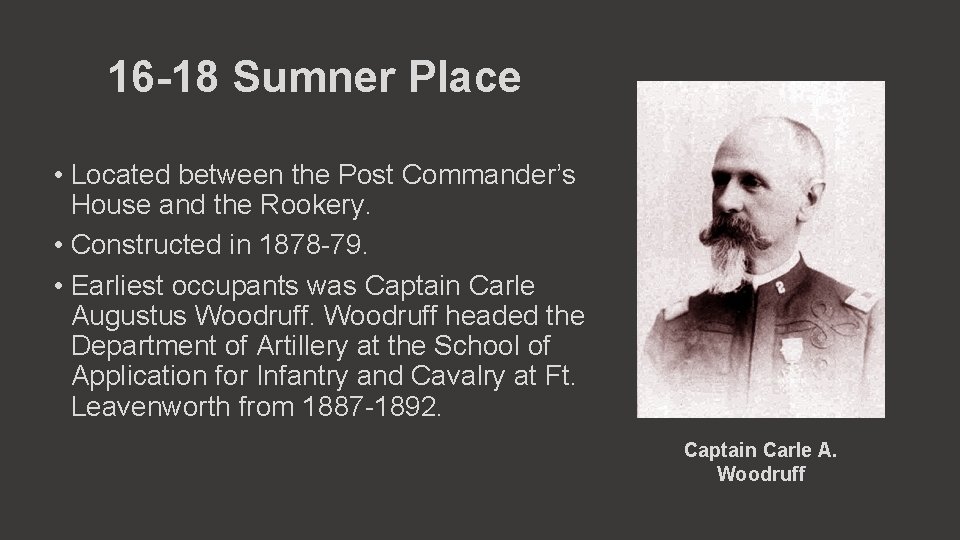
16 -18 Sumner Place • Located between the Post Commander’s House and the Rookery. • Constructed in 1878 -79. • Earliest occupants was Captain Carle Augustus Woodruff headed the Department of Artillery at the School of Application for Infantry and Cavalry at Ft. Leavenworth from 1887 -1892. Captain Carle A. Woodruff
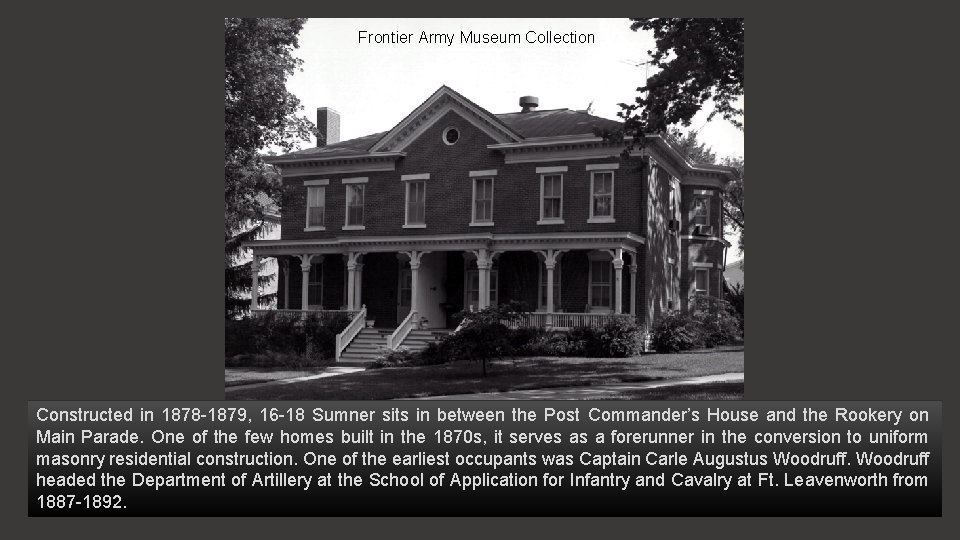
Frontier Army Museum Collection Constructed in 1878 -1879, 16 -18 Sumner sits in between the Post Commander’s House and the Rookery on Main Parade. One of the few homes built in the 1870 s, it serves as a forerunner in the conversion to uniform masonry residential construction. One of the earliest occupants was Captain Carle Augustus Woodruff headed the Department of Artillery at the School of Application for Infantry and Cavalry at Ft. Leavenworth from 1887 -1892.
Haunting: The Lady in Black is said to haunt this house. Described as a middle-aged woman in a woolen skirt she is known to be a helping hand in the house. Stories from previous residents have described a matronly apparition washing their dinner dishes in the kitchen sink. In 1975, the occupants of 18 Sumner were surprised by dinner table discussions of their first grade son. He would relate tales of Jayhawkers, Quantrill’s raid on Lawrence and other Civil War and frontier era tales. One evening the mom asked where he had heard these stories and he replied, “Oh, the nice lady in the black dress reads the stories from her book after I go to bed at night. ” That evening when the mom put her son to bed and went downstairs. After about 15 minutes she went up to her son’s bedroom. A light shone from beneath his door. She entered to find the room quite chilly and the boy in bed covered up to his chin. A rocking chair beside the bed was moving by itself, but no one else was in the room. The little boy began to cry and his mom ran to his side and asked what was wrong. “No!” the boy cried. “She’s gone! She said if my parents ever came she’d go away and never come back. She’s gone and she won’t read to me anymore! You’ve made her go away!” While this apparition housekeeper and nanny loved the little children in this family, she shows hostility toward the children’s babysitters and grandmothers, whom she considered her competition. Sometimes a visiting grandma would be firmly pushed out of the upstairs nursery by unseen hands, or the babysitter would find the children’s beds neatly remade, after she had already turned down the covers for bedtime. While most of the families who lived in this house found their maternal apparition housekeeper amusing, and didn’t mind living with her, one family, was scared of her, and didn’t want this ghostly helper. They asked the chaplain to perform an exorcism. While it successfully got this helpful matron to leave the house, she simply floated into the house next door. However, she never appeared to the family living here, but they did hear her soft footsteps in the attic overhead, and the rattling and turning of doorknobs. Cats and dogs would be chased off the second floor of this house by an unseen presence.
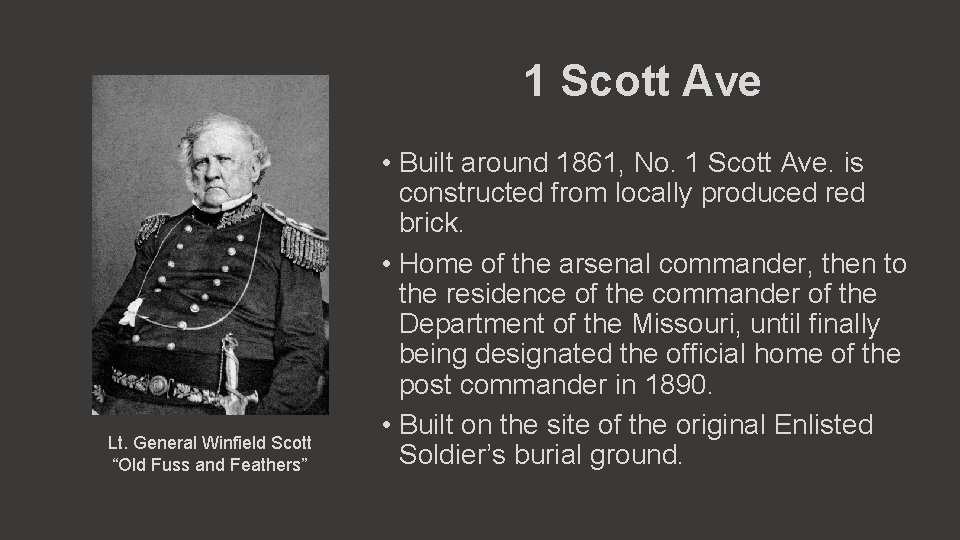
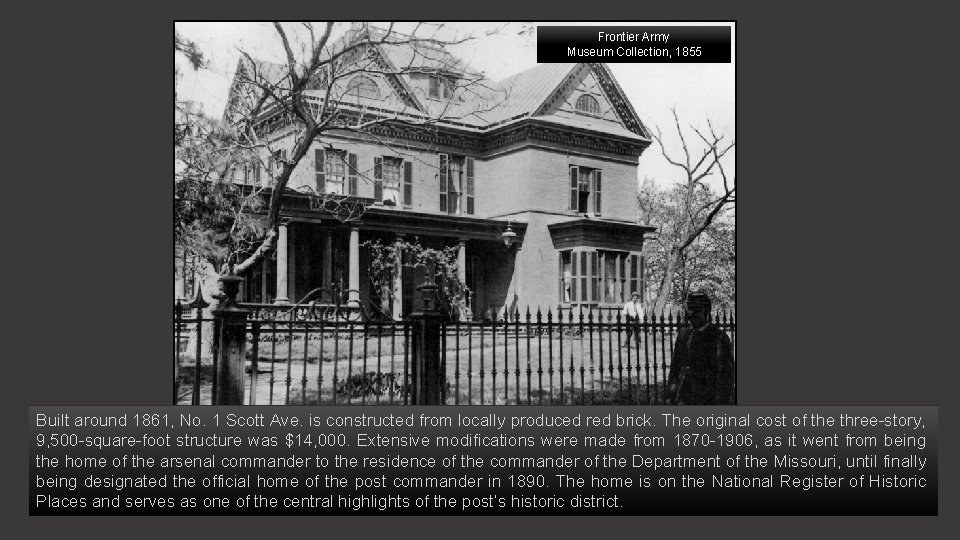
1 Scott Ave Lt. General Winfield Scott “Old Fuss and Feathers” • Built around 1861, No. 1 Scott Ave. is constructed from locally produced red brick. • Home of the arsenal commander, then to the residence of the commander of the Department of the Missouri, until finally being designated the official home of the post commander in 1890. • Built on the site of the original Enlisted Soldier’s burial ground.
Frontier Army Museum Collection, 1855 Built around 1861, No. 1 Scott Ave. is constructed from locally produced red brick. The original cost of the three-story, 9, 500 -square-foot structure was $14, 000. Extensive modifications were made from 1870 -1906, as it went from being the home of the arsenal commander to the residence of the commander of the Department of the Missouri, until finally being designated the official home of the post commander in 1890. The home is on the National Register of Historic Places and serves as one of the central highlights of the post’s historic district.
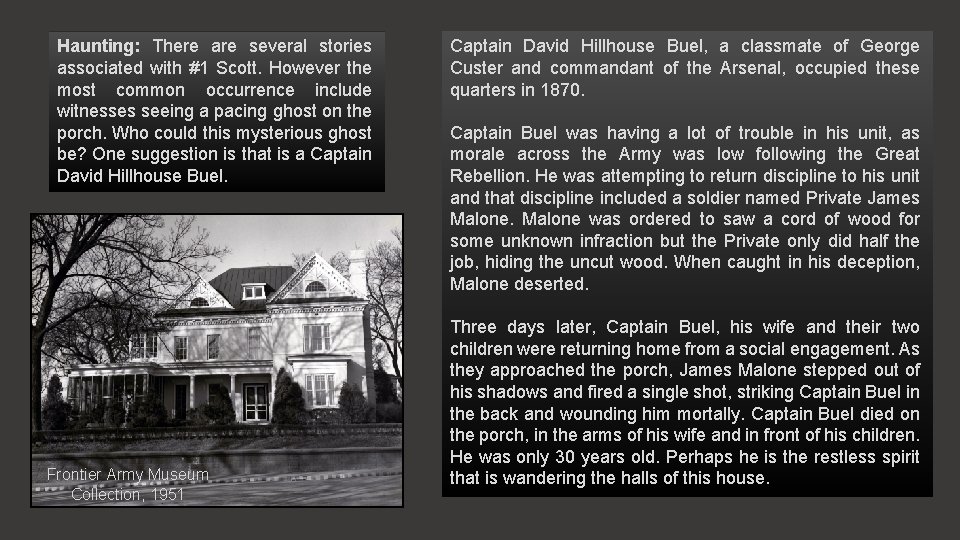
Haunting: There are several stories associated with #1 Scott. However the most common occurrence include witnesses seeing a pacing ghost on the porch. Who could this mysterious ghost be? One suggestion is that is a Captain David Hillhouse Buel. Frontier Army Museum Collection, 1951 Captain David Hillhouse Buel, a classmate of George Custer and commandant of the Arsenal, occupied these quarters in 1870. Captain Buel was having a lot of trouble in his unit, as morale across the Army was low following the Great Rebellion. He was attempting to return discipline to his unit and that discipline included a soldier named Private James Malone was ordered to saw a cord of wood for some unknown infraction but the Private only did half the job, hiding the uncut wood. When caught in his deception, Malone deserted. Three days later, Captain Buel, his wife and their two children were returning home from a social engagement. As they approached the porch, James Malone stepped out of his shadows and fired a single shot, striking Captain Buel in the back and wounding him mortally. Captain Buel died on the porch, in the arms of his wife and in front of his children. He was only 30 years old. Perhaps he is the restless spirit that is wandering the halls of this house.
Another haunting story from #1 Scott Ave: In 1966, the wife of the commanding general at the time was gardening when she came across what she first thought was a large stone. However, when she managed to dig the bulky object out of the ground, she turned it over and was shocked to have a human skull grinning up at her! In a fright about what else might be in her garden, she rushed over to Grant Hall and burst into a high-level meeting her husband was conducting to demand that her husband do something about the body in her garden! #1 Scott Ave was built on the site of the original Enlisted Soldier’s burial ground. The burial ground dated from the founding of the fort in 1827, until it was moved to the site of the present National Cemetery in 1859. Almost immediately, all of the backhoes on post were tearing up the grounds on #1 Scott, moving, if not Heaven, at least Earth in a search for bodies that may have been left behind when the graveyard was moved in 1859. The rest of the skeleton that belonged to the skull was recovered and respectfully transferred to the National Cemetery. However, something is not at rest within the walls of #1 Scott, as over the years there has been many unexplained “bumps in the night” there. A ghost haunting #1 Scott could be anyone of the 70 or so soldiers who were once buried there.
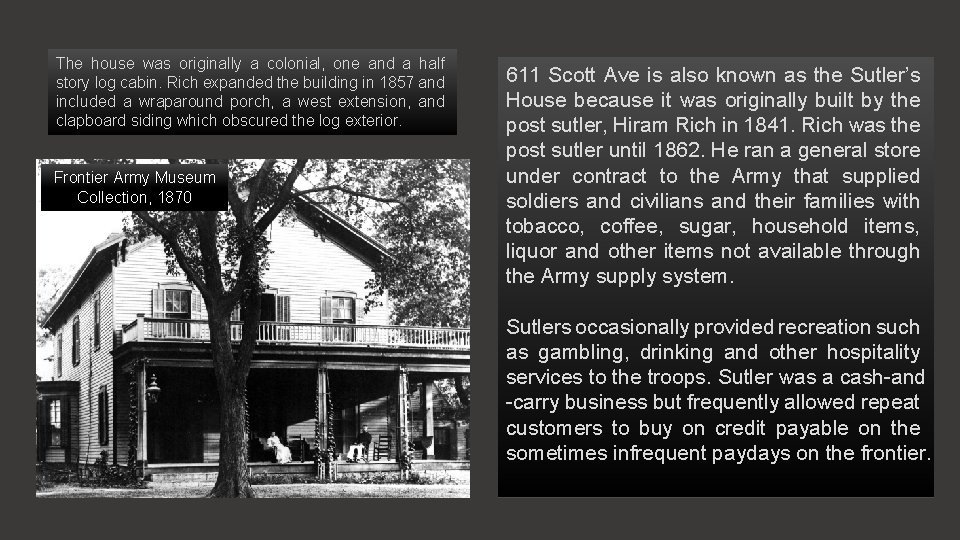
611 Scott Ave Sutler House • Built in 1841 as a log cabin. Was later expanded by Hiram Rich, the post sutler (1841 -1862). • Since 1946, the house has been the exclusive residence of generals and their families. • Notable residents included Generals Winfield Hancock, Philip Sheridan, and John Pope.
The house was originally a colonial, one and a half story log cabin. Rich expanded the building in 1857 and included a wraparound porch, a west extension, and clapboard siding which obscured the log exterior. Frontier Army Museum Collection, 1870 611 Scott Ave is also known as the Sutler’s House because it was originally built by the post sutler, Hiram Rich in 1841. Rich was the post sutler until 1862. He ran a general store under contract to the Army that supplied soldiers and civilians and their families with tobacco, coffee, sugar, household items, liquor and other items not available through the Army supply system. Sutlers occasionally provided recreation such as gambling, drinking and other hospitality services to the troops. Sutler was a cash-and -carry business but frequently allowed repeat customers to buy on credit payable on the sometimes infrequent paydays on the frontier.
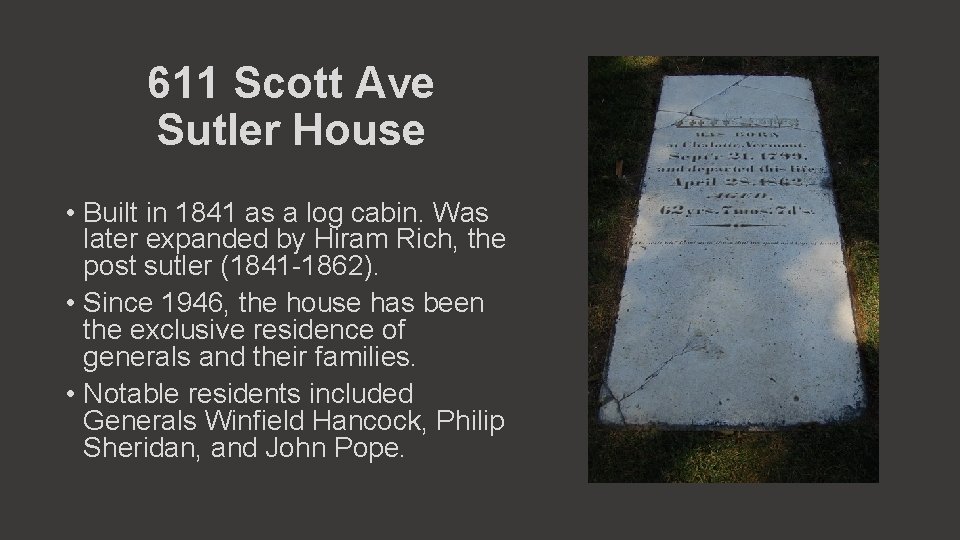
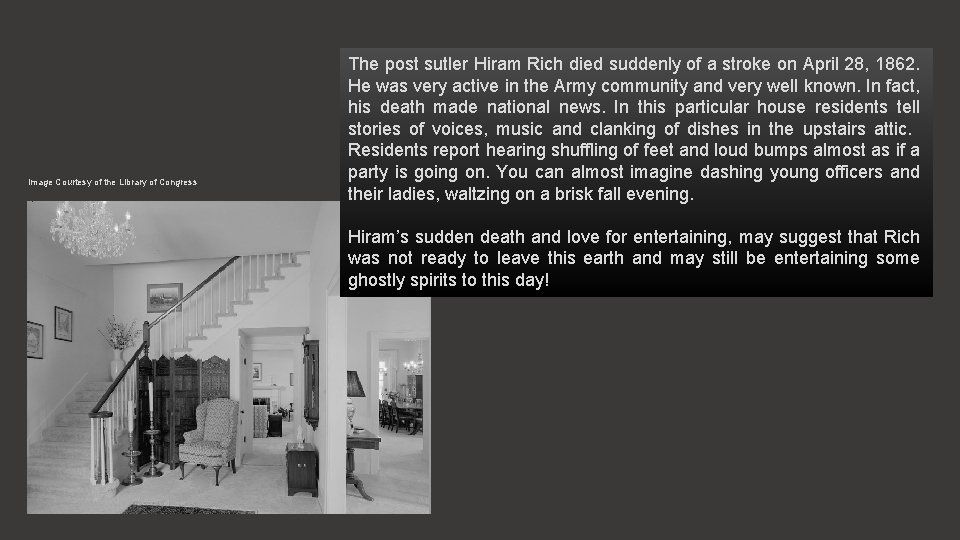
Image Courtesy of the Library of Congress The post sutler Hiram Rich died suddenly of a stroke on April 28, 1862. He was very active in the Army community and very well known. In fact, his death made national news. In this particular house residents tell stories of voices, music and clanking of dishes in the upstairs attic. Residents report hearing shuffling of feet and loud bumps almost as if a party is going on. You can almost imagine dashing young officers and their ladies, waltzing on a brisk fall evening. Hiram’s sudden death and love for entertaining, may suggest that Rich was not ready to leave this earth and may still be entertaining some ghostly spirits to this day!
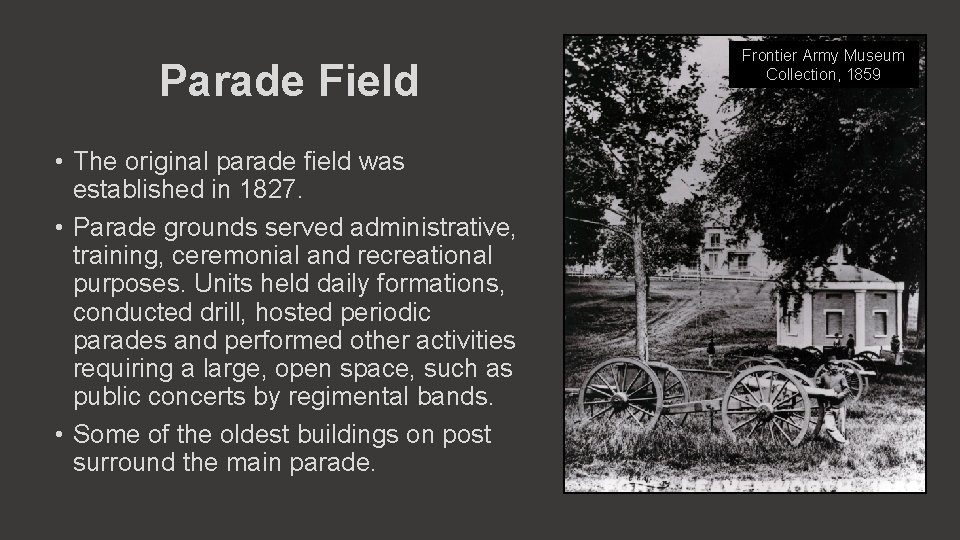
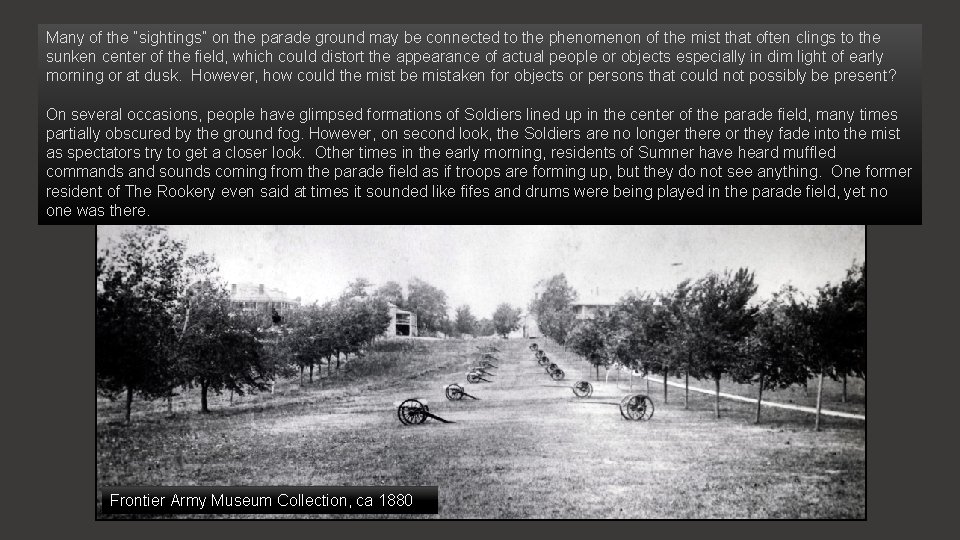
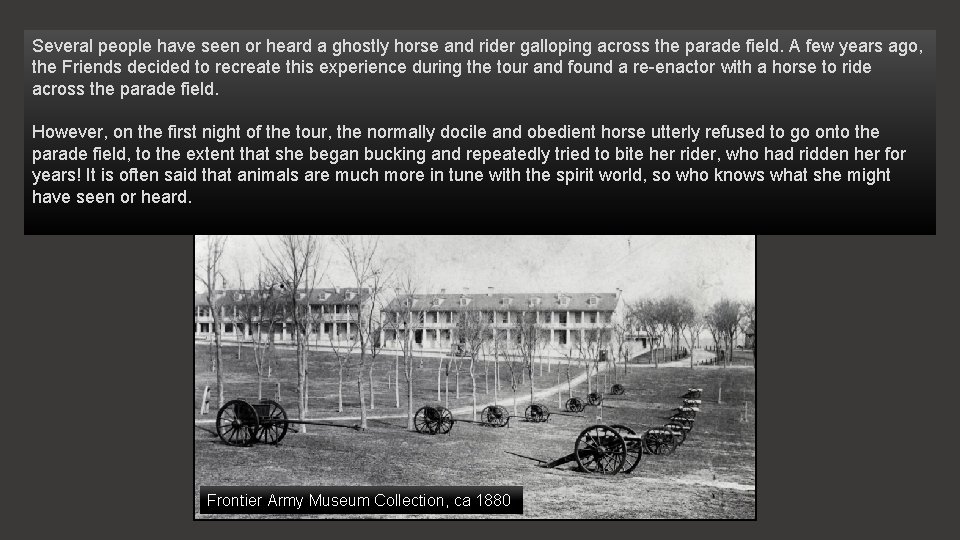
Parade Field • The original parade field was established in 1827. • Parade grounds served administrative, training, ceremonial and recreational purposes. Units held daily formations, conducted drill, hosted periodic parades and performed other activities requiring a large, open space, such as public concerts by regimental bands. • Some of the oldest buildings on post surround the main parade. Frontier Army Museum Collection, 1859
Many of the “sightings” on the parade ground may be connected to the phenomenon of the mist that often clings to the sunken center of the field, which could distort the appearance of actual people or objects especially in dim light of early morning or at dusk. However, how could the mist be mistaken for objects or persons that could not possibly be present? On several occasions, people have glimpsed formations of Soldiers lined up in the center of the parade field, many times partially obscured by the ground fog. However, on second look, the Soldiers are no longer there or they fade into the mist as spectators try to get a closer look. Other times in the early morning, residents of Sumner have heard muffled commands and sounds coming from the parade field as if troops are forming up, but they do not see anything. One former resident of The Rookery even said at times it sounded like fifes and drums were being played in the parade field, yet no one was there. Frontier Army Museum Collection, ca 1880
Several people have seen or heard a ghostly horse and rider galloping across the parade field. A few years ago, the Friends decided to recreate this experience during the tour and found a re-enactor with a horse to ride across the parade field. However, on the first night of the tour, the normally docile and obedient horse utterly refused to go onto the parade field, to the extent that she began bucking and repeatedly tried to bite her rider, who had ridden her for years! It is often said that animals are much more in tune with the spirit world, so who knows what she might have seen or heard. Frontier Army Museum Collection, ca 1880
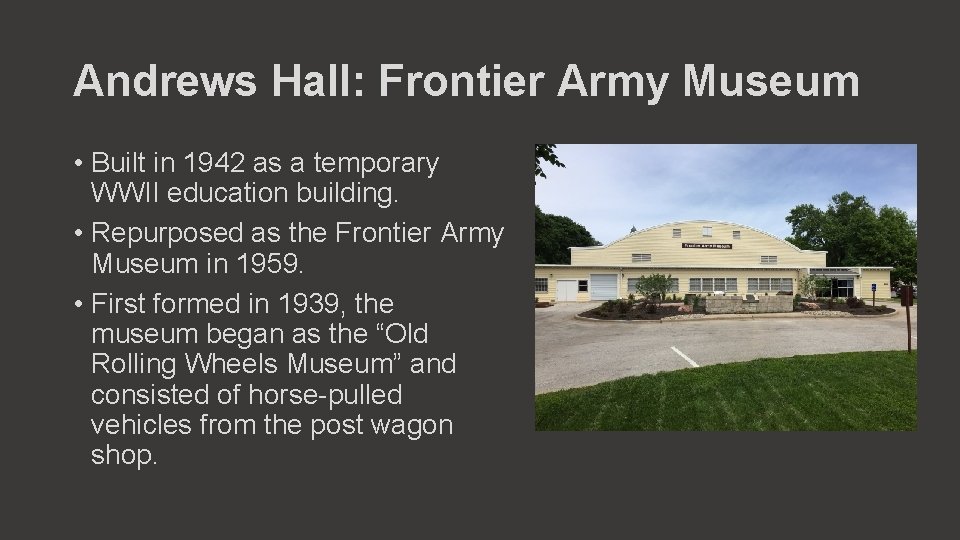
Andrews Hall: Frontier Army Museum • Built in 1942 as a temporary WWII education building. • Repurposed as the Frontier Army Museum in 1959. • First formed in 1939, the museum began as the “Old Rolling Wheels Museum” and consisted of horse-pulled vehicles from the post wagon shop.
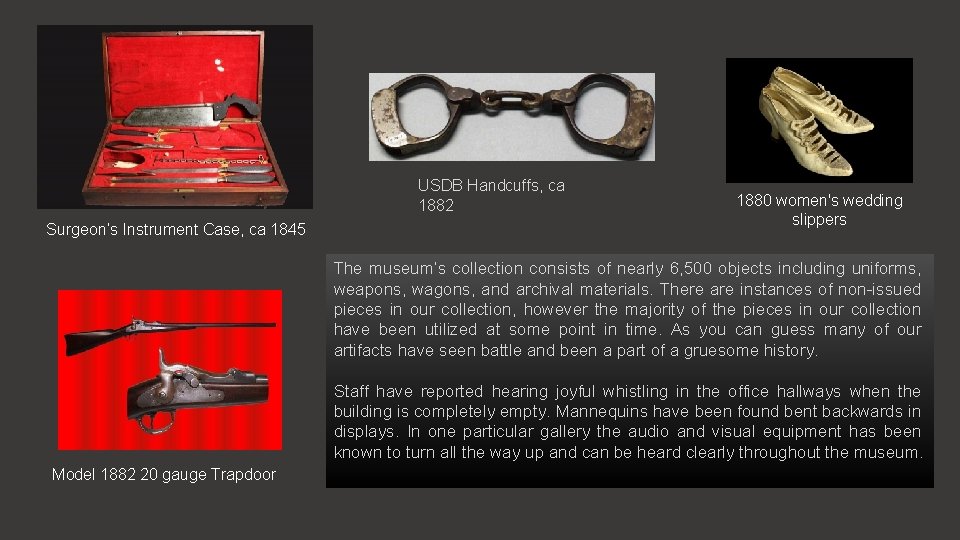
USDB Handcuffs, ca 1882 Surgeon’s Instrument Case, ca 1845 1880 women's wedding slippers The museum’s collection consists of nearly 6, 500 objects including uniforms, weapons, wagons, and archival materials. There are instances of non-issued pieces in our collection, however the majority of the pieces in our collection have been utilized at some point in time. As you can guess many of our artifacts have seen battle and been a part of a gruesome history. Staff have reported hearing joyful whistling in the office hallways when the building is completely empty. Mannequins have been found bent backwards in displays. In one particular gallery the audio and visual equipment has been known to turn all the way up and can be heard clearly throughout the museum. Model 1882 20 gauge Trapdoor
Frontier Army Museum Collections, ca 1870 Ghost stories inspired from The Haunted Houses of Fort Leavenworth by John Reichley (Available for purchase in the museum’s giftshop) Antidotal stories collected by The Friends of the Frontier Army (FFAM) Webpage: https: //www. ffam. us/ Facebook: https: //www. facebook. com/ftleavenworthffam