
Hashing Log 10100 is a big number l
Hashing: Log (10100) is a big number l Comparison based searches are too slow for lots of data Ø How many comparisons needed for a billion elements? Ø What if one billion web-pages indexed? l Hashing is a search method: average case O(1) search Ø Worst case is very bad, but in practice hashing is good Ø Associate a number with every key, use the number to store the key • Like catalog in library, given book title, find the book l A hash function generates the number from the key Ø Goal: Efficient to calculate Ø Goal: Distributes keys evenly in hash table Comp. Sci 100 e 5. 1
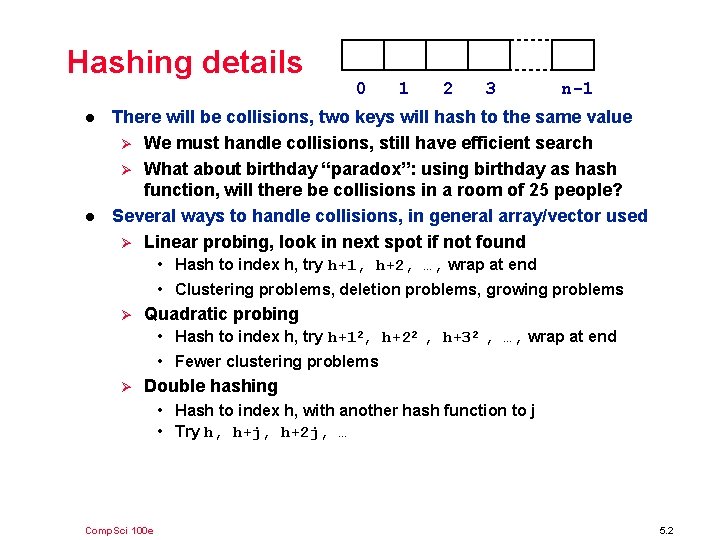
Hashing details l l 0 1 2 3 n-1 There will be collisions, two keys will hash to the same value Ø We must handle collisions, still have efficient search Ø What about birthday “paradox”: using birthday as hash function, will there be collisions in a room of 25 people? Several ways to handle collisions, in general array/vector used Ø Linear probing, look in next spot if not found • Hash to index h, try h+1, h+2, …, wrap at end • Clustering problems, deletion problems, growing problems Ø Quadratic probing • Hash to index h, try h+12, h+22 , h+32 , …, wrap at end • Fewer clustering problems Ø Double hashing • Hash to index h, with another hash function to j • Try h, h+j, h+2 j, … Comp. Sci 100 e 5. 2
Chaining with hashing l With n buckets each bucket stores linked list Ø Compute hash value h, look up key in linked list table[h] Ø Hopefully linked lists are short, searching is fast Ø Unsuccessful searches often faster than successful • Empty linked lists searched more quickly than non-empty Ø l Potential problems? Hash table details Ø Size of hash table should be a prime number Ø Keep load factor small: number of keys/size of table Ø On average, with reasonable load factor, search is O(1) Ø What if load factor gets too high? Rehash or other method Comp. Sci 100 e 5. 3
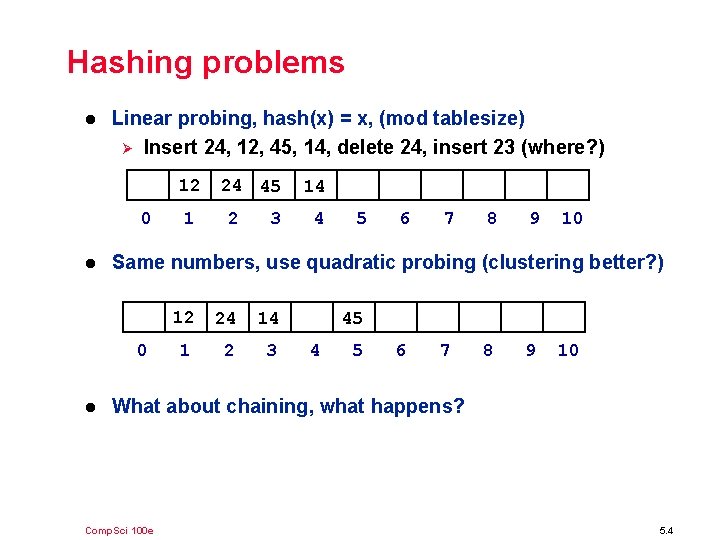
Hashing problems l Linear probing, hash(x) = x, (mod tablesize) Ø Insert 24, 12, 45, 14, delete 24, insert 23 (where? ) 12 0 l 2 3 14 4 5 6 7 8 9 10 Same numbers, use quadratic probing (clustering better? ) 0 l 1 24 45 12 24 14 1 2 3 45 4 5 6 7 8 9 10 What about chaining, what happens? Comp. Sci 100 e 5. 4
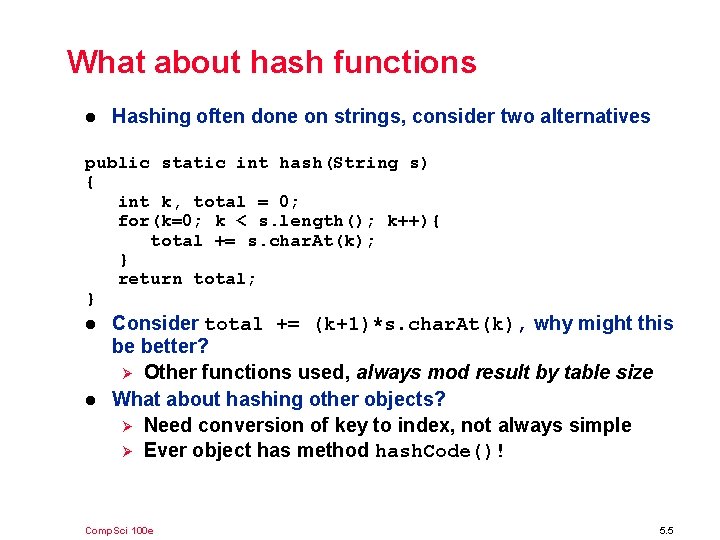
What about hash functions l Hashing often done on strings, consider two alternatives public static int hash(String s) { int k, total = 0; for(k=0; k < s. length(); k++){ total += s. char. At(k); } return total; } l l Consider total += (k+1)*s. char. At(k), why might this be better? Ø Other functions used, always mod result by table size What about hashing other objects? Ø Need conversion of key to index, not always simple Ø Ever object has method hash. Code()! Comp. Sci 100 e 5. 5
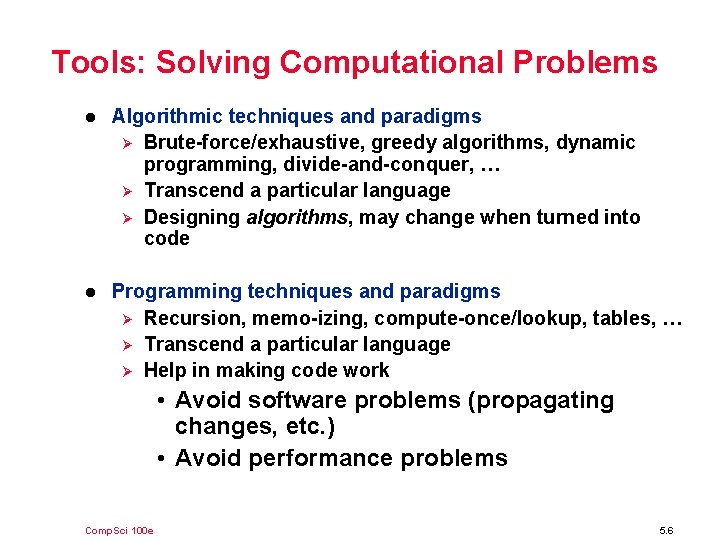
Tools: Solving Computational Problems l Algorithmic techniques and paradigms Ø Brute-force/exhaustive, greedy algorithms, dynamic programming, divide-and-conquer, … Ø Transcend a particular language Ø Designing algorithms, may change when turned into code l Programming techniques and paradigms Ø Recursion, memo-izing, compute-once/lookup, tables, … Ø Transcend a particular language Ø Help in making code work • Avoid software problems (propagating changes, etc. ) • Avoid performance problems Comp. Sci 100 e 5. 6
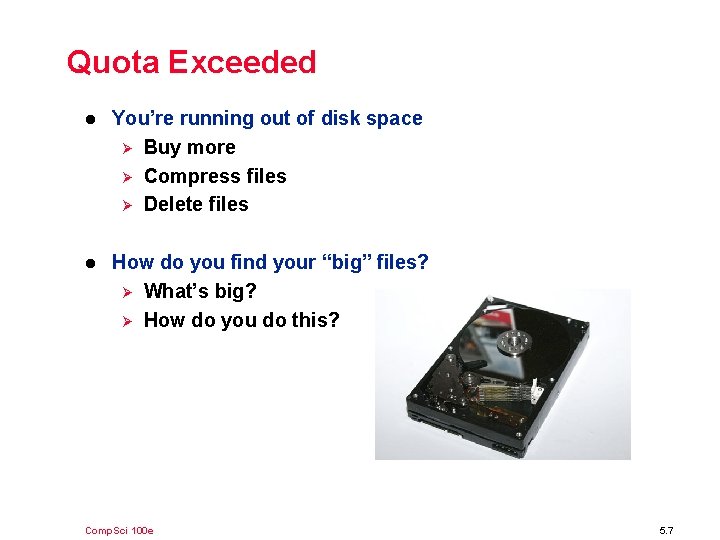
Quota Exceeded l You’re running out of disk space Ø Buy more Ø Compress files Ø Delete files l How do you find your “big” files? Ø What’s big? Ø How do you do this? Comp. Sci 100 e 5. 7
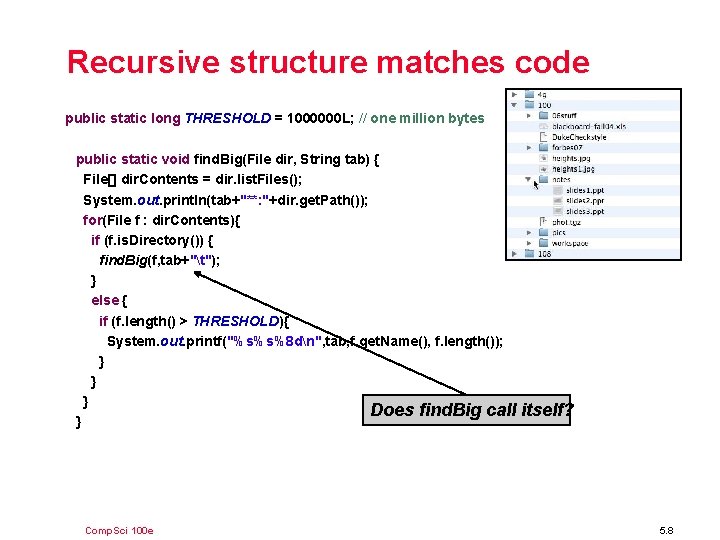
Recursive structure matches code public static long THRESHOLD = 1000000 L; // one million bytes public static void find. Big(File dir, String tab) { File[] dir. Contents = dir. list. Files(); System. out. println(tab+"**: "+dir. get. Path()); for(File f : dir. Contents){ if (f. is. Directory()) { find. Big(f, tab+"t"); } else { if (f. length() > THRESHOLD){ System. out. printf("%s%s%8 dn", tab, f. get. Name(), f. length()); } } } Does find. Big call } Comp. Sci 100 e itself? 5. 8
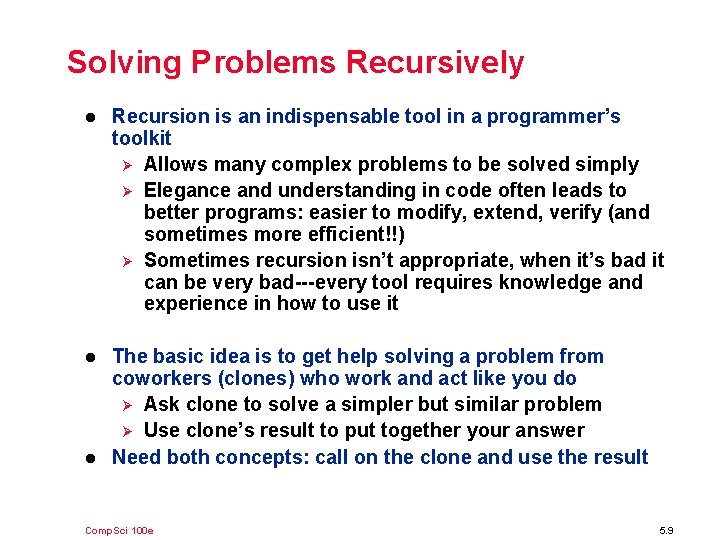
Solving Problems Recursively l Recursion is an indispensable tool in a programmer’s toolkit Ø Allows many complex problems to be solved simply Ø Elegance and understanding in code often leads to better programs: easier to modify, extend, verify (and sometimes more efficient!!) Ø Sometimes recursion isn’t appropriate, when it’s bad it can be very bad---every tool requires knowledge and experience in how to use it l The basic idea is to get help solving a problem from coworkers (clones) who work and act like you do Ø Ask clone to solve a simpler but similar problem Ø Use clone’s result to put together your answer Need both concepts: call on the clone and use the result l Comp. Sci 100 e 5. 9
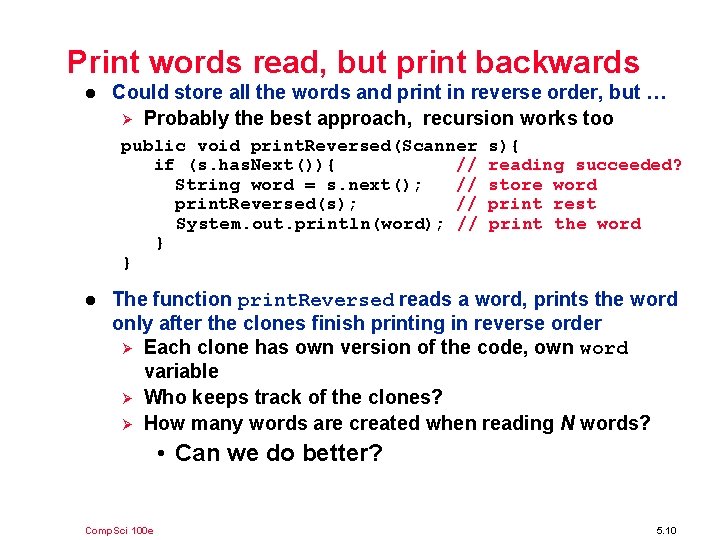
Print words read, but print backwards l Could store all the words and print in reverse order, but … Ø Probably the best approach, recursion works too public void print. Reversed(Scanner if (s. has. Next()){ // String word = s. next(); // print. Reversed(s); // System. out. println(word); // } } l s){ reading succeeded? store word print rest print the word The function print. Reversed reads a word, prints the word only after the clones finish printing in reverse order Ø Each clone has own version of the code, own word variable Ø Who keeps track of the clones? Ø How many words are created when reading N words? • Can we do better? Comp. Sci 100 e 5. 10
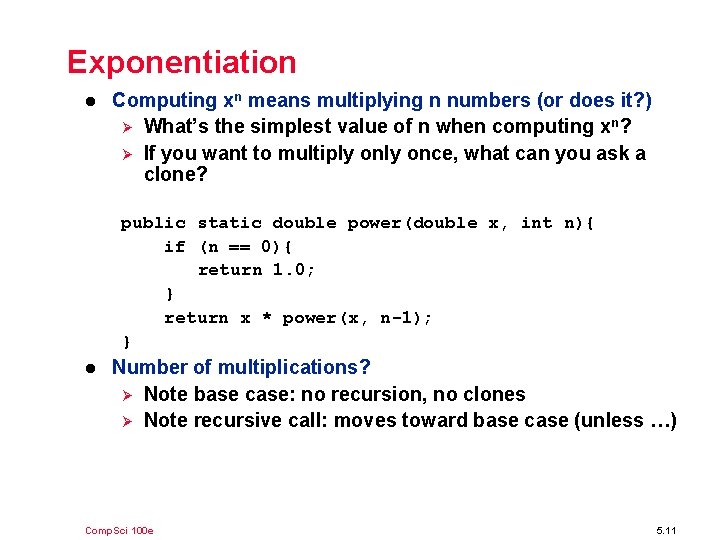
Exponentiation l Computing xn means multiplying n numbers (or does it? ) Ø What’s the simplest value of n when computing x n? Ø If you want to multiply once, what can you ask a clone? public static double power(double x, int n){ if (n == 0){ return 1. 0; } return x * power(x, n-1); } l Number of multiplications? Ø Note base case: no recursion, no clones Ø Note recursive call: moves toward base case (unless …) Comp. Sci 100 e 5. 11
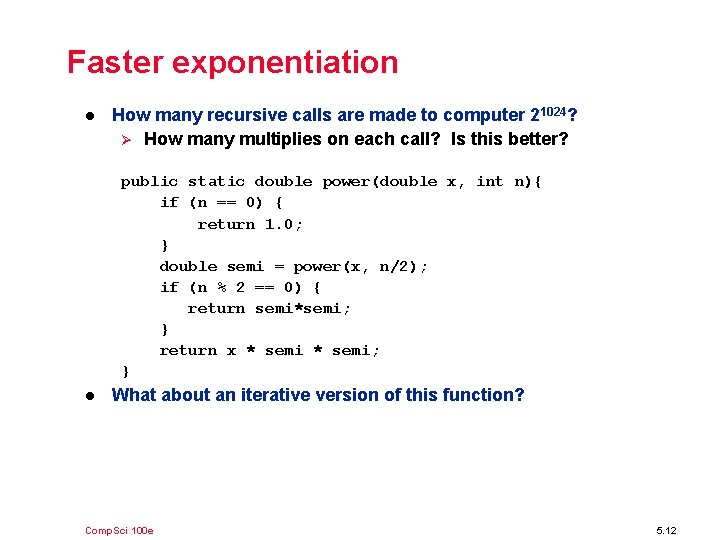
Faster exponentiation l How many recursive calls are made to computer 21024? Ø How many multiplies on each call? Is this better? public static double power(double x, int n){ if (n == 0) { return 1. 0; } double semi = power(x, n/2); if (n % 2 == 0) { return semi*semi; } return x * semi; } l What about an iterative version of this function? Comp. Sci 100 e 5. 12
Back to Recursion l Recursive functions have two key attributes Ø There is a base case, sometimes called the exit case, which does not make a recursive call • See print reversed, exponentiation Ø All other cases make a recursive call, with some parameter or other measure that decreases or moves towards the base case • Ensure that sequence of calls eventually reaches the base case • “Measure” can be tricky, but usually it’s straightforward l Example: finding large files in a directory (on a hard disk) Ø Why is this inherently recursive? Ø How is this different from exponentation? Comp. Sci 100 e 5. 13
![Recognizing recursion: public static void change(String[] a, int first, int last){ if (first <](http://slidetodoc.com/presentation_image_h2/0f818f227f4bfa4542c79ce44fdb0f99/image-14.jpg "Recognizing recursion: public static void change(String[] a, int first, int last){ if (first <")
Recognizing recursion: public static void change(String[] a, int first, int last){ if (first < last) { String temp = a[first]; // swap a[first], a[last] a[first] = a[last]; a[last] = temp; change(a, first+1, last-1); } } // original call (why? ): change(a, 0, a. length-1); l l l What is base case? (no recursive calls) What happens before recursive call made? How is recursive call closer to the base case? Recursive methods sometimes use extra parameters; helper methods set this up Comp. Sci 100 e 5. 14
The Power of Recursion: Brute force l Consider the Typing. Job APT problemn: What is minimum number of minutes needed to type n term papers given page counts and three typists typing one page/minute? (assign papers to typists to minimize minutes to completion) Ø Example: {3, 3, 3 , 5 , 9 , 10} as page counts l How can we solve this in general? Suppose we're told that there are no more than 10 papers on a given day. Ø How does this constraint help us? Ø What is complexity of using brute-force? Comp. Sci 100 e 5. 15
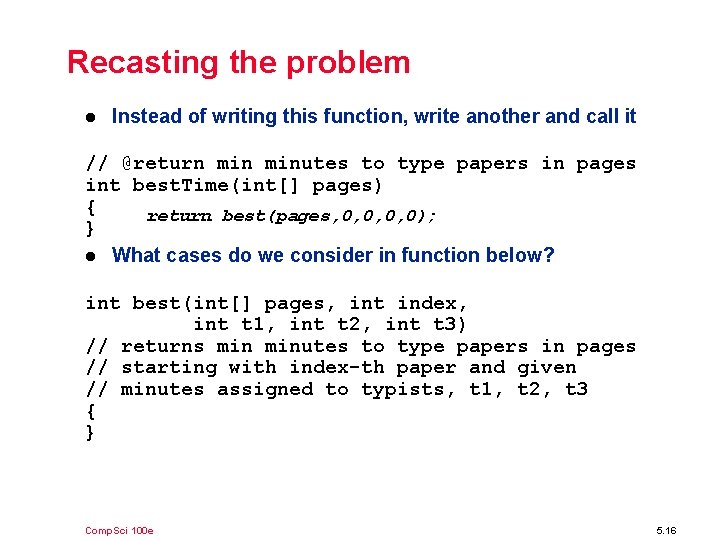
Recasting the problem l Instead of writing this function, write another and call it // @return minutes to type papers in pages int best. Time(int[] pages) { return best(pages, 0, 0); } l What cases do we consider in function below? int best(int[] pages, int index, int t 1, int t 2, int t 3) // returns minutes to type papers in pages // starting with index-th paper and given // minutes assigned to typists, t 1, t 2, t 3 { } Comp. Sci 100 e 5. 16
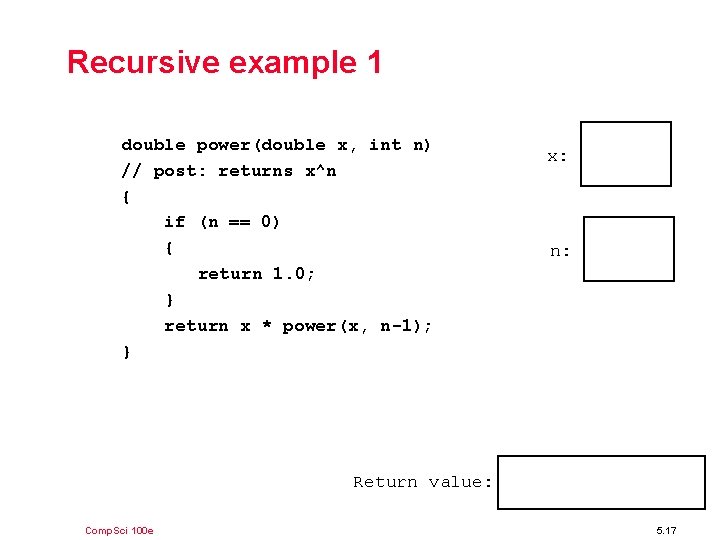
Recursive example 1 double power(double x, int n) // post: returns x^n { if (n == 0) { return 1. 0; } return x * power(x, n-1); } x: n: Return value: Comp. Sci 100 e 5. 17
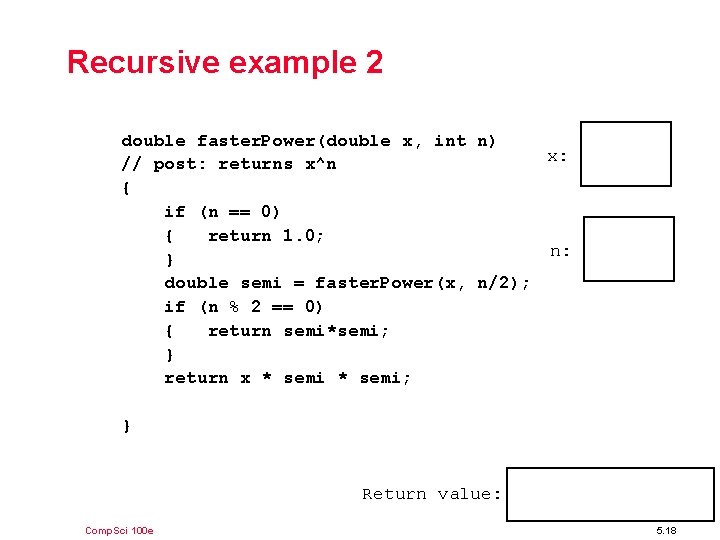
Recursive example 2 double faster. Power(double x, int n) x: // post: returns x^n { if (n == 0) { return 1. 0; n: } double semi = faster. Power(x, n/2); if (n % 2 == 0) { return semi*semi; } return x * semi; } Return value: Comp. Sci 100 e 5. 18
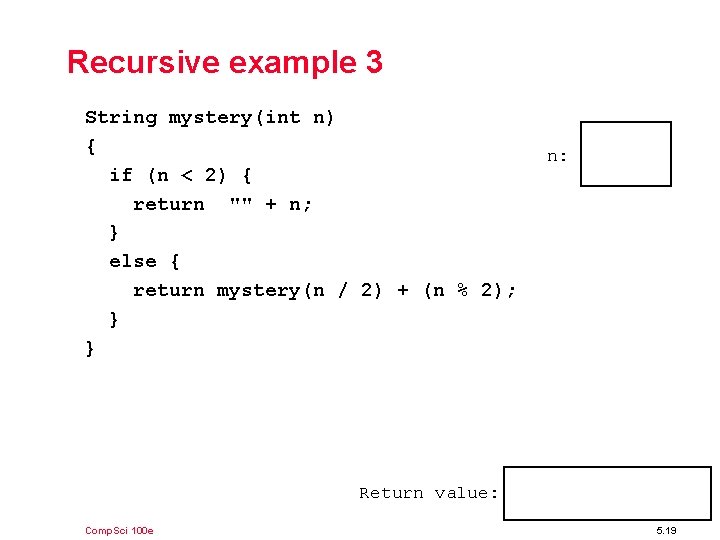
Recursive example 3 String mystery(int n) { if (n < 2) { return "" + n; } else { return mystery(n / 2) + (n % 2); } } n: Return value: Comp. Sci 100 e 5. 19
- Slides: 19