
Hash Tables Sets and Dictionaries Hashing and Collisions

Hash Tables, Sets and Dictionaries Hashing and Collisions Hash Tables Soft. Uni Team Technical Trainers Software University http: //softuni. bg 0 1 null 2 … m-1 Pesho … Lili
Table of Contents 2

Have a Question? sli. do #Ds. Algo 3
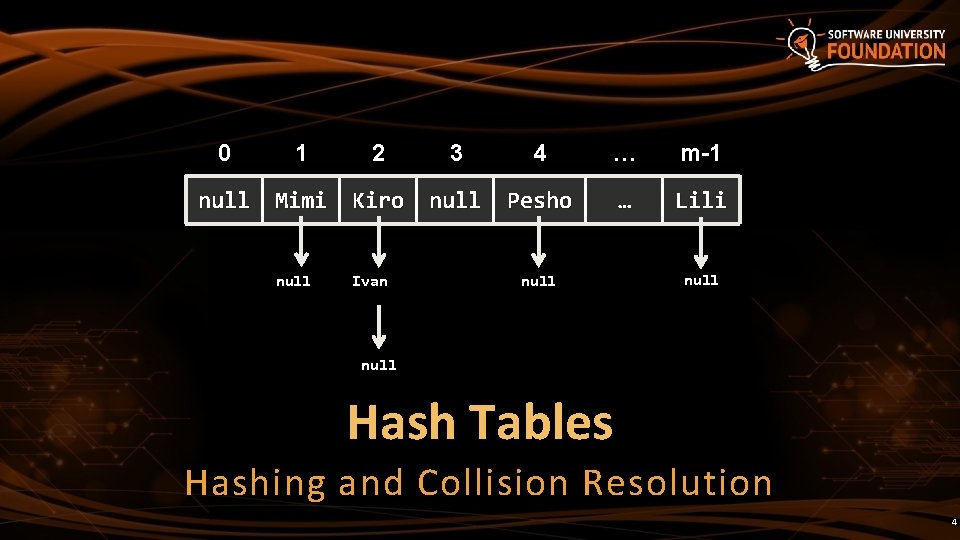
0 1 2 3 null Mimi Kiro null Ivan 4 … m-1 Pesho … Lili null Hash Tables Hashing and Collision Resolution 4
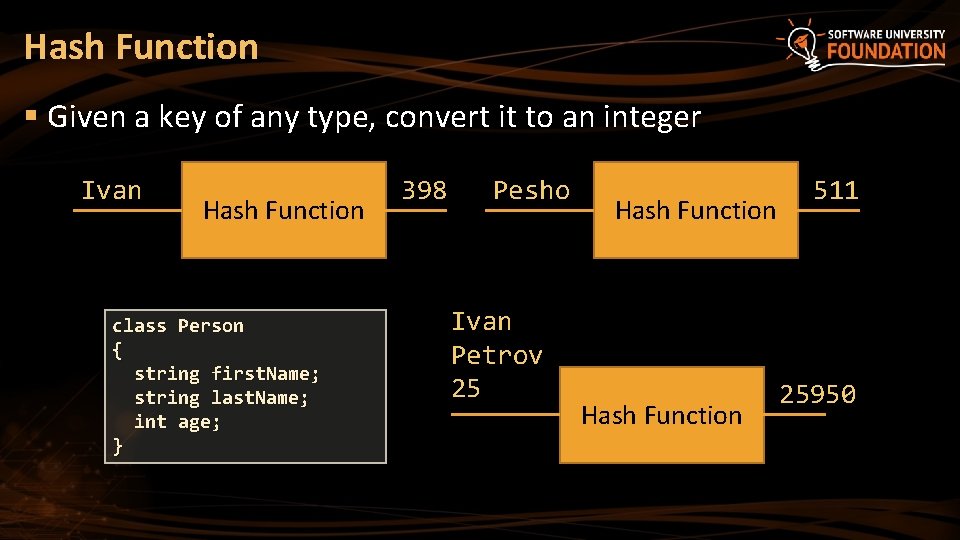
Hash Function § Given a key of any type, convert it to an integer Ivan Hash Function class Person { string first. Name; string last. Name; int age; } 398 Pesho Ivan Petrov 25 Hash Function 511 25950
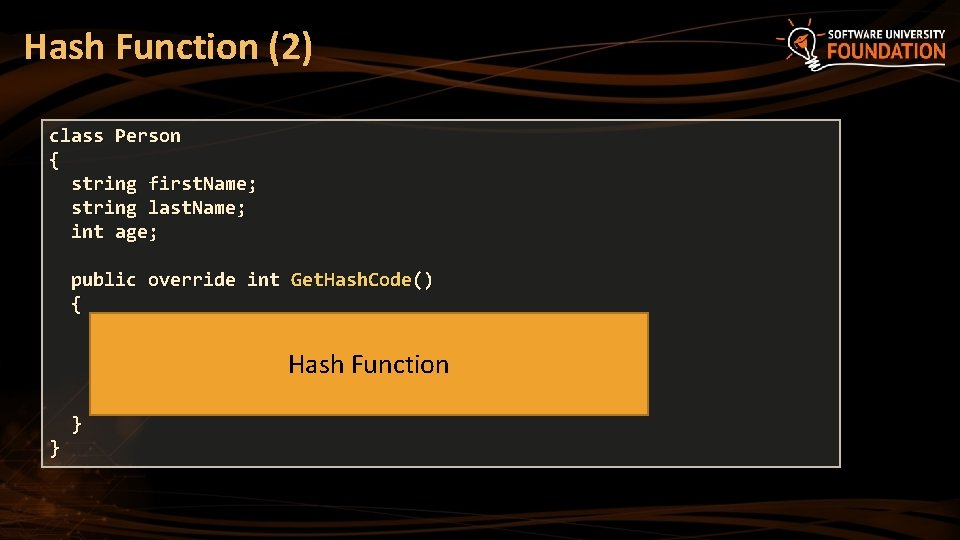
Hash Function (2) class Person { string first. Name; string last. Name; int age; public override int Get. Hash. Code() { int first. Name. Hash = first. Name. Get. Hash. Code() * age; int last. Name. Hash = last. Name. Get. Hash. Code() * age; Hash Function } } return first. Name. Hash + last. Name. Hash;
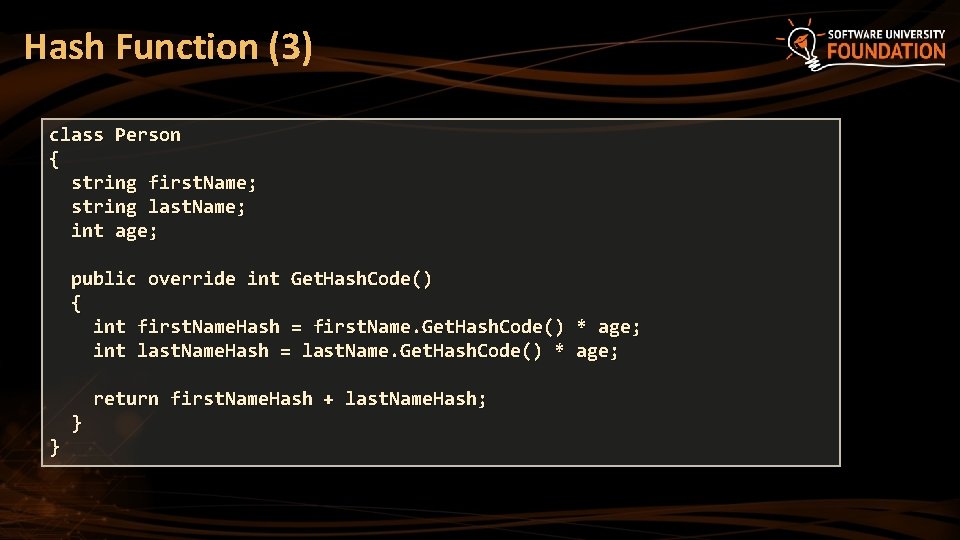
Hash Function (3) class Person { string first. Name; string last. Name; int age; public override int Get. Hash. Code() { int first. Name. Hash = first. Name. Get. Hash. Code() * age; int last. Name. Hash = last. Name. Get. Hash. Code() * age; } } return first. Name. Hash + last. Name. Hash;
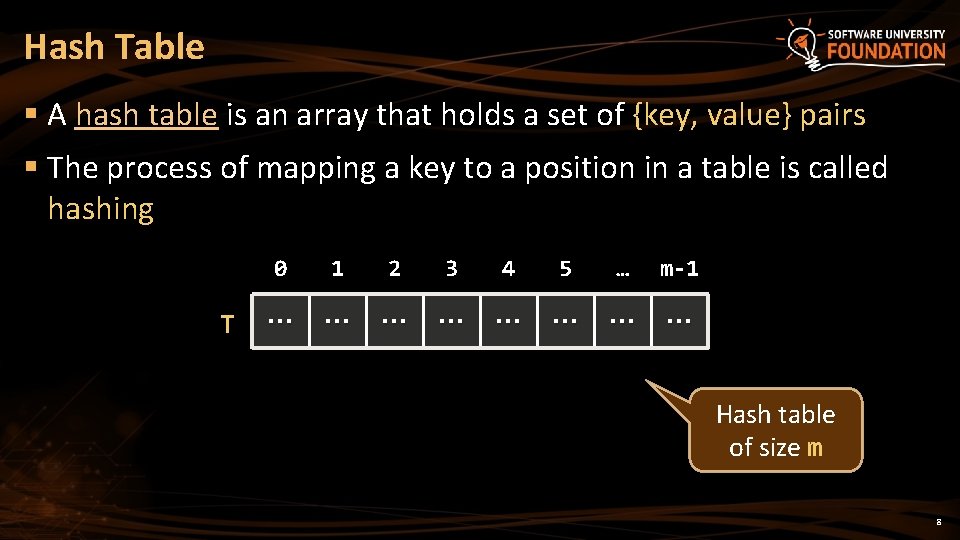
Hash Table § A hash table is an array that holds a set of {key, value} pairs § The process of mapping a key to a position in a table is called hashing 0 T 1 2 3 4 5 … m-1 … … … … Hash table of size m 8
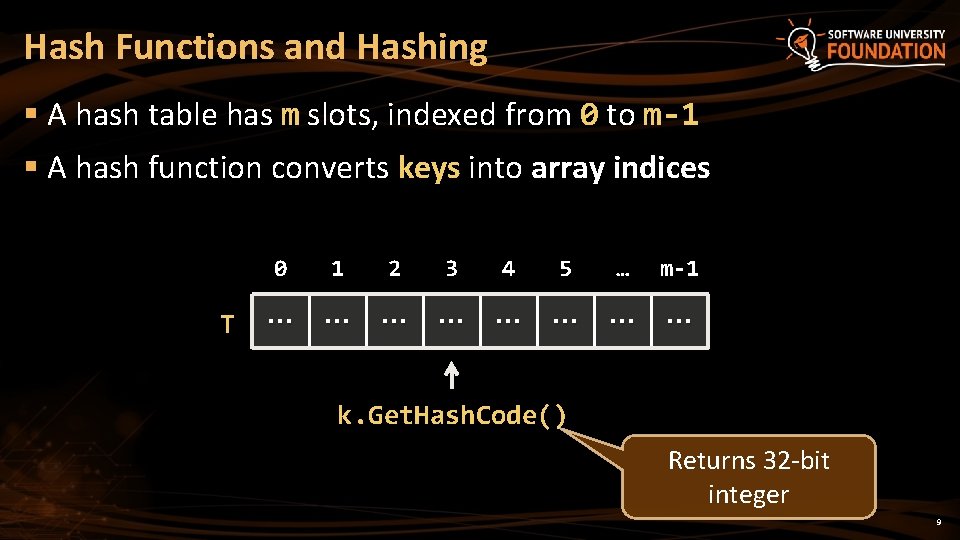
Hash Functions and Hashing § A hash table has m slots, indexed from 0 to m-1 § A hash function converts keys into array indices 0 T 1 2 3 4 5 … m-1 … … … … k. Get. Hash. Code() Returns 32 -bit integer 9
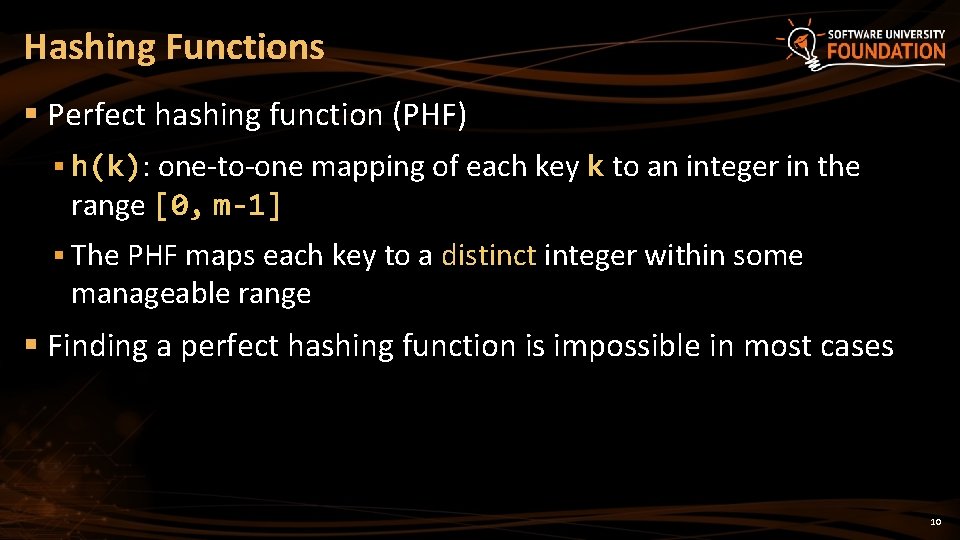
Hashing Functions § Perfect hashing function (PHF) § h(k): one-to-one mapping of each key k to an integer in the range [0, m-1] § The PHF maps each key to a distinct integer within some manageable range § Finding a perfect hashing function is impossible in most cases 10
Hashing Functions (2) § Good hashing function § Consistent - equal keys must produce the same hash value § Efficient - efficient to compute the hash § Uniform - should uniformly distribute the keys 11
Hash Functions - Quiz TIME’S UP! TIME: § Which of the following is not property of a Get. Hash. Code() for strings § Can return a negative integer § Can take time proportional to the length of the string to compute § A string and its reverse will have the same hash code § Two strings with different hash code values are different strings 12
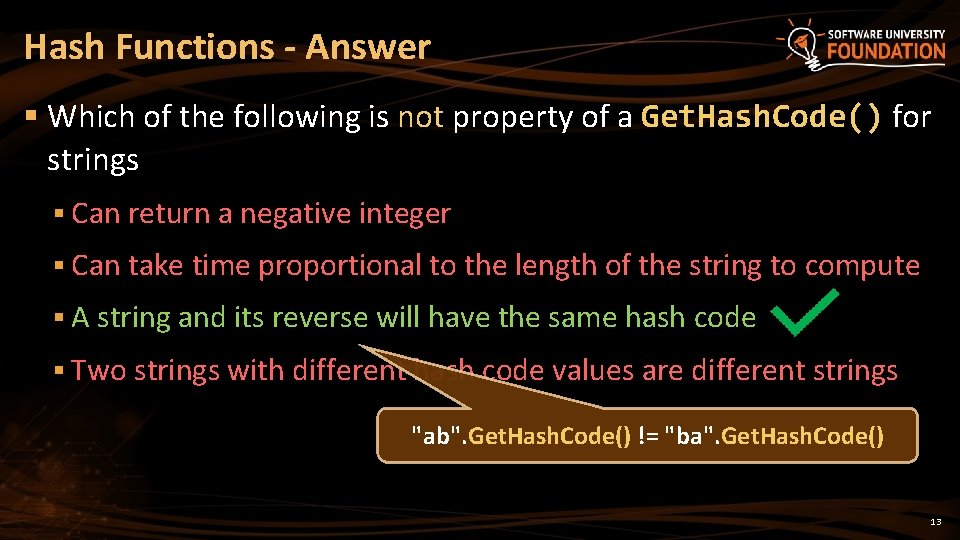
Hash Functions - Answer § Which of the following is not property of a Get. Hash. Code() for strings § Can return a negative integer § Can take time proportional to the length of the string to compute § A string and its reverse will have the same hash code § Two strings with different hash code values are different strings "ab". Get. Hash. Code() != "ba". Get. Hash. Code() 13
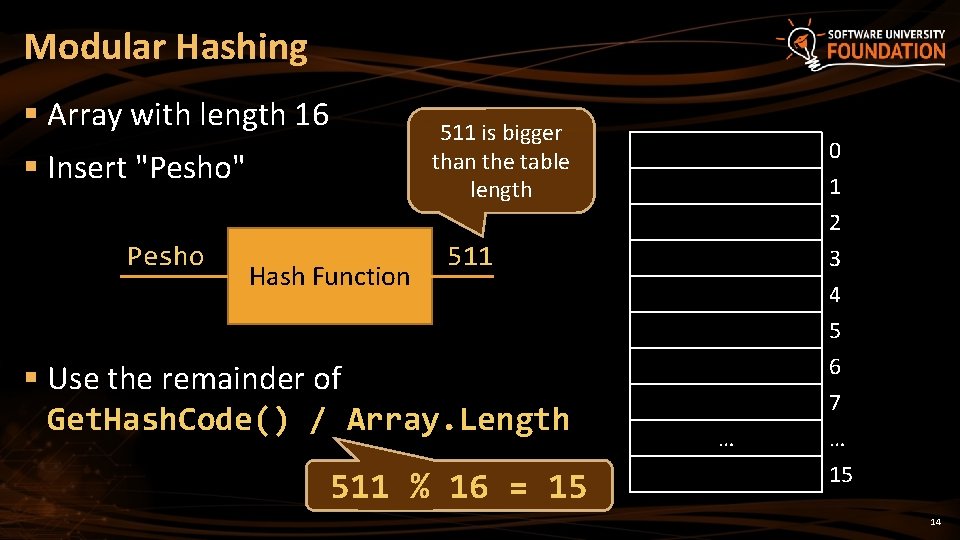
Modular Hashing § Array with length 16 511 is bigger than the table length § Insert "Pesho" Pesho Hash Function 0 1 2 3 511 § Use the remainder of Get. Hash. Code() / Array. Length 511 % 16 = 15 … 4 5 6 7 … 15 14
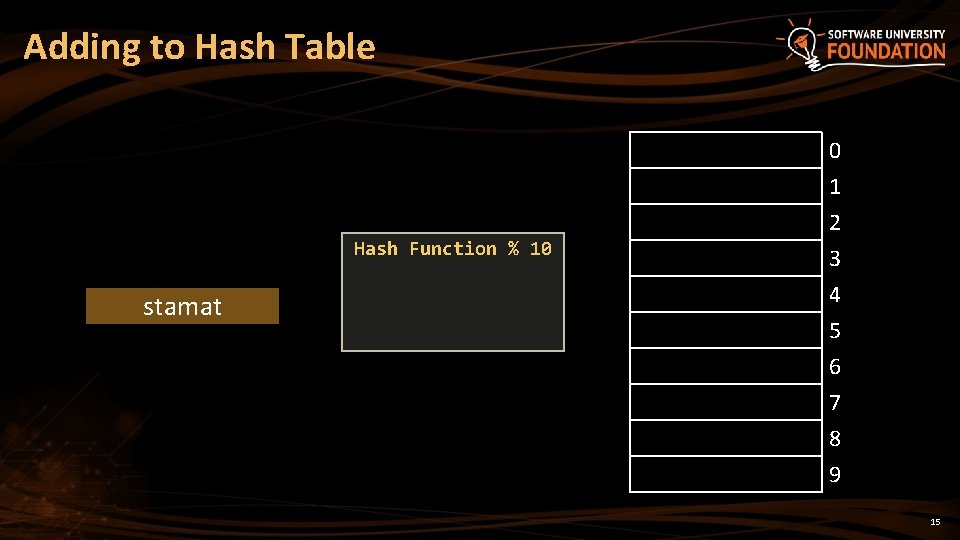
Adding to Hash Table Hash Function % 10 stamat 0 1 2 3 4 5 6 7 8 9 15
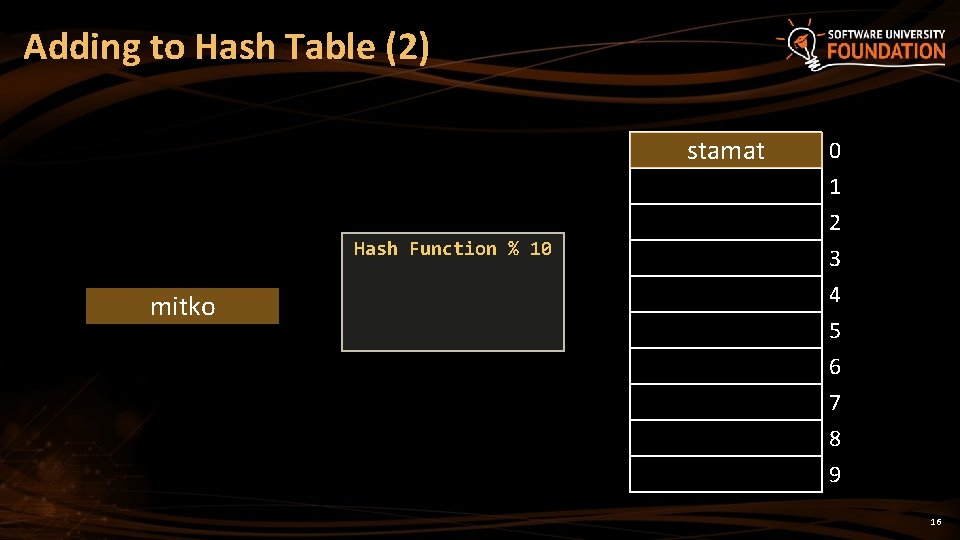
Adding to Hash Table (2) stamat Hash Function % 10 mitko 0 1 2 3 4 5 6 7 8 9 16
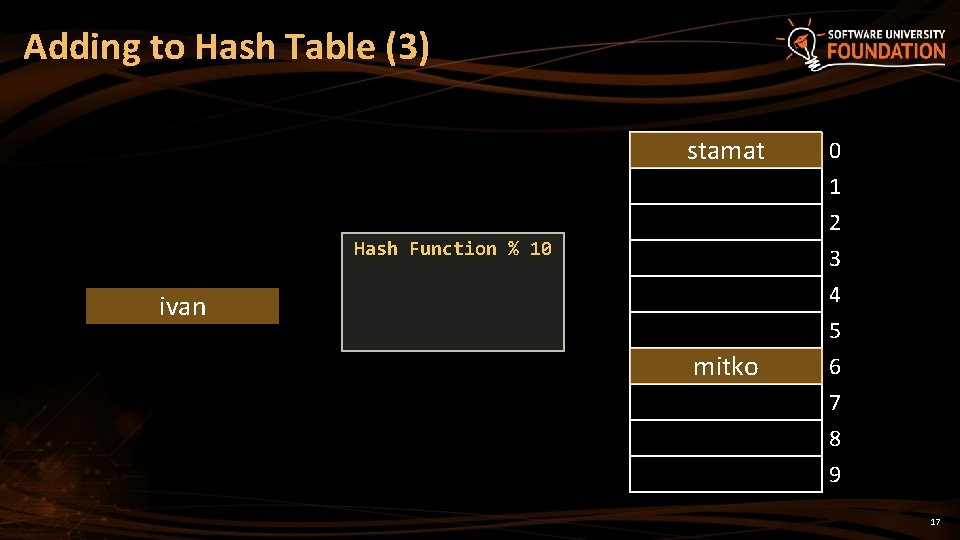
Adding to Hash Table (3) stamat Hash Function % 10 ivan mitko 0 1 2 3 4 5 6 7 8 9 17
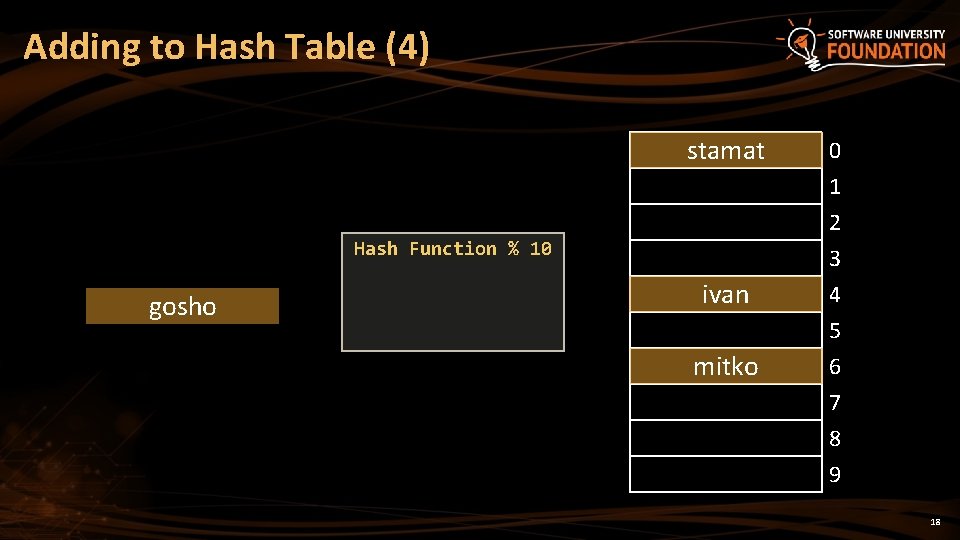
Adding to Hash Table (4) stamat 0 1 2 3 ivan 4 5 6 7 8 9 Hash Function % 10 gosho mitko 18
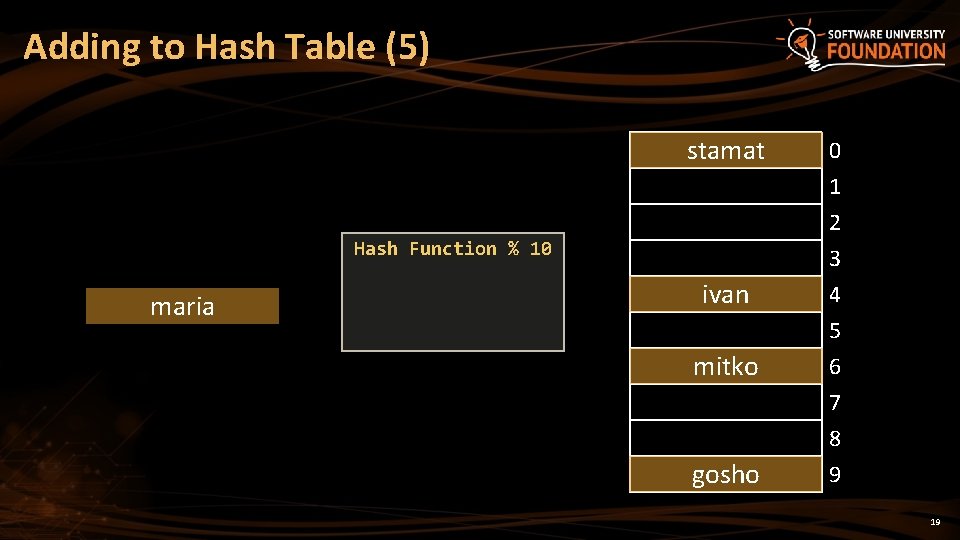
Adding to Hash Table (5) stamat 0 1 2 3 ivan 4 5 6 7 8 9 Hash Function % 10 maria mitko gosho 19
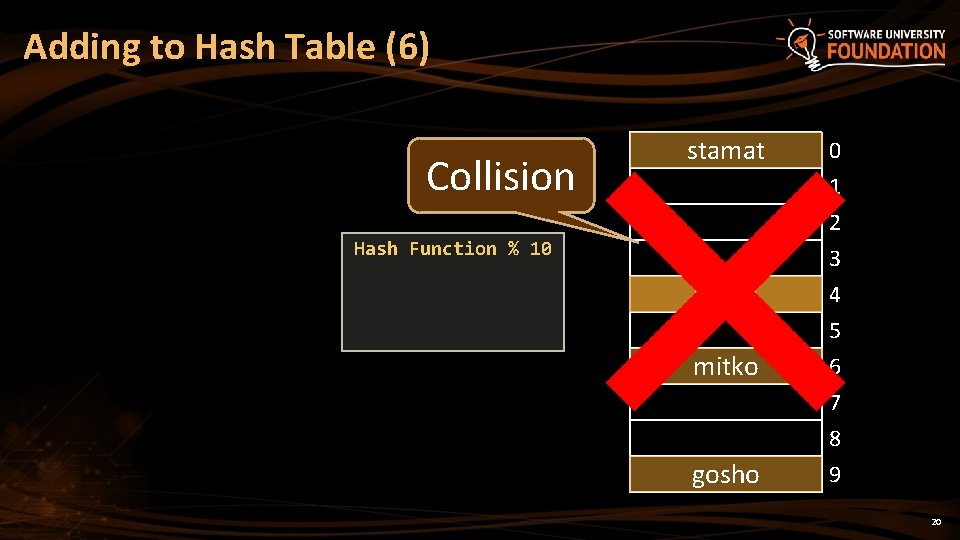
Adding to Hash Table (6) Collision stamat 0 1 2 3 maria ivan 4 5 6 7 8 9 Hash Function % 10 mitko gosho 20
Collisions in a Hash Table § A collision comes when different keys have the same hash value h(k 1) = h(k 2) for k 1 ≠ k 2 § When the number of collisions is sufficiently small, the hash tables work quite well (fast) § Several collisions resolution strategies exist § Chaining collided keys (+ values) in a list § Using other slots in the table (open addressing) § Cuckoo hashing § Many other 21
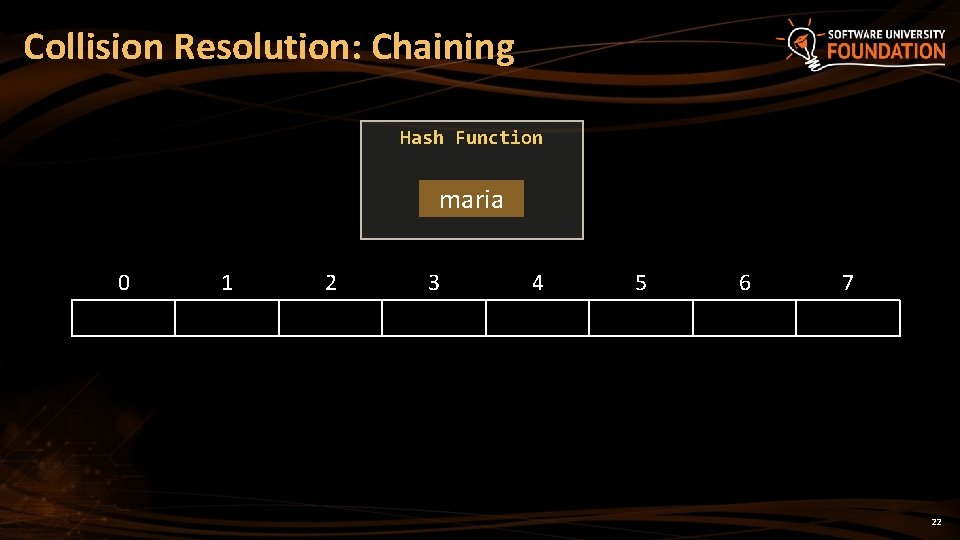
Collision Resolution: Chaining Hash Function maria 0 1 2 3 4 5 6 7 22
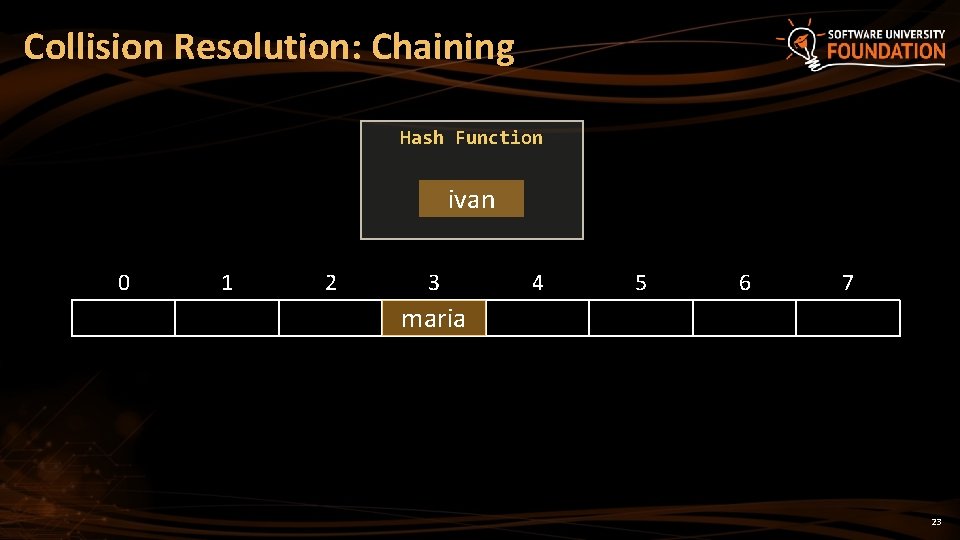
Collision Resolution: Chaining Hash Function ivan 0 1 2 3 4 5 6 7 maria 23
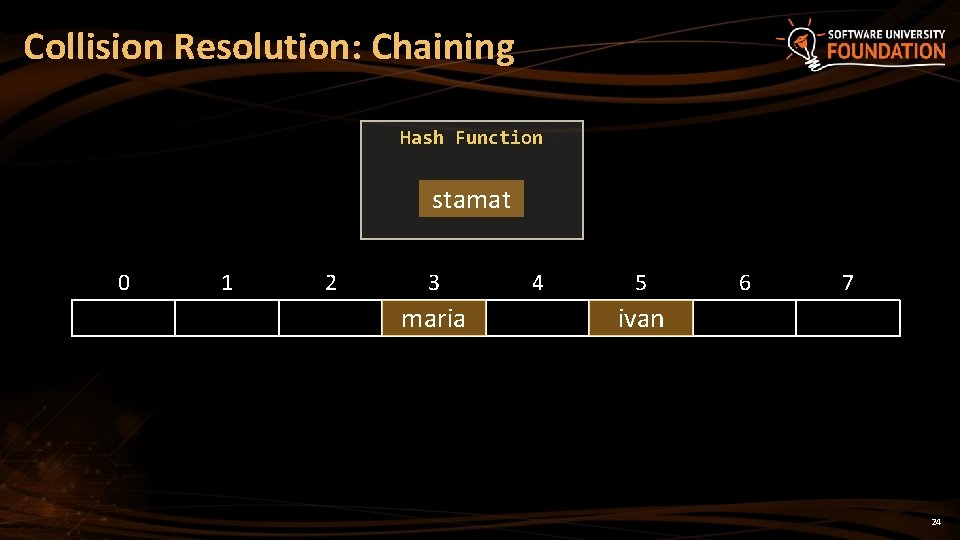
Collision Resolution: Chaining Hash Function stamat 0 1 2 3 maria 4 5 6 7 ivan 24
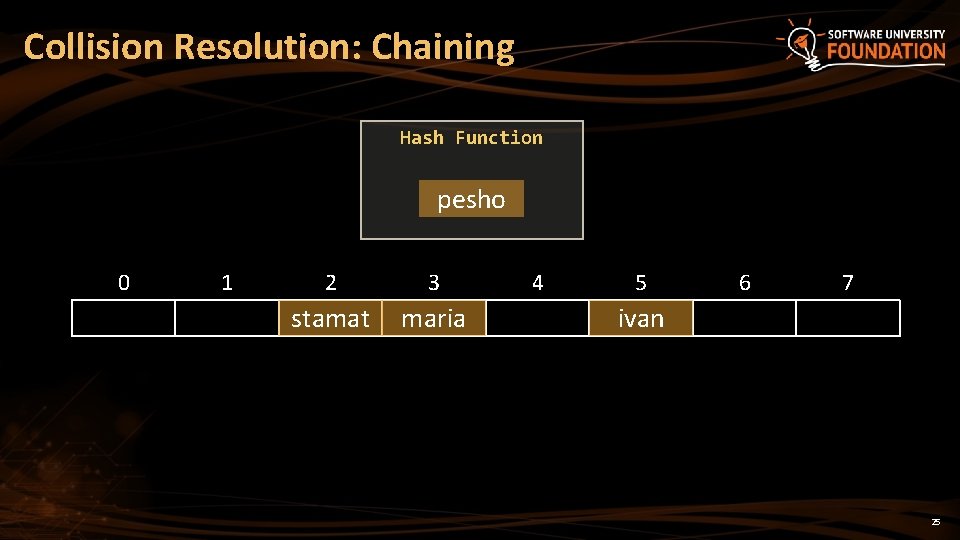
Collision Resolution: Chaining Hash Function pesho 0 1 2 3 stamat maria 4 5 6 7 ivan 25
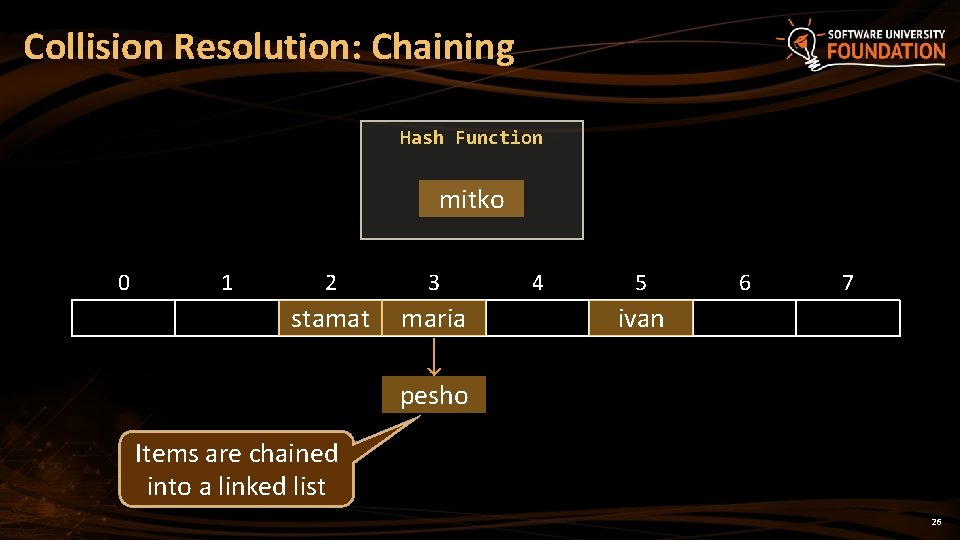
Collision Resolution: Chaining Hash Function mitko 0 1 2 3 stamat maria 4 5 6 7 ivan pesho Items are chained into a linked list 26
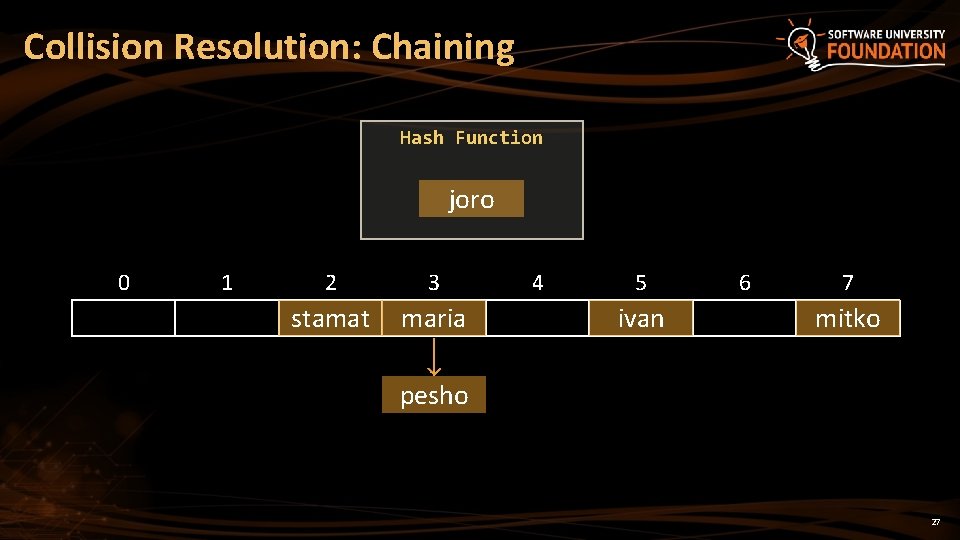
Collision Resolution: Chaining Hash Function joro 0 1 2 3 stamat maria 4 5 ivan 6 7 mitko pesho 27
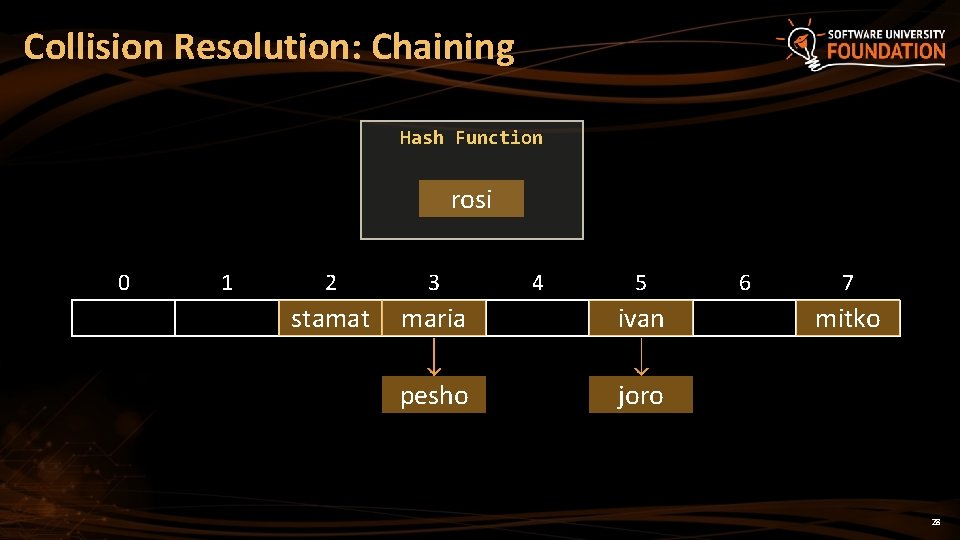
Collision Resolution: Chaining Hash Function rosi 0 1 2 3 4 5 stamat maria ivan pesho joro 6 7 mitko 28
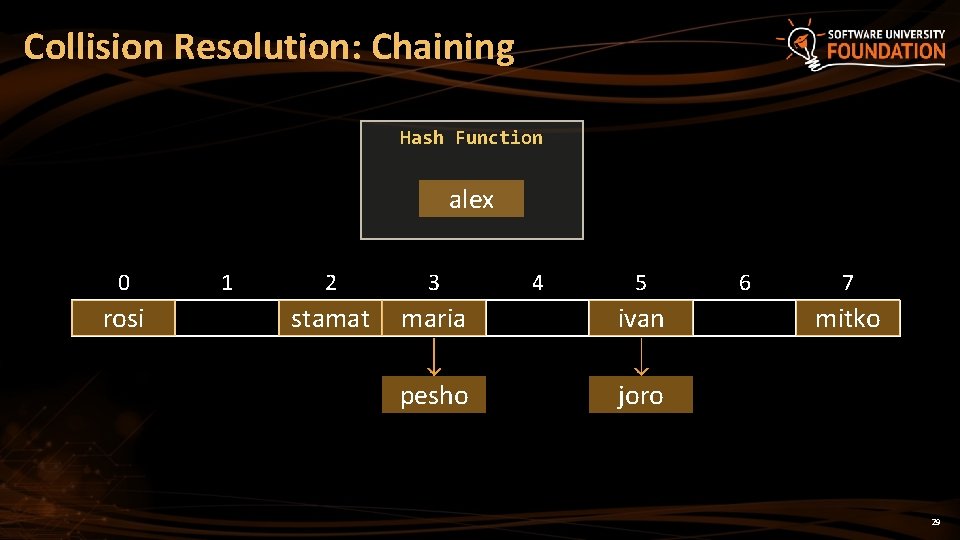
Collision Resolution: Chaining Hash Function alex 0 rosi 1 2 3 4 5 stamat maria ivan pesho joro 6 7 mitko 29
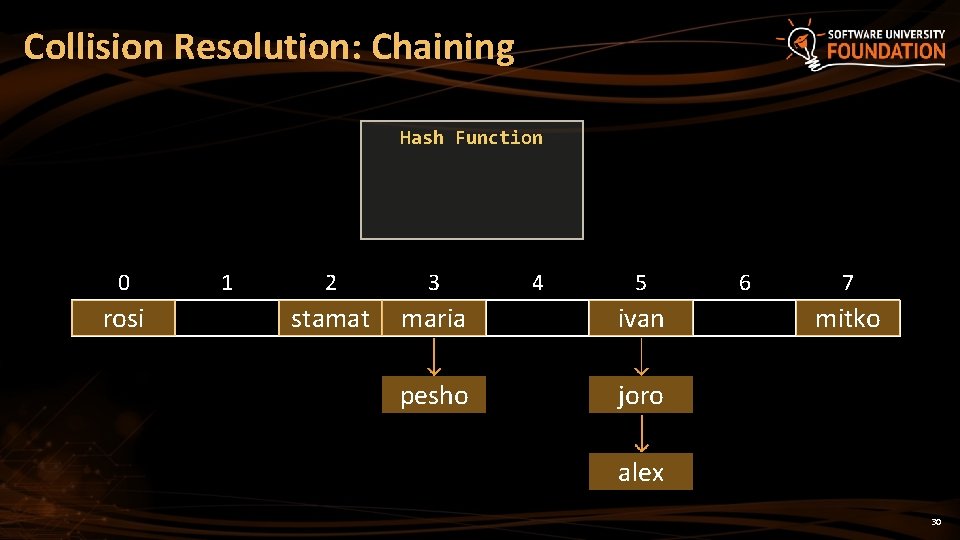
Collision Resolution: Chaining Hash Function 0 rosi 1 2 3 4 5 stamat maria ivan pesho joro 6 7 mitko alex 30
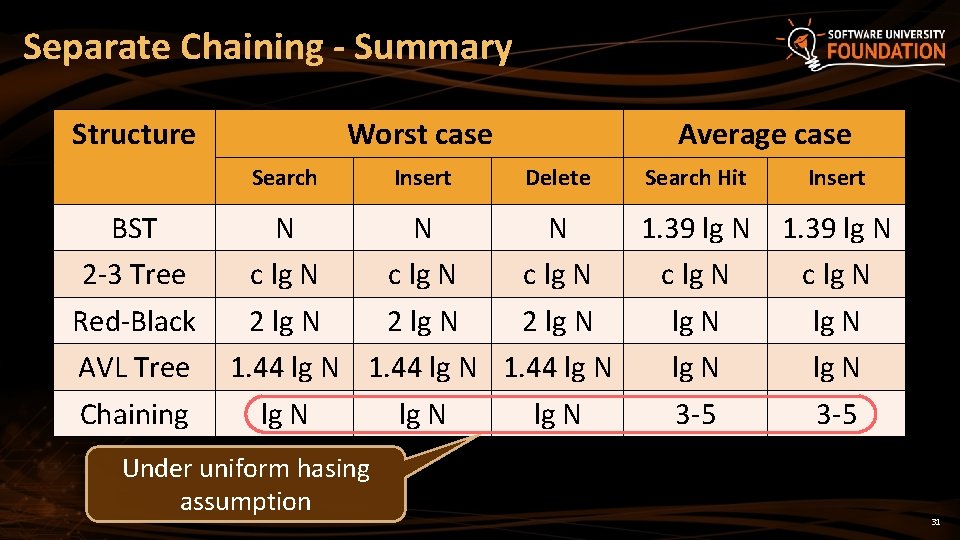
Separate Chaining - Summary Structure Worst case Search BST 2 -3 Tree Red-Black AVL Tree Chaining Insert Average case Delete Search Hit Insert N N N 1. 39 lg N c lg N c lg N 2 lg N 1. 44 lg N lg N Under uniform hasing assumption lg N 3 -5 31
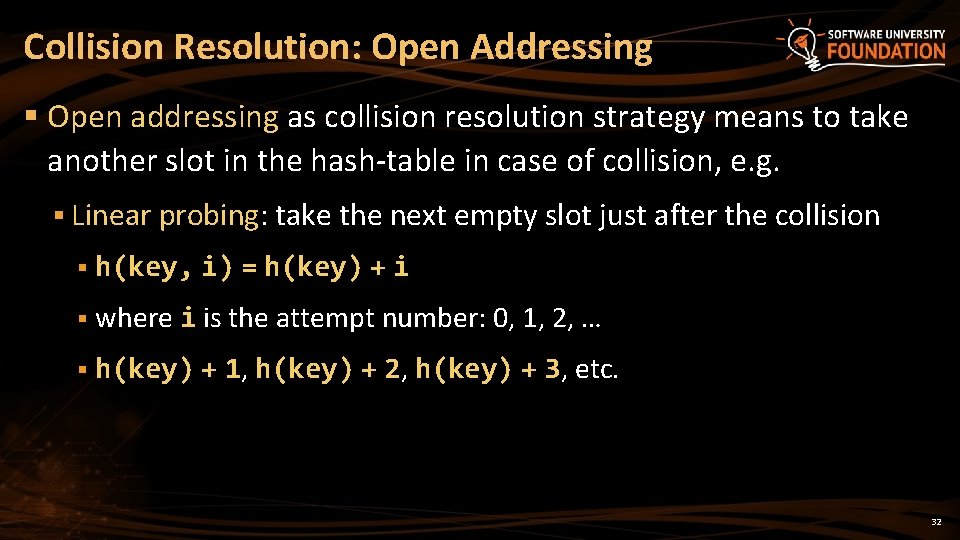
Collision Resolution: Open Addressing § Open addressing as collision resolution strategy means to take another slot in the hash-table in case of collision, e. g. § Linear probing: take the next empty slot just after the collision § h(key, i) = h(key) + i § where i is the attempt number: 0, 1, 2, … § h(key) + 1, h(key) + 2, h(key) + 3, etc. 32
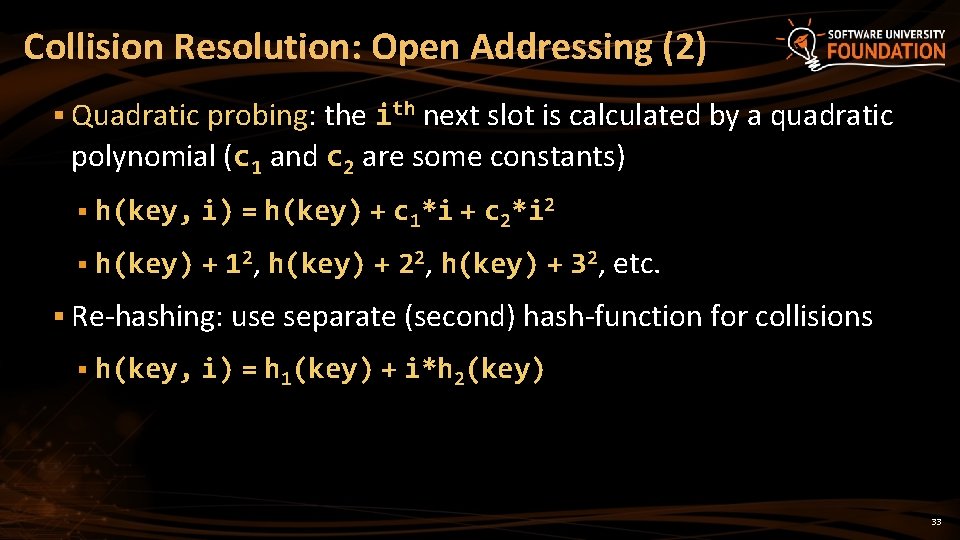
Collision Resolution: Open Addressing (2) § Quadratic probing: the ith next slot is calculated by a quadratic polynomial (c 1 and c 2 are some constants) § h(key, i) = h(key) + c 1*i + c 2*i 2 § h(key) + 12, h(key) + 22, h(key) + 32, etc. § Re-hashing: use separate (second) hash-function for collisions § h(key, i) = h 1(key) + i*h 2(key) 33
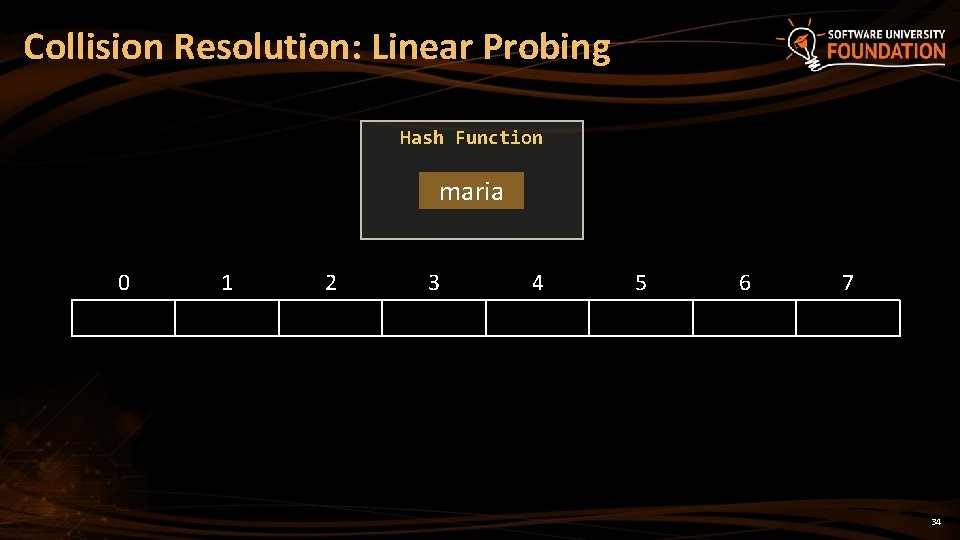
Collision Resolution: Linear Probing Hash Function maria 0 1 2 3 4 5 6 7 34

Collision Resolution: Linear Probing Hash Function ivan 0 1 2 3 4 5 6 7 maria 35
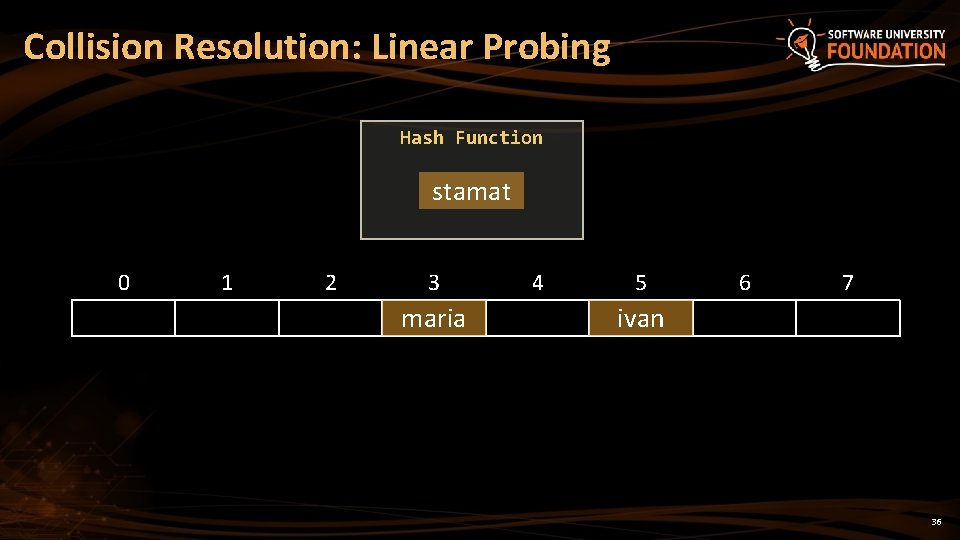
Collision Resolution: Linear Probing Hash Function stamat 0 1 2 3 maria 4 5 6 7 ivan 36

Collision Resolution: Linear Probing Hash Function pesho 0 1 2 3 stamat maria 4 5 6 7 ivan 37
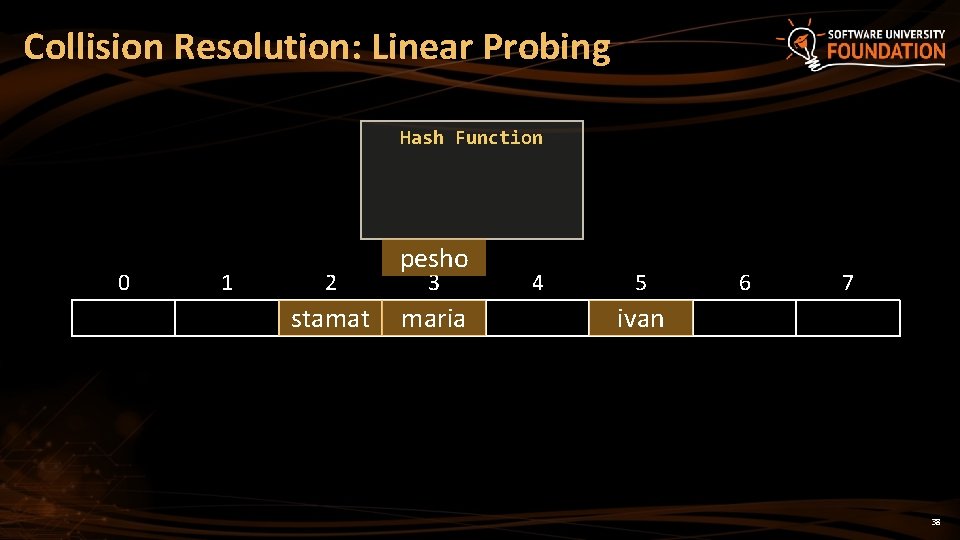
Collision Resolution: Linear Probing Hash Function 0 1 2 stamat pesho 3 maria 4 5 6 7 ivan 38
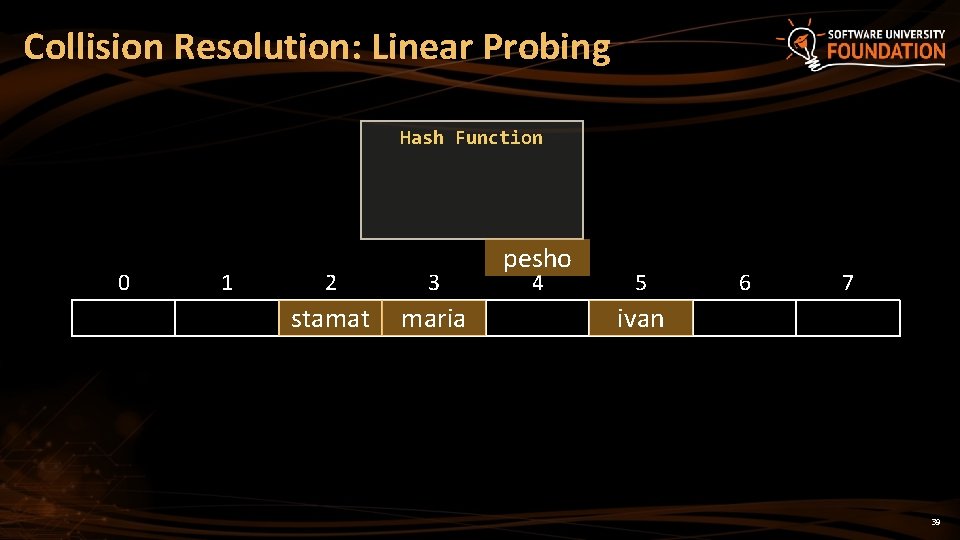
Collision Resolution: Linear Probing Hash Function 0 1 2 3 stamat maria pesho 4 5 6 7 ivan 39
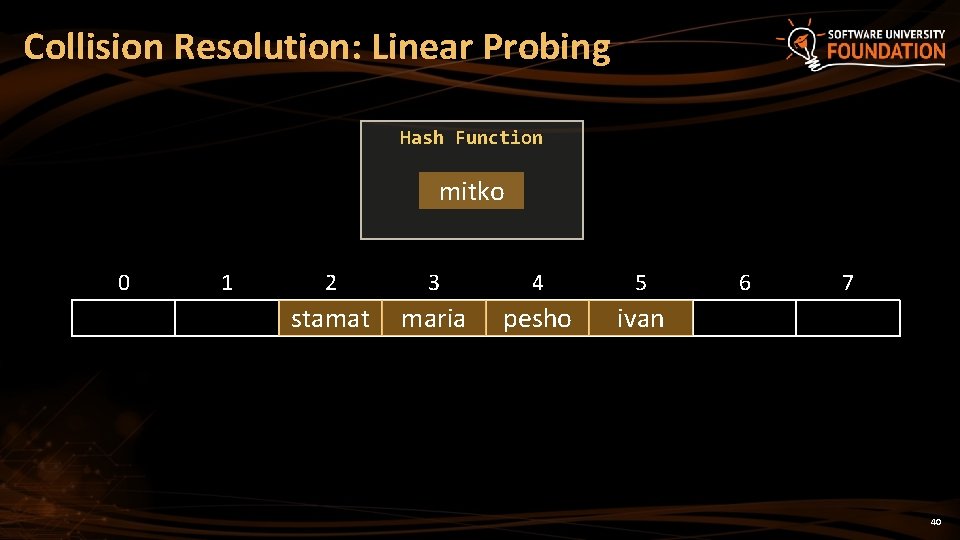
Collision Resolution: Linear Probing Hash Function mitko 0 1 2 3 4 5 stamat maria pesho ivan 6 7 40
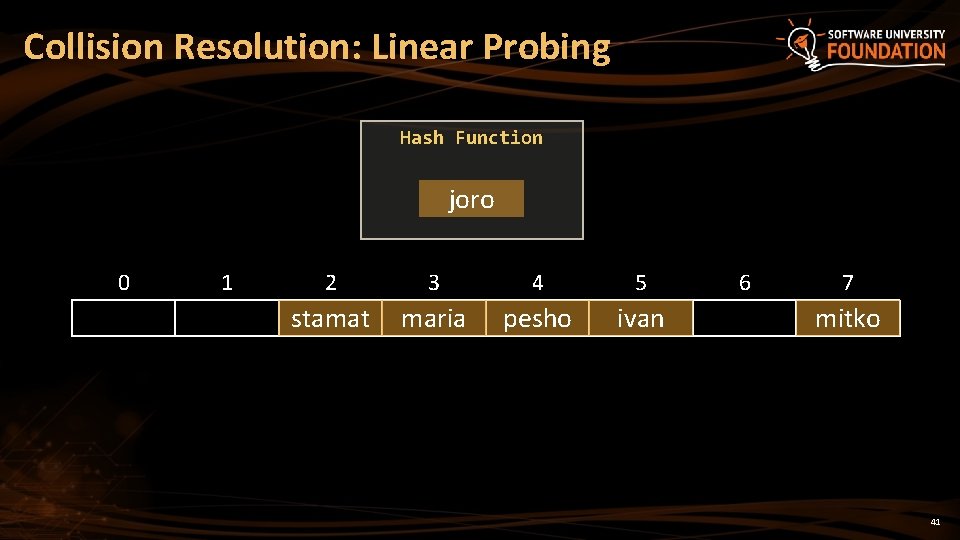
Collision Resolution: Linear Probing Hash Function joro 0 1 2 3 4 5 stamat maria pesho ivan 6 7 mitko 41
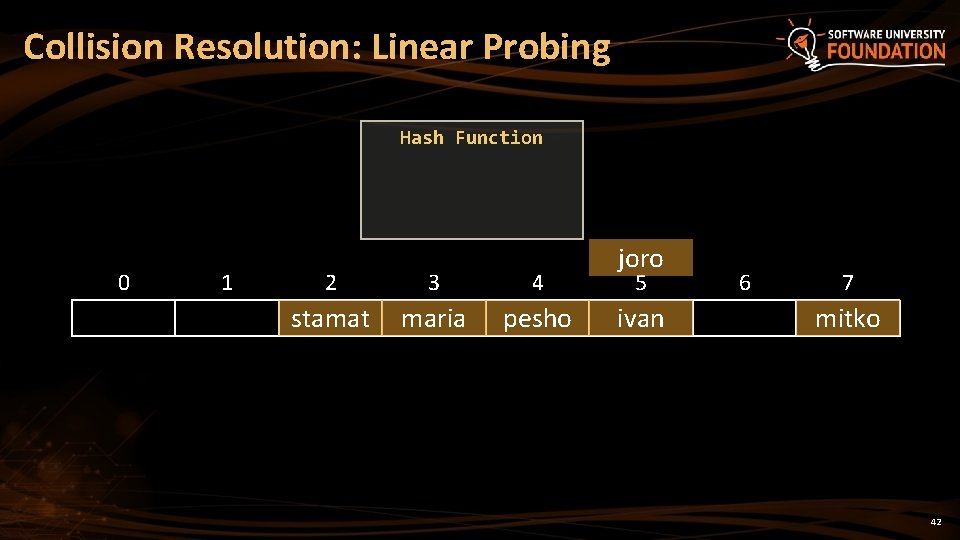
Collision Resolution: Linear Probing Hash Function 0 1 2 3 4 stamat maria pesho joro 5 ivan 6 7 mitko 42
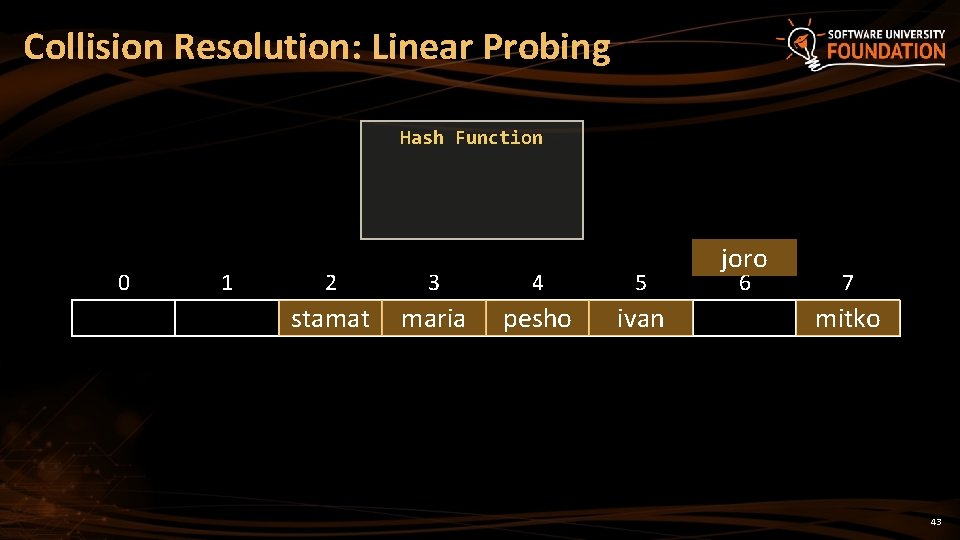
Collision Resolution: Linear Probing Hash Function 0 1 2 3 4 5 stamat maria pesho ivan joro 6 7 mitko 43
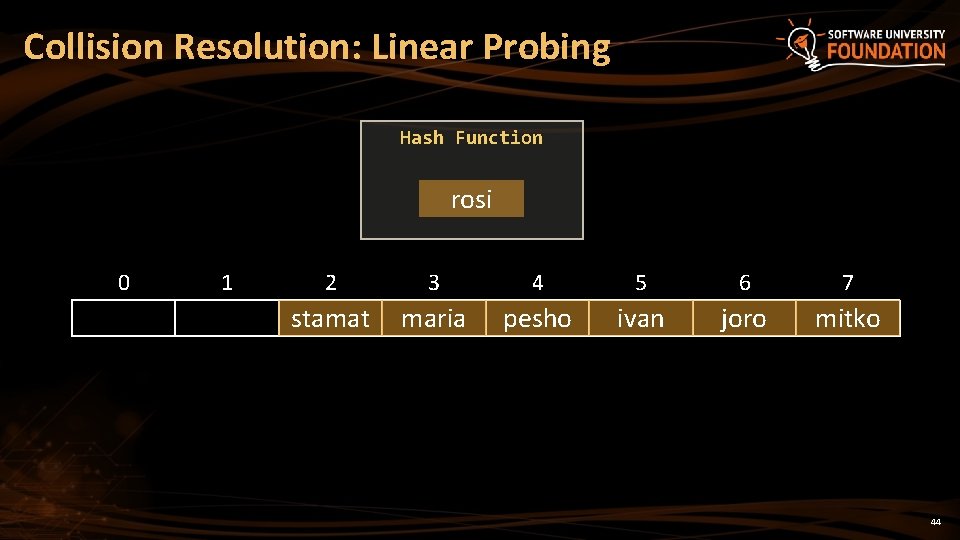
Collision Resolution: Linear Probing Hash Function rosi 0 1 2 3 4 5 6 7 stamat maria pesho ivan joro mitko 44
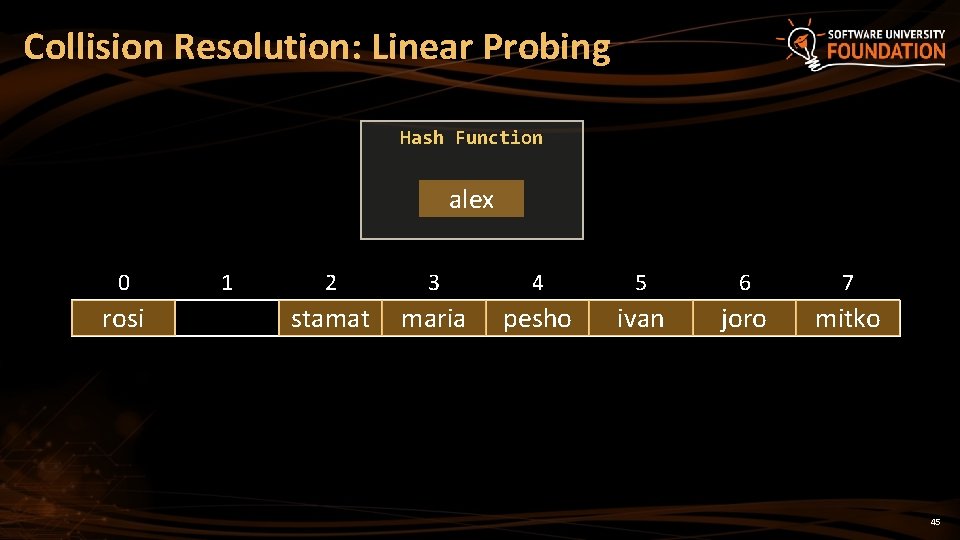
Collision Resolution: Linear Probing Hash Function alex 0 rosi 1 2 3 4 5 6 7 stamat maria pesho ivan joro mitko 45
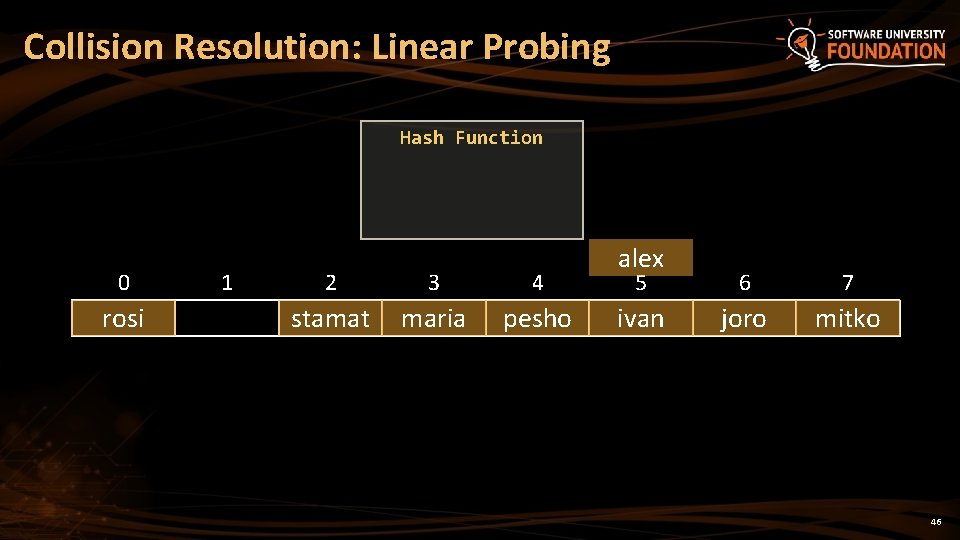
Collision Resolution: Linear Probing Hash Function 0 rosi 1 2 3 4 stamat maria pesho alex 5 6 7 ivan joro mitko 46
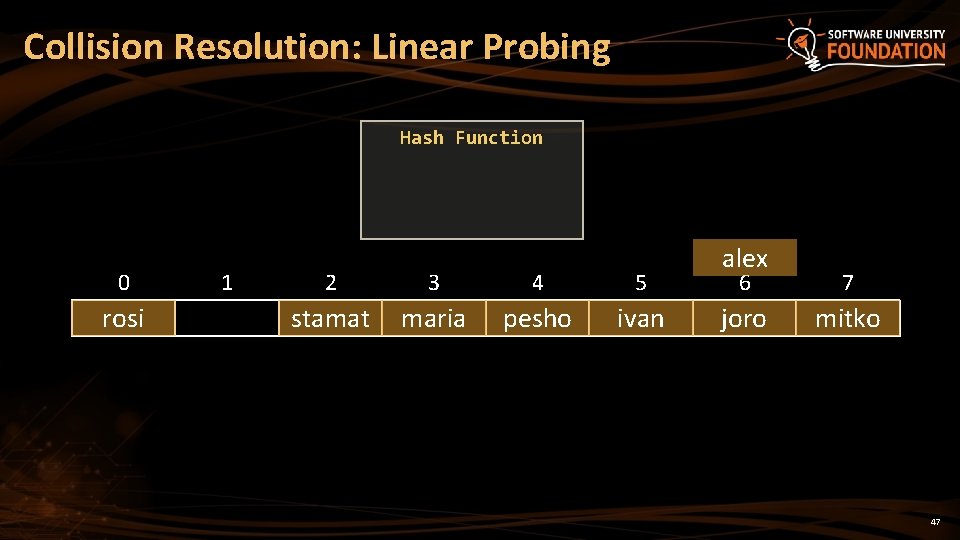
Collision Resolution: Linear Probing Hash Function 0 rosi 1 2 3 4 5 stamat maria pesho ivan alex 6 7 joro mitko 47
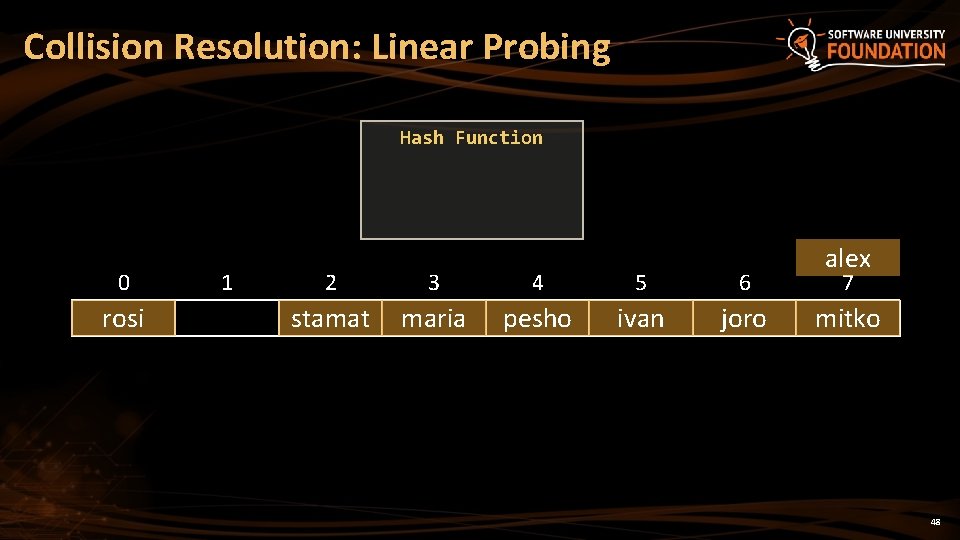
Collision Resolution: Linear Probing Hash Function 0 rosi 1 2 3 4 5 6 stamat maria pesho ivan joro alex 7 mitko 48

Collision Resolution: Linear Probing Hash Function alex 0 rosi 1 2 3 4 5 6 7 stamat maria pesho ivan joro mitko 49
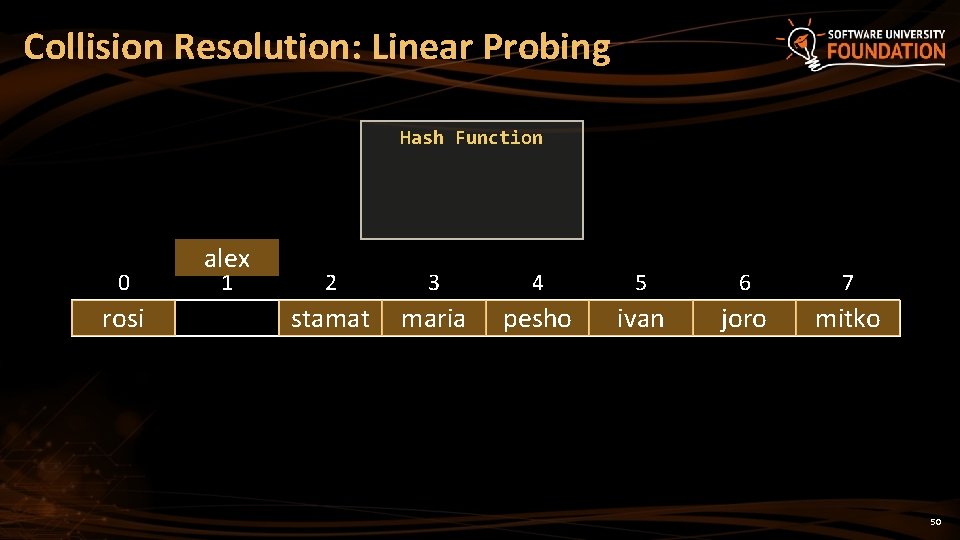
Collision Resolution: Linear Probing Hash Function 0 rosi alex 1 2 3 4 5 6 7 stamat maria pesho ivan joro mitko 50
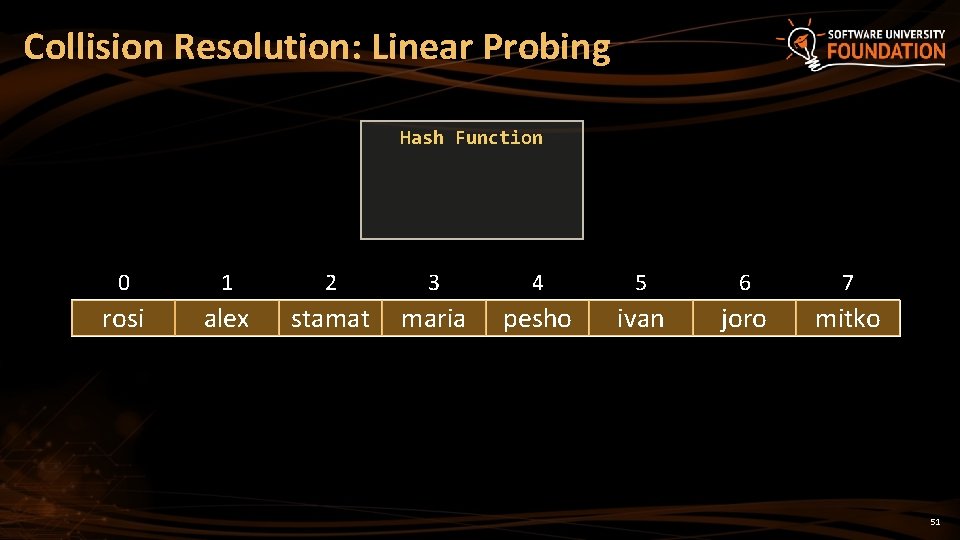
Collision Resolution: Linear Probing Hash Function 0 1 2 3 4 5 6 7 rosi alex stamat maria pesho ivan joro mitko 51
Linear Probing - Quiz TIME’S UP! TIME: § What is the average running time of delete in linear-probing hash table? Your hash function satisfies the uniform hashing assumption and that the hash table is at most 50% full. § O(1) § O(log N) § O(N log N) 52
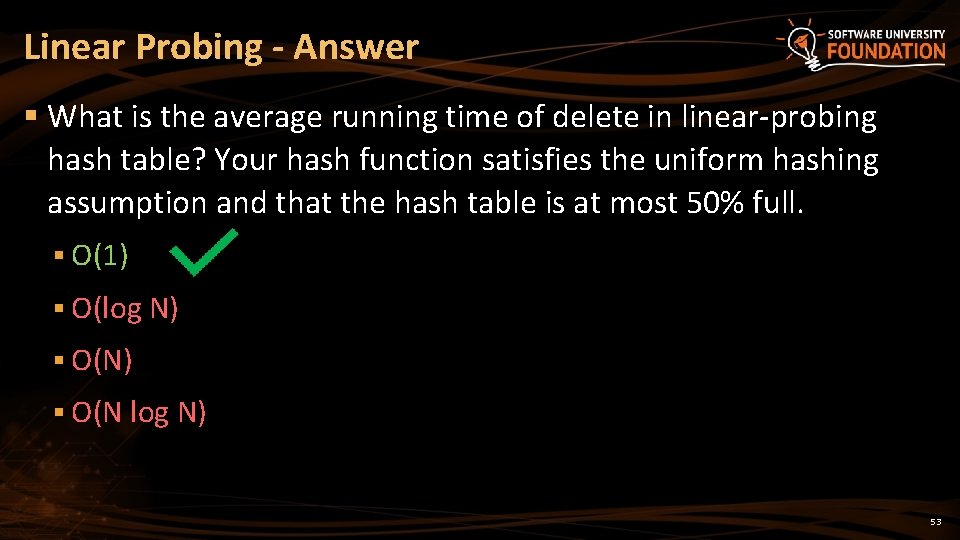
Linear Probing - Answer § What is the average running time of delete in linear-probing hash table? Your hash function satisfies the uniform hashing assumption and that the hash table is at most 50% full. § O(1) § O(log N) § O(N log N) 53
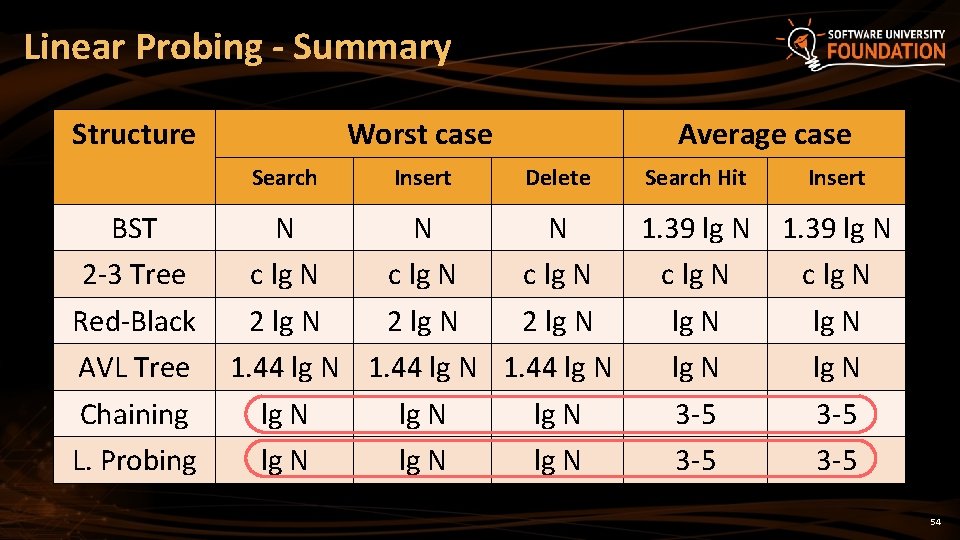
Linear Probing - Summary Structure Worst case Search BST 2 -3 Tree Red-Black AVL Tree Chaining L. Probing Insert Average case Delete Search Hit Insert N N N 1. 39 lg N c lg N c lg N 2 lg N 1. 44 lg N lg N lg N 3 -5 3 -5 54
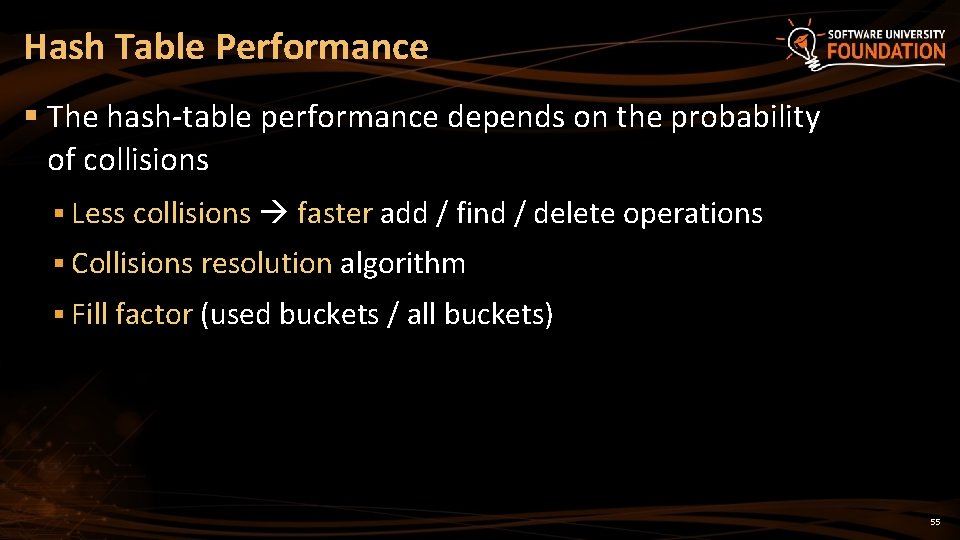
Hash Table Performance § The hash-table performance depends on the probability of collisions § Less collisions faster add / find / delete operations § Collisions resolution algorithm § Fill factor (used buckets / all buckets) 55
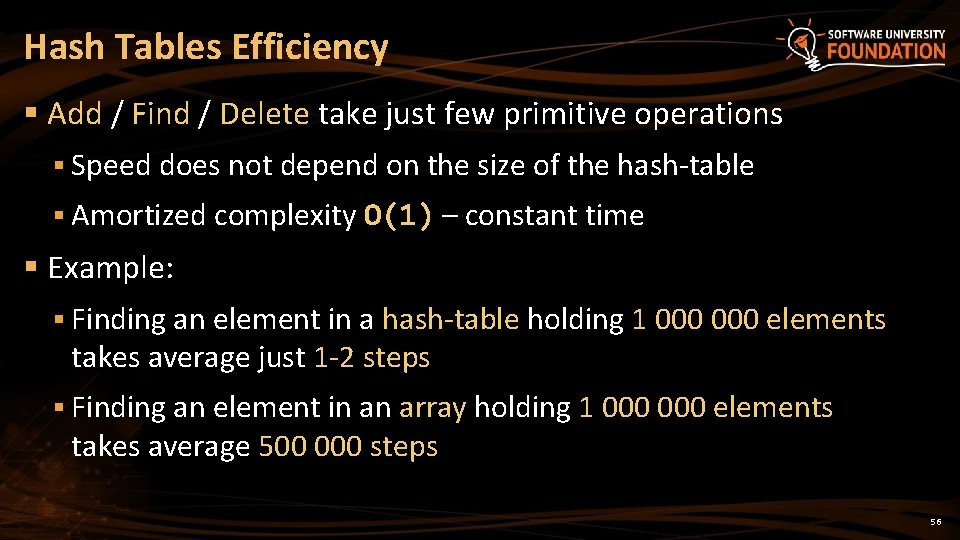
Hash Tables Efficiency § Add / Find / Delete take just few primitive operations § Speed does not depend on the size of the hash-table § Amortized complexity O(1) – constant time § Example: § Finding an element in a hash-table holding 1 000 elements takes average just 1 -2 steps § Finding an element in an array holding 1 000 elements takes average 500 000 steps 56
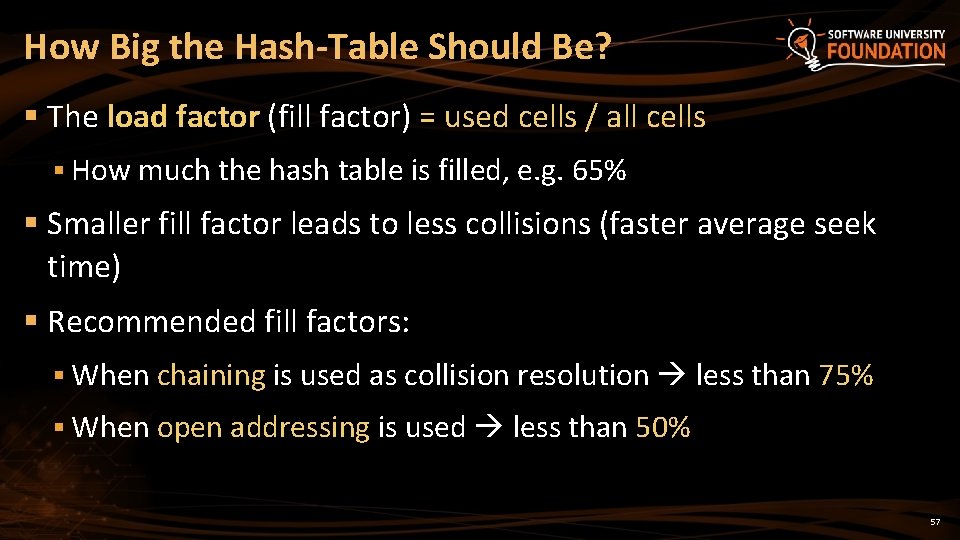
How Big the Hash-Table Should Be? § The load factor (fill factor) = used cells / all cells § How much the hash table is filled, e. g. 65% § Smaller fill factor leads to less collisions (faster average seek time) § Recommended fill factors: § When chaining is used as collision resolution less than 75% § When open addressing is used less than 50% 57
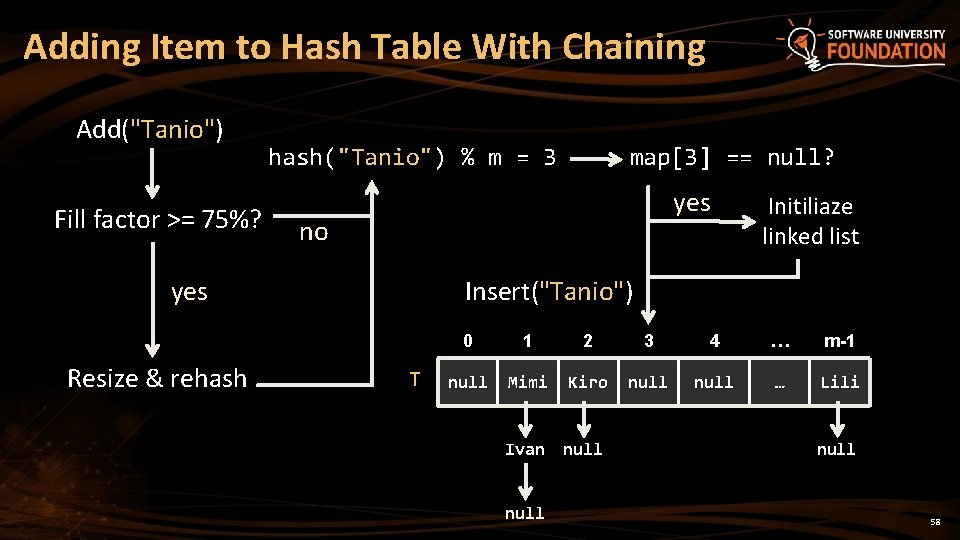
Adding Item to Hash Table With Chaining Add("Tanio") Fill factor >= 75%? yes no yes Resize & rehash map[3] == null? hash("Tanio") % m = 3 Initiliaze linked list Insert("Tanio") T 0 1 2 3 4 … m-1 null Mimi Kiro null … Lili Ivan null 58

Lab Exercise Implement a Hash-Table with Chaining 59
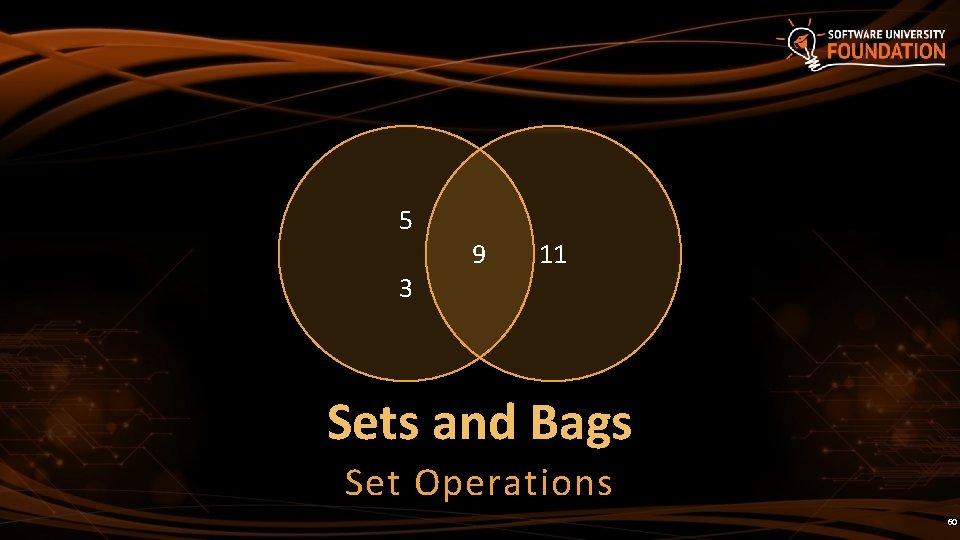
5 3 9 11 Sets and Bags Set Operations 60
Set and Bag ADTs § The abstract data type (ADT) "set" keeps a set of elements with no duplicates § Sets with duplicates are also known as ADT "bag" § Set specific operations: § Union. With(set) § Intersect. With(set) § Except. With(set) § Symmetric. Except. With(set) Known as relative complement in math Known as symmetric difference 61
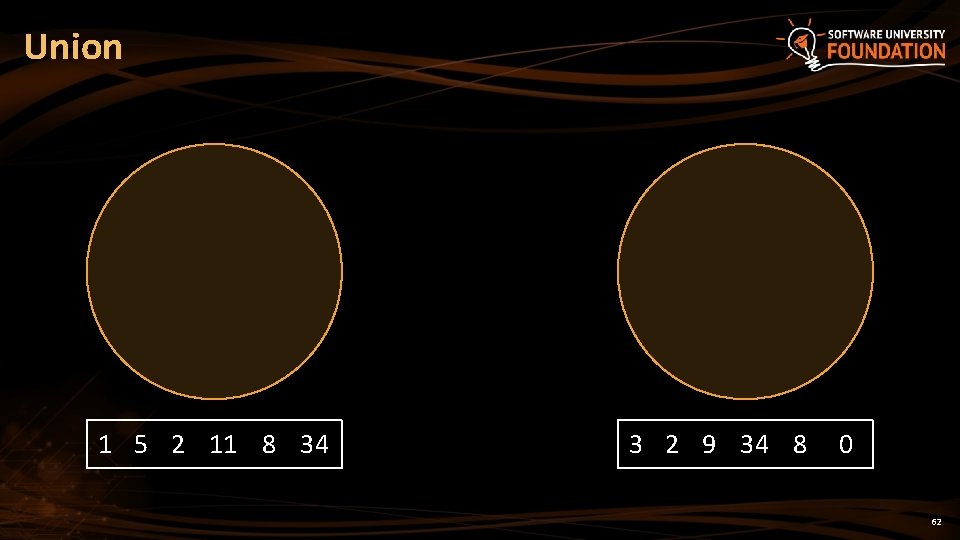
Union 1 5 2 11 8 34 3 2 9 34 8 0 62

Union 1 5 2 11 8 34 1 3 2 9 34 8 5 2 11 8 34 3 9 0 0 63
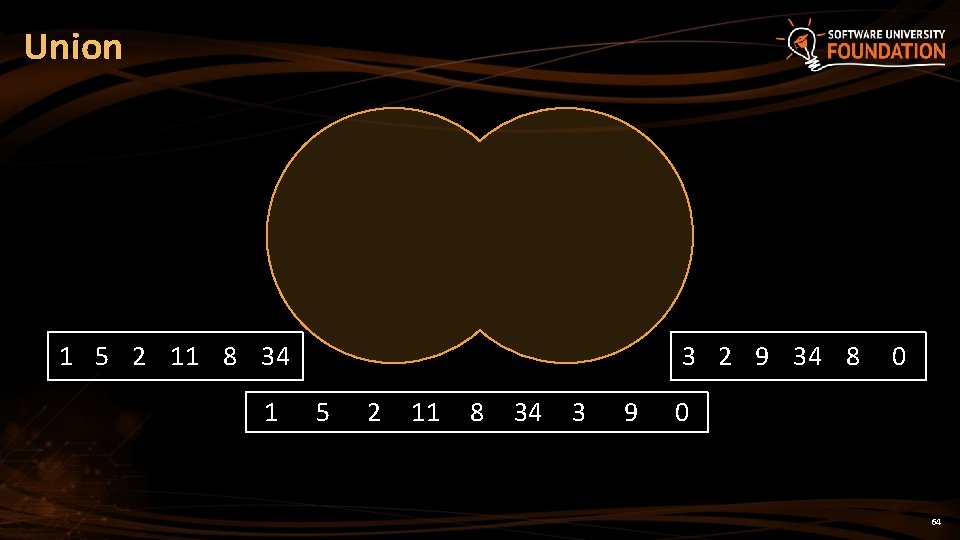
Union 1 5 2 11 8 34 1 3 2 9 34 8 5 2 11 8 34 3 9 0 0 64
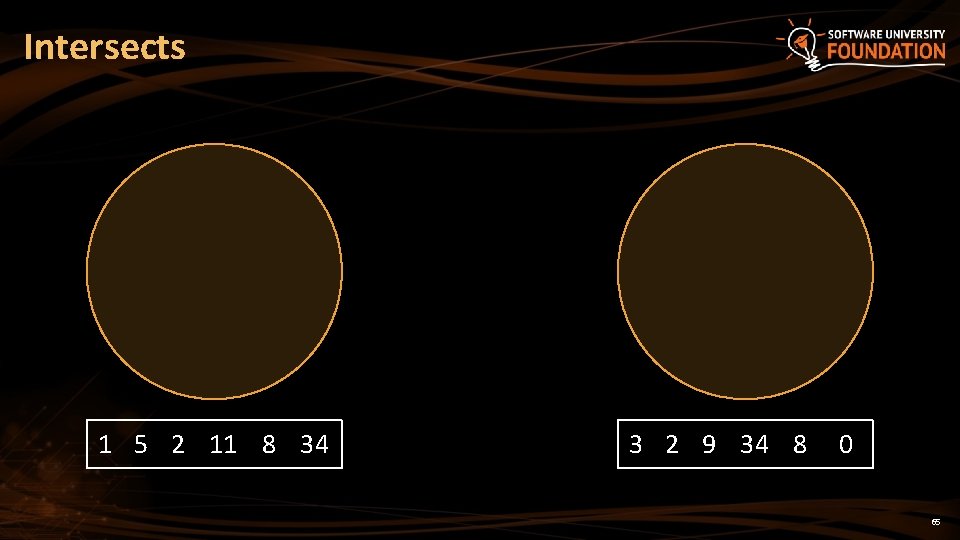
Intersects 1 5 2 11 8 34 3 2 9 34 8 0 65
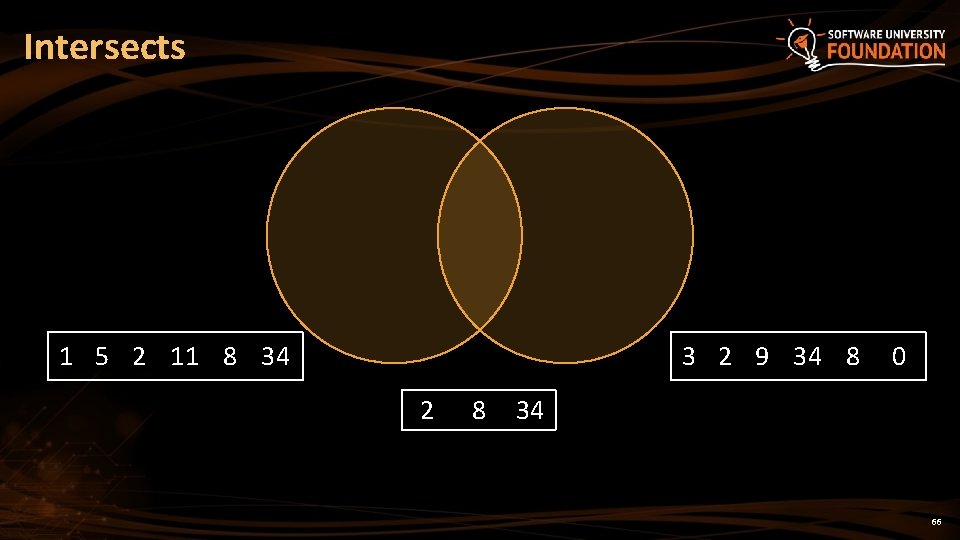
Intersects 1 5 2 11 8 34 3 2 9 34 8 2 8 0 34 66
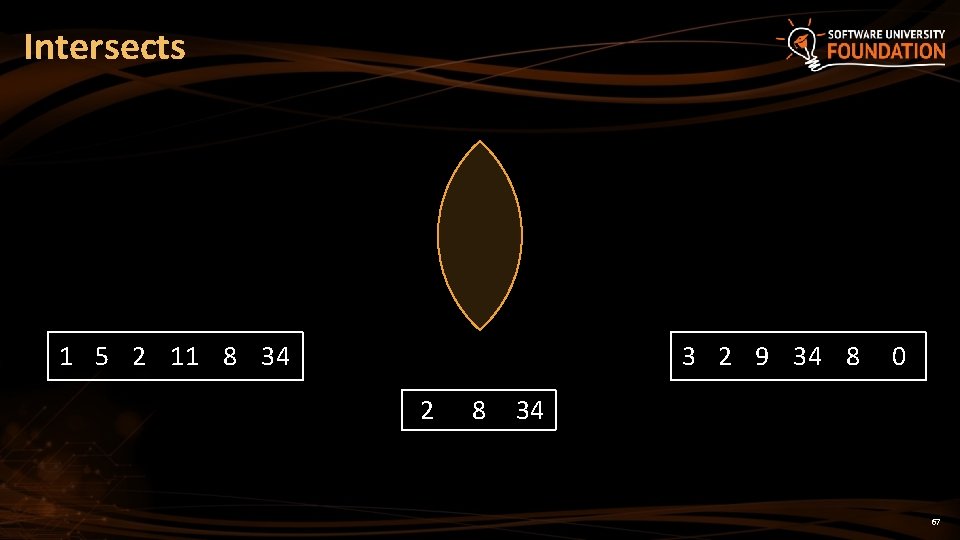
Intersects 1 5 2 11 8 34 3 2 9 34 8 2 8 0 34 67
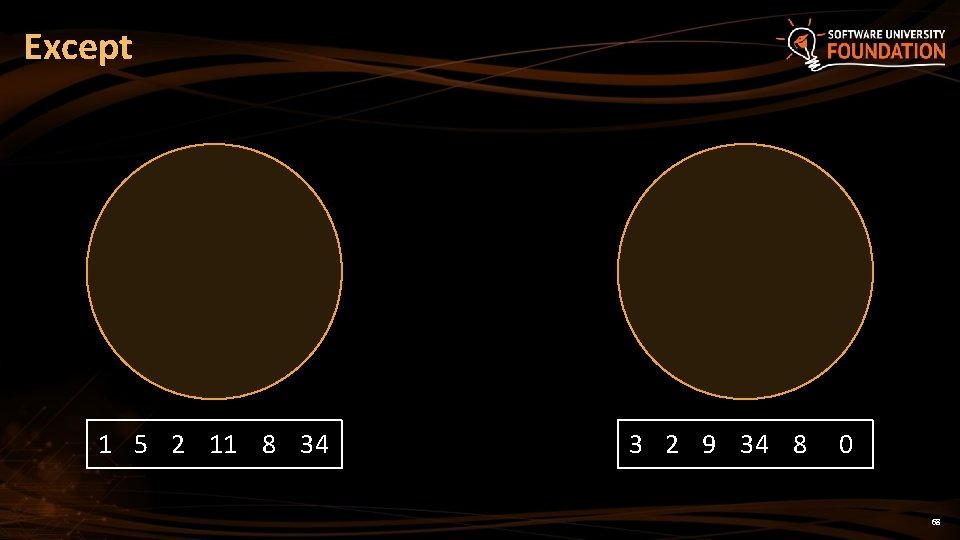
Except 1 5 2 11 8 34 3 2 9 34 8 0 68

Except 1 5 2 11 8 34 3 2 9 34 8 1 5 0 11 69
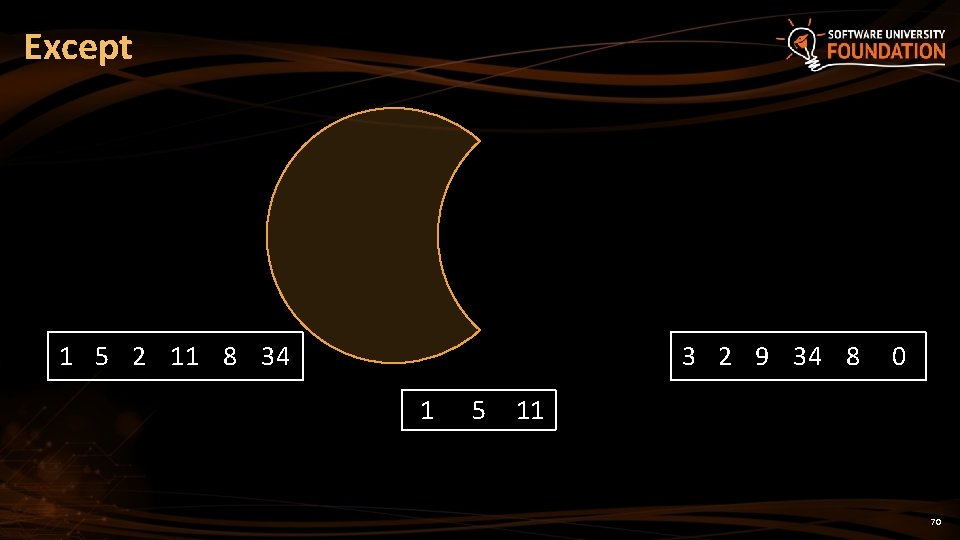
Except 1 5 2 11 8 34 3 2 9 34 8 1 5 0 11 70
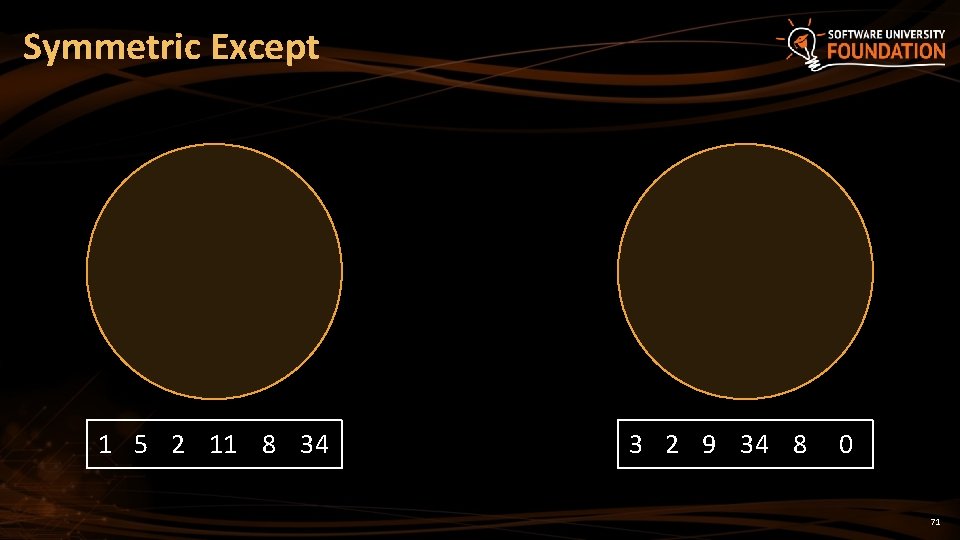
Symmetric Except 1 5 2 11 8 34 3 2 9 34 8 0 71
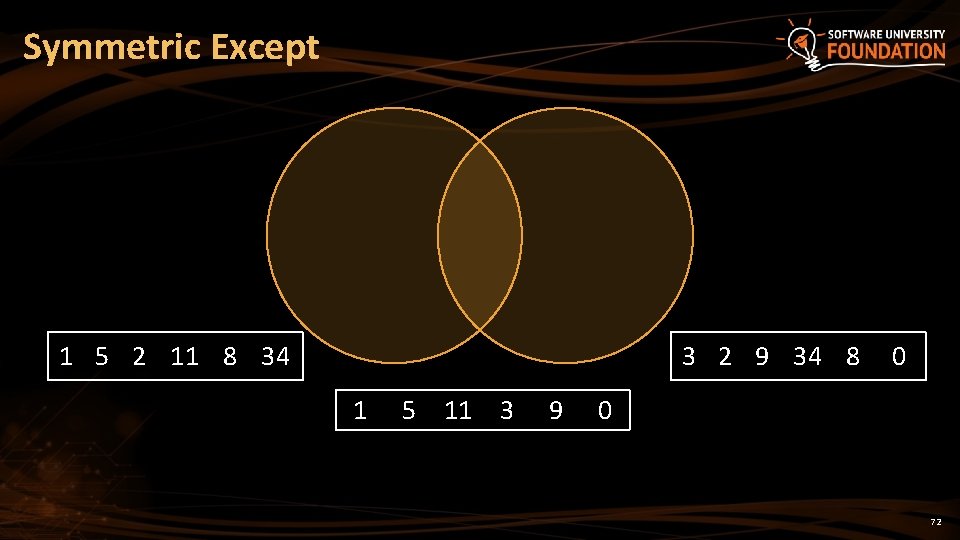
Symmetric Except 1 5 2 11 8 34 3 2 9 34 8 1 5 11 3 9 0 0 72
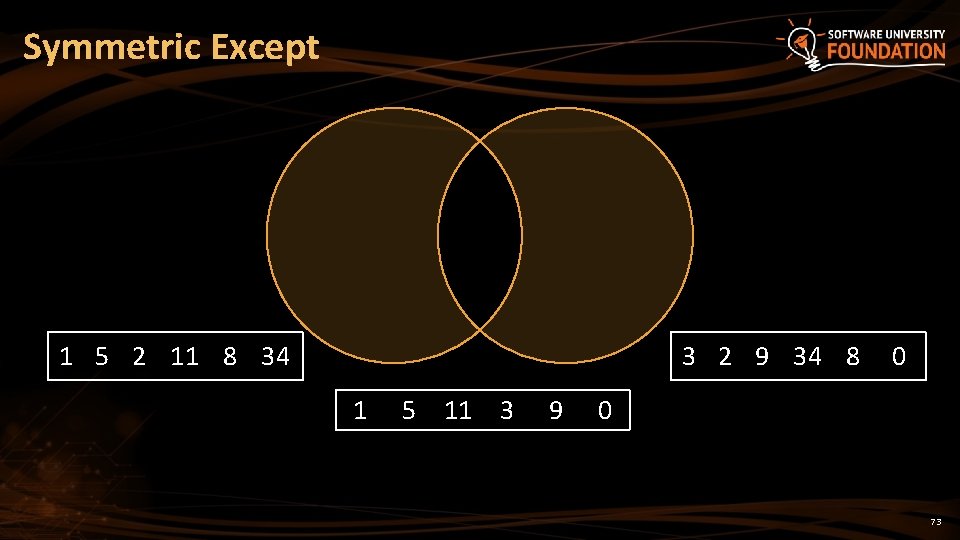
Symmetric Except 1 5 2 11 8 34 3 2 9 34 8 1 5 11 3 9 0 0 73

Live Demo Implementing Set Operations 74

. NET Implementations Hash. Set<T> and Sorted. Set<T>
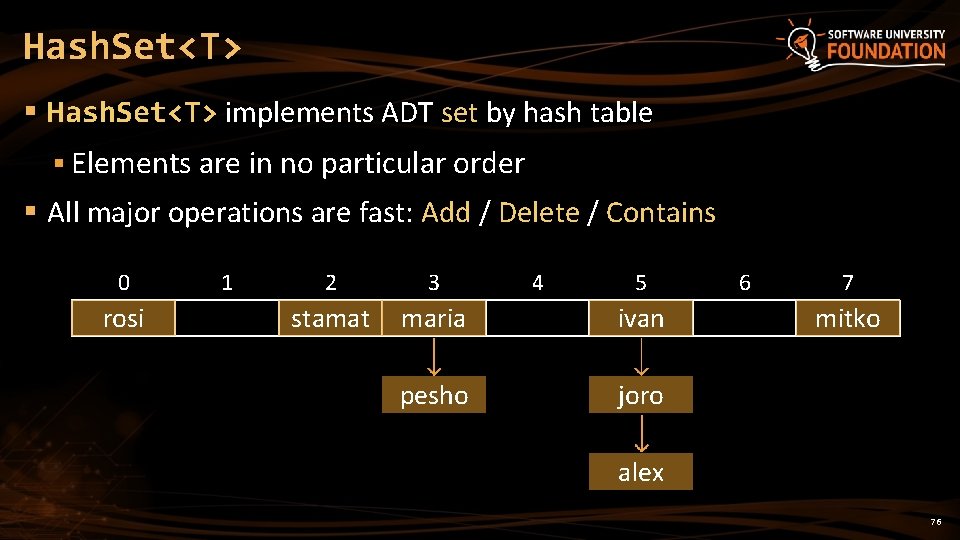
Hash. Set<T> § Hash. Set<T> implements ADT set by hash table § Elements are in no particular order § All major operations are fast: Add / Delete / Contains 0 rosi 1 2 3 4 5 stamat maria ivan pesho joro 6 7 mitko alex 76
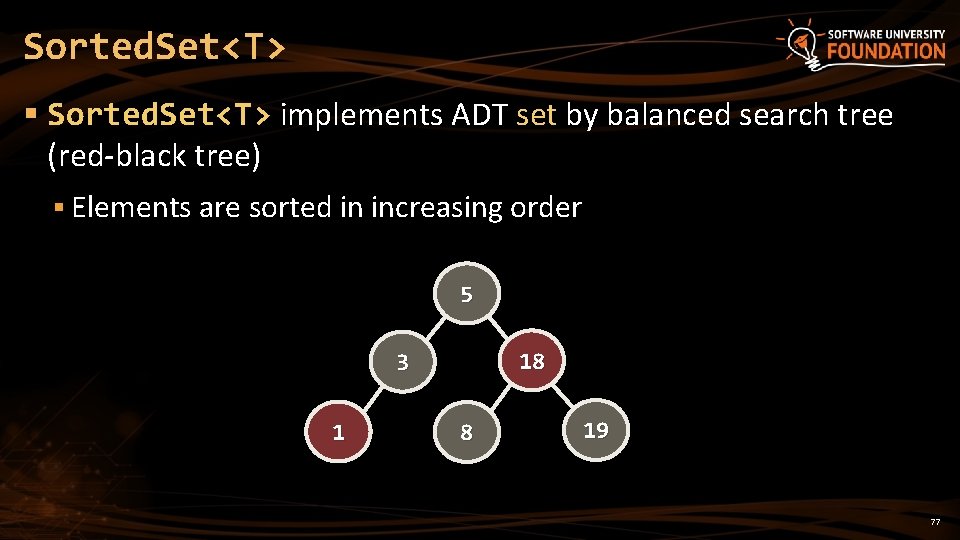
Sorted. Set<T> § Sorted. Set<T> implements ADT set by balanced search tree (red-black tree) § Elements are sorted in increasing order 5 18 3 1 8 19 77
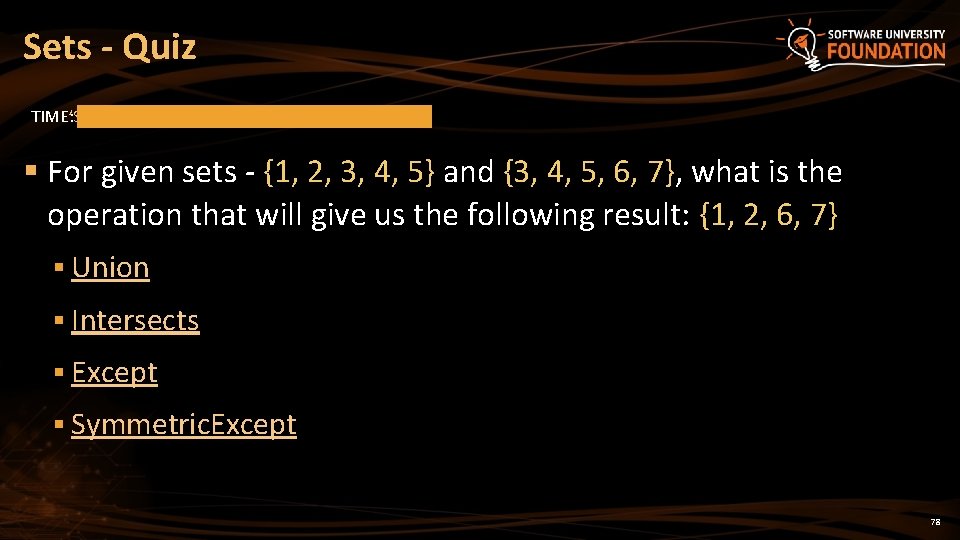
Sets - Quiz TIME’S UP! TIME: § For given sets - {1, 2, 3, 4, 5} and {3, 4, 5, 6, 7}, what is the operation that will give us the following result: {1, 2, 6, 7} § Union § Intersects § Except § Symmetric. Except 78
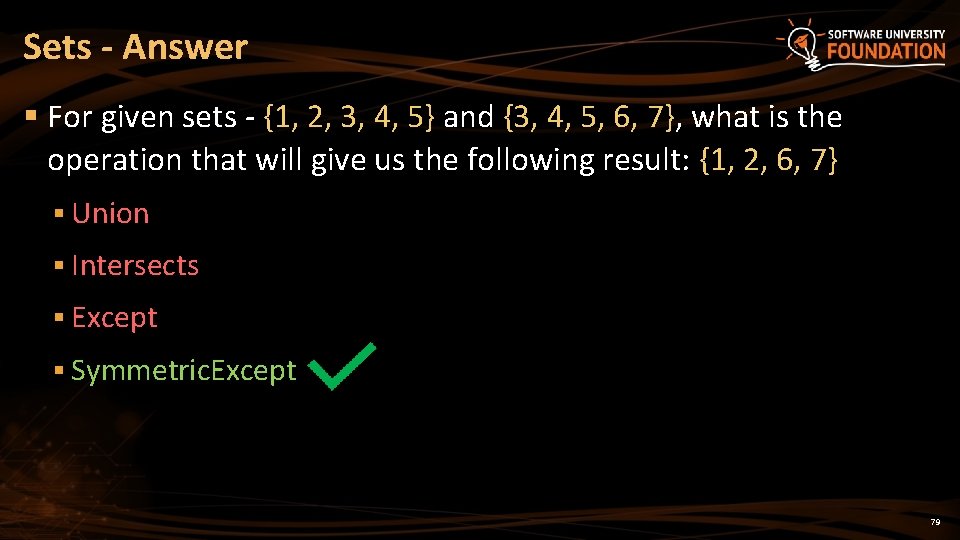
Sets - Answer § For given sets - {1, 2, 3, 4, 5} and {3, 4, 5, 6, 7}, what is the operation that will give us the following result: {1, 2, 6, 7} § Union § Intersects § Except § Symmetric. Except 79

Comparing Keys Using Custom Key Classes
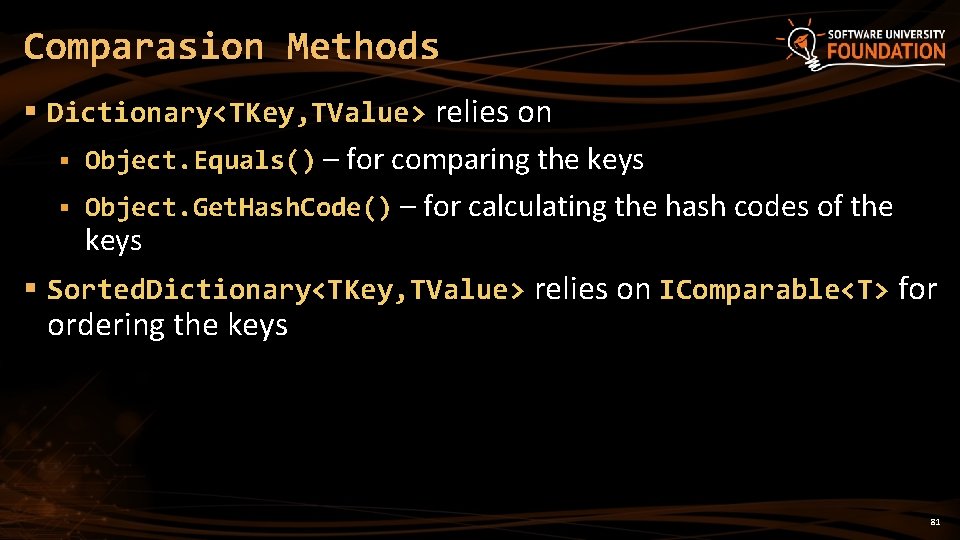
Comparasion Methods § Dictionary<TKey, TValue> relies on § Object. Equals() – for comparing the keys § Object. Get. Hash. Code() – for calculating the hash codes of the keys § Sorted. Dictionary<TKey, TValue> relies on IComparable<T> for ordering the keys 81
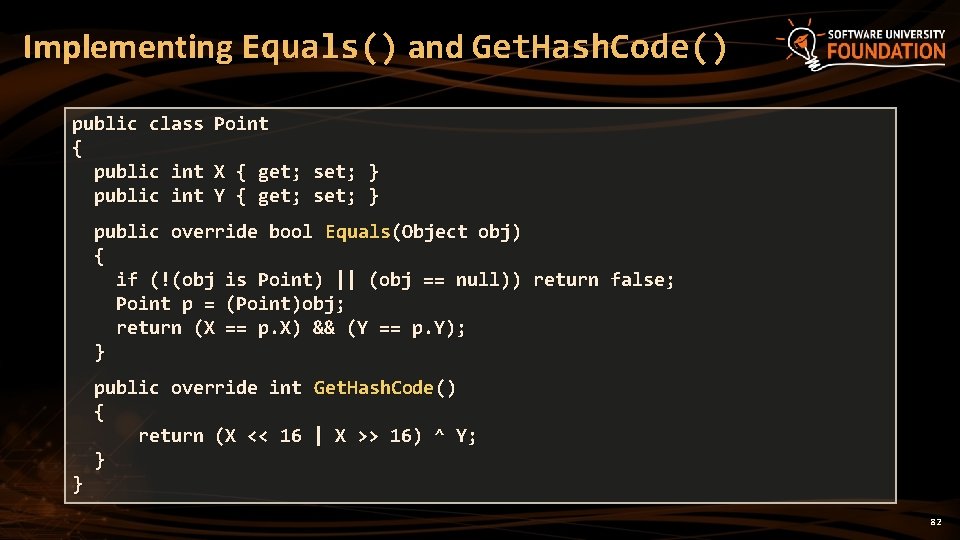
Implementing Equals() and Get. Hash. Code() public class Point { public int X { get; set; } public int Y { get; set; } public override bool Equals(Object obj) { if (!(obj is Point) || (obj == null)) return false; Point p = (Point)obj; return (X == p. X) && (Y == p. Y); } } public override int Get. Hash. Code() { return (X << 16 | X >> 16) ^ Y; } 82
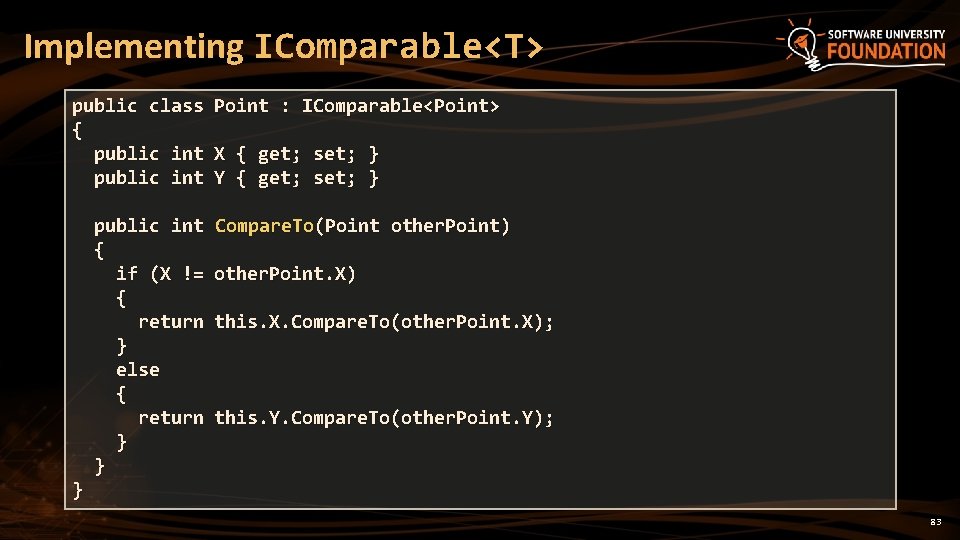
Implementing IComparable<T> public class Point : IComparable<Point> { public int X { get; set; } public int Y { get; set; } } public int { if (X != { return } else { return } } Compare. To(Point other. Point) other. Point. X) this. X. Compare. To(other. Point. X); this. Y. Compare. To(other. Point. Y); 83
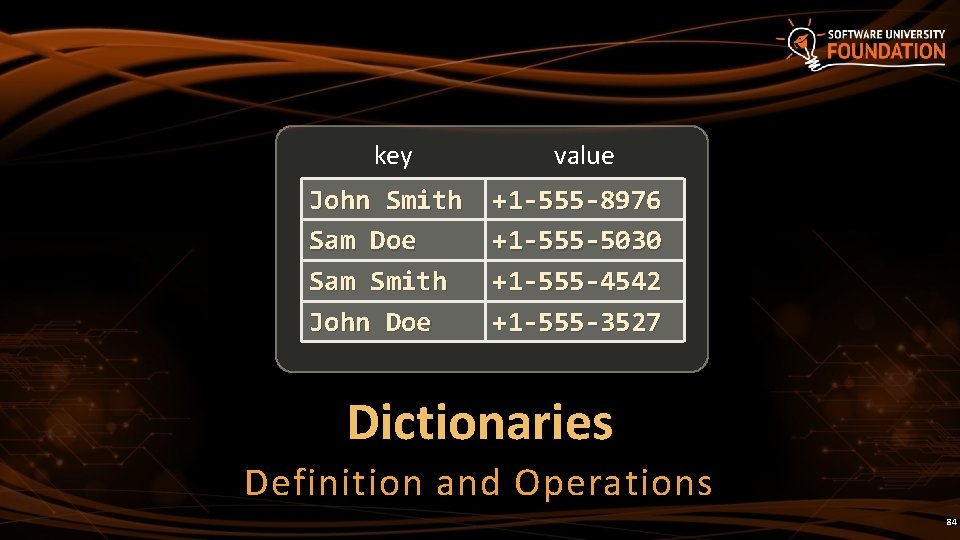
key value John Smith Sam Doe Sam Smith John Doe +1 -555 -8976 +1 -555 -5030 +1 -555 -4542 +1 -555 -3527 Dictionaries Definition and Operations 84
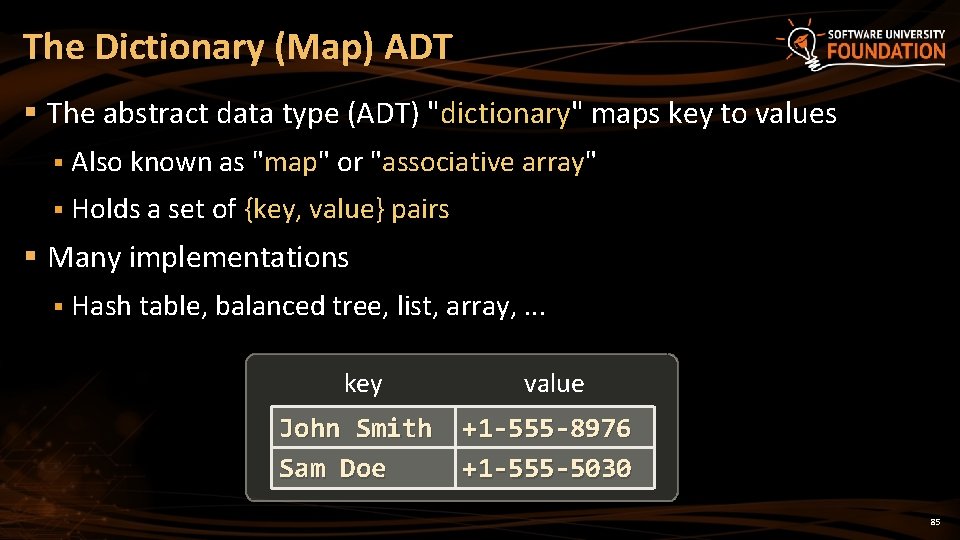
The Dictionary (Map) ADT § The abstract data type (ADT) "dictionary" maps key to values § Also known as "map" or "associative array" § Holds a set of {key, value} pairs § Many implementations § Hash table, balanced tree, list, array, . . . key value John Smith Sam Doe +1 -555 -8976 +1 -555 -5030 85
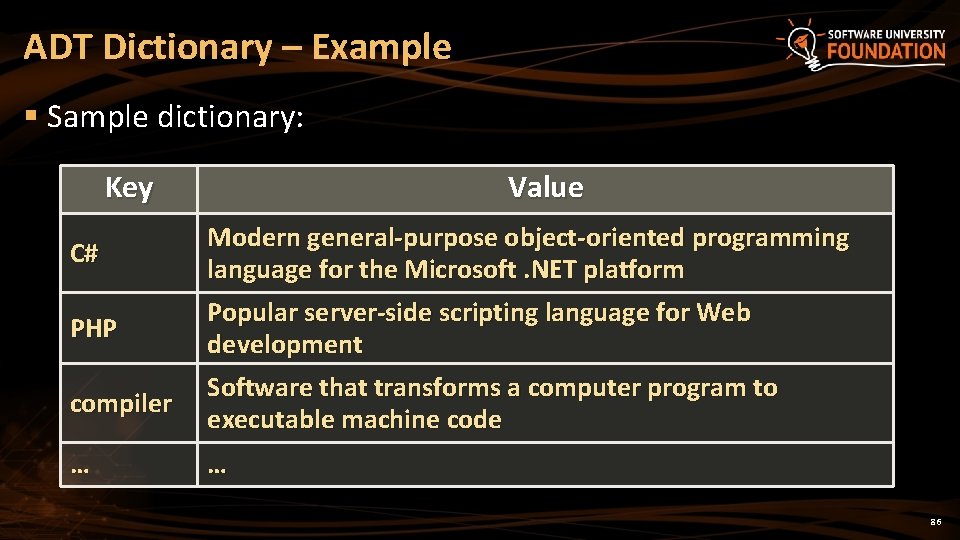
ADT Dictionary – Example § Sample dictionary: Key C# PHP compiler … Value Modern general-purpose object-oriented programming language for the Microsoft. NET platform Popular server-side scripting language for Web development Software that transforms a computer program to executable machine code … 86
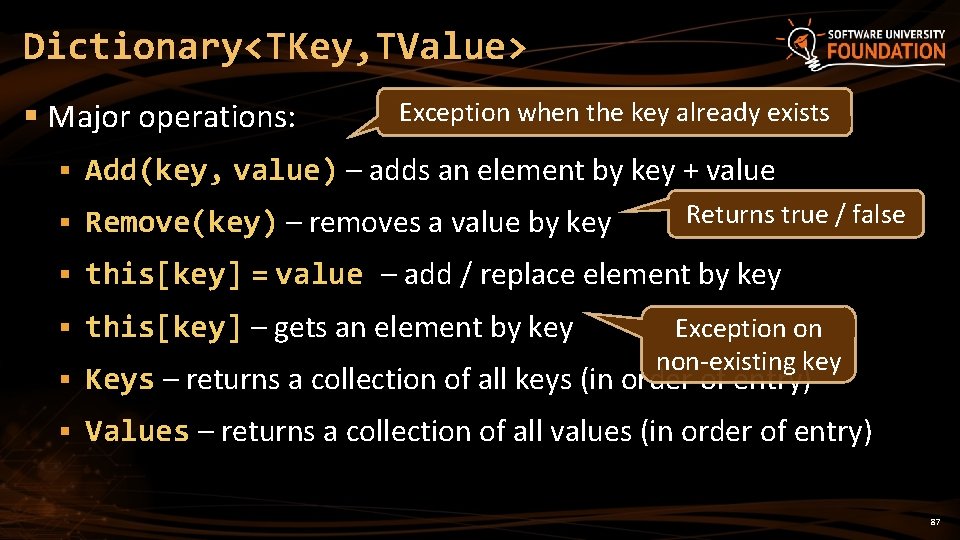
Dictionary<TKey, TValue> § Major operations: Exception when the key already exists § Add(key, value) – adds an element by key + value § Remove(key) – removes a value by key § this[key] = value – add / replace element by key § this[key] – gets an element by key § Keys – returns a collection of all keys (in order of entry) § Values – returns a collection of all values (in order of entry) Returns true / false Exception on non-existing key 87
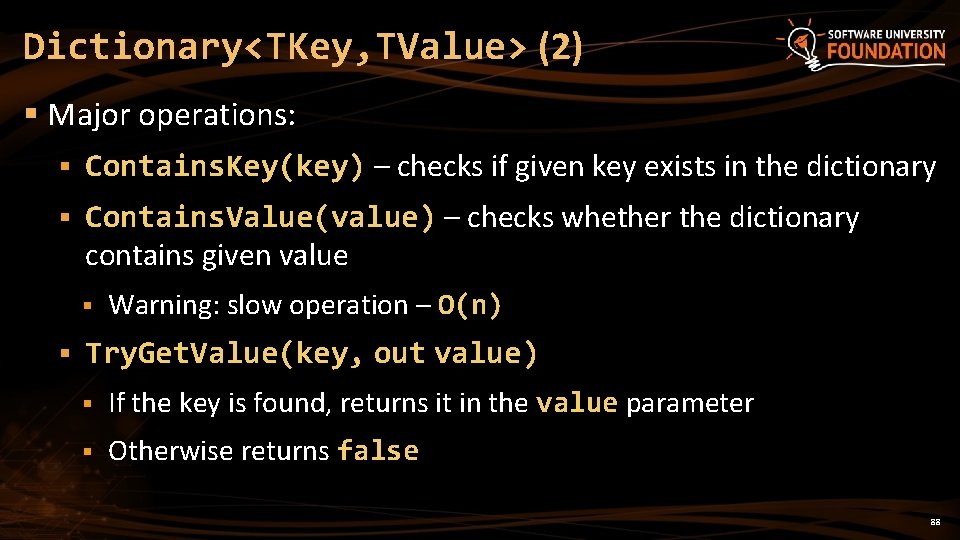
Dictionary<TKey, TValue> (2) § Major operations: § Contains. Key(key) – checks if given key exists in the dictionary § Contains. Value(value) – checks whether the dictionary contains given value § § Warning: slow operation – O(n) Try. Get. Value(key, out value) § If the key is found, returns it in the value parameter § Otherwise returns false 88
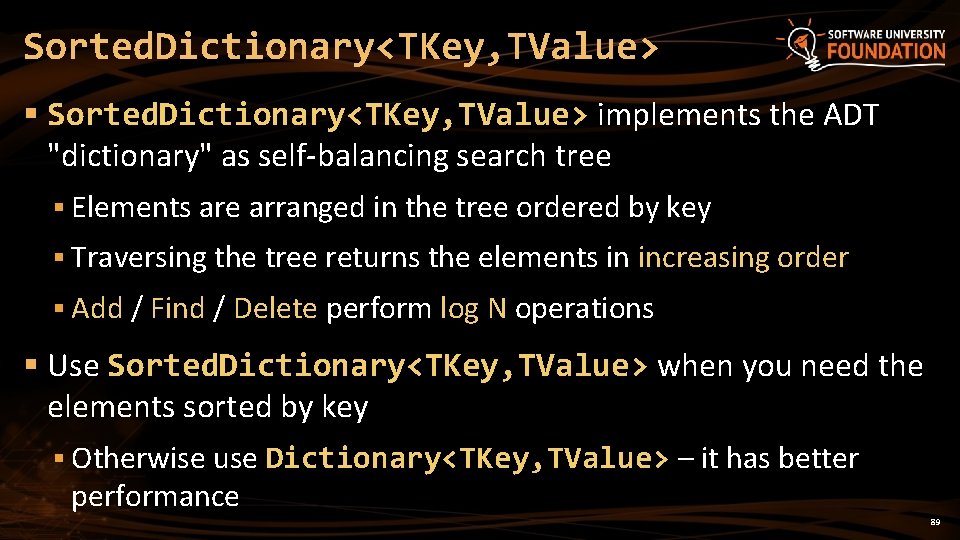
Sorted. Dictionary<TKey, TValue> § Sorted. Dictionary<TKey, TValue> implements the ADT "dictionary" as self-balancing search tree § Elements are arranged in the tree ordered by key § Traversing the tree returns the elements in increasing order § Add / Find / Delete perform log N operations § Use Sorted. Dictionary<TKey, TValue> when you need the elements sorted by key § Otherwise use Dictionary<TKey, TValue> – it has better performance 89

Live Demo Sets and Dictionaries Examples 90
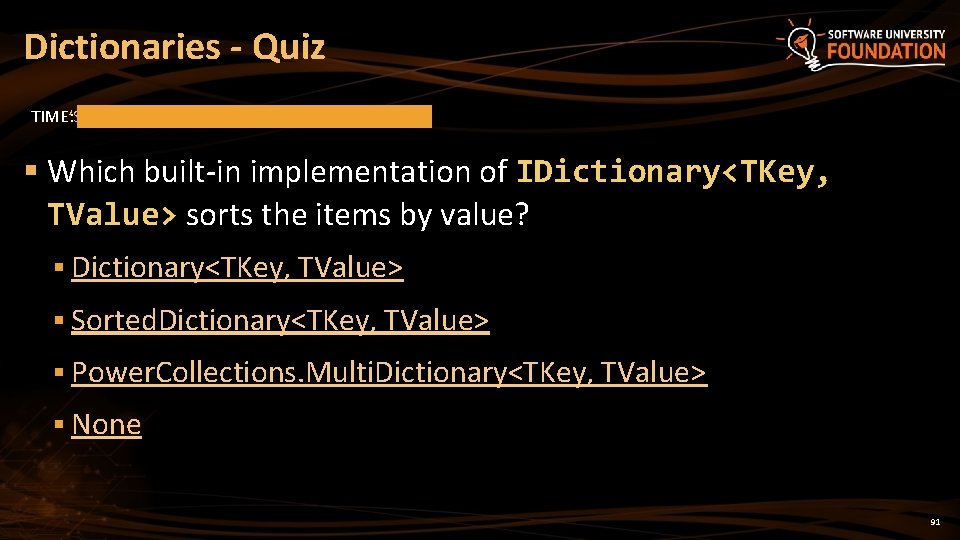
Dictionaries - Quiz TIME’S UP! TIME: § Which built-in implementation of IDictionary<TKey, TValue> sorts the items by value? § Dictionary<TKey, TValue> § Sorted. Dictionary<TKey, TValue> § Power. Collections. Multi. Dictionary<TKey, TValue> § None 91
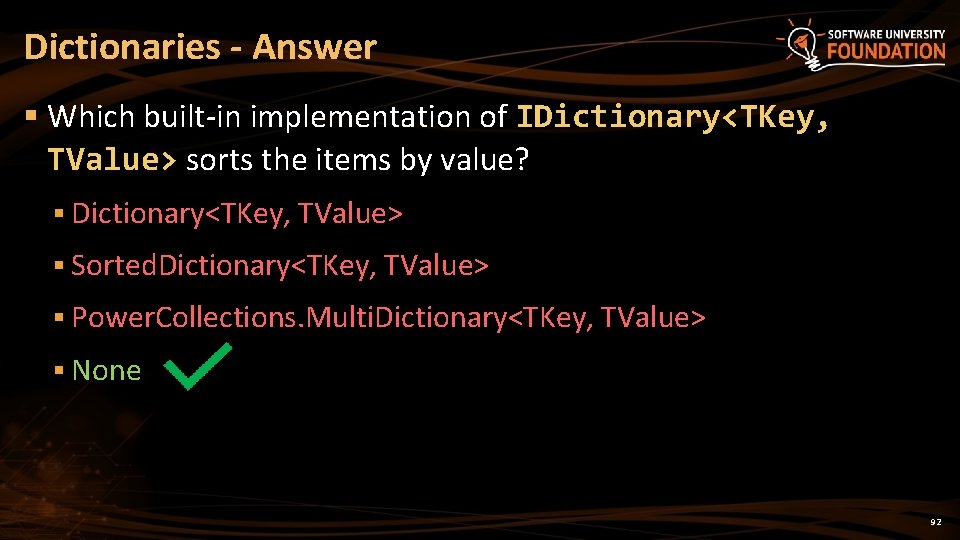
Dictionaries - Answer § Which built-in implementation of IDictionary<TKey, TValue> sorts the items by value? § Dictionary<TKey, TValue> § Sorted. Dictionary<TKey, TValue> § Power. Collections. Multi. Dictionary<TKey, TValue> § None 92
Hash Tables - Quiz TIME’S UP! TIME: § Which is the main reason to use a hash table instead of a redblack BST? § Supports more operations efficiently § Better worst-case performance guarantee § Better performance in practice on typical inputs 93
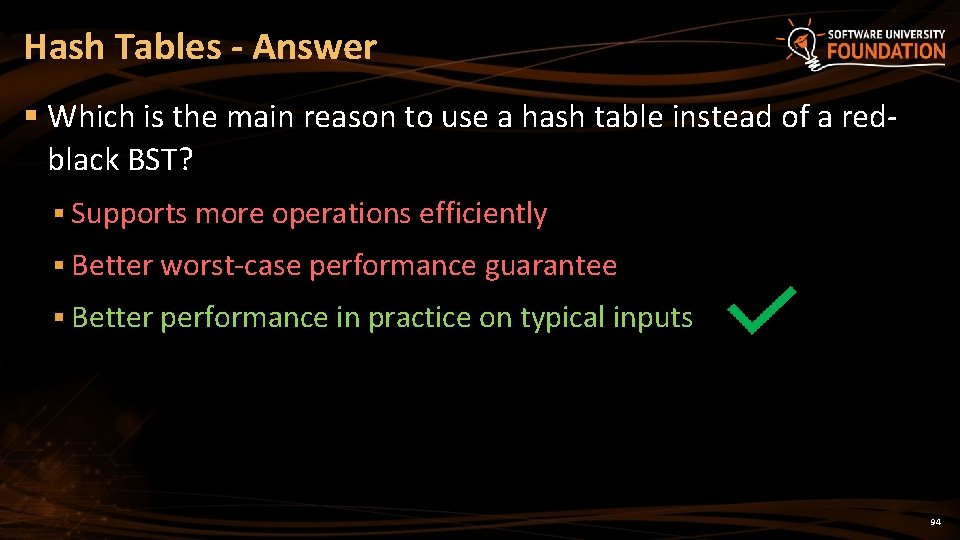
Hash Tables - Answer § Which is the main reason to use a hash table instead of a redblack BST? § Supports more operations efficiently § Better worst-case performance guarantee § Better performance in practice on typical inputs 94
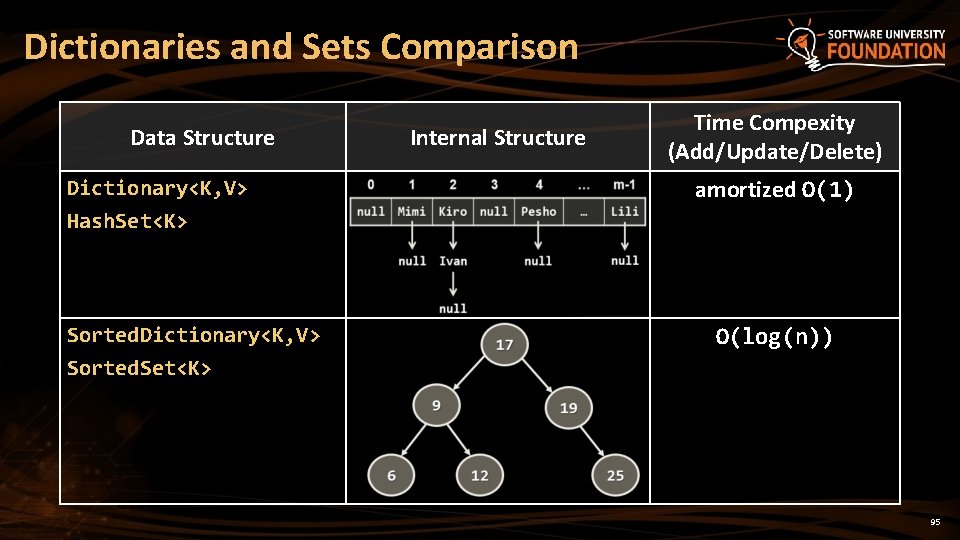
Dictionaries and Sets Comparison Data Structure Dictionary<K, V> Hash. Set<K> Sorted. Dictionary<K, V> Sorted. Set<K> Internal Structure Time Compexity (Add/Update/Delete) amortized O(1) O(log(n)) 95

Summary § Hash-tables map keys to values § Rely on hash-functions to distribute the keys in the table § Collisions needs resolution algorithm (e. g. chaining) § Very fast add / find / delete – O(1) § Sets hold a group of elements § Dictionaries map key to value 96

Hash Tables, Sets and Dictionaries ? s n stio e u Q ? ? ? https: //softuni. bg/opencourses/data-structures
License § This course (slides, examples, labs, videos, homework, etc. ) is licensed under the "Creative Commons Attribution. Non. Commercial-Share. Alike 4. 0 International" license § Attribution: this work may contain portions from § "Fundamentals of Computer Programming with C#" book by Svetlin Nakov & Co. under CC-BY-SA license § "Data Structures and Algorithms" course by Telerik Academy under CC-BY-NC-SA license 98

Trainings @ Software University (Soft. Uni) § Software University – High-Quality Education, Profession and Job for Software Developers § softuni. bg § Software University Foundation § softuni. org § Software University @ Facebook § facebook. com/Software. University § Software University Forums § forum. softuni. bg
- Slides: 99