
Hash Tables Linear Probing Uri Zwick Tel Aviv

Hash Tables: Linear Probing Uri Zwick Tel Aviv University Started: April 2015 Last update: January 12, 2017
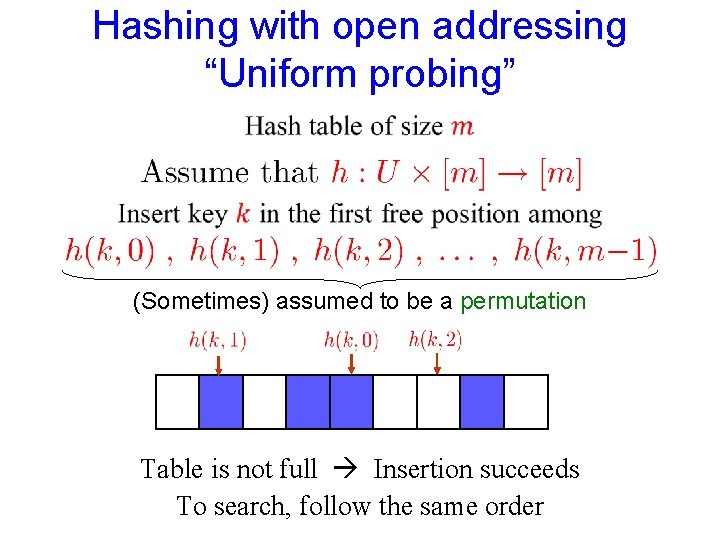
Hashing with open addressing “Uniform probing” (Sometimes) assumed to be a permutation Table is not full Insertion succeeds To search, follow the same order
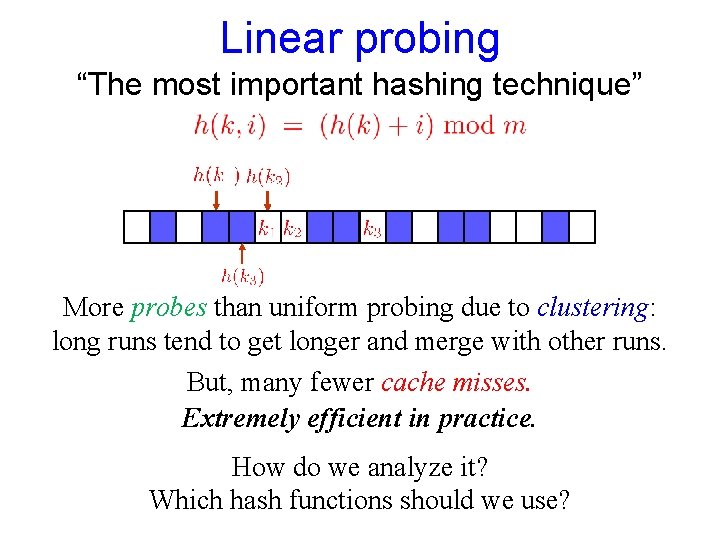
Linear probing “The most important hashing technique” More probes than uniform probing due to clustering: long runs tend to get longer and merge with other runs. But, many fewer cache misses. Extremely efficient in practice. How do we analyze it? Which hash functions should we use?
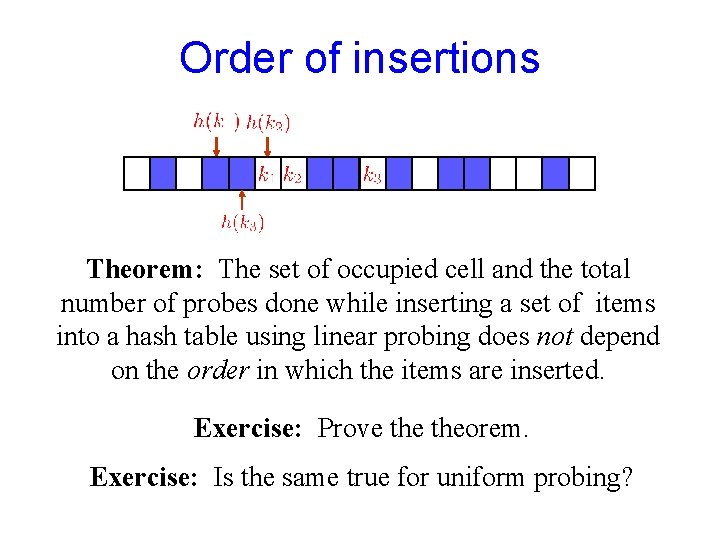
Order of insertions Theorem: The set of occupied cell and the total number of probes done while inserting a set of items into a hash table using linear probing does not depend on the order in which the items are inserted. Exercise: Prove theorem. Exercise: Is the same true for uniform probing?

Number of probes
![Probabilistic analysis of uniform probing [Petersen (1957)] Expected no. of probes in an unsuccessful](http://slidetodoc.com/presentation_image_h2/ef9d4df4cf5028e3db79d4af6a4762ee/image-6.jpg "Probabilistic analysis of uniform probing [Petersen (1957)] Expected no. of probes in an unsuccessful")
Probabilistic analysis of uniform probing [Petersen (1957)] Expected no. of probes in an unsuccessful search of a random item is at most Expected no. of probes in a successful search is at most
![Probabilistic analysis of uniform probing [Petersen (1957)] Claim: Expected no. of probes in an](http://slidetodoc.com/presentation_image_h2/ef9d4df4cf5028e3db79d4af6a4762ee/image-7.jpg "Probabilistic analysis of uniform probing [Petersen (1957)] Claim: Expected no. of probes in an")
Probabilistic analysis of uniform probing [Petersen (1957)] Claim: Expected no. of probes in an unsuccessful search is at most:
![Probabilistic analysis of linear probing [Knuth (1962)] Expected no. of probes in an unsuccessful](http://slidetodoc.com/presentation_image_h2/ef9d4df4cf5028e3db79d4af6a4762ee/image-8.jpg "Probabilistic analysis of linear probing [Knuth (1962)] Expected no. of probes in an unsuccessful")
Probabilistic analysis of linear probing [Knuth (1962)] Expected no. of probes in an unsuccessful search is at most Expected no. of probes in a successful search of a random item is at most
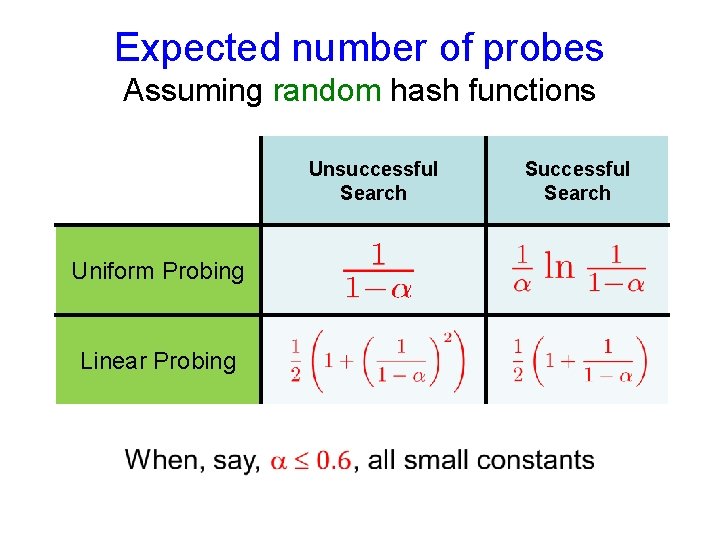
Expected number of probes Assuming random hash functions Unsuccessful Search Uniform Probing Linear Probing Successful Search
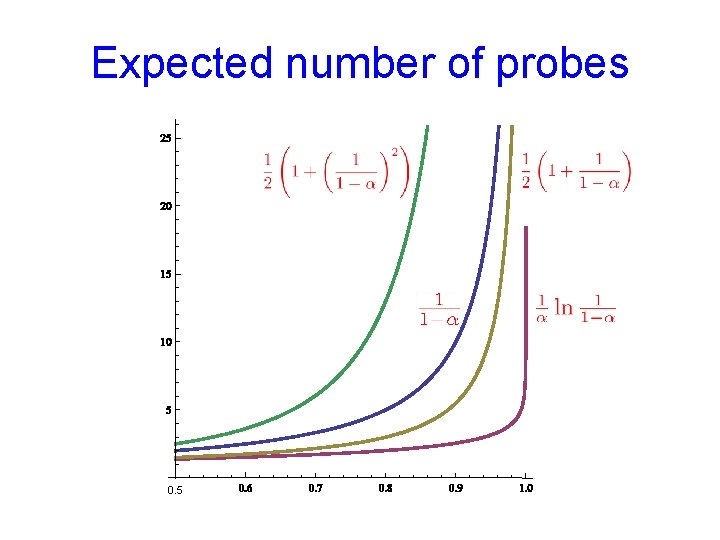
Expected number of probes 0. 5
![Probabilistic analysis of linear probing [Knuth (1962)] By symmetry, all cells are equally likely](http://slidetodoc.com/presentation_image_h2/ef9d4df4cf5028e3db79d4af6a4762ee/image-11.jpg "Probabilistic analysis of linear probing [Knuth (1962)] By symmetry, all cells are equally likely")
Probabilistic analysis of linear probing [Knuth (1962)] By symmetry, all cells are equally likely to be empty 11
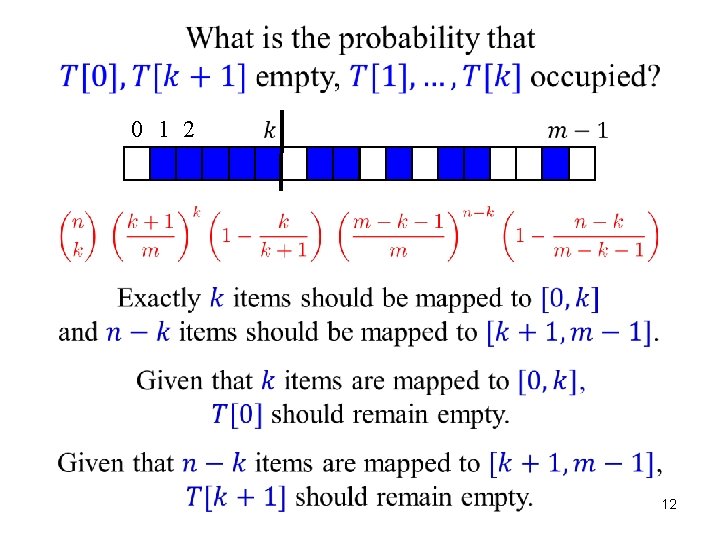
0 1 2 12
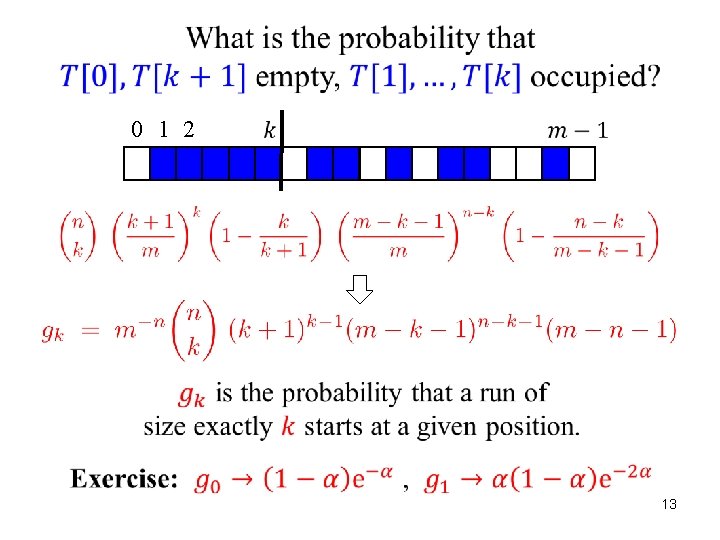
0 1 2 13
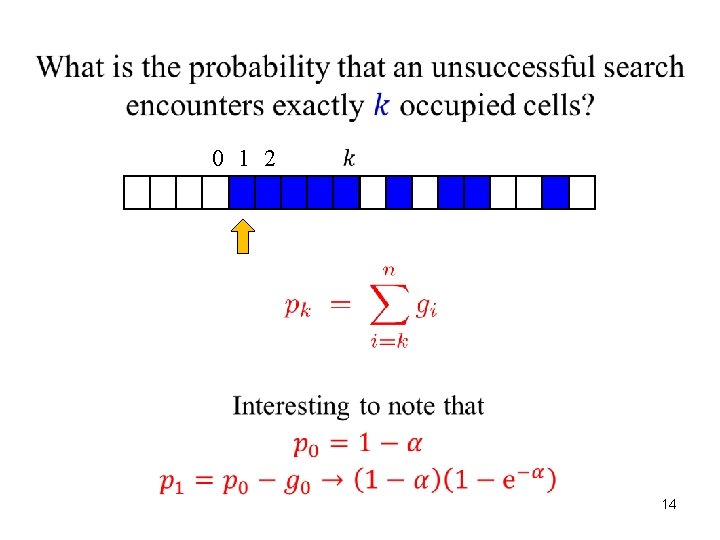
0 1 2 14
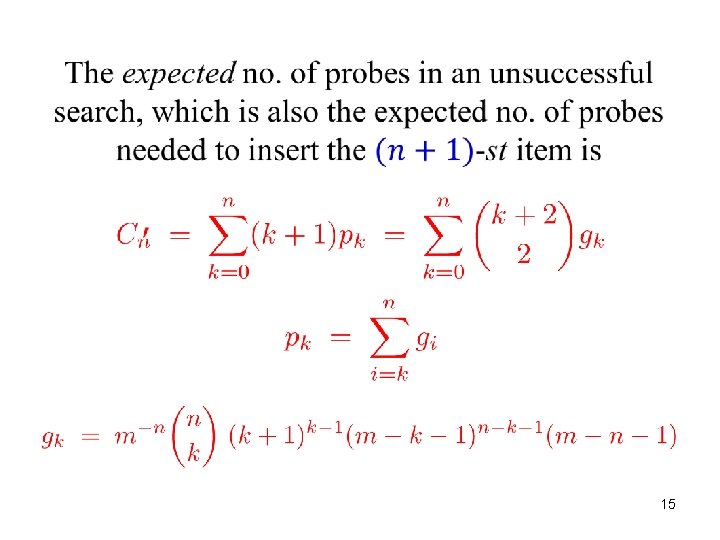
15
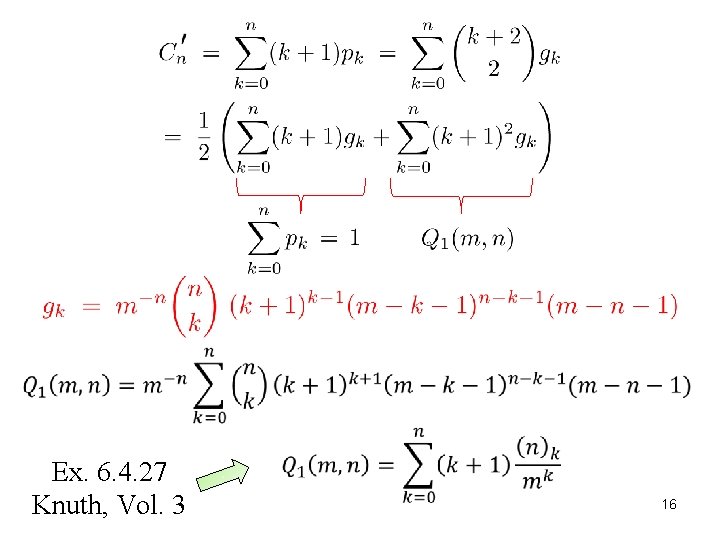
Ex. 6. 4. 27 Knuth, Vol. 3 16
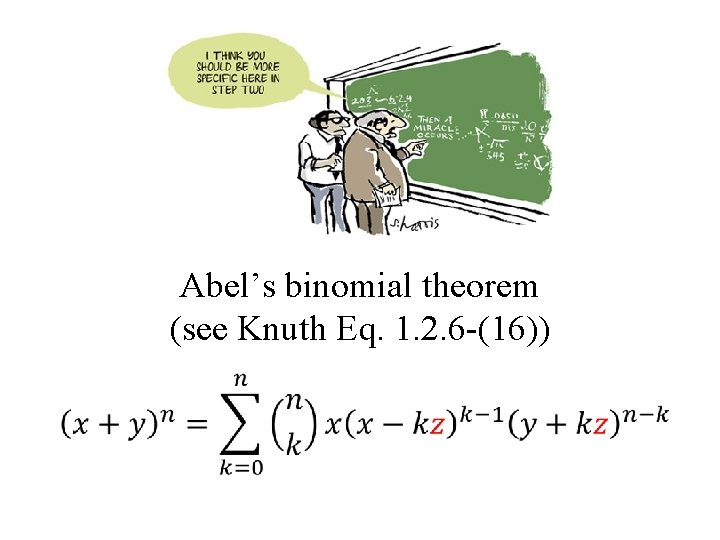
Abel’s binomial theorem (see Knuth Eq. 1. 2. 6 -(16))
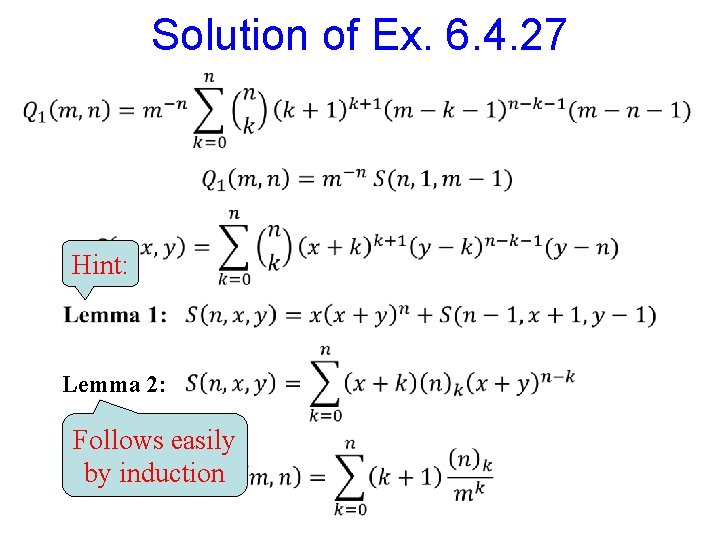
Solution of Ex. 6. 4. 27 Hint: Lemma 2: Follows easily by induction
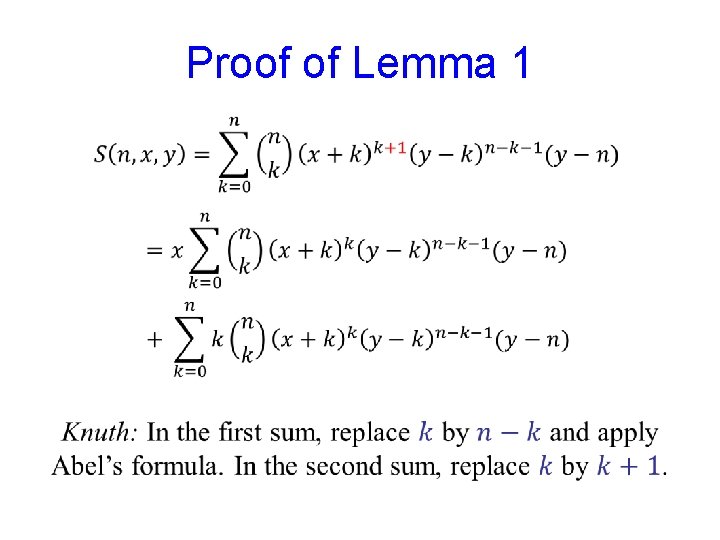
Proof of Lemma 1
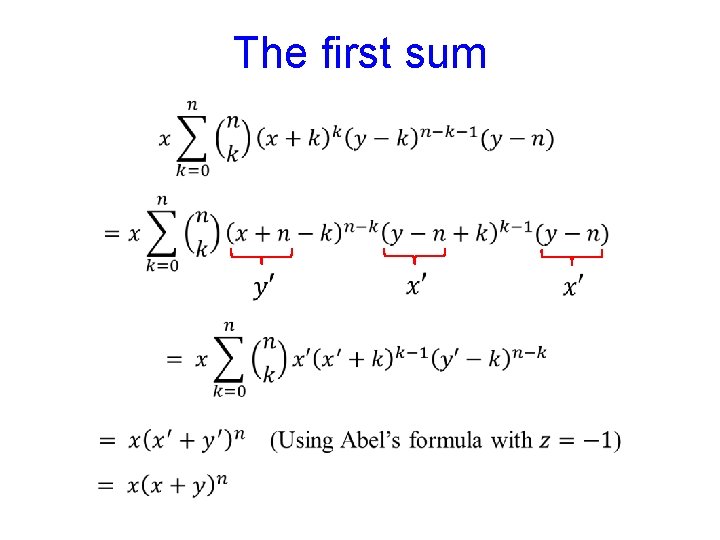
The first sum
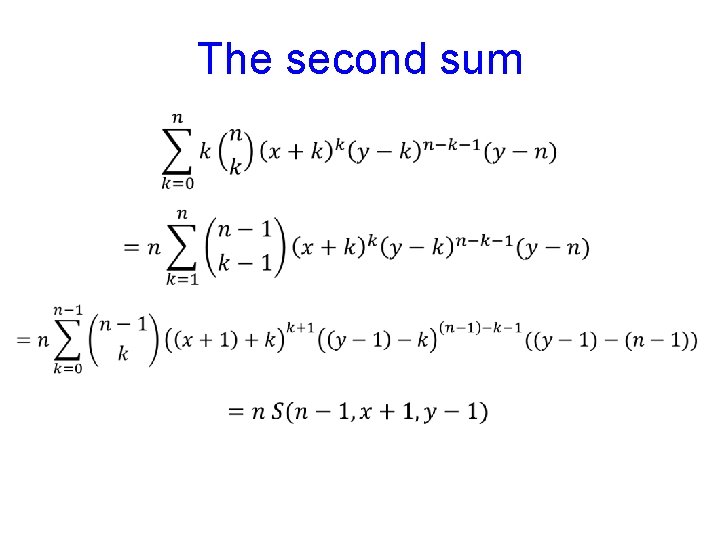
The second sum
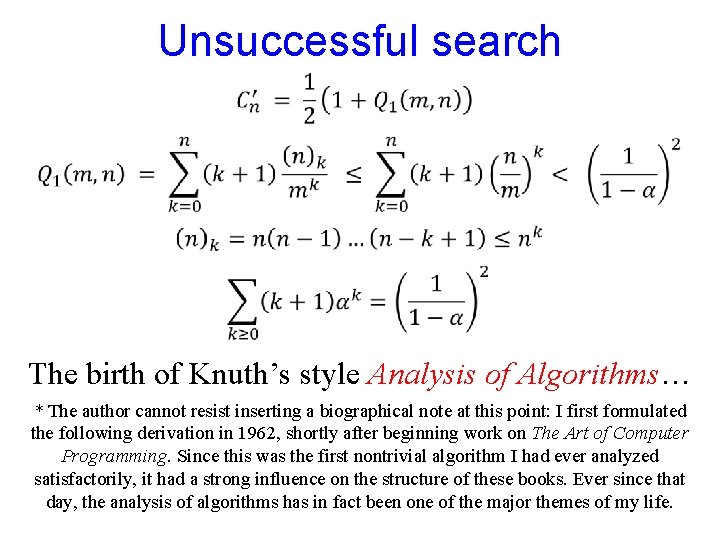
Unsuccessful search The birth of Knuth’s style Analysis of Algorithms… * The author cannot resist inserting a biographical note at this point: I first formulated the following derivation in 1962, shortly after beginning work on The Art of Computer Programming. Since this was the first nontrivial algorithm I had ever analyzed satisfactorily, it had a strong influence on the structure of these books. Ever since that day, the analysis of algorithms has in fact been one of the major themes of my life.
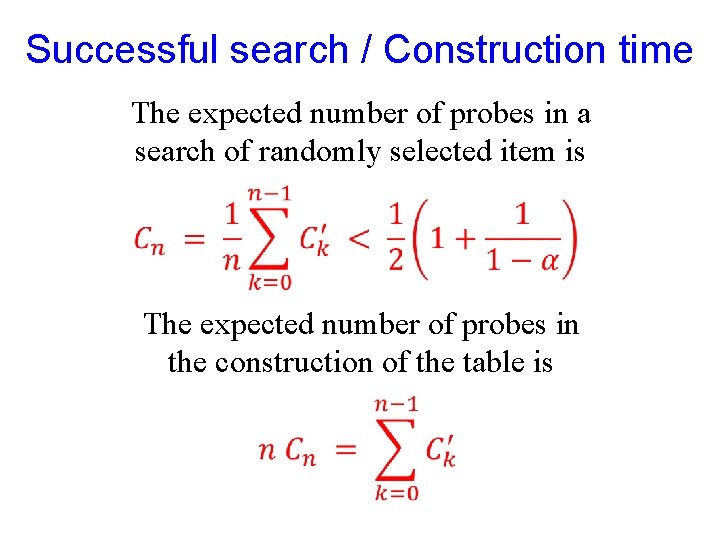
Successful search / Construction time The expected number of probes in a search of randomly selected item is The expected number of probes in the construction of the table is
![The “parking problem” [Knuth (1962)] [Konheim-Weiss (1966)] Exercise: What is the probability that all](http://slidetodoc.com/presentation_image_h2/ef9d4df4cf5028e3db79d4af6a4762ee/image-24.jpg "The “parking problem” [Knuth (1962)] [Konheim-Weiss (1966)] Exercise: What is the probability that all")
The “parking problem” [Knuth (1962)] [Konheim-Weiss (1966)] Exercise: What is the probability that all cars find a parking spot? 24
Linear Probing: Theory vs. Practice In practice, we cannot use a truly random hash function. Does linear probing still have a constant expected time per operation when more realistic hash functions are used? For chaining, 2 -independence, or just “universality”, is enough. How much independence is needed for linear probing?
![Linear Probing: Theory vs. Practice 5 -independence suffices for linear probing! [Pagh-Rŭzíc (2009)] 4](http://slidetodoc.com/presentation_image_h2/ef9d4df4cf5028e3db79d4af6a4762ee/image-26.jpg "Linear Probing: Theory vs. Practice 5 -independence suffices for linear probing! [Pagh-Rŭzíc (2009)] 4")
Linear Probing: Theory vs. Practice 5 -independence suffices for linear probing! [Pagh-Rŭzíc (2009)] 4 -independence does not suffice! [Pătraşcu-Thorup (2010)]
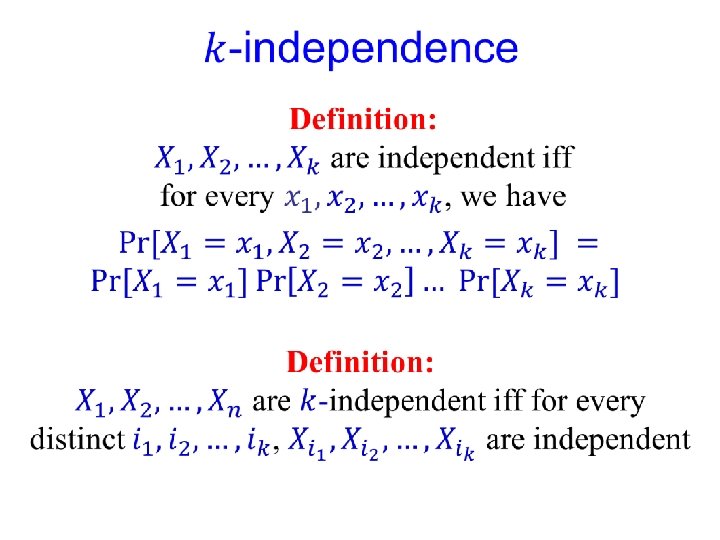
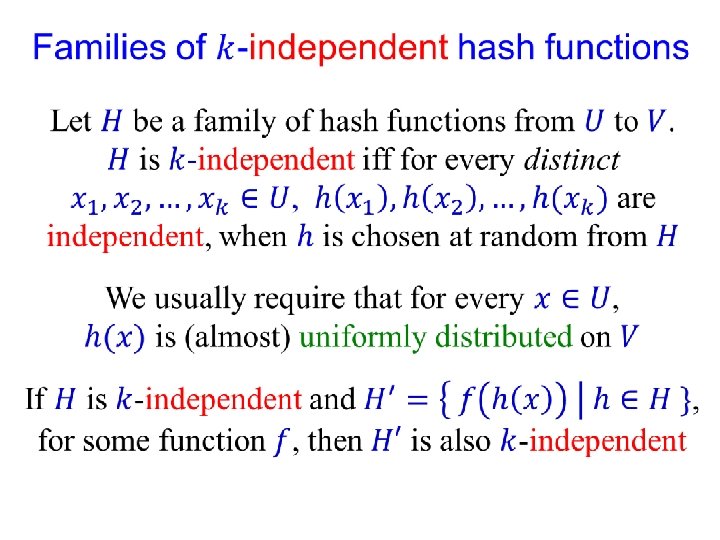
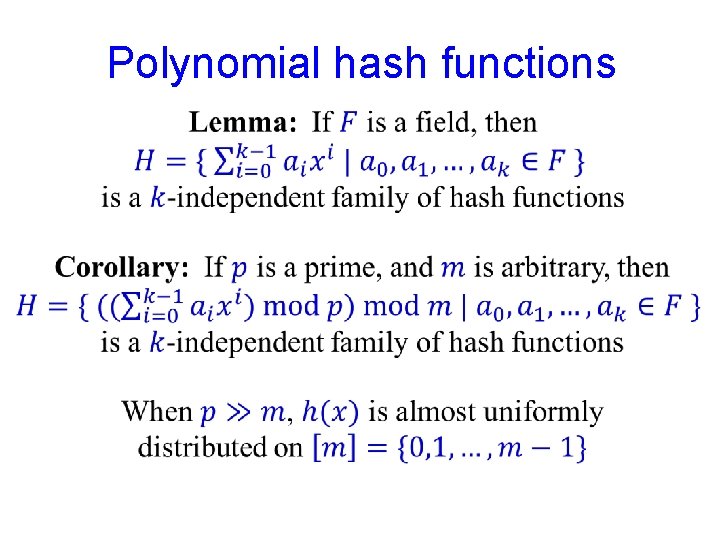
Polynomial hash functions

Polynomial hash functions Unique solution!
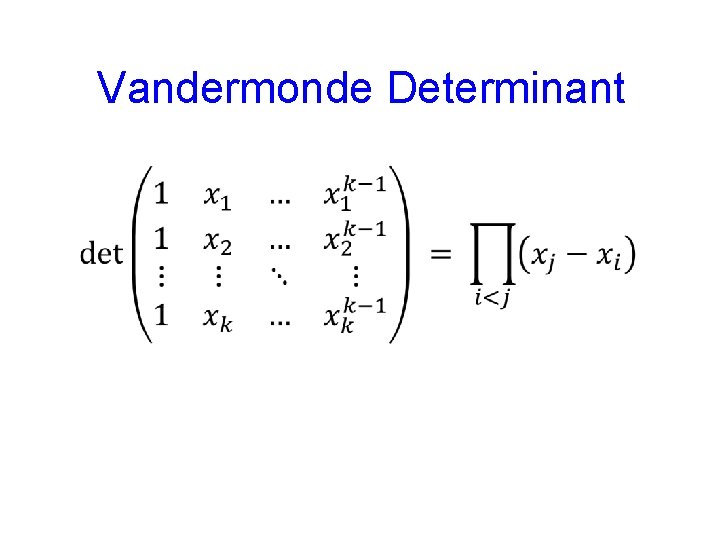
Vandermonde Determinant
![Tabulation-based hash functions [Carter-Wegman (1979)] [Pătraşcu-Thorup (2010)] Very efficient in practice](http://slidetodoc.com/presentation_image_h2/ef9d4df4cf5028e3db79d4af6a4762ee/image-32.jpg "Tabulation-based hash functions [Carter-Wegman (1979)] [Pătraşcu-Thorup (2010)] Very efficient in practice")
Tabulation-based hash functions [Carter-Wegman (1979)] [Pătraşcu-Thorup (2010)] Very efficient in practice
![Tabulation-based hash functions [Carter-Wegman (1979)] [Pătraşcu-Thorup (2010)] Not 4 -independent!](http://slidetodoc.com/presentation_image_h2/ef9d4df4cf5028e3db79d4af6a4762ee/image-33.jpg "Tabulation-based hash functions [Carter-Wegman (1979)] [Pătraşcu-Thorup (2010)] Not 4 -independent!")
Tabulation-based hash functions [Carter-Wegman (1979)] [Pătraşcu-Thorup (2010)] Not 4 -independent!
![Tabulation-based hash functions [Thorup-Zhang (2012)] Higher independence possible at the cost of more table](http://slidetodoc.com/presentation_image_h2/ef9d4df4cf5028e3db79d4af6a4762ee/image-34.jpg "Tabulation-based hash functions [Thorup-Zhang (2012)] Higher independence possible at the cost of more table")
Tabulation-based hash functions [Thorup-Zhang (2012)] Higher independence possible at the cost of more table look-ups
![Linear probing with bounded independence [Pagh-Rŭzíc (2009)] [Pătraşcu-Thorup (2010)] Independence 2 3 4 5](http://slidetodoc.com/presentation_image_h2/ef9d4df4cf5028e3db79d4af6a4762ee/image-35.jpg "Linear probing with bounded independence [Pagh-Rŭzíc (2009)] [Pătraşcu-Thorup (2010)] Independence 2 3 4 5")
Linear probing with bounded independence [Pagh-Rŭzíc (2009)] [Pătraşcu-Thorup (2010)] Independence 2 3 4 5 Search time Construction time Upper bounds hold for any set of keys and any family with the specified independence. Lower bounds hold for some sets of keys and some families with the specified independence. 35
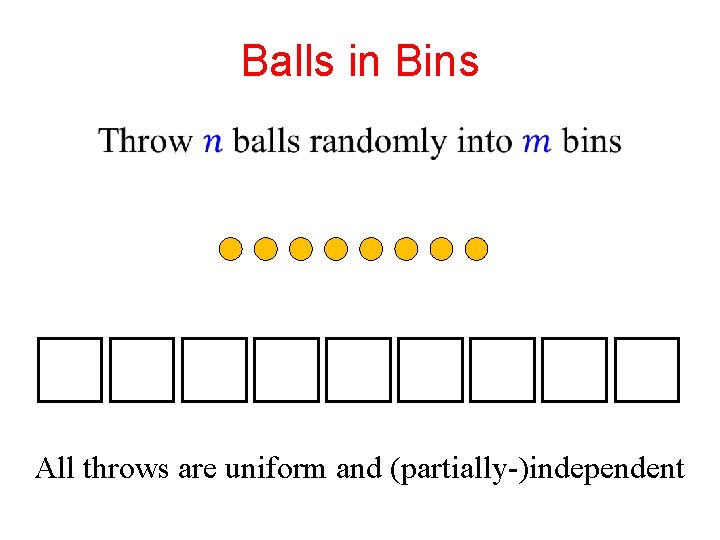
Balls in Bins All throws are uniform and (partially-)independent
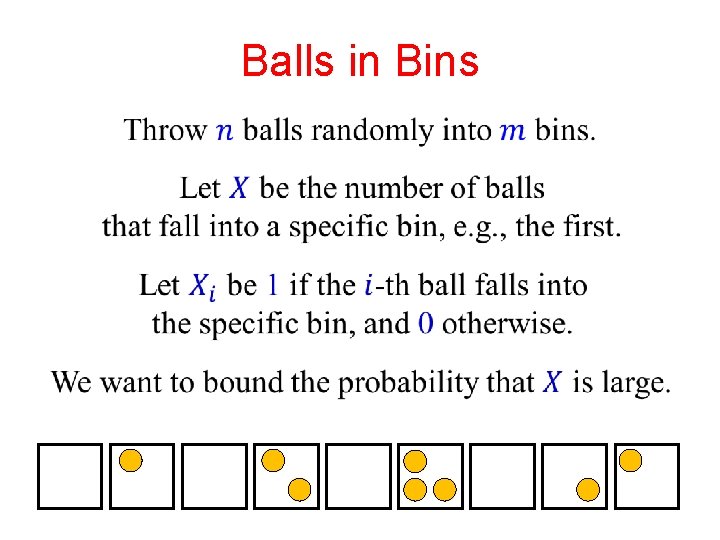
Balls in Bins
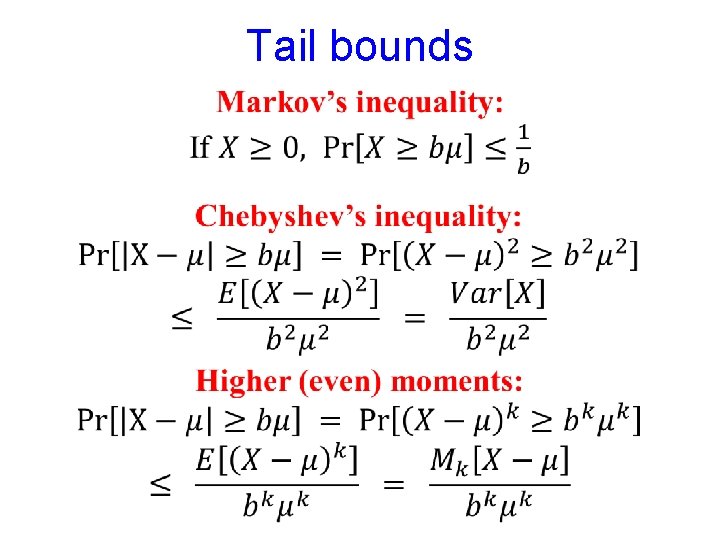
Tail bounds
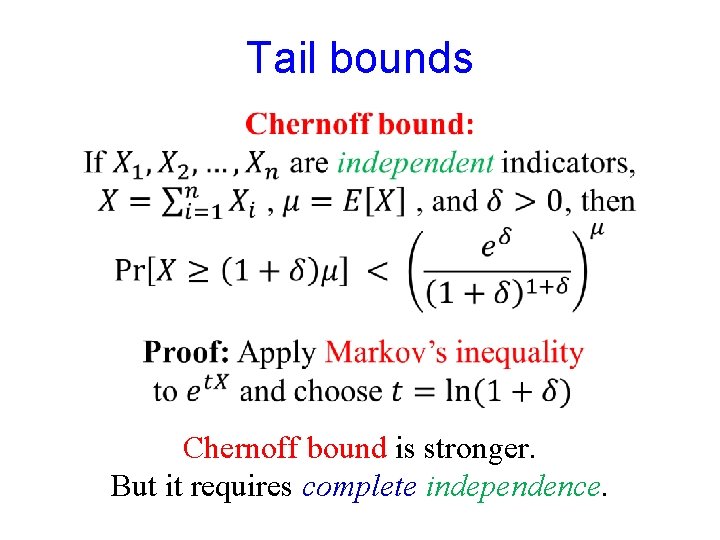
Tail bounds Chernoff bound is stronger. But it requires complete independence.
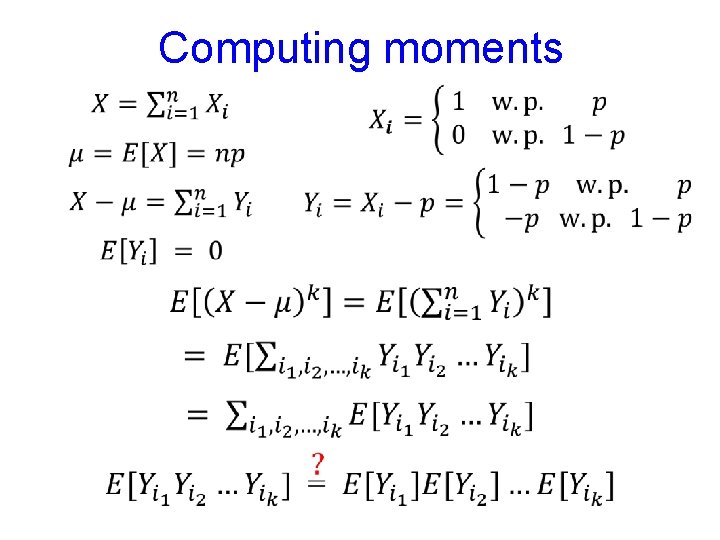
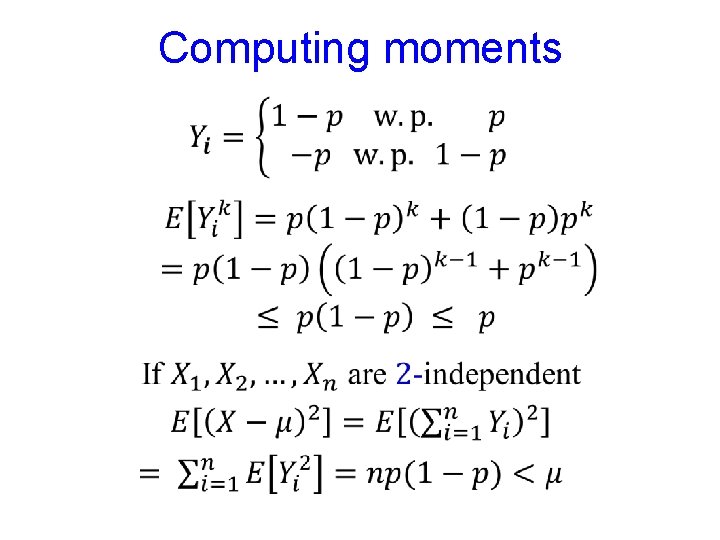
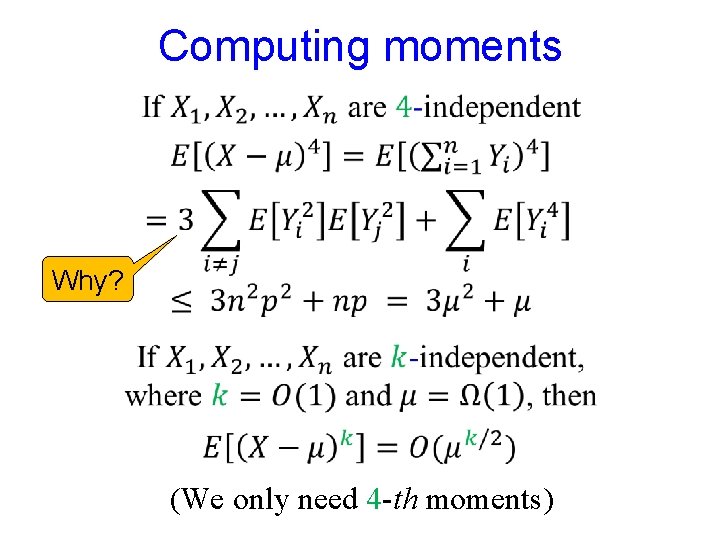
Computing moments
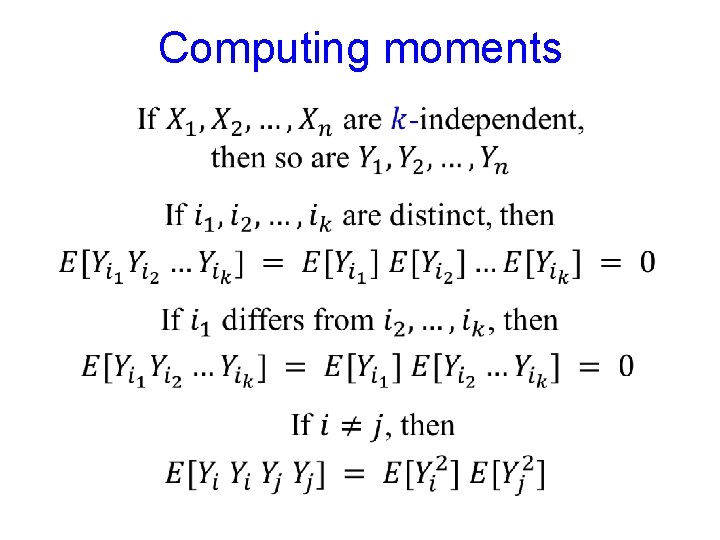
Computing moments
Computing moments
Computing moments Why? (We only need 4 -th moments)
Planting a binary tree
![Crowded nodes [Pătraşcu-Thorup (2010)] Simplifying assumptions: The final locations of items mapped into an](http://slidetodoc.com/presentation_image_h2/ef9d4df4cf5028e3db79d4af6a4762ee/image-45.jpg "Crowded nodes [Pătraşcu-Thorup (2010)] Simplifying assumptions: The final locations of items mapped into an")
Crowded nodes [Pătraşcu-Thorup (2010)] Simplifying assumptions: The final locations of items mapped into an interval may be outside the interval.
Simple observation I
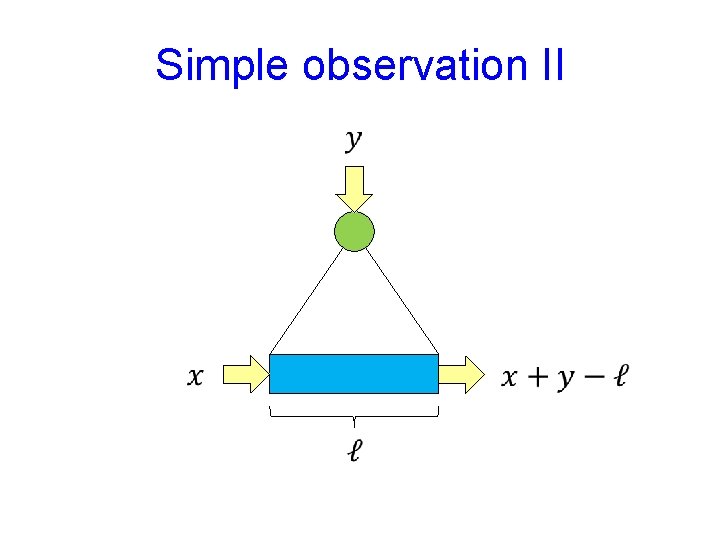
Simple observation II
![Main observation [Pătraşcu-Thorup (2010)] 1 2 3 4](http://slidetodoc.com/presentation_image_h2/ef9d4df4cf5028e3db79d4af6a4762ee/image-48.jpg "Main observation [Pătraşcu-Thorup (2010)] 1 2 3 4")
Main observation [Pătraşcu-Thorup (2010)] 1 2 3 4
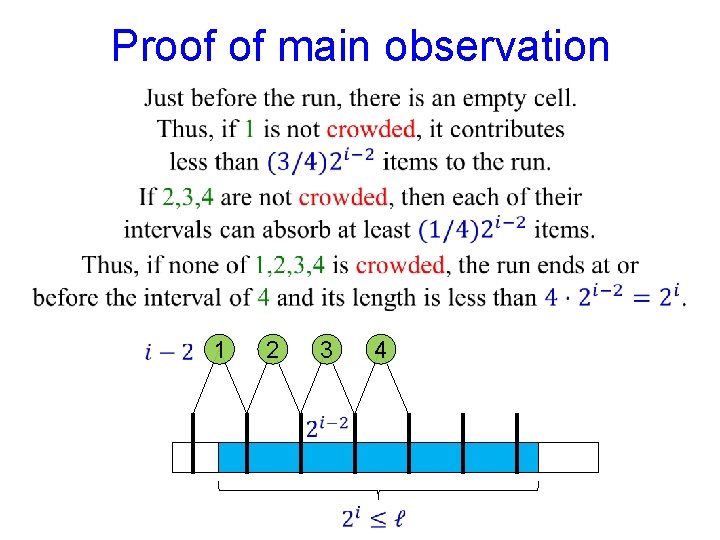
Proof of main observation 1 2 3 4
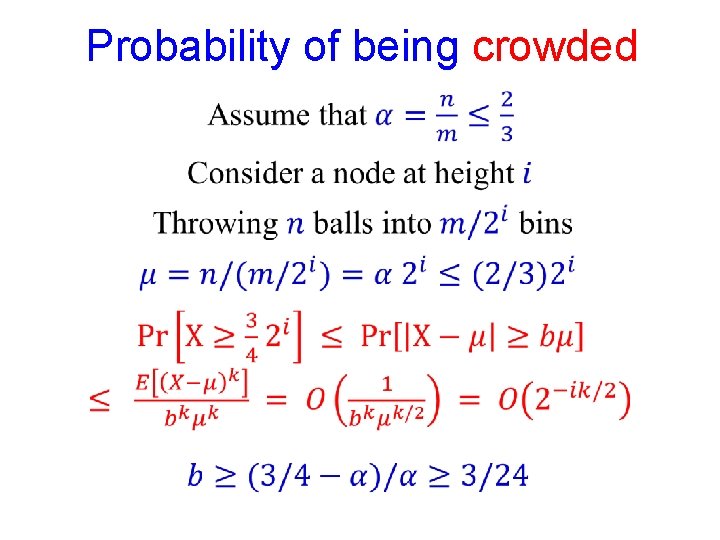
Probability of being crowded
![Construction time [Pătraşcu-Thorup (2010)]](http://slidetodoc.com/presentation_image_h2/ef9d4df4cf5028e3db79d4af6a4762ee/image-51.jpg "Construction time [Pătraşcu-Thorup (2010)]")
Construction time [Pătraşcu-Thorup (2010)]
![Construction time [Pătraşcu-Thorup (2010)]](http://slidetodoc.com/presentation_image_h2/ef9d4df4cf5028e3db79d4af6a4762ee/image-52.jpg "Construction time [Pătraşcu-Thorup (2010)]")
Construction time [Pătraşcu-Thorup (2010)]
![Query time (successful/unsuccessful) [Pătraşcu-Thorup (2010)]](http://slidetodoc.com/presentation_image_h2/ef9d4df4cf5028e3db79d4af6a4762ee/image-53.jpg "Query time (successful/unsuccessful) [Pătraşcu-Thorup (2010)]")
Query time (successful/unsuccessful) [Pătraşcu-Thorup (2010)]
![Query time (successful/unsuccessful) [Pătraşcu-Thorup (2010)]](http://slidetodoc.com/presentation_image_h2/ef9d4df4cf5028e3db79d4af6a4762ee/image-54.jpg "Query time (successful/unsuccessful) [Pătraşcu-Thorup (2010)]")
Query time (successful/unsuccessful) [Pătraşcu-Thorup (2010)]
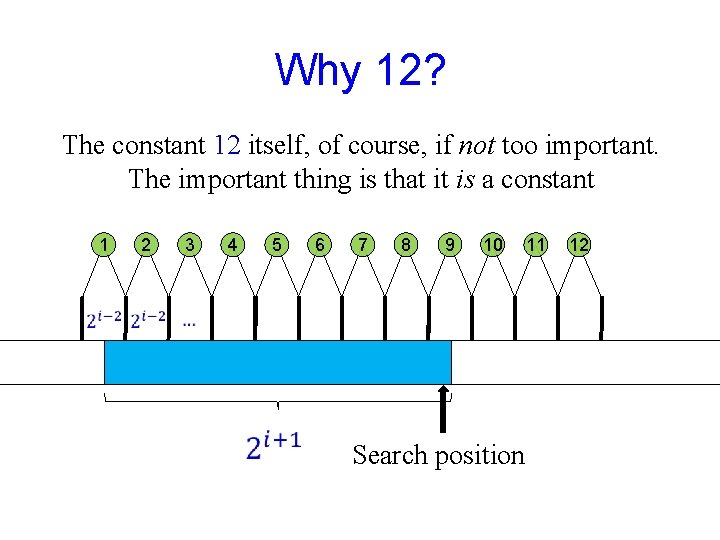
Why 12? The constant 12 itself, of course, if not too important. The important thing is that it is a constant 1 2 3 4 5 6 7 8 9 10 Search position 11 12
- Slides: 55