
Has the Blind Mexican Cave Fish Lost its
Has the Blind Mexican Cave Fish Lost its Rhythm? Abigail Bailey & Natalie Hafez

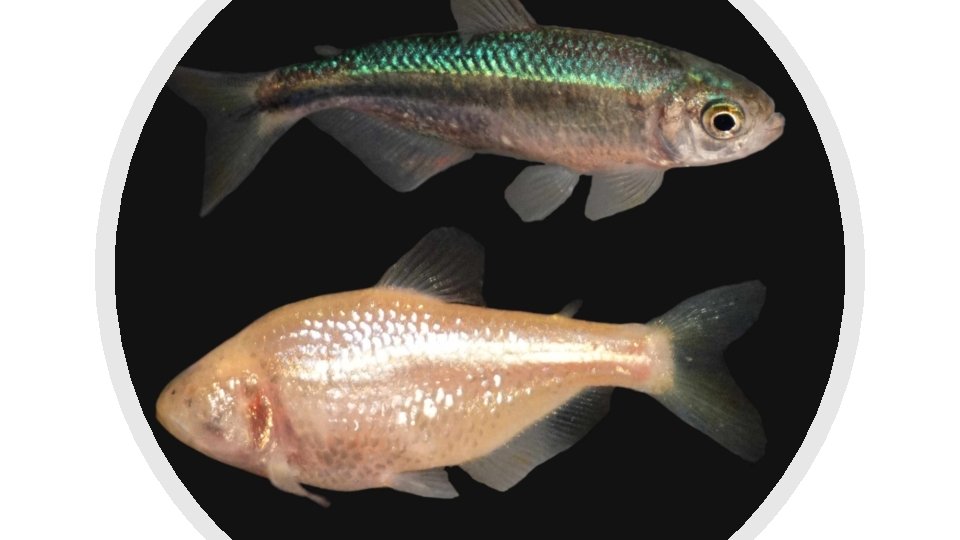
Introduction • Circadian rhythm is an internal genetic timing system primarily dependent on light • Cave animals have limited ability to detect changes in light due to their environment • The Mexican cave fish lives in darkness and has developed troglomorphic characteristics • Astyanax mexicanus is not affected by day/night cycles
Hypothesis: • Astyanax mexicanus has altered circadian rhythm proteins that are reliant on visual perception • Astyanax mexicanus has altered light input pathway
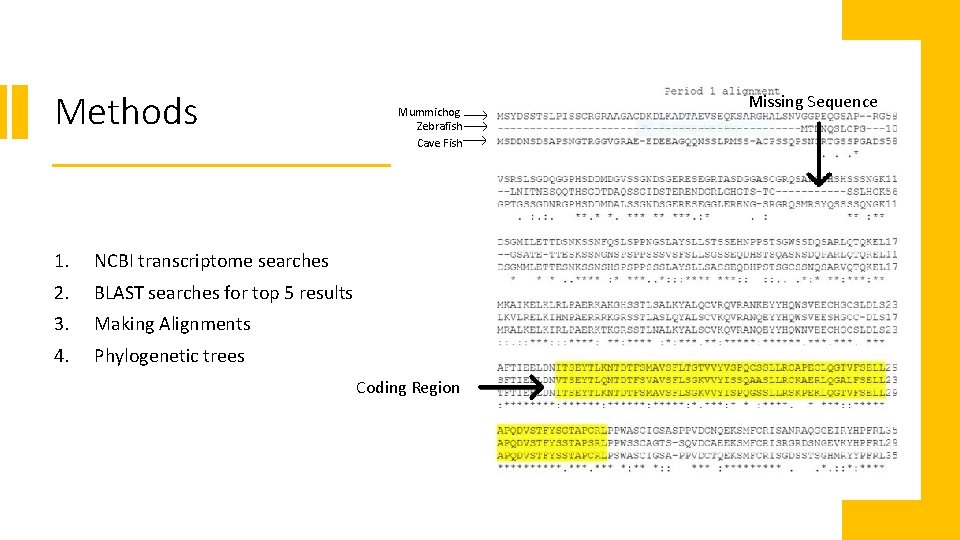
Methods 1. NCBI transcriptome searches 2. BLAST searches for top 5 results 3. Making Alignments 4. Phylogenetic trees Mummichog Zebrafish Cave Fish Coding Region Missing Sequence
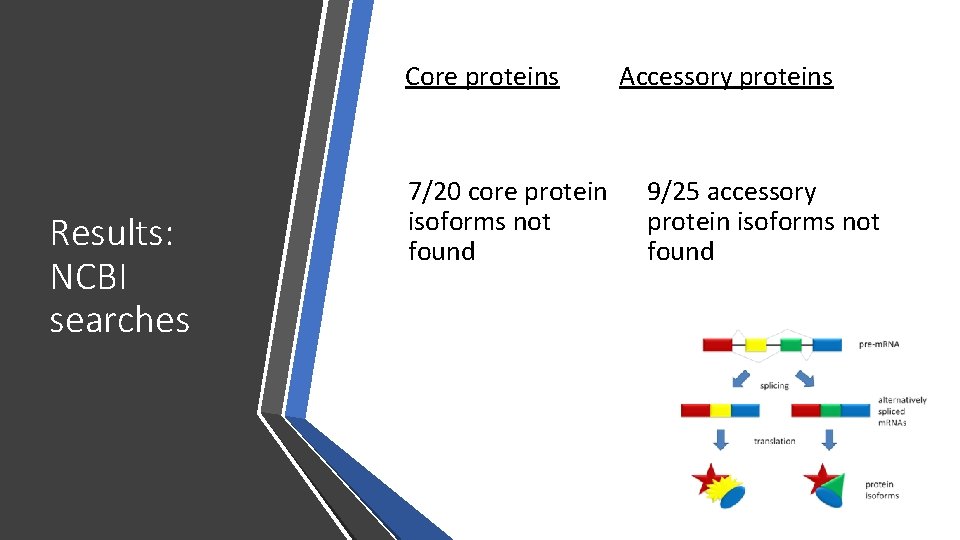
Core proteins Results: NCBI searches 7/20 core protein isoforms not found Accessory proteins 9/25 accessory protein isoforms not found
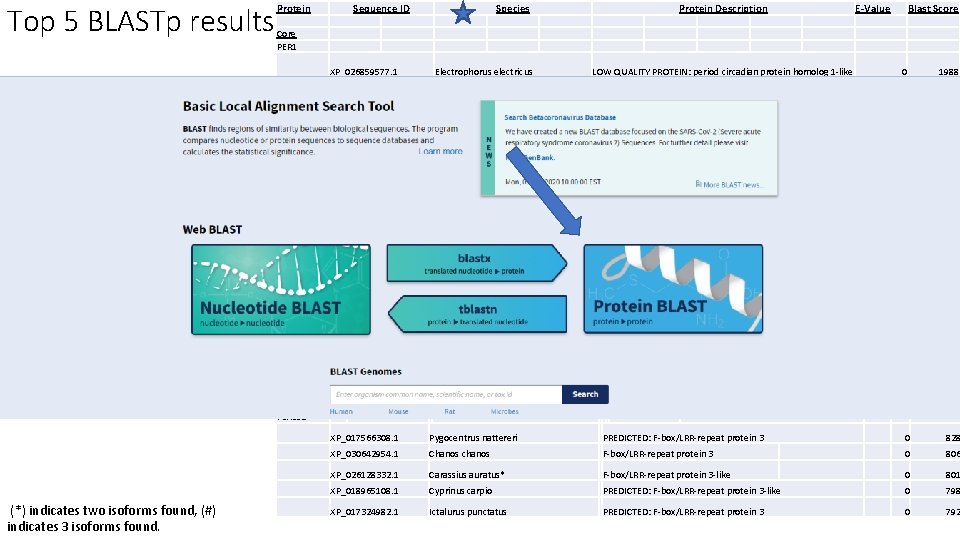
Top 5 BLASTp results Protein The same species occurring • Warm, freshwater fish • Sinocyclocheilus Species Protein Description E-Value Blast Score Core PER 1 Core proteins • Sequence ID XP_026859577. 1 Electrophorus electricus LOW QUALITY PROTEIN: period circadian protein homolog 1 -like 0 1988 XP_016372039. 1 Sinocyclocheilus rhinocerous* PREDICTED: period circadian protein homolog 1 -like isoform X 1 0 1929 XP_016096450. 1 XP_026070899. 1 Sinocyclocheilus grahami* Carassius auratus* PREDICTED: period circadian protein homolog 1 -like isoform X 2 period circadian protein homolog 1 -like 0 0 1869 1862 XP_016328367. 1 Sinocyclocheilus anshuiensis PREDICTED: period circadian protein homolog 1 -like isoform X 2 0 1859 XP_017543591. 1 Pygocentrus nattereri PREDICTED: circadian locomoter output cycles protein kaput 0 1417 XP_027001955. 1 Tachysurus fulvidraco* 0 1413 XP_016149761. 1 Sinocyclocheilus grahami* 0 1402 XP_017311559. 1 Ictalurus punctatus* circadian locomoter output cycles protein kaput isoform X 2 PREDICTED: circadian locomoter output cycles protein kaput isoform X 1 0 1397 XP_021324029. 1 Danio rerio# circadian locomoter output cycles protein kaput isoform X 2 0 1387 XP_017560258. 1 Pygocentrus nattereri# PREDICTED: protein timeless homolog isoform X 3 0 2047 XP_017306586. 1 Ictalurus punctatus PREDICTED: protein timeless homolog 0 1984 XP_027021368. 1 Tachysurus fulvidraco* protein timeless homolog isoform X 1 0 1977 XP_026788703. 1 Pangasianodon hypophthalmus# protein timeless homolog isoform X 2 0 1944 XP_030632952. 1 Chanos chanos protein timeless homolog isoform X 1 Chanos chanos 0 1884 CLOCK 1 Accessory proteins • Model fishes • No clear relationships Timeless FBXL 3 a (*) indicates two isoforms found, (#) indicates 3 isoforms found. XP_017566308. 1 Pygocentrus nattereri PREDICTED: F-box/LRR-repeat protein 3 0 828 XP_030642954. 1 Chanos chanos F-box/LRR-repeat protein 3 0 806 XP_026128332. 1 Carassius auratus* F-box/LRR-repeat protein 3 -like 0 801 XP_018965108. 1 Cyprinus carpio PREDICTED: F-box/LRR-repeat protein 3 -like 0 798 XP_017324982. 1 Ictalurus punctatus PREDICTED: F-box/LRR-repeat protein 3 0 792
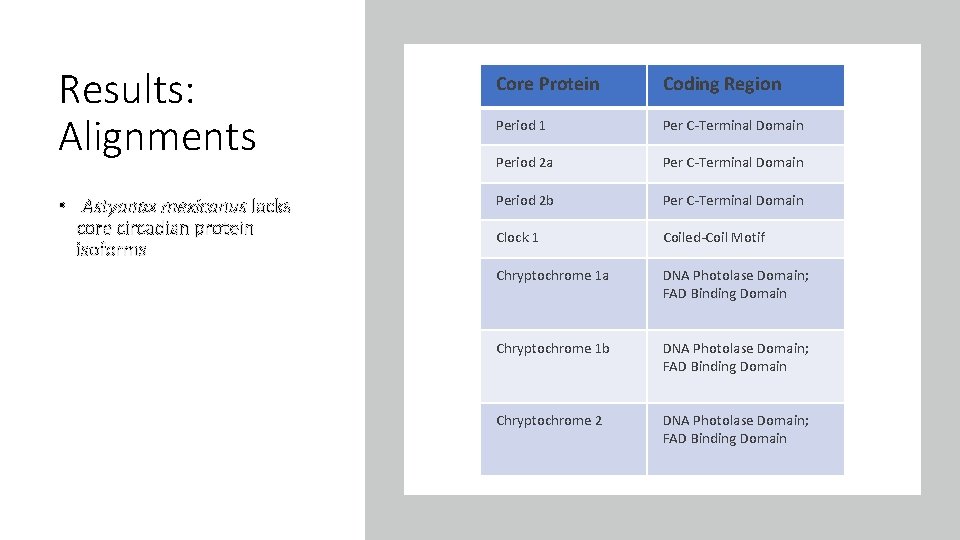
Results: Alignments • Astyanax mexicanus lacks core circadian protein isoforms Core Protein Coding Region Period 1 Per C-Terminal Domain Period 2 a Per C-Terminal Domain Period 2 b Per C-Terminal Domain Clock 1 Coiled-Coil Motif Chryptochrome 1 a DNA Photolase Domain; FAD Binding Domain Chryptochrome 1 b DNA Photolase Domain; FAD Binding Domain Chryptochrome 2 DNA Photolase Domain; FAD Binding Domain
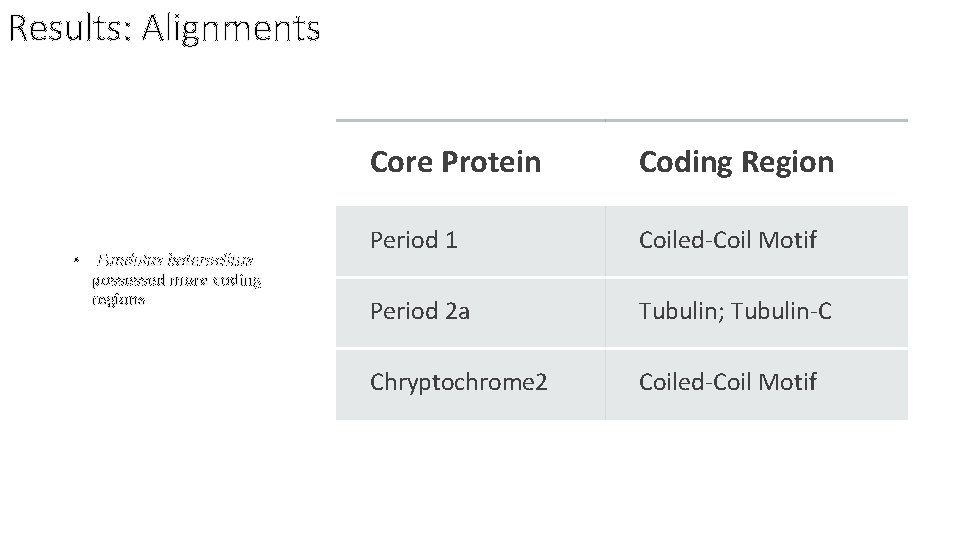
Results: Alignments • Fundulus heteroclitus possessed more coding regions Core Protein Coding Region Period 1 Coiled-Coil Motif Period 2 a Tubulin; Tubulin-C Chryptochrome 2 Coiled-Coil Motif
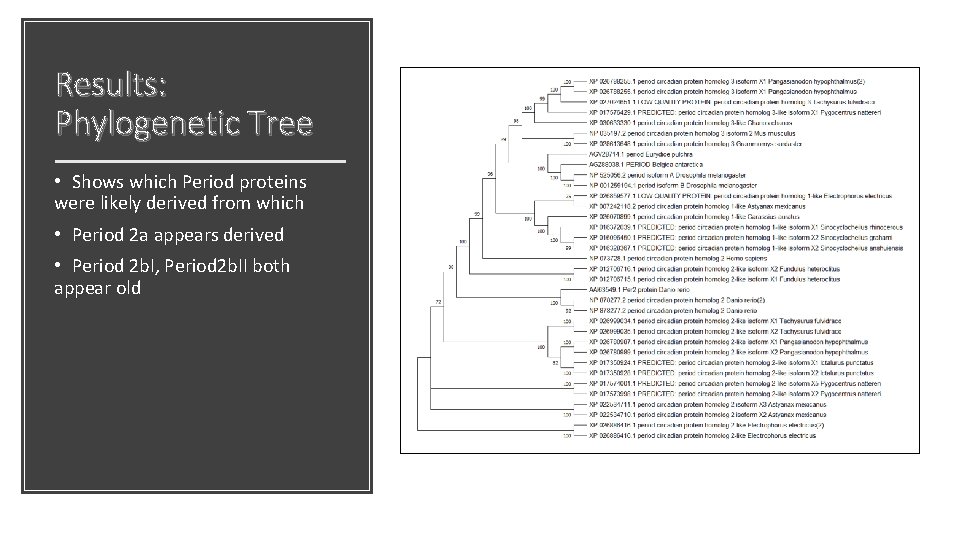
Results: Phylogenetic Tree • Shows which Period proteins were likely derived from which • Period 2 a appears derived • Period 2 b. I, Period 2 b. II both appear old
Discussion: Astyanax transcriptome Am may have never doubled its transcriptome Poor coverage in NCBI Rounds of whole genome duplication during evolution Astyanax mexicanus has 70 X genome coverage lost those isoforms due to their environment Cave animals don’t need light input genes
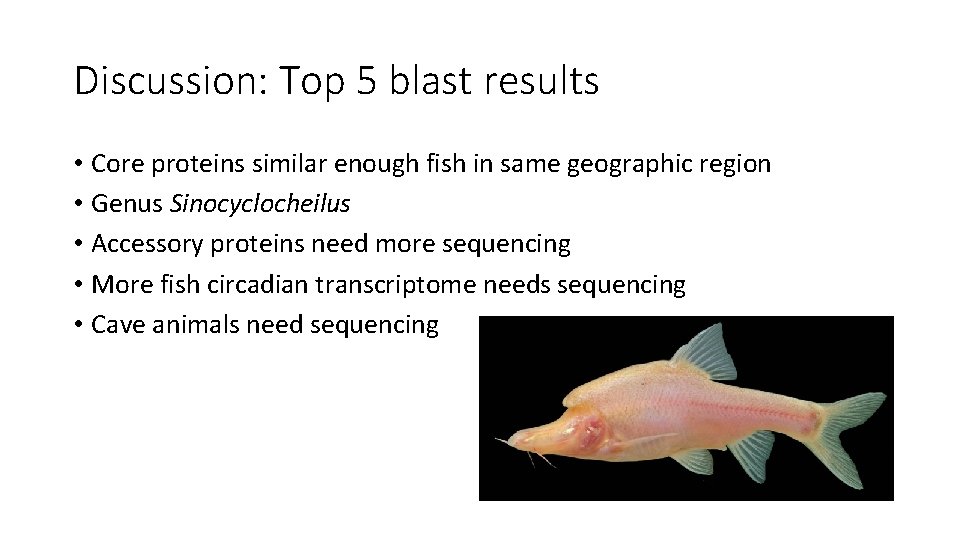
Discussion: Top 5 blast results • Core proteins similar enough fish in same geographic region • Genus Sinocyclocheilus • Accessory proteins need more sequencing • More fish circadian transcriptome needs sequencing • Cave animals need sequencing
• Danio rerio and Fundulus heteroclitus may have more coding regions than Astyanax mexicanus Discussion: Alignments and Phylogenetic Tree • Danio rerio and Fundulus heteroclitus have more available core protein forms • Possible Astyanax mexicanus has lost or altered some transcriptome • Possible Astyanax has added less transcriptome than other fish
Future Study • Epigenetic factors • Phenotypic plasticity • More cave fish
Acknowledgements – Thank you • Dr. Chabot & Brendan Riley for providing mummichog and zebrafish circadian transcriptome as well as the blueprint methods. • Dr. Jolles for helping us throughout our project • Dr. Chabot again for mentoring us throughout our research
Literature Cited • Reppert, S. M. , & Weaver, D. R. (2002). Coordination of circadian timing in mammals. Nature, 418(6901), 935 -941 • Stemmer, M. , Schuhmacher, L. N. , Foulkes, N. S. , Bertolucci, C. , & Wittbrodt, J. (2015). Cavefish eye loss in response to an early block in retinal differentiation progression. Development, 142(4), 743 -752. • Yamazaki, S. , Numano, R. , Abe, M. , Hida, A. , Takahashi, R. I. , Ueda, M. , . . . & Tei, H. (2000). Resetting central and peripheral circadian oscillators in transgenic rats. Science, 288(5466), 682 -685. • Beale, A. , Guibal, C. , Tamai, T. K. , Klotz, L. , Cowen, S. , Peyric, E. , . . . & Whitmore, D. (2013). Circadian rhythms in Mexican blind cavefish Astyanax mexicanus in the lab and in the field. Nature communications, 4(1), 1 -10. • Marzban, H. , Hoy, N. , Buchok, M. , Catania, K. C. , & Hawkes, R. (2015). Compartmentation of the cerebellar cortex: adaptation to lifestyle in the starnosed mole Condylura cristata. The Cerebellum, 14(2), 106 -118 • Chesmore, K. N. , Watson III, W. H. , & Chabot, C. C. (2016). Identification of putative circadian clock genes in the American horseshoe crab, Limulus polyphemus. Comparative Biochemistry and Physiology Part D: Genomics and Proteomics, 19, 45 -61. • Allada, R. , & Chung, B. Y. (2010). Circadian organization of behavior and physiology in Drosophila. Annual review of physiology, 72, 605 -624. • Dunlap, J. C. (1999). Molecular bases for circadian clocks. Cell, 96(2), 271 -290. • Reilly, B. , & Chabot, C. (2020). dentification of a putative circadian system in the mummichog, Fundulus heteroclituss. Unpublished manuscript, Department of Biological Sciences, Plymouth State University, Plymouth, New Hampshire, United States of America • (6), 1547 -1549. • Jeffery, W. R. (2005). Adaptive evolution of eye degeneration in the Mexican blind cavefish. Journal of Heredity, 96(3), 185 -196.
More Literature Cited • Madeira, F. , Park, Y. M. , Lee, J. , Buso, N. , Gur, T. , Madhusoodanan, N. , . . . & Lopez, R. (2019). The EMBL-EBI search and sequence analysis tools APIs in 2019. Nucleic acids research, , 47(W 1), W 636 -W 64 • Cavallari Nicola, Frigato Elena, Vallone Daniela, Fröhlich Nadine, Fernando Lopez-Olmeda Jose, Foà Augusto, Berti Roberto, Javier Sánchez-Vázquez Francisco, Bertolucci Christiano, S. Foulkes Nicholas. (2011). A Blind Circadian Clock in Cavefish Reveals that Opsins Mediate Peripheral Clock Photoreception. PLOS Biology. • Ceinos, Rosa & Frigato, Elena & Pagano, Cristina & Fröhlich, Nadine & Negrini, Pietro Foulkes, Nicholas & Whitmore, David & Vallone, Daniela & Bertolucci, Cristiano. (2016). Studying the Evolution of the Vertebrate Circadian Clock: The Power of Fish as Comparative Models. 1016/bs. adgen. 2016. 05. 002. • Friedrich, Markus. (2013). Biological Clocks and Visual Systems in Cave-Adapted Animals at the Dawn of Speleogenomics. Integrative and comparative biology. 53. 1093/icb/ict 058 • Hong Sun, Qianqian Dong, Chenchen Wanga, Mengwan Jianga, Baishi Wang, Zhenlong Wang. (2018). Evolution of circadian genes PER and CRY in subterranean rodents. International Journal of Biological Hong Sun, Qianqian Dong, Chenchen Wanga, Mengwan Jianga, Baishi Wang, Zhenlong Wang. (2018). Evolution of circadian genes PER and Macromolecules 118 (B) 1400 -1405. Macromolecules 118(B) 1400 -1405. • Smit, Andrea & Broesch, Tanya & Siegel, Jerome & Mistlberger, Ralph. (2019). Sleep timing and duration in indigenous villages with and without electric lighting on Tanna Island, Vanuatu. Scientific Reports. 9. 10. 1038/s 41598 -019 -53635 -y. • Van Jaarsveld, Barry & Bennett, Nigel & Hart, Daniel & Oosthuizen, Maria. (2018). Locomotor activity and body temperature rhythms in the Mahali mole-rat (C. h. mahali): The effect of light and ambient temperature variations. Journal of Thermal Biology. 79. 24 -32. 1016/j. jtherbio. 2018. 11. 013. • Villamizar, Natalia & Blanco-Vives, Borja & Oliveira, Catarina & Dinis, Maria & Rosa, Viviana & Negrini, Pietro & Bertolucci, Cristiano & Sanchez Vazquez, F. Javier. (2013). Circadian Rhythms of Embryonic Development and Hatching in Fish: A Comparative Study of Zebrafish (Diurnal), Senegalese Sole (Nocturnal), and Somalian Cavefish (Blind). Chronobiology international. 30. 10. 3109/07420528. 2013. 784772. • • NCBI Resource Coordinators (2016). Database resources of the National Center for Biotechnology Information. Nucleic acids research https: //doi. org/10. 1093/nar/gkv 1290 NCBI Resource Coordinators (2016). Database resources of the National Center for Biotechnology Information. Nucleic acids research, , 44(D 1), D 7–D 19. https: //doi. org/10. 1093/nar/gkv 1290 Klaus, S. , Mendoza, J. C. , Liew, J. H. , Plath, M. , Meier, R. , & Yeo, D. C. (2013). Rapid evolution of troglomorphic characters suggests selection rather than neutral mutation as a driver of eye reduction in cave crabs. Biology letters, , 9(2), 20121098. https: //doi. org/10. 1098/rsbl. 2012. 1098 • Madeira, F. , Park, Y. M. , Lee, J. , Buso, N. , Gur, T. , Madhusoodanan, N. , . . . & Lopez, R. (2019). The EMBL-EBI search and sequence analysis tools APIs in 2019. Nucleic acids research, , 47(W 1), W 636 -W 641. • Letunic, I. , & Bork, P. (2018). 20 years of the SMART protein domain annotation resource. Nucleic acids research, , 46(D 1), D 493 -D 496. • Kumar, S. , Stecher, G. , Li, M. , Knyaz, C. , & Tamura, K. (2018). MEGA X: molecular evolutionary genetics analysis across computing platforms. Molecular biology and evolution, , 35

Any Questions?
- Slides: 18