
Harville Hendrix Helen Hunt Imago Therapy When women


- Slides: 40
Harville Hendrix & Helen Hunt Imago Therapy
When women in an MRI machine were shown a sign that meant they might be shocked on their feet, their brains registered a high stress response, especially if they were alone and even if a stranger held their hand. But if they felt loved in their marriage and their husband held their hand, then these women's brains were much calmer and the shock seemed to hurt less; holding hands with a loved one "calms jittery neurons" in the brain. Research by Jim Coan
Familiar Love • We have an unconscious list of what we look for in a romantic partner. We are drawn to someone who fits for us based on our early relationship experience. • Two basic needs for healing and growth: – a corrective experience of getting what we always needed and didn't get enough of – To develop in ourselves all aspects of ourselves to be able to express our Core Self, our aliveness in the world.
Imago Therapy -help make the unconscious aspects of relationship conscious -address conflict at its roots rather than just trying to solve it in a surface way -work towards healing and growth -create emotional safety for each other -learn how to better meet each other's needs -transform conflict into opportunities for deeper intimacy and connection
Intentional Dialogue "You are vital to my well-being. With that in mind, I will put my version of the world aside for a short time and be with you and see the world through your eyes”
Validation
Validation • I know, right • Totally • That makes sense to me
Practice Imago Therapy
So notice: Our version of the world • The stories we tell ourselves, over and over again, may get in the way of actually hearing what others say to us. We are likely to misinterpret so that it fits with the stories we tell ourselves. • Projection (I’m not “bad”, you’re “bad”. If we don’t like it we project it out of ourselves and on to others. • Lens ( I expect to be rejected/criticized). I am likely to interpret neutral things as negative/rejecting/critical
Sue Johnson: EFT The world of therapy has been obsessed with maintaining boundaries in recent years. I say our problem is just the opposite—we're all cut off from each other.
Sue Johnson “We have a wired-in need for emotional contact and responsiveness from significant others. It's a survival response, the driving force of the bond of security a baby seeks with its mother…. A great deal of evidence indicates that the need for secure attachment never disappears; it evolves into the adult need for a secure emotional bond with a partner. ” https: //www. psychologytoday. com/articles/200812/hold-me-tight
“Although our culture has framed dependency as a bad thing, a weakness, it is not. Being attached to someone provides our greatest sense of security and safety. ” - Sue Johnson
Underneath all the distress, partners are desperate to know: Are you there for me? Do you need me? Do you rely on me?
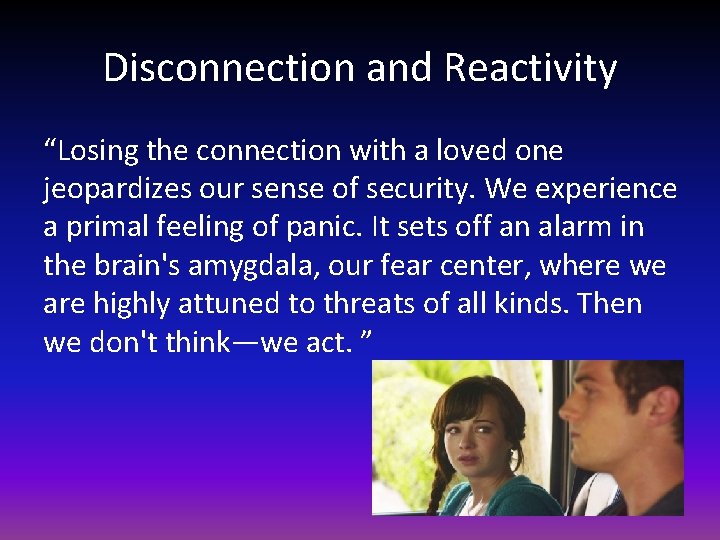
Disconnection and Reactivity “Losing the connection with a loved one jeopardizes our sense of security. We experience a primal feeling of panic. It sets off an alarm in the brain's amygdala, our fear center, where we are highly attuned to threats of all kinds. Then we don't think—we act. ”
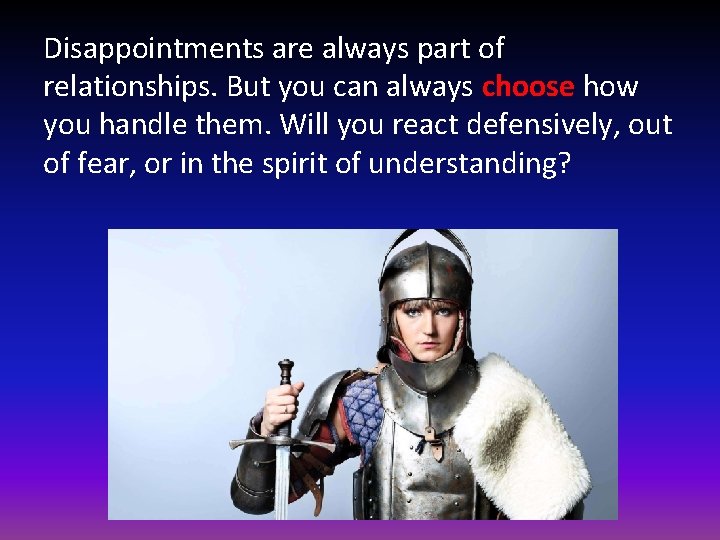
Disappointments are always part of relationships. But you can always choose how you handle them. Will you react defensively, out of fear, or in the spirit of understanding?
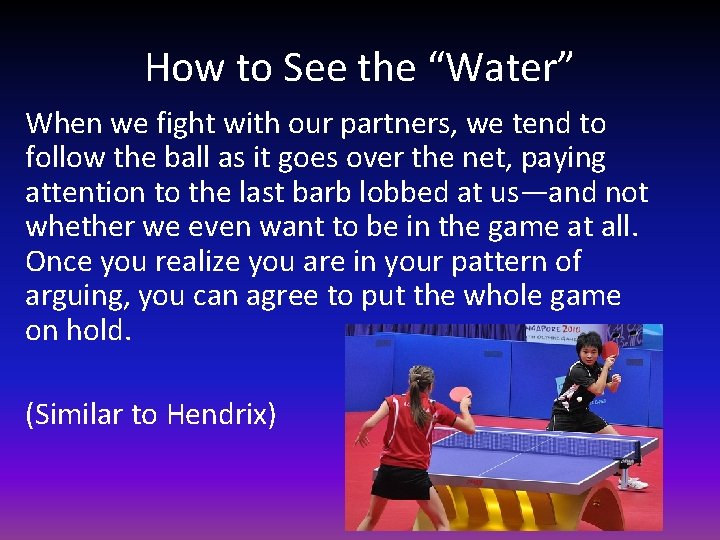
How to See the “Water” When we fight with our partners, we tend to follow the ball as it goes over the net, paying attention to the last barb lobbed at us—and not whether we even want to be in the game at all. Once you realize you are in your pattern of arguing, you can agree to put the whole game on hold. (Similar to Hendrix)
Of course, you may not feel you really have a choice if your panic button has been pushed and your emotions are boiling over. But just being aware that it has been pushed can help calm you down. You can think to yourself, "What is happening here? I'm yelling. But inside, I'm feeling really small. " Then you can tell your partner, "I got really scared there—I'm feeling hurt. "
Men/Women- generally speaking (and why it’s valuable to generalize in this case) Women are more sensitive to the first signs of connection breakdown than men, They will respond by pursuing their partners in a futile attempt to get a comforting response. However they tend to blame their partner for failing in some essential way. Men are taught to suppress emotional responses and needs, so they are more likely to withdraw from conflict. Both are feeling underlying vulnerability and need for connection, now compounded by sadness, shame, and, most of all, fear. (women lead in dancing)
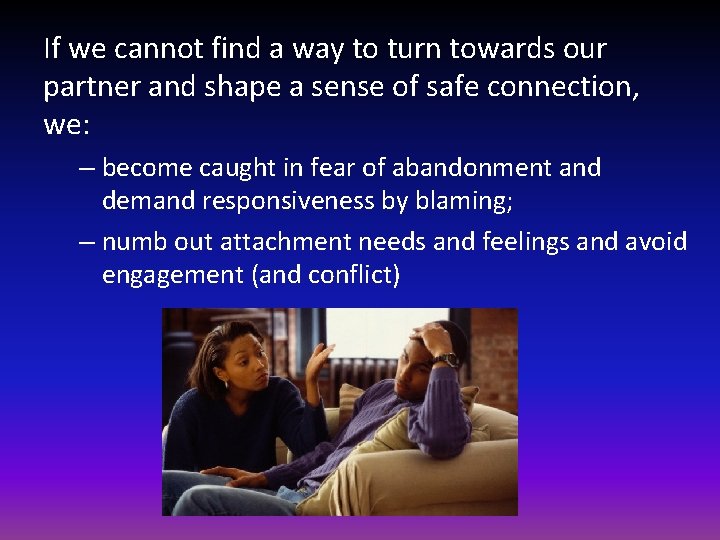
If we cannot find a way to turn towards our partner and shape a sense of safe connection, we: – become caught in fear of abandonment and demand responsiveness by blaming; – numb out attachment needs and feelings and avoid engagement (and conflict)
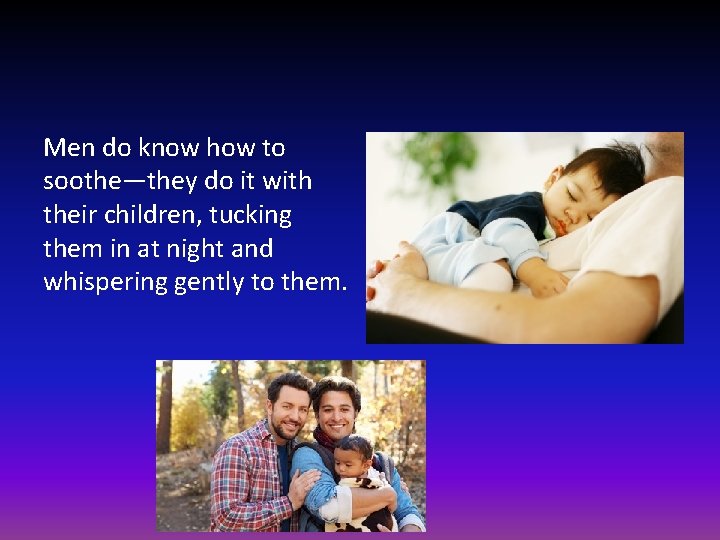
Men do know how to soothe—they do it with their children, tucking them in at night and whispering gently to them.
Passion is like everything else: It ebbs and flows. But sex is always going to be boring if it's onedimensional, cut off from emotional connection. On the other hand, if you're emotionally involved, sex has a hundred dimensions to it, and is as much play as passion.
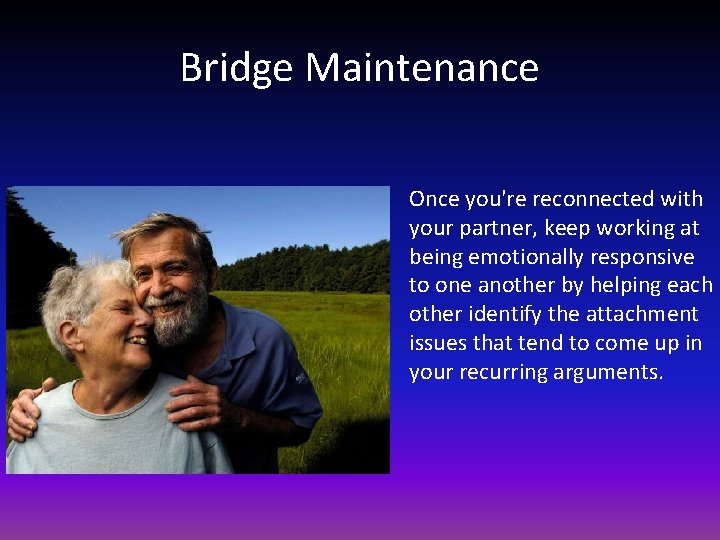
Bridge Maintenance Once you're reconnected with your partner, keep working at being emotionally responsive to one another by helping each other identify the attachment issues that tend to come up in your recurring arguments.
Loving is a process that constantly moves from harmony to disharmony, from mutual attunement and responsiveness to misattunement and disconnection— and back again. (ebb and flow)
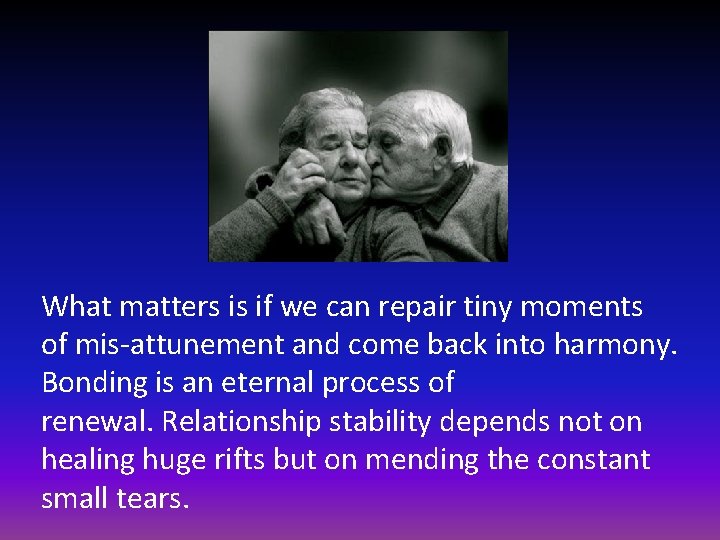
What matters is if we can repair tiny moments of mis-attunement and come back into harmony. Bonding is an eternal process of renewal. Relationship stability depends not on healing huge rifts but on mending the constant small tears.
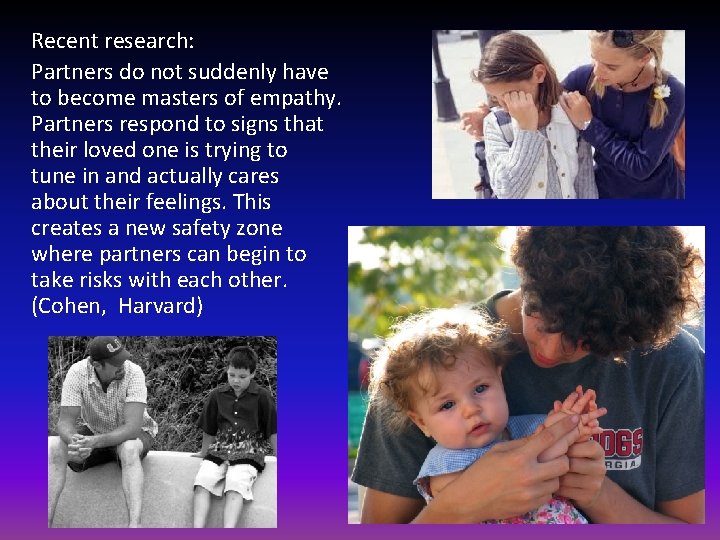
Recent research: Partners do not suddenly have to become masters of empathy. Partners respond to signs that their loved one is trying to tune in and actually cares about their feelings. This creates a new safety zone where partners can begin to take risks with each other. (Cohen, Harvard)
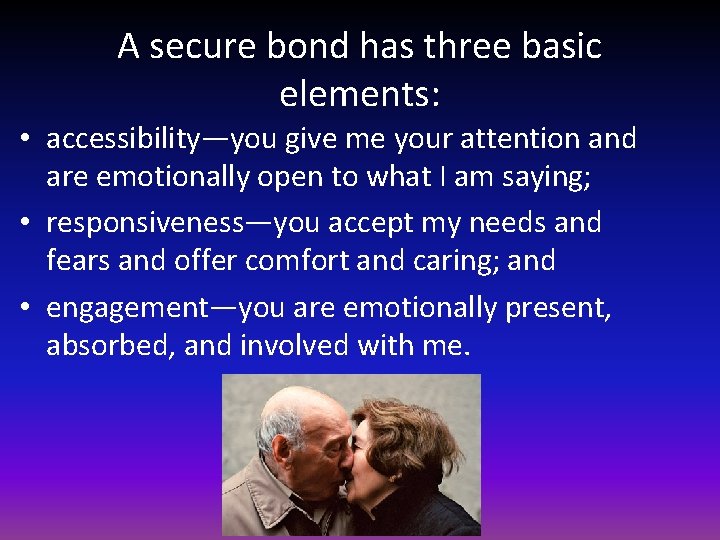
A secure bond has three basic elements: • accessibility—you give me your attention and are emotionally open to what I am saying; • responsiveness—you accept my needs and fears and offer comfort and caring; and • engagement—you are emotionally present, absorbed, and involved with me.
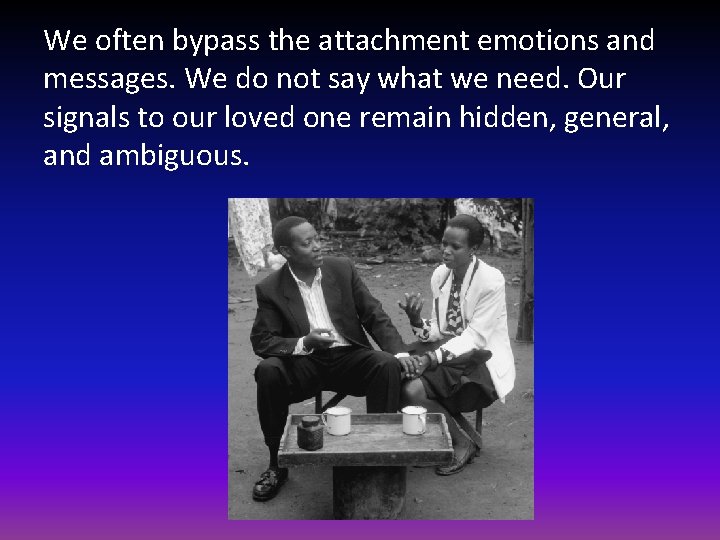
We often bypass the attachment emotions and messages. We do not say what we need. Our signals to our loved one remain hidden, general, and ambiguous.
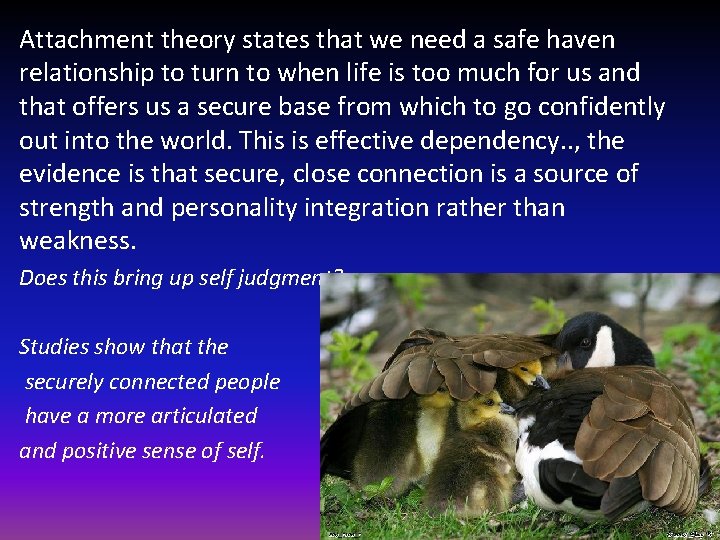
Attachment theory states that we need a safe haven relationship to turn to when life is too much for us and that offers us a secure base from which to go confidently out into the world. This is effective dependency. . , the evidence is that secure, close connection is a source of strength and personality integration rather than weakness. Does this bring up self judgment? Studies show that the securely connected people have a more articulated and positive sense of self.
Couples Can: (read independently) • Tune in to and stay with their own softer emotions and hold on to the hope of potential connection with the loved one. • Regulate their emotions so they can look out at the other person with some openness and curiosity and show willingness to listen to incoming cues. They are not flooded or trying to shut down and stay numb. • Turn their emotions into clear, specific signals. Messages are not conflicted or garbled. Clear communication flows from a clear inner sense of feared danger and longed-for safety. • Tolerate fears of the other’s response enough to stay engaged and give the other a chance to respond. • Explicitly state needs. To do this they have to recognize and accept their attachment needs. • Hear and accept the needs of the other. Respond to these needs with empathy and honesty. • React to the other’s response, even if it is not what is hoped for, in a way that is relatively balanced and, especially if it is what is hoped for, with increased trust and positive emotion. • Explore and take into account the partner’s reality and make sense of, rather than dismiss, his or her response.
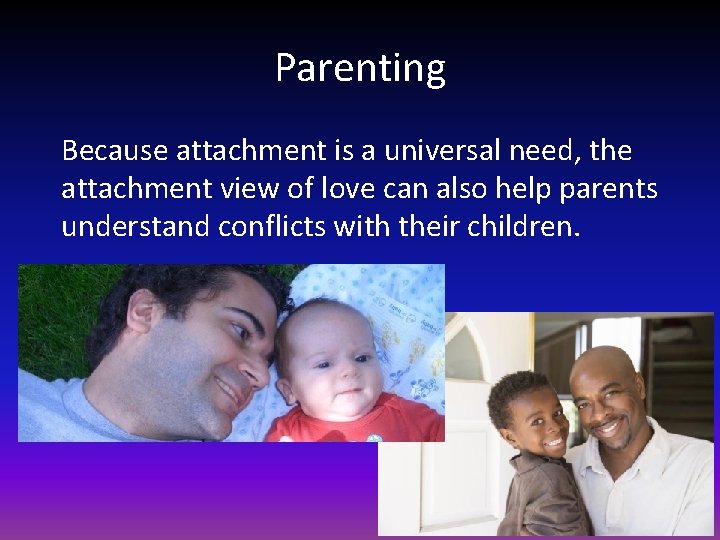
Parenting Because attachment is a universal need, the attachment view of love can also help parents understand conflicts with their children.
The end
EFT Therapy • Validation is used to create a safe haven in the session for both partners. • Emotions are tracked • Responses are framed and clarified within the new understanding of attachment. • Profound core emotions are heightened and evoked to move partners into new, more responsive interactions. • Help partners move into interactions where each one of them can reach for the other and respond caringly to the other.
Connection to Others Discussion • Groups of 4 • Count off to mix it up • 15 -20 minutes
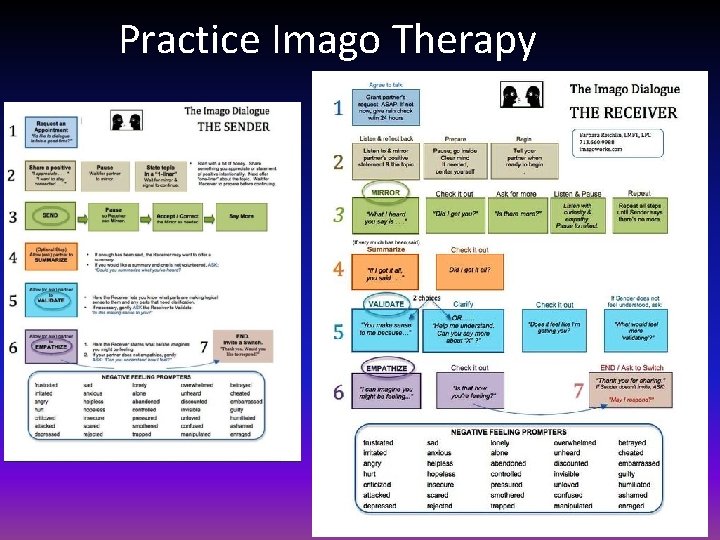
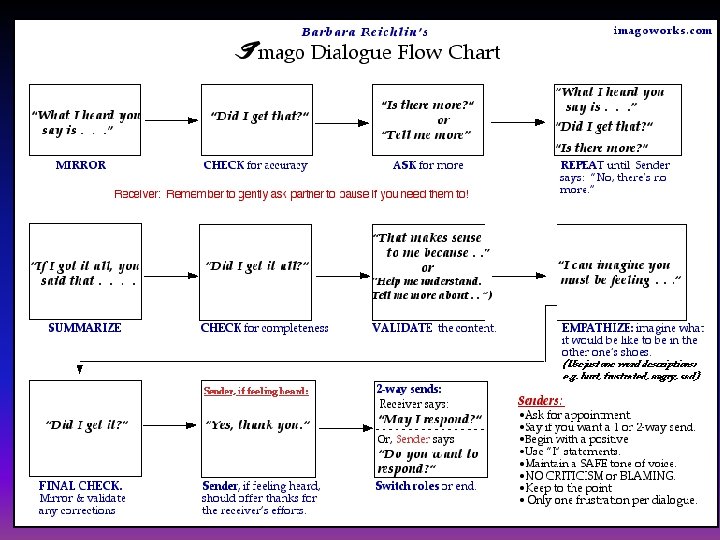
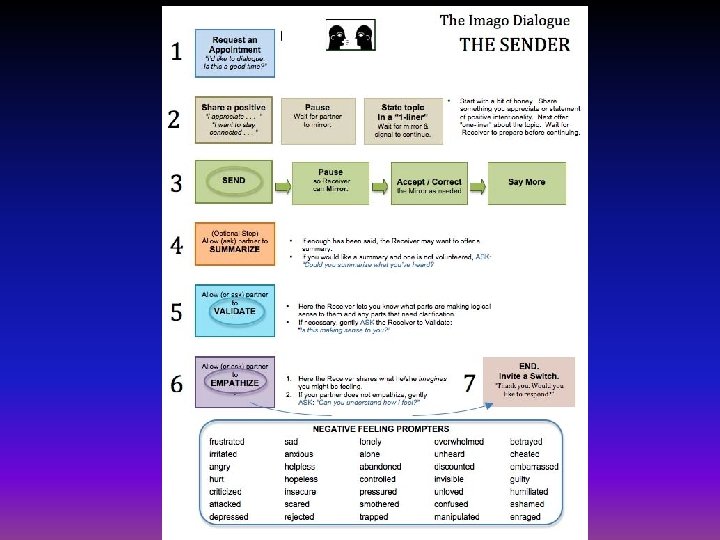
INSTRUCTIONS FOR THE SENDER Make an appointment! When is a good time to dialogue? 2. Statement of Intentionality. Begin with an introductory statement that helps your partner feel safe about "what" and "how" you are going to send. "I want you to know that I am sharing this with you because I care about our relationship. " Or, "I want this to be a win discussion. " Remember to pause periodically so your partner can mirror back what you’ve said. If your partner does not mirror, ask them to do so in a non-demanding manner. 3. One topic per dialogue! 4. Use “I” statements. These are sentences that begin with the word “I” and which describe how you feel and what you need. ”I feel uncared for when you. . . ” Or, “When you don’t call, I start to get scared angry. . . ”. “I” statements reduce the blaming caused by “you” statements. (”You don’t care about my feelings. . . ” “You make me. . . ”) Note: “I think that you. . . ”, does not qualify as an “I” statement. 5. Maintain a non-threatening, non-accusatory tone of voice. If your voice is angry, your partner will have no choice but to put up their defenses and they will have a difficult time mirroring. If you cannot remove the anger, it is not a good time to ask for a dialogue. Wait until you are more calm. 6. Select your words carefully. It is inflammatory to blame, label, mind-read or use absolutes (e. g. , ”you always” and “you never”). It is quite acceptable to say: “I feel unloved when you don’t talk to me”. It is NOT acceptable to say: “You never talk to me because you are selfish and do not love me. ” 7. Actively reinforce positive behaviors! If you like the way your partner mirrors what you have said, SAY SO! “Thank you for hearing me. It really helped. ”
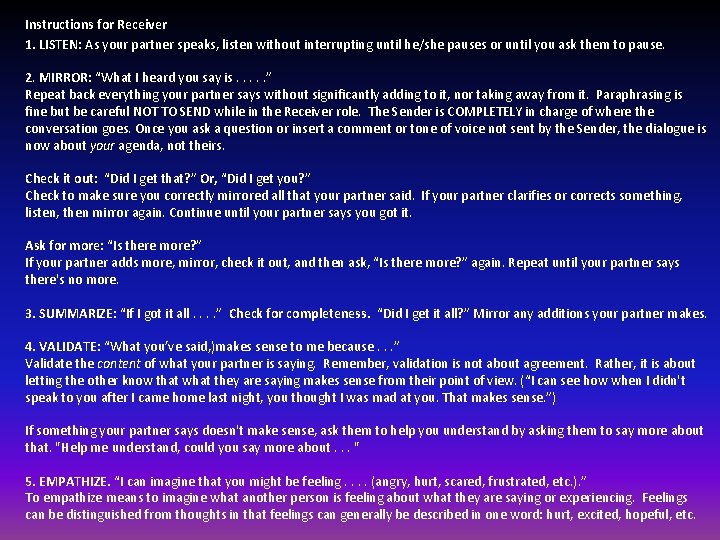
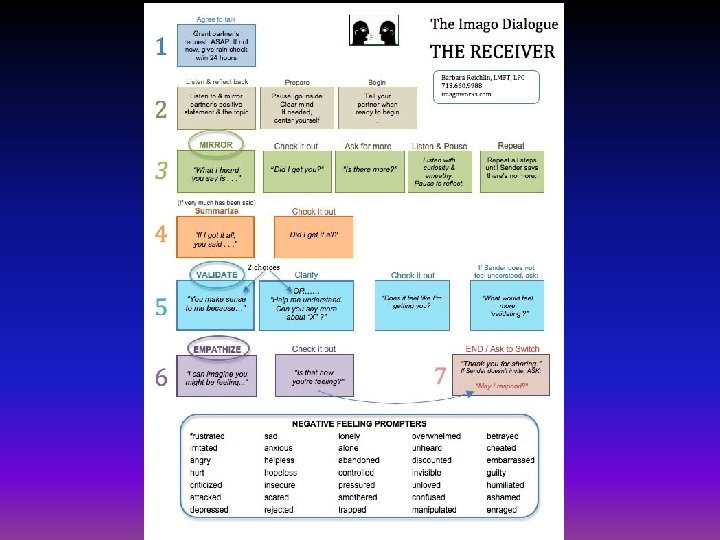
Instructions for Receiver 1. LISTEN: As your partner speaks, listen without interrupting until he/she pauses or until you ask them to pause. 2. MIRROR: “What I heard you say is. . . ” Repeat back everything your partner says without significantly adding to it, nor taking away from it. Paraphrasing is fine but be careful NOT TO SEND while in the Receiver role. The Sender is COMPLETELY in charge of where the conversation goes. Once you ask a question or insert a comment or tone of voice not sent by the Sender, the dialogue is now about your agenda, not theirs. Check it out: “Did I get that? ” Or, “Did I get you? ” Check to make sure you correctly mirrored all that your partner said. If your partner clarifies or corrects something, listen, then mirror again. Continue until your partner says you got it. Ask for more: “Is there more? ” If your partner adds more, mirror, check it out, and then ask, “Is there more? ” again. Repeat until your partner says there's no more. 3. SUMMARIZE: “If I got it all. . ” Check for completeness. “Did I get it all? ” Mirror any additions your partner makes. 4. VALIDATE: “What you’ve said, )makes sense to me because. . . ” Validate the content of what your partner is saying. Remember, validation is not about agreement. Rather, it is about letting the other know that what they are saying makes sense from their point of view. (“I can see how when I didn't speak to you after I came home last night, you thought I was mad at you. That makes sense. ”) If something your partner says doesn't make sense, ask them to help you understand by asking them to say more about that. "Help me understand, could you say more about. . . " 5. EMPATHIZE. “I can imagine that you might be feeling. . (angry, hurt, scared, frustrated, etc. ). ” To empathize means to imagine what another person is feeling about what they are saying or experiencing. Feelings can be distinguished from thoughts in that feelings can generally be described in one word: hurt, excited, hopeful, etc.
Imago Theory • Our original state is one of wholeness, joy, connection, curiosity, spontaneity, and passion. • Over/under-parenting and the process of socialization, creates wounding at various stages of childhood development. The child creates patterned behavior to adapt to the wounding. • Partner selection is the result of the unconscious desire to complete or correct what was unfinished in childhood. We select a partner who carries both the positive and negative characteristics of our caretakers (the 'Imago'), and who was wounded in the same area, but adapted in a complementary way. • The adaptation patterns of one partner triggers the wound and survival pattern of the other, creating a cycle of reactivity. • Specific nurturing of each partner helps heal the childhood wound. Paradoxically, our partner will need the very thing that will stretch us out of our own pattern and help us reclaim aspects of our self. • The more primitive part of the brain stores emotion and memory related to perceived threats to survival. It is atemporal and ignores our rational explanations about its fear. While insight is important, consistent corrective experience is needed to change survival patterns.
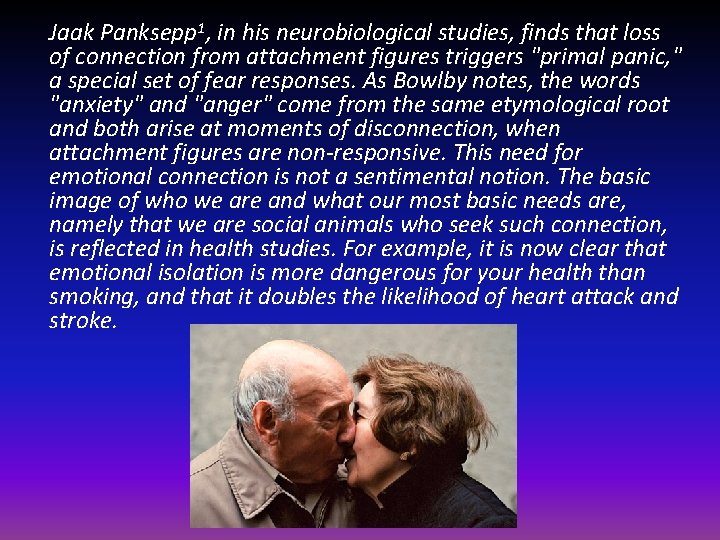
Jaak Panksepp 1, in his neurobiological studies, finds that loss of connection from attachment figures triggers "primal panic, " a special set of fear responses. As Bowlby notes, the words "anxiety" and "anger" come from the same etymological root and both arise at moments of disconnection, when attachment figures are non-responsive. This need for emotional connection is not a sentimental notion. The basic image of who we are and what our most basic needs are, namely that we are social animals who seek such connection, is reflected in health studies. For example, it is now clear that emotional isolation is more dangerous for your health than smoking, and that it doubles the likelihood of heart attack and stroke.