
Harvest by Jim Crace ENGLISH LITERATURE B PAPER
Harvest by Jim Crace ENGLISH LITERATURE B PAPER 2: TEXTS AND GENRES ELEMENTS OF POLITICAL AND SOCIAL PROTEST WRITING Lesson 1
Components of narrative • Narratives are made up of a range of different components and you should think about what each of these contribute to the development of the story: Component The ways In which authors… Characterisation …build characters Narrative voice …use narrative voices, sometimes more than one, to tell stories. This includes deviant mind styles and unreliable narrators. Often narrators are constructed to allow the reader to see the world from a very different perspective. Perspective …use differing points of view from which stories are told and read. We can have a very different view of events depending on whose viewpoint we see. Setting …set the narrative in specific places and at specific times Structure …sequence the narrative and the ordering of events in time Destination …bring the narrative to an end that may suggest particular meanings
Interview with Jim Crace interview Note down key points.
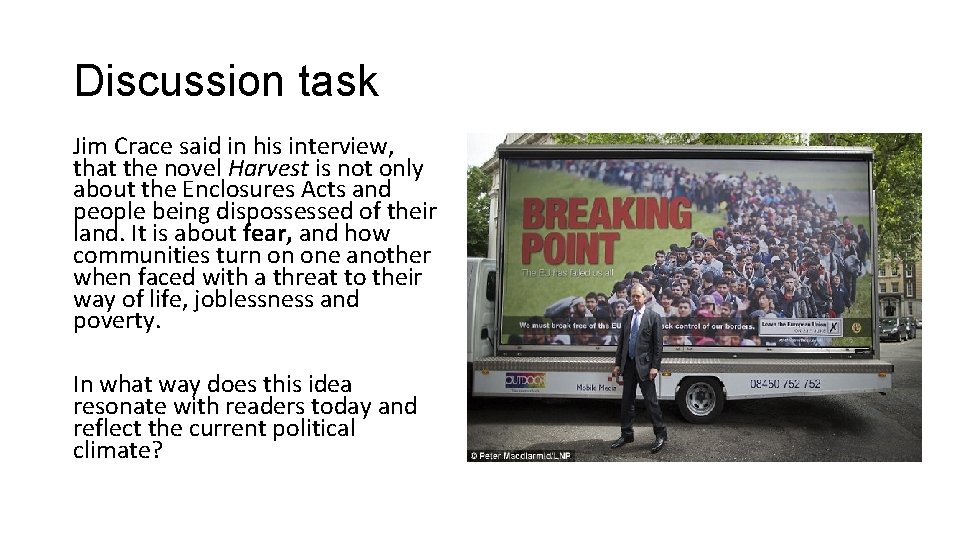
Discussion task Jim Crace said in his interview, that the novel Harvest is not only about the Enclosures Acts and people being dispossessed of their land. It is about fear, and how communities turn on one another when faced with a threat to their way of life, joblessness and poverty. In what way does this idea resonate with readers today and reflect the current political climate?
Harvest • What is the significance of the title? How does the title relate to events and ideas explored in the novel?
Harvest by Jim Crace ENGLISH LITERATURE B PAPER 2: TEXTS AND GENRES ELEMENTS OF POLITICAL AND SOCIAL PROTEST WRITING Lesson 2
Narrative setting: scenes/places/locations Researching context: 1. Research the feudal system of farming in Britain, when and how this system came to an end and why. 2. Find out about the Enclosure Acts? When did enclosure of land begin in England? What did the enclosure of land mean for the people who lived there?
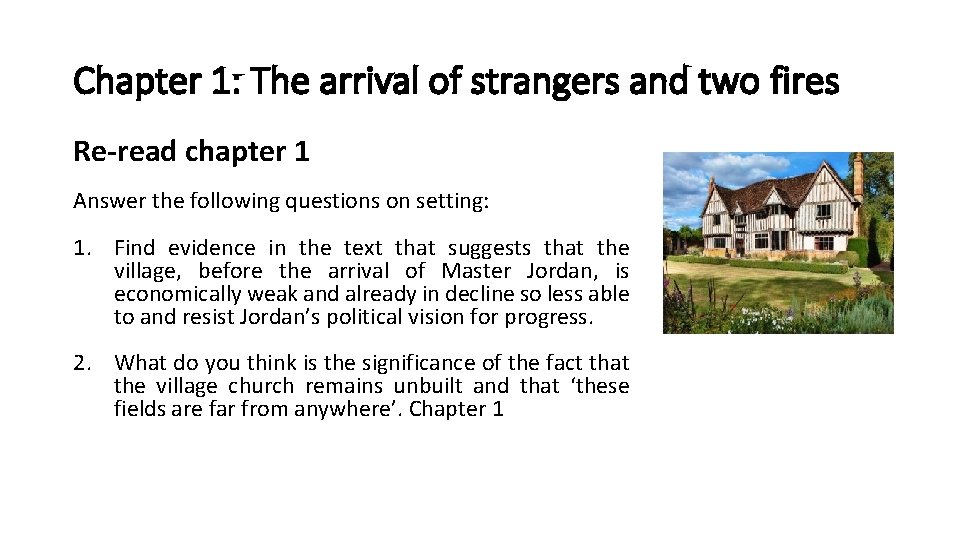
Chapter 1: The arrival of strangers and two fires Re-read chapter 1 Answer the following questions on setting: 1. Find evidence in the text that suggests that the village, before the arrival of Master Jordan, is economically weak and already in decline so less able to and resist Jordan’s political vision for progress. 2. What do you think is the significance of the fact that the village church remains unbuilt and that ‘these fields are far from anywhere’. Chapter 1
Chapter 1 Exploring components of narrative 1. What do you learn about the narrator, Walter Thirsk, in chapter 1? 2. Does the narrator’s language differ from the other characters in chapter 1? 3. What complications or disruptions are introduced in chapter 1? How do you think these complications will develop? 4. How tension built up and a sense of foreboding is established in chapter 1? 5. How is social division between the rich and poor presented? 6. Find references to manual agricultural labour, the land animals. Look up any words you are unfamiliar with.

Harvest by Jim Crace ENGLISH LITERATURE B PAPER 2: TEXTS AND GENRES ELEMENTS OF POLITICAL AND SOCIAL PROTEST WRITING Lesson 3
STARTER: Narrative characterisation Identify the characters in the novel so far. Who are the major and minor characters? Create a mind map linking these characters to different settings in the novel. Are the names of the characters or the terms used to address them significant?
Close reading activity Read again the paragraph on page 6 beginning with, ‘Reap and gossip. ’ and ending with, ‘So there is openness and jollity. ’ Analyse this paragraph looking for the following, although this list is not exhaustive: Use of imagery Natural imagery, pastoral imagery Simile Metaphor Personification Use of colour adjectives Sound and sound effects Alliteration Sibilance Meter and rhythm Onomatopoeia
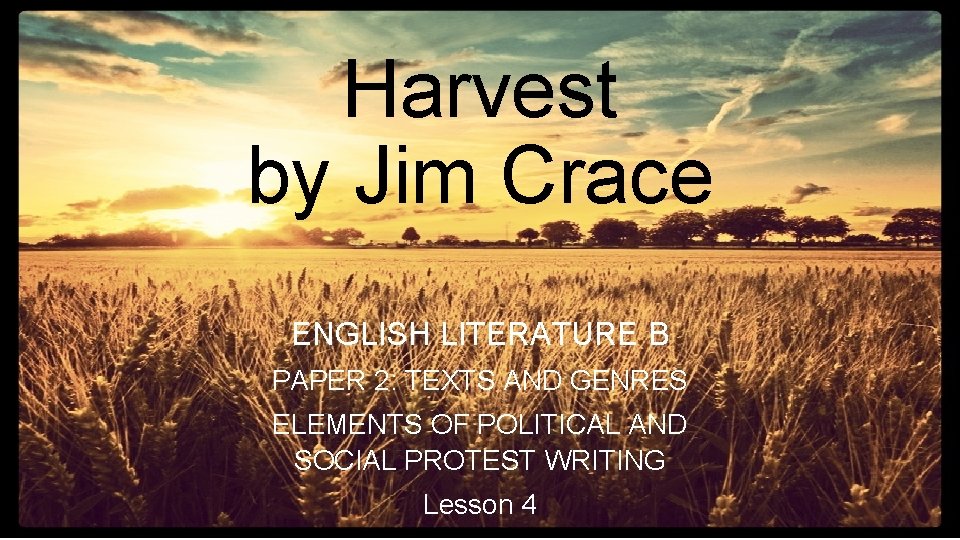
Harvest by Jim Crace ENGLISH LITERATURE B PAPER 2: TEXTS AND GENRES ELEMENTS OF POLITICAL AND SOCIAL PROTEST WRITING Lesson 4
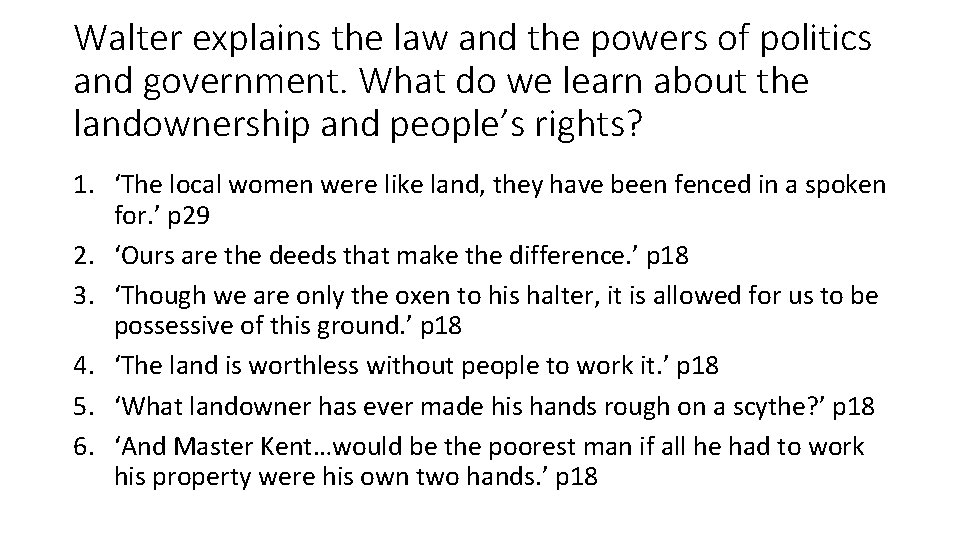
Walter explains the law and the powers of politics and government. What do we learn about the landownership and people’s rights? 1. ‘The local women were like land, they have been fenced in a spoken for. ’ p 29 2. ‘Ours are the deeds that make the difference. ’ p 18 3. ‘Though we are only the oxen to his halter, it is allowed for us to be possessive of this ground. ’ p 18 4. ‘The land is worthless without people to work it. ’ p 18 5. ‘What landowner has ever made his hands rough on a scythe? ’ p 18 6. ‘And Master Kent…would be the poorest man if all he had to work his property were his own two hands. ’ p 18
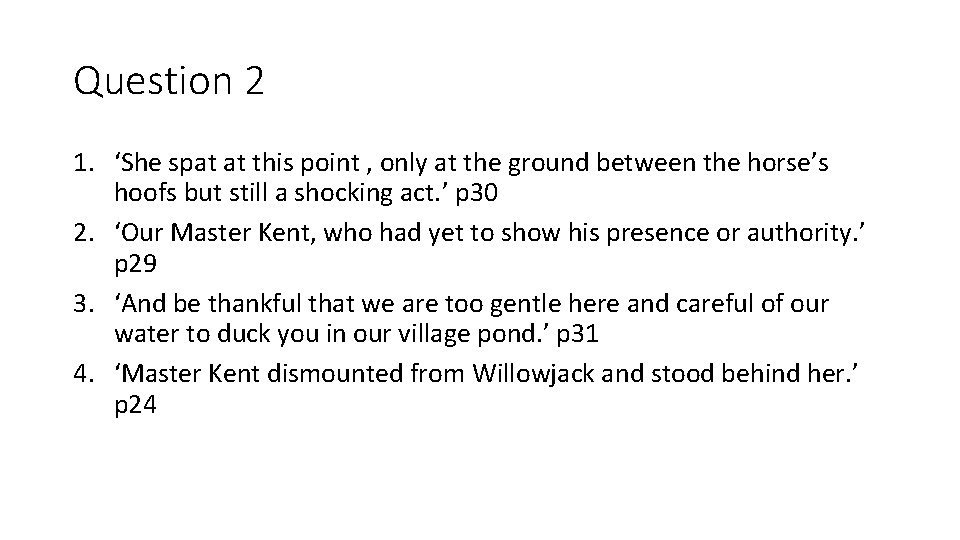
Question 2 1. ‘She spat at this point , only at the ground between the horse’s hoofs but still a shocking act. ’ p 30 2. ‘Our Master Kent, who had yet to show his presence or authority. ’ p 29 3. ‘And be thankful that we are too gentle here and careful of our water to duck you in our village pond. ’ p 31 4. ‘Master Kent dismounted from Willowjack and stood behind her. ’ p 24
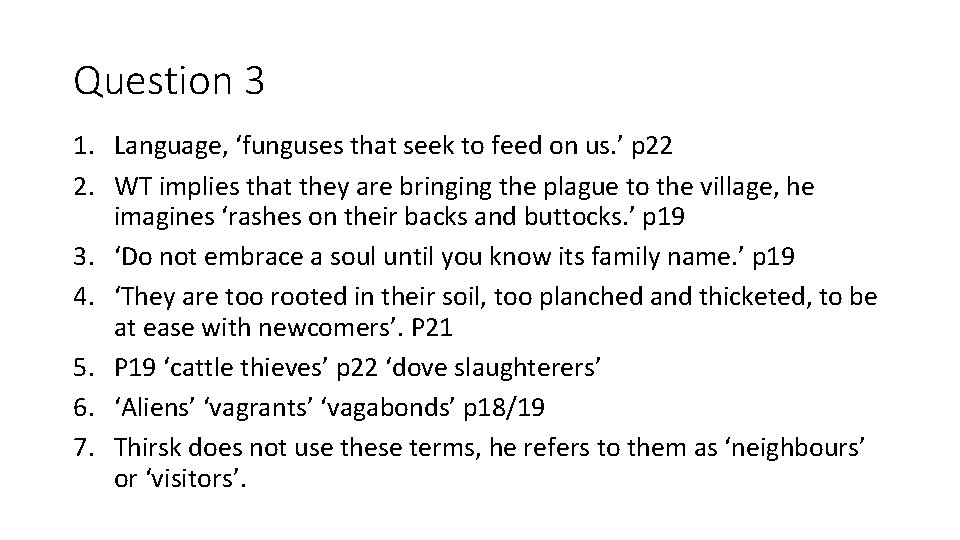
Question 3 1. Language, ‘funguses that seek to feed on us. ’ p 22 2. WT implies that they are bringing the plague to the village, he imagines ‘rashes on their backs and buttocks. ’ p 19 3. ‘Do not embrace a soul until you know its family name. ’ p 19 4. ‘They are too rooted in their soil, too planched and thicketed, to be at ease with newcomers’. P 21 5. P 19 ‘cattle thieves’ p 22 ‘dove slaughterers’ 6. ‘Aliens’ ‘vagrants’ ‘vagabonds’ p 18/19 7. Thirsk does not use these terms, he refers to them as ‘neighbours’ or ‘visitors’.
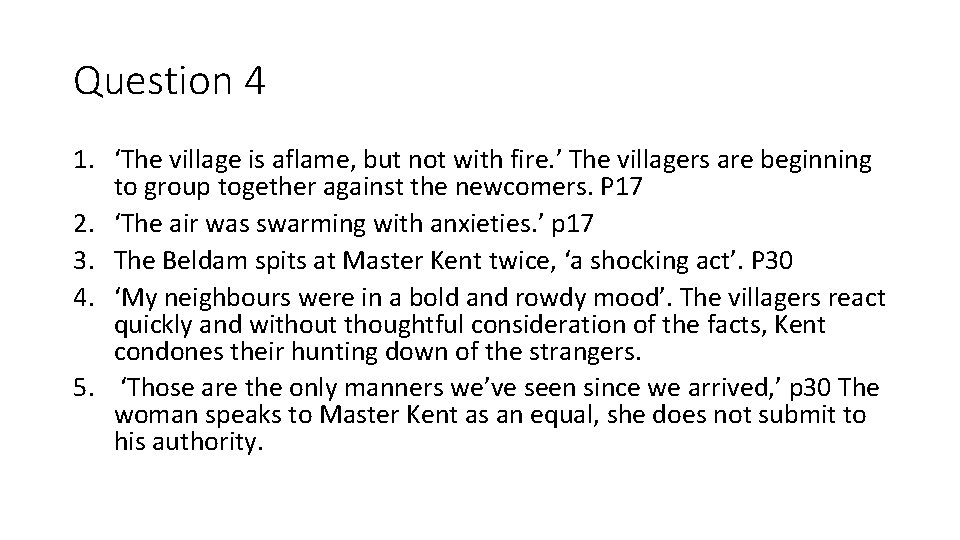
Question 4 1. ‘The village is aflame, but not with fire. ’ The villagers are beginning to group together against the newcomers. P 17 2. ‘The air was swarming with anxieties. ’ p 17 3. The Beldam spits at Master Kent twice, ‘a shocking act’. P 30 4. ‘My neighbours were in a bold and rowdy mood’. The villagers react quickly and without thoughtful consideration of the facts, Kent condones their hunting down of the strangers. 5. ‘Those are the only manners we’ve seen since we arrived, ’ p 30 The woman speaks to Master Kent as an equal, she does not submit to his authority.
Question 5 1. ‘The village is aflame, but not with fire’. The village is ‘aflame’ with fear and anxiety. The novel explores how fear can cause groups of people to overreact and become hateful and violent. 2. ‘Swarms of anxiety’ 3. ‘The twins and Brooker Higgs no longer wish to be numbered amongst the front rank of their most aggressive neighbours’. P 24 4. The situation is diffused by Mr Quill, he is not influenced by the actions of the mob. The woman’s bleeding head wound subdues the villagers, pricks at their conscience. 5. ‘We have no magistrate or constable. ’ p 12

Question 6

Question 7

Question 8
Harvest by Jim Crace ENGLISH LITERATURE B PAPER 2: TEXTS AND GENRES ELEMENTS OF POLITICAL AND SOCIAL PROTEST WRITING Lesson 5
Group presentation task Chapter 3 Group 1 • Explore the presentation of Master Kent and his responsibilities to the villagers Group 2 • Explore the prospect of change on the villagers’ lives if new farming methods are adopted. Group 3 • Explore the presentation of the narrator, his moral strengths and weaknesses, his relationship with Master Kent. Group 4 • Explore the presentation of ‘Mistress Beldam’ and her impact on the men of the village and the feast.
Explore the presentation of Master Kent and his responsibilities to the villagers ‘Master Kent, especially since his wife passed on…cherishes the fellowship we provide. ’ p 34 Shows that he has a good relationship with the villagers, he is grateful for their company however this compromising him when it come to maintaining law and order in the village. Master Kent has to fulfil too many civic duties, judge, magistrate, priest and landlord. ‘He’s satisfied us with his feast. ’ p 42 The villagers are less likely to react against him as he has provided a feast. ‘Master Kent will not avenge himself on the twins and Brooker Higgs if they reveal the truth. ’ p 34 He adapts his attitude to punishment dependent on the crime and who has done it. ‘Our pillory has not been used for many years. ’ P 35 Master Kent conducts our marriages and baptisms. ’ p 37 He has the respect of the village they all listen to him and at the moment don’t question him too much about the sheep. P 38 ‘Do what you can to make her safe. ’ p 48 Kent has a sense of responsibility and good intentions towards the woman.
Explore the prospect of change on the villagers’ lives if new farming methods are adopted. P 40 ‘He means to throw a halter round our lives. ’ Thirsk realises that there will be no more land to farm anymore and that their land will be fenced off/enclosed for sheep. ‘For dreams are currency, even amongst commoners. ’ They can only dream – Kent’s version of the future utopia is idealistic and deceptive. He hides the fact that he is no longer their landlord, and that they will soon have a new lord and their land will be taken from them. P 41 ‘But wool is more predicable. ’ Kent trying to make the best of this uncertainty. ‘We are not ploughing’ – their work will change, they will become employees. P 42 ‘Somewhere too far away to name. ’ Their produce will be sent away, now working in a new economy – making cloth for the rich. P 44 ‘Tomorrow she will be the first…against the colder times ahead. ’ The villages future will be ‘colder’ less of a community, they will no longer work together in the fields. Walter is pessimistic for the future.
Explore the presentation of the narrator, his moral strengths and weaknesses, his relationship with Master Kent.
Explore the presentation of ‘Mistress Beldam’ and her impact on the men of the village and the feast.
Class relationships in Harvest • One of the central themes of Jim Crace’s novel is class and power relationships in a village in England during a period of land enclosure. In particular the novel explores the vulnerability of ordinary people with few rights in a society controlled by a small but powerful elite of wealthy land owners. Homework Activity: Read texts 1 A and 1 B in your handout. Think about the ways that Crace represents class, power and relationships in the two extracts. Treat this as you would a response to an unseen text, you will need to comment on the language used in the two extracts and make some comparisions.
- Slides: 28