
HARVARD UNIVERSITY Office of Technology Development Introduction to


- Slides: 27
HARVARD UNIVERSITY Office of Technology Development Introduction to Technology Transfer and Intellectual Property Responsible Conduct of Research Harvard School of Public Health September 19 th, 2014 Jen Rice, Ph. D. Business Development Associate Office of Technology Development
Agenda • What is technology transfer? • The Bayh-Dole Act • Technology Transfer at Harvard • What is Intellectual Property (IP)? • Patents • Introduction to Patents • What is patentable? • The Patenting Process HARVARD UNIVERSITY Office of Technology Development
What is technology transfer?
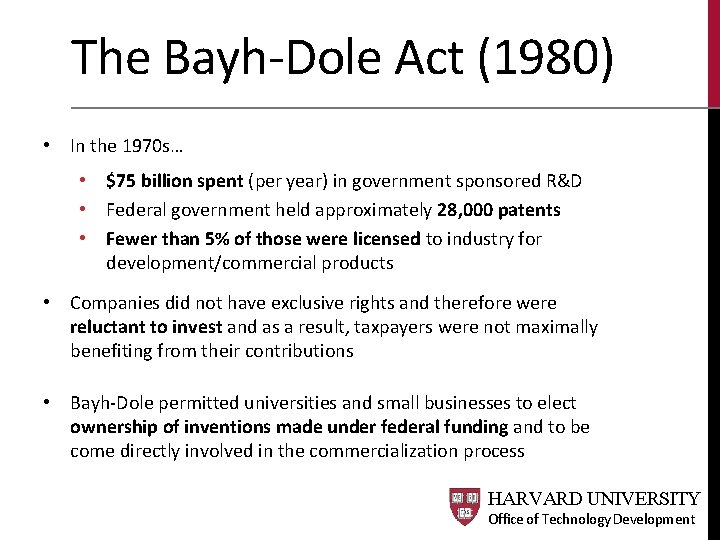
The Bayh-Dole Act (1980) • In the 1970 s… • $75 billion spent (per year) in government sponsored R&D • Federal government held approximately 28, 000 patents • Fewer than 5% of those were licensed to industry for development/commercial products • Companies did not have exclusive rights and therefore were reluctant to invest and as a result, taxpayers were not maximally benefiting from their contributions • Bayh-Dole permitted universities and small businesses to elect ownership of inventions made under federal funding and to be come directly involved in the commercialization process HARVARD UNIVERSITY Office of Technology Development
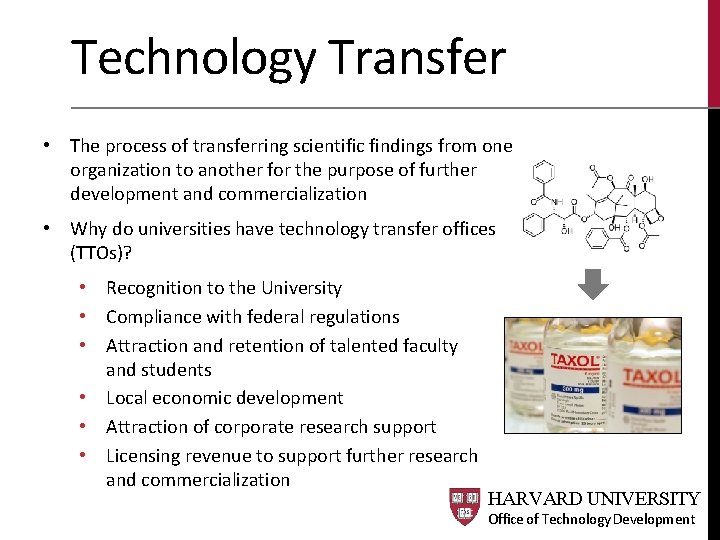
Technology Transfer • The process of transferring scientific findings from one organization to another for the purpose of further development and commercialization • Why do universities have technology transfer offices (TTOs)? • Recognition to the University • Compliance with federal regulations • Attraction and retention of talented faculty and students • Local economic development • Attraction of corporate research support • Licensing revenue to support further research and commercialization HARVARD UNIVERSITY Office of Technology Development
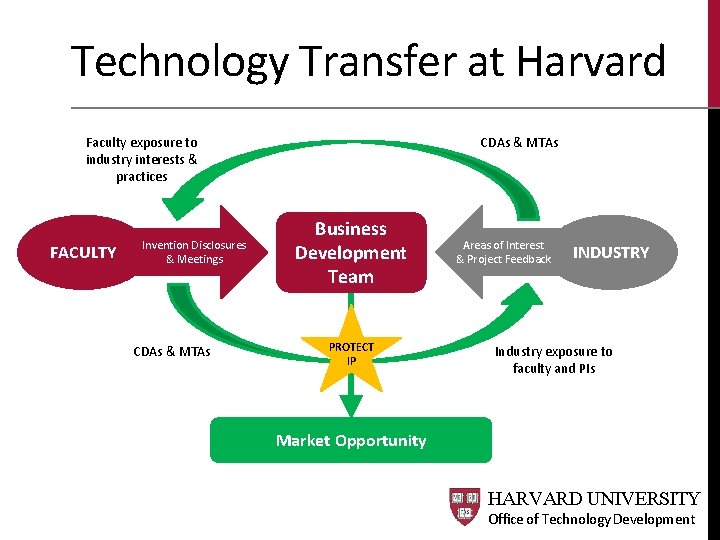
Technology Transfer at Harvard Faculty exposure to industry interests & practices FACULTY Invention Disclosures & Meetings CDAs & MTAs Business Development Team PROTECT IP Areas of Interest & Project Feedback INDUSTRY Industry exposure to faculty and PIs Market Opportunity HARVARD UNIVERSITY Office of Technology Development
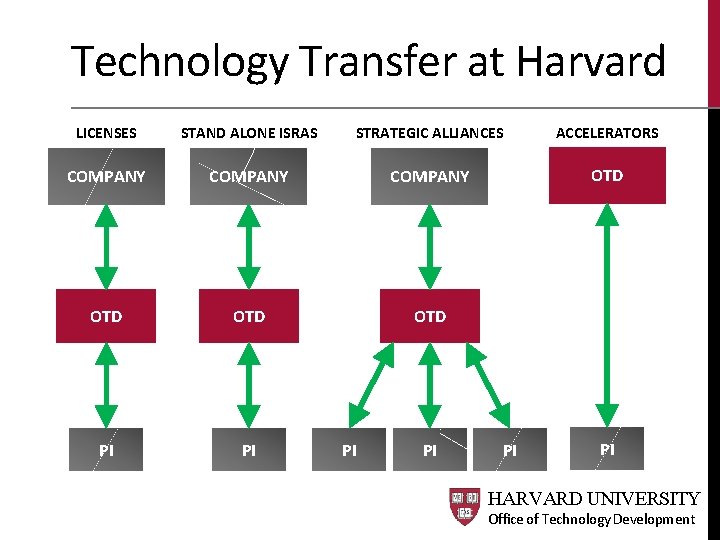
Technology Transfer at Harvard LICENSES STAND ALONE ISRAS STRATEGIC ALLIANCES ACCELERATORS COMPANY OTD OTD PI PI PI HARVARD UNIVERSITY Office of Technology Development
Intellectual Property (IP)
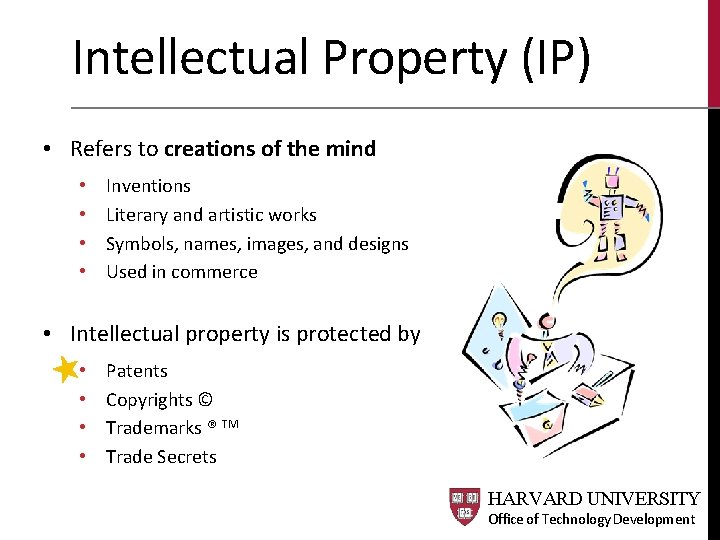
Intellectual Property (IP) • Refers to creations of the mind • • Inventions Literary and artistic works Symbols, names, images, and designs Used in commerce • Intellectual property is protected by • • Patents Copyrights © Trademarks ® TM Trade Secrets HARVARD UNIVERSITY Office of Technology Development
Patents
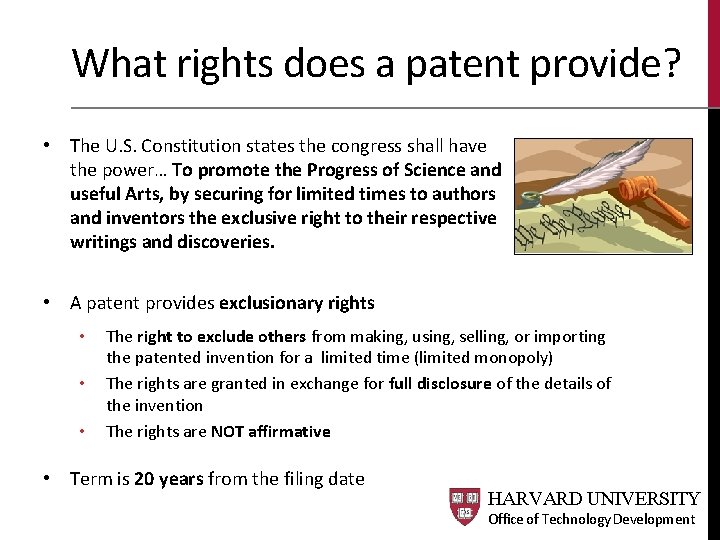
What rights does a patent provide? • The U. S. Constitution states the congress shall have the power… To promote the Progress of Science and useful Arts, by securing for limited times to authors and inventors the exclusive right to their respective writings and discoveries. • A patent provides exclusionary rights • • • The right to exclude others from making, using, selling, or importing the patented invention for a limited time (limited monopoly) The rights are granted in exchange for full disclosure of the details of the invention The rights are NOT affirmative • Term is 20 years from the filing date HARVARD UNIVERSITY Office of Technology Development
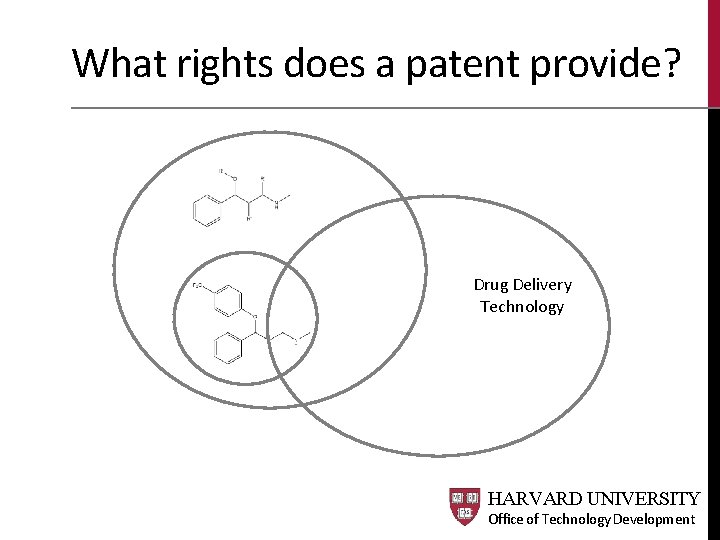
What rights does a patent provide? Drug Delivery Technology HARVARD UNIVERSITY Office of Technology Development
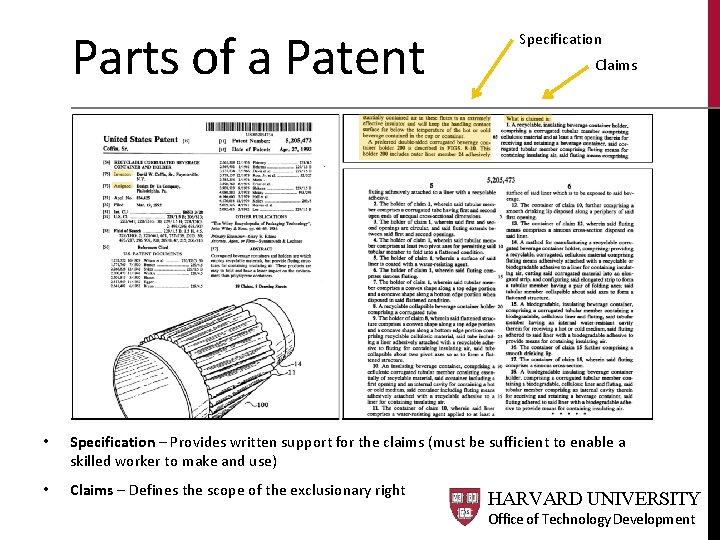
Parts of a Patent Specification Claims • Specification – Provides written support for the claims (must be sufficient to enable a skilled worker to make and use) • Claims – Defines the scope of the exclusionary right HARVARD UNIVERSITY Office of Technology Development
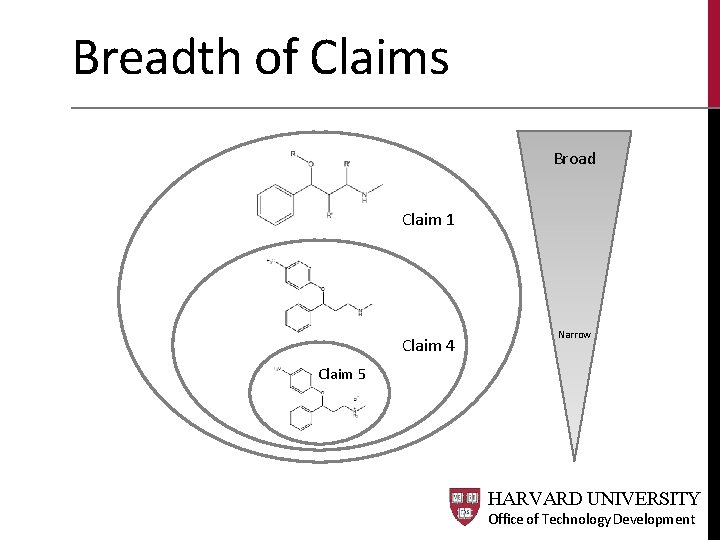
Breadth of Claims Broad Claim 1 Claim 4 Narrow Claim 5 HARVARD UNIVERSITY Office of Technology Development
What is patentable?
Patentable Subject Matter “Congress intended statutory subject matter to include anything under the sun that is made by man. ” U. S. Supreme Court in Diamond v. Chakrabarty, 447 U. S. 303 (1980) HARVARD UNIVERSITY Office of Technology Development
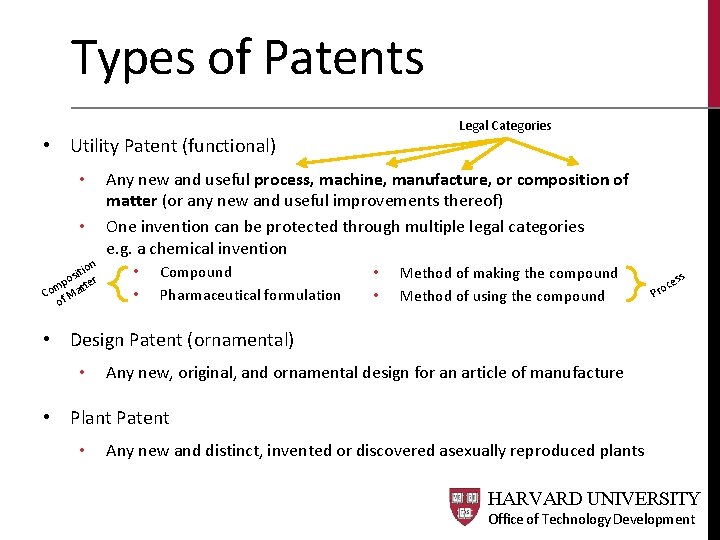
Types of Patents Legal Categories • Utility Patent (functional) • • ion sit r o mp tte Co f Ma o Any new and useful process, machine, manufacture, or composition of matter (or any new and useful improvements thereof) One invention can be protected through multiple legal categories e. g. a chemical invention • • Compound Pharmaceutical formulation • • Method of making the compound Method of using the compound ess c Pro • Design Patent (ornamental) • Any new, original, and ornamental design for an article of manufacture • Plant Patent • Any new and distinct, invented or discovered asexually reproduced plants HARVARD UNIVERSITY Office of Technology Development
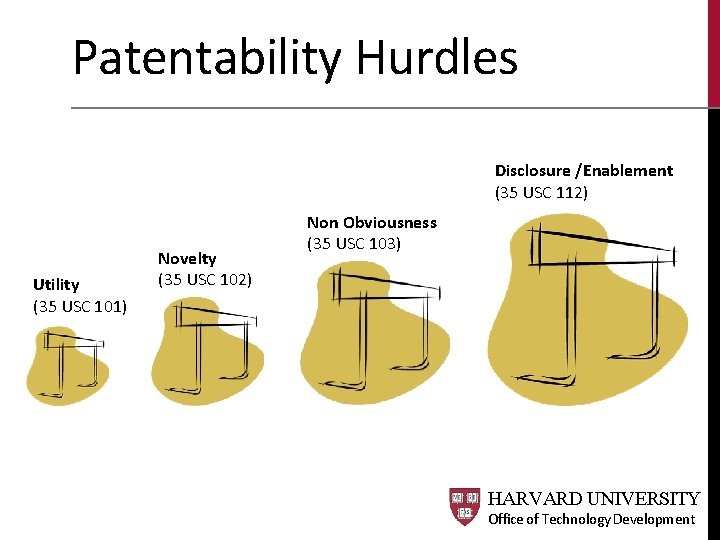
Patentability Hurdles Disclosure /Enablement (35 USC 112) Utility (35 USC 101) Novelty (35 USC 102) Non Obviousness (35 USC 103) HARVARD UNIVERSITY Office of Technology Development
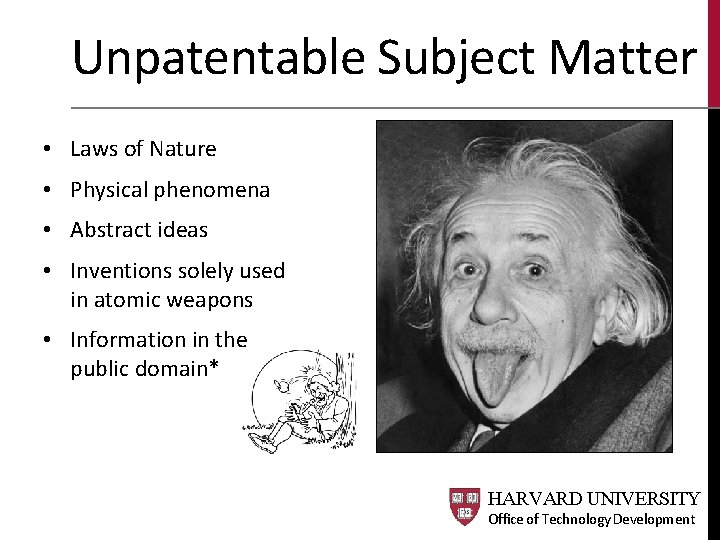
Unpatentable Subject Matter • Laws of Nature • Physical phenomena • Abstract ideas • Inventions solely used in atomic weapons • Information in the public domain* HARVARD UNIVERSITY Office of Technology Development
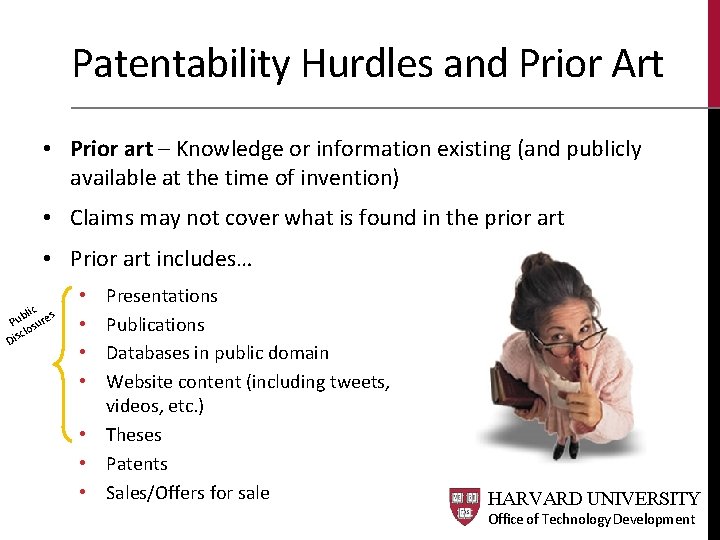
Patentability Hurdles and Prior Art • Prior art – Knowledge or information existing (and publicly available at the time of invention) • Claims may not cover what is found in the prior art • Prior art includes… c s bli Pu sure clo Dis Presentations Publications Databases in public domain Website content (including tweets, videos, etc. ) • Theses • Patents • Sales/Offers for sale • • HARVARD UNIVERSITY Office of Technology Development
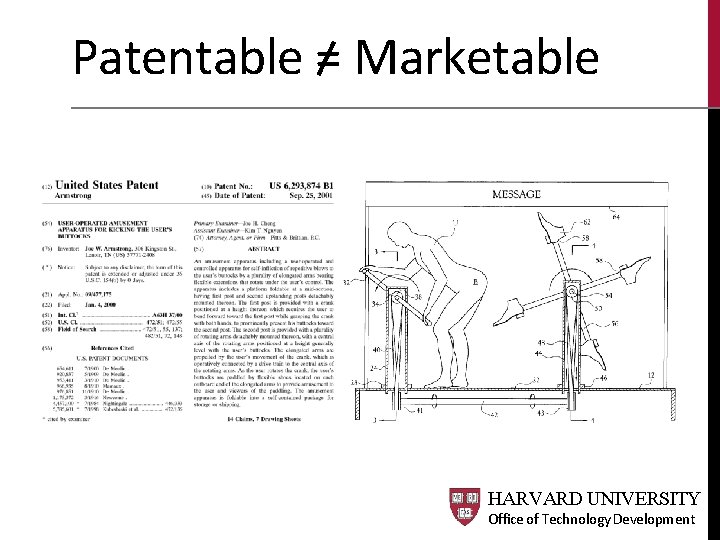
Patentable = Marketable HARVARD UNIVERSITY Office of Technology Development
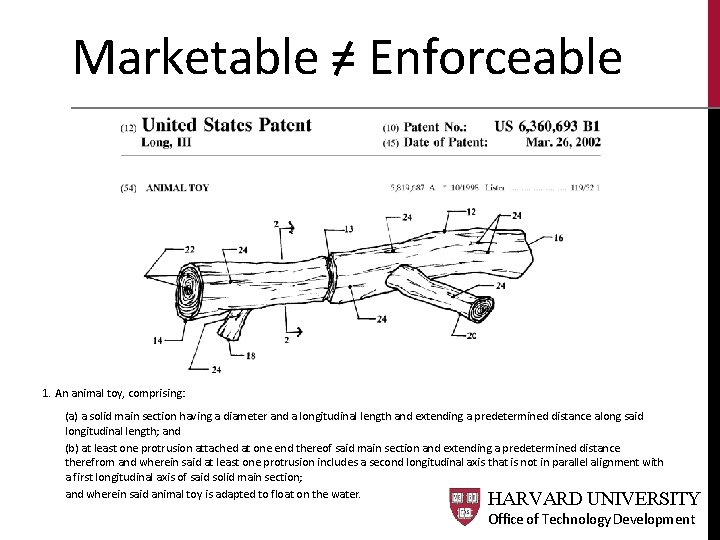
Marketable = Enforceable 1. An animal toy, comprising: (a) a solid main section having a diameter and a longitudinal length and extending a predetermined distance along said longitudinal length; and (b) at least one protrusion attached at one end thereof said main section and extending a predetermined distance therefrom and wherein said at least one protrusion includes a second longitudinal axis that is not in parallel alignment with a first longitudinal axis of said solid main section; and wherein said animal toy is adapted to float on the water. HARVARD UNIVERSITY Office of Technology Development
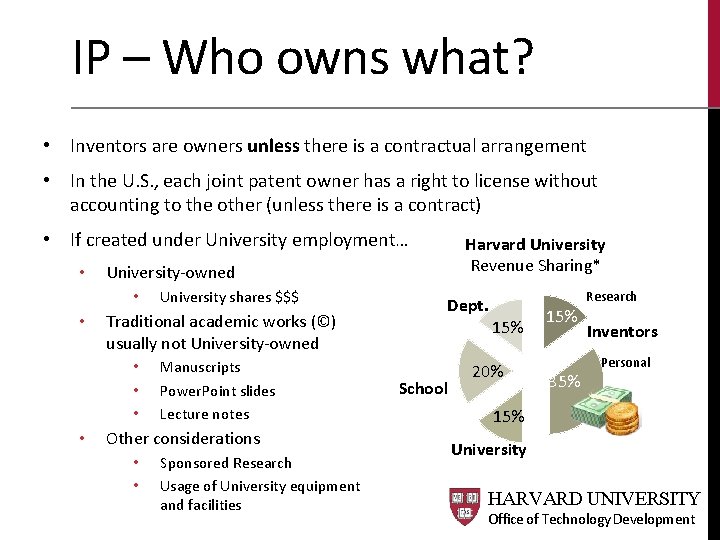
IP – Who owns what? • Inventors are owners unless there is a contractual arrangement • In the U. S. , each joint patent owner has a right to license without accounting to the other (unless there is a contract) • If created under University employment… • University-owned • • University shares $$$ Traditional academic works (©) usually not University-owned • • Harvard University Revenue Sharing* Manuscripts Power. Point slides Lecture notes Other considerations • • Sponsored Research Usage of University equipment and facilities Research Dept. 15% School 20% 15% 35% Inventors Personal 15% University HARVARD UNIVERSITY Office of Technology Development
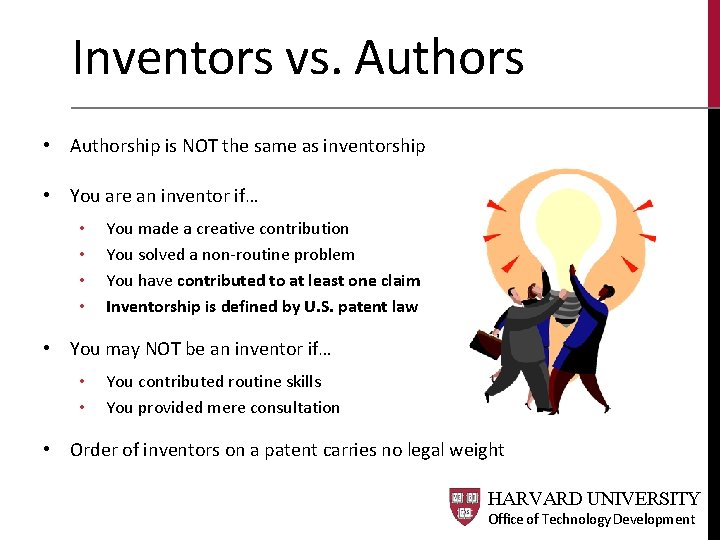
Inventors vs. Authors • Authorship is NOT the same as inventorship • You are an inventor if… • • You made a creative contribution You solved a non-routine problem You have contributed to at least one claim Inventorship is defined by U. S. patent law • You may NOT be an inventor if… • • You contributed routine skills You provided mere consultation • Order of inventors on a patent carries no legal weight HARVARD UNIVERSITY Office of Technology Development
The Patenting Process
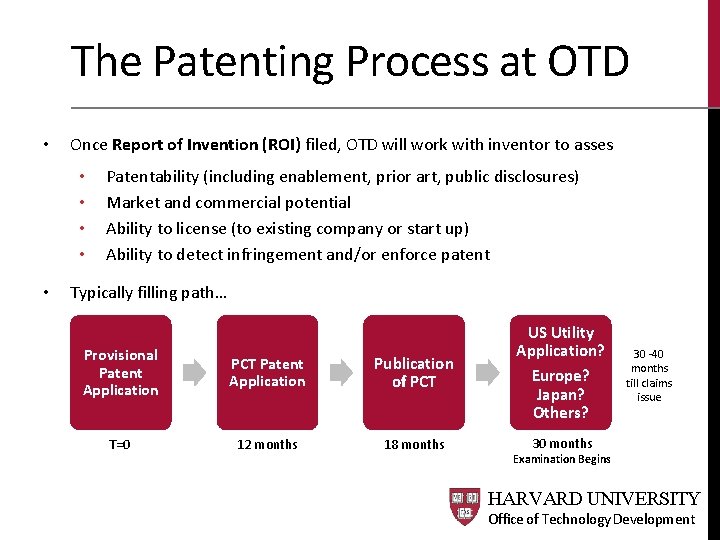
The Patenting Process at OTD • Once Report of Invention (ROI) filed, OTD will work with inventor to asses • • • Patentability (including enablement, prior art, public disclosures) Market and commercial potential Ability to license (to existing company or start up) Ability to detect infringement and/or enforce patent Typically filling path… Provisional Patent Application PCT Patent Application Publication of PCT US Utility Application? Europe? Japan? Others? T=0 12 months 18 months 30 -40 months till claims issue Examination Begins HARVARD UNIVERSITY Office of Technology Development
Thanks! Jen Rice, Ph. D. jennifer_rice@harvard. edu http: //otd. harvard. edu