
HARMFUL TRADITIONAL PRACTICES AFFECTING THE HEALTH OF CHILDREN
![RECOMMENDATIONS • More concerted efforts to promote alternatives to these HTPs [Kenya] • Prevention:](https://slidetodoc.com/presentation_image_h/d5cb4bdde1eb95507190c33e0ed5805b/image-28.jpg "RECOMMENDATIONS • More concerted efforts to promote alternatives to these HTPs [Kenya] • Prevention:")
- Slides: 34
HARMFUL TRADITIONAL PRACTICES AFFECTING THE HEALTH OF CHILDREN a GROUP E PRESENTATION.
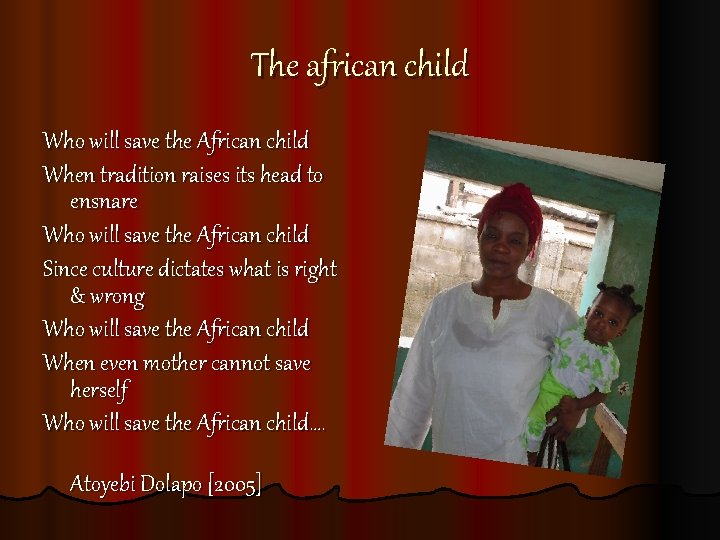
The african child Who will save the African child When tradition raises its head to ensnare Who will save the African child Since culture dictates what is right & wrong Who will save the African child When even mother cannot save herself Who will save the African child…. Atoyebi Dolapo [2005]
outline INTRODUCTION TYPES OF HTPs IMPLICATION THE NIGERIAN SCENARIO EFFORTS SO FAR LESSONS LEARNED RECOMMENDATIONS CONCLUSION
INTRODUCTION Harmful traditional practices are customary practices which are transgenerational, aimed at preserving cultural identity but which tend to have adverse consequences in terms of health and psychology of the recipient of such practices. • Hx of HTPs predates religion • Majority of cases in developing countries.
REASONS FOR PERSISTENCE OF HTPs ü So deeply rooted ü Take an aura of morality ü No knowledge and understanding about risks of practice ü Near absent/total lack of concern by government ü Further ingrains the economic and political subordination of women and their inferior status
POSITIVELY IMPACTING TRADITIONAL PRACTICES • Healthy postpartum practices: - Rest - Cleanliness - Love - Good nutrition (Nigeria & Korea) • Long periods of breastfeeding in many parts of Africa, Latin America & Asia
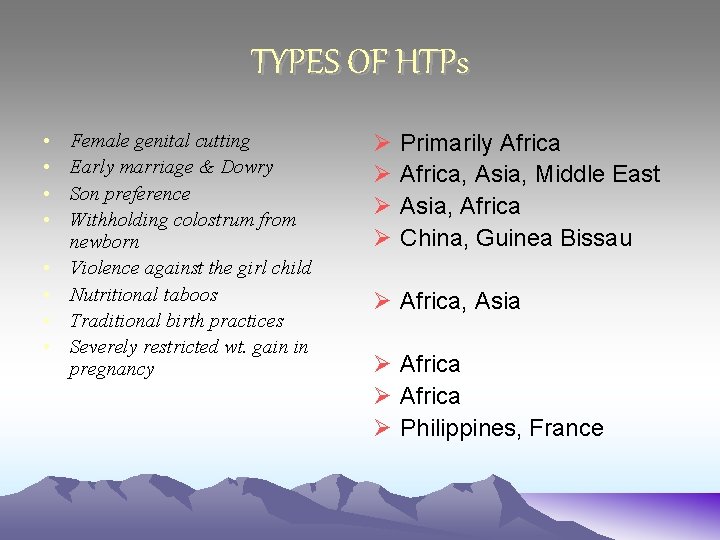
TYPES OF HTPs • • Female genital cutting Early marriage & Dowry Son preference Withholding colostrum from newborn Violence against the girl child Nutritional taboos Traditional birth practices Severely restricted wt. gain in pregnancy Ø Ø Primarily Africa, Asia, Middle East Asia, Africa China, Guinea Bissau Ø Africa, Asia Ø Africa Ø Philippines, France
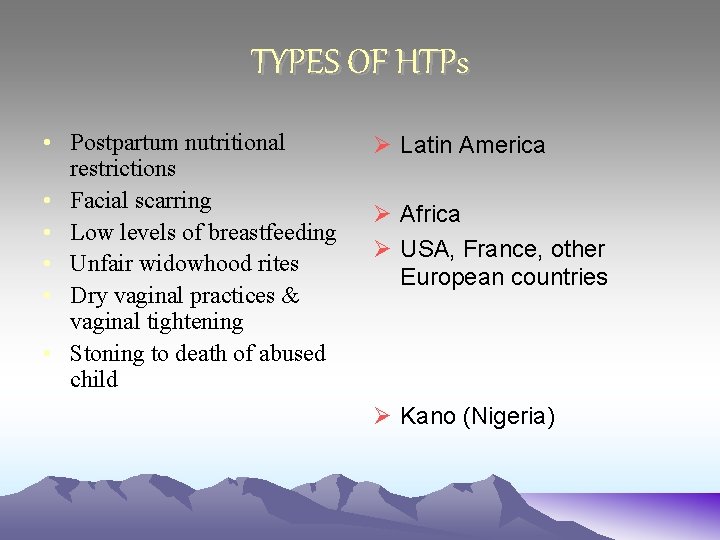
TYPES OF HTPs • Postpartum nutritional restrictions • Facial scarring • Low levels of breastfeeding • Unfair widowhood rites • Dry vaginal practices & vaginal tightening • Stoning to death of abused child Ø Latin America Ø Africa Ø USA, France, other European countries Ø Kano (Nigeria)
FEMALE GENITAL CUTTING • All procedures (however crude) involving removal of part or all of the female external genitalia or other injury to the genital organs for cultural and non therapeutic reasons
REASONS FOR FGC “Coming of age” of the girl child Controlling of female sexuality ensuring virginity before; and chastity after marriage
PUBLIC HEALTH BURDEN ü 2 Million girls estimated to be at risk annually. ü Practiced in at least 28 of 43 African countries + ethnic groups in Arabian peninsula, Malaysia and immigrant populations in Australia, Canada, England, France… ü Prevalence varies from 98% in Somalia to 5% in Uganda ü Risk of HIV/AIDS Amplified.
FORMS OF FGC CIRCUMSICION OR SUNNA EXCISION / CLITORIDECTOMY INFIBULATION/PHARAONIC CIRCUMCISION VARIANT – PITTA PATTA ABORIGENES
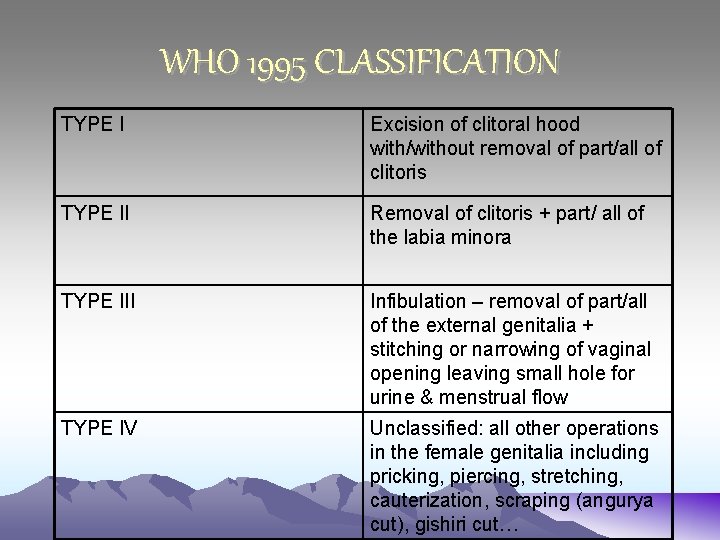
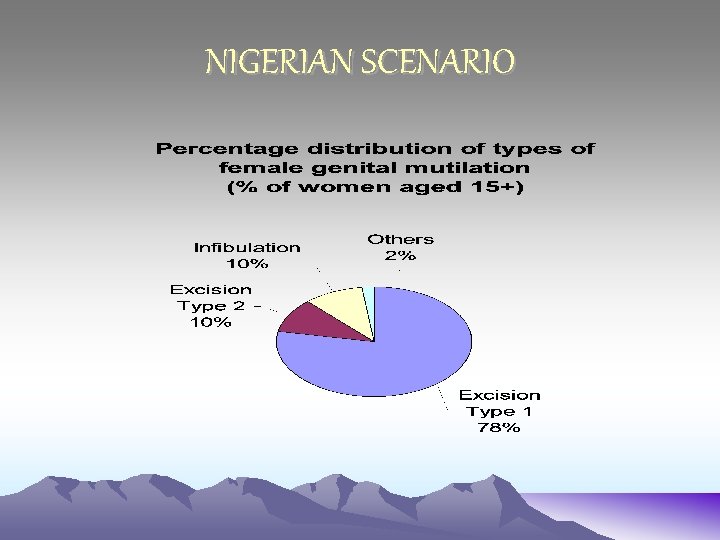
WHO 1995 CLASSIFICATION TYPE I Excision of clitoral hood with/without removal of part/all of clitoris TYPE II Removal of clitoris + part/ all of the labia minora TYPE III Infibulation – removal of part/all of the external genitalia + stitching or narrowing of vaginal opening leaving small hole for urine & menstrual flow TYPE IV Unclassified: all other operations in the female genitalia including pricking, piercing, stretching, cauterization, scraping (angurya cut), gishiri cut…
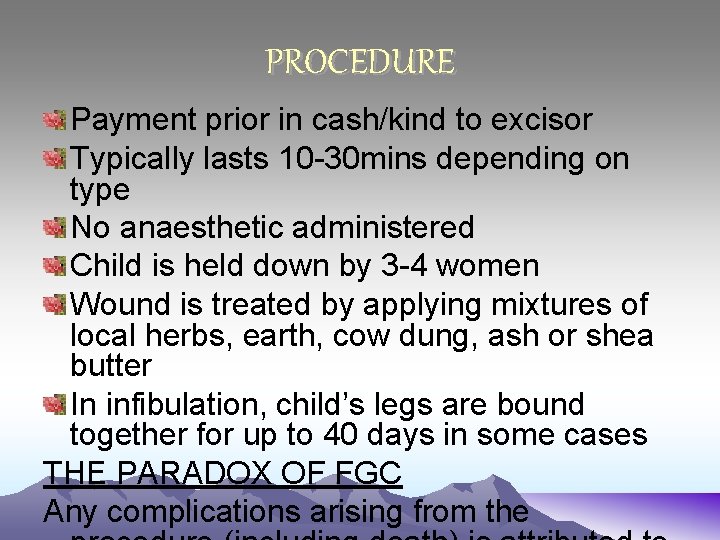
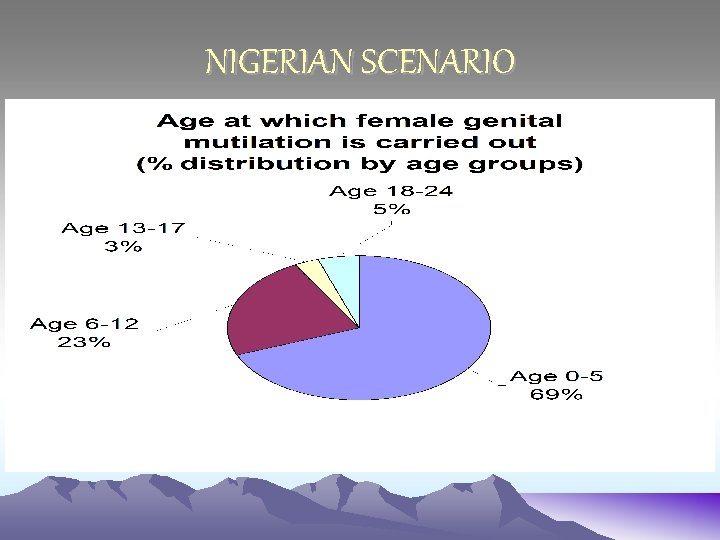
PROCEDURE Payment prior in cash/kind to excisor Typically lasts 10 -30 mins depending on type No anaesthetic administered Child is held down by 3 -4 women Wound is treated by applying mixtures of local herbs, earth, cow dung, ash or shea butter In infibulation, child’s legs are bound together for up to 40 days in some cases THE PARADOX OF FGC Any complications arising from the
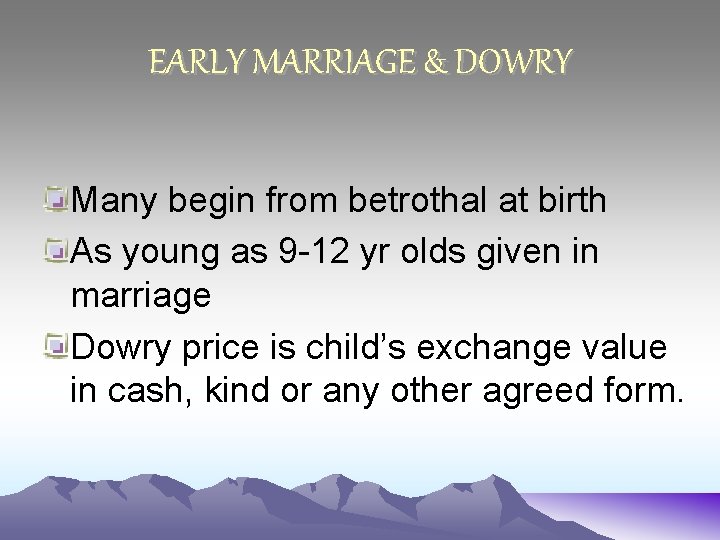
EARLY MARRIAGE & DOWRY Many begin from betrothal at birth As young as 9 -12 yr olds given in marriage Dowry price is child’s exchange value in cash, kind or any other agreed form.
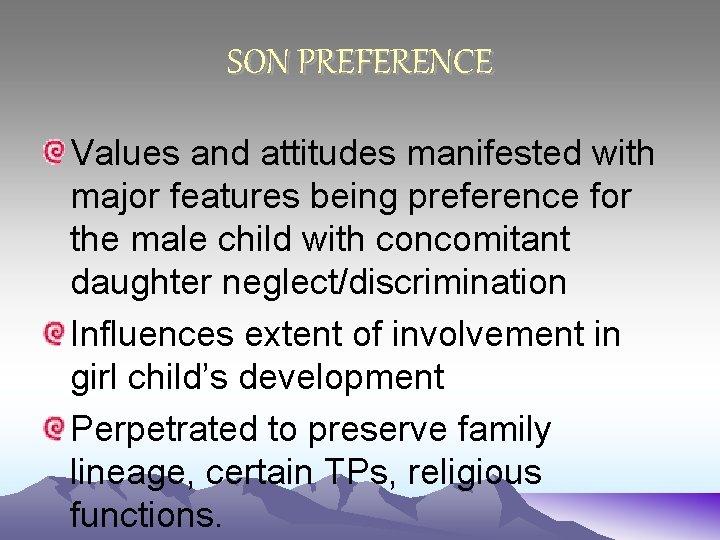
SON PREFERENCE Values and attitudes manifested with major features being preference for the male child with concomitant daughter neglect/discrimination Influences extent of involvement in girl child’s development Perpetrated to preserve family lineage, certain TPs, religious functions.
NUTRITIONAL TABOOS Deprivation of essential nutrients Children on receiving end commonly suffer from Fe & protein deficiency Steeped mainly in superstition
VIOLENCE AGAINST THE GIRL CHILD Global phenomenon Takes covert & overt forms [physical & mental abuse] Entails FGC, wife burning, dowry related violence, rape, incest, wife battering, female feticide, infanticide, female trafficking and prostitution Violates article 6 of CRC
TRADITIONAL BIRTH PRACTICES Mainly occurs in developing countries Delivery supervised by TBAs who learn by apprenticeship backed by generational knowledge Laboring female expected to deliver by herself if she has been faithful Forceful massage/ human pressure Gishiri cut Zurzur Use of herbal mixture
IMPLICATIONS/CONSEQUENCES OF HTPs Multifaceted with grave consequences bordering on health, psychological, socioeconomic problems in the immediate time frame or long term
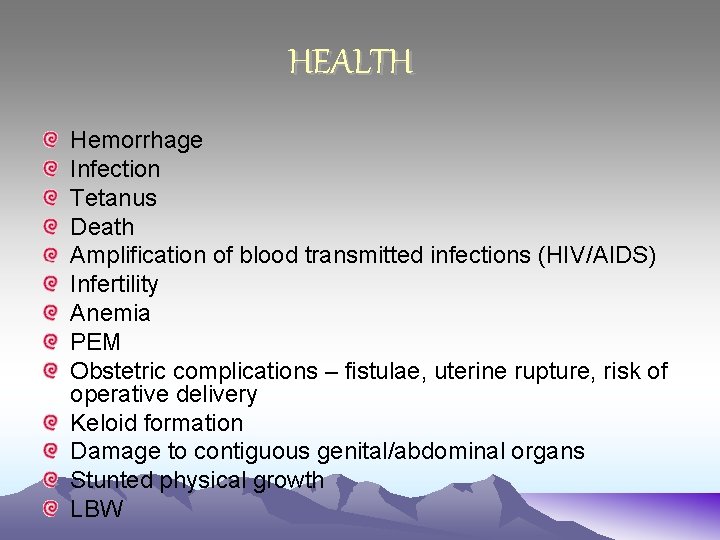
HEALTH Hemorrhage Infection Tetanus Death Amplification of blood transmitted infections (HIV/AIDS) Infertility Anemia PEM Obstetric complications – fistulae, uterine rupture, risk of operative delivery Keloid formation Damage to contiguous genital/abdominal organs Stunted physical growth LBW
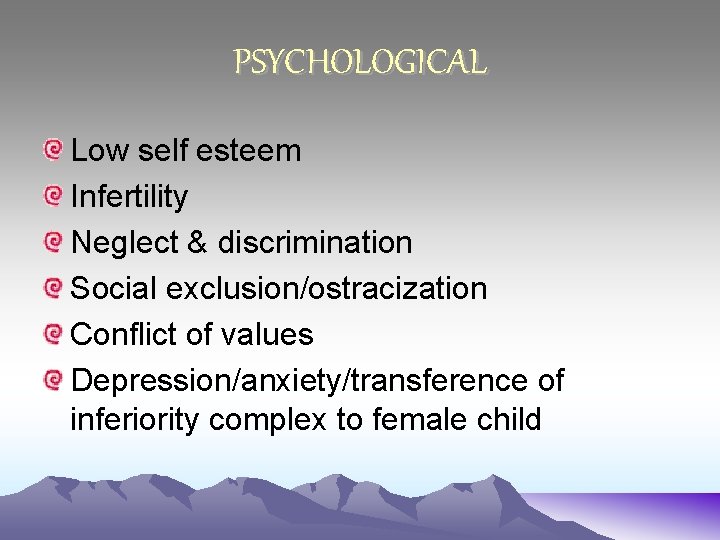
PSYCHOLOGICAL Low self esteem Infertility Neglect & discrimination Social exclusion/ostracization Conflict of values Depression/anxiety/transference of inferiority complex to female child
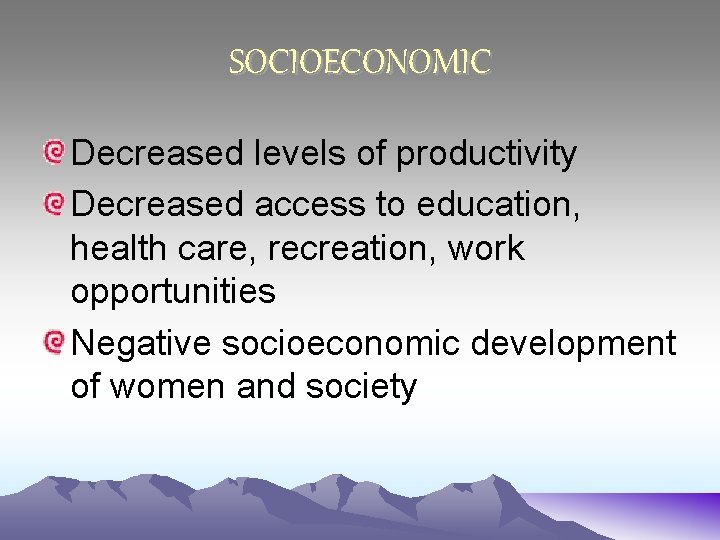
SOCIOECONOMIC Decreased levels of productivity Decreased access to education, health care, recreation, work opportunities Negative socioeconomic development of women and society
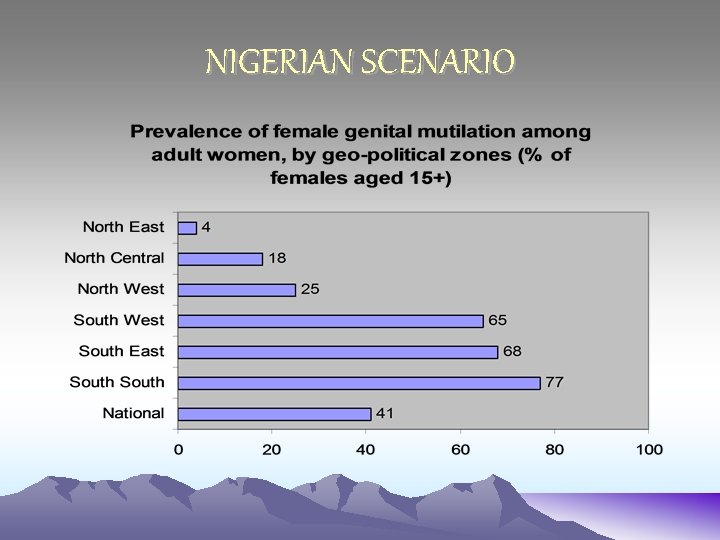
NIGERIAN SCENARIO
NIGERIAN SCENARIO
NIGERIAN SCENARIO
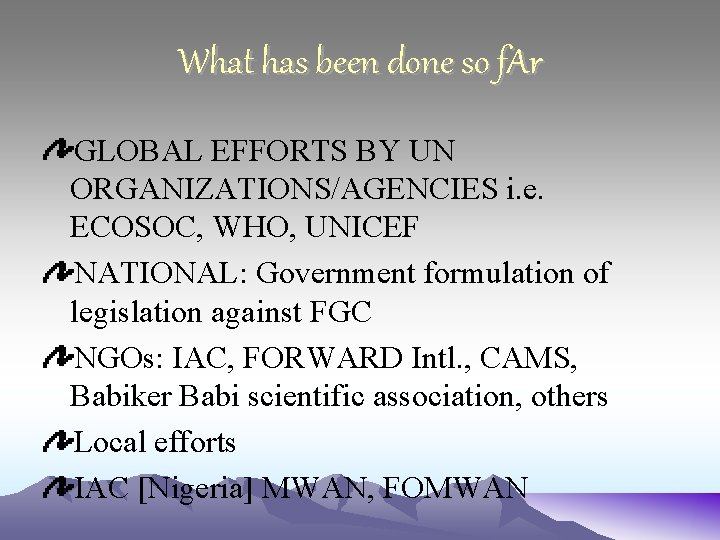
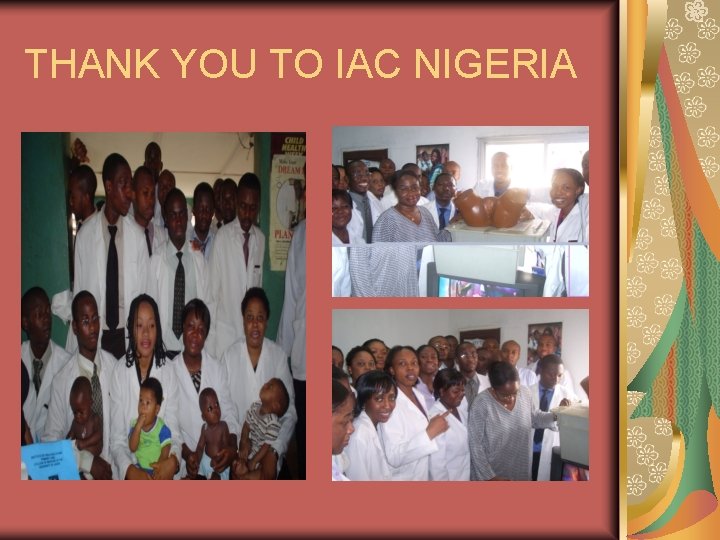
What has been done so f. Ar GLOBAL EFFORTS BY UN ORGANIZATIONS/AGENCIES i. e. ECOSOC, WHO, UNICEF NATIONAL: Government formulation of legislation against FGC NGOs: IAC, FORWARD Intl. , CAMS, Babiker Babi scientific association, others Local efforts IAC [Nigeria] MWAN, FOMWAN
RECOMMENDATIONS • More concerted efforts to promote alternatives to these HTPs [Kenya] • Prevention: using behavioral change communication to improve health • Integrating cultural based health systems with use of “cultural brokers” • Advocacy/policy oriented research/technical cooperation
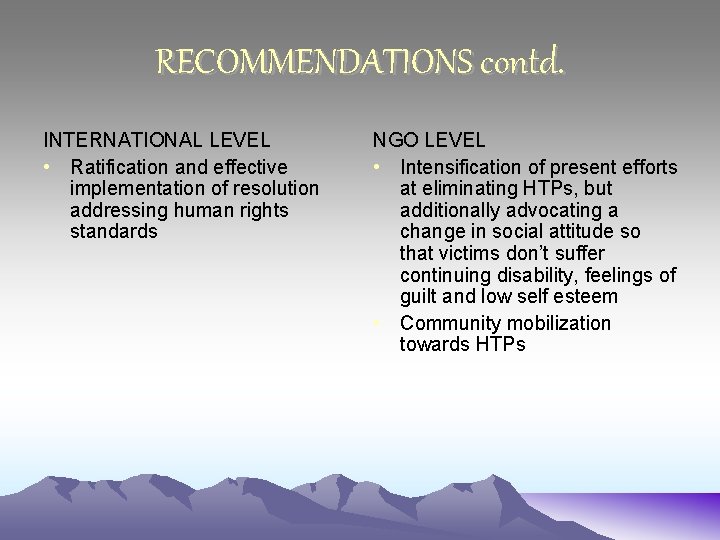
RECOMMENDATIONS contd. INTERNATIONAL LEVEL • Ratification and effective implementation of resolution addressing human rights standards NGO LEVEL • Intensification of present efforts at eliminating HTPs, but additionally advocating a change in social attitude so that victims don’t suffer continuing disability, feelings of guilt and low self esteem • Community mobilization towards HTPs
RECOMMENDATIONS contd. NATIONAL LEVEL Legislation and programs prohibiting practices with adverse effects on health of children Formal training for TBAs and community members to promote attitudinal change Nutrition education programs to address special needs of the child Promotion of positive image of girl child Implementation of universal basic education to further aid gender equality Introduction of social security system
CONCLUSION HTPs in their entirety are largely seen as a violation of the girl child, perpetrated by females for the benefit of males. And as a result of ignorance of human rights, acceptance and consequently perpetration of such practices is ensured. Vital to any process of change, and to stamp out HTPs is -
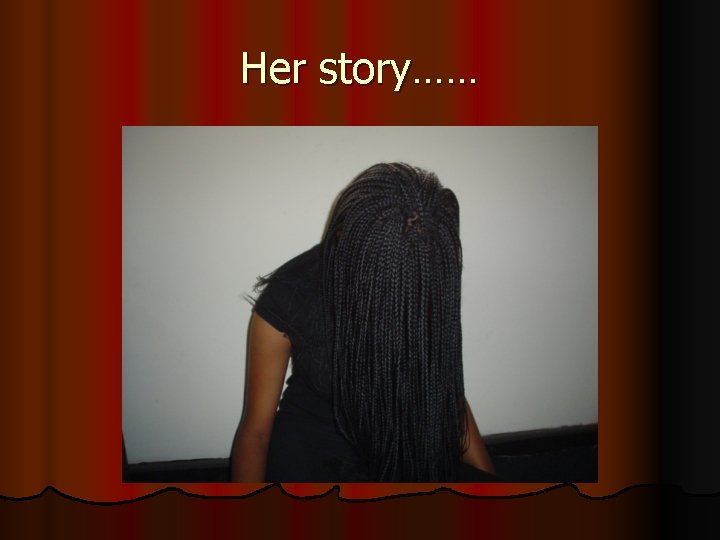
A SURVIVOR’S STORY “MYTHS OF FEMALE CIRCUMCISION” Testimony cited in Raza 2001 Extracted from Children’s and Women’s Rights in Nigeria: A wake up call Situation assessment analysis 2001 “In my village circumcision for the girls takes place every…”
Her story……
THANK YOU TO IAC NIGERIA