
HardyWeinberg Principle Natural selection acts on individuals but
Hardy-Weinberg Principle Natural selection acts on individuals, but only populations evolve • Explain this statement
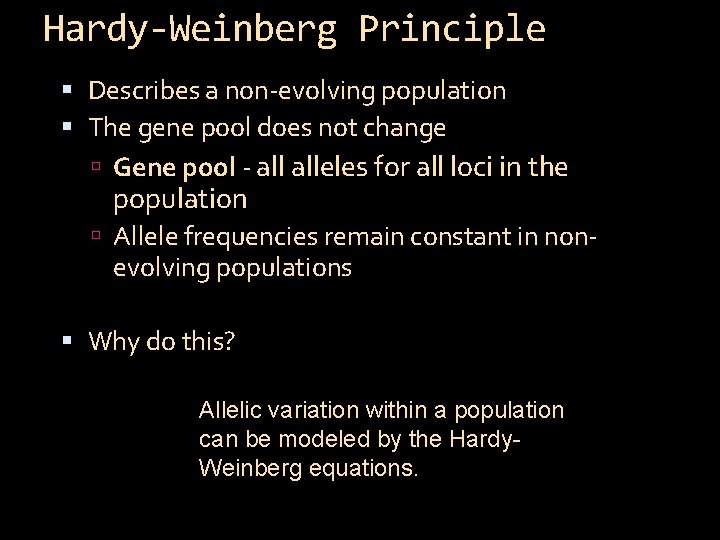
Hardy-Weinberg Principle Describes a non-evolving population The gene pool does not change Gene pool - alleles for all loci in the population Allele frequencies remain constant in non- evolving populations Why do this? Allelic variation within a population can be modeled by the Hardy. Weinberg equations.
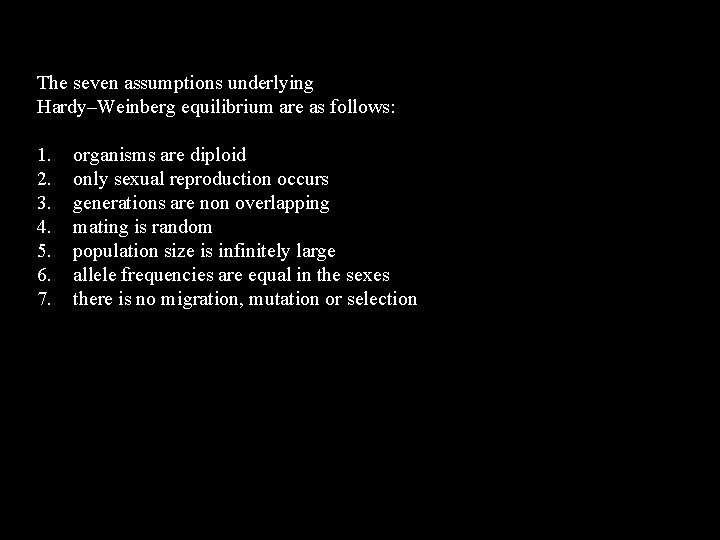
The seven assumptions underlying Hardy–Weinberg equilibrium are as follows: 1. 2. 3. 4. 5. 6. 7. organisms are diploid only sexual reproduction occurs generations are non overlapping mating is random population size is infinitely large allele frequencies are equal in the sexes there is no migration, mutation or selection
2 p + 2 pq + 2 q = 1
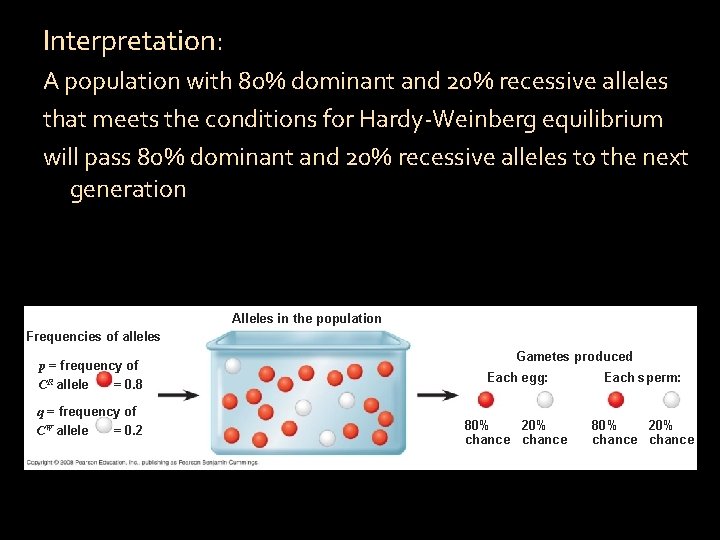
Interpretation: A population with 80% dominant and 20% recessive alleles that meets the conditions for Hardy-Weinberg equilibrium will pass 80% dominant and 20% recessive alleles to the next generation Alleles in the population Frequencies of alleles p = frequency of CR allele = 0. 8 q = frequency of CW allele = 0. 2 Gametes produced Each egg: Each sperm: 80% 20% chance
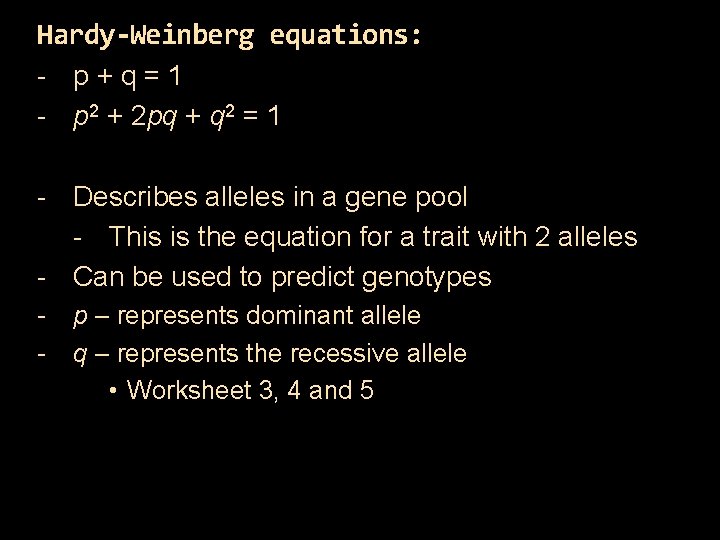
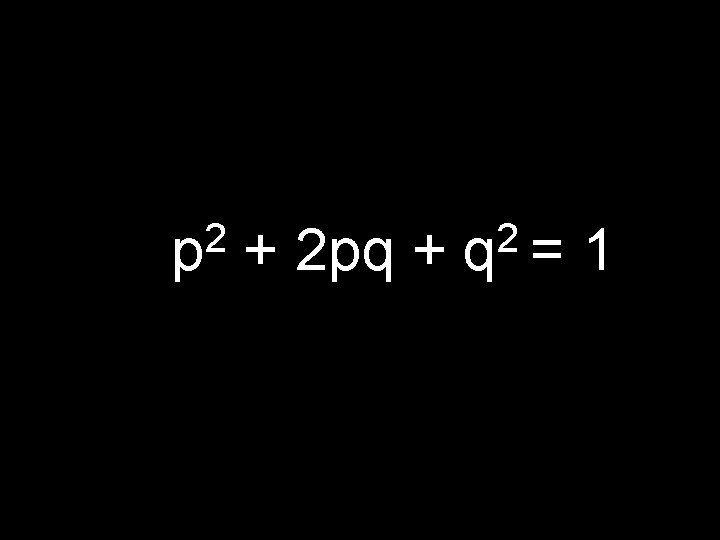
Hardy-Weinberg equations: - p+q=1 - p 2 + 2 pq + q 2 = 1 - Describes alleles in a gene pool - This is the equation for a trait with 2 alleles - Can be used to predict genotypes - p – represents dominant allele q – represents the recessive allele • Worksheet 3, 4 and 5
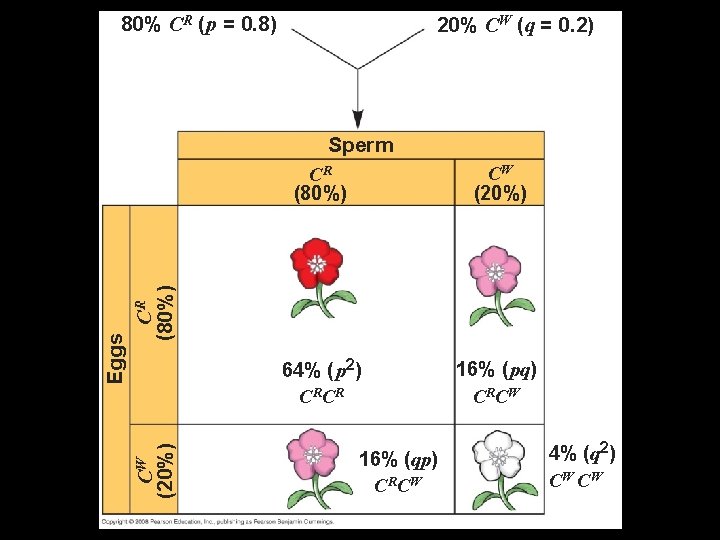
80% CR ( p = 0. 8) 20% CW (q = 0. 2) CR (80%) CW (20%) 64% ( p 2) CRCR 16% ( pq) CRCW CR (80%) CW (20%) Eggs Sperm 16% (qp) CRCW 4% (q 2) CW CW
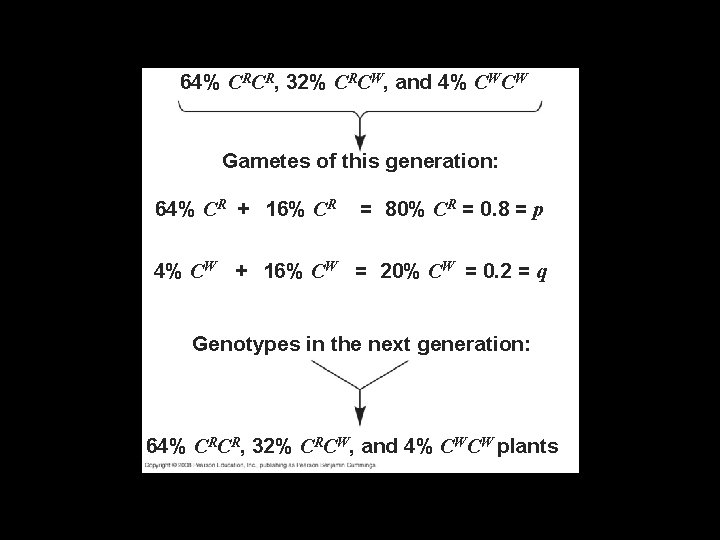
64% CRCR, 32% CRCW, and 4% CWCW Gametes of this generation: 64% CR + 16% CR = 80% CR = 0. 8 = p 4% CW + 16% CW = 20% CW = 0. 2 = q Genotypes in the next generation: 64% CRCR, 32% CRCW, and 4% CWCW plants
Reality Hardy-Weinberg - hypothetical population In real populations, allele and genotype frequencies change over time
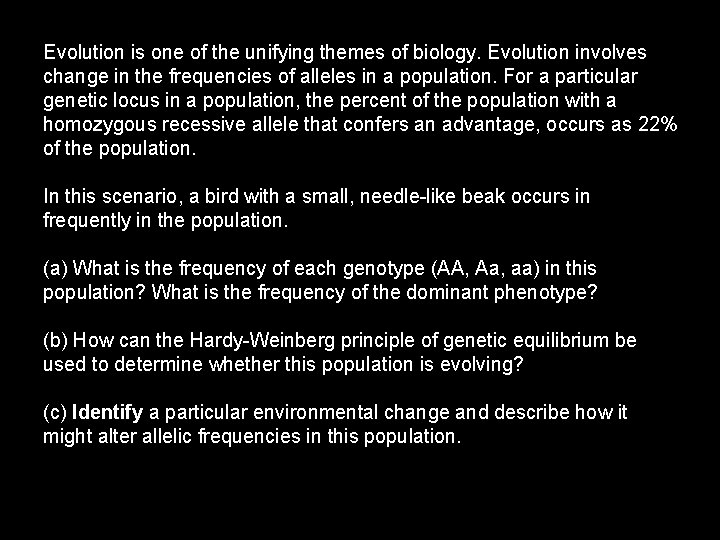
Evolution is one of the unifying themes of biology. Evolution involves change in the frequencies of alleles in a population. For a particular genetic locus in a population, the percent of the population with a homozygous recessive allele that confers an advantage, occurs as 22% of the population. In this scenario, a bird with a small, needle-like beak occurs in frequently in the population. (a) What is the frequency of each genotype (AA, Aa, aa) in this population? What is the frequency of the dominant phenotype? (b) How can the Hardy-Weinberg principle of genetic equilibrium be used to determine whether this population is evolving? (c) Identify a particular environmental change and describe how it might alter allelic frequencies in this population.
- Slides: 10