
HardyWeinberg Equilibrium Model The HardyWeinberg model states that
Hardy-Weinberg Equilibrium Model
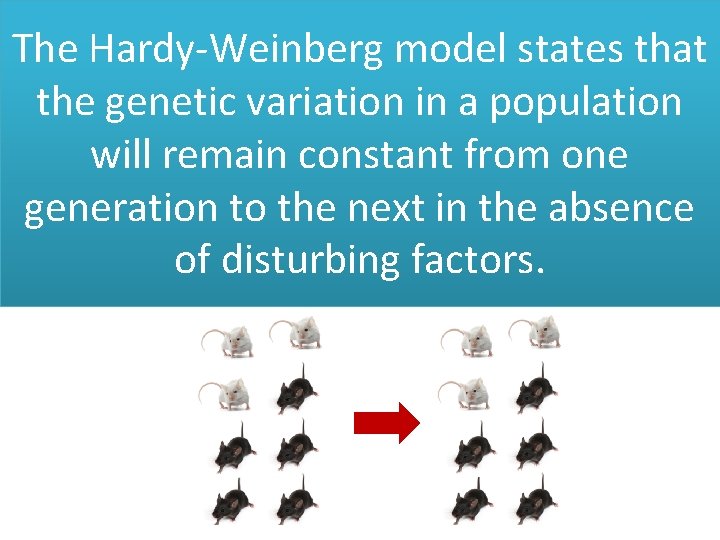
The Hardy-Weinberg model states that the genetic variation in a population will remain constant from one generation to the next in the absence of disturbing factors.
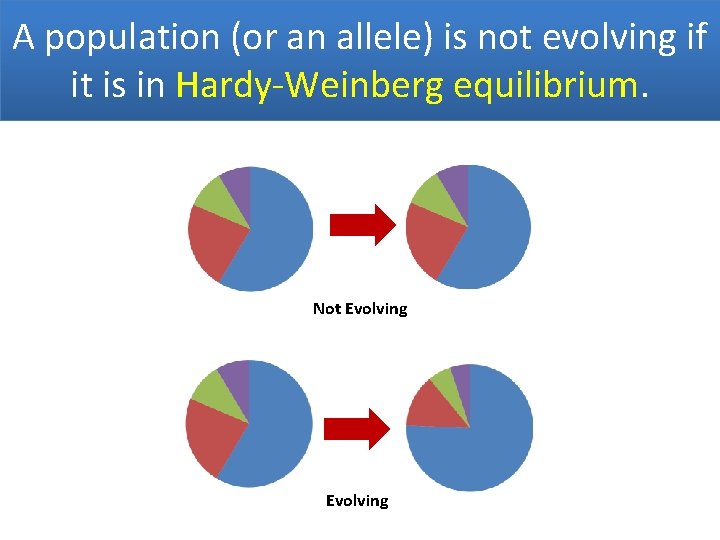
A population (or an allele) is not evolving if it is in Hardy-Weinberg equilibrium. Not Evolving
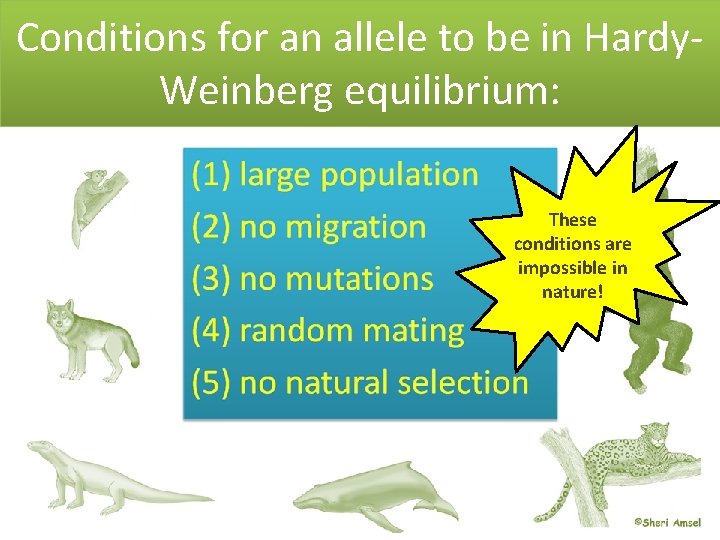
Conditions for an allele to be in Hardy. Weinberg equilibrium: These conditions are impossible in nature!
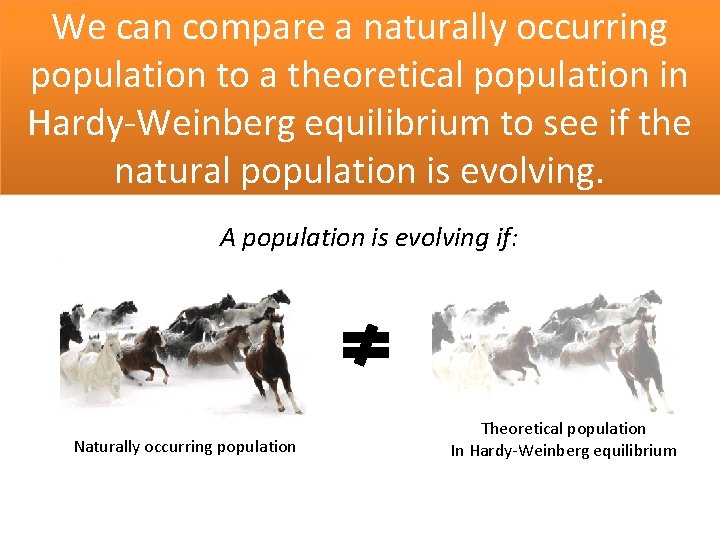
We can compare a naturally occurring population to a theoretical population in Hardy-Weinberg equilibrium to see if the natural population is evolving. A population is evolving if: Naturally occurring population Theoretical population In Hardy-Weinberg equilibrium
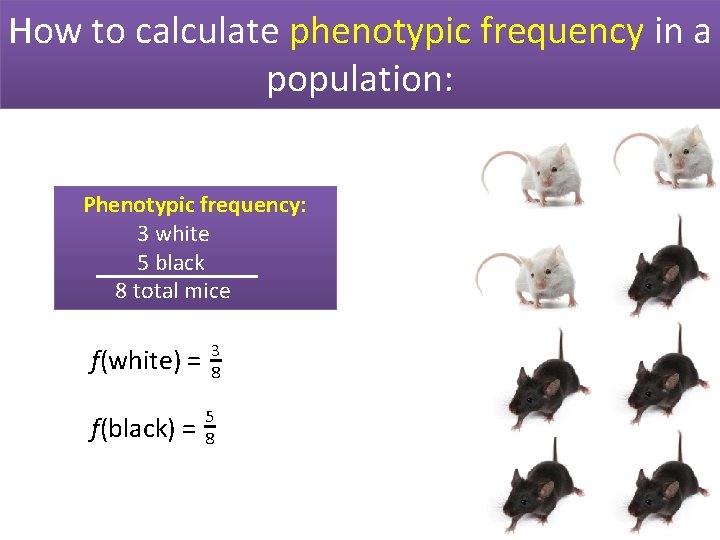
How to calculate phenotypic frequency in a population: Phenotypic frequency: 3 white 5 black 8 total mice f(white) = f(black) = 3 8 5 8
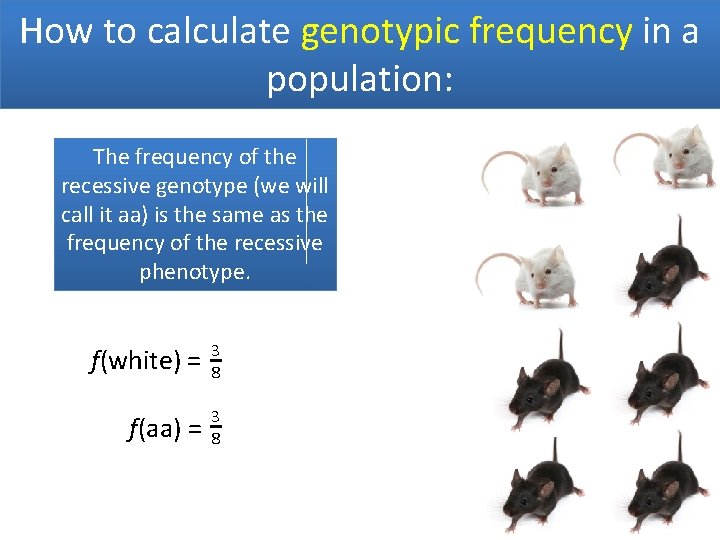
How to calculate genotypic frequency in a population: The frequency of the recessive genotype (we will call it aa) is the same as the frequency of the recessive phenotype. f(white) = 3 8 f(aa) = 3 8
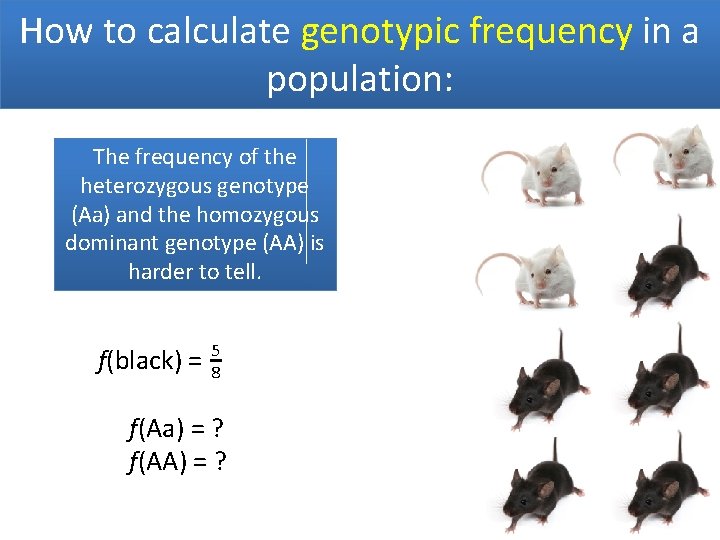
How to calculate genotypic frequency in a population: The frequency of the heterozygous genotype (Aa) and the homozygous dominant genotype (AA) is harder to tell. f(black) = 5 8 f(Aa) = ? f(AA) = ?
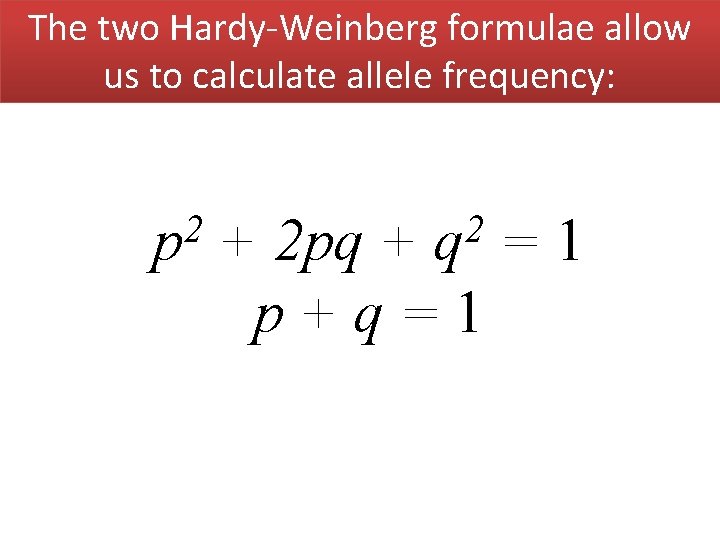
The two Hardy-Weinberg formulae allow us to calculate allele frequency: 2 p 2 q + 2 pq + = 1 p+q=1
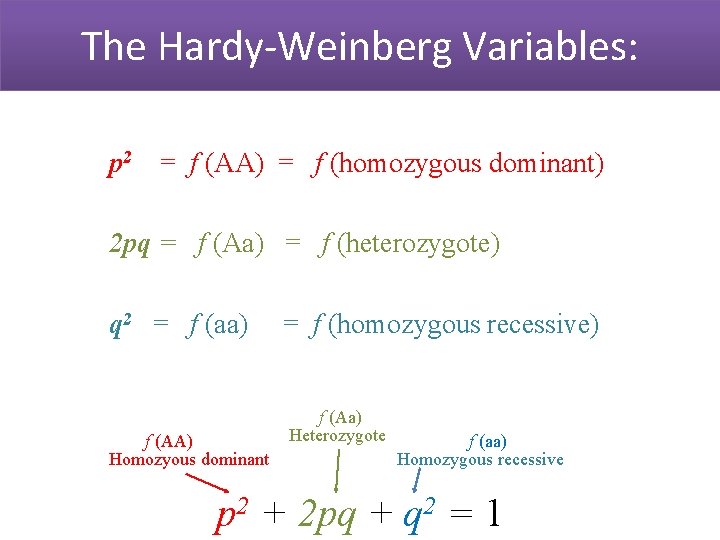
The Hardy-Weinberg Variables: p 2 = f (AA) = f (homozygous dominant) 2 pq = f (Aa) = f (heterozygote) q 2 = f (aa) f (AA) Homozyous dominant = f (homozygous recessive) f (Aa) Heterozygote f (aa) Homozygous recessive p 2 + 2 pq + q 2 = 1
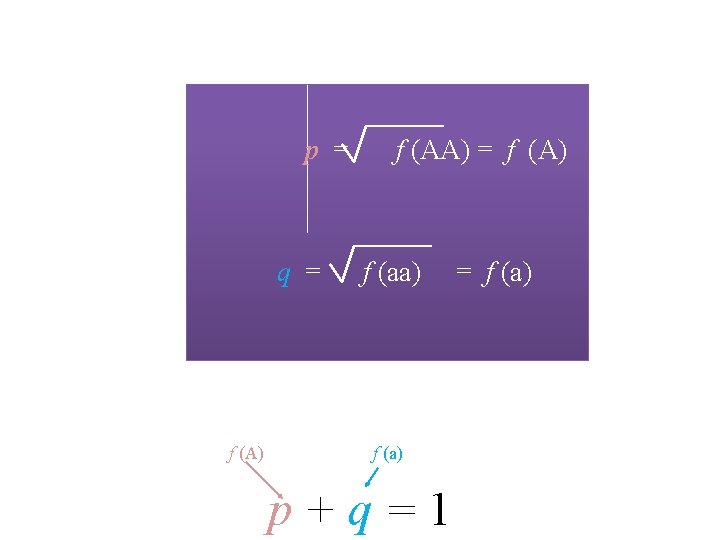
p = q = f (A) f (AA) = f (A) f (aa) f (a) p+q=1 = f (a)
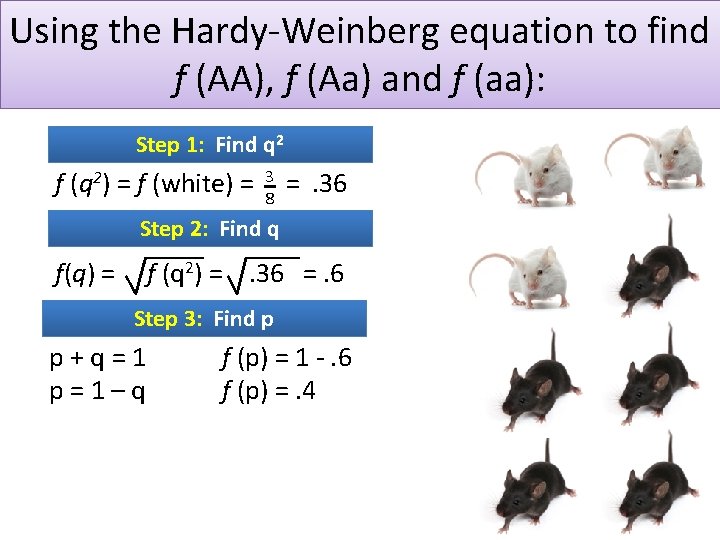
Using the Hardy-Weinberg equation to find f (AA), f (Aa) and f (aa): Step 1: Find q 2 f (q 2) = f (white) = 3 8 Step 4: Find f (aa) =. 36 Step 2: Find q f(q) = f (q 2) =. 36 =. 6 Step 3: Find p p+q=1 p=1–q f (p) = 1 -. 6 f (p) =. 4 f (aa) = f (q 2) =. 36 Step 5: Find f (Aa) = 2 pq = 2(. 4)(. 6) =. 48 Step 6: Find f (AA) = f (p 2) =. 42 =. 16
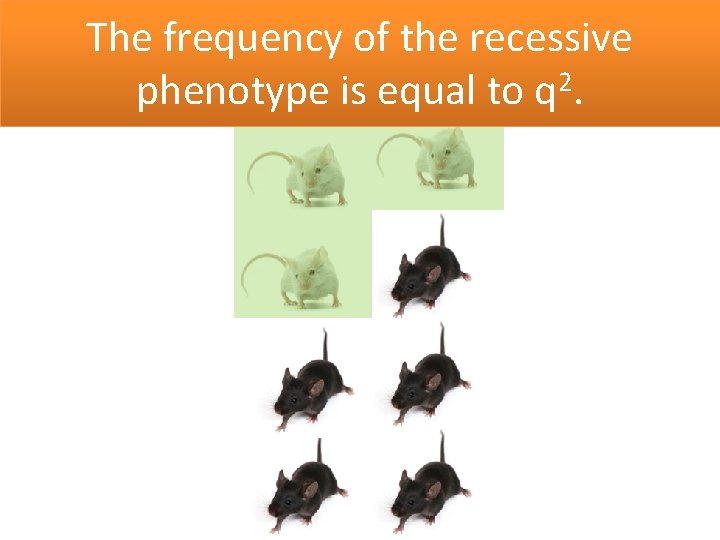
The frequency of the recessive 2 phenotype is equal to q.
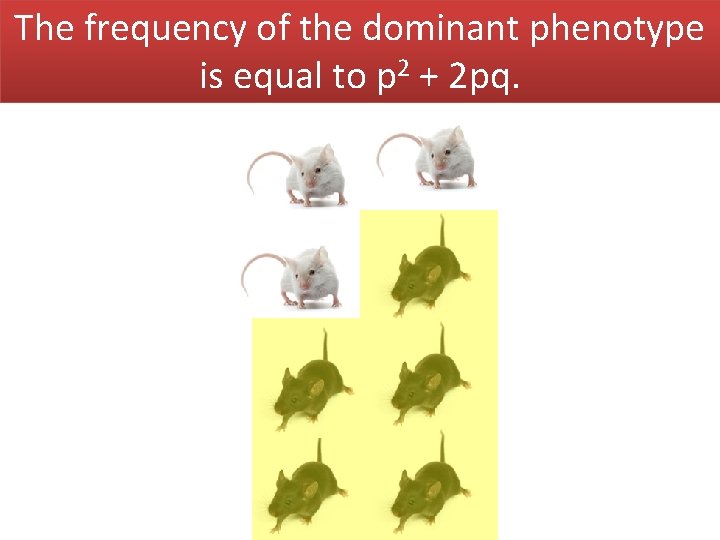
The frequency of the dominant phenotype is equal to p 2 + 2 pq.
A population is evolving if: • Any one of the five Hardy-Weinberg conditions are not met. • The allele frequency changes. • It is not in Hardy-Weinberg Equilibrium
Allele frequency is the proportion of gametes in a population. To calculate allele frequency: • There always twice the number of alleles as there are individuals in the population (every individual has two alleles for a gene). AA Aa aa
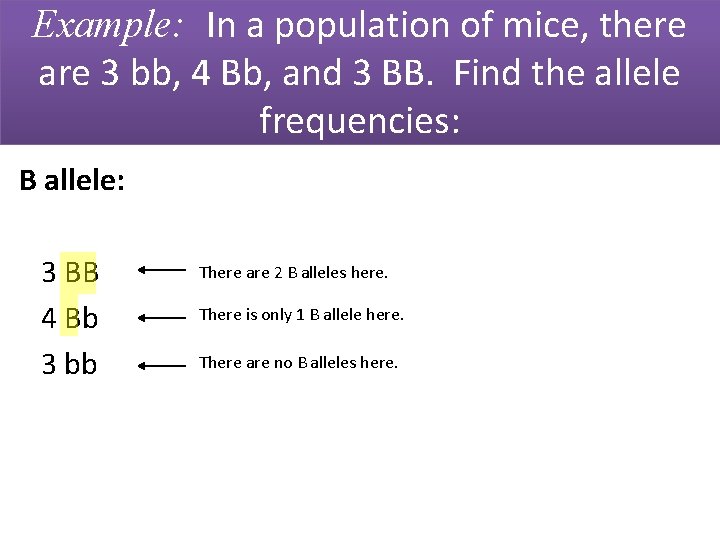
Example: In a population of mice, there are 3 bb, 4 Bb, and 3 BB. Find the allele frequencies: B allele: 3 BB 4 Bb 3 bb There are 2 B alleles here. There is only 1 B allele here. There are no B alleles here.
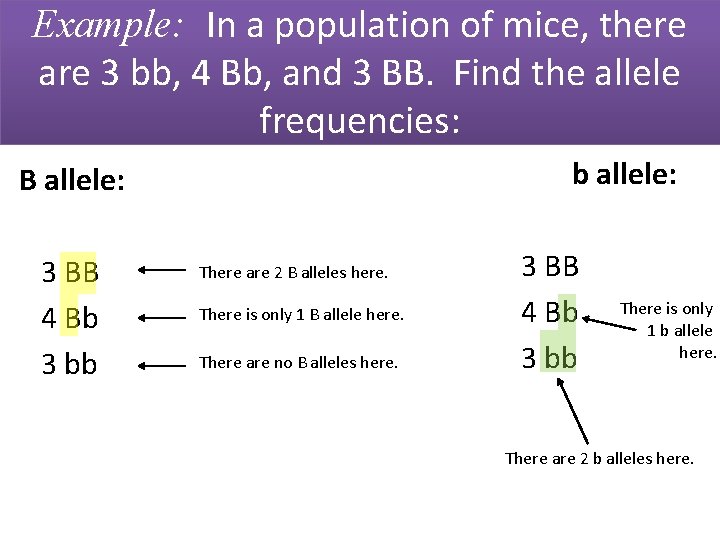
Example: In a population of mice, there are 3 bb, 4 Bb, and 3 BB. Find the allele frequencies: b allele: B allele: 3 BB 4 Bb 3 bb There are 2 B alleles here. There is only 1 B allele here. There are no B alleles here. 3 BB 4 Bb 3 bb There is only 1 b allele here. There are 2 b alleles here.
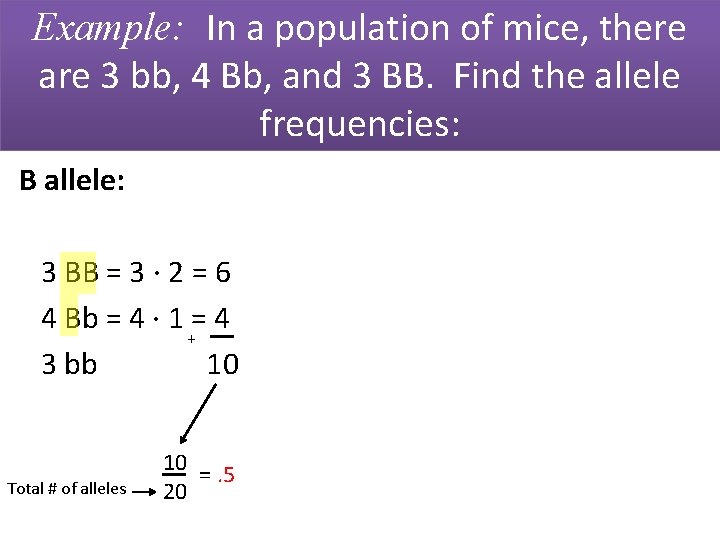
Example: In a population of mice, there are 3 bb, 4 Bb, and 3 BB. Find the allele frequencies: B allele: 3 BB = 3 · 2 = 6 4 Bb = 4 · 1 = 4 + 3 bb 10 Total # of alleles 10 =. 5 20
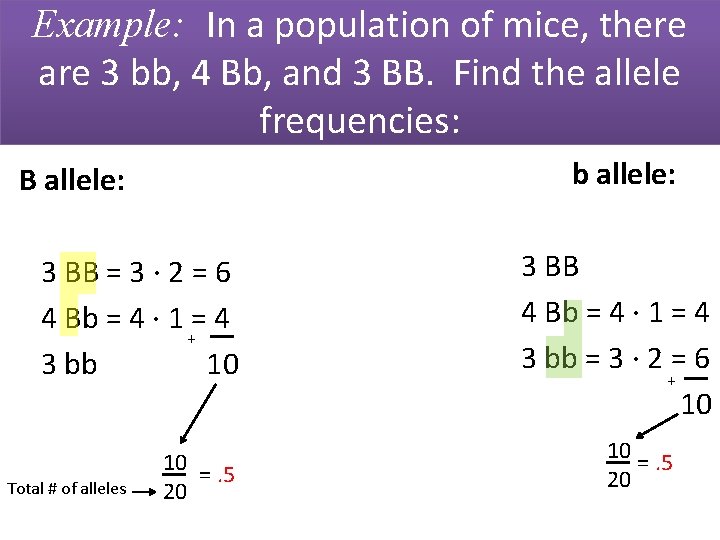
Example: In a population of mice, there are 3 bb, 4 Bb, and 3 BB. Find the allele frequencies: b allele: B allele: 3 BB = 3 · 2 = 6 4 Bb = 4 · 1 = 4 + 3 bb 10 Total # of alleles 10 =. 5 20 3 BB 4 Bb = 4 · 1 = 4 3 bb = 3 · 2 = 6 + 10 10 =. 5 20
- Slides: 20