
Hardware Level Organization CPU Major components memory central
- Slides: 14
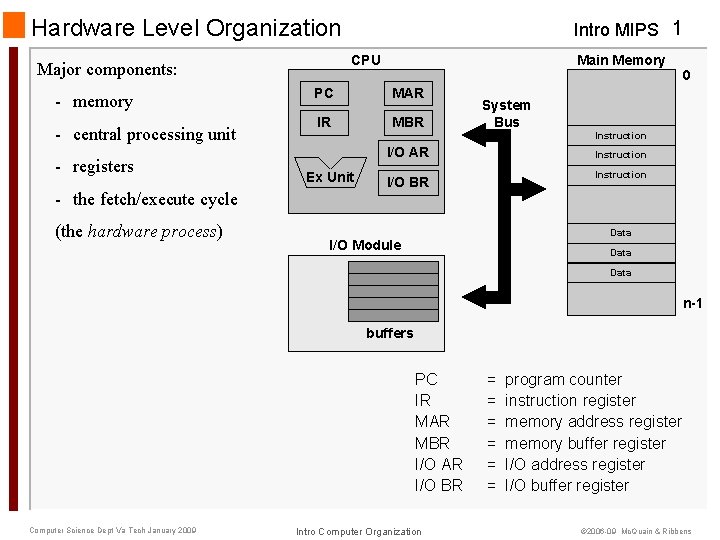
Hardware Level Organization CPU Major components: - memory - central processing unit - registers - the fetch/execute cycle (the hardware process) Intro MIPS 1 Main Memory PC MAR IR MBR System Bus I/O AR Ex Unit 0 Instruction I/O BR Data I/O Module Data n-1 buffers PC IR MAR MBR I/O AR I/O BR Computer Science Dept Va Tech January 2009 Intro Computer Organization = = = program counter instruction register memory address register memory buffer register I/O address register I/O buffer register © 2006 -09 Mc. Quain & Ribbens
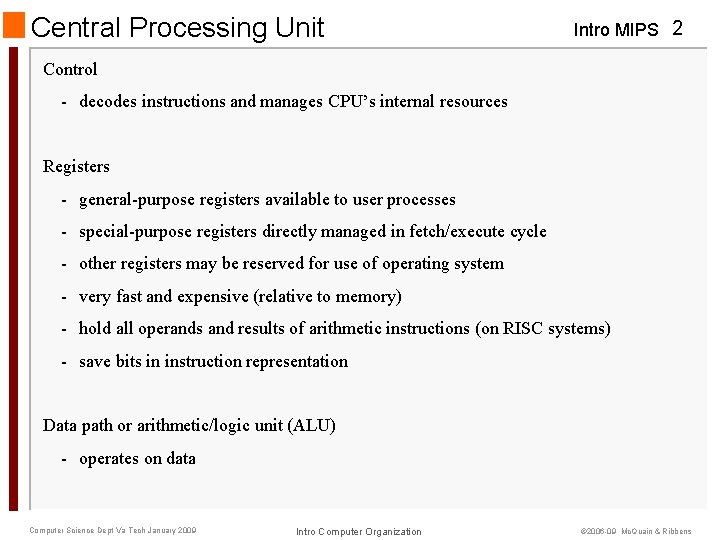
Central Processing Unit Intro MIPS 2 Control - decodes instructions and manages CPU’s internal resources Registers - general-purpose registers available to user processes - special-purpose registers directly managed in fetch/execute cycle - other registers may be reserved for use of operating system - very fast and expensive (relative to memory) - hold all operands and results of arithmetic instructions (on RISC systems) - save bits in instruction representation Data path or arithmetic/logic unit (ALU) - operates on data Computer Science Dept Va Tech January 2009 Intro Computer Organization © 2006 -09 Mc. Quain & Ribbens
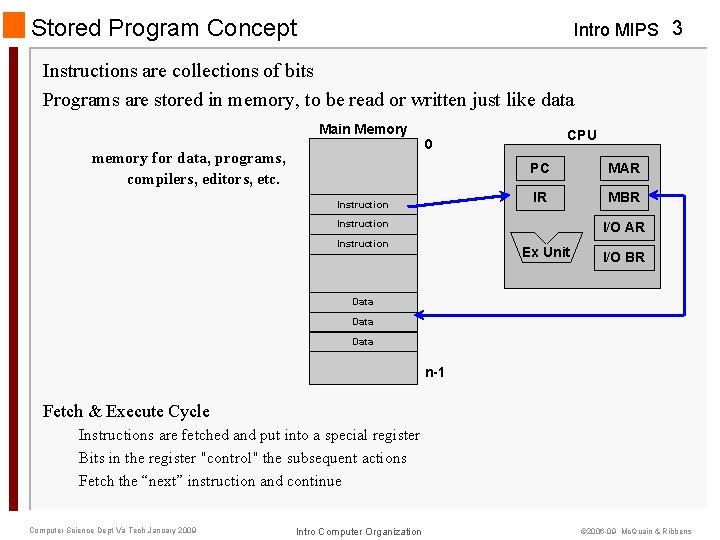
Stored Program Concept Intro MIPS 3 Instructions are collections of bits Programs are stored in memory, to be read or written just like data Main Memory memory for data, programs, compilers, editors, etc. CPU 0 Instruction PC MAR IR MBR Instruction I/O AR Instruction Ex Unit I/O BR Data n-1 Fetch & Execute Cycle Instructions are fetched and put into a special register Bits in the register "control" the subsequent actions Fetch the “next” instruction and continue Computer Science Dept Va Tech January 2009 Intro Computer Organization © 2006 -09 Mc. Quain & Ribbens
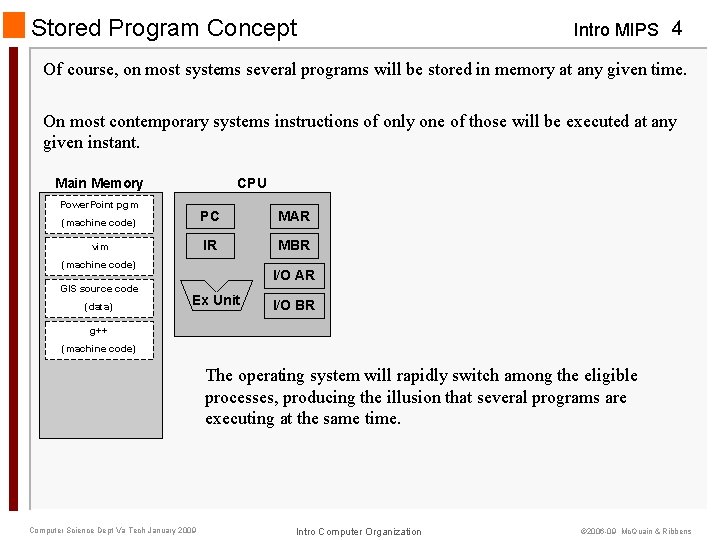
Stored Program Concept Intro MIPS 4 Of course, on most systems several programs will be stored in memory at any given time. On most contemporary systems instructions of only one of those will be executed at any given instant. Main Memory CPU Power. Point pgm (machine code) PC MAR vim IR MBR (machine code) GIS source code (data) I/O AR Ex Unit I/O BR g++ (machine code) The operating system will rapidly switch among the eligible processes, producing the illusion that several programs are executing at the same time. Computer Science Dept Va Tech January 2009 Intro Computer Organization © 2006 -09 Mc. Quain & Ribbens
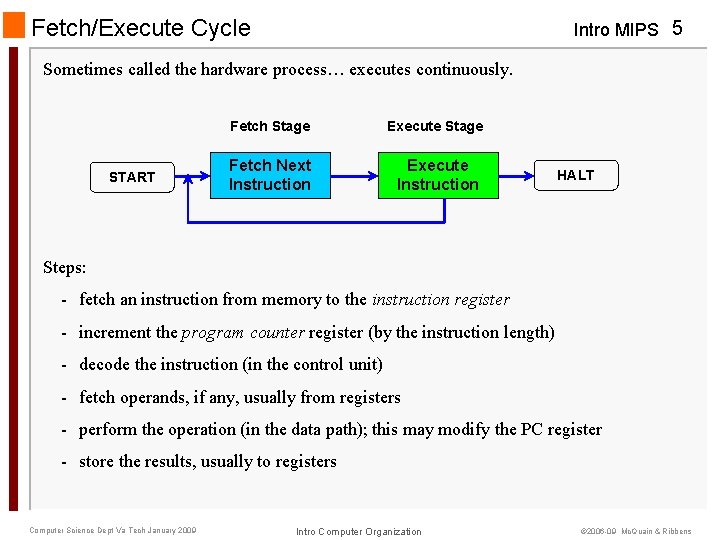
Fetch/Execute Cycle Intro MIPS 5 Sometimes called the hardware process… executes continuously. START Fetch Stage Execute Stage Fetch Next Instruction Execute Instruction HALT Steps: - fetch an instruction from memory to the instruction register - increment the program counter register (by the instruction length) - decode the instruction (in the control unit) - fetch operands, if any, usually from registers - perform the operation (in the data path); this may modify the PC register - store the results, usually to registers Computer Science Dept Va Tech January 2009 Intro Computer Organization © 2006 -09 Mc. Quain & Ribbens
Machine Language Intro MIPS 6 But, how is all of this driven? Machine language: - registers store collections of bits - all data and instructions must be encoded as collections of bits (binary) - bits are represented as electrical charges (more or less) - control logic and arithmetic operations are implemented as circuits, which are driven by the movement of electrical charges - so, the instructions directly manipulate the underlying hardware (cool, huh? ) The collection of all valid binary instructions is known as the machine language. - what’s valid depends on the design of the hardware, especially the control circuitry - must be formally specified - machine language is not human-friendly Computer Science Dept Va Tech January 2009 Intro Computer Organization © 2006 -09 Mc. Quain & Ribbens
Assembly Language Intro MIPS 7 More human-friendly syntax: - expressed in text, not in binary - instructions are identified by (more-or-less) mnemonic names - instruction operands may include registers, memory locations, or… Aspects of assembly language: - unlike high-level languages, each instruction is extremely simple, so assembly language programs are much longer than corresponding high-level language programs - assembly language must be translated into machine language in order to be executed - assembly language is not usually any more portable across different hardware platforms that is machine language - most assembly languages are quite similar… from a certain point of view Computer Science Dept Va Tech January 2009 Intro Computer Organization © 2006 -09 Mc. Quain & Ribbens
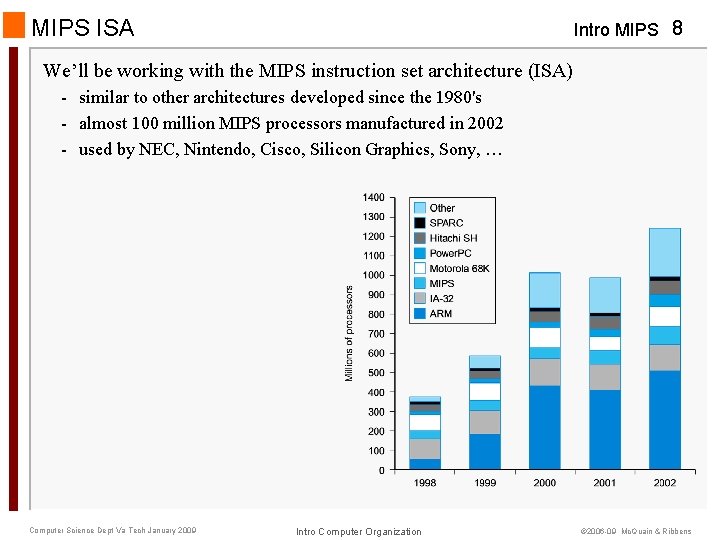
MIPS ISA Intro MIPS 8 We’ll be working with the MIPS instruction set architecture (ISA) - similar to other architectures developed since the 1980's - almost 100 million MIPS processors manufactured in 2002 - used by NEC, Nintendo, Cisco, Silicon Graphics, Sony, … Computer Science Dept Va Tech January 2009 Intro Computer Organization © 2006 -09 Mc. Quain & Ribbens
MIPS Registers Intro MIPS 9 Registers - 32 32 -bit general-purpose registers, referred to as $0, $1, …, $31 32 32 -bit floating-point registers, referred to as $f 0, $f 1, … $f 31 16 64 -bit floating-point registers, referred to as $f 0, $f 2, … $f 30 conventions govern the use of the general registers We will, for now, adopt the view that the underlying computer is a “black box” that understands MIPS machine language. Computer Science Dept Va Tech January 2009 Intro Computer Organization © 2006 -09 Mc. Quain & Ribbens
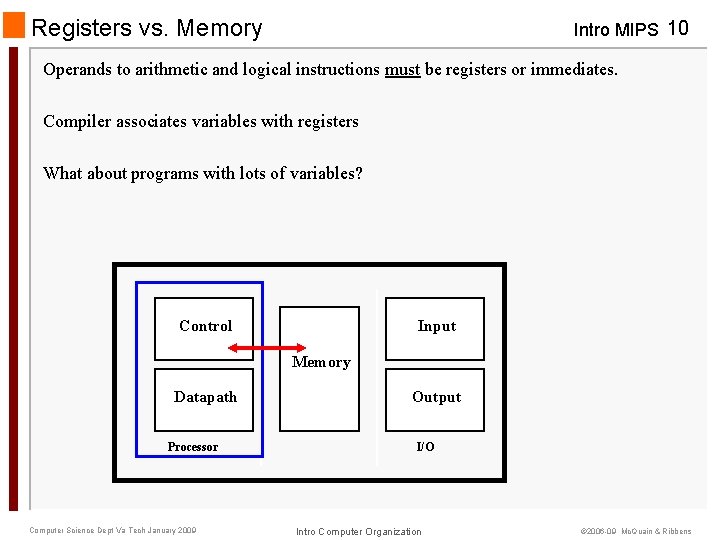
Registers vs. Memory Intro MIPS 10 Operands to arithmetic and logical instructions must be registers or immediates. Compiler associates variables with registers What about programs with lots of variables? Control Input Memory Datapath Processor Computer Science Dept Va Tech January 2009 Output I/O Intro Computer Organization © 2006 -09 Mc. Quain & Ribbens
MIPS Assembly Language Intro MIPS 11 We will study the MIPS assembly language as an exemplar of the concept. MIPS assembly instructions each consist of a single token specifying the command to be carried out, and zero or more operation parameters: <opcode> par 1 par 2 … par. N The tokens are separated by commas. Indentation is insignificant to the assembler, but is certainly significant to the human reader. MIPS command tokens are short and mnemonic (in principle). For example: add lw sw jr The MIPS reference card bound in the front of P&H includes a complete listing of many of the MIPS commands you will need to understand use. Computer Science Dept Va Tech January 2009 Intro Computer Organization © 2006 -09 Mc. Quain & Ribbens
MIPS Assembly Language Intro MIPS 12 MIPS operands include: - hardware registers - offset and base register - literal constants (immediate parameters) - labels Of course, MIPS assembly also allows comments. Simply, all characters from a ‘#’ character to the end of the line are considered a comment. There also some special directives, but those can wait. . . Computer Science Dept Va Tech January 2009 Intro Computer Organization © 2006 -09 Mc. Quain & Ribbens
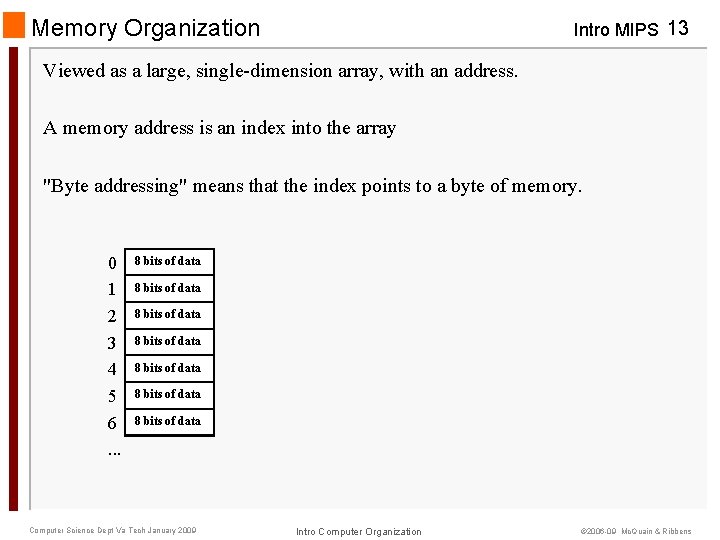
Memory Organization Intro MIPS 13 Viewed as a large, single-dimension array, with an address. A memory address is an index into the array "Byte addressing" means that the index points to a byte of memory. 0 1 2 3 4 5 6. . . 8 bits of data 8 bits of data Computer Science Dept Va Tech January 2009 Intro Computer Organization © 2006 -09 Mc. Quain & Ribbens
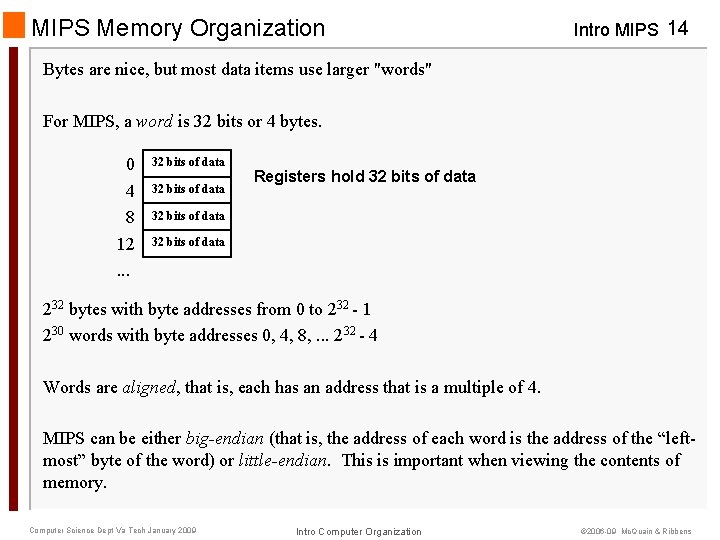
MIPS Memory Organization Intro MIPS 14 Bytes are nice, but most data items use larger "words" For MIPS, a word is 32 bits or 4 bytes. 0 4 8 12. . . 32 bits of data Registers hold 32 bits of data 232 bytes with byte addresses from 0 to 232 - 1 230 words with byte addresses 0, 4, 8, . . . 232 - 4 Words are aligned, that is, each has an address that is a multiple of 4. MIPS can be either big-endian (that is, the address of each word is the address of the “leftmost” byte of the word) or little-endian. This is important when viewing the contents of memory. Computer Science Dept Va Tech January 2009 Intro Computer Organization © 2006 -09 Mc. Quain & Ribbens