
Hardware common lidar architecture and especially but not
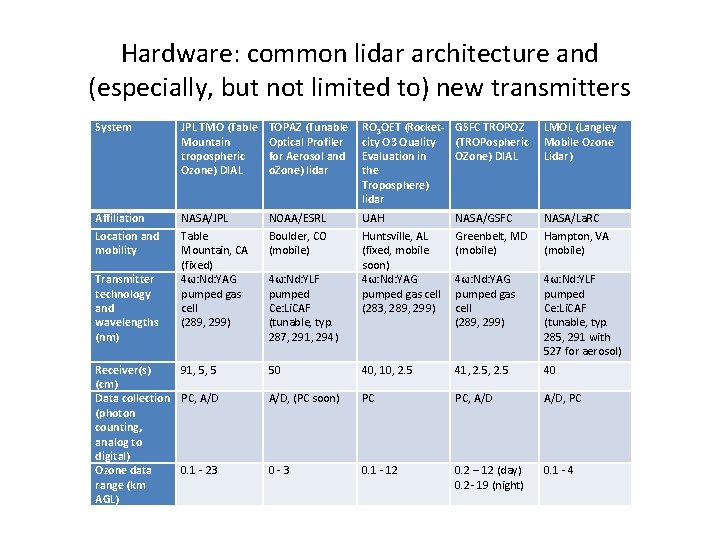
Hardware: common lidar architecture and (especially, but not limited to) new transmitters System JPL TMO (Table Mountain tropospheric Ozone) DIAL TOPAZ (Tunable Optical Profiler for Aerosol and o. Zone) lidar RO 3 QET (Rocket- GSFC TROPOZ city O 3 Quality (TROPospheric Evaluation in OZone) DIAL the Troposphere) lidar LMOL (Langley Mobile Ozone Lidar) Affiliation NASA/JPL NOAA/ESRL UAH NASA/GSFC NASA/La. RC Location and mobility Table Mountain, CA (fixed) 4ω: Nd: YAG pumped gas cell (289, 299) Boulder, CO (mobile) Huntsville, AL (fixed, mobile soon) 4ω: Nd: YAG pumped gas cell (283, 289, 299) Greenbelt, MD (mobile) Hampton, VA (mobile) 4ω: Nd: YAG pumped gas cell (289, 299) 4ω: Nd: YLF pumped Ce: Li. CAF (tunable, typ. 285, 291 with 527 for aerosol) 50 40, 10, 2. 5 41, 2. 5 40 A/D, (PC soon) PC PC, A/D, PC 0 -3 0. 1 - 12 0. 2 – 12 (day) 0. 2 - 19 (night) 0. 1 - 4 Transmitter technology and wavelengths (nm) Receiver(s) 91, 5, 5 (cm) Data collection PC, A/D (photon counting, analog to digital) Ozone data 0. 1 - 23 range (km AGL) 4ω: Nd: YLF pumped Ce: Li. CAF (tunable, typ. 287, 291, 294)
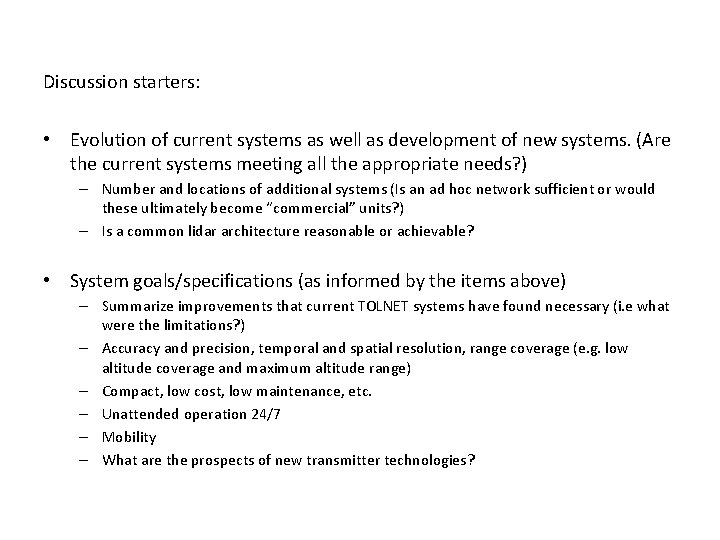
Discussion starters: • Evolution of current systems as well as development of new systems. (Are the current systems meeting all the appropriate needs? ) – Number and locations of additional systems (Is an ad hoc network sufficient or would these ultimately become “commercial” units? ) – Is a common lidar architecture reasonable or achievable? • System goals/specifications (as informed by the items above) – Summarize improvements that current TOLNET systems have found necessary (i. e what were the limitations? ) – Accuracy and precision, temporal and spatial resolution, range coverage (e. g. low altitude coverage and maximum altitude range) – Compact, low cost, low maintenance, etc. – Unattended operation 24/7 – Mobility – What are the prospects of new transmitter technologies?
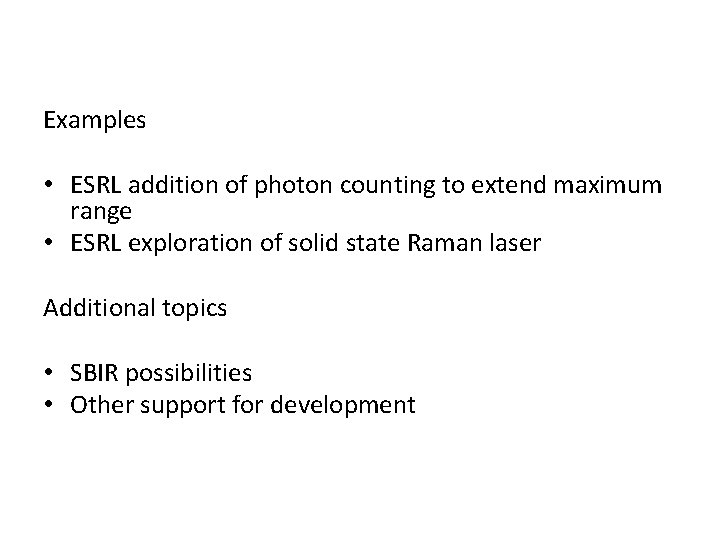
Examples • ESRL addition of photon counting to extend maximum range • ESRL exploration of solid state Raman laser Additional topics • SBIR possibilities • Other support for development
Solid-state Raman lasers: a tutorial Jim Piper Professor of Physics Centre for Lasers and Applications, Macquarie University, Sydney (Carnegie Centenary Professor, Heriot-Watt University, Edinburgh) Acknowledgements: H Pask, R Mildren, H Ogilvy, P Dekker Australian Research Council, DSTO Australia Solid-state Raman lasers
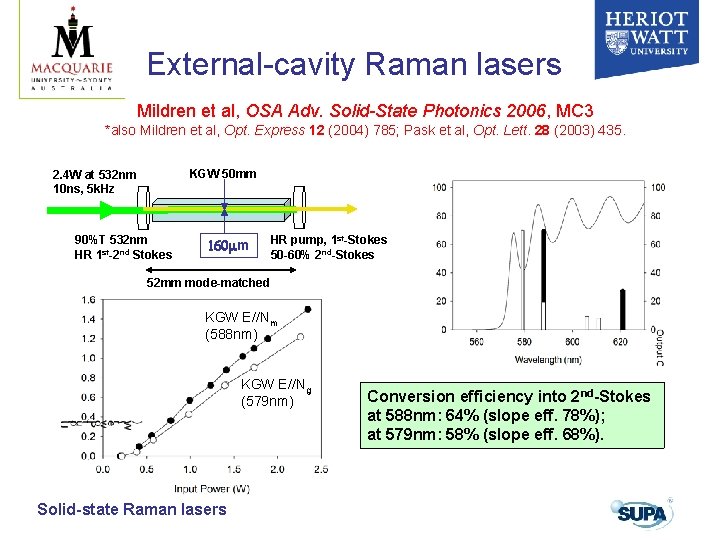
External-cavity Raman lasers Mildren et al, OSA Adv. Solid-State Photonics 2006, MC 3 *also Mildren et al, Opt. Express 12 (2004) 785; Pask et al, Opt. Lett. 28 (2003) 435. KGW 50 mm 2. 4 W at 532 nm 10 ns, 5 k. Hz 90%T 532 nm HR 1 st-2 nd Stokes 160 mm HR pump, 1 st-Stokes 50 -60% 2 nd-Stokes 52 mm mode-matched KGW E//Nm (588 nm) KGW E//Ng (579 nm) Solid-state Raman lasers Conversion efficiency into 2 nd-Stokes at 588 nm: 64% (slope eff. 78%); at 579 nm: 58% (slope eff. 68%).
- Slides: 5