
Hardness Objective n to understand the chemical basis
Hardness Objective n to understand the chemical basis of water hardness, how it originates, and ways it can affect water distribution systems. n n to know the methods for measuring and expressing hardness, and its relationship with other water quality parameters. to know the significance of water hardness in Environmental Engineering
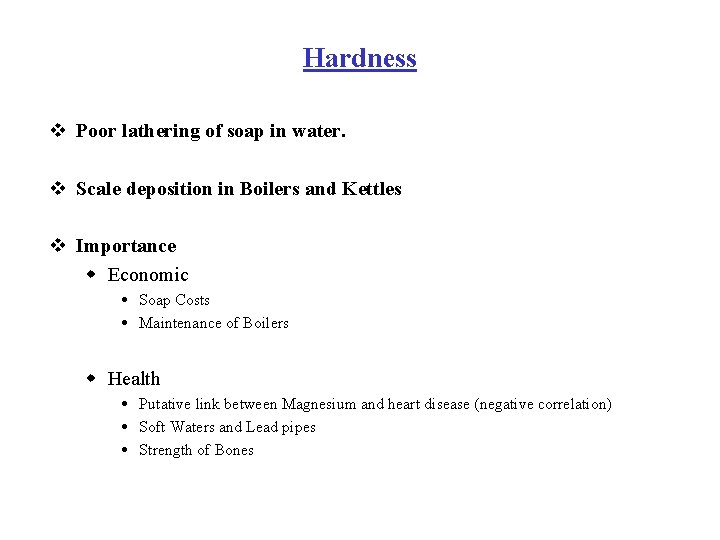
Hardness v Poor lathering of soap in water. v Scale deposition in Boilers and Kettles v Importance w Economic Soap Costs Maintenance of Boilers w Health Putative link between Magnesium and heart disease (negative correlation) Soft Waters and Lead pipes Strength of Bones
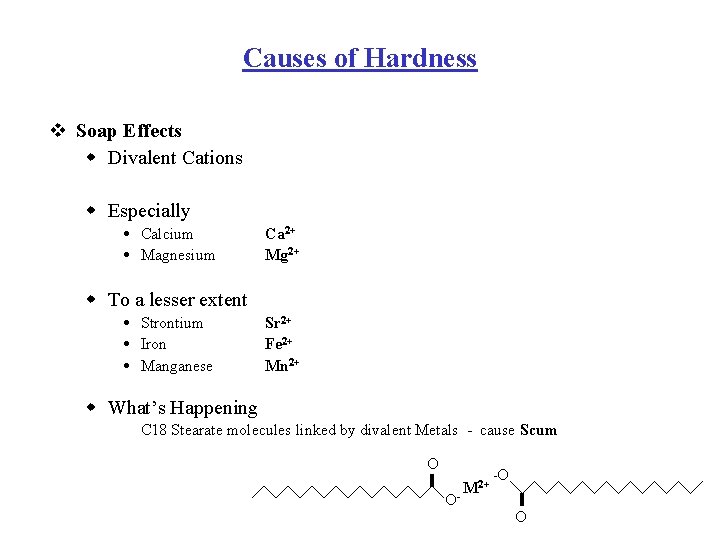
Causes of Hardness v Soap Effects w Divalent Cations w Especially Calcium Magnesium Ca 2+ Mg 2+ w To a lesser extent Strontium Iron Manganese Sr 2+ Fe 2+ Mn 2+ w What’s Happening C 18 Stearate molecules linked by divalent Metals - cause Scum M 2+ O O- O- O
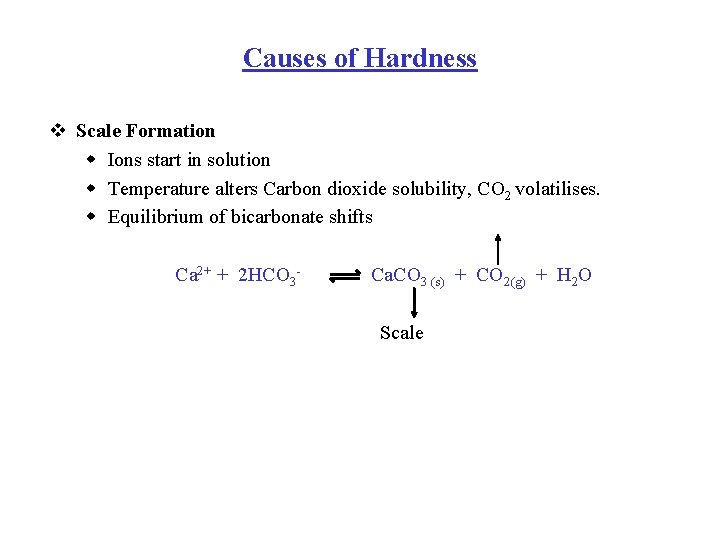
Causes of Hardness v Scale Formation w Ions start in solution w Temperature alters Carbon dioxide solubility, CO 2 volatilises. w Equilibrium of bicarbonate shifts Ca 2+ + 2 HCO 3 - Ca. CO 3 (s) + CO 2(g) + H 2 O Scale
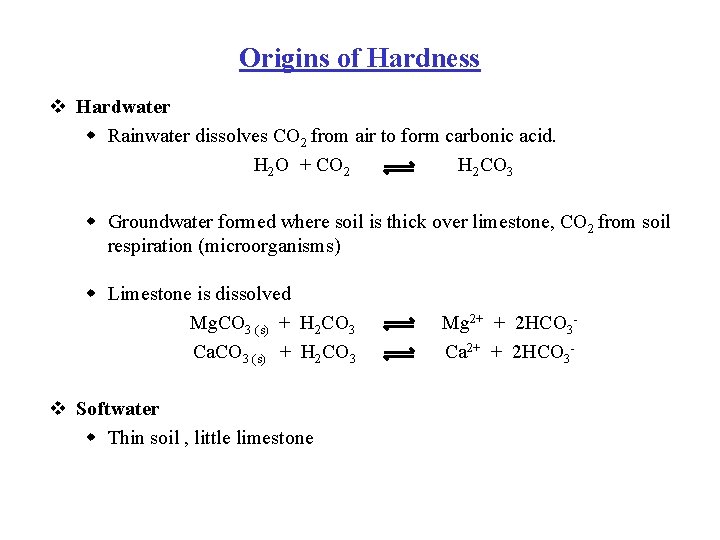
Origins of Hardness v Hardwater w Rainwater dissolves CO 2 from air to form carbonic acid. H 2 O + CO 2 H 2 CO 3 w Groundwater formed where soil is thick over limestone, CO 2 from soil respiration (microorganisms) w Limestone is dissolved Mg. CO 3 (s) + H 2 CO 3 Ca. CO 3 (s) + H 2 CO 3 v Softwater w Thin soil , little limestone Mg 2+ + 2 HCO 3 Ca 2+ + 2 HCO 3 -

Solubility of Minerals rain CO 2 Dissolves AIR Bacteria Release CO 2 (Respiration) SOIL CO 2 + H 2 O Ca. CO 3 + H 2 CO 3 Ca(HCO 3)2 (aq) LIMESTONE Mg. CO 3 + H 2 CO 3 Mg(HCO 3)2 (s) Ca. CO 3 + H 2 CO 3 Ca(HCO 3)2 (s)
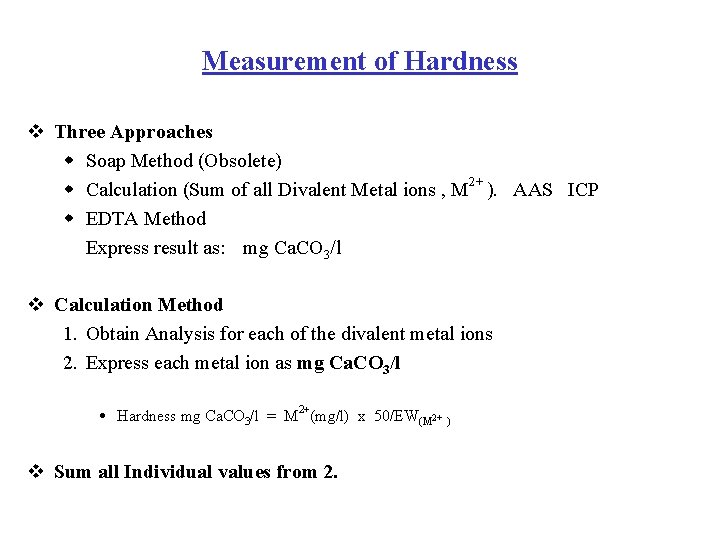
Measurement of Hardness v Three Approaches w Soap Method (Obsolete) w Calculation (Sum of all Divalent Metal ions , M 2+ ). AAS ICP w EDTA Method Express result as: mg Ca. CO 3/l v Calculation Method 1. Obtain Analysis for each of the divalent metal ions 2. Express each metal ion as mg Ca. CO 3/l Hardness mg Ca. CO 3/l = M 2+(mg/l) x 50/EW(M 2+ ) v Sum all Individual values from 2.
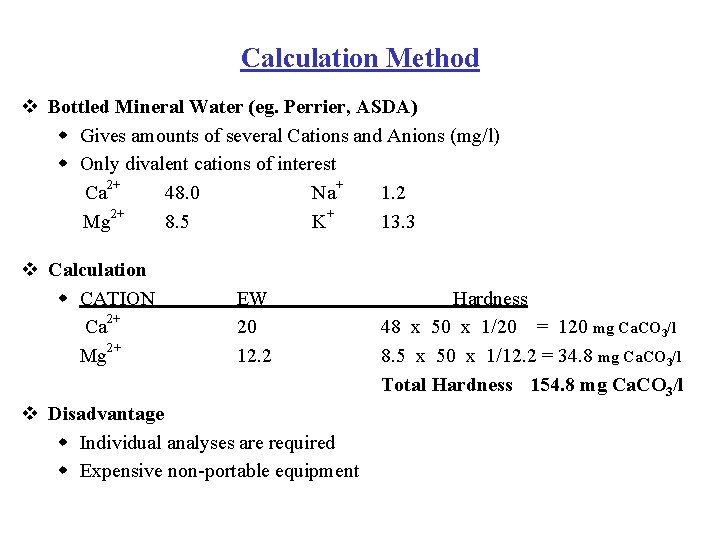
Calculation Method v Bottled Mineral Water (eg. Perrier, ASDA) w Gives amounts of several Cations and Anions (mg/l) w Only divalent cations of interest Ca 2+ 48. 0 Na+ 1. 2 2+ + Mg 8. 5 K 13. 3 v Calculation w CATION Ca 2+ Mg 2+ EW 20 12. 2 v Disadvantage w Individual analyses are required w Expensive non-portable equipment Hardness 48 x 50 x 1/20 = 120 mg Ca. CO 3/l 8. 5 x 50 x 1/12. 2 = 34. 8 mg Ca. CO 3/l Total Hardness 154. 8 mg Ca. CO 3/l
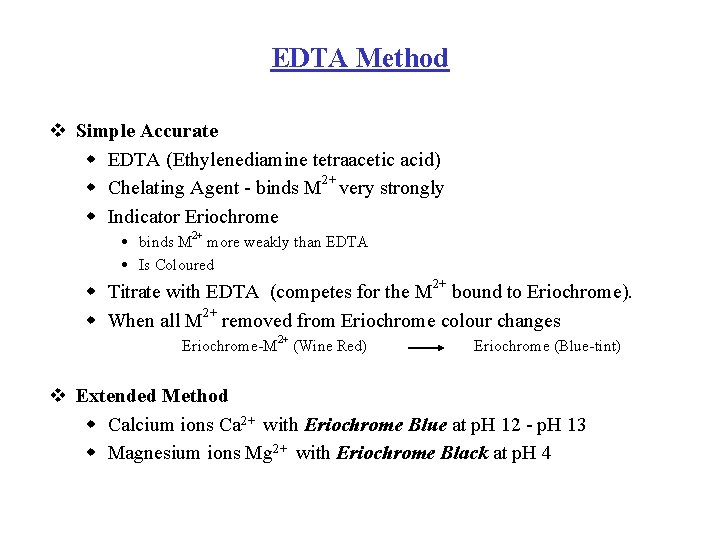
EDTA Method v Simple Accurate w EDTA (Ethylenediamine tetraacetic acid) w Chelating Agent - binds M 2+ very strongly w Indicator Eriochrome binds M 2+ more weakly than EDTA Is Coloured w Titrate with EDTA (competes for the M 2+ bound to Eriochrome). w When all M 2+ removed from Eriochrome colour changes Eriochrome-M 2+ (Wine Red) Eriochrome (Blue-tint) v Extended Method w Calcium ions Ca 2+ with Eriochrome Blue at p. H 12 - p. H 13 w Magnesium ions Mg 2+ with Eriochrome Black at p. H 4

Types of Hardness v Specific Cations w Calcium or Magnesium Hardness Total Hardness - Calcium Hardness = Magnesium Hardness v Specific Anions w Carbonate Hardness (formerly called Temporary Hardness) Divalent cations associated with carbonate or bicarbonate anions w Non-Carbonate Hardness (NCH) (formerly called Permanent Hardness) NCH = Total Hardness - Carbonate Hardness Divalent cations associated with sulphate, chloride, or nitrate anions. v Pseudo- Hardness w Salt Water - Common Ion Effect (Na+ with soap)
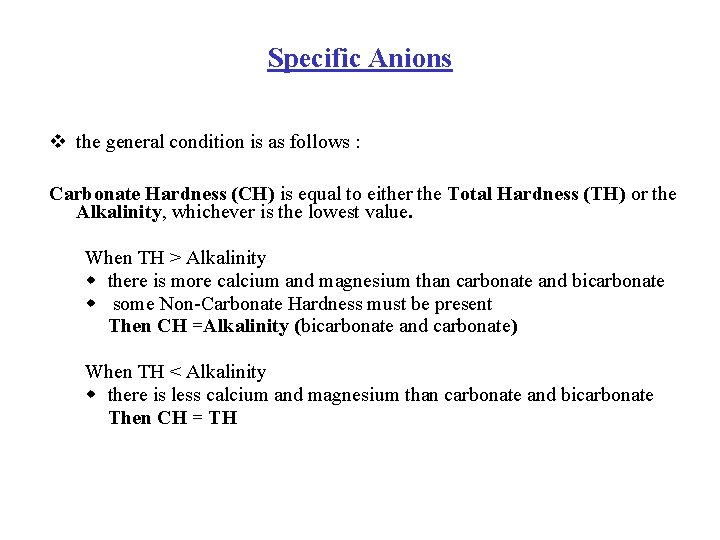
Specific Anions v the general condition is as follows : Carbonate Hardness (CH) is equal to either the Total Hardness (TH) or the Alkalinity, whichever is the lowest value. When TH > Alkalinity w there is more calcium and magnesium than carbonate and bicarbonate w some Non-Carbonate Hardness must be present Then CH =Alkalinity (bicarbonate and carbonate) When TH < Alkalinity w there is less calcium and magnesium than carbonate and bicarbonate Then CH = TH
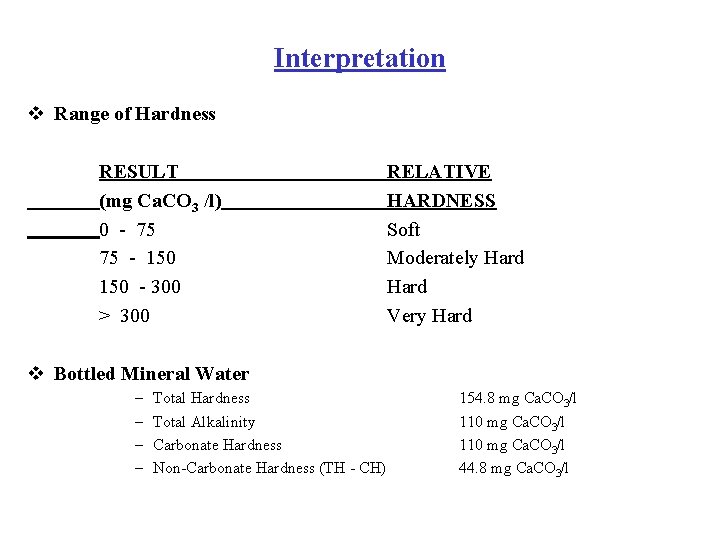
Interpretation v Range of Hardness RESULT (mg Ca. CO 3 /l) 0 - 75 75 - 150 - 300 > 300 RELATIVE HARDNESS Soft Moderately Hard Very Hard v Bottled Mineral Water – – Total Hardness Total Alkalinity Carbonate Hardness Non-Carbonate Hardness (TH - CH) 154. 8 mg Ca. CO 3/l 110 mg Ca. CO 3/l 44. 8 mg Ca. CO 3/l
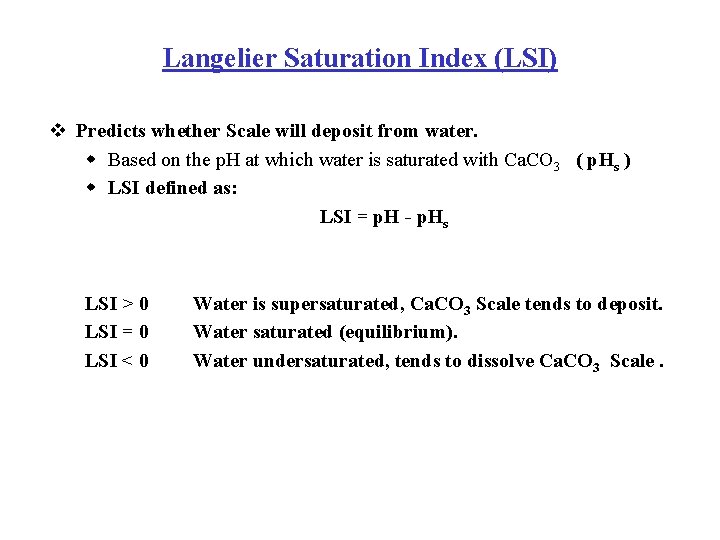
Langelier Saturation Index (LSI) v Predicts whether Scale will deposit from water. w Based on the p. H at which water is saturated with Ca. CO 3 ( p. Hs ) w LSI defined as: LSI = p. H - p. Hs LSI > 0 LSI = 0 LSI < 0 Water is supersaturated, Ca. CO 3 Scale tends to deposit. Water saturated (equilibrium). Water undersaturated, tends to dissolve Ca. CO 3 Scale.
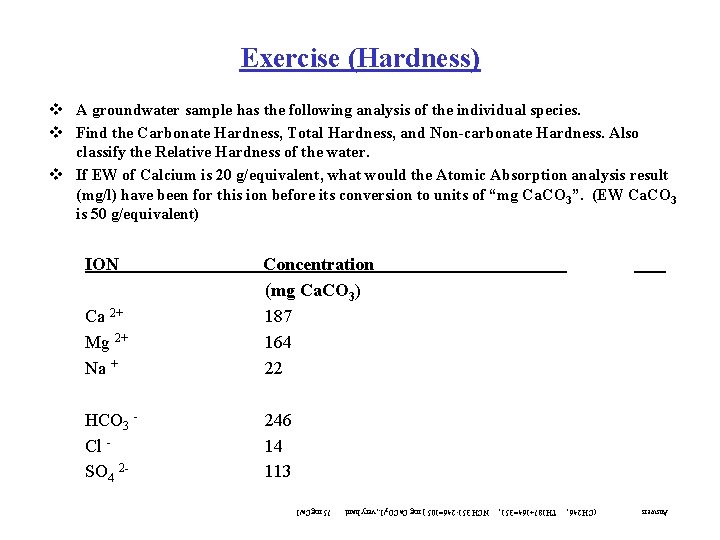
Exercise (Hardness) v A groundwater sample has the following analysis of the individual species. v Find the Carbonate Hardness, Total Hardness, and Non-carbonate Hardness. Also classify the Relative Hardness of the water. v If EW of Calcium is 20 g/equivalent, what would the Atomic Absorption analysis result (mg/l) have been for this ion before its conversion to units of “mg Ca. CO 3”. (EW Ca. CO 3 is 50 g/equivalent) 246 14 113 TH 187+164=351, HCO 3 Cl SO 4 2 - (CH 246, Ca 2+ Mg 2+ Na + Concentration (mg Ca. CO 3) 187 164 22 Answers NCH 351 -246=105 ) mg Ca. CO 3/l. , very hard 75 mg. Ca/l ION
- Slides: 14