
Hard Xray study of lobes of radio galaxy
Hard X-ray study of lobes of radio galaxy Fornax A Naoki Isobe (RIKEN/Suzaku Help Desk) Makoto Tashiro, Hiromi Seta, Yuichi Yaji (Saitama Univ. ) Keiko Matsuta, Hidehiro Kaneda (ISAS/JAXA), Kazuo Makishima (RIKEN/Univ. of Tokyo) etc. July 7 -11, 2008 Radio Galaxies in the Chandra Era 1
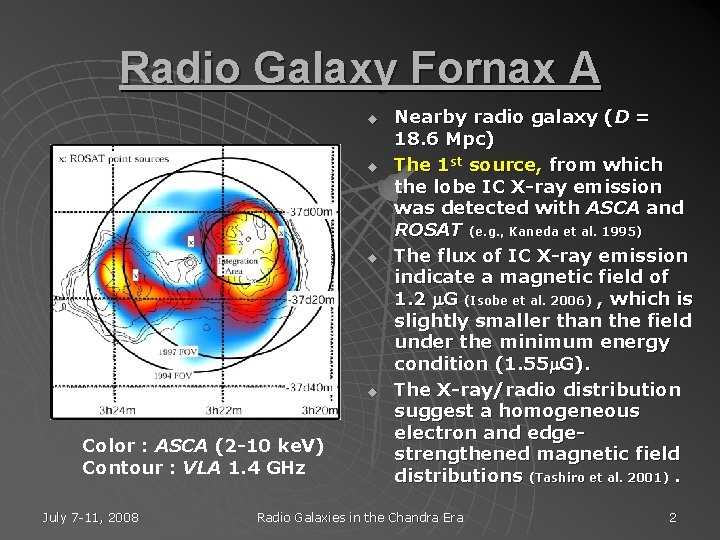
Radio Galaxy Fornax A u u Color : ASCA (2 -10 ke. V) Contour : VLA 1. 4 GHz July 7 -11, 2008 Nearby radio galaxy (D = 18. 6 Mpc) The 1 st source, from which the lobe IC X-ray emission was detected with ASCA and ROSAT (e. g. , Kaneda et al. 1995) The flux of IC X-ray emission indicate a magnetic field of 1. 2 m. G (Isobe et al. 2006) , which is slightly smaller than the field under the minimum energy condition (1. 55 m. G). The X-ray/radio distribution suggest a homogeneous electron and edgestrengthened magnetic field distributions (Tashiro et al. 2001). Radio Galaxies in the Chandra Era 2
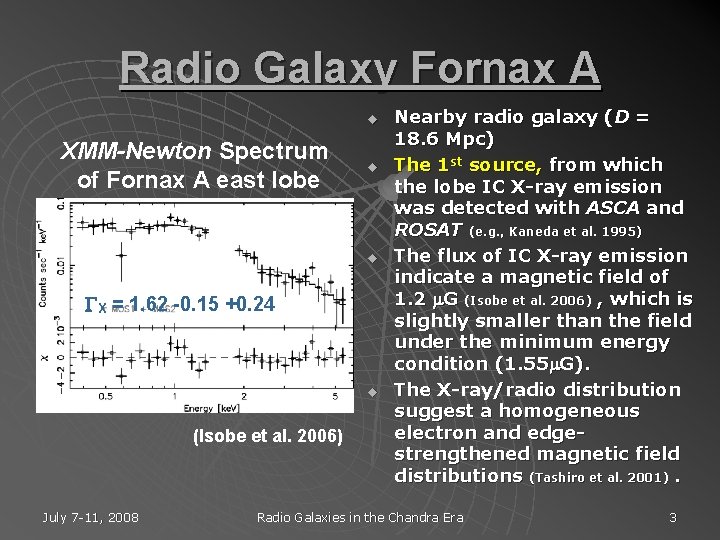
Radio Galaxy Fornax A u XMM-Newton Spectrum of Fornax A east lobe u u GX = 1. 62 -0. 15 +0. 24 u (Isobe et al. 2006) July 7 -11, 2008 Nearby radio galaxy (D = 18. 6 Mpc) The 1 st source, from which the lobe IC X-ray emission was detected with ASCA and ROSAT (e. g. , Kaneda et al. 1995) The flux of IC X-ray emission indicate a magnetic field of 1. 2 m. G (Isobe et al. 2006) , which is slightly smaller than the field under the minimum energy condition (1. 55 m. G). The X-ray/radio distribution suggest a homogeneous electron and edgestrengthened magnetic field distributions (Tashiro et al. 2001). Radio Galaxies in the Chandra Era 3
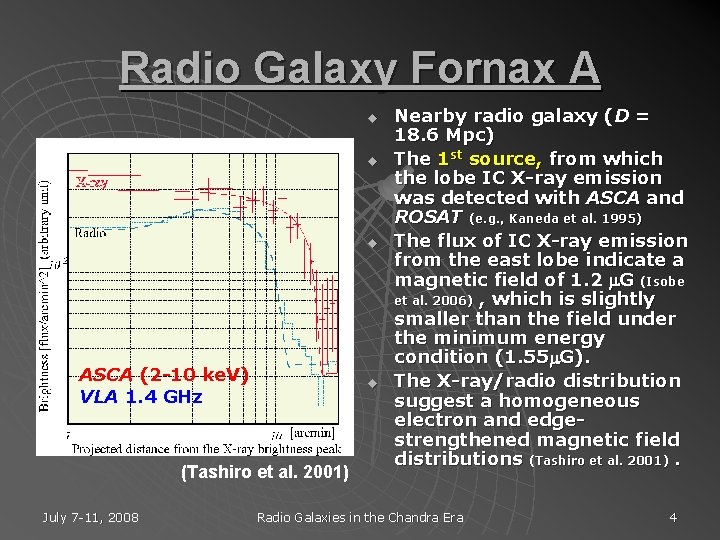
Radio Galaxy Fornax A u u u ASCA (2 -10 ke. V) VLA 1. 4 GHz u (Tashiro et al. 2001) July 7 -11, 2008 Nearby radio galaxy (D = 18. 6 Mpc) The 1 st source, from which the lobe IC X-ray emission was detected with ASCA and ROSAT (e. g. , Kaneda et al. 1995) The flux of IC X-ray emission from the east lobe indicate a magnetic field of 1. 2 m. G (Isobe et al. 2006) , which is slightly smaller than the field under the minimum energy condition (1. 55 m. G). The X-ray/radio distribution suggest a homogeneous electron and edgestrengthened magnetic field distributions (Tashiro et al. 2001). Radio Galaxies in the Chandra Era 4
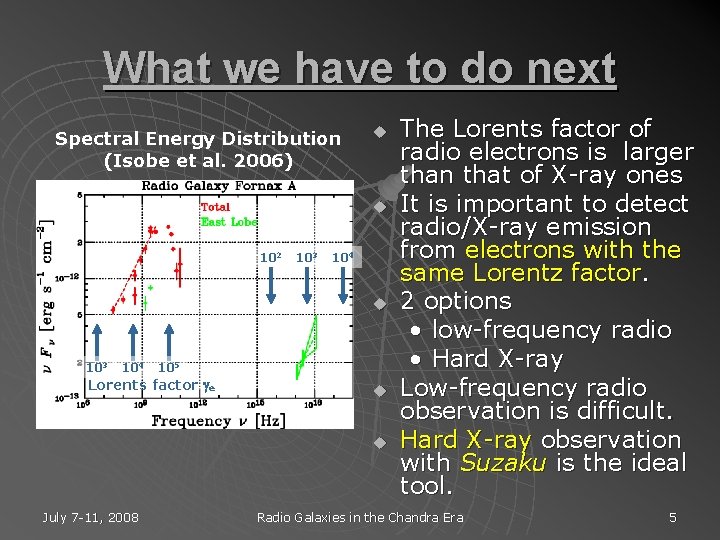
What we have to do next Spectral Energy Distribution (Isobe et al. 2006) u u 102 103 104 u 103 104 105 Lorents factor ge u u July 7 -11, 2008 The Lorents factor of radio electrons is larger than that of X-ray ones It is important to detect radio/X-ray emission from electrons with the same Lorentz factor. 2 options • low-frequency radio • Hard X-ray Low-frequency radio observation is difficult. Hard X-ray observation with Suzaku is the ideal tool. Radio Galaxies in the Chandra Era 5
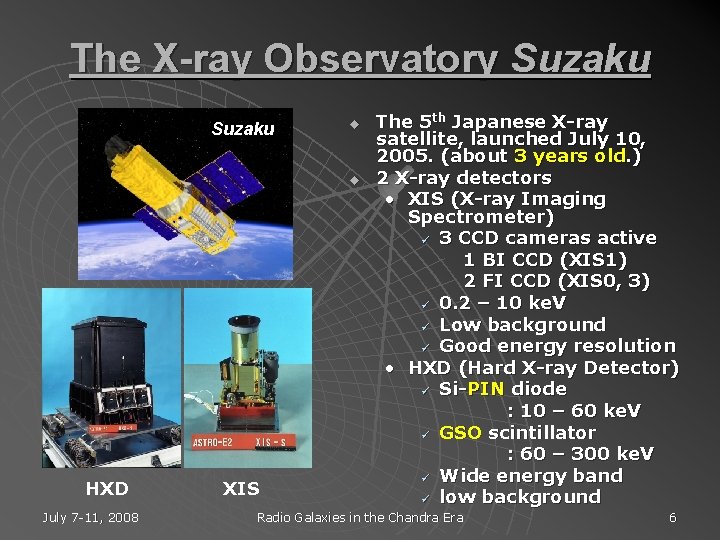
The X-ray Observatory Suzaku u u HXD July 7 -11, 2008 XIS The 5 th Japanese X-ray satellite, launched July 10, 2005. (about 3 years old. ) 2 X-ray detectors • XIS (X-ray Imaging Spectrometer) ü 3 CCD cameras active 1 BI CCD (XIS 1) 2 FI CCD (XIS 0, 3) ü 0. 2 – 10 ke. V ü Low background ü Good energy resolution • HXD (Hard X-ray Detector) ü Si-PIN diode : 10 – 60 ke. V ü GSO scintillator : 60 – 300 ke. V ü Wide energy band ü low background Radio Galaxies in the Chandra Era 6
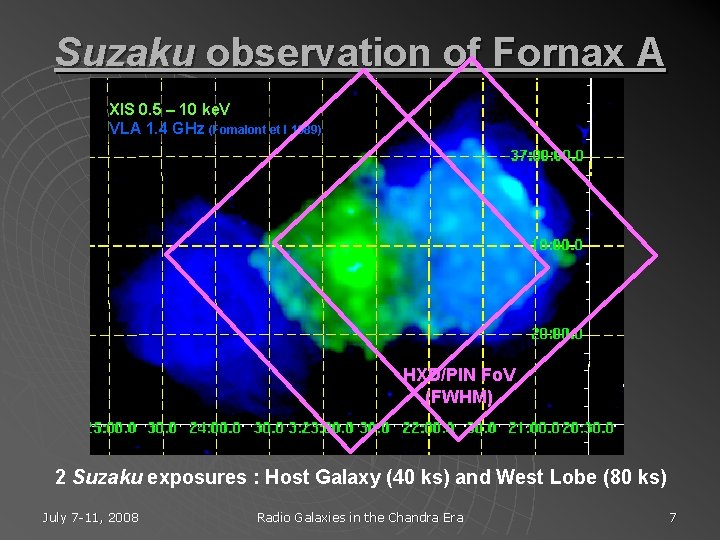
Suzaku observation of Fornax A XIS 0. 5 – 10 ke. V VLA 1. 4 GHz (Fomalont et l 1989) HXD/PIN Fo. V (FWHM) 2 Suzaku exposures : Host Galaxy (40 ks) and West Lobe (80 ks) July 7 -11, 2008 Radio Galaxies in the Chandra Era 7
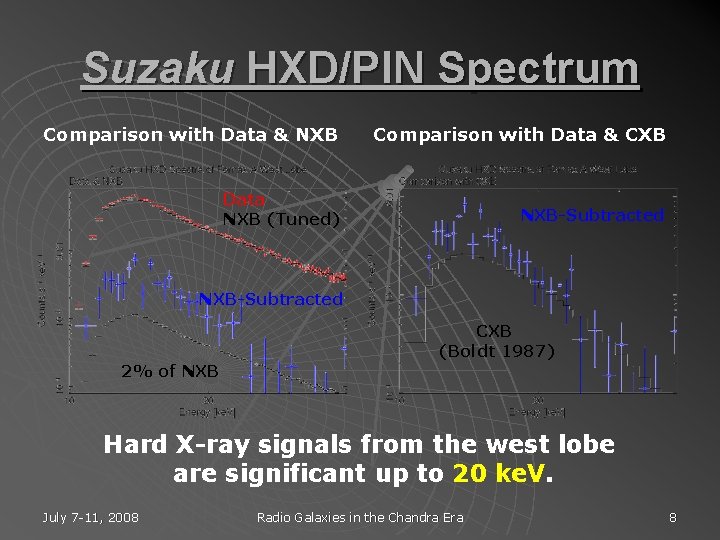
Suzaku HXD/PIN Spectrum Comparison with Data & NXB Comparison with Data & CXB Data NXB (Tuned) NXB-Subtracted CXB (Boldt 1987) 2% of NXB Hard X-ray signals from the west lobe are significant up to 20 ke. V. July 7 -11, 2008 Radio Galaxies in the Chandra Era 8
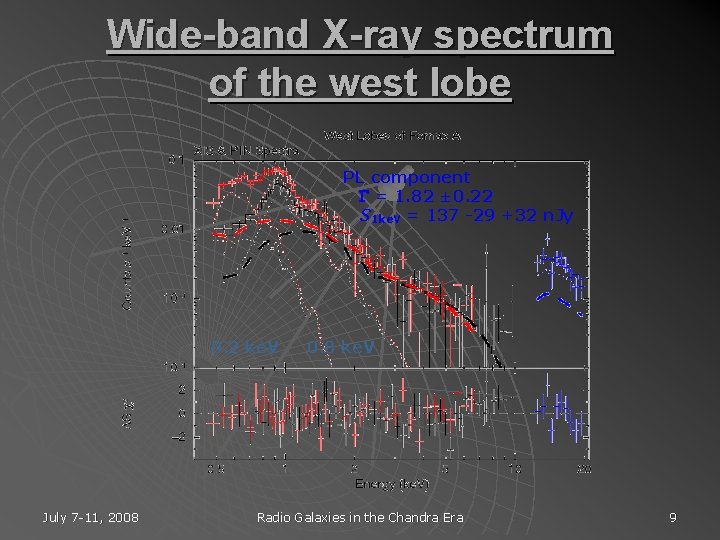
Wide-band X-ray spectrum of the west lobe PL component G = 1. 82 ± 0. 22 S 1 ke. V = 137 -29 +32 n. Jy 0. 2 ke. V July 7 -11, 2008 0. 8 ke. V Radio Galaxies in the Chandra Era 9
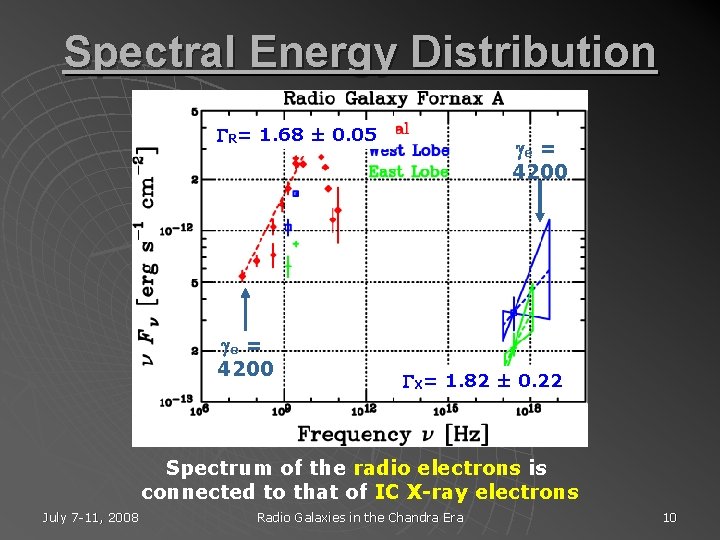
Spectral Energy Distribution GR= 1. 68 ± 0. 05 ge = 4200 GX= 1. 82 ± 0. 22 Spectrum of the radio electrons is connected to that of IC X-ray electrons July 7 -11, 2008 Radio Galaxies in the Chandra Era 10
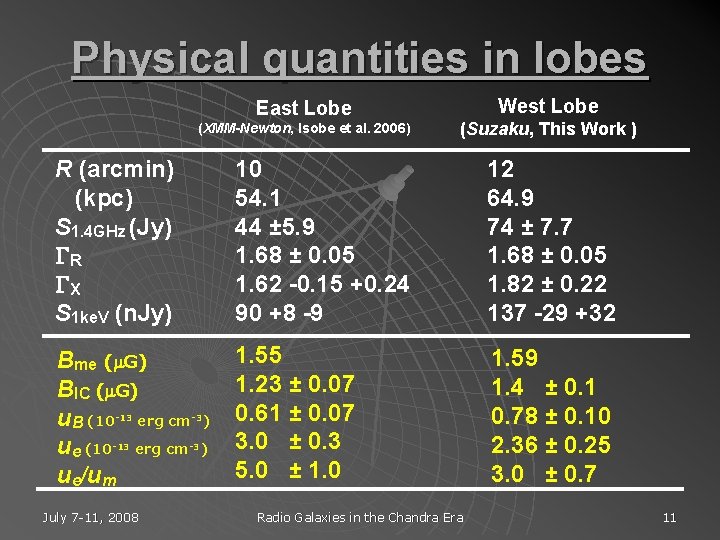
Physical quantities in lobes East Lobe West Lobe (XMM-Newton, Isobe et al. 2006) (Suzaku, This Work ) R (arcmin) (kpc) S 1. 4 GHz (Jy) GR GX S 1 ke. V (n. Jy) 10 54. 1 44 ± 5. 9 1. 68 ± 0. 05 1. 62 -0. 15 +0. 24 90 +8 -9 12 64. 9 74 ± 7. 7 1. 68 ± 0. 05 1. 82 ± 0. 22 137 -29 +32 Bme (m. G) BIC (m. G) u. B (10 erg cm ue/um 1. 55 1. 23 ± 0. 07 0. 61 ± 0. 07 3. 0 ± 0. 3 5. 0 ± 1. 0 1. 59 1. 4 ± 0. 1 0. 78 ± 0. 10 2. 36 ± 0. 25 3. 0 ± 0. 7 -13 -3) July 7 -11, 2008 Radio Galaxies in the Chandra Era 11
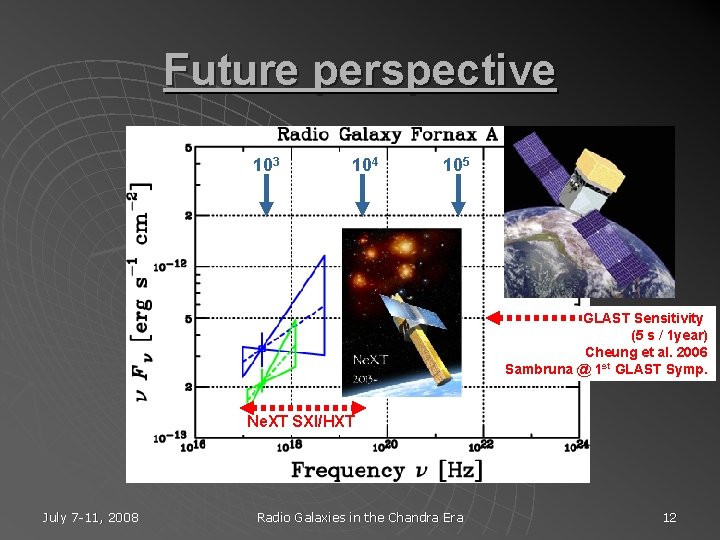
Future perspective 103 104 105 GLAST Sensitivity (5 s / 1 year) Cheung et al. 2006 Sambruna @ 1 st GLAST Symp. Ne. XT SXI/HXT July 7 -11, 2008 Radio Galaxies in the Chandra Era 12
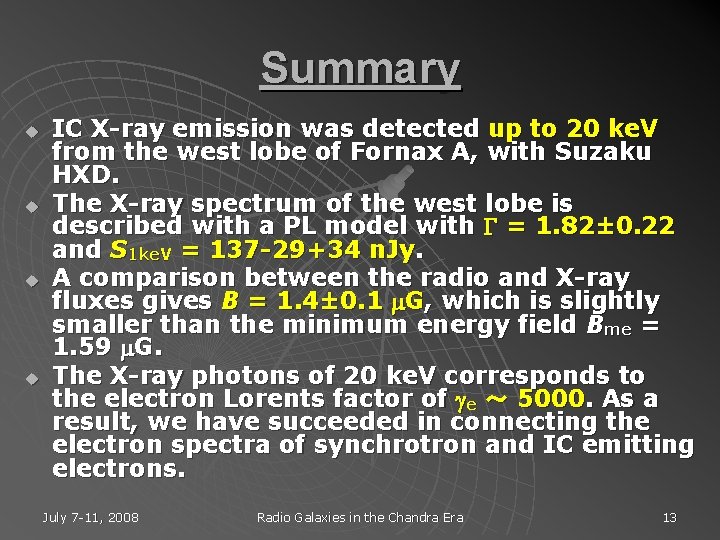
Summary u u IC X-ray emission was detected up to 20 ke. V from the west lobe of Fornax A, with Suzaku HXD. The X-ray spectrum of the west lobe is described with a PL model with G = 1. 82± 0. 22 and S 1 ke. V = 137 -29+34 n. Jy. A comparison between the radio and X-ray fluxes gives B = 1. 4± 0. 1 m. G, which is slightly smaller than the minimum energy field Bme = 1. 59 m. G. The X-ray photons of 20 ke. V corresponds to the electron Lorents factor of ge ~ 5000. As a result, we have succeeded in connecting the electron spectra of synchrotron and IC emitting electrons. July 7 -11, 2008 Radio Galaxies in the Chandra Era 13
References Kaneda et al. 1995 Ap. J 453, L 13 u Iyomoto et al. 1998 Ap. J 503, L 31 u Tashiro et al. 2001 Ap. J 546, L 19 u Isobe et al. 2006 Ap. J 645, 256 u July 7 -11, 2008 Radio Galaxies in the Chandra Era 14
- Slides: 14