
Hard Shoulder Running HSR in the Netherlands Bert
Hard Shoulder Running (HSR) in the Netherlands Bert Helleman Senior Consultant Smart roads and ATMS AVV Transport Research Centre Scanning tour FHWA june 13 -14, 2006
Hard Shoulder Running in the Netherlands Content • • Introduction and background Design & Lay out Additional facilities Innovative instruments • Research and practice • HSR and incident management Scanning tour FHWA june 13 -14, 2006 2
Hard Shoulder Running in the Netherlands • Introduction and background • Design & Lay out • Additional facilities • Innovative instruments • Research and practice • HSR and incident management Scanning tour FHWA june 13 -14, 2006 3
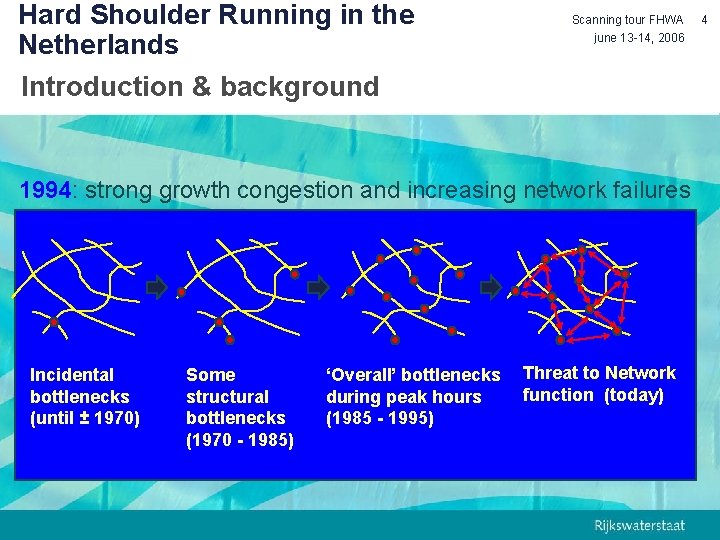
Hard Shoulder Running in the Netherlands Introduction & background Scanning tour FHWA june 13 -14, 2006 1994: strong growth congestion and increasing network failures Traffic policy: maintenance, more efficient use, road widening 1995: Traffic Management Program 1995 – 2000 à Traffic management: from experiments to large programme Incidental Some ‘Overall’ bottlenecks à 2003: Traffic management is usual business bottlenecks structural during peak hours (until ± 1970) - 1995) à 2004 - 2007: bottlenecks program ZSM(1985 (hard shoulder (1970 - 1985) Threat to Network function (today) running) and regional traffic management (area approach) 4
Hard Shoulder Running in the Netherlands Introduction & background Scanning tour FHWA june 13 -14, 2006 1994: strong growth congestion and increasing network failures Traffic policy: maintenance, more efficient use, road widening 1995: Traffic Management Program 1995 – 2000 à Traffic management: from experiments to large programme à 2003: Traffic management is usual business à 2004 - 2007: program ZSM (hard shoulder running) and regional traffic management (area approach) 5
Hard Shoulder Running in the Netherlands Introduction & background Scanning tour FHWA june 13 -14, 2006 Main issues of ZSM Program • Improve infrastructure (missing links in road network) • Improve utilization (HSR, planning road works, IM) • Improve procedures (rush act) • Improve input from road users (periodic road user polls) 6
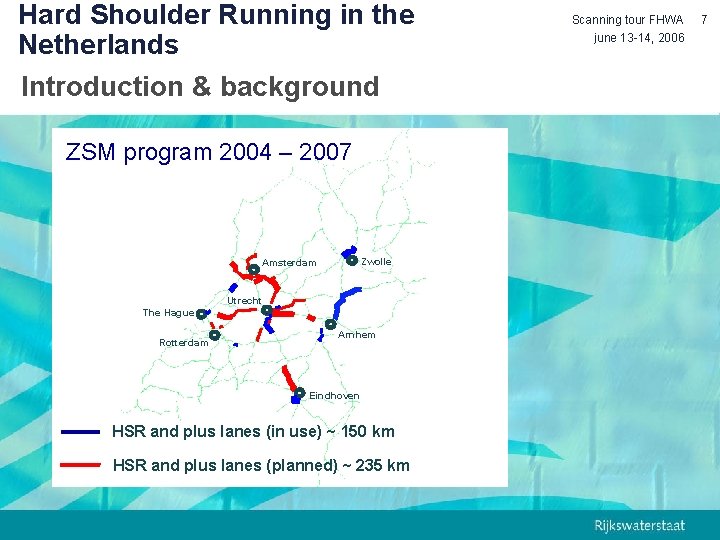
Hard Shoulder Running in the Netherlands Introduction & background ZSM program 2004 – 2007 Zwolle Amsterdam Utrecht The Hague Rotterdam Arnhem Eindhoven HSR and plus lanes (in use) ~ 150 km HSR and plus lanes (planned) ~ 235 km Scanning tour FHWA june 13 -14, 2006 7
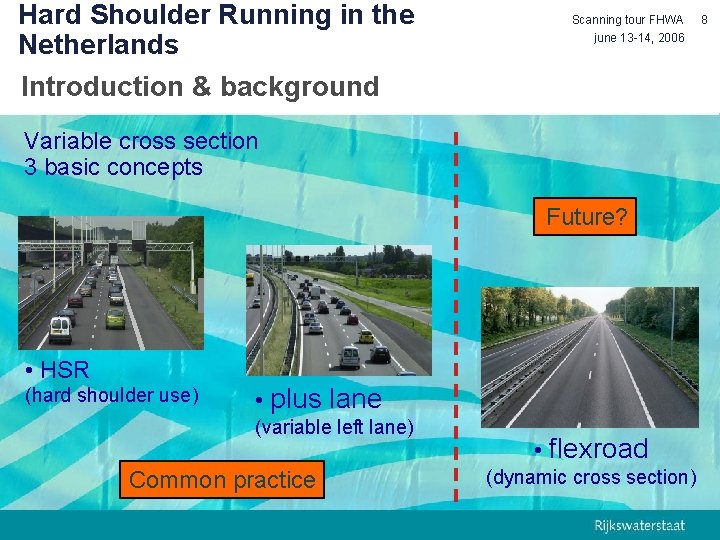
Hard Shoulder Running in the Netherlands Introduction & background Scanning tour FHWA june 13 -14, 2006 Variable cross section 3 basic concepts Future? • HSR (hard shoulder use) • plus lane (variable left lane) Common practice • flexroad (dynamic cross section) 8
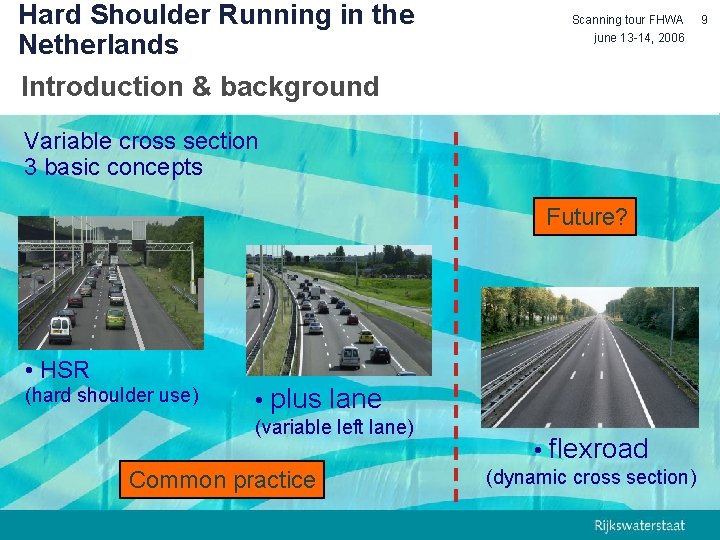
Hard Shoulder Running in the Netherlands Introduction & background Scanning tour FHWA june 13 -14, 2006 Variable cross section 3 basic concepts Future? • HSR (hard shoulder use) • plus lane (variable left lane) Common practice • flexroad (dynamic cross section) 9
Hard Shoulder Running in the Netherlands • Introduction and background • Design & Lay out of HSR • Additional facilities • HSR and incident management • Research and practice • Innovative instruments Scanning tour FHWA 10 june 13 -14, 2006
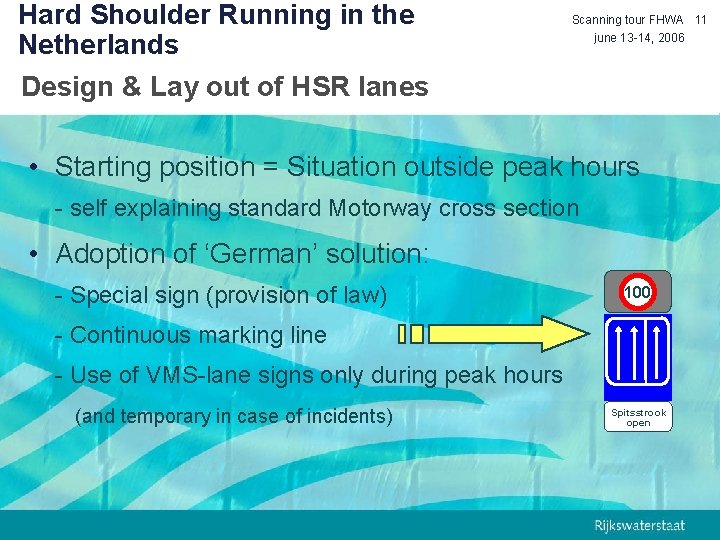
Hard Shoulder Running in the Netherlands Design & Lay out of HSR lanes Scanning tour FHWA 11 june 13 -14, 2006 • Starting position = Situation outside peak hours - self explaining standard Motorway cross section • Adoption of ‘German’ solution: - Special sign (provision of law) 100 - Continuous marking line - Use of VMS-lane signs only during peak hours (and temporary in case of incidents) Spitsstrook open
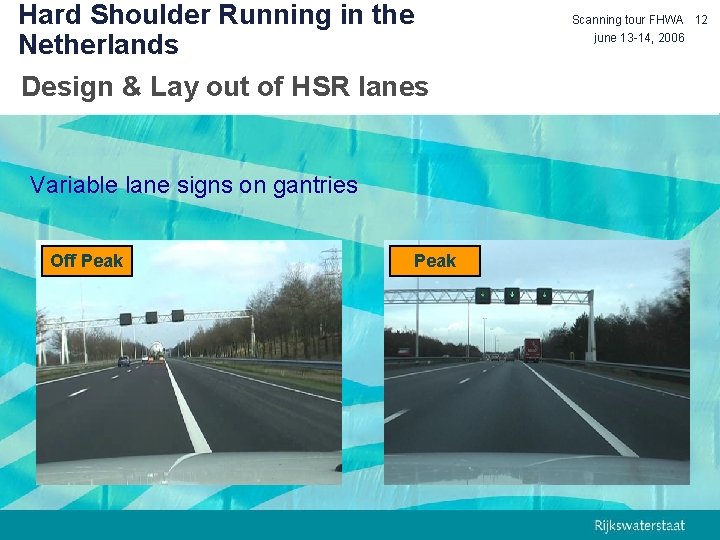
Hard Shoulder Running in the Netherlands Design & Lay out of HSR lanes Variable lane signs on gantries Off Peak Scanning tour FHWA 12 june 13 -14, 2006
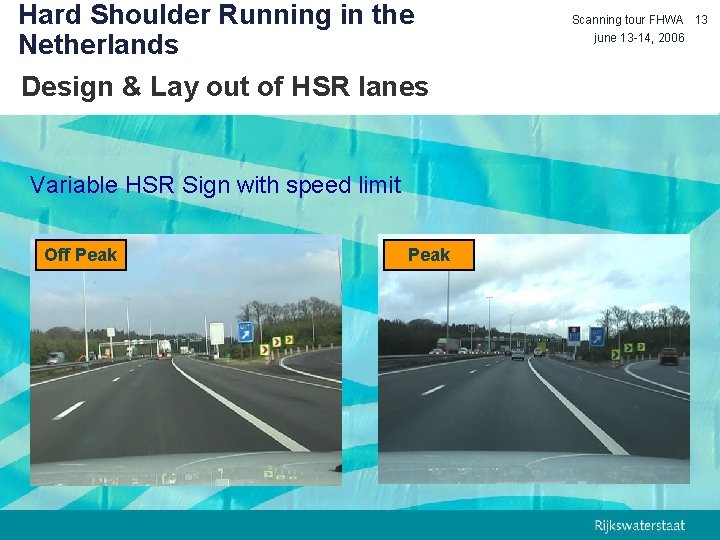
Hard Shoulder Running in the Netherlands Design & Lay out of HSR lanes Variable HSR Sign with speed limit Off Peak Scanning tour FHWA 13 june 13 -14, 2006
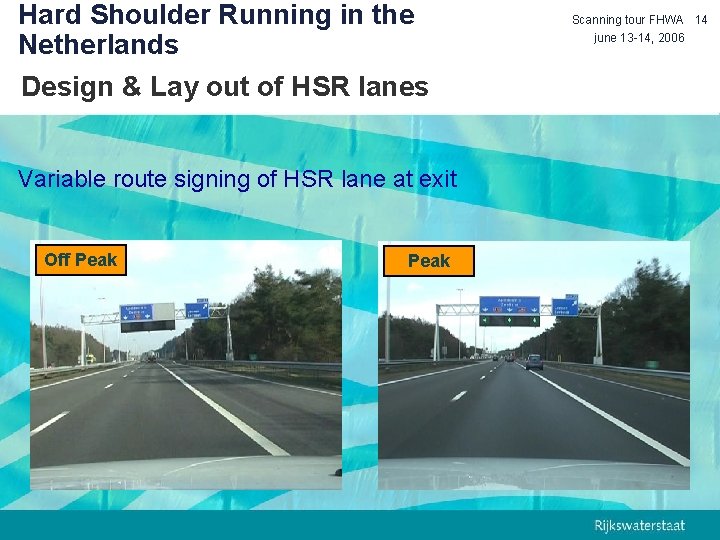
Hard Shoulder Running in the Netherlands Design & Lay out of HSR lanes Variable route signing of HSR lane at exit Off Peak Scanning tour FHWA 14 june 13 -14, 2006
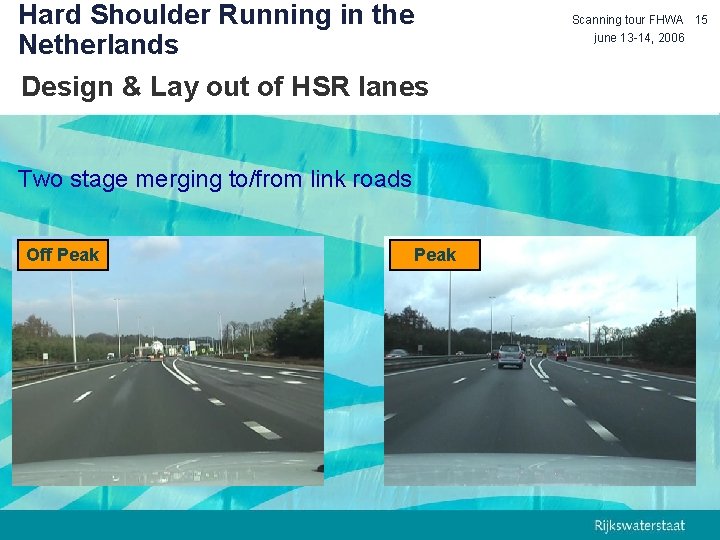
Hard Shoulder Running in the Netherlands Design & Lay out of HSR lanes Two stage merging to/from link roads Off Peak Scanning tour FHWA 15 june 13 -14, 2006
Hard Shoulder Running in the Netherlands Design & Lay out of HSR lanes A ride on the A 50 Scanning tour FHWA 16 june 13 -14, 2006
Hard Shoulder Running in the Netherlands • Introduction and background • Design & Lay out • Additional facilities • Innovative instruments • Research and practice • HSR and incident management Scanning tour FHWA 17 june 13 -14, 2006
Hard Shoulder Running in the Netherlands Additional facilities • MTM system (overhead lane signs) • ERA’s (Emergency Refuge Areas) • Speed reduction at times of HSR • Variable Route signs at junctions • Advanced Incident Detection • CCTV surveillance • Incident Management • Public lighting Scanning tour FHWA 18 june 13 -14, 2006
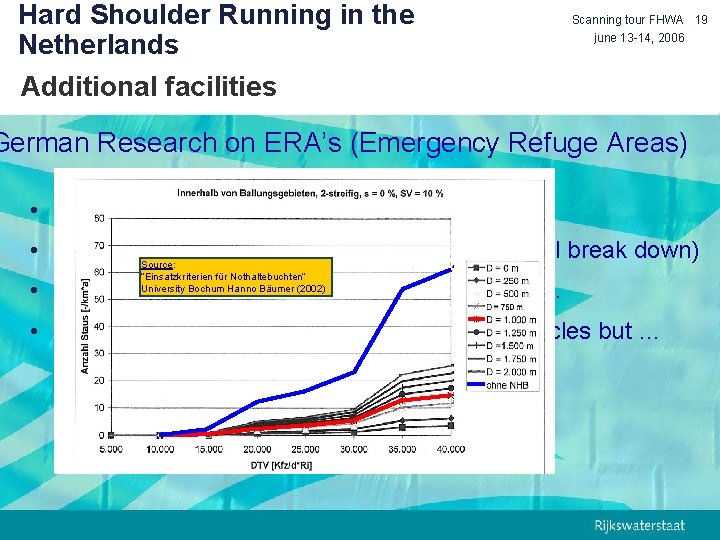
Hard Shoulder Running in the Netherlands Additional facilities Scanning tour FHWA 19 june 13 -14, 2006 German Research on ERA’s (Emergency Refuge Areas) • Average use 185 / 106 veh. km • Approx. Source: 90% used as a ‘parking place’ (5% real break down) “Einsatzkriterien für Nothaltebuchten” University Bochum Hanno Bäumer (2002) • Great impact of distance between refuge areas. • Very few accidents caused by breakdown vehicles but … - great severity of accidents (2 - 3 times) - particular at dawn/night conditions (70%)
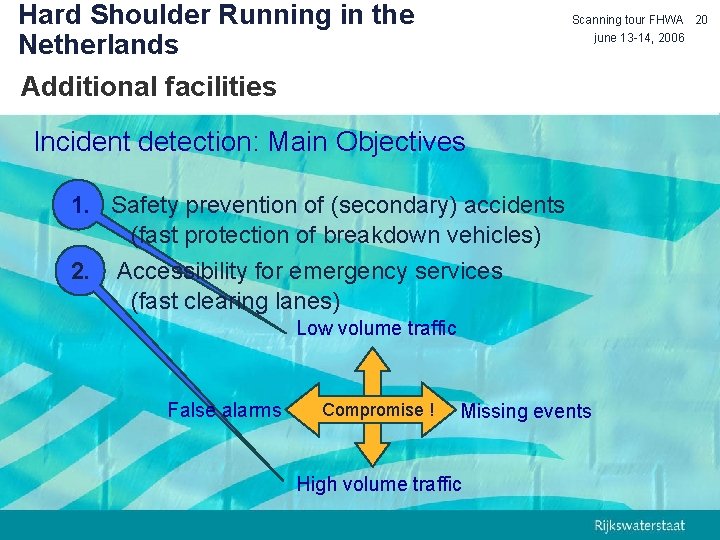
Hard Shoulder Running in the Netherlands Additional facilities Scanning tour FHWA 20 june 13 -14, 2006 Incident detection: Main Objectives 1. Safety prevention of (secondary) accidents (fast protection of breakdown vehicles) 2. Accessibility for emergency services (fast clearing lanes) Low volume traffic False alarms Compromise ! Missing events High volume traffic
Hard Shoulder Running in the Netherlands Additional facilities Scanning tour FHWA 21 june 13 -14, 2006 Incident detection: history Earlier system (dense loop detector system with speed threshold) - very expensive (about 35% of total costs) - many false alarms in case of heavy traffic flows (slow moving vehicles) Present system: - AID (proven system) and blockade loop detector (optimising) - Mobile phones 112 (problem: location verification) Future: - Testing other (reliable) techniques (some scepticism on video detection) - New technics e-call (perfect location verification)
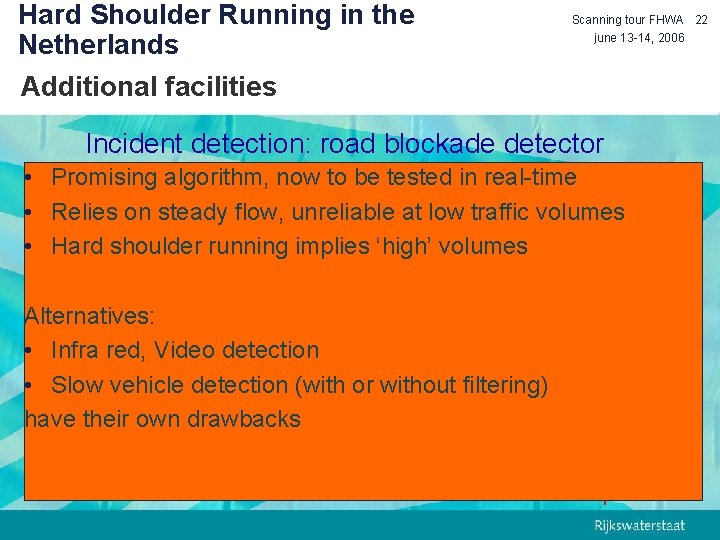
Hard Shoulder Running in the Netherlands Additional facilities Scanning tour FHWA 22 june 13 -14, 2006 • Promising algorithm, now to be tested in real-time 15 – 20 km/u 80 – 120 km/u • Relies on steady flow, unreliable at low traffic volumes • 1 Hard shoulder running implies ‘high’ volumes Alternatives: 2 • Infra red, Video detection • 3 Slow vehicle detection (with or without filtering) have their own drawbacks 4 Drop in traffic flow downstream (with check on downstream speed) Incident detection: road blockade detector Loop detectors
Hard Shoulder Running in the Netherlands • Introduction and background • Design & Lay out • Additional facilities • Innovative instruments • Research and practice • HSR and incident management Scanning tour FHWA 23 june 13 -14, 2006
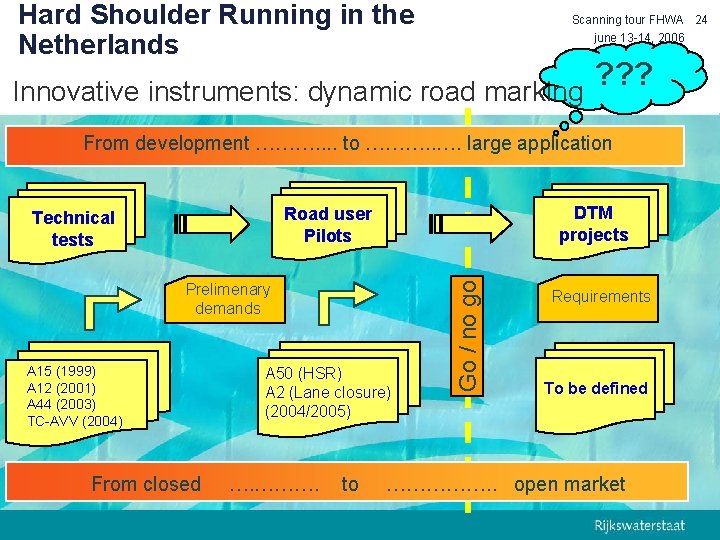
Hard Shoulder Running in the Netherlands Scanning tour FHWA 24 june 13 -14, 2006 ? ? ? Innovative instruments: dynamic road marking From development ………. . to ………. . …. large application DTM projects Prelimenary demands A 15 (1999) A 12 (2001) A 44 (2003) TC-AVV (2004) From closed A 50 (HSR) A 2 (Lane closure) (2004/2005) …. ………. to Go / no go Road user Pilots Technical tests Requirements To be defined ……………. . open market
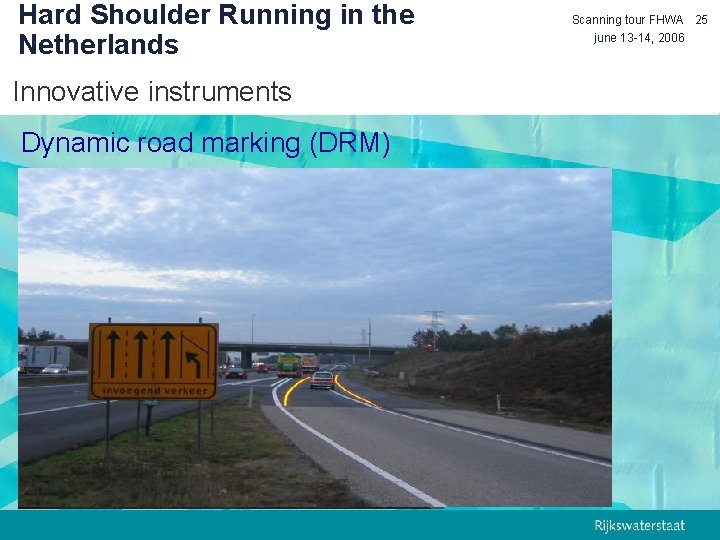
Hard Shoulder Running in the Netherlands Innovative instruments Dynamic road marking (DRM) Scanning tour FHWA 25 june 13 -14, 2006
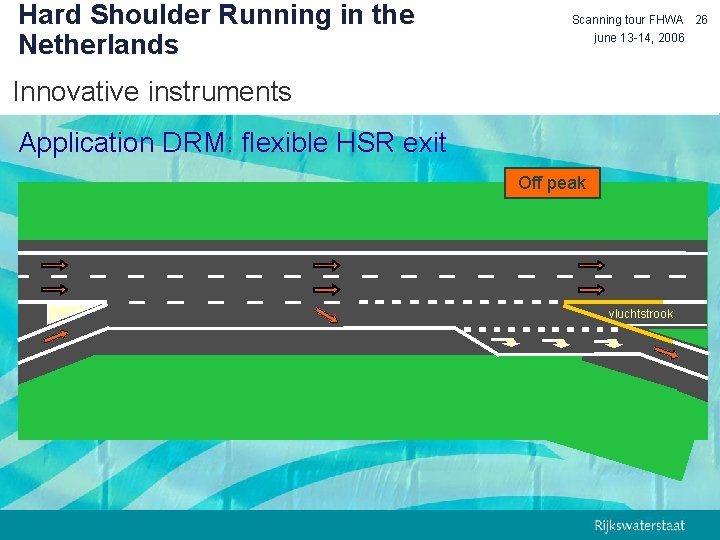
Hard Shoulder Running in the Netherlands Scanning tour FHWA 26 june 13 -14, 2006 Innovative instruments Application DRM: flexible HSR exit Off peak vluchtstrook
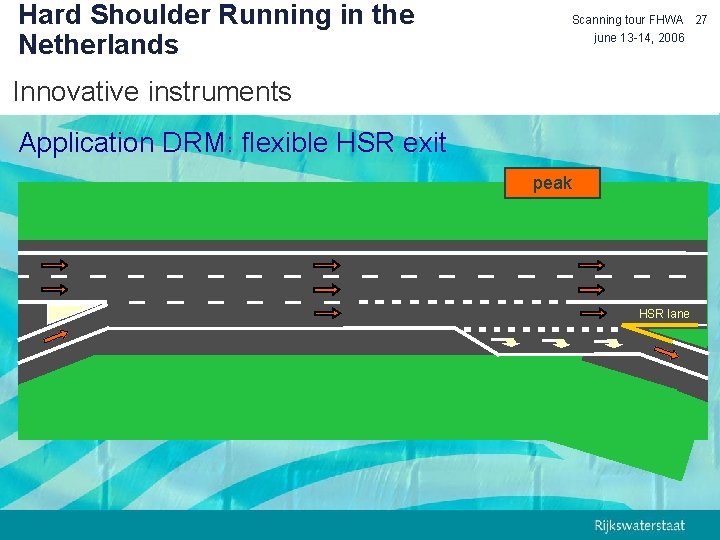
Hard Shoulder Running in the Netherlands Scanning tour FHWA 27 june 13 -14, 2006 Innovative instruments Application DRM: flexible HSR exit peak HSR lane
Hard Shoulder Running in the Netherlands • • Introduction and background Design & Lay out Additional facilities Innovative instruments • Research and practice • HSR and incident management Scanning tour FHWA 28 june 13 -14, 2006
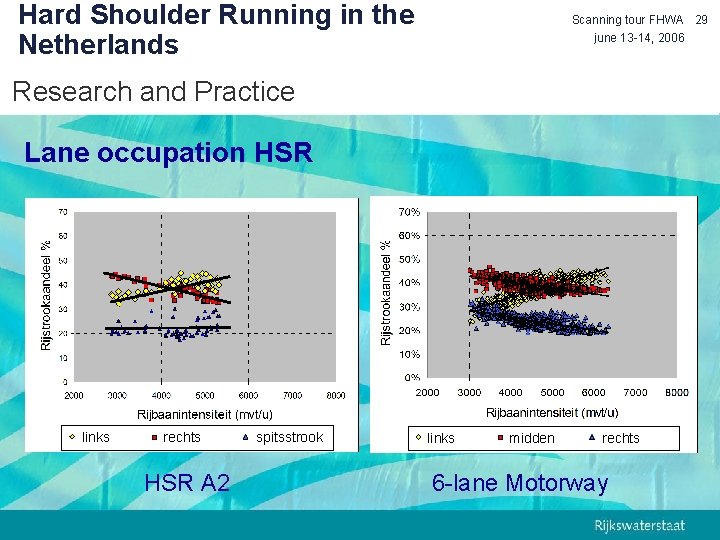
Hard Shoulder Running in the Netherlands Scanning tour FHWA 29 june 13 -14, 2006 Research and Practice Lane occupation HSR links rechts HSR A 2 spitsstrook links midden rechts 6 -lane Motorway
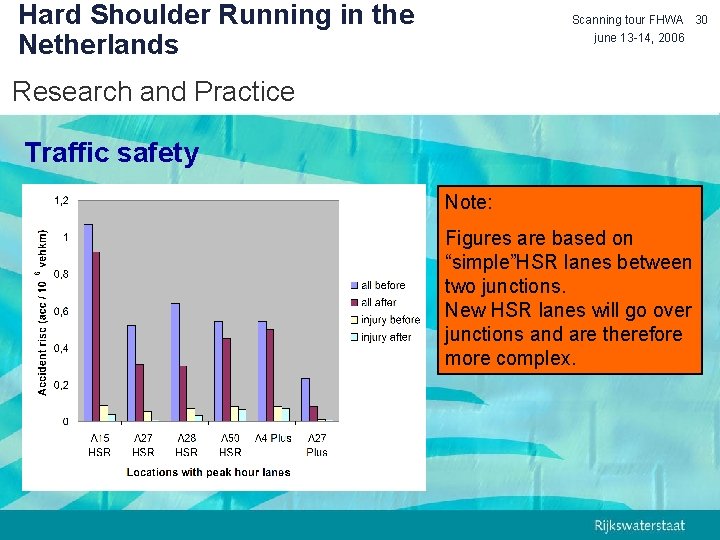
Hard Shoulder Running in the Netherlands Scanning tour FHWA 30 june 13 -14, 2006 Research and Practice Traffic safety Note: Figures are based on “simple”HSR lanes between two junctions. New HSR lanes will go over junctions and are therefore more complex.
Hard Shoulder Running in the Netherlands Research and Practice Monitoring and evaluation • Quick scan on every new HSR project - Critical view on design (compliance in off peak) - Possible constrains in IM (accessibility emergency services) - Working processes in TMC (check on protocols) • National evaluation of ZSM-program - Effects on accessibility - Effects on safety - Evaluation of process (organisation) Scanning tour FHWA 31 june 13 -14, 2006
Hard Shoulder Running in the Netherlands • • Introduction and background Design & Lay out Additional facilities Innovative instruments • Research and practice • HSR and incident management Scanning tour FHWA 32 june 13 -14, 2006
Hard Shoulder Running in the Netherlands HSR and Incident management Scanning tour FHWA 33 june 13 -14, 2006 Organisation & Incident management • SLA’s (between road manger and emergency authorities) • Guidelines IM and protocols on HSR lanes (for TMC) • Calamity schemes (Legislation) • Central towing turn out • Key role for TMC (spider in web)
Hard Shoulder Running in the Netherlands HSR and Incident management Practice: Incident on a HSR section Scanning tour FHWA 34 june 13 -14, 2006
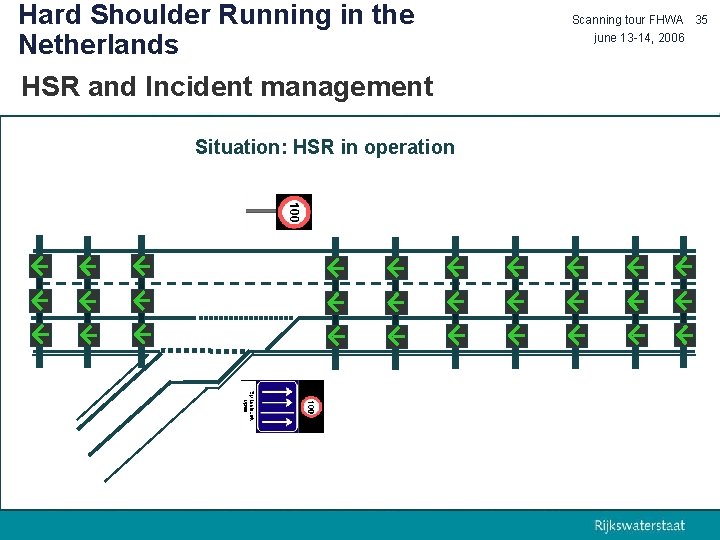
Hard Shoulder Running in the Netherlands HSR and Incident management Situation: HSR in operation Scanning tour FHWA 35 june 13 -14, 2006
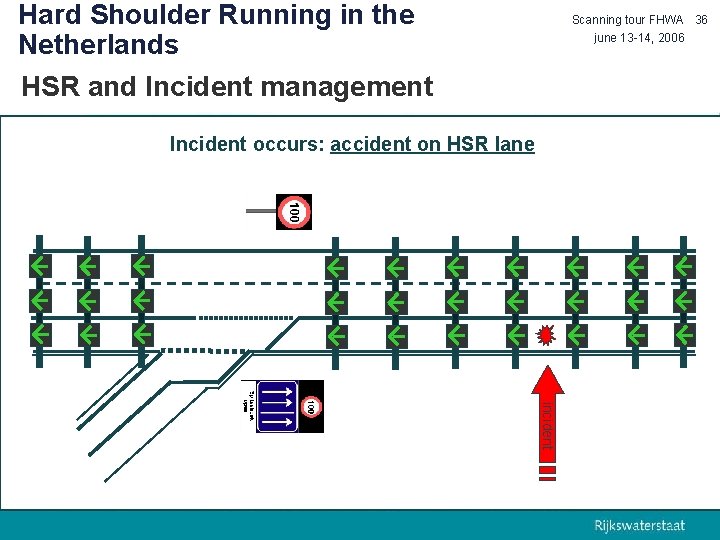
Hard Shoulder Running in the Netherlands HSR and Incident management Scanning tour FHWA 36 june 13 -14, 2006 Incident occurs: accident on HSR lane incident
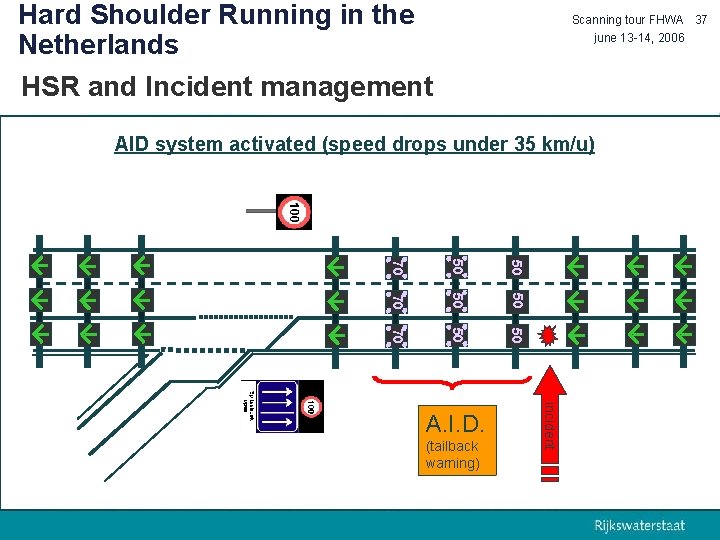
Hard Shoulder Running in the Netherlands HSR and Incident management Scanning tour FHWA 37 june 13 -14, 2006 AID system activated (speed drops under 35 km/u) 50 50 70 (tailback warning) incident A. I. D.
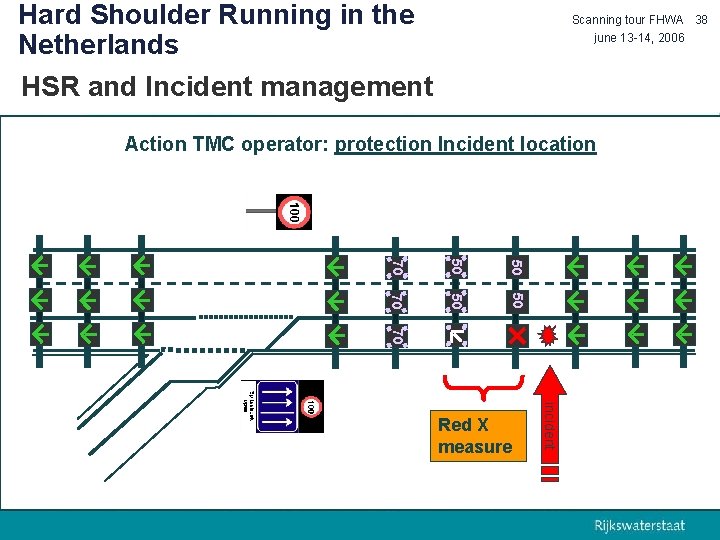
Hard Shoulder Running in the Netherlands HSR and Incident management Scanning tour FHWA 38 june 13 -14, 2006 Action TMC operator: protection Incident location 50 50 50 70 70 incident Red X measure
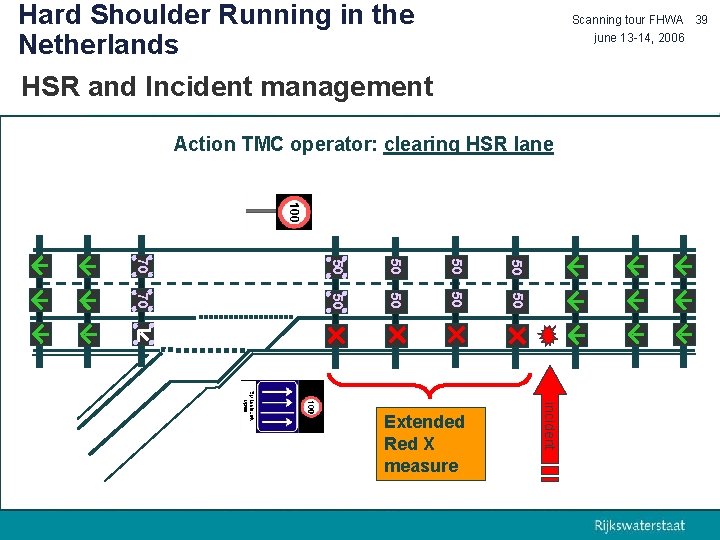
Hard Shoulder Running in the Netherlands HSR and Incident management Scanning tour FHWA 39 june 13 -14, 2006 Action TMC operator: clearing HSR lane 50 50 70 incident Extended Red X measure
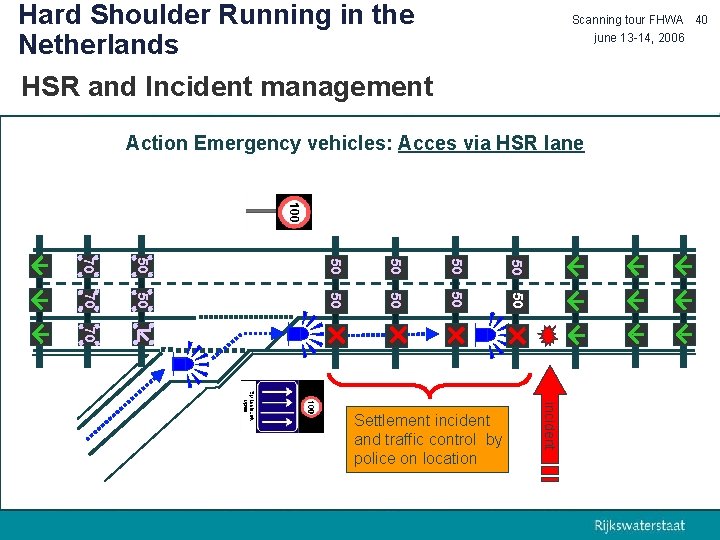
Hard Shoulder Running in the Netherlands HSR and Incident management Scanning tour FHWA 40 june 13 -14, 2006 Action Emergency vehicles: Acces via HSR lane 50 50 50 70 70 incident Settlement incident and traffic control by police on location
Hard Shoulder Running in the Netherlands Thanks for your attention ! Any questions ? Scanning tour FHWA 41 june 13 -14, 2006
- Slides: 41