
Hard and Soft Acids and Bases 1 chem
Hard and Soft Acids and Bases 1 ﺗﻬﺎﻧﻲ ﺍﻟﻤﺤﻴﻤﻴﺪ chem 423
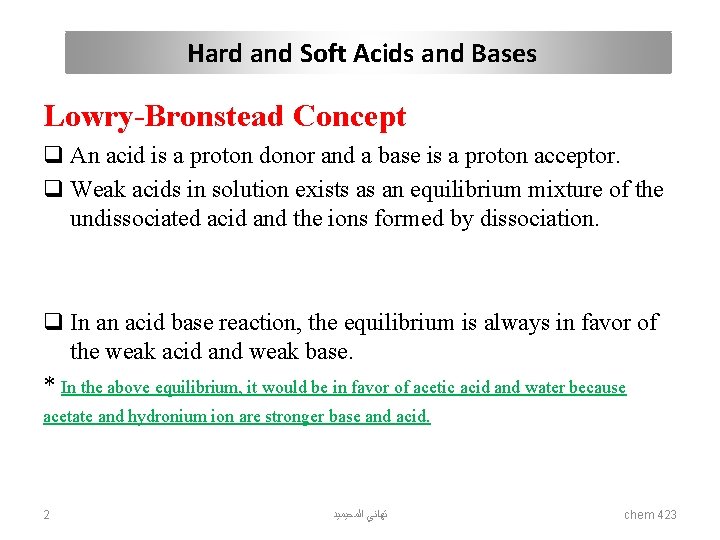
Hard and Soft Acids and Bases Lowry-Bronstead Concept q An acid is a proton donor and a base is a proton acceptor. q Weak acids in solution exists as an equilibrium mixture of the undissociated acid and the ions formed by dissociation. q In an acid base reaction, the equilibrium is always in favor of the weak acid and weak base. * In the above equilibrium, it would be in favor of acetic acid and water because acetate and hydronium ion are stronger base and acid. 2 ﺗﻬﺎﻧﻲ ﺍﻟﻤﺤﻴﻤﻴﺪ chem 423
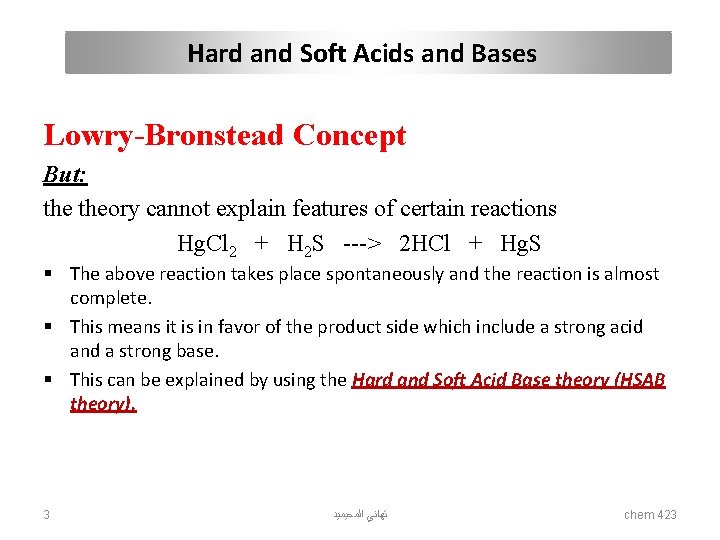
Hard and Soft Acids and Bases Lowry-Bronstead Concept But: theory cannot explain features of certain reactions Hg. Cl 2 + H 2 S ---> 2 HCl + Hg. S § The above reaction takes place spontaneously and the reaction is almost complete. § This means it is in favor of the product side which include a strong acid and a strong base. § This can be explained by using the Hard and Soft Acid Base theory (HSAB theory). 3 ﺗﻬﺎﻧﻲ ﺍﻟﻤﺤﻴﻤﻴﺪ chem 423

Hard and Soft Acids and Bases 1965 - Ralph Pearson introduced the hard-soft-acid-base (HSAB) principle. “Hard acids prefer to coordinate the hard bases and soft acids to soft bases” According to this theory a soft acid will react with a soft base more easily. Similarly a hard acid will react with a hard base. Hg 2+ is a soft acid and S 2 - is a soft base. So interaction between these two takes place very easily. Hg. Cl 2 + H 2 S ---> 2 HCl + Hg. S 4 ﺗﻬﺎﻧﻲ ﺍﻟﻤﺤﻴﻤﻴﺪ chem 423

Hard and Soft Acids and Bases Hard and Soft Acids and Base • This concept is classified into hard, soft and borderline acids bases. • Hard acids and bases have a tendency to form ionic bonds while soft ones form covalent bonds. • Interactions between soft acid and soft base or hard acid and hard base are more effective. • HSAB theory endeavors to help one decide if AB + CD AC + BD goes to the left or the right (also helps you to know if AB + CD forms AC + BD or AD + BC) 5 ﺗﻬﺎﻧﻲ ﺍﻟﻤﺤﻴﻤﻴﺪ chem 423
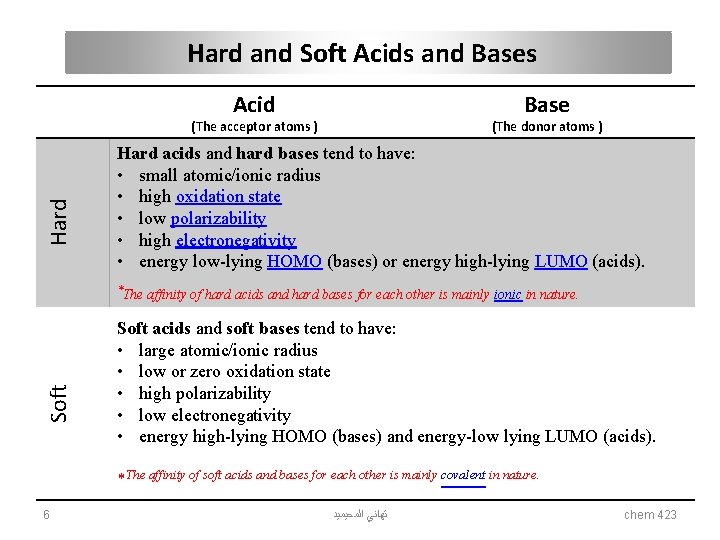
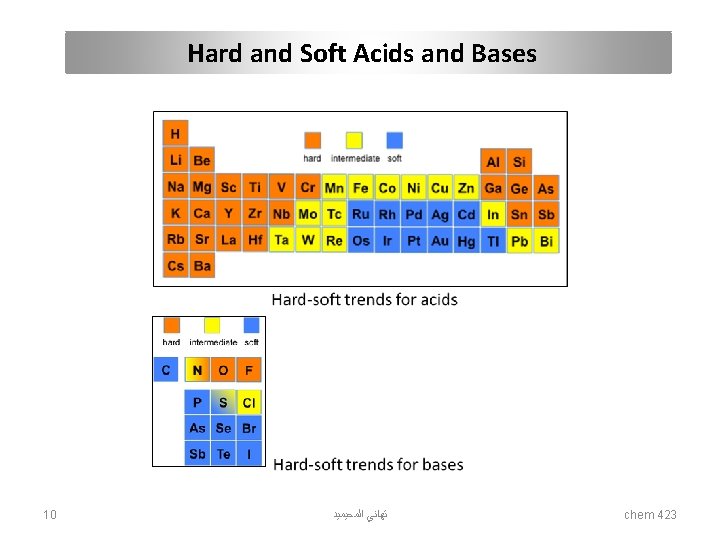
Hard and Soft Acids and Bases Acid Base Hard (The acceptor atoms ) (The donor atoms ) Hard acids and hard bases tend to have: • small atomic/ionic radius • high oxidation state • low polarizability • high electronegativity • energy low-lying HOMO (bases) or energy high-lying LUMO (acids). Soft *The affinity of hard acids and hard bases for each other is mainly ionic in nature. Soft acids and soft bases tend to have: • large atomic/ionic radius • low or zero oxidation state • high polarizability • low electronegativity • energy high-lying HOMO (bases) and energy-low lying LUMO (acids). *The affinity of soft acids and bases for each other is mainly covalent in nature. 6 ﺗﻬﺎﻧﻲ ﺍﻟﻤﺤﻴﻤﻴﺪ chem 423

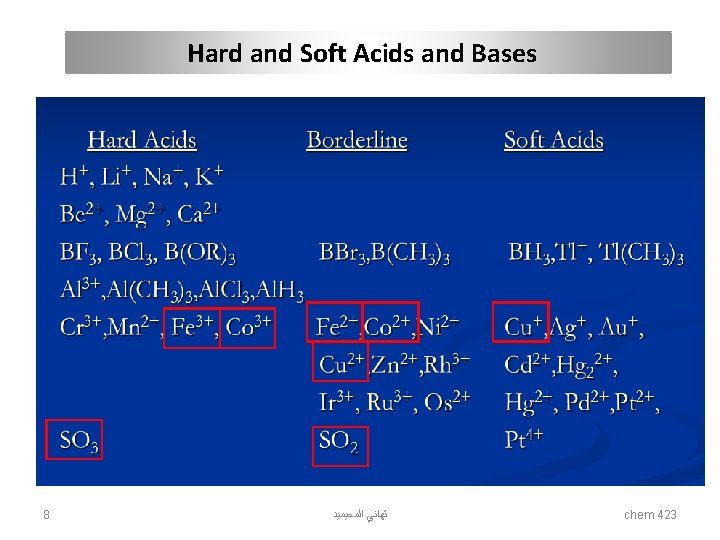
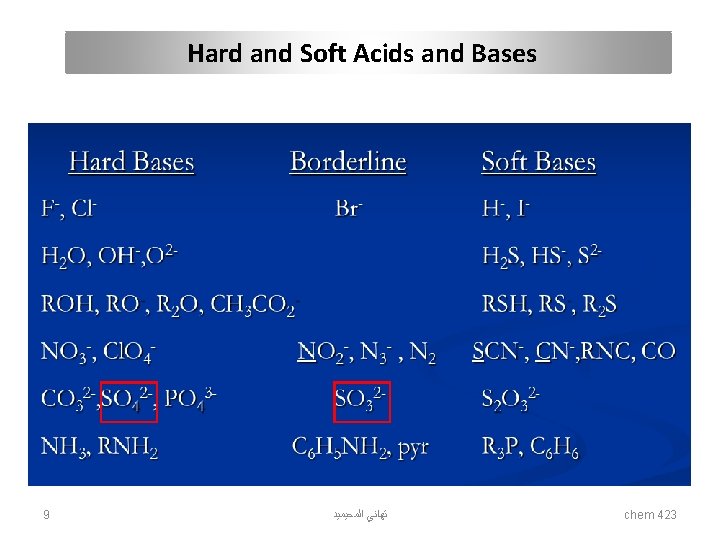
Hard and Soft Acids and Bases Acids hard Bases soft hard soft Hydronium H+ Mercury CH 3 Hg+, Hg 2+, Hg 22+ Hydroxyl OH- Hydride H- Alkali metals Li+, Na+, K+ Platinum Pt 2+ Alkoxide RO- Thiolate RS- Titanium Ti 4+ Palladium Pd 2+ Halogens F-, Cl- Halogens I- Chromium Cr 3+, Cr 6+ Silver Ag+ Ammonia NH 3 Phosphine PR 3 Boron trifluoride BF 3 borane BH 3 Carboxylate CH 3 COO- Thiocyanate SCN- Carbocation R 3 C+ P-chloranil Carbonate CO 32 - carbon monoxide CO Hydrazine N 2 H 4 Benzene C 6 H 6 bulk Metals M 0 Gold Au+ Table 1. Hard and soft acids and bases 7 ﺗﻬﺎﻧﻲ ﺍﻟﻤﺤﻴﻤﻴﺪ chem 423
Hard and Soft Acids and Bases 8 ﺗﻬﺎﻧﻲ ﺍﻟﻤﺤﻴﻤﻴﺪ chem 423
Hard and Soft Acids and Bases 9 ﺗﻬﺎﻧﻲ ﺍﻟﻤﺤﻴﻤﻴﺪ chem 423
Hard and Soft Acids and Bases 10 ﺗﻬﺎﻧﻲ ﺍﻟﻤﺤﻴﻤﻴﺪ chem 423

Hard and Soft Acids and Bases 11 ﺗﻬﺎﻧﻲ ﺍﻟﻤﺤﻴﻤﻴﺪ chem 423

Hard and Soft Acids and Bases Example: a given base, B, may be classified as hard or soft based on the equilibrium: BH+ + CH 3 Hg+ CH 3 Hg. B+ + H+ There is a competition here between the acid H+ and CH 3 Hg+. ü If B is soft then → to the right ü If B is hard then ← to the left v Important to remember that the listings in the tables do not have a sharp dividing line between them. These terms, “hard” & “soft”, are relative. v Some are borderline and even though within the same category are not all of the same degree of “hardness” and “softness” e. g. although all alkali metals in ionic form M+ are “hard”, the larger, more polarizable, Cs+ ion is much softer than Li+ 12 ﺗﻬﺎﻧﻲ ﺍﻟﻤﺤﻴﻤﻴﺪ chem 423
- Slides: 12