
HAPTIC PROTOTYPE ASSEMBLY TOOL FOR NONSIGHTED VISUALLY IMPAIRED
HAPTIC PROTOTYPE ASSEMBLY TOOL FOR NON-SIGHTED, VISUALLY IMPAIRED AND FULLY SIGHTED DESIGN STUDENTS, STUDYING AT A DISTANCE. ESTEEM 2018
“ Western civilization has had a deep-rooted trouble in making connections between head and hand, in recognizing and encouraging the impulse of craftsmanship. " Richard Senett (2009)
Keywords: Designers, Haptics, Non-Sighted, Visually Impaired
AGENDA Background on haptic (machine) used within creative and education practice The motivations behind the ‘Shape Assembly Test’ student-led project The purpose and role of haptics in ‘applied’ education Formative pilot test (Academic) Main empirical study protocol and methodologies Results and discussion
BACKGROUND -HAPTICS (MACHINE) PUT SIMPLY… Haptic (machine) technology is designed to offer the user TACTILE or FORCE led interaction with computers. Tactile - feedback which creates skin sensations to the user, e. g. feelings of buzzing, temperature, textures, Force – feedback which creates feeling of force, pressures to the user e. g. feelings of solid-plane resistance feelings of weight,
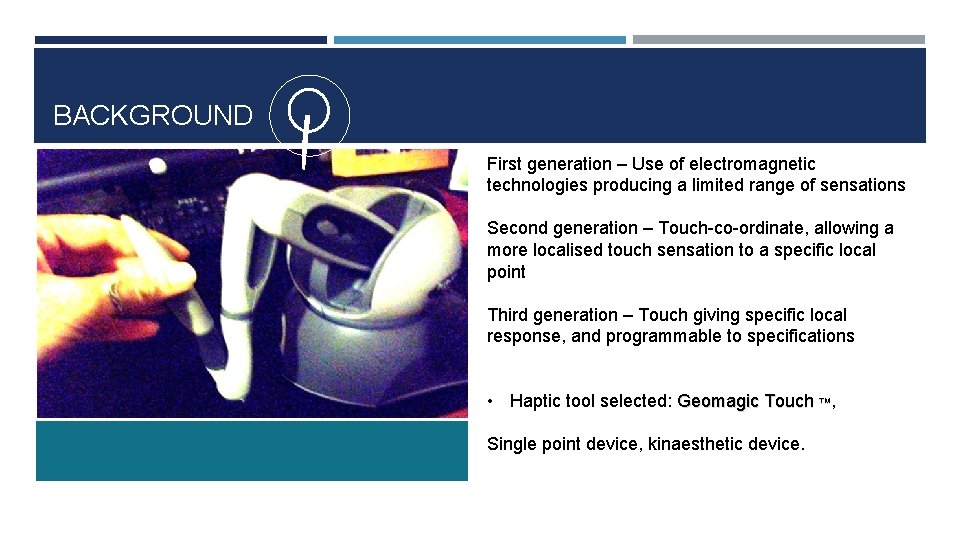
BACKGROUND First generation – Use of electromagnetic technologies producing a limited range of sensations Second generation – Touch-co-ordinate, allowing a more localised touch sensation to a specific local point Third generation – Touch giving specific local response, and programmable to specifications • Haptic tool selected: Geomagic Touch ™, Single point device, kinaesthetic device.
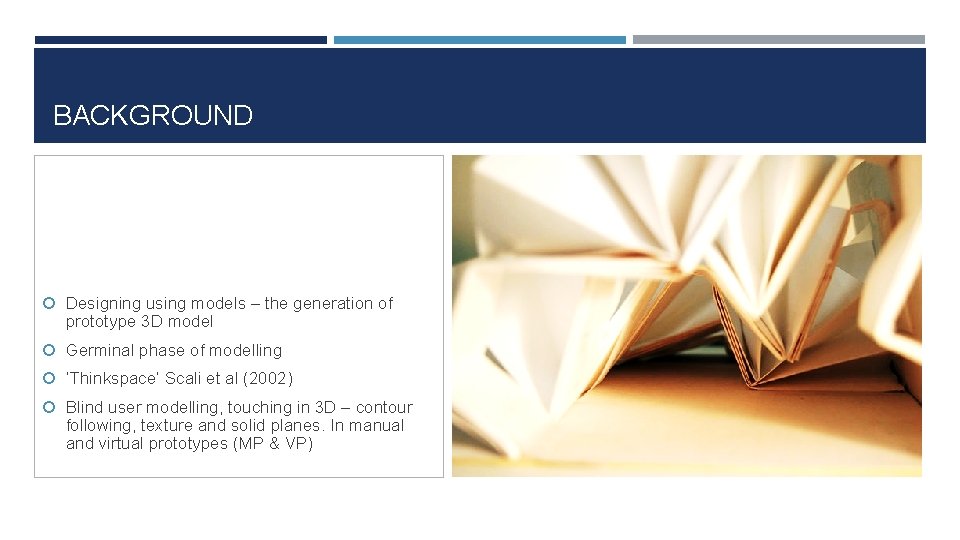
BACKGROUND Designing using models – the generation of prototype 3 D model Germinal phase of modelling ‘Thinkspace’ Scali et al (2002) Blind user modelling, touching in 3 D – contour following, texture and solid planes. In manual and virtual prototypes (MP & VP)
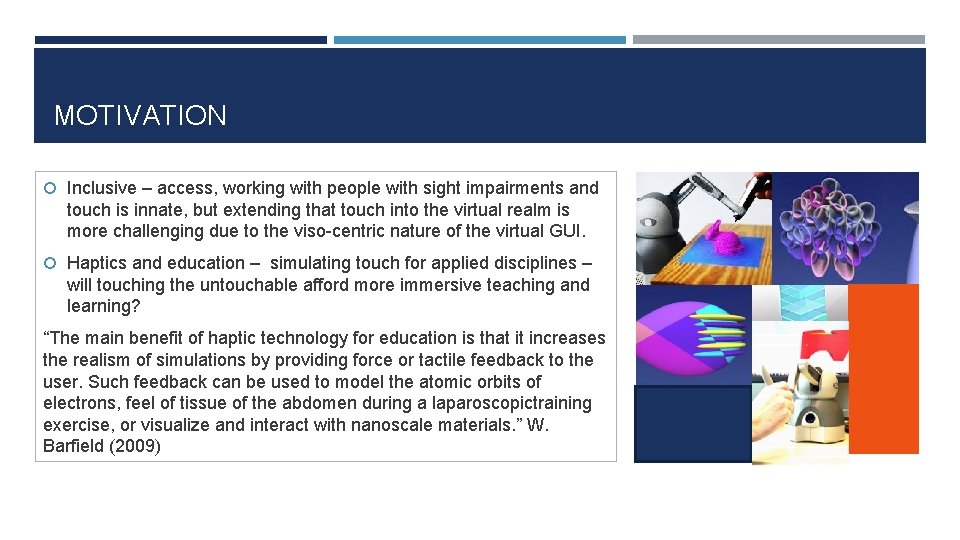
MOTIVATION Inclusive – access, working with people with sight impairments and touch is innate, but extending that touch into the virtual realm is more challenging due to the viso-centric nature of the virtual GUI. Haptics and education – simulating touch for applied disciplines – will touching the untouchable afford more immersive teaching and learning? “The main benefit of haptic technology for education is that it increases the realism of simulations by providing force or tactile feedback to the user. Such feedback can be used to model the atomic orbits of electrons, feel of tissue of the abdomen during a laparoscopictraining exercise, or visualize and interact with nanoscale materials. ” W. Barfield (2009)
THE PURPOSE AND ROLE OF HAPTICS IN ‘APPLIED’ EDUCATION “Tangible user interfaces (TUIs) is an expression to represent a technology including digital information and physical objects to virtually mimic an absolute environment”. Farzard (2011) Designers are only one group of professional practitioners who train and work in a tangible hands-on manner, others include: Vets, - the Haptic Cow Dentist – the. Haptic Mouth Doctors/Surgeons – the Haptic body , upper and lower torso Engineers – Haptic technical tooling Until the introduction of haptic tools many applied discipline practitioners/students could not use physical interactivity to enhance study and training practices.
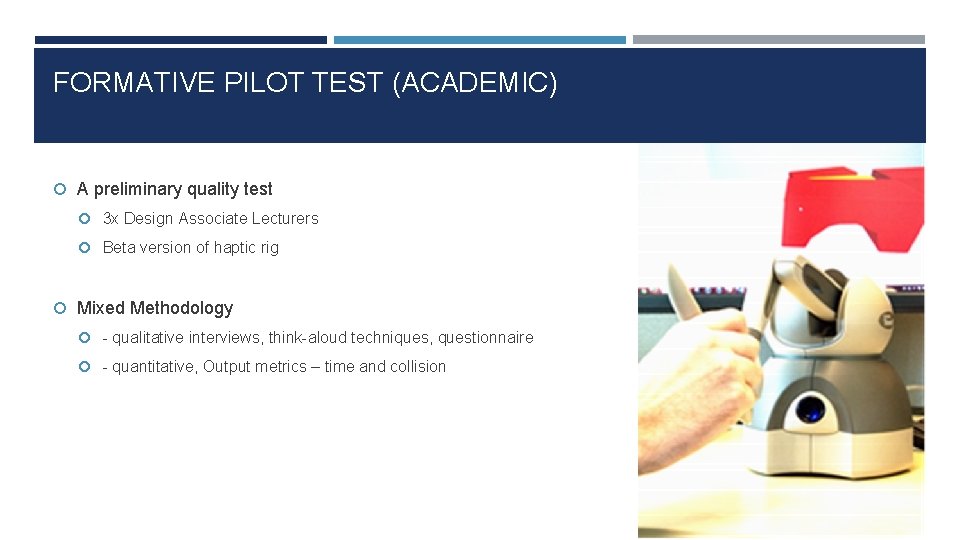
FORMATIVE PILOT TEST (ACADEMIC) A preliminary quality test 3 x Design Associate Lecturers Beta version of haptic rig Mixed Methodology - qualitative interviews, think-aloud techniques, questionnaire - quantitative, Output metrics – time and collision
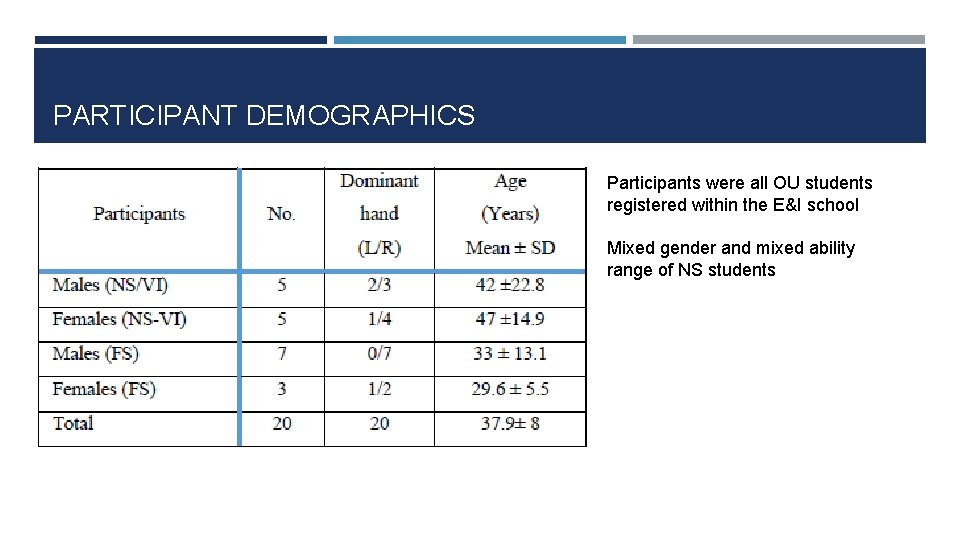
PARTICIPANT DEMOGRAPHICS Participants were all OU students registered within the E&I school Mixed gender and mixed ability range of NS students
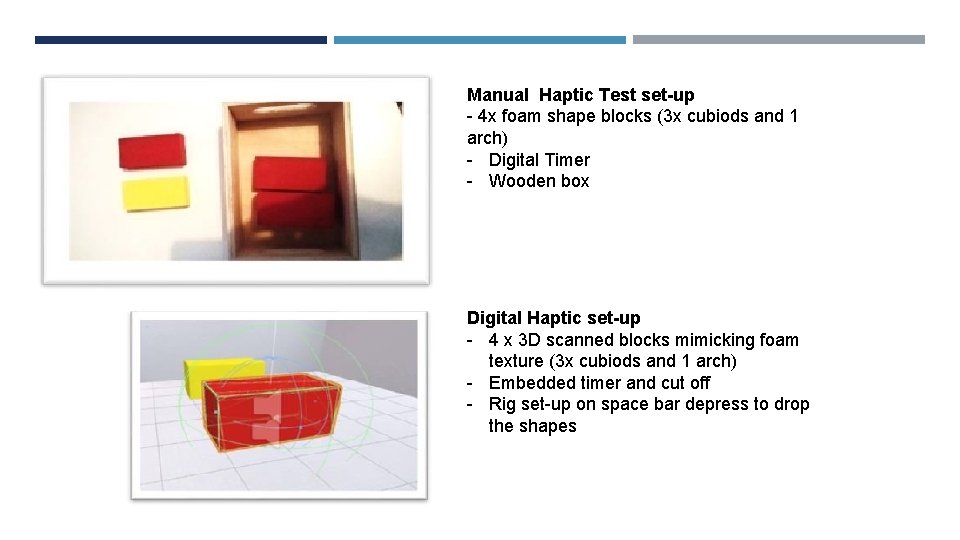
Manual Haptic Test set-up - 4 x foam shape blocks (3 x cubiods and 1 arch) - Digital Timer - Wooden box Digital Haptic set-up - 4 x 3 D scanned blocks mimicking foam texture (3 x cubiods and 1 arch) - Embedded timer and cut off - Rig set-up on space bar depress to drop the shapes
MAIN EMPIRICAL STUDY PROTOCOL AND METHODOLOGIES Non-sighted and fully sighted Design and Engineering students were invited and consented – ethics guided by the SST and HREC process. Shape Assembly Test working with manual and haptic digital prototype rigs Each participant was trained on haptic handling and specific manoeuvres working with the haptic rig, and asked to assembly the given 3 D prototype in the allotted period of 5 mins – industry norm for sketch model assembly. All participants were asked to use think-aloud technique throughout manual and digital haptic use, and then they were sent feedback evaluations using the lickert scale to quantify the reactions to each haptic mode. All results were collated analysed using Nvivo (V 21) and SPSS (v 10).
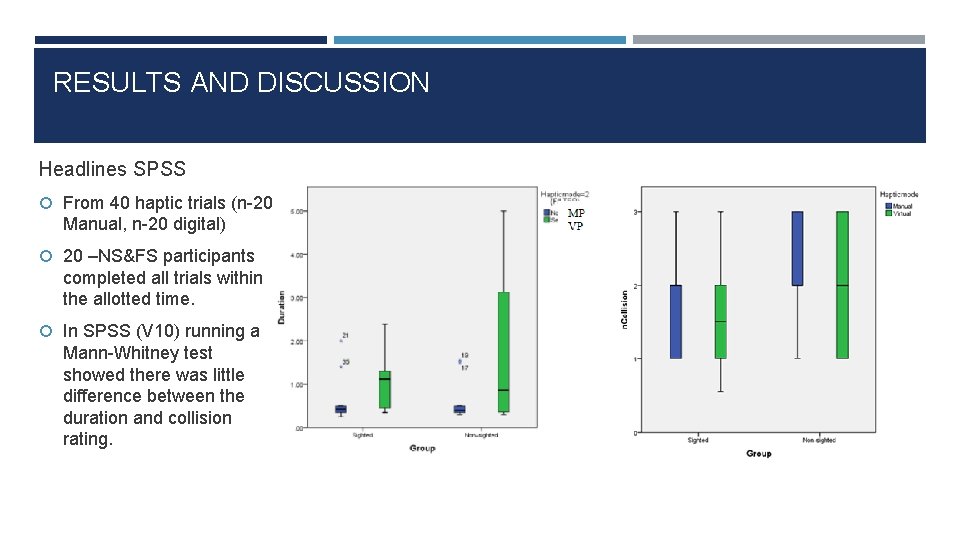
RESULTS AND DISCUSSION Headlines SPSS From 40 haptic trials (n-20 Manual, n-20 digital) 20 –NS&FS participants completed all trials within the allotted time. In SPSS (V 10) running a Mann-Whitney test showed there was little difference between the duration and collision rating.
QUALITATIVE ANALYSIS Using Nvivo (v 21) theme analysis was set on the following themes : accessibility, complexity and immersion, innate tactile immersions Previously held opinions by NS participants were that the haptic was going to be complex to use – and mathematics skills would be needed. Sample qualitative feedback from NS participants : “ Do you know, I really thought using this would be more tricky, look I am just picking that up as I would normally[sic]” “ It was satisfying accomplishing something which I had thought impossible/very difficult in a relatively easy manner. ” “ Moving from a mental picture to actually creating a prototype was satisfying. Without the interface I can’t conceive how the task could be accomplished on my own. Only [sic] other alternative would have been a sighted assistant to do all the work”.
DISCUSSION When comparing the performance between sighted and non-sighted participants, manual prototype (MP) task, they had a similar performance measured by duration and n. Collision parameters. This was similar for the virtual prototype machine haptics (MH). As there was an insignificant statistical difference shown between groups, between MP and MH, reflected by both duration and n. Collision, then we can agree with the hypothesis that haptic MH has enabled both groups (N-VI&FS) enough to ‘level the plane for teaching and learning’, through the prototype shape assembly task.
FUTURE WORK This study was created as a proof of concept haptic rig test. Further development and further iterations of the haptic VP assembly interface is required, to offer a battery of textures to apply to models for prototype builds within design and engineering at the OU. Future work is to be aimed at linear haptic drawing, with a view to inculcating a battery of textures and colors for users to use.
QUESTIONS… THANK YOU…
- Slides: 19