
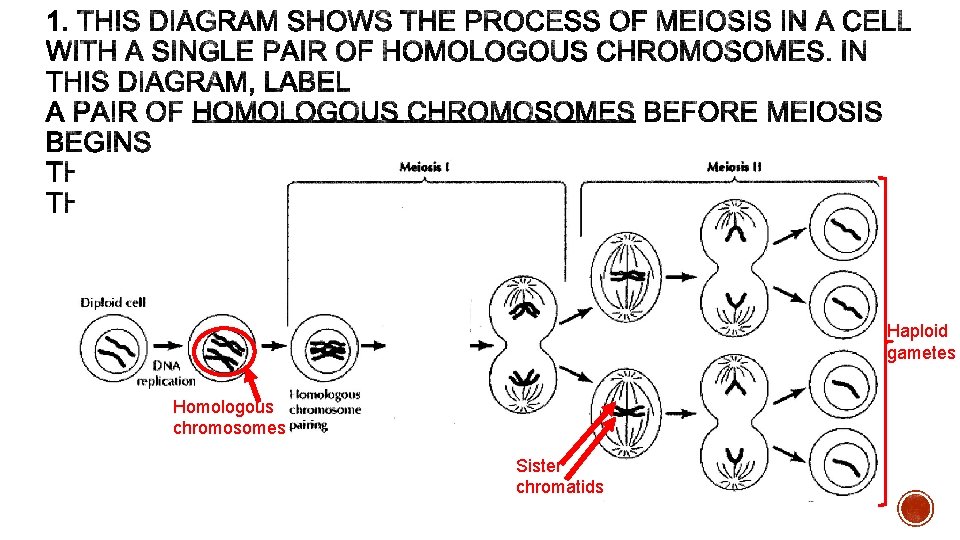
Haploid gametes Homologous chromosomes Sister chromatids An egg
- Slides: 10
Haploid gametes Homologous chromosomes Sister chromatids
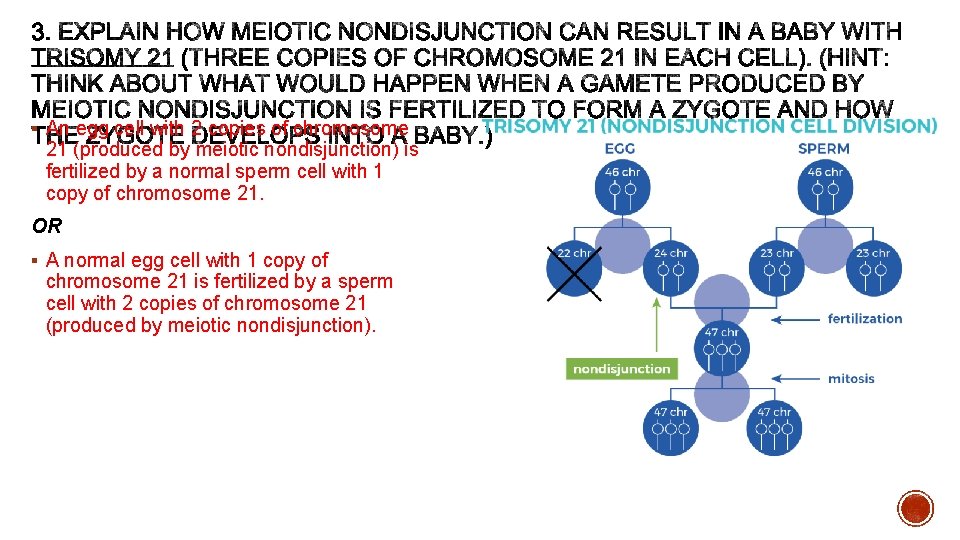
§ An egg cell with 2 copies of chromosome 21 (produced by meiotic nondisjunction) is fertilized by a normal sperm cell with 1 copy of chromosome 21. OR § A normal egg cell with 1 copy of chromosome 21 is fertilized by a sperm cell with 2 copies of chromosome 21 (produced by meiotic nondisjunction).
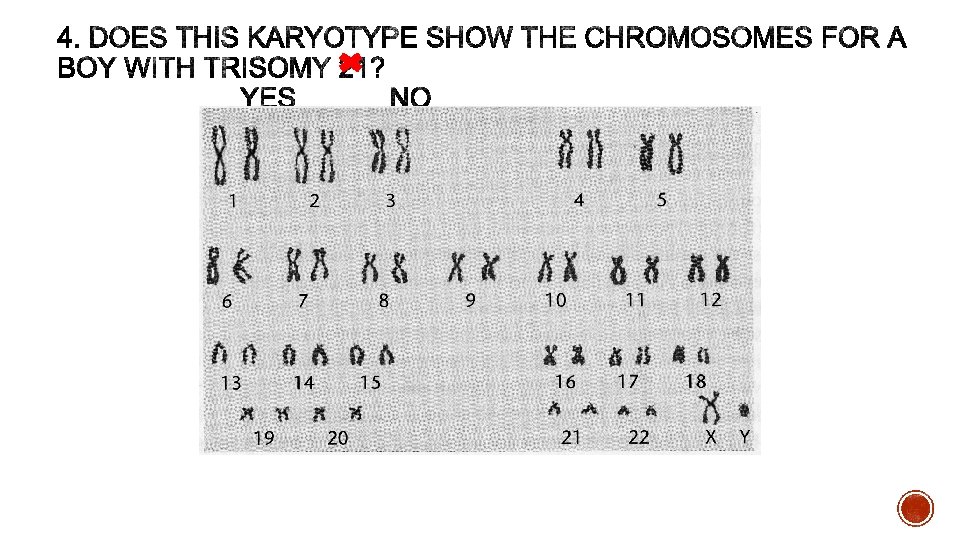
§ 5. When a cell has three copies of a chromosome, the extra copies of the genes on this chromosome result in extra copies of the proteins coded for by these genes, and this causes abnormal cell function. As a result, a zygote that has three copies of a chromosome will develop abnormally. For example: § If a zygote has an extra copy of any of the chromosomes in the top row of the karyotype, the embryo develops such severe abnormalities that it dies and the pregnancy ends in a miscarriage. (A miscarriage occurs when a pregnancy ends spontaneously before the 20 th week, usually during the first trimester). Therefore, no babies are born with trisomy 1, 2, 3, 4, or 5. § If a zygote has an extra copy of chromosome 21 (trisomy 21), the embryo may die or a baby may be born with Down syndrome which includes mental retardation, a broad flat face, a big tongue, short height, and often heart defects. § What do you think is the reason that trisomy 1, 2, 3, 4 or 5 always results in miscarriage, but trisomy 21 has less serious effects on development so some babies are born with trisomy 21? A cell cannot function properly when there are too many copies of some types of proteins due to an extra copy of one of the (large) chromosomes.
§ Trisomy 21 arises due to meiotic nondisjunction, which is a mistake during the formation of a gamete, and is not inherited within the genes of a chromosome. It is not caused by the genetic makeup of a parent.
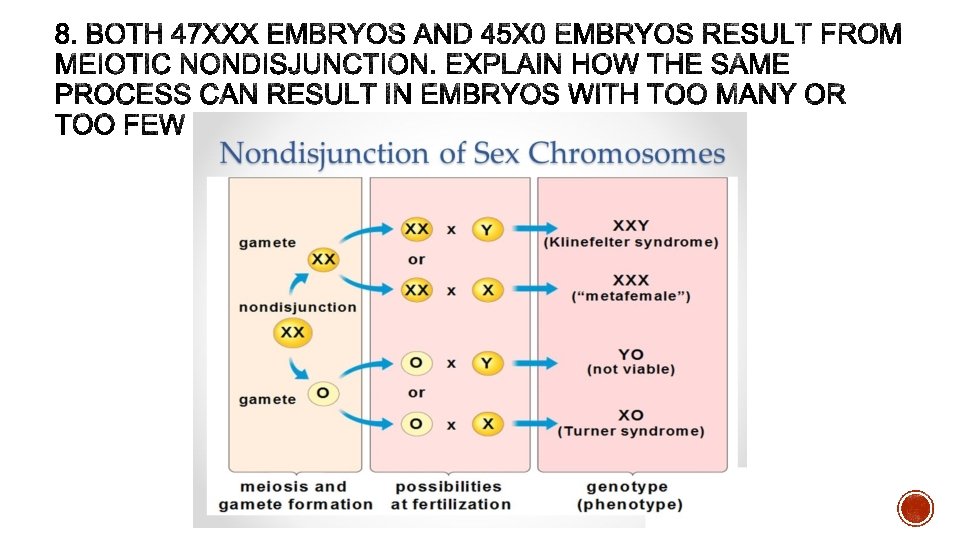
§ 7. Normally, each cell in a person has 2 sex chromosomes + 44 autosomes = 46 chromosomes. Normal females are 46 XX (i. e. 44 autosomes + 2 X chromosomes in each cell). Normal males are 46 XY. However, in some cases the chromosomal makeup is abnormal. § Some females are 47 XXX (i. e. 44 autosomes + 3 X chromosomes), 48 XXXX, or § 45 X 0 (i. e. 44 autosomes +1 X chromosome). § Some males are 47 XYY, 47 XXY, or 48 XXYY. § No babies, children or adults are 46 YY, 47 YYY or 45 Y 0. § Based on this information, which chromosome is crucial for determining the sex of a person? § Y chromosome § Which sex chromosome must be present in order for a zygote to develop into a baby? § X chromosome § Explain why this sex chromosome is required in order for a zygote to develop into a baby. § The X chromosome is a relatively large chromosome with many crucial genes which are needed for the development of a baby.
§ 9. If more than one X chromosome is present in a cell, all but one is inactivated, so both male and female cells have the same balance between a single active X chromosome and 44 autosomes. A small part of each X chromosome has the same genes as part of the Y chromosome, and these genes remain active even if the rest of the X chromosome is inactivated. § Based on this information, explain why 45 X 0 embryos can survive and develop into relatively normal girls and women, but an embryo with an autosomal monosomy (a single copy of one of the autosomes in each cell) has such severe abnormalities that it does not survive to birth. § Even in females with two X chromosome, one X chromosome is inactivated, which provides the basis for normal cellular function both for the cells in males and the cells in females. So most females are operating with one active X chromosome. § 45 X 0 girls or women have Turner syndrome; their ovaries are usually small and not functional and they have a substantial risk of other abnormalities such as heart defects or kidney problems. Provide a genetic explanation for these abnormalities in 45 X 0 females. § Both the X and Y chromosome have similar genes in their pseudoautosomal regions, and these genes are active even on an inactive X chromosome. 45 X 0 females will lack the second copy of these genes.