
Hanyang University ANTENNA THEORY by Constantine A Balanis

Hanyang University ANTENNA THEORY by Constantine A. Balanis Chapter 1 Harim KIM 2017. 01. 20 1/40 Antennas & RF Devices Lab.
Hanyang University Contents 1. Antennas 1. 1 Introduction 1. 2 Types of Antennas 1. 3 Radiation Mechanism 1. 4 Current Distribution on a Thin Wire Antenna 1. 5 Historical Advancement 2/40 Antennas & RF Devices Lab.
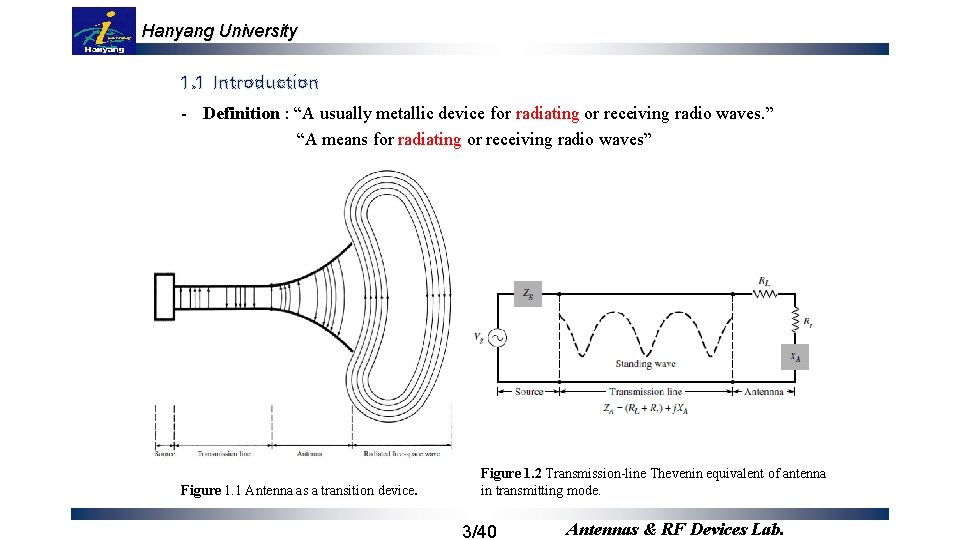
Hanyang University 1. 1 Introduction - Definition : “A usually metallic device for radiating or receiving radio waves. ” “A means for radiating or receiving radio waves” Figure 1. 1 Antenna as a transition device. Figure 1. 2 Transmission-line Thevenin equivalent of antenna in transmitting mode. 3/40 Antennas & RF Devices Lab.
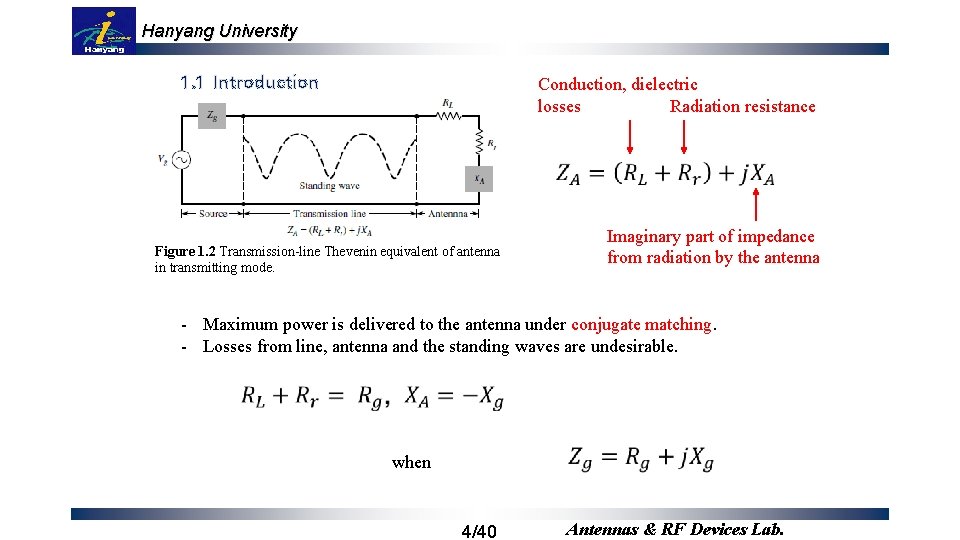
Hanyang University 1. 1 Introduction Conduction, dielectric losses Radiation resistance Imaginary part of impedance from radiation by the antenna Figure 1. 2 Transmission-line Thevenin equivalent of antenna in transmitting mode. - Maximum power is delivered to the antenna under conjugate matching. - Losses from line, antenna and the standing waves are undesirable. when 4/40 Antennas & RF Devices Lab.
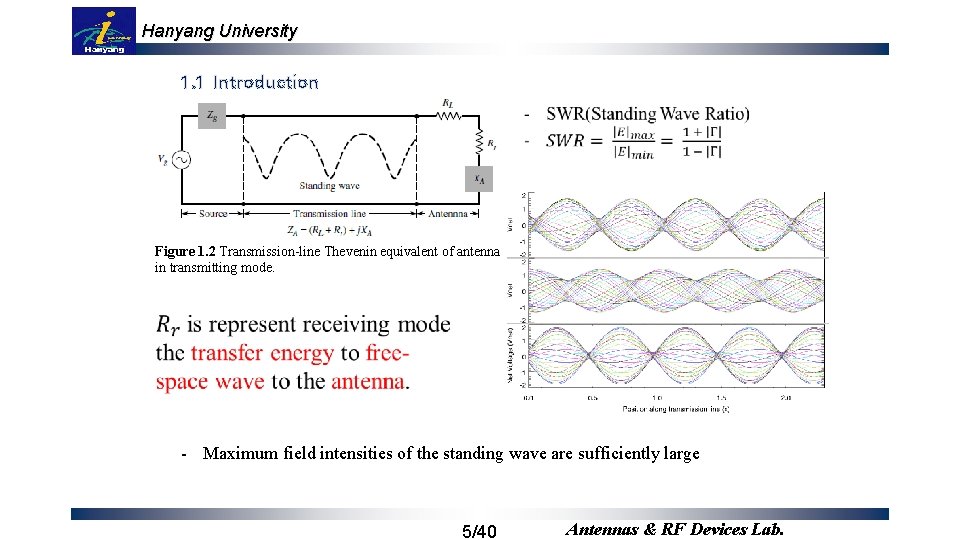
Hanyang University 1. 1 Introduction Figure 1. 2 Transmission-line Thevenin equivalent of antenna in transmitting mode. - Maximum field intensities of the standing wave are sufficiently large 5/40 Antennas & RF Devices Lab.
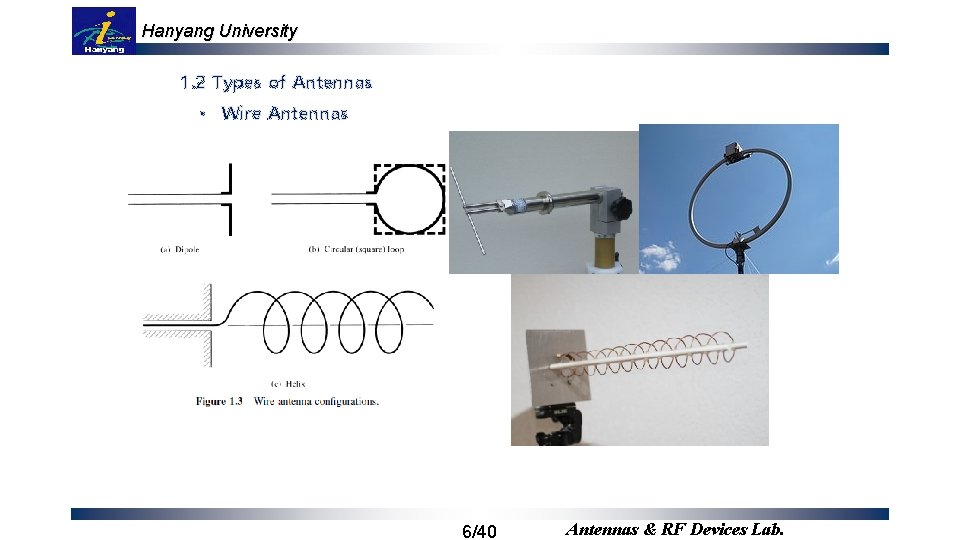
Hanyang University 1. 2 Types of Antennas • Wire Antennas 6/40 Antennas & RF Devices Lab.
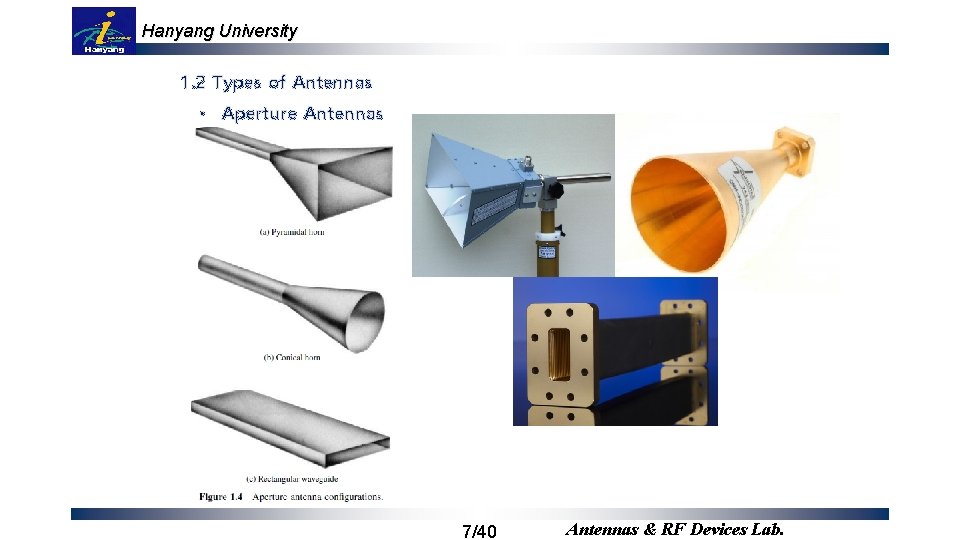
Hanyang University 1. 2 Types of Antennas • Aperture Antennas 7/40 Antennas & RF Devices Lab.
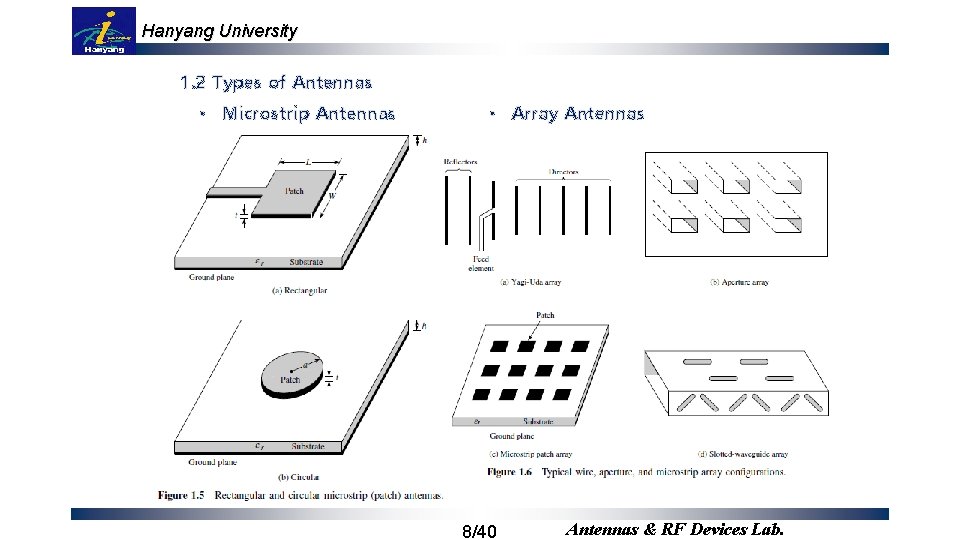
Hanyang University 1. 2 Types of Antennas • Microstrip Antennas • Array Antennas 8/40 Antennas & RF Devices Lab.
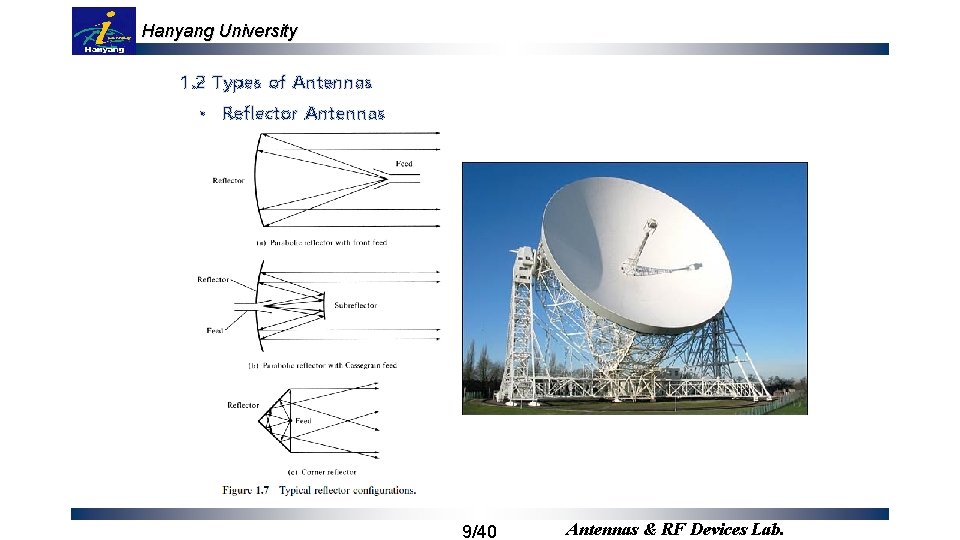
Hanyang University 1. 2 Types of Antennas • Reflector Antennas 9/40 Antennas & RF Devices Lab.
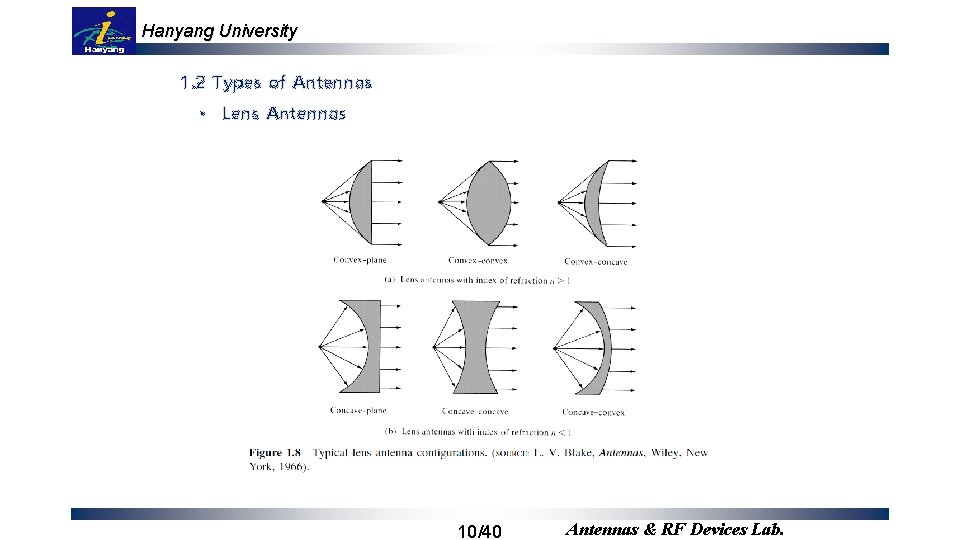
Hanyang University 1. 2 Types of Antennas • Lens Antennas 10/40 Antennas & RF Devices Lab.
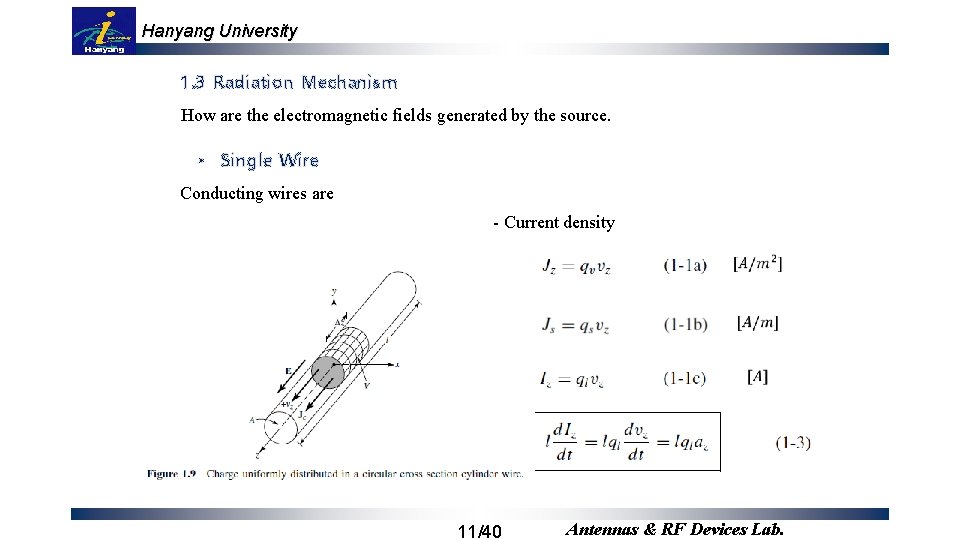
Hanyang University 1. 3 Radiation Mechanism How are the electromagnetic fields generated by the source. • Single Wire Conducting wires are - Current density 11/40 Antennas & RF Devices Lab.
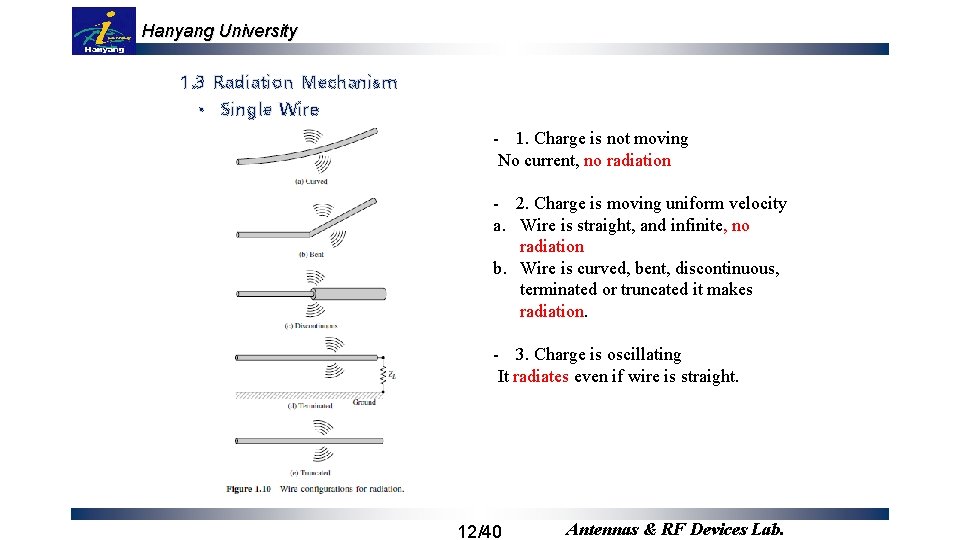
Hanyang University 1. 3 Radiation Mechanism • Single Wire - 1. Charge is not moving No current, no radiation - 2. Charge is moving uniform velocity a. Wire is straight, and infinite, no radiation b. Wire is curved, bent, discontinuous, terminated or truncated it makes radiation. - 3. Charge is oscillating It radiates even if wire is straight. 12/40 Antennas & RF Devices Lab.

Hanyang University 1. 3 Radiation Mechanism • Two-Wires 13/40 Antennas & RF Devices Lab.
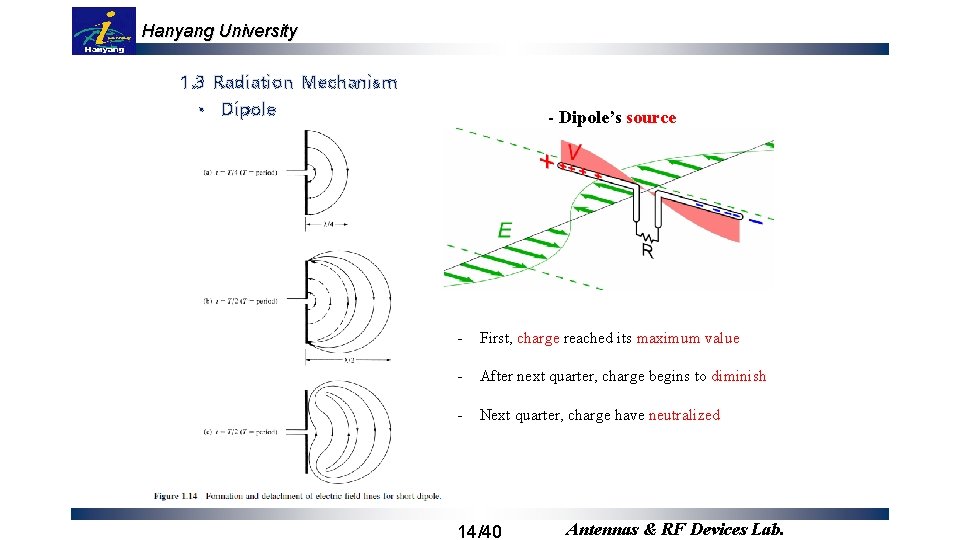
Hanyang University 1. 3 Radiation Mechanism • Dipole - Dipole’s source - First, charge reached its maximum value - After next quarter, charge begins to diminish - Next quarter, charge have neutralized 14/40 Antennas & RF Devices Lab.
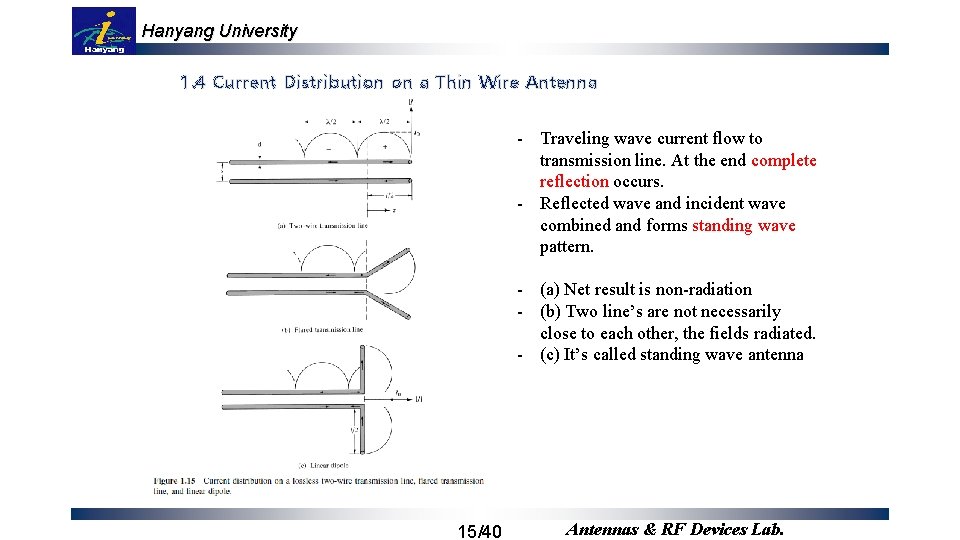
Hanyang University 1. 4 Current Distribution on a Thin Wire Antenna - Traveling wave current flow to transmission line. At the end complete reflection occurs. - Reflected wave and incident wave combined and forms standing wave pattern. - (a) Net result is non-radiation - (b) Two line’s are not necessarily close to each other, the fields radiated. - (c) It’s called standing wave antenna 15/40 Antennas & RF Devices Lab.

Hanyang University 1. 4 Current Distribution on a Thin Wire Antenna 16/40 Antennas & RF Devices Lab.
Hanyang University Thank you for your attention 17/40 Antennas & RF Devices Lab.
- Slides: 17