
Hanyang University ANTENNA THEORY ANALYSIS AND DESIGN Linear

- Slides: 27
Hanyang University ANTENNA THEORY ANALYSIS AND DESIGN Linear Wire Antennas 2014101922 Taewon Kim 1/27 Antennas & RF Devices Lab.
Hanyang University Contents Chapter 6 Arrays : Linear, Planar, and Circular 6. 10 PLANAR ARRAY 6. 11 DESIGN CONSIDERATIONS 6. 12 CIRCULAR ARRAY 2/27 Antennas & RF Devices Lab.
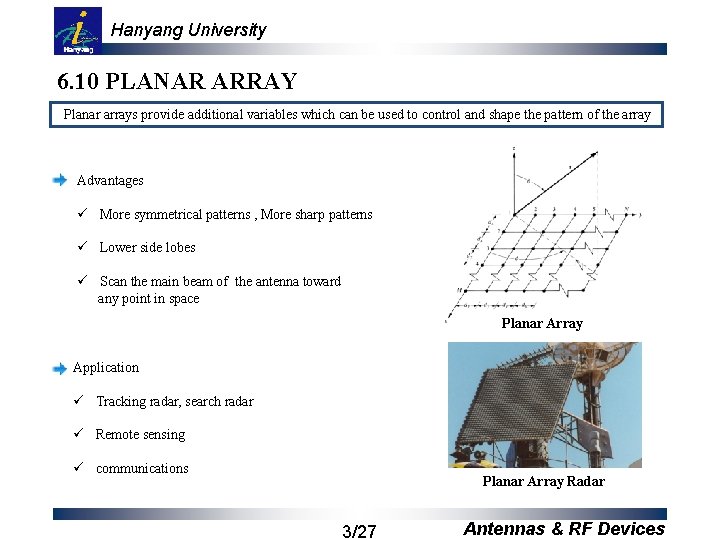
Hanyang University 6. 10 PLANAR ARRAY Planar arrays provide additional variables which can be used to control and shape the pattern of the array Advantages ü More symmetrical patterns , More sharp patterns ü Lower side lobes ü Scan the main beam of the antenna toward any point in space Planar Array Application ü Tracking radar, search radar ü Remote sensing ü communications Planar Array Radar 3/27 Antennas & RF Devices
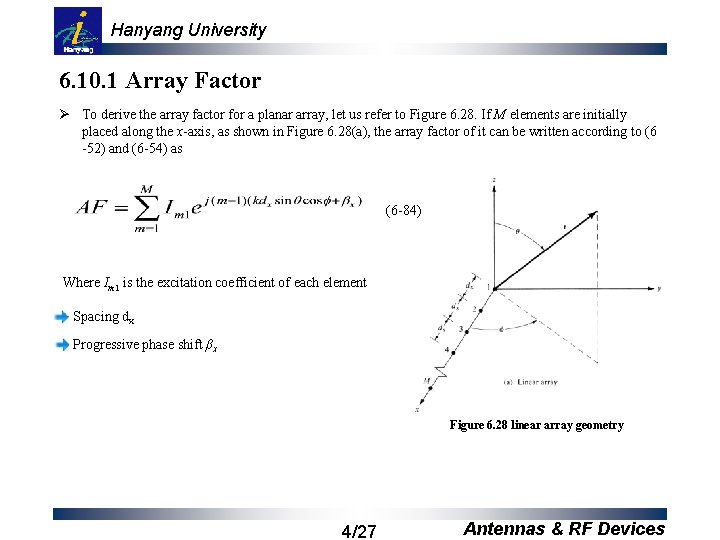
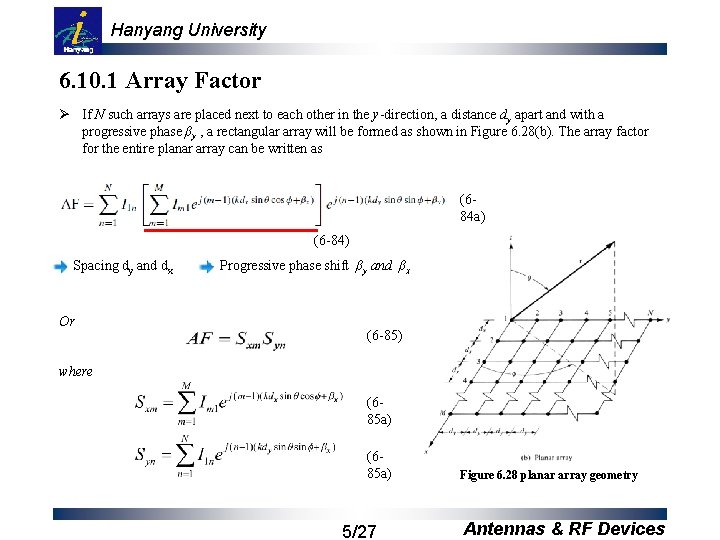
Hanyang University 6. 10. 1 Array Factor Ø To derive the array factor for a planar array, let us refer to Figure 6. 28. If M elements are initially placed along the x-axis, as shown in Figure 6. 28(a), the array factor of it can be written according to (6 -52) and (6 -54) as (6 -84) Where Im 1 is the excitation coefficient of each element Spacing dx Progressive phase shift βx Figure 6. 28 linear array geometry 4/27 Antennas & RF Devices
Hanyang University 6. 10. 1 Array Factor Ø If N such arrays are placed next to each other in the y-direction, a distance dy apart and with a progressive phase βy , a rectangular array will be formed as shown in Figure 6. 28(b). The array factor for the entire planar array can be written as (684 a) (6 -84) Spacing dy and dx Progressive phase shift βy and βx Or (6 -85) where (685 a) 5/27 Figure 6. 28 planar array geometry Antennas & RF Devices
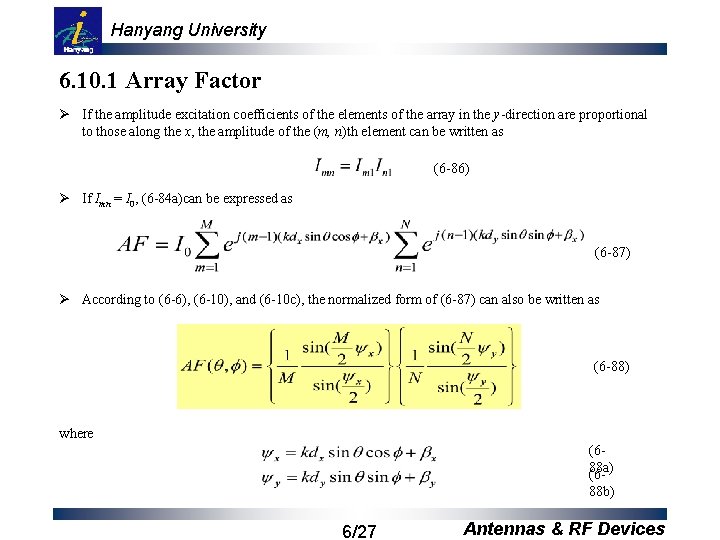
Hanyang University 6. 10. 1 Array Factor Ø If the amplitude excitation coefficients of the elements of the array in the y-direction are proportional to those along the x, the amplitude of the (m, n)th element can be written as (6 -86) Ø If Imn = I 0, (6 -84 a)can be expressed as (6 -87) Ø According to (6 -6), (6 -10), and (6 -10 c), the normalized form of (6 -87) can also be written as (6 -88) where (688 a) (688 b) 6/27 Antennas & RF Devices
Hanyang University 6. 10. 1 Array Factor Ø When the spacing between the elements is equal or greater than λ/2, multiple maxima of equal magnitude can be formed. The principle maximum is referred to as the major lobe and the remaining as the grating lobes Ø Grating lobe definition ü A lobe, other than the main lobe, produced by an array antenna when the inter element spacing is sufficiently large to permit the in-phase addition of radiated fields in more than one direction Ø To avoid grating lobes in the x-z and y-z planes, the spacing between the elements in the x- and y- directions, respectively, must be less than λ/2 7/27 Antennas & RF Devices
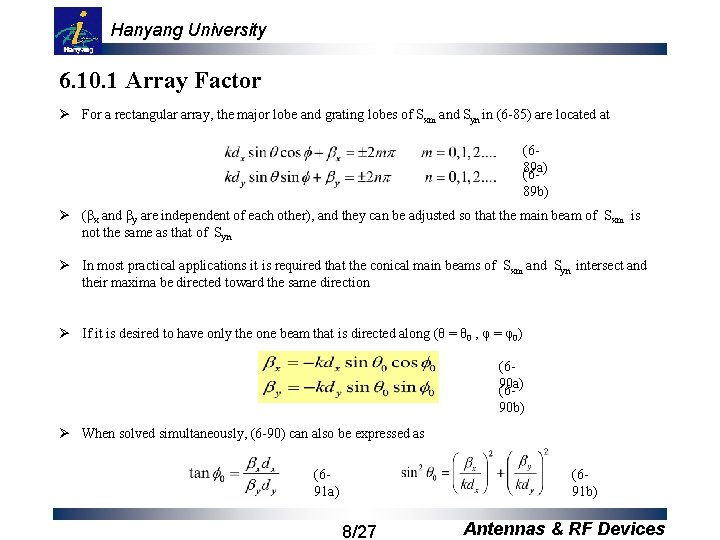
Hanyang University 6. 10. 1 Array Factor Ø For a rectangular array, the major lobe and grating lobes of Sxm and Syn in (6 -85) are located at (689 a) (689 b) Ø (βx and βy are independent of each other), and they can be adjusted so that the main beam of Sxm is not the same as that of Syn Ø In most practical applications it is required that the conical main beams of S xm and Syn intersect and their maxima be directed toward the same direction Ø If it is desired to have only the one beam that is directed along (θ = θ 0 , φ = φ0) (690 a) (690 b) Ø When solved simultaneously, (6 -90) can also be expressed as (691 a) (691 b) 8/27 Antennas & RF Devices
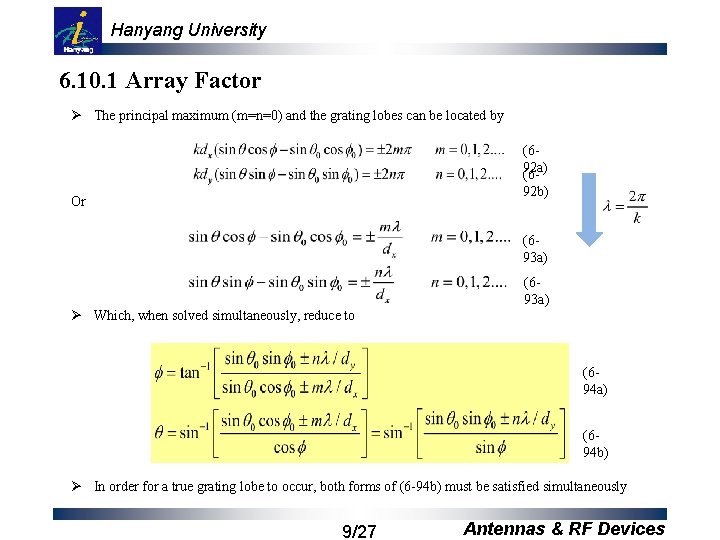
Hanyang University 6. 10. 1 Array Factor Ø The principal maximum (m=n=0) and the grating lobes can be located by (692 a) (692 b) Or (693 a) Ø Which, when solved simultaneously, reduce to (690 a) (6 - (694 a) 90 b) (694 b) Ø In order for a true grating lobe to occur, both forms of (6 -94 b) must be satisfied simultaneously 9/27 Antennas & RF Devices
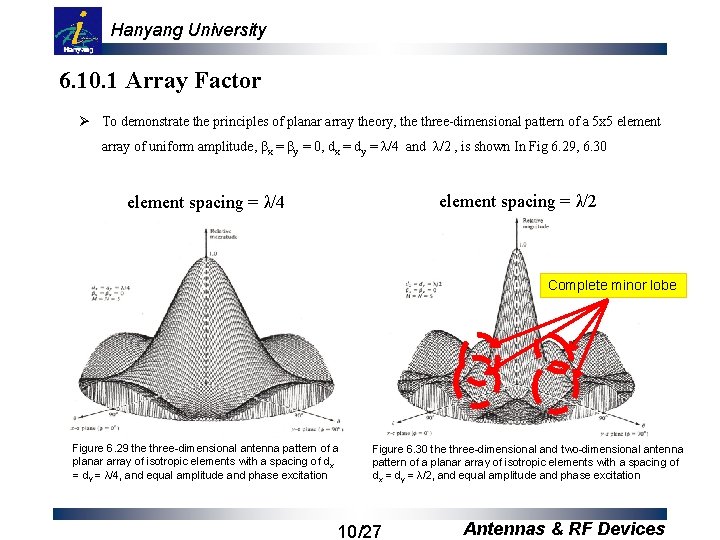
Hanyang University 6. 10. 1 Array Factor Ø To demonstrate the principles of planar array theory, the three-dimensional pattern of a 5 x 5 element array of uniform amplitude, βx = βy = 0, dx = dy = λ/4 and λ/2 , is shown In Fig 6. 29, 6. 30 element spacing = λ/2 element spacing = λ/4 Complete minor lobe Figure 6. 29 the three-dimensional antenna pattern of a planar array of isotropic elements with a spacing of dx = dy = λ/4, and equal amplitude and phase excitation Figure 6. 30 the three-dimensional and two-dimensional antenna pattern of a planar array of isotropic elements with a spacing of dx = dy = λ/2, and equal amplitude and phase excitation 10/27 Antennas & RF Devices
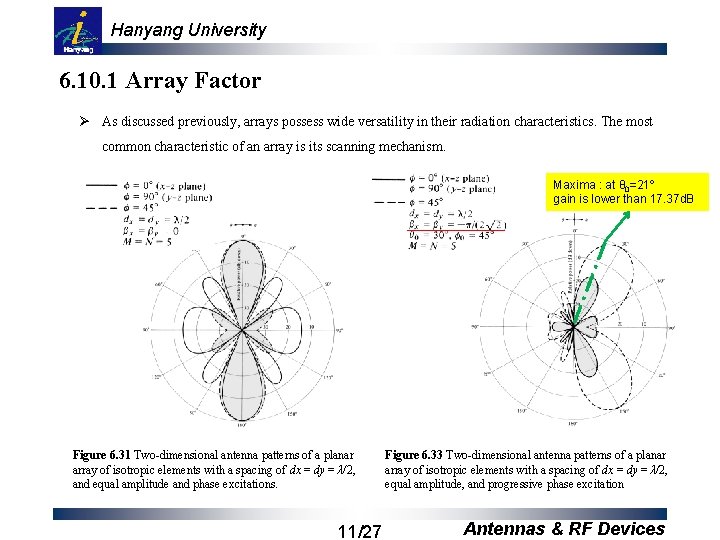
Hanyang University 6. 10. 1 Array Factor Ø As discussed previously, arrays possess wide versatility in their radiation characteristics. The most common characteristic of an array is its scanning mechanism. Maxima : at θ 0=21º gain is lower than 17. 37 d. B Figure 6. 31 Two-dimensional antenna patterns of a planar array of isotropic elements with a spacing of dx = dy = λ/2, and equal amplitude and phase excitations. 11/27 Figure 6. 33 Two-dimensional antenna patterns of a planar array of isotropic elements with a spacing of dx = dy = λ/2, equal amplitude, and progressive phase excitation Antennas & RF Devices
Hanyang University 6. 10. 1 Array Factor Ø To illustrate the formation of the grating lobes, when the spacing between the elements is large, the three-dimensional pattern of the 5 x 5 element array with βx = βy = 0, dx = dy = λ are displayed in Fig 6. 34, its corresponding two-dimensional elevation pattern are displayed Fig 6. 35 element spacing = λ Figure 6. 34 Three-dimensional antenna pattern of a planar array of isotropic elements with a spacing of dx = dy = λ, and equal amplitude and phase excitations. 12/27 Figure 6. 35 Two-dimensional antenna patterns of a planar array of isotropic elements with a spacing of dx = dy = λ, and equal amplitude and phase excitations. Antennas & RF Devices
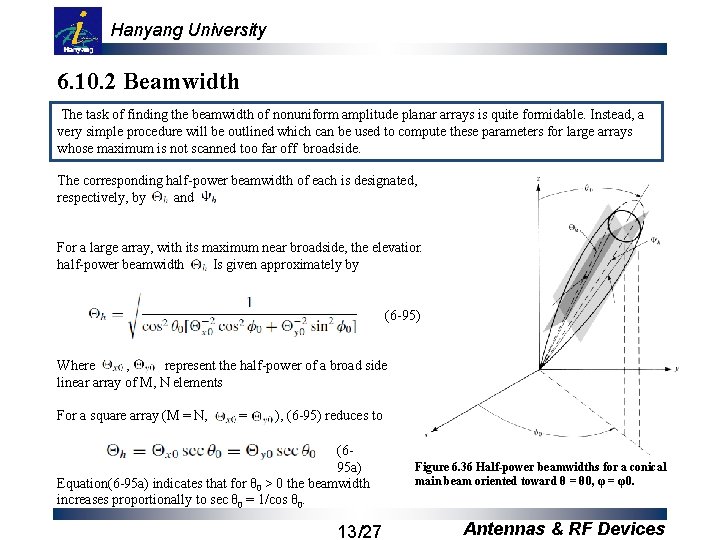
Hanyang University 6. 10. 2 Beamwidth The task of finding the beamwidth of nonuniform amplitude planar arrays is quite formidable. Instead, a very simple procedure will be outlined which can be used to compute these parameters for large arrays whose maximum is not scanned too far off broadside. The corresponding half-power beamwidth of each is designated, respectively, by and. For a large array, with its maximum near broadside, the elevation plane half-power beamwidth Is given approximately by (6 -95) Where , represent the half-power of a broad side linear array of M, N elements For a square array (M = N, = ), (6 -95) reduces to (695 a) Equation(6 -95 a) indicates that for θ 0 > 0 the beamwidth increases proportionally to sec θ 0 = 1/cos θ 0. 13/27 Figure 6. 36 Half-power beamwidths for a conical main beam oriented toward θ = θ 0, φ = φ0. Antennas & RF Devices
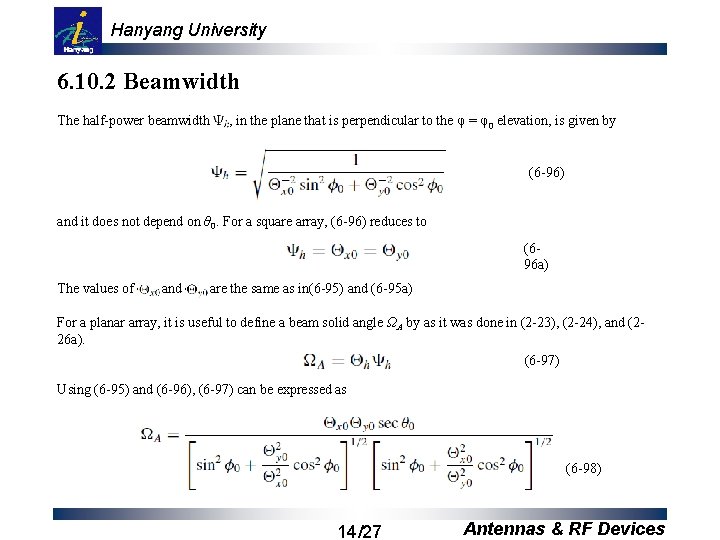
Hanyang University 6. 10. 2 Beamwidth The half-power beamwidth Zh, in the plane that is perpendicular to the φ = φ0 elevation, is given by (6 -96) and it does not depend on θ 0. For a square array, (6 -96) reduces to (696 a) The values of 4 x 0 and 4 y 0 are the same as in(6 -95) and (6 -95 a) For a planar array, it is useful to define a beam solid angle ΩA by as it was done in (2 -23), (2 -24), and (226 a). (6 -97) Using (6 -95) and (6 -96), (6 -97) can be expressed as (6 -98) 14/27 Antennas & RF Devices
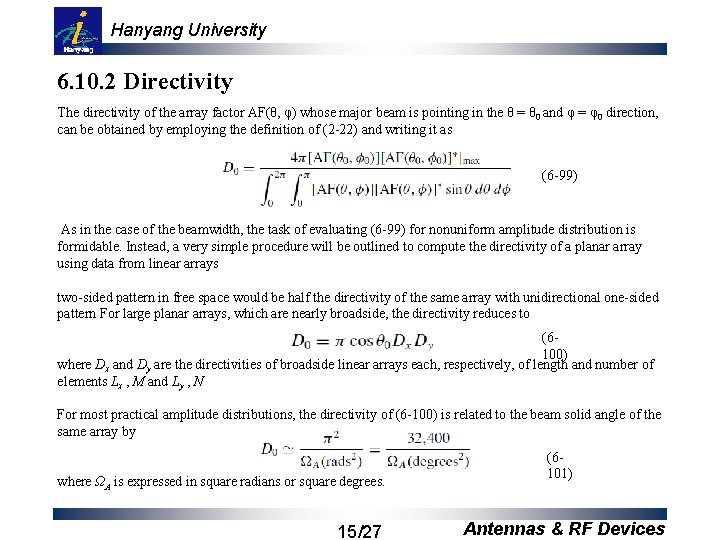
Hanyang University 6. 10. 2 Directivity The directivity of the array factor AF(θ, φ) whose major beam is pointing in the θ = θ 0 and φ = φ0 direction, can be obtained by employing the definition of (2 -22) and writing it as (6 -99) As in the case of the beamwidth, the task of evaluating (6 -99) for nonuniform amplitude distribution is formidable. Instead, a very simple procedure will be outlined to compute the directivity of a planar array using data from linear arrays two-sided pattern in free space would be half the directivity of the same array with unidirectional one-sided pattern For large planar arrays, which are nearly broadside, the directivity reduces to (6100) where Dx and Dy are the directivities of broadside linear arrays each, respectively, of length and number of elements Lx , M and Ly , N For most practical amplitude distributions, the directivity of (6 -100) is related to the beam solid angle of the same array by where ΩA is expressed in square radians or square degrees. 15/27 (6101) Antennas & RF Devices
Hanyang University 6. 11 DESIGN CONSIDERATIONS Ø Antenna arrays can be designed to control their radiation characteristics by properly selecting the phase and/or amplitude distribution between the elements Ø it has been shown that a proper amplitude excitation taper between the elements can be used to control the beamwidth and side lobe level (SLL) Ø Typically the level of the minor lobes can be controlled by tapering the distribution across the array; the smoother the taper from the center of the array toward the edges, the lower the side lobe level and the larger the half-power beamwidth, and conversely Ø Therefore, if it is desired to achieve simultaneously both a very low side lobe level, as well as a small half-power beamwidth, a compromise design has to be selected. The Dolph-Tschebyscheff design of Section 6. 8. 3 is one such distribution Ø There are other designs that can be used effectively to achieve a good compromise between side lobe level and beamwidth. Two such examples are the Taylor Line-Source (Tschebyscheff-Error) and the Taylor Line-Source (One-Parameter). These are discussed in detail in CH 7 16/27 Antennas & RF Devices
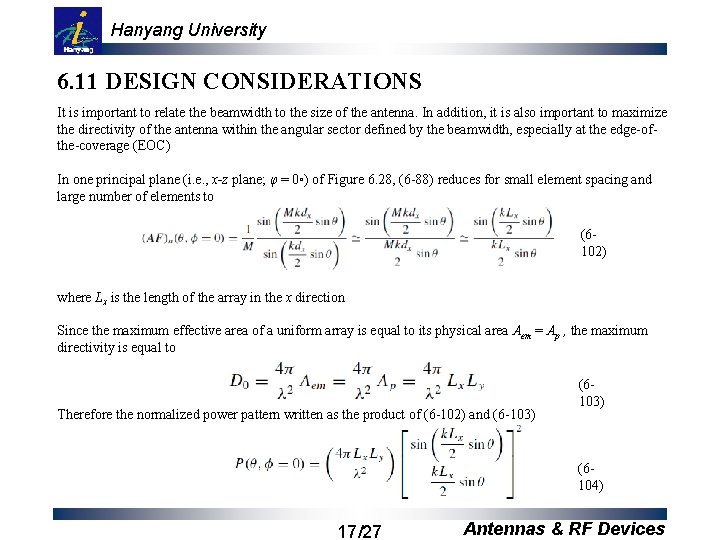
Hanyang University 6. 11 DESIGN CONSIDERATIONS It is important to relate the beamwidth to the size of the antenna. In addition, it is also important to maximize the directivity of the antenna within the angular sector defined by the beamwidth, especially at the edge-ofthe-coverage (EOC) In one principal plane (i. e. , x-z plane; φ = 0◦) of Figure 6. 28, (6 -88) reduces for small element spacing and large number of elements to (6102) where Lx is the length of the array in the x direction Since the maximum effective area of a uniform array is equal to its physical area Aem = Ap , the maximum directivity is equal to Therefore the normalized power pattern written as the product of (6 -102) and (6 -103) (6104) 17/27 Antennas & RF Devices
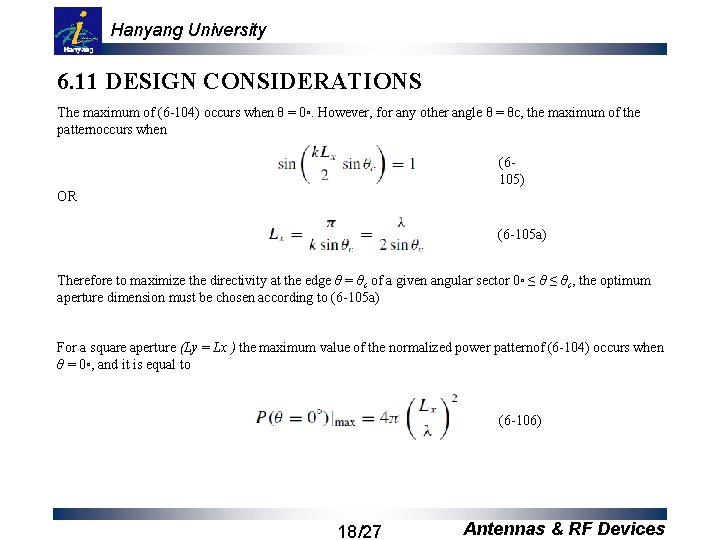
Hanyang University 6. 11 DESIGN CONSIDERATIONS The maximum of (6 -104) occurs when θ = 0◦. However, for any other angle θ = θc, the maximum of the patternoccurs when (6105) OR (6 -105 a) Therefore to maximize the directivity at the edge θ = θc of a given angular sector 0◦ ≤ θc, the optimum aperture dimension must be chosen according to (6 -105 a) For a square aperture (Ly = Lx ) the maximum value of the normalized power patternof (6 -104) occurs when θ = 0◦, and it is equal to (6 -106) 18/27 Antennas & RF Devices
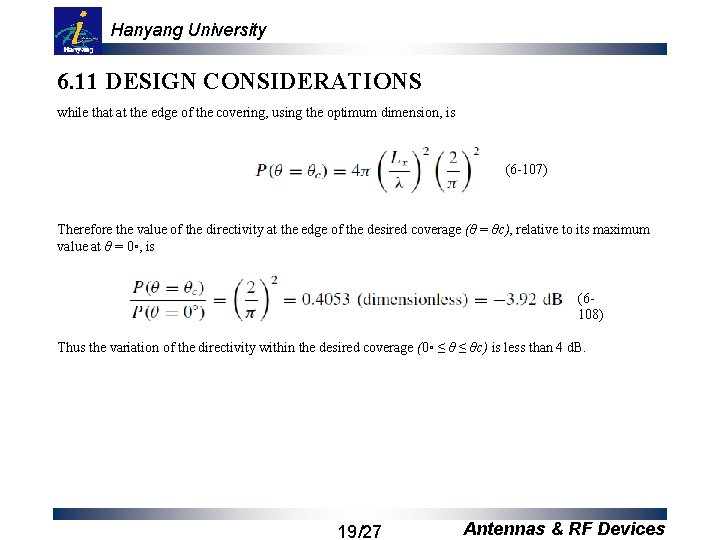
Hanyang University 6. 11 DESIGN CONSIDERATIONS while that at the edge of the covering, using the optimum dimension, is (6 -107) Therefore the value of the directivity at the edge of the desired coverage (θ = θc), relative to its maximum value at θ = 0◦, is (6108) Thus the variation of the directivity within the desired coverage (0◦ ≤ θc) is less than 4 d. B. 19/27 Antennas & RF Devices
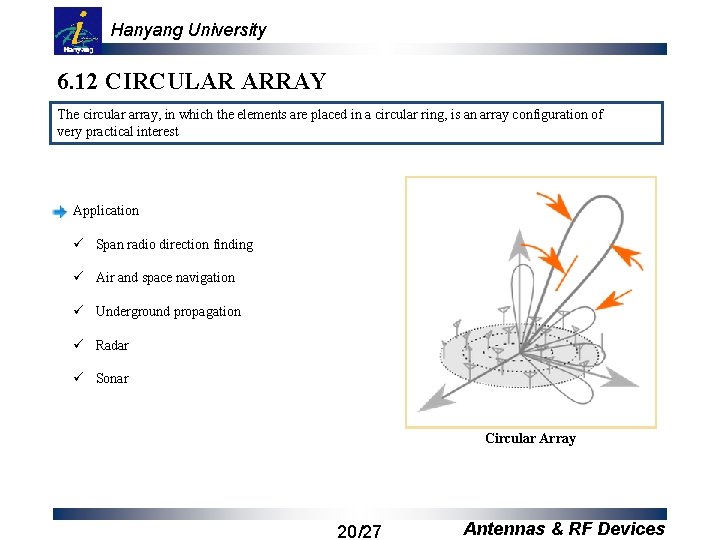
Hanyang University 6. 12 CIRCULAR ARRAY The circular array, in which the elements are placed in a circular ring, is an array configuration of very practical interest Application ü Span radio direction finding ü Air and space navigation ü Underground propagation ü Radar ü Sonar Circular Array 20/27 Antennas & RF Devices
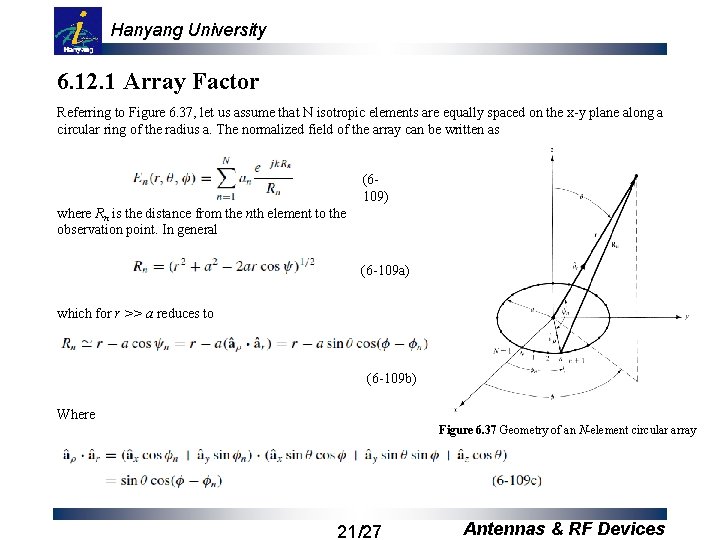
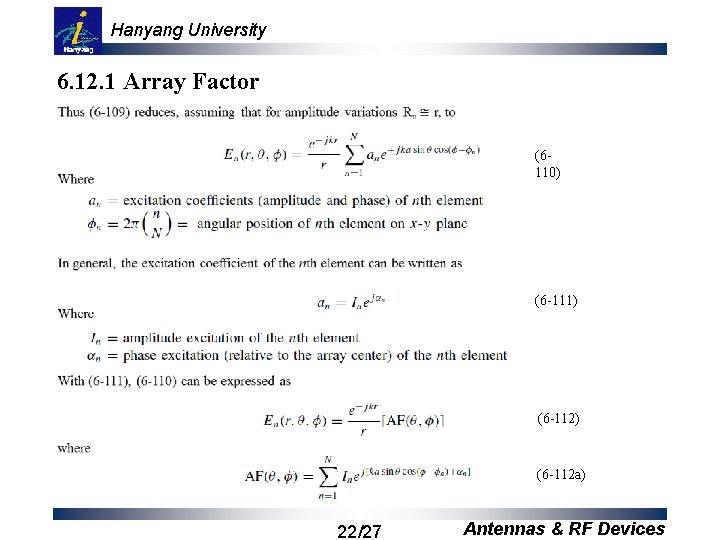
Hanyang University 6. 12. 1 Array Factor Referring to Figure 6. 37, let us assume that N isotropic elements are equally spaced on the x-y plane along a circular ring of the radius a. The normalized field of the array can be written as (6109) where Rn is the distance from the nth element to the observation point. In general (6 -109 a) which for r >> a reduces to (6 -109 b) Where Figure 6. 37 Geometry of an N-element circular array 21/27 Antennas & RF Devices
Hanyang University 6. 12. 1 Array Factor (6110) (6 -111) (6 -112 a) 22/27 Antennas & RF Devices
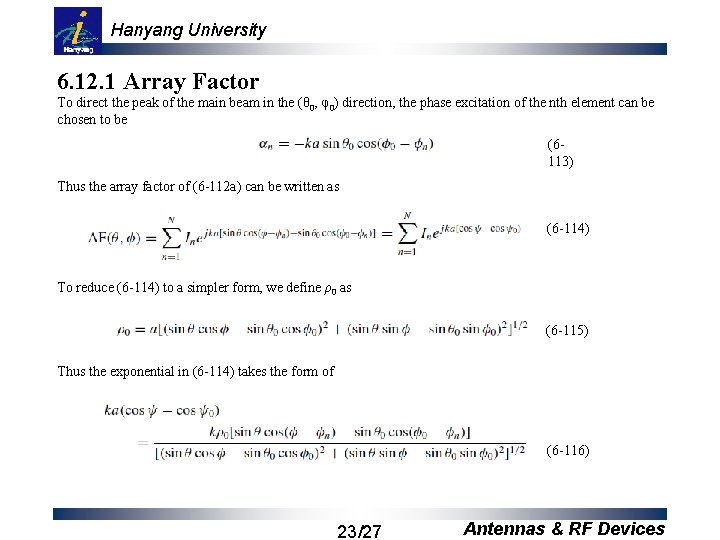
Hanyang University 6. 12. 1 Array Factor To direct the peak of the main beam in the (θ 0, φ0) direction, the phase excitation of the nth element can be chosen to be (6113) Thus the array factor of (6 -112 a) can be written as (6 -114) To reduce (6 -114) to a simpler form, we define ρ0 as (6 -115) Thus the exponential in (6 -114) takes the form of (6 -116) 23/27 Antennas & RF Devices
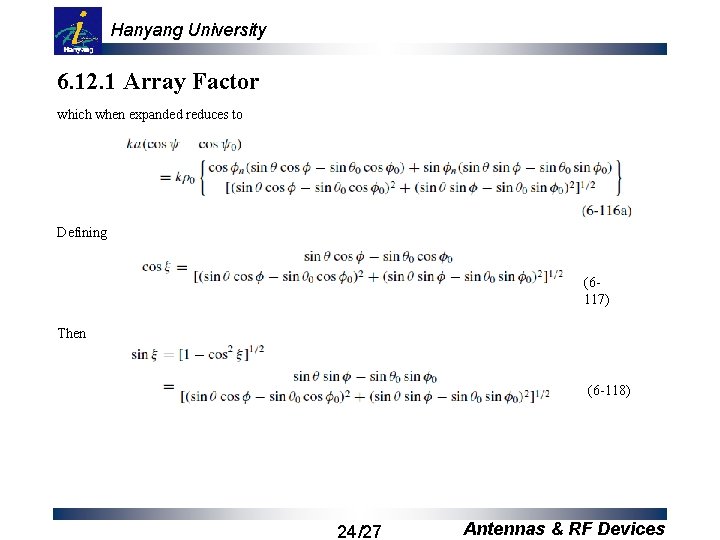
Hanyang University 6. 12. 1 Array Factor which when expanded reduces to Defining (6117) Then (6 -118) 24/27 Antennas & RF Devices
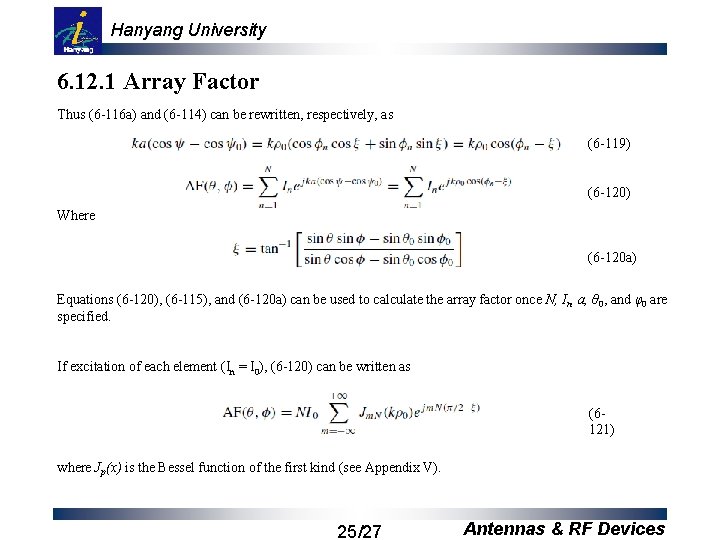
Hanyang University 6. 12. 1 Array Factor Thus (6 -116 a) and (6 -114) can be rewritten, respectively, as (6 -119) (6 -120) Where (6 -120 a) Equations (6 -120), (6 -115), and (6 -120 a) can be used to calculate the array factor once N, In, a, θ 0, and φ0 are specified. If excitation of each element (In = I 0), (6 -120) can be written as (6121) where Jp(x) is the Bessel function of the first kind (see Appendix V). 25/27 Antennas & RF Devices
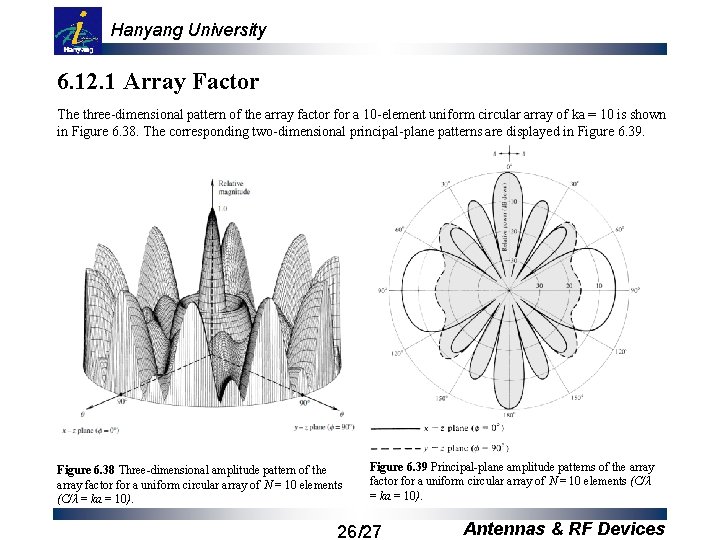
Hanyang University 6. 12. 1 Array Factor The three-dimensional pattern of the array factor for a 10 -element uniform circular array of ka = 10 is shown in Figure 6. 38. The corresponding two-dimensional principal-plane patterns are displayed in Figure 6. 39. Figure 6. 38 Three-dimensional amplitude pattern of the array factor for a uniform circular array of N = 10 elements (C/λ = ka = 10). Figure 6. 39 Principal-plane amplitude patterns of the array factor for a uniform circular array of N = 10 elements (C/λ = ka = 10). 26/27 Antennas & RF Devices
Hanyang University Thank you for your attention 27/27 Antennas & RF Devices Lab.