
Hanyang University ANTENNA THEORY ANALYSIS AND DESIGN Chapter
- Slides: 24
Hanyang University ANTENNA THEORY ANALYSIS AND DESIGN Chapter. 2 Sungjoon YOON 2015. 07. 09 1/24
Hanyang University Contents 2. Fundamental Parameters Of Antennas 2. 13 Input Impedance 2. 14 Antenna Radiation Efficiency 2. 15 Antenna Vector Effective Length And Equivalent Areas 2. 16 Maximum Directivity And Maximum Effective Area 2. 17 Friss Transmission Equation And Radar Range Equation 2. 18 Antenna Temperature 2/24 Antennas & RF Devices Lab.
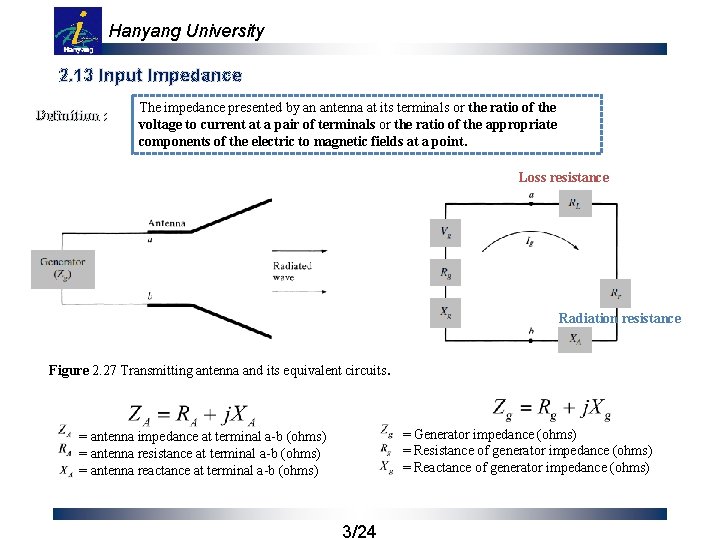
Hanyang University 2. 13 Input Impedance Definition : The impedance presented by an antenna at its terminals or the ratio of the voltage to current at a pair of terminals or the ratio of the appropriate components of the electric to magnetic fields at a point. Loss resistance Radiation resistance Figure 2. 27 Transmitting antenna and its equivalent circuits. = Generator impedance (ohms) = Resistance of generator impedance (ohms) = Reactance of generator impedance (ohms) = antenna impedance at terminal a-b (ohms) = antenna resistance at terminal a-b (ohms) = antenna reactance at terminal a-b (ohms) 3/24
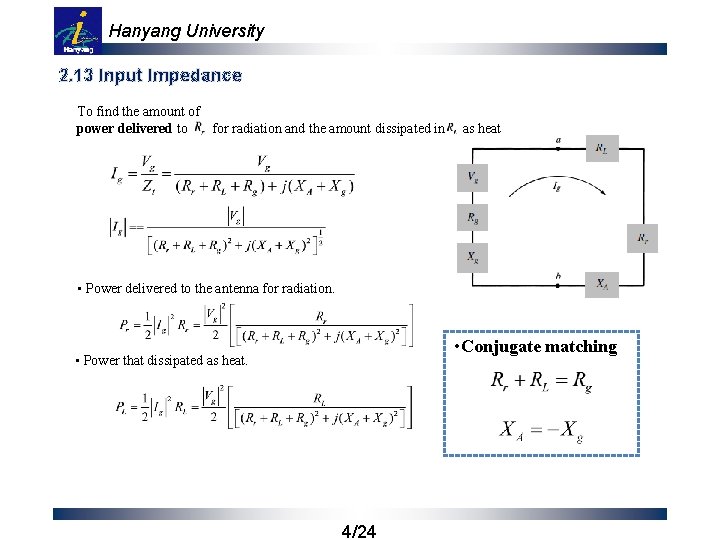
Hanyang University 2. 13 Input Impedance To find the amount of power delivered to for radiation and the amount dissipated in as heat • Power delivered to the antenna for radiation. • Conjugate matching • Power that dissipated as heat. 4/24
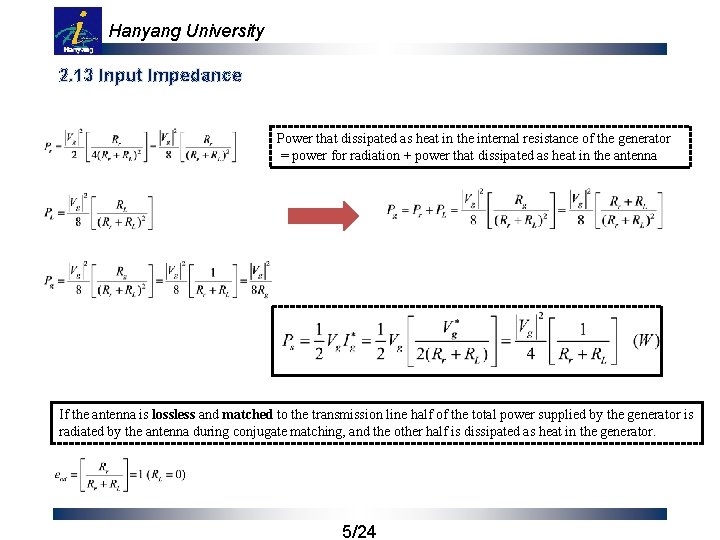
Hanyang University 2. 13 Input Impedance Power that dissipated as heat in the internal resistance of the generator = power for radiation + power that dissipated as heat in the antenna If the antenna is lossless and matched to the transmission line half of the total power supplied by the generator is radiated by the antenna during conjugate matching, and the other half is dissipated as heat in the generator. 5/24
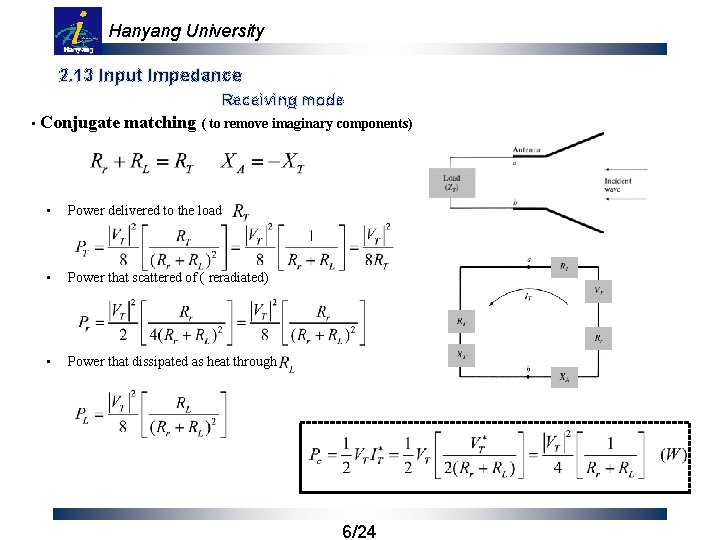
Hanyang University 2. 13 Input Impedance Receiving mode • Conjugate matching ( to remove imaginary components) • Power delivered to the load • Power that scattered of ( reradiated) • Power that dissipated as heat through 6/24
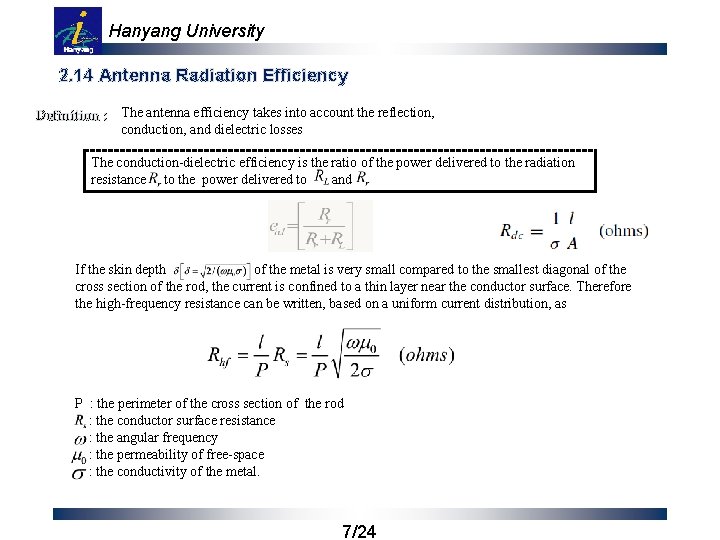
Hanyang University 2. 14 Antenna Radiation Efficiency Definition : The antenna efficiency takes into account the reflection, conduction, and dielectric losses The conduction-dielectric efficiency is the ratio of the power delivered to the radiation resistance to the power delivered to and If the skin depth of the metal is very small compared to the smallest diagonal of the cross section of the rod, the current is confined to a thin layer near the conductor surface. Therefore the high-frequency resistance can be written, based on a uniform current distribution, as P : the perimeter of the cross section of the rod : the conductor surface resistance : the angular frequency : the permeability of free-space : the conductivity of the metal. 7/24
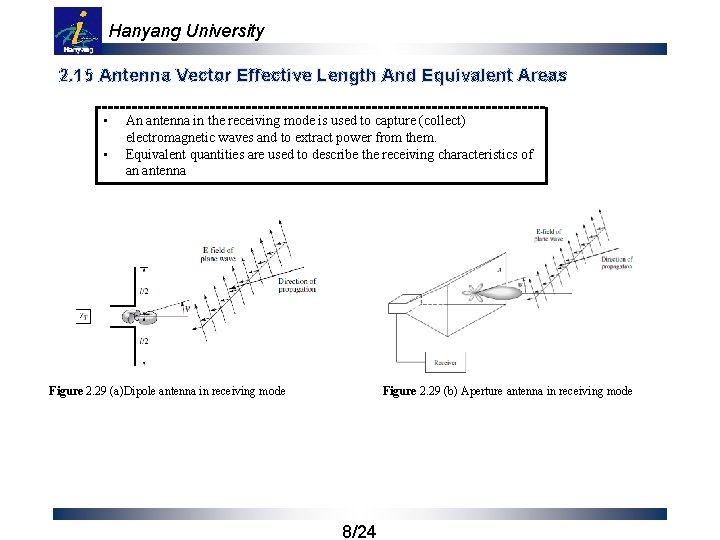
Hanyang University 2. 15 Antenna Vector Effective Length And Equivalent Areas • • An antenna in the receiving mode is used to capture (collect) electromagnetic waves and to extract power from them. Equivalent quantities are used to describe the receiving characteristics of an antenna Figure 2. 29 (a)Dipole antenna in receiving mode Figure 2. 29 (b) Aperture antenna in receiving mode 8/24
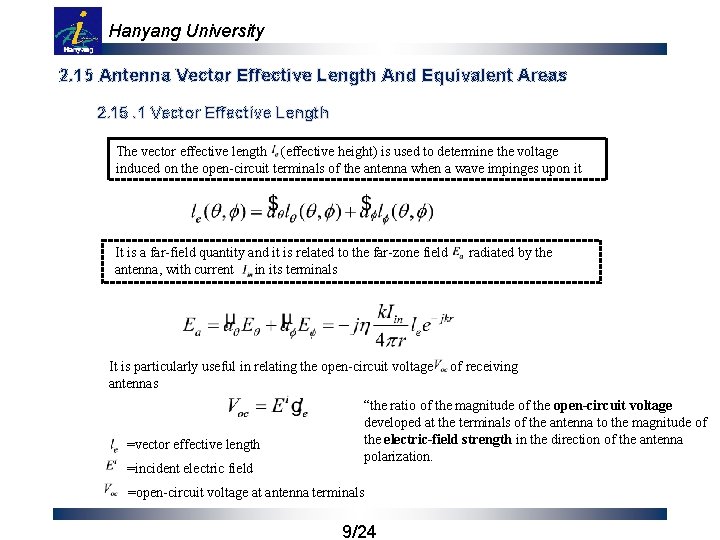
Hanyang University 2. 15 Antenna Vector Effective Length And Equivalent Areas 2. 15. 1 Vector Effective Length The vector effective length (effective height) is used to determine the voltage induced on the open-circuit terminals of the antenna when a wave impinges upon it It is a far-field quantity and it is related to the far-zone field antenna, with current in its terminals It is particularly useful in relating the open-circuit voltage antennas =vector effective length =incident electric field radiated by the of receiving “the ratio of the magnitude of the open-circuit voltage developed at the terminals of the antenna to the magnitude of the electric-field strength in the direction of the antenna polarization. =open-circuit voltage at antenna terminals 9/24
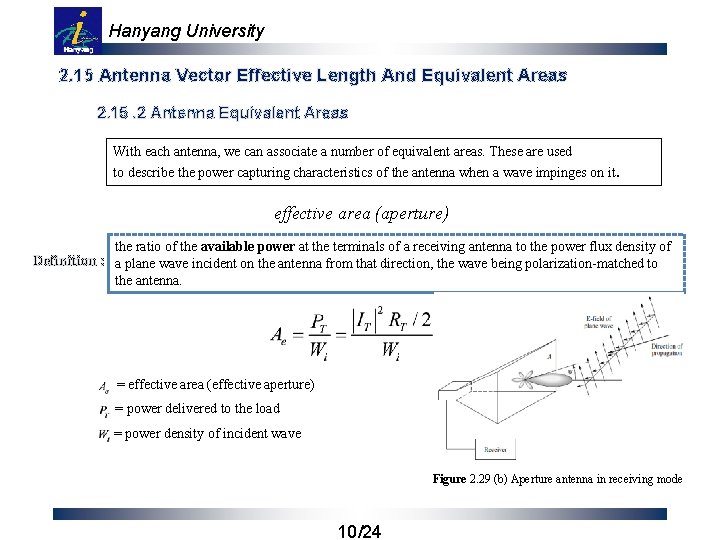
Hanyang University 2. 15 Antenna Vector Effective Length And Equivalent Areas 2. 15. 2 Antenna Equivalent Areas With each antenna, we can associate a number of equivalent areas. These are used to describe the power capturing characteristics of the antenna when a wave impinges on it. effective area (aperture) the ratio of the available power at the terminals of a receiving antenna to the power flux density of Definition : a plane wave incident on the antenna from that direction, the wave being polarization-matched to the antenna. = effective area (effective aperture) = power delivered to the load = power density of incident wave Figure 2. 29 (b) Aperture antenna in receiving mode 10/24
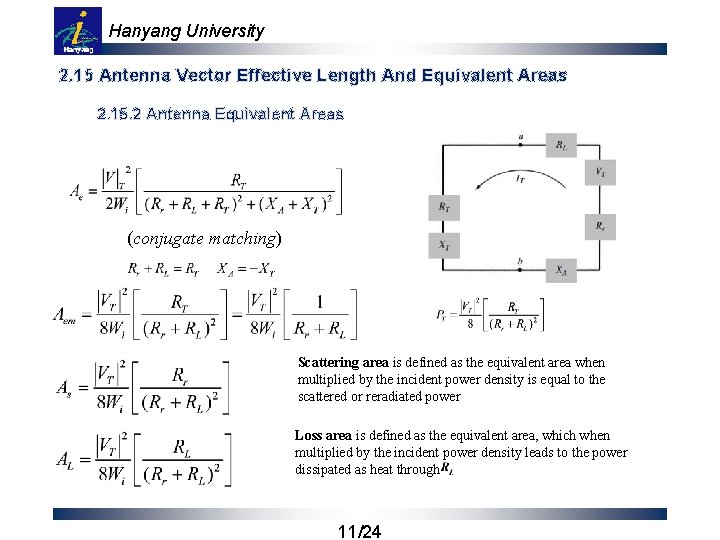
Hanyang University 2. 15 Antenna Vector Effective Length And Equivalent Areas 2. 15. 2 Antenna Equivalent Areas (conjugate matching) Scattering area is defined as the equivalent area when multiplied by the incident power density is equal to the scattered or reradiated power Loss area is defined as the equivalent area, which when multiplied by the incident power density leads to the power dissipated as heat through 11/24
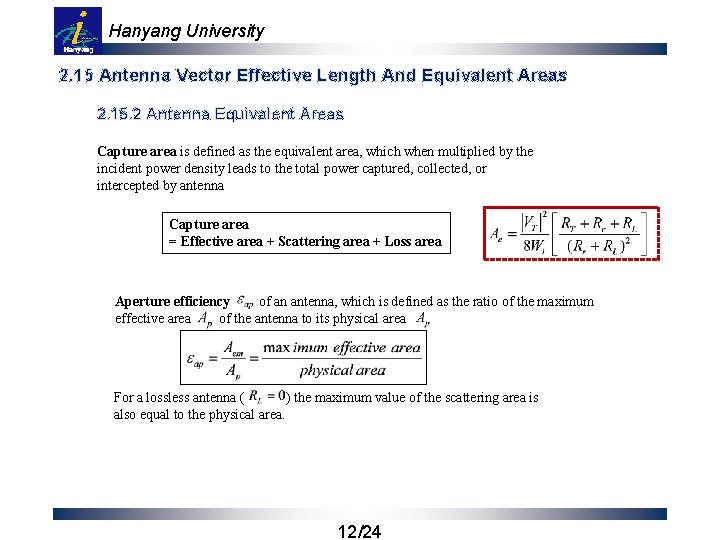
Hanyang University 2. 15 Antenna Vector Effective Length And Equivalent Areas 2. 15. 2 Antenna Equivalent Areas Capture area is defined as the equivalent area, which when multiplied by the incident power density leads to the total power captured, collected, or intercepted by antenna Capture area = Effective area + Scattering area + Loss area Aperture efficiency of an antenna, which is defined as the ratio of the maximum effective area of the antenna to its physical area For a lossless antenna ( ) the maximum value of the scattering area is also equal to the physical area. 12/24
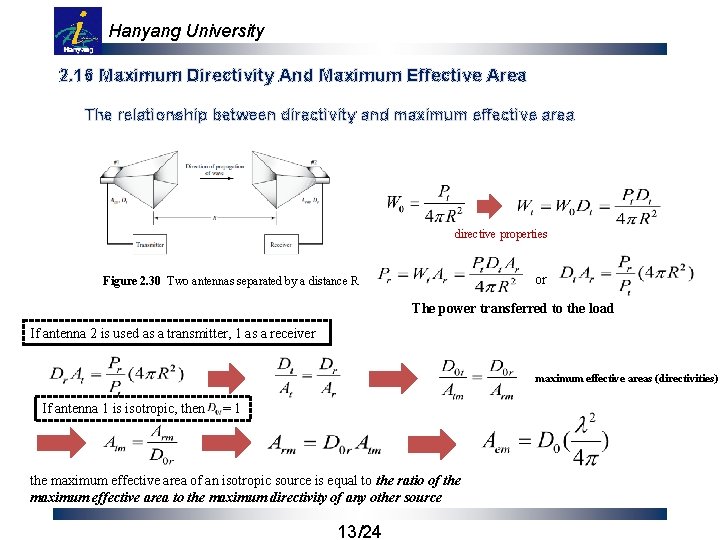
Hanyang University 2. 16 Maximum Directivity And Maximum Effective Area The relationship between directivity and maximum effective area directive properties or Figure 2. 30 Two antennas separated by a distance R The power transferred to the load If antenna 2 is used as a transmitter, 1 as a receiver maximum effective areas (directivities) If antenna 1 is isotropic, then =1 the maximum effective area of an isotropic source is equal to the ratio of the maximum effective area to the maximum directivity of any other source 13/24
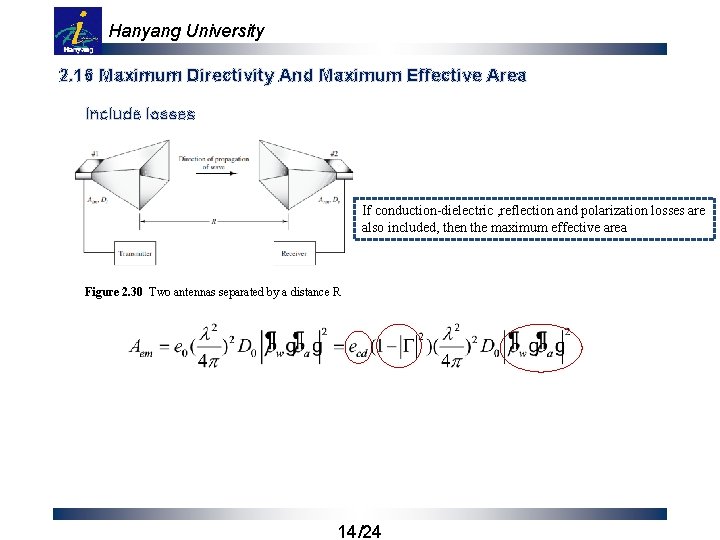
Hanyang University 2. 16 Maximum Directivity And Maximum Effective Area Include losses If conduction-dielectric , reflection and polarization losses are also included, then the maximum effective area Figure 2. 30 Two antennas separated by a distance R 14/24
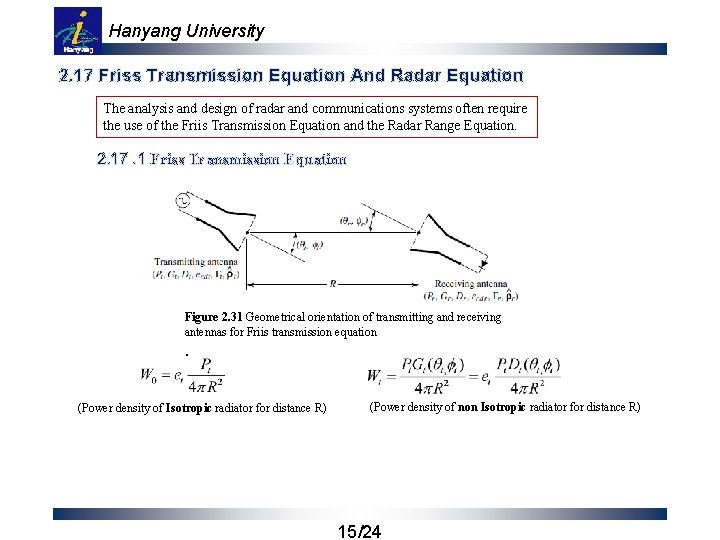
Hanyang University 2. 17 Friss Transmission Equation And Radar Equation The analysis and design of radar and communications systems often require the use of the Friis Transmission Equation and the Radar Range Equation. 2. 17. 1 Friss Transmission Equation Figure 2. 31 Geometrical orientation of transmitting and receiving antennas for Friis transmission equation . (Power density of Isotropic radiator for distance R) (Power density of non Isotropic radiator for distance R) 15/24
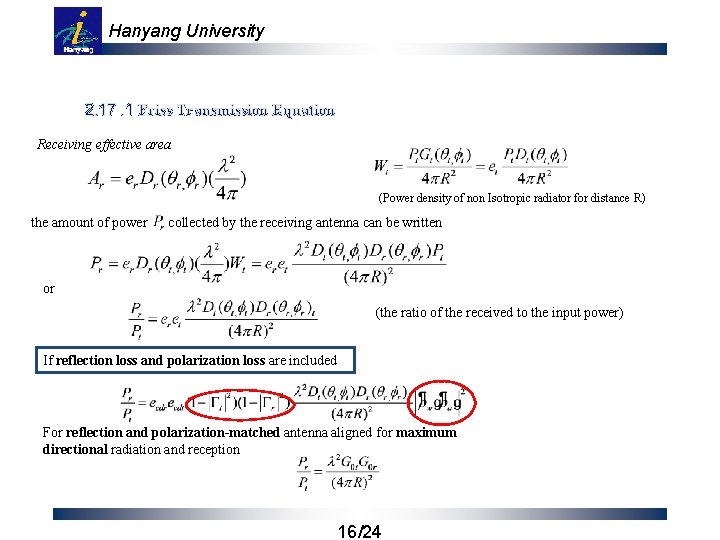
Hanyang University 2. 17. 1 Friss Transmission Equation Receiving effective area (Power density of non Isotropic radiator for distance R) the amount of power collected by the receiving antenna can be written or (the ratio of the received to the input power) If reflection loss and polarization loss are included For reflection and polarization-matched antenna aligned for maximum directional radiation and reception 16/24
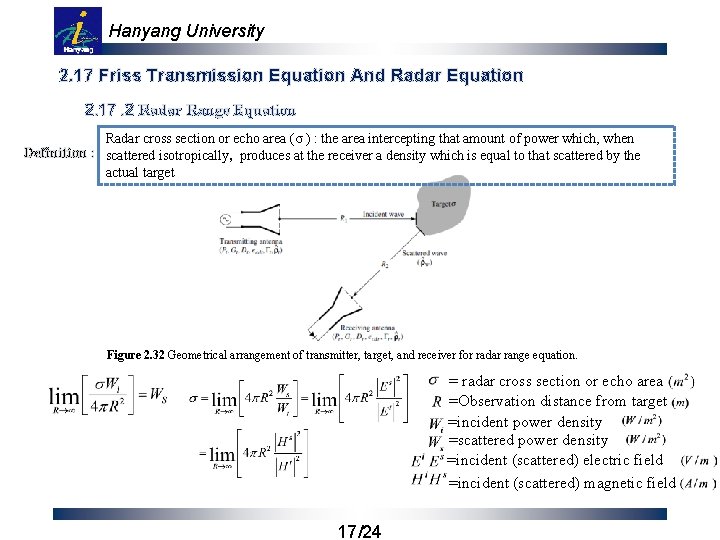
Hanyang University 2. 17 Friss Transmission Equation And Radar Equation 2. 17. 2 Radar Range Equation Radar cross section or echo area (σ ) : the area intercepting that amount of power which, when Definition : scattered isotropically, produces at the receiver a density which is equal to that scattered by the actual target Figure 2. 32 Geometrical arrangement of transmitter, target, and receiver for radar range equation. = radar cross section or echo area =Observation distance from target =incident power density =scattered power density =incident (scattered) electric field =incident (scattered) magnetic field 17/24
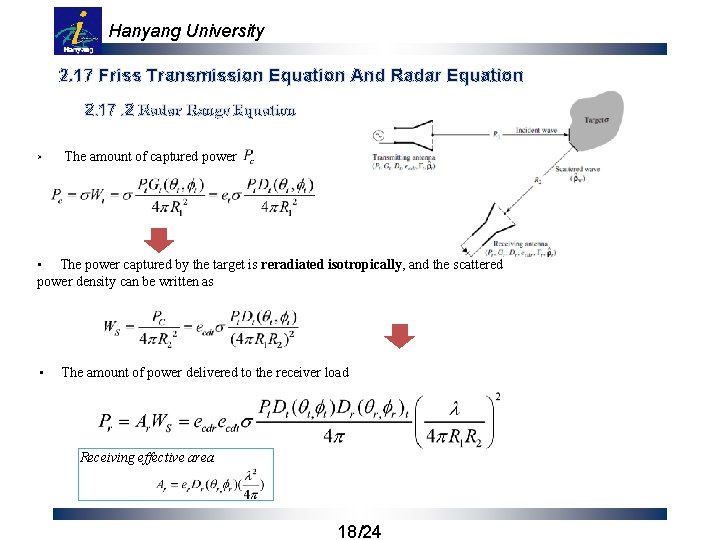
Hanyang University 2. 17 Friss Transmission Equation And Radar Equation 2. 17. 2 Radar Range Equation • The amount of captured power • The power captured by the target is reradiated isotropically, and the scattered power density can be written as • The amount of power delivered to the receiver load Receiving effective area 18/24
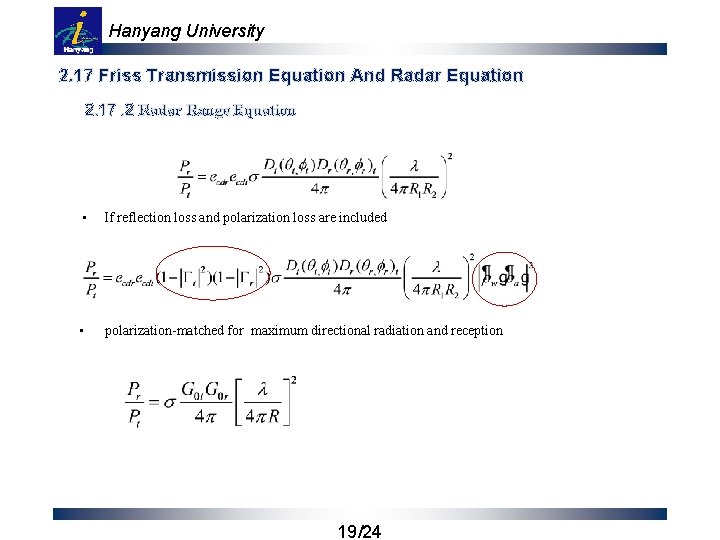
Hanyang University 2. 17 Friss Transmission Equation And Radar Equation 2. 17. 2 Radar Range Equation • If reflection loss and polarization loss are included • polarization-matched for maximum directional radiation and reception 19/24
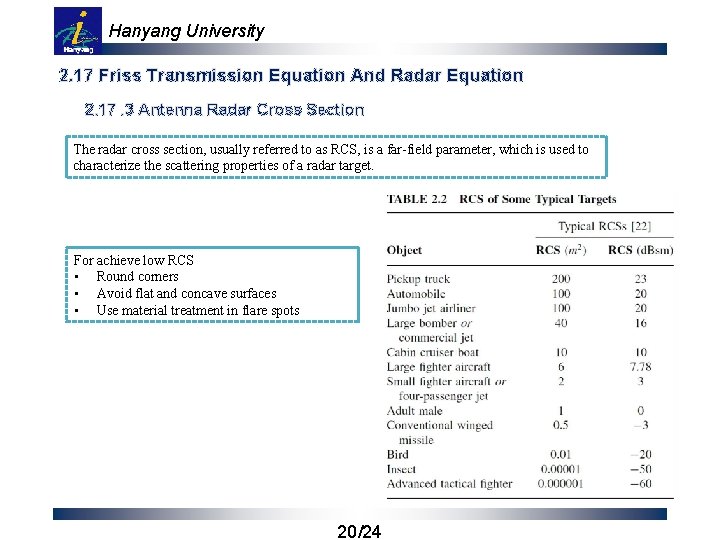
Hanyang University 2. 17 Friss Transmission Equation And Radar Equation 2. 17. 3 Antenna Radar Cross Section The radar cross section, usually referred to as RCS, is a far-field parameter, which is used to characterize the scattering properties of a radar target. For achieve low RCS • Round corners • Avoid flat and concave surfaces • Use material treatment in flare spots 20/24
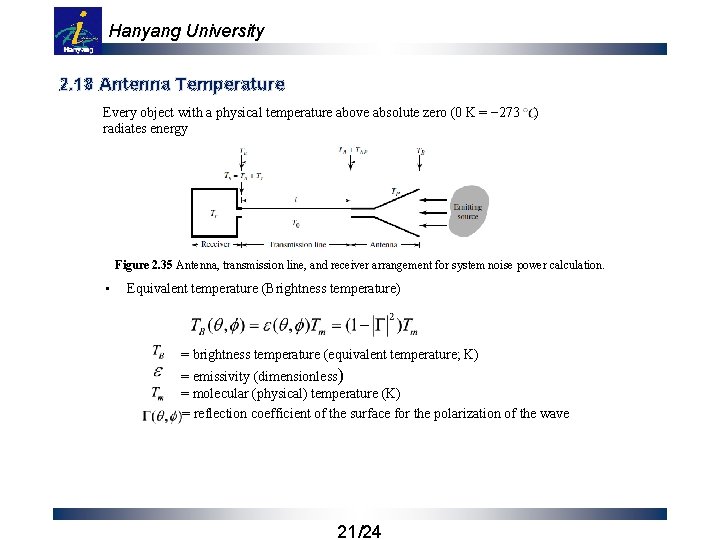
Hanyang University 2. 18 Antenna Temperature Every object with a physical temperature above absolute zero (0 K = − 273 radiates energy ) Figure 2. 35 Antenna, transmission line, and receiver arrangement for system noise power calculation. • Equivalent temperature (Brightness temperature) = brightness temperature (equivalent temperature; K) = emissivity (dimensionless) = molecular (physical) temperature (K) = reflection coefficient of the surface for the polarization of the wave 21/24
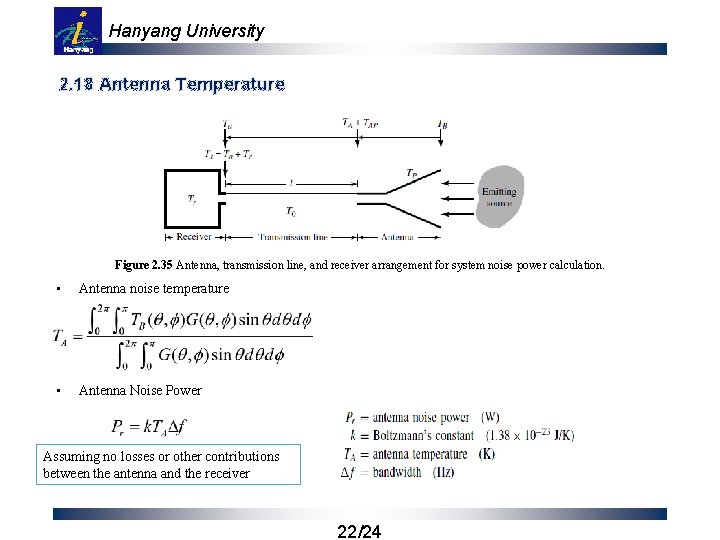
Hanyang University 2. 18 Antenna Temperature Figure 2. 35 Antenna, transmission line, and receiver arrangement for system noise power calculation. • Antenna noise temperature • Antenna Noise Power Assuming no losses or other contributions between the antenna and the receiver 22/24
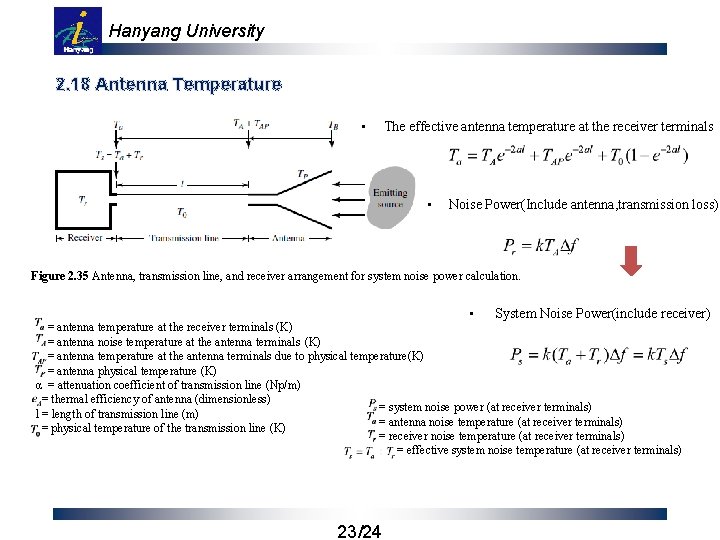
Hanyang University 2. 18 Antenna Temperature • The effective antenna temperature at the receiver terminals • Noise Power(Include antenna, transmission loss) Figure 2. 35 Antenna, transmission line, and receiver arrangement for system noise power calculation. • System Noise Power(include receiver) = antenna temperature at the receiver terminals (K) = antenna noise temperature at the antenna terminals (K) = antenna temperature at the antenna terminals due to physical temperature(K) = antenna physical temperature (K) α = attenuation coefficient of transmission line (Np/m) = thermal efficiency of antenna (dimensionless) = system noise power (at receiver terminals) l = length of transmission line (m) = antenna noise temperature (at receiver terminals) = physical temperature of the transmission line (K) = receiver noise temperature (at receiver terminals) = effective system noise temperature (at receiver terminals) 23/24
Hanyang University Thank you for your attention 24/24 Antennas & RF Devices Lab.