
Handson Workshop Efficiency and Power Loss PRESENTED BY

Hands-on Workshop: Efficiency and Power Loss PRESENTED BY: <<PRESENTER’S NAME>> <<PRESENTER’S TITLE>> © 2018 Analog Devices, Inc. All rights reserved. 1
Outline ► Efficiency and Power Loss Lab Exercise § Efficiency concepts – Linear Regulator vs. Switching Regulator § Construction Methods 2 © 2018 Analog Devices, Inc. All rights reserved.
Hands-On Session: Efficiency and Power Loss ► Lab URL: https: //wiki. analog. com/university/courses/electronics/efficiency_power_loss ► Materials Required: § ADALP 2000 Parts Kit § TO-220 Heat Sink, Aavid 7021 or other heat sink with thermal performance listed in datasheet, or 50 x 50 mm section of copper-clad board. § Mounting hardware for above. § Rubber bands OR cyanoacrylate adhesive (to attach temperature sensor to regulator) § 0 -24 V, 1 A power supply with current and voltage meters ► Software Required: § LTspice ► Recommend ► Print working in groups of 3 Out (slides with “Print Me” at the top): § Pictorial and schematic, double-sided § Data worksheets ► See Speaker Notes for preparation hints 3 © 2018 Analog Devices, Inc. All rights reserved.
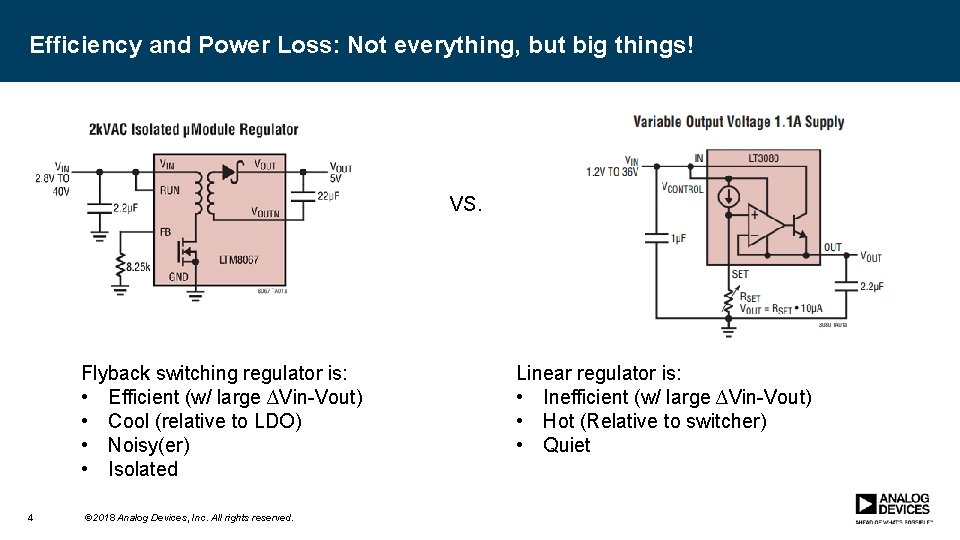
Efficiency and Power Loss: Not everything, but big things! VS. Flyback switching regulator is: • Efficient (w/ large ∆Vin-Vout) • Cool (relative to LDO) • Noisy(er) • Isolated 4 © 2018 Analog Devices, Inc. All rights reserved. Linear regulator is: • Inefficient (w/ large ∆Vin-Vout) • Hot (Relative to switcher) • Quiet
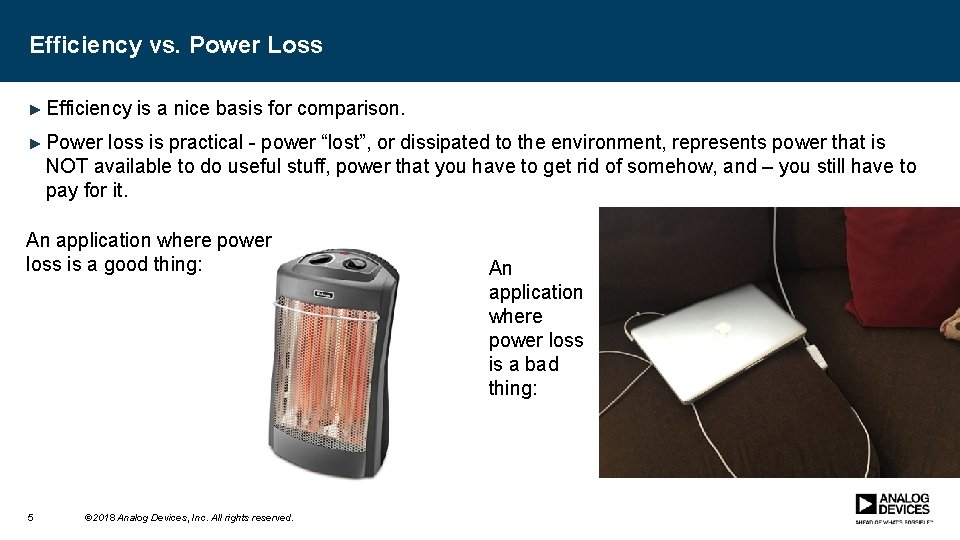
Efficiency vs. Power Loss ► Efficiency is a nice basis for comparison. ► Power loss is practical - power “lost”, or dissipated to the environment, represents power that is NOT available to do useful stuff, power that you have to get rid of somehow, and – you still have to pay for it. An application where power loss is a good thing: 5 © 2018 Analog Devices, Inc. All rights reserved. An application where power loss is a bad thing:
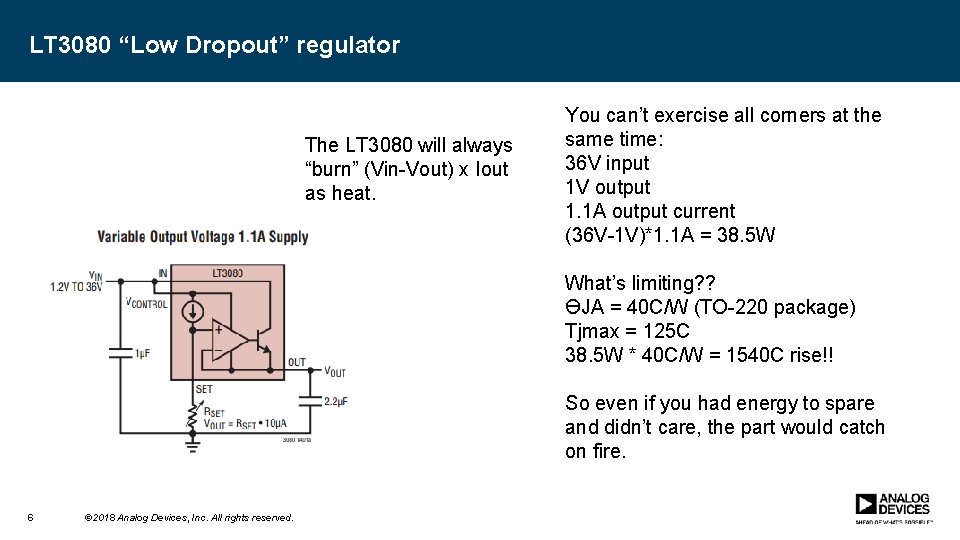
LT 3080 “Low Dropout” regulator The LT 3080 will always “burn” (Vin-Vout) x Iout as heat. You can’t exercise all corners at the same time: 36 V input 1 V output 1. 1 A output current (36 V-1 V)*1. 1 A = 38. 5 W What’s limiting? ? ϴJA = 40 C/W (TO-220 package) Tjmax = 125 C 38. 5 W * 40 C/W = 1540 C rise!! So even if you had energy to spare and didn’t care, the part would catch on fire. 6 © 2018 Analog Devices, Inc. All rights reserved.

LTspice Interlude… ► LT 3080 simulations with various input voltages, output currents ► LTM 8067 efficiency Grab files here and run in LTspice: https: //minhaskamal. github. io/Down. Git/#/home? url=https: //github. com/analogdevicesinc/education_to ols/tree/master/m 2 k/ltspice/efficency_power_loss_ltspice 7 © 2018 Analog Devices, Inc. All rights reserved.
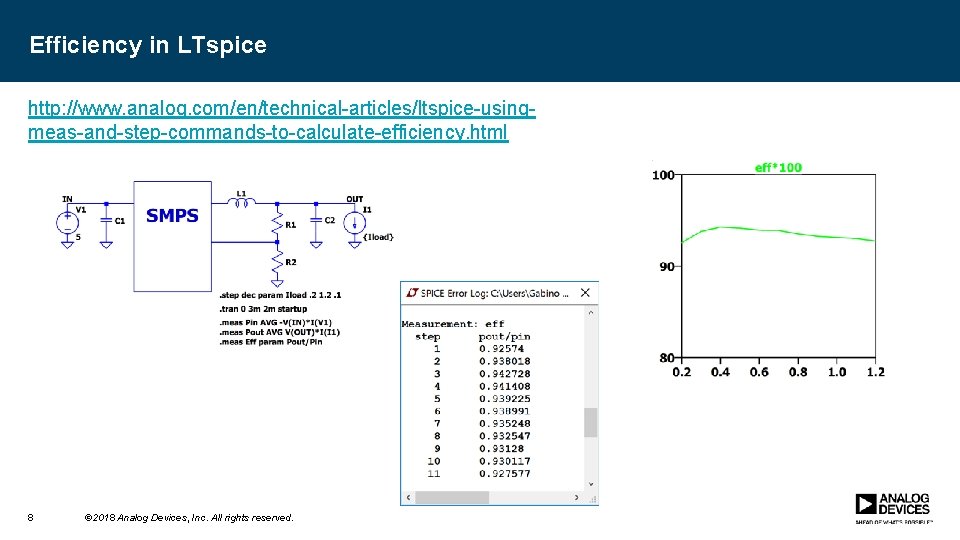
Efficiency in LTspice http: //www. analog. com/en/technical-articles/ltspice-usingmeas-and-step-commands-to-calculate-efficiency. html 8 © 2018 Analog Devices, Inc. All rights reserved.
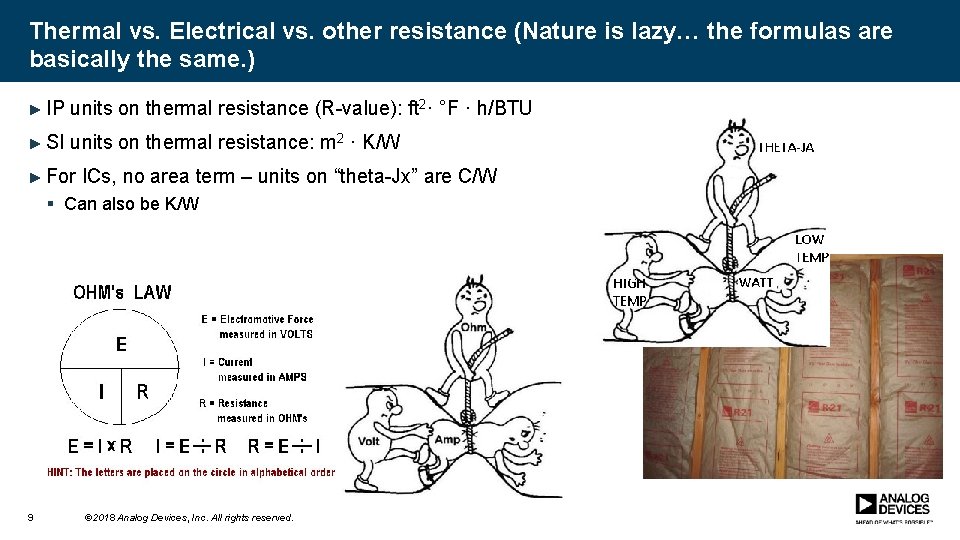
Thermal vs. Electrical vs. other resistance (Nature is lazy… the formulas are basically the same. ) ► IP units on thermal resistance (R-value): ft 2· °F · h/BTU ► SI units on thermal resistance: m 2 · K/W ► For ICs, no area term – units on “theta-Jx” are C/W § Can also be K/W 9 © 2018 Analog Devices, Inc. All rights reserved.
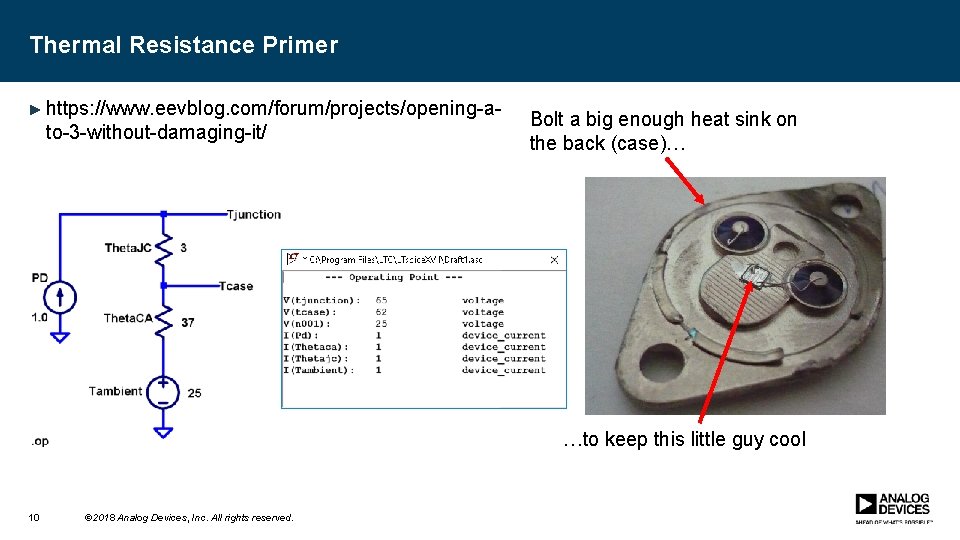
Thermal Resistance Primer ► https: //www. eevblog. com/forum/projects/opening-a- to-3 -without-damaging-it/ Bolt a big enough heat sink on the back (case)… …to keep this little guy cool 10 © 2018 Analog Devices, Inc. All rights reserved.
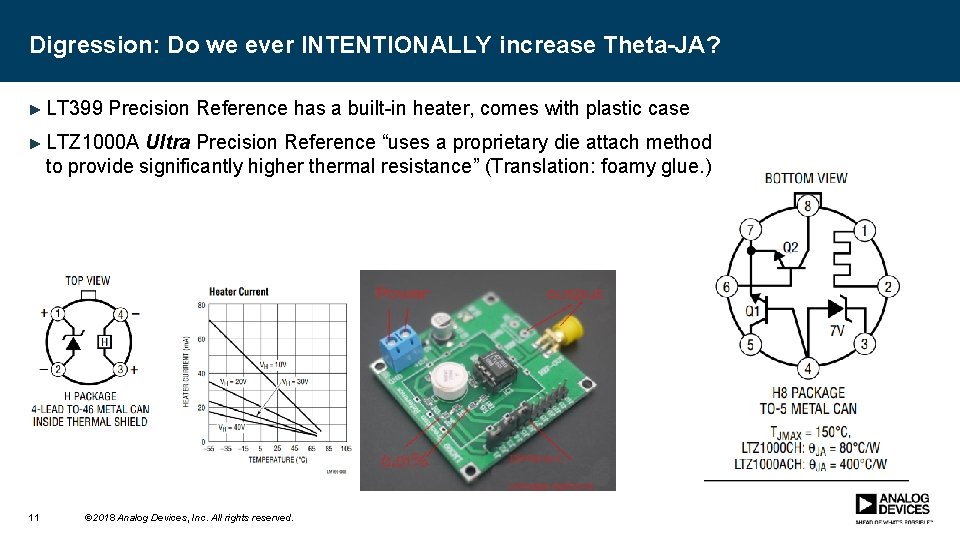
Digression: Do we ever INTENTIONALLY increase Theta-JA? ► LT 399 Precision Reference has a built-in heater, comes with plastic case ► LTZ 1000 A Ultra Precision Reference “uses a proprietary die attach method to provide significantly higher thermal resistance” (Translation: foamy glue. ) 11 © 2018 Analog Devices, Inc. All rights reserved.
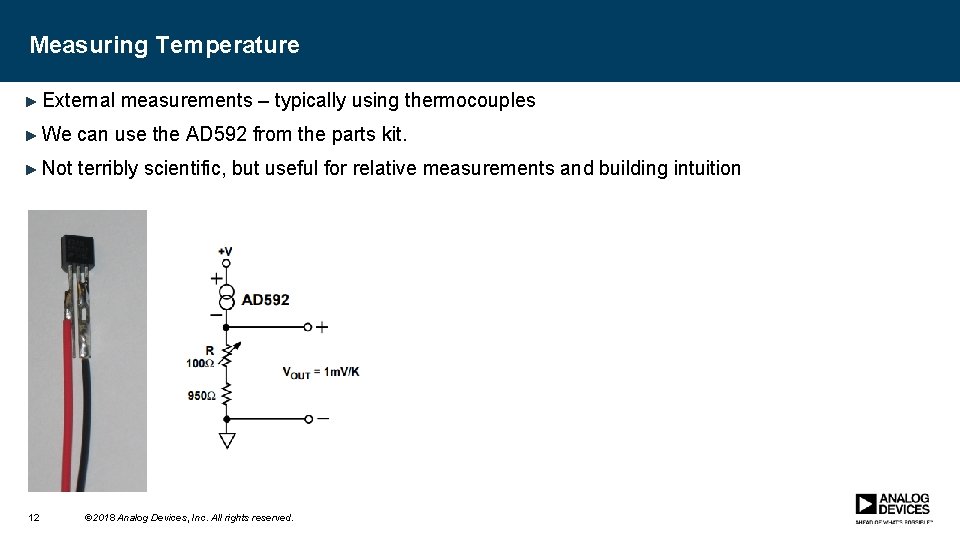
Measuring Temperature ► External measurements – typically using thermocouples ► We can use the AD 592 from the parts kit. ► Not terribly scientific, but useful for relative measurements and building intuition 12 © 2018 Analog Devices, Inc. All rights reserved.
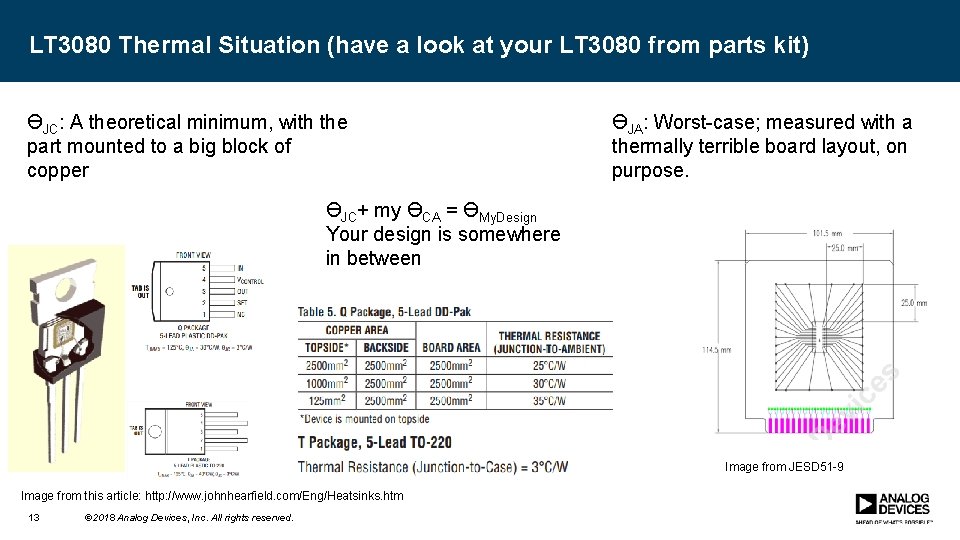
LT 3080 Thermal Situation (have a look at your LT 3080 from parts kit) ϴJC: A theoretical minimum, with the part mounted to a big block of copper ϴJA: Worst-case; measured with a thermally terrible board layout, on purpose. ϴJC+ my ϴCA = ϴMy. Design Your design is somewhere in between Image from JESD 51 -9 Image from this article: http: //www. johnhearfield. com/Eng/Heatsinks. htm 13 © 2018 Analog Devices, Inc. All rights reserved.
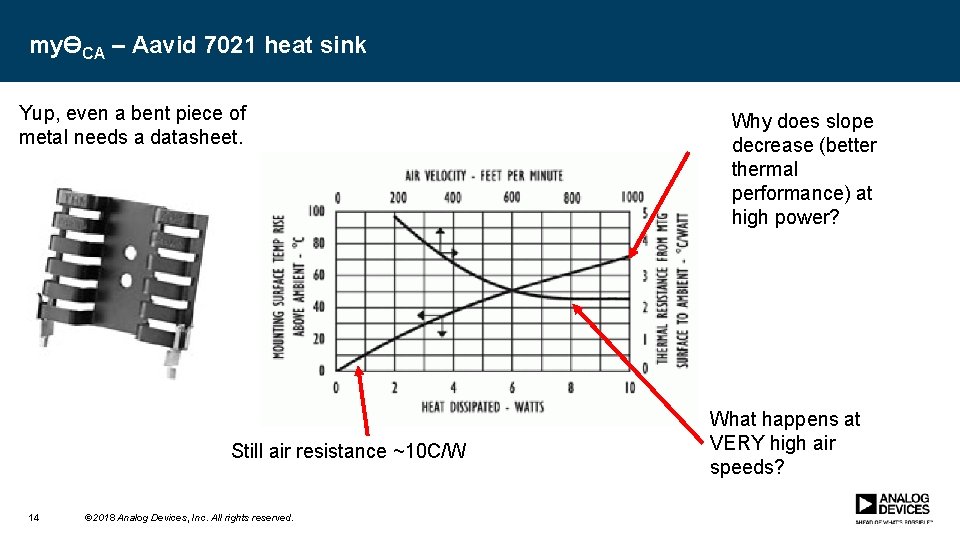
myϴCA – Aavid 7021 heat sink Yup, even a bent piece of metal needs a datasheet. Still air resistance ~10 C/W 14 © 2018 Analog Devices, Inc. All rights reserved. Why does slope decrease (better thermal performance) at high power? What happens at VERY high air speeds?
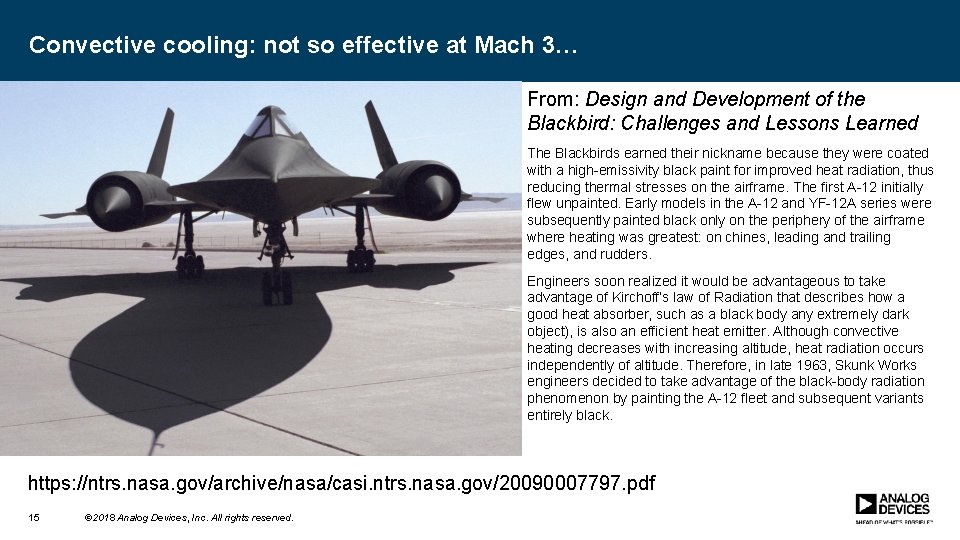
Convective cooling: not so effective at Mach 3… From: Design and Development of the Blackbird: Challenges and Lessons Learned The Blackbirds earned their nickname because they were coated with a high-emissivity black paint for improved heat radiation, thus reducing thermal stresses on the airframe. The first A-12 initially flew unpainted. Early models in the A-12 and YF-12 A series were subsequently painted black only on the periphery of the airframe where heating was greatest: on chines, leading and trailing edges, and rudders. Engineers soon realized it would be advantageous to take advantage of Kirchoff’s law of Radiation that describes how a good heat absorber, such as a black body any extremely dark object), is also an efficient heat emitter. Although convective heating decreases with increasing altitude, heat radiation occurs independently of altitude. Therefore, in late 1963, Skunk Works engineers decided to take advantage of the black-body radiation phenomenon by painting the A-12 fleet and subsequent variants entirely black. https: //ntrs. nasa. gov/archive/nasa/casi. ntrs. nasa. gov/20090007797. pdf 15 © 2018 Analog Devices, Inc. All rights reserved.
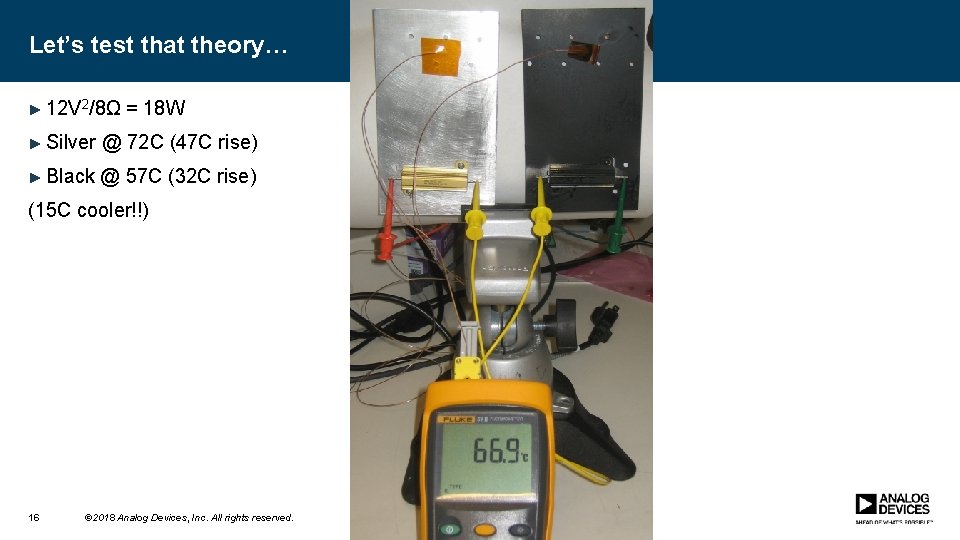
Let’s test that theory… ► 12 V 2/8Ω = 18 W ► Silver @ 72 C (47 C rise) ► Black @ 57 C (32 C rise) (15 C cooler!!) 16 © 2018 Analog Devices, Inc. All rights reserved.
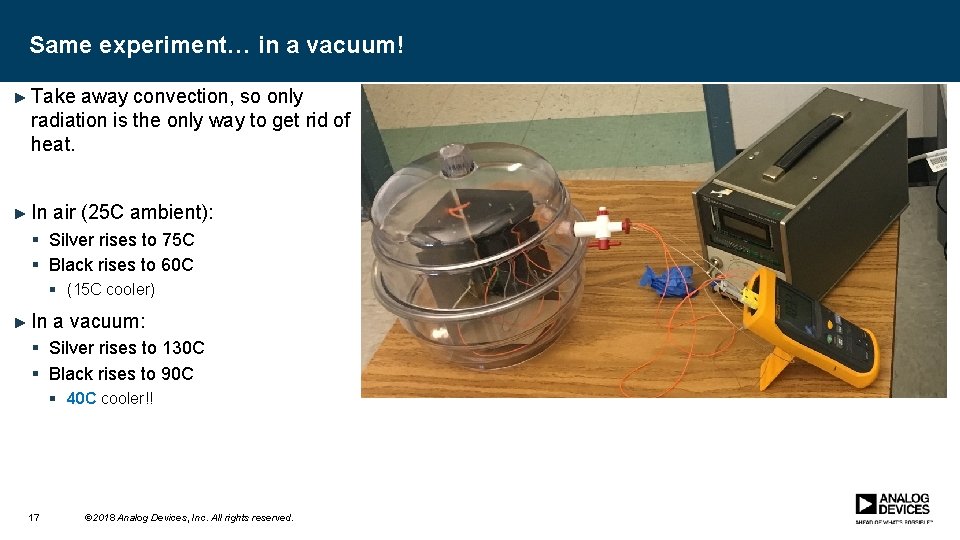
Same experiment… in a vacuum! ► Take away convection, so only radiation is the only way to get rid of heat. ► In air (25 C ambient): § Silver rises to 75 C § Black rises to 60 C § (15 C cooler) ► In a vacuum: § Silver rises to 130 C § Black rises to 90 C § 40 C cooler!! 17 © 2018 Analog Devices, Inc. All rights reserved.
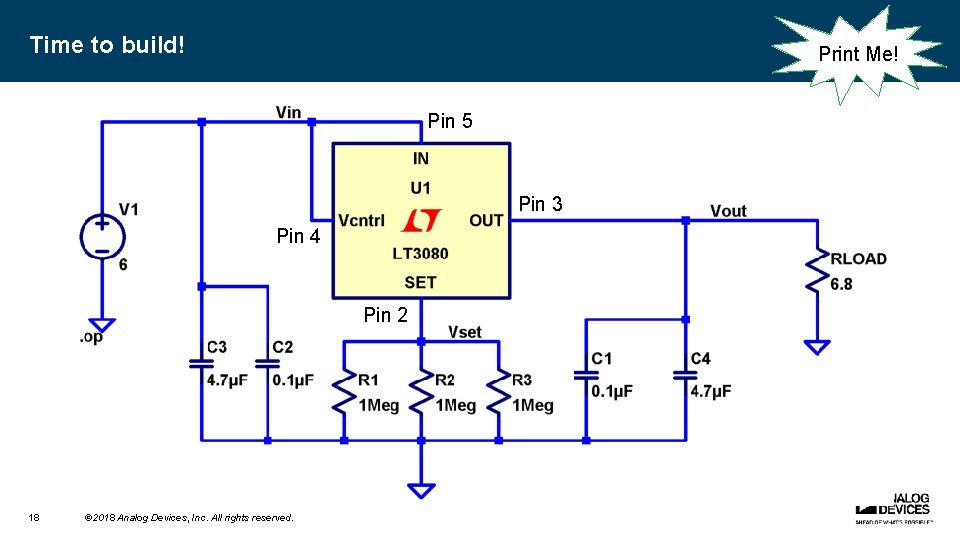
Time to build! Print Me! Pin 5 Pin 3 Pin 4 Pin 2 18 © 2018 Analog Devices, Inc. All rights reserved.
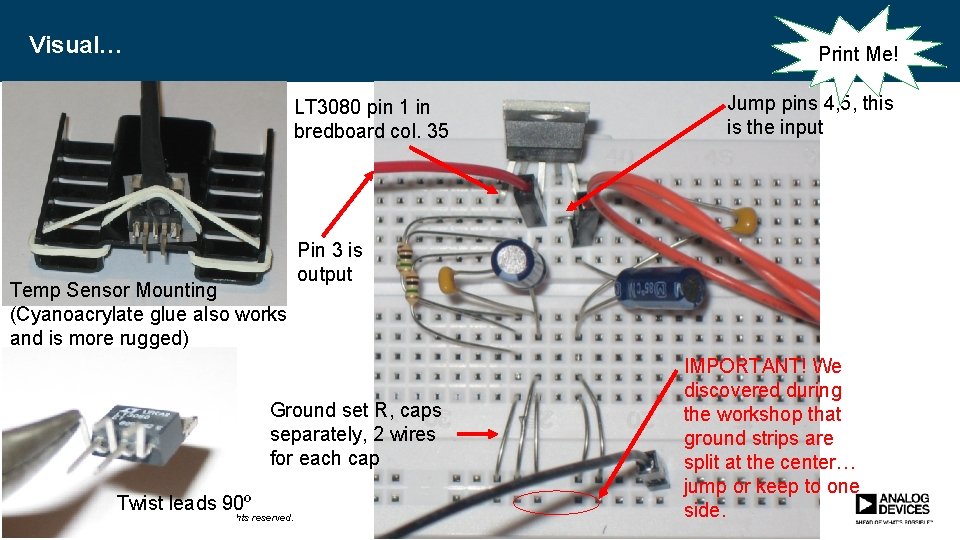
Visual… Print Me! LT 3080 pin 1 in bredboard col. 35 Temp Sensor Mounting (Cyanoacrylate glue also works and is more rugged) Pin 3 is output Ground set R, caps separately, 2 wires for each cap 19 Twist leads 90º © 2018 Analog Devices, Inc. All rights reserved. Jump pins 4, 5, this is the input IMPORTANT! We discovered during the workshop that ground strips are split at the center… jump or keep to one side.
LT 3080 efficiency measurements ► Build up LT 3080 circuits, 2. 5 V output, 6. 8 -ohm load resistor ► Measure § § § efficiency with 6 V in Measure load current Measure input current (are they different? ) Measure power delivered to load (V*I) Measure power dissipated in LT 3080 Measure temperature rise ► Increase input to 10 V § Repeat measurements ► What 20 would happen if we increased input to 24 V? © 2018 Analog Devices, Inc. All rights reserved.
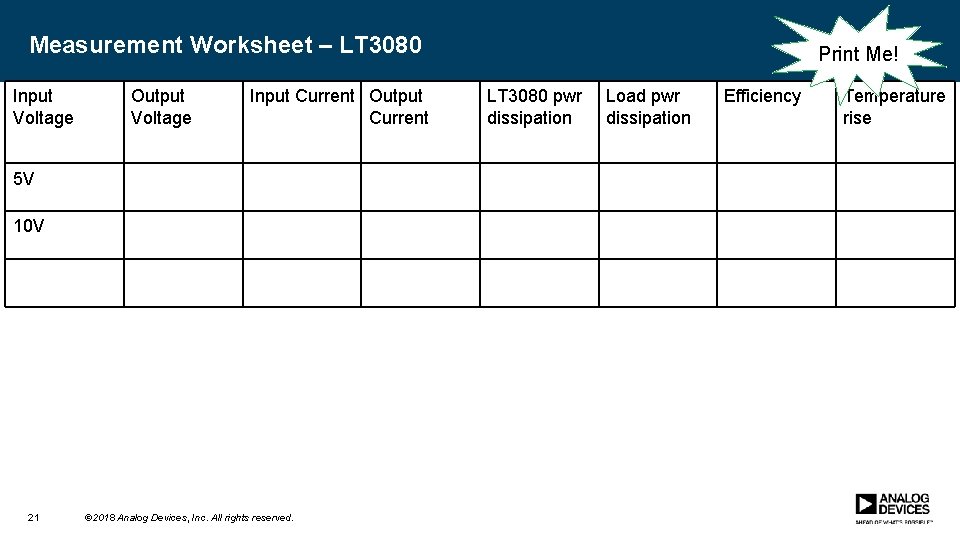
Measurement Worksheet – LT 3080 Input Voltage Output Voltage Input Current Output Current 5 V 10 V 21 © 2018 Analog Devices, Inc. All rights reserved. Print Me! LT 3080 pwr dissipation Load pwr dissipation Efficiency Temperature rise
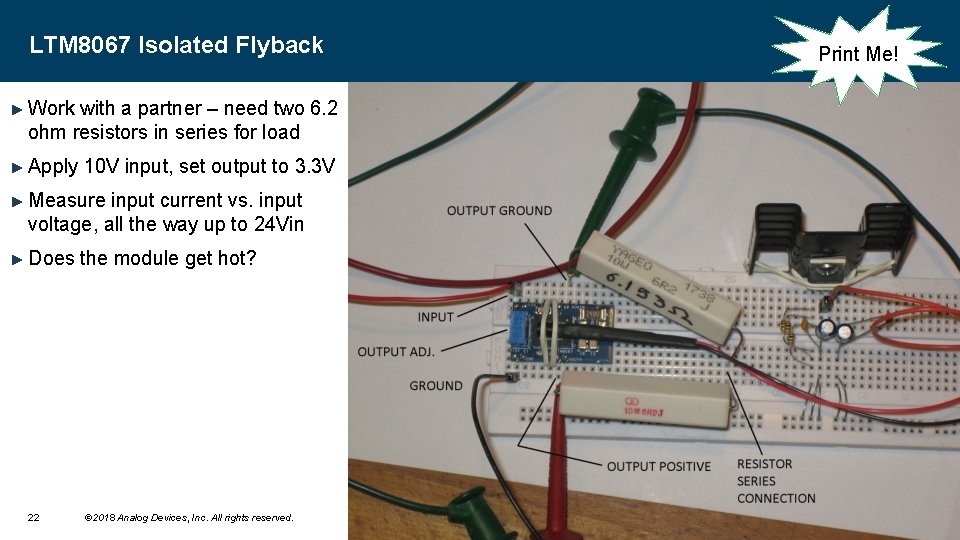
LTM 8067 Isolated Flyback ► Work with a partner – need two 6. 2 ohm resistors in series for load ► Apply 10 V input, set output to 3. 3 V ► Measure input current vs. input voltage, all the way up to 24 Vin ► Does 22 the module get hot? © 2018 Analog Devices, Inc. All rights reserved. Print Me!
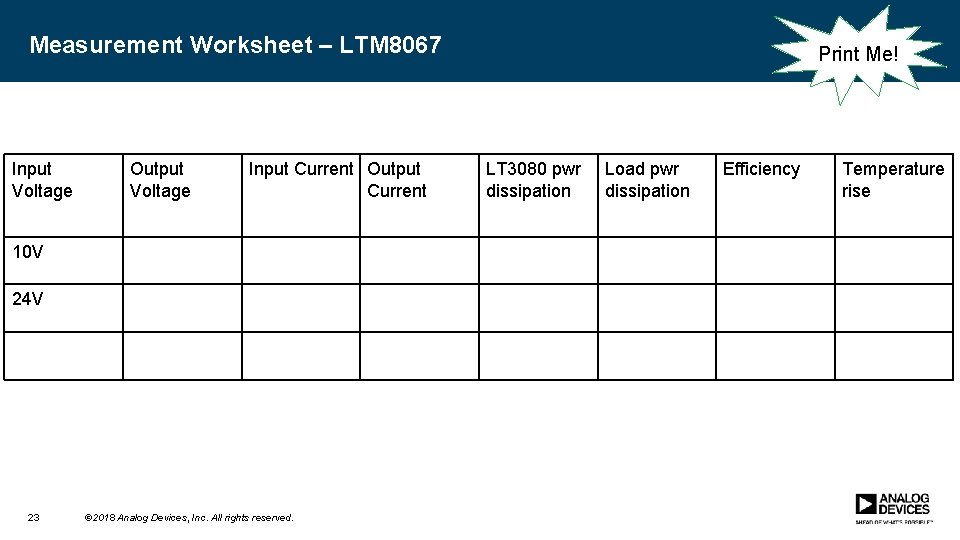
Measurement Worksheet – LTM 8067 Input Voltage Output Voltage Input Current Output Current 10 V 24 V 23 © 2018 Analog Devices, Inc. All rights reserved. Print Me! LT 3080 pwr dissipation Load pwr dissipation Efficiency Temperature rise

Acknowledgements 24 © 2018 Analog Devices, Inc. All rights reserved.

Thanks! 25 © 2018 Analog Devices, Inc. All rights reserved.
- Slides: 25