
Handson Calculus Activities The University of Arizona Mathematics
- Slides: 24
Hands-on Calculus Activities The University of Arizona Mathematics Instruction Colloquium Liana Dawson November 6, 2007
Introduction (and disclaimer) n Examples of various hands-on and nontraditional calculus activities n Most from a Project NEx. T Workshop attended during Summer 2007 q n Presented by Julie Barnes, Western Carolina University (anything with a * is from this workshop) Disclaimer: I have not used any of these activities, nor do I claim they are all appropriate for students at the U of A
Calculus I - Differentiation n Functions on the floor* (also for precalculus) n Optimization of a cereal box q n Matching Notecards q n Lynette Boos, Trinity College Kristin Camenga, Houghton College Filling a Vase q Robert Kowalczyk & Adam Hausknecht, UMass Dartmouth, (http: //www 2. umassd. edu/temath/TEMATH 2/Examples. Content. html) Sarah Mason, Davidson College
Functions on the Floor n First and Second Derivatives q q n n Materials: Adding machine tape, rope Place several axis systems on the floor using adding machine tape Provide students with a collection of conditions on derivatives and second derivatives Give students jump ropes (other heavy rope) to create graphs with given conditions Similar activities can be used for precalculus (give increasing/decreasing, concavity), parametric equations Students can also draw axes on paper and use string to create graphs
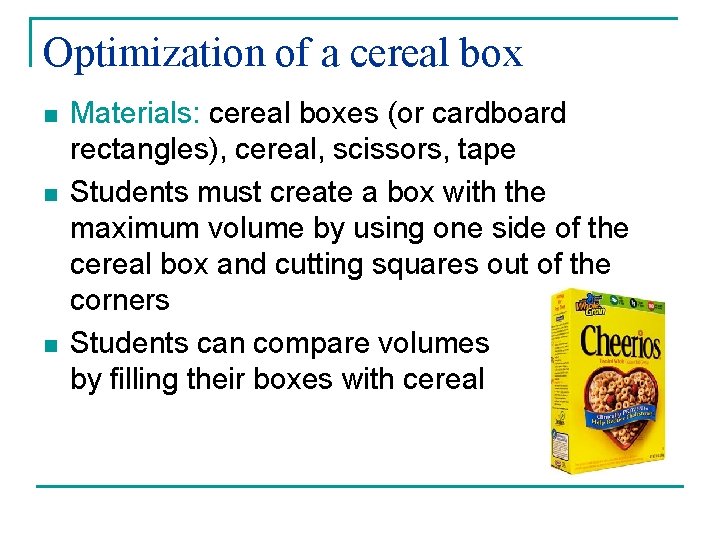
Optimization of a cereal box n n n Materials: cereal boxes (or cardboard rectangles), cereal, scissors, tape Students must create a box with the maximum volume by using one side of the cereal box and cutting squares out of the corners Students can compare volumes by filling their boxes with cereal
Matching Notecards n Differentiation/Integration functions q q q n Materials: Notecards Create two sets of notecards – one with the original function and one with the derivative Pass out the cards and have students find their “match” Activity can be expanded by including graphs of the functions and the derivatives, the limit definition of derivatives, or chains of functions where students need to line up according differentiation
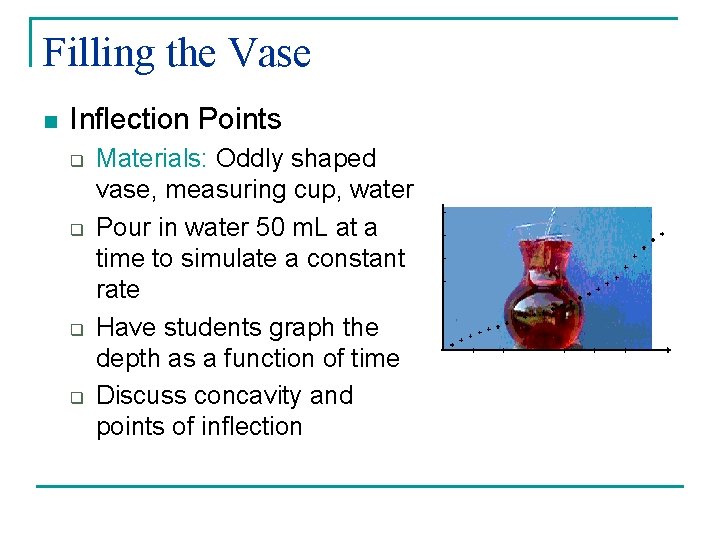
Filling the Vase n Inflection Points q q Materials: Oddly shaped vase, measuring cup, water Pour in water 50 m. L at a time to simulate a constant rate Have students graph the depth as a function of time Discuss concavity and points of inflection
Calculus I - Integration n Gum and Riemann Sums* n Cookie Calorie Counter*
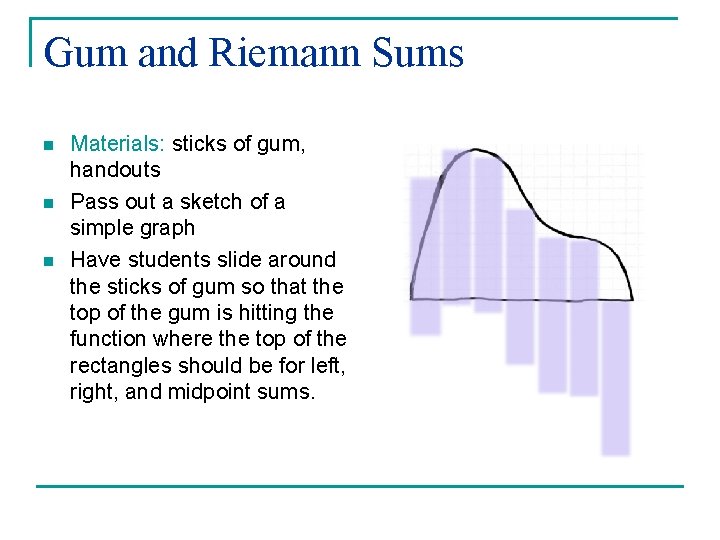
Gum and Riemann Sums n n n Materials: sticks of gum, handouts Pass out a sketch of a simple graph Have students slide around the sticks of gum so that the top of the gum is hitting the function where the top of the rectangles should be for left, right, and midpoint sums.
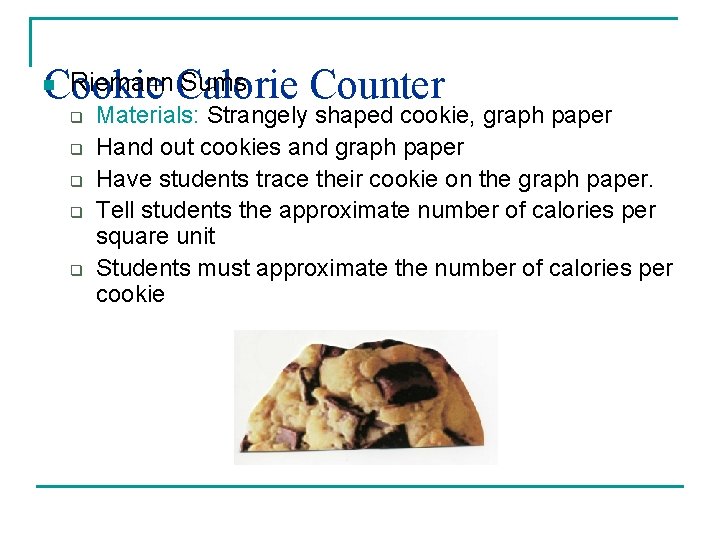
Riemann. Calorie Sums Cookie Counter n q q q Materials: Strangely shaped cookie, graph paper Hand out cookies and graph paper Have students trace their cookie on the graph paper. Tell students the approximate number of calories per square unit Students must approximate the number of calories per cookie
Calculus II n Party Favors* n Play-doh* n Bundt Cake* n Who sucks the most q Stu Schwartz, www. mastermathmentor. com
Play-Doh n n Materials: Play-doh, dental floss Students use play-doh to model solids of revolution q Example: Let A be the region bounded by exp(x), y=0, x=1 n n Model the solid obtained by rotating A around the x-axis Model the solid obtained by rotating A around the y-axis Model the solid obtained by rotating A around y=-2 Use floss to cut the objects to see crosssections
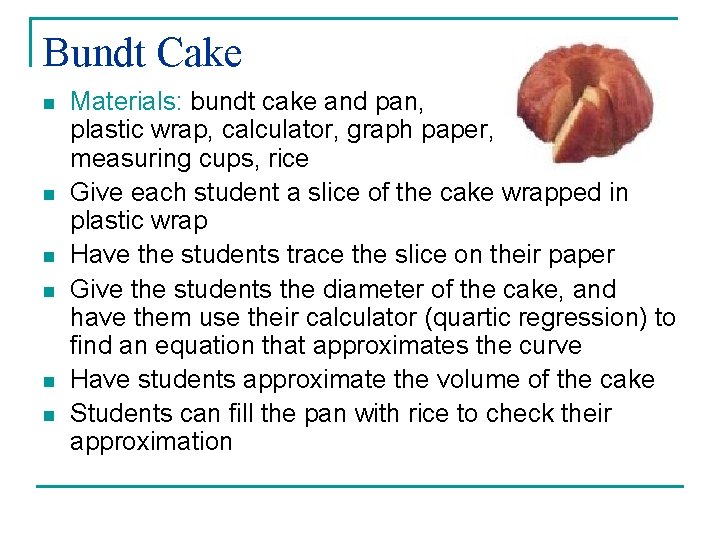
Bundt Cake n n n Materials: bundt cake and pan, plastic wrap, calculator, graph paper, measuring cups, rice Give each student a slice of the cake wrapped in plastic wrap Have the students trace the slice on their paper Give the students the diameter of the cake, and have them use their calculator (quartic regression) to find an equation that approximates the curve Have students approximate the volume of the cake Students can fill the pan with rice to check their approximation
Who sucks the most n n n Work Materials: paper cups, water, straws, rulers Each student receives a cup of water and a straw. Time the students on how long it takes them to drink the water through the straw (the straws should be kept perpendicular and very close to the bottom of the cup) Students then must calculate the volume of water in the cup and the amount of work needed to empty the cup through the straw Students then calculate their “sucking power” and the horsepower of their mouth.
Calculus III n More Play-doh q n Kathy Ivey, Western Carolina University Level curves of heads q Hope Mc. Ilwain, Mercer University n 3 -D axes* n Topographical maps* n Running hills q Cayley Rice, Albion College
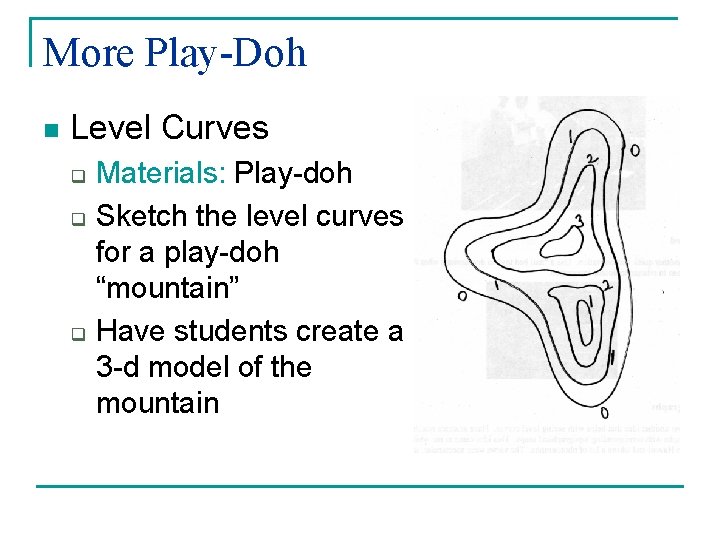
More Play-Doh n Level Curves q q q Materials: Play-doh Sketch the level curves for a play-doh “mountain” Have students create a 3 -d model of the mountain
Level Curves of heads n n Materials: Adding machine tape, tape Tape several lines on the floor. Ask for volunteers who are 5’ 10”, 5’ 8”, 5’ 6”, and 5’ 4” (or whatever heights that work for your class). Have these students stand on their respective lines Students can visual the surface by looking at the tops of the volunteers’ heads.
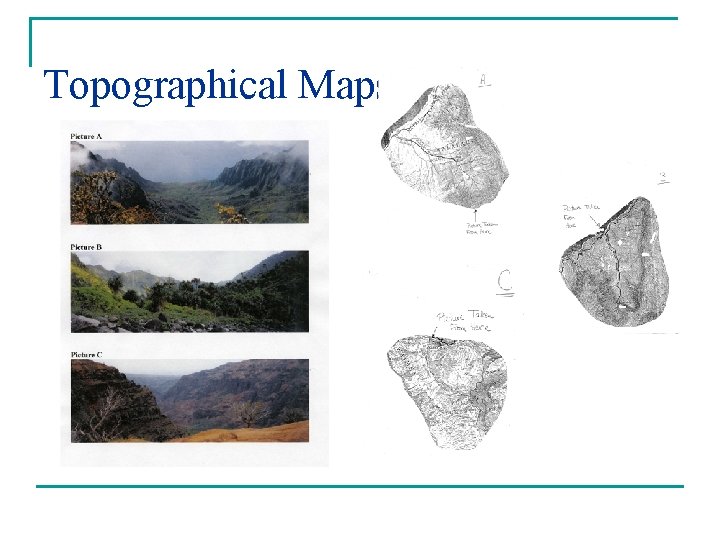
Topographical maps n Level Curves q q Materials: Photos, topographical maps Have students match photographs with topographical maps
Topographical Maps
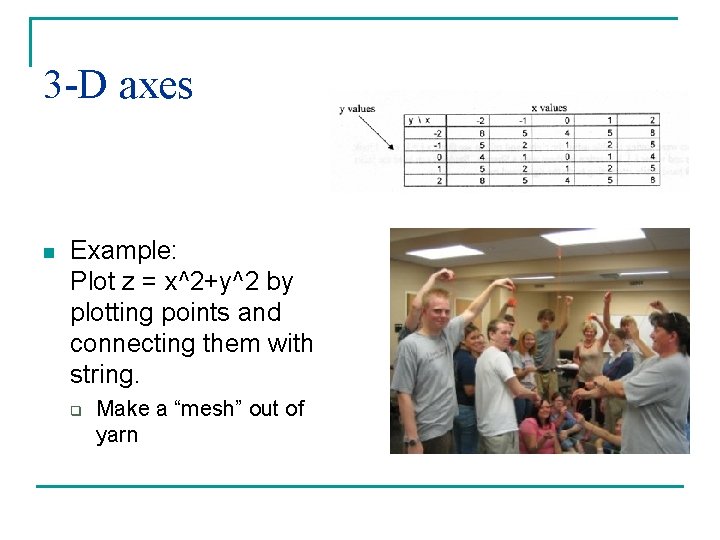
3 -D axes n n n Materials: Yarn, tape Create 3 -d axes using the yarn and tape Have students plot points, curves, or more complex examples
3 -D axes n Example: Plot z = x^2+y^2 by plotting points and connecting them with string. q Make a “mesh” out of yarn
Running Hills n n n Gradients Materials: Hills, yarn Students are each told to pick a spot on the hill Students walk along the level curve from their spot a few steps, and lay down a piece of yarn along their path. Students then must find the steepest direction and walk along it. Students should “discover” that the gradient is perpendicular to the level curves
Mathematical Visualization Toolkit n n Java applet developed by the Department of Applied Mathematics, University of Colorado, Boulder http: //amath. colorado. edu/java/ Basic plotting tools Applications: tangent slider, Riemann sums, solids of revolution
Discussion n What classes these activities might be appropriate? n Other activities?