
Hands of Data Communications Networking TCPIP Troubleshooting Technology
Hands of Data Communications, Networking & TCP/IP Troubleshooting Technology Training that Works
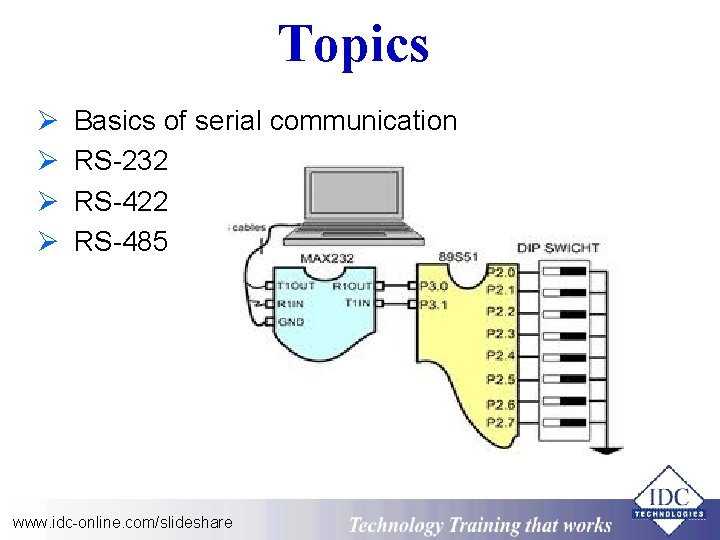
Topics Ø Ø Basics of serial communication RS-232 RS-422 RS-485 www. idc-online. com/slideshare Technology Training that Works
Serial Communication Ø Data is sent and received one bit at a time over a communication channel. Ø Serial ports § 9 pin and 25 pin § Used to communicate with terminals and peripheral devices § Also known as COM port, controlled by UART www. idc-online. com/slideshare Technology Training that Works
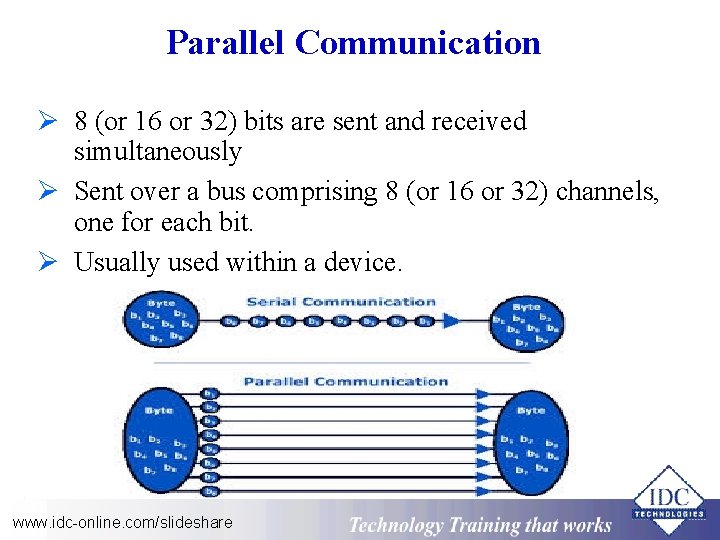
Parallel Communication Ø 8 (or 16 or 32) bits are sent and received simultaneously Ø Sent over a bus comprising 8 (or 16 or 32) channels, one for each bit. Ø Usually used within a device. www. idc-online. com/slideshare Technology Training that Works
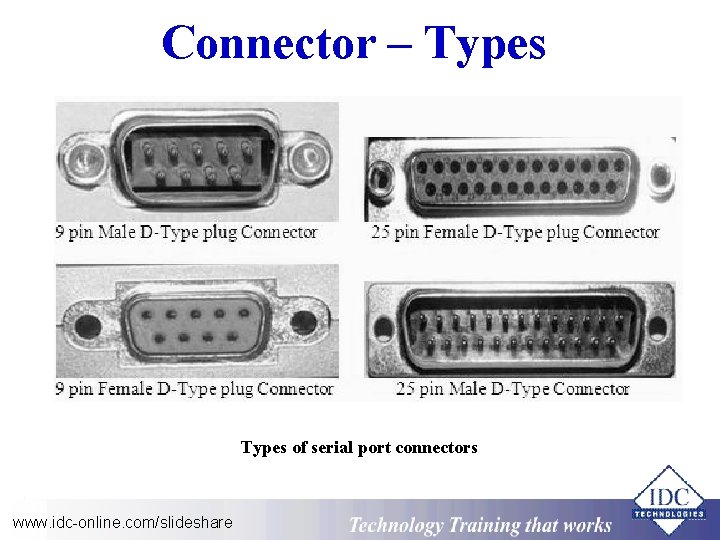
Connector – Types of serial port connectors www. idc-online. com/slideshare Technology Training that Works
DTE vs. DCE Ø Devices that use serial cables for their communication Ø DTE § Data Terminal Equipment § E. g. computers, printers § Transmits on Pin 2 Ø DCE § Data Communications Equipment § E. g. modems § Transmits on Pin 3 www. idc-online. com/slideshare Technology Training that Works
Asynchronous vs. Synchronous Asynchronous Ø No clock sent Ø Level sync Ø Character transfer Ø Susceptible to noise Ø Slow Ø Short lengths www. idc-online. com/slideshare Synchronous Ø Clock sent Ø Edge sync Ø Packet transfer Ø Resistant to noise Ø Fast Ø Long distances Technology Training that Works
Serial Communication – Keywords Ø Handshaking - a procedure used to check the link between DTE & DCE before transmitting data Ø Baud Rate § Transmission speed § Number of bits that are actually being sent over the serial link Ø Type of Cables § Modem Cable § Null Modem Cables www. idc-online. com/slideshare Technology Training that Works
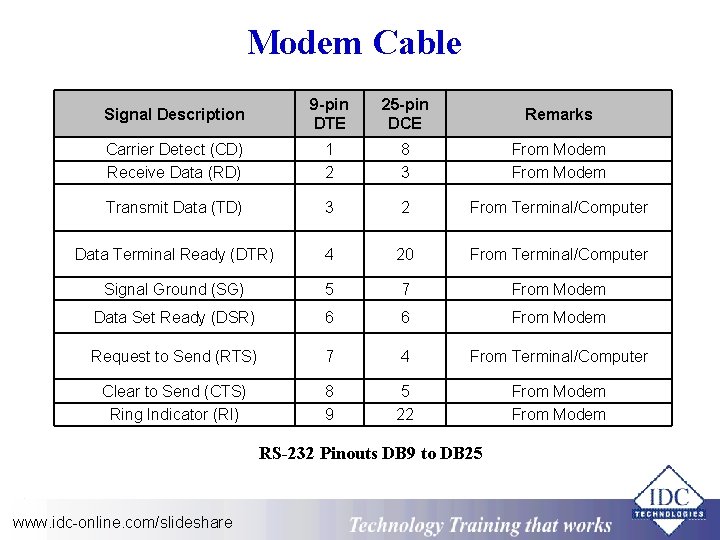
Modem Cable Signal Description 9 -pin DTE 25 -pin DCE Remarks Carrier Detect (CD) Receive Data (RD) 1 2 8 3 From Modem Transmit Data (TD) 3 2 From Terminal/Computer Data Terminal Ready (DTR) 4 20 From Terminal/Computer Signal Ground (SG) 5 7 From Modem Data Set Ready (DSR) 6 6 From Modem Request to Send (RTS) 7 4 From Terminal/Computer Clear to Send (CTS) Ring Indicator (RI) 8 9 5 22 From Modem RS-232 Pinouts DB 9 to DB 25 www. idc-online. com/slideshare Technology Training that Works
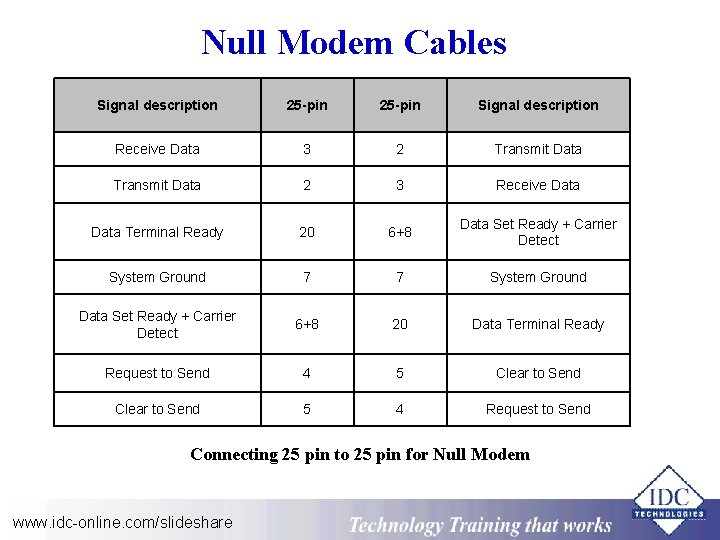
Null Modem Cables Signal description 25 -pin Signal description Receive Data 3 2 Transmit Data 2 3 Receive Data Terminal Ready 20 6+8 Data Set Ready + Carrier Detect System Ground 7 7 System Ground Data Set Ready + Carrier Detect 6+8 20 Data Terminal Ready Request to Send 4 5 Clear to Send 5 4 Request to Send Connecting 25 pin to 25 pin for Null Modem www. idc-online. com/slideshare Technology Training that Works
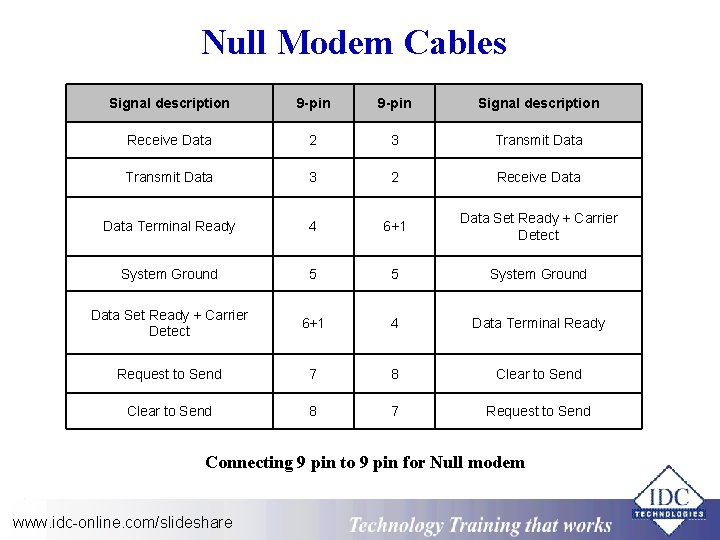
Null Modem Cables Signal description 9 -pin Signal description Receive Data 2 3 Transmit Data 3 2 Receive Data Terminal Ready 4 6+1 Data Set Ready + Carrier Detect System Ground 5 5 System Ground Data Set Ready + Carrier Detect 6+1 4 Data Terminal Ready Request to Send 7 8 Clear to Send 8 7 Request to Send Connecting 9 pin to 9 pin for Null modem www. idc-online. com/slideshare Technology Training that Works
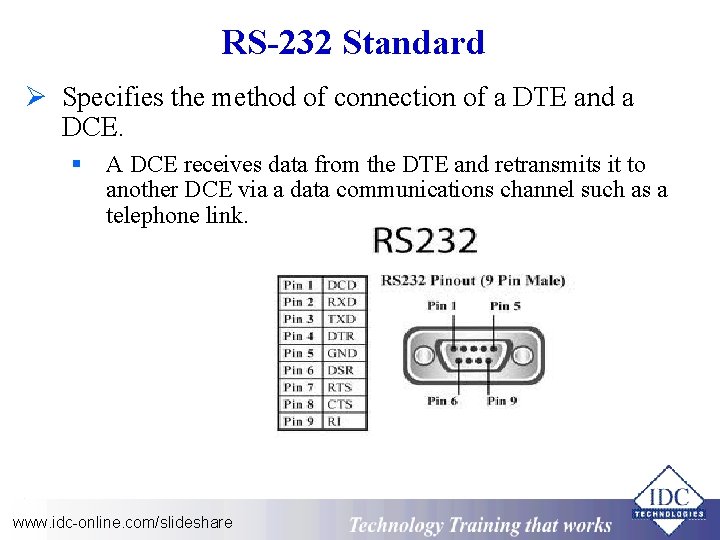
RS-232 Standard Ø Specifies the method of connection of a DTE and a DCE. § A DCE receives data from the DTE and retransmits it to another DCE via a data communications channel such as a telephone link. www. idc-online. com/slideshare Technology Training that Works
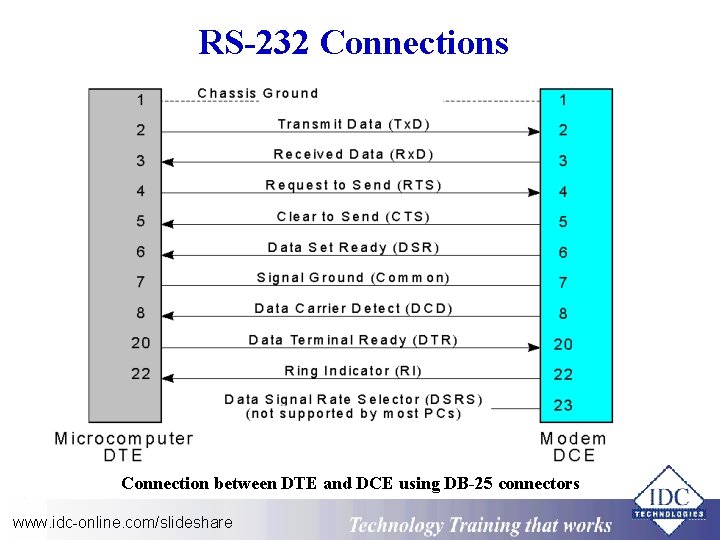
RS-232 Connections Connection between DTE and DCE using DB-25 connectors www. idc-online. com/slideshare Technology Training that Works
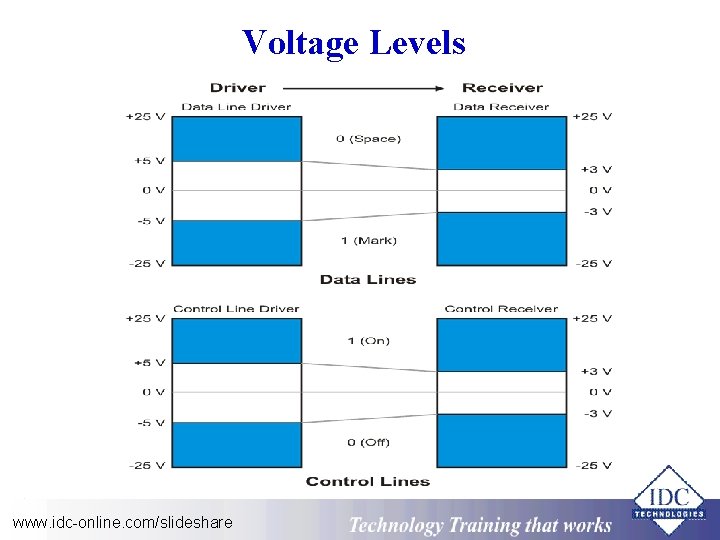
Voltage Levels www. idc-online. com/slideshare Technology Training that Works
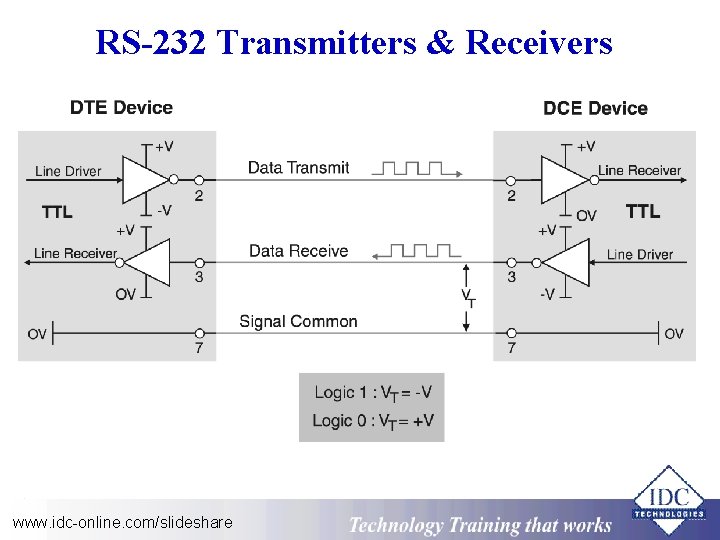
RS-232 Transmitters & Receivers www. idc-online. com/slideshare Technology Training that Works
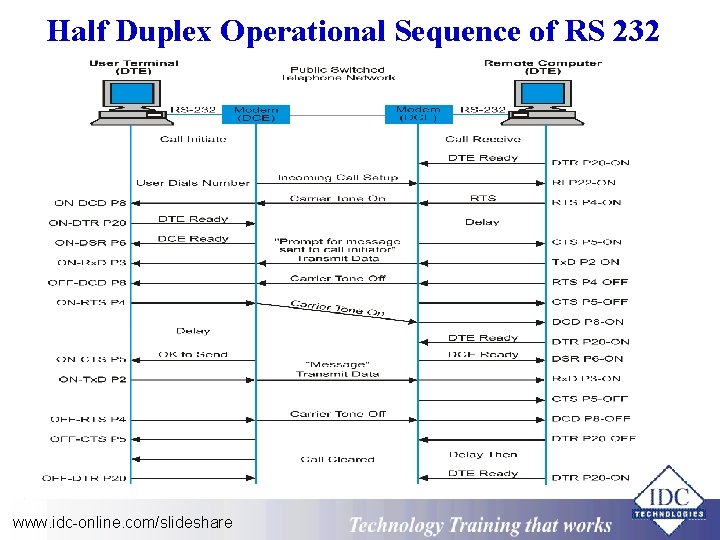
Half Duplex Operational Sequence of RS 232 www. idc-online. com/slideshare Technology Training that Works
RS-422 Interface Standard Ø Defines a balanced, or differential, data communications interface Ø Uses two separate wires for each signal Ø Permits very high data rates Ø Minimizes problems with varying ground potentials www. idc-online. com/slideshare Technology Training that Works
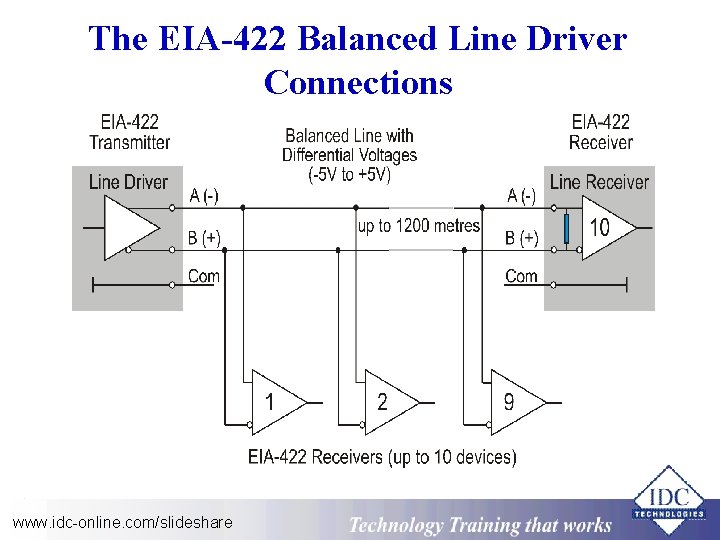
The EIA-422 Balanced Line Driver Connections www. idc-online. com/slideshare Technology Training that Works
EIA 422 Voltages vs. Real Life Ø EIA voltages: ± 6 volts to ± 2 volts Ø In real systems the voltage is between ± 5 volts and ±. 2 volts Ø Often the same chips that are used for 485 systems are used for 422 Ø Typical measured voltage is approximately ± 2 volts www. idc-online. com/slideshare Technology Training that Works
EIA - 422 vs. Real Life Simplex Half or full duplex Ø 10 Mbps Ø Differential Ø 10 devices Ø No speed defined Ø Differential Ø Point to point www. idc-online. com/slideshare Technology Training that Works
RS-485 Interface Standard Ø Most versatile EIA standard § § Distances of up to 1200 m Data rates of up to 10 Mbps 32 line drivers 32 line receivers www. idc-online. com/slideshare Technology Training that Works
RS-485 Ø RS-485 is the most common voltage standard in use today for multi-drop communication systems. Ø This is because … § It is very resistant to noise § It can send data at high speeds § And can go long distances www. idc-online. com/slideshare Technology Training that Works
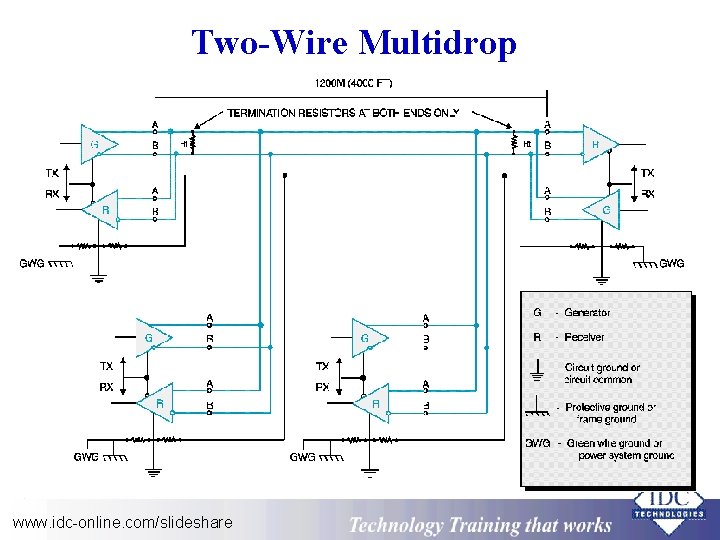
Two-Wire Multidrop www. idc-online. com/slideshare Technology Training that Works
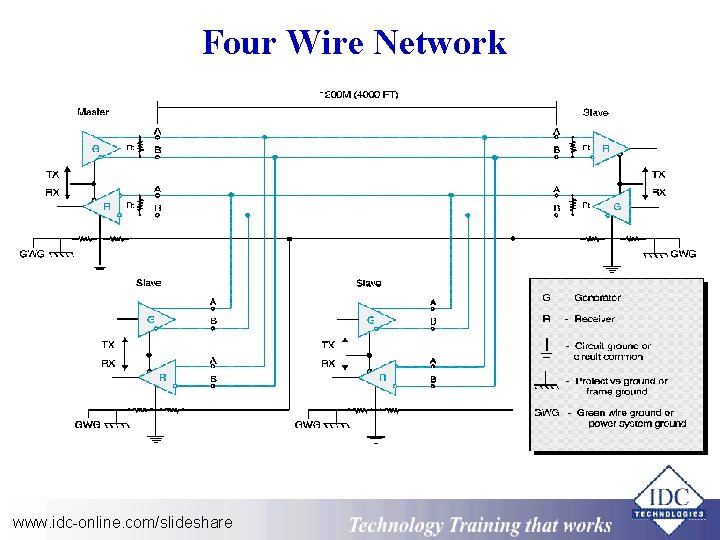
Four Wire Network www. idc-online. com/slideshare Technology Training that Works

DO YOU WANT TO KNOW MORE? If you are interested in further training or information, please visit: http: //idc-online. com/slideshare www. idc-online. com/slideshare Technology Training that Works
- Slides: 25